
OCZ RevoDrive Hybrid PCI-E SSD RVDHY-FH-1T
OCZ RevoDrive Hybrid PCI-E SSD Review
Manufacturer: OCZ Technology Group, Inc.
Product Name: RevoDrive Hybrid PCI-E SSD
Model Number: RVDHY-FH-1T
Price:$499.99 at Newegg
Full Disclosure: The product sample used in this article has been provided by OCZ.
That moment when solid state drive technology can offer the high capacity of large hard disk counterparts is nearly here. OCZ Technology, a pioneer in the SSD market, combines their experience with both SATA and PCI-Express SSDs to offer the OCZ RevoDrive Hybrid SSD. Based on OCZ Virtualized Controller Architecture technology, RevoDrive Hybrid uses Dataplex caching software to pair a 100GB SandForce SF-2281 SSD to a 1TB 7200RPM hard drive. The results are surprising: a bootable PCI-Express device with the speed of a solid state drive and the storage capacity of a hard disk drive. Join Benchmark Reviews as we test the OCZ RevoDrive Hybrid PCI-E SSD RVDHY-FH-1T.
Benchmark Reviews has previously tested the SandForce-driven OCZ RevoDrive, OCZ RevoDrive X2, and OCZ RevoDrive3 X2, all of which are PCI-Express storage solutions. We've also tested the Seagate Momentus-XT Solid State Hybrid Drive, a SATA-based hard disk drive with a built-in SSD cache. The OCZ RevoDrive Hybrid is a combination of both product lines, designed to use the caching of an SSD to read and write data onto a much larger hard disk drive. While the Seagate Momentus XT was a great idea in concept, it never really delivered the ideal blend of speed and capacity. OCZ's RevoDrive Hybrid uses a PCI-Express SuperScale storage controller to produce up to 120,000 random write IOPS with transfers up to 910 MB/s.
Solid State Drive storage began as a technology best suited for durable computer devices, then slowly evolved into the notebook and desktop space with affordable high-speed SATA-based SSD solutions. Once SSDs became mainstream for power users, the demand for high-performance workstations and servers soon followed. Most personal computers are capable of offering 3.0 GB/s bandwidth via second-generation SATA controllers, which is fast enough for conventional power-users. The latest generation of desktop motherboards incorporate third-generation SATA controllers good for up to 6.0 GB/s bandwidth, ideal for hardware enthusiasts. For high-performance professional workstations, PCI-Express is an ideal alternative because it delivers 5.0 GB/s bandwidth without any add-on chips or upgrades.
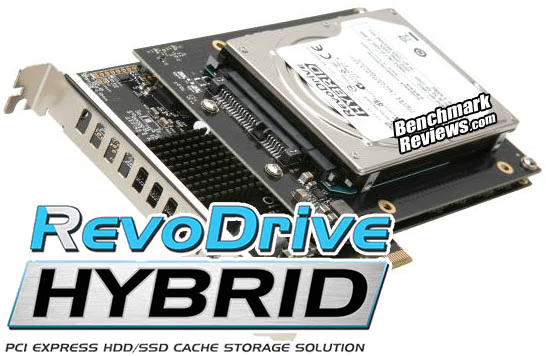
RevoDrive Hybrid Features
Source: OCZ Technology
OCZ RevoDrive Hybrid is the next step in the evolution of storage technology for power users, multimedia designers and game enthusiasts. The PCIe-based RevoDrive Hybrid not only eliminates the SATA bottleneck to unleash groundbreaking bandwidth and landmark IOPS performance, but it also includes a high-capacity hard disk drive and intelligent software that integrates SSD and HDD into a single high-performance and high-capacity storage solution. The OCZ RevoDrive Hybrid comes bundled with intelligent caching software that dynamically manages the use of the SSD with the 1TBHDD for superior overall storage performance. The most frequently/recently used "hot" data stays on the ultra-fast SSD while "cold" data remains on the slower but larger capacity disk. Advanced caching algorithms learn user behavior and adapt storage policies to ensure optimal performance for each individual user. Welcome to the next generation storage from OCZ Technology.
- Capacity: 1TB
- Dedicated Cache: 100GB
- Interface: PCI-Express Gen. 2 x4
- Form factor: Full height
- Read: Up to 910 MB/s
- Write: Up to 810 MB/s
- Max Random Write 4KB: 120,000 IOPS
- Average Write: 65,000 IOPS
- Part Number: 1TB: RVDHY-FH-1T
- OCZ SuperScale Storage Controller
- Virtualized Controller Architecture 2.0
- Included Caching Software Key
- ECC, Encryption
- SMART monitoring
- 167.64 (L) x 98.42 (W) x 22.15mm (H)
- Weight: 289g
- Operating Temp: 5°C ~ 50°C
- Storage Temp: 0°C ~ 60°C
- Power Consumption: 8.1W idle, 10W active
- MTBF: 600,000 hours
- 3-Year Warranty
- Compatible with Windows 7 32-bit and 64-bit
Bandwidth Speed vs Operational Performance
As we've explained in our SSD Benchmark Tests: SATA IDE vs AHCI Mode guide, Solid State Drive performance revolves around two dynamics: bandwidth speed (MB/s) and operational performance (IOPS). These two metrics work together, but one is more important than the other. Consider this analogy: operational IOPS performance determines how much cargo a ship can transport in one voyage, and the bandwidth speed is how fast the ship moves. By understanding this and applying it to SSD storage, there is a clear importance set on each variable depending on the task at hand.
For casual users, especially those with laptop or desktop computers that have been upgraded to use an SSD, the naturally quick response time is enough to automatically improve the user experience. Bandwidth speed is important, but only to the extent that operational performance meets the minimum needs of the system. If an SSD has a very high bandwidth speed but a low operational performance, it will take longer to load applications and boot the computer into Windows than if the SSD offered a higher IOPS performance.
Closer Look: OCZ RevoDrive Hybrid SSD
In this article, Benchmark Reviews tests the new OCZ RevoDrive Hybrid PCI-Express SSD. As one of OCZ's first SSDs to incorporate Virtualized Controller Architecture 2.0 (VLC 2.0), the RevoDrive Hybrid is advertised to reach maximum read speeds of 910 MB/s sequential reads and 810 MB/s sequential writes. Additionally, the OCZ RevoDrive Hybrid SSD is expected to produce 4KB random writes (QD64, 4K Aligned, 8GB LBA) up to 120,000 IOPS.
The OCZ RevoDrive Hybrid PCI-E SSD builds up storage capacity by combining a 1 Terabyte hard disk with a PCI-Express SSD. The solid state drive portion is comprised of two SandForce SF-2281 SSD controllers tied to 100GB of MLC NAND flash. The OCZ RevoDrive Hybrid PCI-E SSD comes with a 1TB capacity and receives OCZ's three-year product warranty support.
After loading a boot driver before installing the Operating System, nearly all modern desktop motherboards with PCI-Express 2.0 expansion slots will support the OCZ RevoDrive Hybrid SSD as a boot device. For caching to work properly with the Dataplex software, OCZ recommends using the RevoDrive Hybrid as the primary boot drive (C). Windows will require a boot driver (F6) to be loaded before installing the O/S onto RevoDrive Hybrid, and an active Internet connection is required to install the Dataplex caching software.
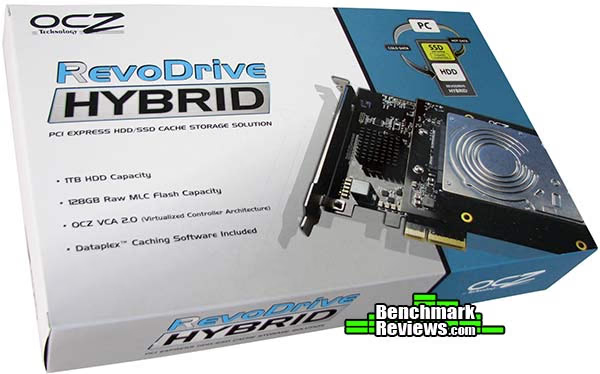
SSDs are catching on quickly because they will work equally well in PC, Linux, or Apple Mac computers; but the OCZ RevoDrive-series is different. Instead of packaging the NAND and drive controller into a SATA-connected enclosure, OCZ has built the RevoDrive series to utilize a single 4x PCI-Express 1.1 slot. Because it requires a 4x PCI-Express 1.1 slot to operate, the OCZ RevoDrive Hybrid SSD is best suited for enthusiast-class computer systems quick response times with large storage capacity are desired. SandForce SF-2281 SSD controllers have been designed with a focus on high-performance operational and data transfer speeds, and include encrypted data protection and improved NAND wear-leveling through their proprietary DuraWrite technology.

Located on the mainboard are an Enpirion Corporation EN5364QI 6-Amp low-power switching converter with integrated inductor. A single Lattice Power Manager II ispPAC-POWR1014 sequence controller chip monitors power supply with programmable digital and analog circuitry.

OCZ SuperScale Storage Controller ICT-0138
An OCZ SuperScale Storage Controller ICT-0138 (illustrated above) is located under a passive aluminum heatsink. As of this writing, OCZ Technology has declined to share the specifications or source manufacturer for their SuperScale Storage Controller, so very little technical detail is known about this component.

OCZ's PCB-0151-X02 printed circuit board contains two SandForce SF-2281 controllers, while allowing an elevated daughter board to connect that houses supplemental 1TB hard drive. Our test sample came with a Toshiba 1TB hard drive, but according to the OCZ RevoDrive Hybrid FAQ users are not able to replace the hard drive. We'll test this statement, and let you know what we discover. :)
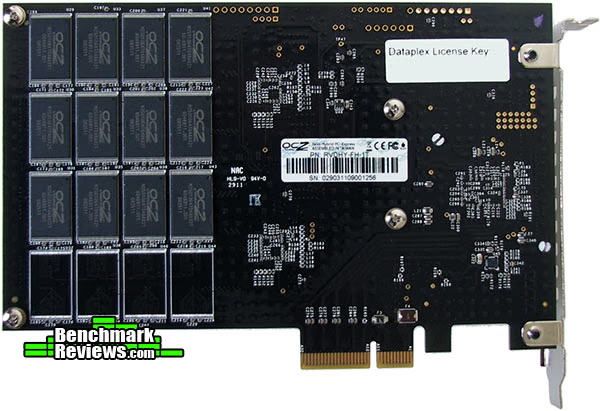
The new SATA 6Gb/s SandForce SF-2281VB1-SDC processor is part of their SF-2200 family of retail SSD controller chips, although an identical SF-2181 also processor exists for older SATA 3Gb/s connections. Offering eight total flash channels with 8 Byte lanes configured (one lane per channel), the SF-2281 maintains a BGA-256 package whereas the top-end SF-2282 delivers two lanes per channel on a BGA-400 package. More detail is available in our SandForce SF-2000 Series SSD Processor Overview article.
All SandForce SSD controllers offer native TRIM garbage collection in supporting Operating Systems (such as Microsoft Windows-7), Native Command Queuing (NCQ) with 32 command slots, and basic Self-Monitoring, Analysis, and Reporting Technology (SMART) command set. VCA 2.0 also provides a highly intelligent Complex Command Queuing Structure (CCQS) that utilizes both Native and Tagged Command Queuing. This is a unique technology that enables command switching and balancing based on OCZ's proprietary Queue Balancing Algorithm (QBA), which balances drive loading, while maximizing internal bandwidth for nearly linear performance aggregation.
NOTE: While the SandForce controller supports TRIM, the OCZ RevoDrive Hybrid is based on a SCSI architecture which Microsoft Windows StorPort does not currently support with either TRIM or SCSI UNMAP. Since these controller commands are not generated by the OS as a result, OCZ's VCA 2.0 is prevented from executing them. OCZ is working with Microsoft to have this functionality enabled as soon as possible.

SandForce SF-2281VA1-SDC-ES Controller
The SF-2200 SSD processor provides enhanced ECC with BCH data protection, and also includes SandForce's unique RAISE (Redundant Array of Independent Silicon Elements) technology. RAISE provides the protection and reliability of RAID on a single SSD drive, thanks to flash architecture, without the significant write overhead of parity. The SandForce DuraClass technology automatically stores data using Trusted Computing Group (TCG) OPAL security with 256-bit AES encryption and automatic, line-rate double encryption with a drive-level password, preventing data extraction directly from the physical flash memory modules.
SandForce enables support for advanced 30nm- and 20nm-class NAND flash from all leading flash vendors with Asynch/ONFi1/ONFi2/Toggle interfaces with data transfer rates up to 166 Mega Transfers per second. Their latest generation of controllers also offers advanced ECC engine correcting up to 55 bits per 512-byte sector to assure high data integrity and support for future generations of flash memory.
SSD Testing Methodology
Solid State Drives have traveled a long winding course to finally get where they are today. Up to this point in technology, there have been several key differences separating Solid State Drives from magnetic rotational Hard Disk Drives. While the DRAM-based buffer size on desktop HDDs has recently reached 64 MB and is ever-increasing, there is still a hefty delay in the initial response time. This is one key area in which flash-based Solid State Drives continually dominates because they lack moving parts to "get up to speed".
However the benefits inherent to SSDs have traditionally fallen off once the throughput begins, even though data reads or writes are executed at a high constant rate whereas the HDD tapers off in performance. This makes the average transaction speed of a SSD comparable to the data burst rate mentioned in HDD tests, albeit usually lower than the HDD's speed.
Comparing a Solid State Disk to a standard Hard Disk Drive is always relative; even if you're comparing the fastest rotational spindle speeds. One is going to be many times faster in response (SSDs), while the other is usually going to have higher throughput bandwidth (HDDs). Additionally, there are certain factors which can affect the results of a test which we do our best to avoid.
SSD Testing Disclaimer
Early on in our SSD coverage, Benchmark Reviews published an article which detailed Solid State Drive Benchmark Performance Testing. The research and discussion that went into producing that article changed the way we now test SSD products. Our previous perceptions of this technology were lost on one particular difference: the wear leveling algorithm that makes data a moving target. Without conclusive linear bandwidth testing or some other method of total-capacity testing, our previous performance results were rough estimates at best.
Our test results were obtained after each SSD had been prepared using DISKPART or Sanitary Erase tools. As a word of caution, applications such as these offer immediate but temporary restoration of original 'pristine' performance levels. In our tests, we discovered that the maximum performance results (charted) would decay as subsequent tests were performed. SSDs attached to TRIM enabled Operating Systems will benefit from continuously refreshed performance, whereas older O/S's will require a garbage collection (GC) tool to avoid 'dirty NAND' performance degradation.
It's critically important to understand that no software for the Microsoft Windows platform can accurately measure SSD performance in a comparable fashion. Synthetic benchmark tools such as HD Tach and PCMark are helpful indicators, but should not be considered the ultimate determining factor. That factor should be measured in actual user experience of real-world applications. Benchmark Reviews includes both bandwidth benchmarks and application speed tests to present a conclusive measurement of product performance.
Test System
- Motherboard: ASUS P8P67 EVO (Intel P67 Sandy Bridge Platform, B3 Stepping)
- Processor: Intel Core i7-2600K 3.4 GHz Quad-Core CPU
- System Memory: 4GB Dual-Channel DDR3 1600MHz CL6-6-6-18
- SATA 6Gb/s Storage HBA: Integrated Intel P67 Controller
- AHCI mode - Intel Rapid Storage Technology Driver 10.1.0.1008
- SATA 3Gb/s Storage HBA: Integrated Intel P67 Controller
- AHCI mode - Intel Rapid Storage Technology Driver 10.1.0.1008
- Operating System: Microsoft Windows 7 Ultimate Edition 64-Bit with Service Pack 1
Storage Hardware Tested
The following storage hardware has been used in our benchmark performance testing, and may be included in portions of this article:
- ACARD ANS-9010 DDR2 SATA RAM-Drive
- Crucial RealSSD-C300 CTFDDAC256MAG-1G1 256GB MLC SSD
- Crucial m4 CT256M4SSD2 256GB SATA 6Gb/s MLC SSD
- Intel X25-E Extreme SSDSA2SH032G1GN SATA SLC SSD
- Intel SSD 311 Series Larson Creek SSDSA2VP020G2E
- Intel SSD 320 Series MLC Solid State Drive SSDSA2CW160G3
- Kingston SSDNowV+ SNVP325-S2 128GB SATA MLC SSD
- LiteOn LA-32M1S Strong-Page 32GB MLC SSD
- OCZ Agility OCZSSD2-1AGT120G 120GB SATA MLC SSD (Firmware version 1.5)
- OCZ Agility-EX OCZSSD2-1AGTEX60G 64GB SATA SLC (Firmware version 1.5)
- OCZ Agility 2 'Extended' OCZSSD2-2AGTE120G 120GB MLC SSD
- OCZ Agility 3 AGT3-25SAT3-240G 240GB MLC SSD (Firmware version 2.06)
- OCZ RevoDrive OCZSSDPX-1RVD0120 120GB MLC PCI-Express SSD
- OCZ RevoDrive X2 OCZSSDPX-1RVDX0240 240GB MLC PCI-E SSD
- OCZ RevoDrive3 X2 RVD3X2-FHPX4 MLC PCI-E SSD
- OCZ RevoDrive Hybrid RVDHY-FH-1T MLC PCI SSD
- OCZ Vertex OCZSSD2-1VTX120G 120GB SATA SSD (Firmware 1.5)
- OCZ Vertex-EX OCZSSD2-1VTX120G 120GB SATA SLC SSD (Firmware version 1.5)
- OCZ Vertex Turbo OCZSSD2-1VTXT120G 120GB SATA SSD (Firmware version 1.5)
- OCZ Vertex 2 'Extended' OCZSSD2-2VTXE120G 120GB MLC SSD (Firmware version 1.2)
- OCZ Vertex 3 VTX3-25SAT3-240G 240GB MLC SSD (Firmware 1.1)
- OCZ Vertex 3 Max IOPS VTX3MI-25SAT3-240G MLC SSD (Firmware 2.06)
- Patriot Torqx 2 PT2128GS25SSDR 128GB MLC SSD
- Seagate Momentus-XT Solid State Hybrid Drive ST95005620AS
- Seagate Barracuda-XT ST32000641AS 2TB 7200RPM SATA 6Gb/s Hard Drive
- Western Digital VelociRaptor WD3000HLFS 300GB 10,000 RPM SATA Hard Disk Drive
- WD SiliconEdge-Blue SSC-D0256SC-2100 256GB SATA SSD
Test Tools
- AS SSD Benchmark 1.6.4067.34354: Multi-purpose speed and operational performance test
- ATTO Disk Benchmark 2.46: Spot-tests static file size chunks for basic I/O bandwidth
- CrystalDiskMark 3.0.1a by Crystal Dew World: Sequential speed benchmark spot-tests various file size chunks
- Iometer 1.1.0 (built 08-Nov-2010) by Intel Corporation: Tests IOPS performance and I/O response time
- Lavalys EVEREST Ultimate Edition 5.50: Disk Benchmark component tests linear read and write bandwidth speeds
- Futuremark PCMark Vantage 1.02: HDD Benchmark Suite tests real-world drive performance
Test Results Disclaimer
This article utilizes benchmark software tools to produce operational IOPS performance and bandwidth speed results. Each test was conducted in a specific fashion, and repeated for all products. These test results are not comparable to any other benchmark application, neither on this website or another, regardless of similar IOPS or MB/s terminology in the scores. The test results in this project are only intended to be compared to the other test results conducted in identical fashion for this article.
AS-SSD Benchmark
Alex Schepeljanski of Alex Intelligent Software develops the free AS SSD Benchmark utility for testing storage devices. The AS SSD Benchmark tests sequential read and write speeds, input/output operational performance, and response times. Because this software receives frequent updates, Benchmark Reviews recommends that you compare results only within the same version family.
Beginning with sequential read and write performance, the OCZ RevoDrive Hybrid PCI-E SSD produced a 386.62 MB/s read speed, with 143.26 MB/s write performance. Because this benchmark uses compressed data, sequential file transfer speeds are reported lower than with other tools using uncompressed data. For this section, we will concentrate on the operational IOPS performance using compressed data. Single-threaded 4K IOPS performance delivers 18.68 MB/s read and 53.58 MB/s write, while the 64-thread 4K reads recorded 118.53 MB/s and write performance was 140.10 MB/s.

AS-SSD 64-thread 4KB IOPS performance results are displayed in the chart below, which compares several enthusiast-level storage products currently on the market. In these 64-thread 4KB IOPS performance tests the OCZ RevoDrive Hybrid PCI-E SSD performed on the level of first-generation SandForce SSDs, and far better than the industry's other hybrid storage solutions. The chart is sorted by total combined performance, which helps to illustrate which products offer the best operational input/output under load:

In the next section, Benchmark Reviews tests transfer rates using ATTO Disk Benchmark.
ATTO Disk Benchmark
The ATTO Disk Benchmark program is free and offers a comprehensive set of test variables to work with. In terms of disk performance, it measures interface transfer rates at various intervals for a user-specified length and then reports read and write speeds for these spot-tests. There are some minor improvements made to the 2.46 version of the program that allow for test lengths up to 2GB, but all of our benchmarks are conducted with 256MB total length. ATTO Disk Benchmark requires that an active partition be set on the drive being tested. Please consider the results displayed by this benchmark to be basic bandwidth speed performance indicators.

ATTO Disk Benchmark: Queue Depth 4 (Default)
Our basic bandwidth speed tests begin with the OCZ RevoDrive Hybrid PCI-E SSD installed into the Intel P67-Express motherboard's 8x PCI-Express port. Using the ATTO Disk Benchmark tool, the test drive performs file transfers ranging from 0.5 KB to 8192 KB. After several caching runs followed by restarts, this 1TB SSD model RVDHY-FH-1T reveals 984 MBps maximum read speed that plateaus from approximately 256-8192 KB file chunks, and 839 MBps peak write bandwidth plateaus from 128-8192 KB. These results both exceed OCZ's own specifications of 910/810 MB/s for the RevoDrive Hybrid.
ATTO Disk Benchmark Results Sequence:
-
Open ATTO Disk Benchmark (x5)
-
Reboot System
-
Max Read: 987 MB/s, Max Write: 829 MB/s
-
Max Read: 989 MB/s, Max Write: 817 MB/s
-
Max Read: 992 MB/s, Max Write: 823 MB/s
-
Max Read: 987 MB/s, Max Write: 829 MB/s
-
Max Read: 991 MB/s, Max Write: 823 MB/s
-
Max Read: 992 MB/s, Max Write: 817 MB/s
- Max Read: 989 MB/s, Max Write: 817 MB/s
- Max Read: 987 MB/s, Max Write: 815 MB/s
- Max Read: 987 MB/s, Max Write: 823 MB/s
- Max Read: 989 MB/s, Max Write: 821 MB/s
- Reboot System
- Max Read: 984 MB/s, Max Write: 839 MB/s
- Max Read: 982 MB/s, Max Write: 831 MB/s
- Reboot System
- Max Read: 895 MB/s, Max Write: 786 MB/s
- Max Read: 959 MB/s, Max Write: 812 MB/s
- Reboot System
- Max Read: 968 MB/s, Max Write: 825 MB/s
- Max Read: 973 MB/s, Max Write: 823 MB/s

In the next section, Benchmark Reviews tests sequential performance using the CrystalDiskMark 3.0 software tool...
CrystalDiskMark 3.0 Tests
CrystalDiskMark 3.0 is a file transfer and operational bandwidth benchmark tool from Crystal Dew World that offers performance transfer speed results using sequential, 512KB random, and 4KB random samples. For our test results chart below, the 4KB 32-Queue Depth read and write performance was measured using a 1000MB space. CrystalDiskMark requires that an active partition be set on the drive being tested, and all drives are formatted with NTFS on the Intel P67 chipset configured to use AHCI-mode. Benchmark Reviews uses CrystalDiskMark to illustrate operational IOPS performance with multiple threads. In addition to our other tests, this benchmark allows us to determine operational bandwidth under heavy load.
After several initial cache runs, each subsequent test with the OCZ RevoDrive Hybrid PCI-E Solid State Drive were consistent with the best results obtained used in the chart below. Because this benchmark uses compressed data, sequential file transfer (write) speeds are reported lower than with other tools using uncompressed data. CrystalDiskMark 3.0 reports sequential speeds at 331.8 MB/s read and 105.8 MB/s write. 512K results reached 325.1 MB/s read and 107.9 MB/s write performance.

For this section, we will concentrate on the operational IOPS performance using compressed data. 4K tests produced 26.16 read and 73.45 write performance. Displayed in the chart below, the maximum 4KB queue depth 32 IOPS performance results for several enthusiast-level storage products illustrate which products offer the best operation under load:

In the next section, we continue our testing using Iometer to measure input/output performance...
Iometer IOPS Performance
Iometer is an I/O subsystem measurement and characterization tool for single and clustered systems. Iometer does for a computer's I/O subsystem what a dynamometer does for an engine: it measures performance under a controlled load. Iometer was originally developed by the Intel Corporation and formerly known as "Galileo". Intel has discontinued to work on Iometer and has given it to the Open Source Development Lab (OSDL). There is currently a new version of Iometer in beta form, which adds several new test dimensions for SSDs.
Iometer is both a workload generator (that is, it performs I/O operations in order to stress the system) and a measurement tool (that is, it examines and records the performance of its I/O operations and their impact on the system). It can be configured to emulate the disk or network I/O load of any program or benchmark, or can be used to generate entirely synthetic I/O loads. It can generate and measure loads on single or multiple (networked) systems.
To measure random I/O response time as well as total I/O's per second, Iometer is set to use 4KB file size chunks over a 100% random sequential distribution at a queue depth of 32 outstanding I/O's per target. The tests are given a 50% read and 50% write distribution. While this pattern may not match traditional 'server' or 'workstation' profiles, it illustrates a single point of reference relative to our product field.
All of our SSD tests used Iometer 1.1.0 (build 08-Nov-2010) by Intel Corporation to measure IOPS performance, using a SandForce-created QD30 configuration: 4KB 100 Random 50-50 Read and Write.icf. The chart below illustrates combined random read and write IOPS over a 120-second Iometer test phase, where highest I/O total is preferred:

In our Iometer tests, which use 32 outstanding I/O's per target and a random 50/50 read/write distribution, SandForce SSDs generally outperform the competition when tested with a larger queue depth. The latest SATA 6Gb/s storage solutions lead the pack, and while the OCZ RevoDrive Hybrid produced 37,956 combined read/write IOPS it still falls very short of 120,000 maximum random write 4KB IOPS advertised in the specifications. Nevertheless, 38K IOPS is quite impressive for a hybrid drive, and obliterates the paltry 337 produced by the competition.
In the next section we use PCMark Vantage to test real-world performance...
PCMark Vantage HDD Tests
PCMark Vantage is an objective hardware performance benchmark tool for PCs running 32- and 64-bit versions of Microsoft Windows Vista or Windows 7. PCMark Vantage is well suited for benchmarking any type of Microsoft Windows Vista/7 PC: from multimedia home entertainment systems and laptops, to dedicated workstations and high-end gaming rigs. Benchmark Reviews has decided to use the HDD Test Suite to demonstrate simulated real-world storage drive performance in this article.
PCMark Vantage runs eight drive tests, each with a specific purpose. Once the benchmarking tests were complete, the results are given a PCMark score while the detailed results show actual transaction speeds. After several cache runs and system restarts, the OCZ RevoDrive Hybrid drive produced its best HDD Test Suite score of 40692 in PCMark Vantage:

HDD Test Suite Results Sequence:
-
Open PCMark Vantage (x5)
-
Reboot System
-
6227
-
18214
- Reboot System
-
5913
-
19002
- Reboot System
-
25664
-
17396
- Reboot System
-
3956
-
40692
Our tests were conducted on an Intel P67 Sandy Bridge motherboard using the onboard SATA 6Gb/s controller and 8x PCI-Express bus with 64-bit Windows 7. Results are displayed in the chart below:

In the next section I share my conclusion and share the final product rating.
OCZ RevoDrive Hybrid Conclusion
IMPORTANT: Although the rating and final score mentioned in this conclusion are made to be as objective as possible, please be advised that every author perceives these factors differently at various points in time. While we each do our best to ensure that all aspects of the product are considered, there are often times unforeseen market conditions and manufacturer changes which occur after publication that could render our rating obsolete. Please do not base any purchase solely on our conclusion, as it represents our product rating specifically for the product tested which may differ from future versions. Benchmark Reviews begins our conclusion with a short summary for each of the areas that we rate.
NOTE: Solid state drive owners experiencing stability issues with their product are encouraged to use the latest OCZ SSD firmware available.
SandForce SSDs have taken the market by storm, which has helped companies like OCZ to expand their reach deep into the high-performance storage hardware segment. The OCZ RevoDrive Hybrid firmly places test-proven SandForce solid state drive technology onto an extremely fast PCI-Express interface, capable of delivering unmatched operational performance and flash component durability, and joins it to a 1TB hard disk drive. The OCZ RevoDrive Hybrid PCI-Express SSD combines two powerful SandForce SF-2281 controllers to 100GB of 25nm Micron-Intel NAND flash 'cache' SSD with their proprietary SuperScale technology. It's all tied together with Dataplex software, which manages the usage algorithms.
Our performance rating considers how effective the OCZ RevoDrive Hybrid drive performs in benchmark operations directly against competing storage solutions, especially the Seagate Momentus XT hybrid and original RevoDrive SSD. In our benchmark performance tests, the OCZ RevoDrive Hybrid delivered 984/839 MBps peak read and write speeds using ATTO Disk Benchmark - surpassing the manufacturer's specified maximum speeds of 910/810 MBps. PCMark Vantage produced 40692 in the HDD tests, positioning the OCZ RevoDrive Hybrid between the Vertex 2 and Vertex 3 SSDs.
The 1TB retail kit (model RVDHY-FH-1T) that OCZ sent to us for testing is advertised to deliver 65,000 random write IOPS, but unfortunately our test results did not reach this specification. Using a SandForce-provided configuration for our own Iometer operational performance tests, we used a queue depth of 32 outstanding I/O's per target to produce a modest 37,956 combined read/write IOPS performance. In this test, the OCZ RevoDrive Hybrid produced operational performance similar to the OCZ Vertex 2, a first-generation SandForce SSD. In the 4K 32QD tests with AS-SSD and CrystalDiskMark, the OCZ RevoDrive Hybrid trailed behind the newest 2nd-generation SandForce storage devices. With the results we've received in our tests, power users can expect very good operational performance and storage functionality for demanding applications, far ahead of the competitions hybrid drive, but still trailing the latest SSDs.
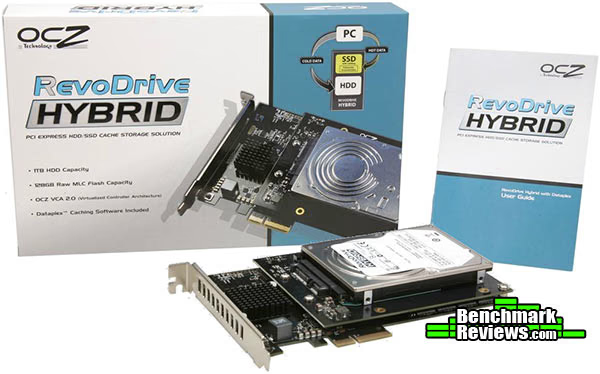
While the latest SandForce SF2281 SSD controller fully supports TRIM commands, the OCZ RevoDrive Hybrid is based on SCSI architecture which Microsoft Windows StorPort does not currently support with either TRIM or SCSI UNMAP. Since these controller commands are therefore not generated by the Microsoft Windows OS as a result, OCZ's VCA 2.0 is prevented from executing them. OCZ is working with Microsoft to have this functionality enabled as soon as possible, however the older RevoDrive enthusiast series shares a similar issue and still lacks support.
Because the OCZ RevoDrive Hybrid is a PCI-Express storage device, it automatically cuts out notebook/laptop users from its user base. Casual users might not need the boost in application response times, but power users certainly do. It's my opinion that the RevoDrive Hybrid would best fit the performance profile of demanding computer users with high-performance systems, especially those needing the large capacity of a 1TB drive. OCZ's RevoDrive Hybrid can (and must) be assigned as the primary boot drive for the operating system, because at the time of this writing Dataplex caching software does not function properly if RevoDrive Hybrid is configured as a secondary storage drive.
If any RevoDrive-series products happen to fail during the 3-year warranty period end-users may contact OCZ via the company website or extensive support forums. Fortunately, there's also a toll-free telephone number (800-459-1816) for free technical support and customer service questions. OCZ has been proven to be one of the best companies in the business when it comes to customer service, and replacement parts are often sent with priority delivery.
As of late October 2011, the OCZ RevoDrive Hybrid PCI-Express Solid Stat Drive (1TB model SSD RVDHY-FH-1T) costs $499.99 at Newegg or as low as $467 elsewhere online. Even with the occasional discount or rebate promotion, RevoDrive Hybrid can seem expensive to those not familiar with premium PCI-E SSD storage solutions. You're getting a 100GB SSD with two SandForce controllers and a 1TB hard drive all on a bootable PCI-Express card, so there's clearly some level of cost involved with delivering the product. I can see that there's a fair value in the OCZ RevoDrive Hybrid, but those on a tight budget may not agree.
In summary, OCZ has truly revolutionized hybrid storage options for the consumer, and RevoDrive Hybrid dramatically outperforms competing hybrid HDD/SSD storage solutions. The Dataplex caching software works well once an initial ramp-up period has completed, and quickly learns to prioritize applications based on user needs. Most all data transfers up to about 90GB begin at SSD level speeds, but in the rare event you're moving something larger it will transfer at traditional hard drive speed. Overall I see the OCZ RevoDrive Hybrid as a success, and a hybrid storage product that is actually ready for prime time.
Pros:
+ Delivers 38,000 combined IOPS in Iometer tests
+ Outstanding 984/839 MBps read/write speed with ATTO
+ 1TB High-performance storage capacity
+ Primary O/S boot drive PCI-E SSD capability
+ 3-Year OCZ product warranty support
+ TCG OPAL security with 256-bit AES encryption
+ DuraWrite technology extends NAND lifetime
+ Compact single-slot PCI-E storage solution
+ SandForce SF-2281 processor supports TRIM, SMART, and RAISE
Cons:
- SCSI architecture prohibits TRIM with Windows OS
- Expensive high-performance storage product
- Dataplex software requires active Internet connection to install
Ratings:
- Performance: 8.25
- Appearance: 8.75
- Construction: 9.50
- Functionality: 9.00
- Value: 7.50
Final Score: 8.6 out of 10.
Benchmark Reviews invites you to leave constructive feedback below, or ask questions in our Discussion Forum.
Reader comments from the original article
20 comments were posted before commenting closed. They are preserved as written. Original avatars no longer resolve and are shown as a placeholder.
OCZ RevoDrive Hybrid mailman65er Permalink:
Awesome. I think the review was thorough, but one major point was left out: the price/performance/capacity. Nothing comes close to delivering this level of performance, at this price, with this (1TB !) capacity. Great job OCZ! Now, when will we see a review of the OCZ Synapse cache SSD, which lets the user add his/her own HDD for a hybrid solution???
RE: OCZ RevoDrive Hybrid PCI-E SSD RVDHY-FH-1T David Ramsey Permalink:
Hm. Does this require an F6 driver during Windows installation? If not, it might be usable on a Hackintosh...
RE: RE: OCZ RevoDrive Hybrid PCI-E SSD RVDHY-FH-1T Olin Coles Permalink:
Yes, as mentioned in the review it requires the OCZ driver duing the setup phase. All Revo series require this driver.
RE: RE: RE: OCZ RevoDrive Hybrid PCI-E SSD RVDHY-FH-1T David Ramsey Permalink:
Dang. Dang. (It said one "Dang" was too short a comment...)
RE: RE: RE: RE: OCZ RevoDrive Hybrid PCI-E SSD RVDHY-FH-1T Iskanzar Permalink:
this is an abomination !
bah Telstar Permalink:
Expensive, horrible read latency and not suitable for data disk only OS. An immature product still, but the direction is the right one.
RE: OCZ RevoDrive Hybrid PCI-E SSD RVDHY-FH-1T Doug Dallam Permalink:
These drives remind me of something either steam-punk or the Borg. "We will assimilate your technology and integrate it with our own. Resistance if futile." lol I thik some twice pipes coming out of the back with some stability fins would have made it look better. Yeah and like the other guys said--500.00 USD? That must be for the "1%." hahahaha
RE: RE: OCZ RevoDrive Hybrid PCI-E SSD RVDHY-FH-1T David Ramsey Permalink:
Not really; just a few years ago, $500 hard drives were common, and it didn't seem to hold the market back much. I paid almost $3,000 for my first hard drive, and it held 10 megabytes...one one-hundredth of a gigabyte. You kids lack perspective.
RE: RE: RE: OCZ RevoDrive Hybrid PCI-E SSD RVDHY-FH-1T Olin Coles Permalink:
I learned that 'a few' is three or so... not thirty. I haven't seen a consumer hard drive selling for $500 in my adult lifetime.
RE: RE: RE: RE: OCZ RevoDrive Hybrid PCI-E SSD RVDHY-FH-1T David Ramsey Permalink:
I suppose it depends on when you consider yourself to have been an "adult". $500+ hard drives were quite common in the early 2000s. Heck, the first terabyte drive (Hitachi, 2007) was $400... ##mkomo.com/cost-per-gigabyte
RE: RE: RE: RE: RE: OCZ RevoDrive Hybrid PCI-E SSD RVDHY-FH-1T Doug Dallam Permalink:
That would make Olin about, hmmm, 12? LOL But that is a good point. I remember I bought my first SCSI drive in I think 1998. I think I paid 350 or 400 for 6GBs? But David, true that drives were 500 in 2000, but that was what you got, buy it or not. That's not the case now. I can buy two fast SATA drives, RAID them, and have nearly the same non seek non IOPs performance of a 500USD drive at 180 bucks. I think I paid 85.00 each for the 640s a few years ago with rebates. I did a Crystal Disk Mark test on HOCP a few years a go and was tuning my array. Two disk testing applications: HD Tune 2.55 and CrystalDiskMark 2.2. CrystalDiskMark: Set to 50MB all other options left default. Run "All." HD Tune: Go to Bench Mark tab and in the upper right look for the options icon. Slide the slider to "Accurate"--slide the slider all the way down. Report ONLY Avg and Burst. 2 WD Caviar Black 640 Vista 64 SP1 Type: RAID 0 HD Tune Avg: 185.8 MB/sec Burst: 1212.7MB/sec CrystalDiskMark 2.2 Test Size : 50 MB Sequential Read : 314.573 MB/s Sequential Write : 199.878 MB/s Random Read 512KB : 111.848 MB/s Random Write 512KB : 103.648 MB/s Random Read 4KB : 2.138 MB/s Random Write 4KB : 5.357 MB/s CrystalDiskMark 2.2 Test Size : 1000 MB Sequential Read : 203.311 MB/s Sequential Write : 199.558 MB/s Random Read 512KB : 41.127 MB/s Random Write 512KB : 40.570 MB/s Random Read 4KB : 0.618 MB/s Random Write 4KB : 3.014 MB/s Sequential Read : 141.572 MB/s Sequential Write : 159.479 MB/s Random Read 512KB : 52.159 MB/s Random Write 512KB : 58.321 MB/s Random Read 4KB : 0.834 MB/s Random Write 4KB : 3.929 MB/s I dunno. I think I'd opt for the RAID at 180USD.
RE: RE: RE: OCZ RevoDrive Hybrid PCI-E SSD RVDHY-FH-1T Griver Permalink:
Couldn't be put more accurately ,Hats of to you sir.
RE: OCZ RevoDrive Hybrid PCI-E SSD RVDHY-FH-1T Jean Permalink:
Thanks for your interresting review. Pitty they don't have 2GB (yet!) I would like to use two of them for save as RAID1 (possible ?) Jean
RE: RE: OCZ RevoDrive Hybrid PCI-E SSD RVDHY-FH-1T Olin Coles Permalink:
It is not possible to combine two of these PCI-E SSDs into a RAID array. I will soon know if the unit's HDD can be upgraded... stay tuned.
Replaceable hard drive George Permalink:
It says in your review you will be testing whether the Toshiba hard drive is replaceable. What were the results?
RE: Replaceable hard drive Olin Coles Permalink:
Replaceable, so long as you configure the new drive in the SSDs BIOS at startup.
Replaceable hard drive George Permalink:
Would you be able to post up a guide or review ?
RE: Replaceable hard drive Olin Coles Permalink:
Not likely, as my current workload and project rotation are pretty full. Did you buy one of these SSDs and plan to change the HDD?
Replaceable hard drive George Permalink:
Yeah I got this a week ago and I'm keen on replacing the HDD to a Velociraptor. I'm just not sure how I would be able to changed the ssd bios. Using ATTOS Disk Benchmark (transfer size of 8192.0kb) my max write is about 714mb/s and my max read is about 920mb/s. These speeds are faster than an average ssd but I don't know why my WEI score is only 6.0. Any help or suggestions is appreciated
RE: Replaceable hard drive Olin Coles Permalink:
You might want to measure twice and cut once, because that drive isn't going to fit. Good night.