
OCZ RevoDrive 3 X2 PCI-E Solid State Drive
OCZ RevoDrive 3 X2 SuperScale PCI-E SSD Review
Manufacturer: OCZ Technology Group, Inc.
Product Name: RevoDrive 3 X2 PCI-E SSD
UPC: 842024027102
Models/Pricing: 240GB: RVD3X2-FHPX4-240G $737 Amazon / $720 Newegg
480GB: RVD3X2-FHPX4-480G $1660 Amazon / $1660 Newegg
960GB: RVD3X2-FHPX4-960G $3300 Amazon / $3300 Newegg
Full Disclosure: The product sample used in this article has been provided by OCZ.
Solid State Drive storage began as a technology best suited for durable computer devices, then slowly evolved into the notebook and desktop space with affordable high-speed SATA-based SSD solutions. Once SSDs became mainstream for power users, the demand for high-performance workstations and servers soon followed. Most personal computers are capable of offering 3.0 GB/s bandwidth via second-generation SATA controllers, which is fast enough for conventional power-users. The latest generation of desktop motherboards incorporate third-generation SATA controllers good for up to 6.0 GB/s bandwidth, ideal for hardware enthusiasts. For high-performance professional workstations, PCI-Express is an ideal alternative because it delivers 5.0 GB/s bandwidth without any add-on chips or upgrades.
Over the past four years, OCZ have transformed themselves from an enthusiast system memory brand into a recognized name for high-performance solid-state storage devices. They have traditionally offered several different options for performance enthusiasts, from economic yet responsive storage to premium high-speed enthusiast solid state drive solutions. They've earned consumer praise for their ability to deliver Solid State Drive technology at a reasonable price, and they push the boundaries with their High Speed Data Link project. There's a solid middle ground between SATA and HSDL, and that's the PCI Express bus, which has been the focus of OCZ Virtualized Controller Architecture technology.
Not long ago Benchmark Reviews tested the SandForce-driven OCZ RevoDrive and OCZ RevoDrive X2, both of which OCZ designate as enthusiast strorage solution. Stepping-up to the professional workstation segment, OCZ offers the RevoDrive 3 X2. In this article, Benchmark Reviews tests the OCZ RevoDrive 3 X2 PCI-E workstation-class solid state drive against several enthusiast options. Available in 240-960GB capacities, the model RVD3X2-FHPX4-480G PCI-Express workstation-class SSD uses OCZ's SuperScale storage controller to produce up to 230,000 IOPS with transfers up to 1500 MB/s.
Even after decades of design improvements, the hard disk drive (HDD) is still the slowest component in any personal computer system. Consider that modern desktop processors have a 1 ns response time (nanosecond = one billionth of one second), while system memory responds between 30-90 ns. Traditional hard drive technology utilizes magnetic spinning media, and even the fastest spinning mechanical storage products still exhibit a 9,000,000 ns / 9 ms initial response time (millisecond = one thousandth of one second). In more relevant terms, the processor receives the command and must then wait for system memory to fetch related data from the storage drive. This is why any computer system is only as fast as the slowest component in the data chain; usually the hard drive.
In a perfect world all of the components operate at the same speed. Until that day comes, the real-world goal for achieving optimal performance is for system memory to operate as quickly as the central processor and then for the storage drive to operate as fast as memory. With present-day technology this is an impossible task, so enthusiasts try to close the speed gaps between components as much as possible. Although system memory is up to 90x (9000%) slower than most processors, consider then that the hard drive is an added 1000x (100,000%) slower than that same memory. Essentially, these three components are as different in speed as walking is to driving and flying.
Solid State Drive technology bridges the largest gap in these response times. The difference a SSD makes to operational response times and program speeds is dramatic, and takes the storage drive from a slow 'walking' speed to a much faster 'driving' speed. Solid State Drive technology improves initial response times by more than 450x (45,000%) for applications and Operating System software, when compared to their mechanical HDD counterparts. The biggest mistake PC hardware enthusiasts make with regard to SSD technology is grading them based on bandwidth speed. File transfer speeds are important, but only so long as the operational IOPS performance can sustain that bandwidth under load.
Bandwidth Speed vs Operational Performance
As we've explained in our SSD Benchmark Tests: SATA IDE vs AHCI Mode guide, Solid State Drive performance revolves around two dynamics: bandwidth speed (MB/s) and operational performance (IOPS). These two metrics work together, but one is more important than the other. Consider this analogy: operational IOPS performance determines how much cargo a ship can transport in one voyage, and the bandwidth speed is to fast the ship moves. By understanding this and applying it to SSD storage, there is a clear importance set on each variable depending on the task at hand.
For casual users, especially those with laptop or desktop computers that have been upgraded to use an SSD, the naturally quick response time is enough to automatically improve the user experience. Bandwidth speed is important, but only to the extent that operational performance meets the minimum needs of the system. If an SSD has a very high bandwidth speed but a low operational performance, it will take longer to load applications and boot the computer into Windows than if the SSD offered a higher IOPS performance.
Closer Look: OCZ RevoDrive 3 X2 SSD
In this article, Benchmark Reviews tests the new workstation-class OCZ RevoDrive 3 X2 PCI-Express SSD. As one of OCZ's first SSDs to incorporate Virtualized Controller Architecture 2.0 (VLC 2.0), the RevoDrive 3 X2 is advertised to reach maximum speeds of 1500 MB/s sequential reads and 1250 MB/s sequential writes. Additionally, the OCZ RevoDrive 3 X2 SSD is expected to produce 4KB random writes (QD64, 4K Aligned, 8GB LBA) up to 200,000 IOPS.
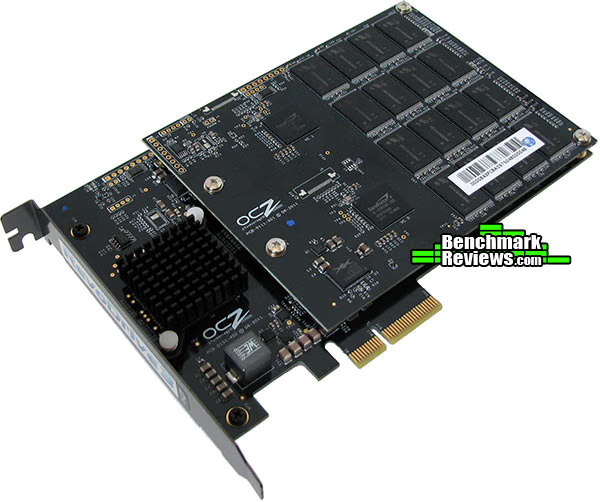
The OCZ RevoDrive 3 X2 PCI-E SSD builds up storage capacity by combining four independent SandForce SF-2281 SSD controllers to Micron-Intel NAND flash contained in this SSD are allocated for data use. The OCZ RevoDrive 3 X2 PCI-E SSD comes in three capacities: 240/480/960GB, and all models receive OCZ's three-year product warranty support.
Most all modern desktop motherboards with PCI-Express 2.0 expansion slots will support the OCZ RevoDrive 3 X2 SSD as a boot device, especially Intel's 5x series and AMD's 8xx series, however older motherboards may require a BIOS update. OCZ offers a list of compatible motherboards on their product website.
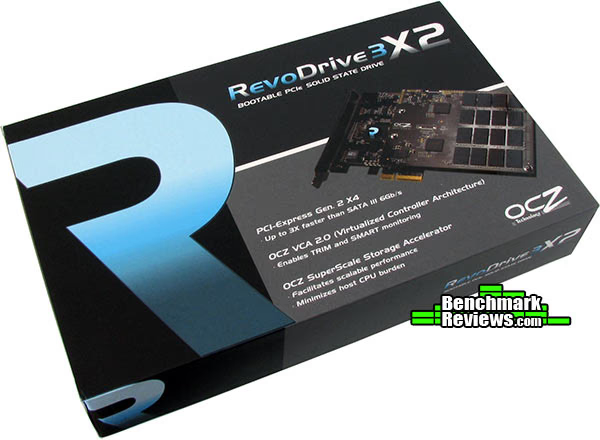
SSDs are catching on quickly because they will work equally well in PC, Linux, or Apple Mac computers; but the OCZ RevoDrive-series is different. Instead of packaging the NAND and drive controller into a SATA-connected enclosure, OCZ has built the RevoDrive series to utilize a single 4x PCI-Express 1.1 slot. Because it requires a 4x PCI-Express 1.1 slot to operate, the OCZ RevoDrive 3 X2 SSD is best suited for workstation-class computer systems and performance-orientated application servers where 200,000 IOPS could really make a difference on productivity. SandForce SF-2281 SSD controllers have been designed with a focus on high-performance operational and data transfer speeds, and include encrypted data protection and improved NAND wear-leveling through their proprietary DuraWrite technology.
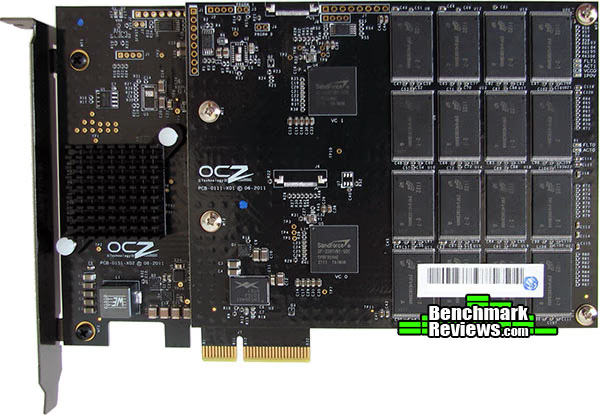
Present on both the main and daughter boards are Enpirion Corporation EN5364QI 6-Amp low-power switching converters with integrated inductors. A single Lattice Power Manager II ispPAC-POWR1014 sequence controller chip monitors power supply with programmable digital and analog circuitry.

OCZ SuperScale Storage Controller ICT-0138
Specific to the OCZ RevoDrive 3 X2 SSD models, the Silicon Image RAID chip and Pericom PI7C9X130 PCIe-to-PCIx reversible bridge chip found on previous RevoDrive-series SSDs has been replaced with the OCZ SuperScale Storage Controller ICT-0138 located under an aluminum heatsink. As of this writing, OCZ Technology has declined to share the specifications or source manufacturer for their SuperScale Storage Controller, so very little technical detail is known about this component.

OCZ's PCB-0151-X02 printed circuit (mother)board contains two SandForce SF-2281 controllers, while allowing an elevated daughter board to connect that houses supplemental NAND flash and two additional storage controllers. The image below illustrates how the OCZ RevoDrive 3 X2 PCI-E SSD has room to spare in a single PCI-Express expansion slot. While a PCI-Express interface excludes notebook consumers, it opens up a market to users in need of Hot-Plug drive support.

The new SATA 6Gb/s SandForce SF-2281VB1-SDC processor is part of their SF-2200 family of retail SSD controller chips, although an identical SF-2181 also processor exists for older SATA 3Gb/s connections. Offering eight total flash channels with 8 Byte lanes configured (one lane per channel), the SF-2281 maintains a BGA-256 package whereas the top-end SF-2282 delivers two lanes per channel on a BGA-400 package. More detail is available in our SandForce SF-2000 Series SSD Processor Overview article.
All SandForce SSD controllers offer native TRIM garbage collection in supporting Operating System (such as Microsoft Windows-7), Native Command Queuing (NCQ) with 32 command slots, and basic Self-Monitoring, Analysis, and Reporting Technology (SMART) command set. VCA 2.0 also provides a highly intelligent Complex Command Queuing Structure (CCQS) that utilizes both Native and Tagged Command Queuing. This is a unique technology that enables command switching and balancing based on OCZ's proprietary Queue Balancing Algorithm (QBA), which balances drive loading, while maximizing internal bandwidth for nearly linear performance aggregation.
NOTE: While the SandForce controller supports TRIM, the OCZ RevoDrive 3 X2 is based on SCSI architecture which Microsoft Windows StorPort does not currently support with either TRIM or SCSI UNMAP. Since these controller commands are not generated by the OS as a result, OCZ's VCA 2.0 is prevented from executing them. OCZ are working with Microsoft to have this functionality enabled as soon as possible.

SandForce SF-2281VA1-SDC-ES Controller
The SF-2200 SSD processor provides enhanced ECC with BCH data protection, and also includes SandForce's unique RAISE (Redundant Array of Independent Silicon Elements) technology. RAISE provides the protection and reliability of RAID on a single SSD drive, thanks to flash architecture, without the significant write overhead of parity. The SandForce DuraClass technology automatically stores data using Trusted Computing Group (TCG) OPAL security with 256-bit AES encryption and automatic, line-rate double encryption with a drive-level password, preventing data extraction directly from the physical flash memory modules.
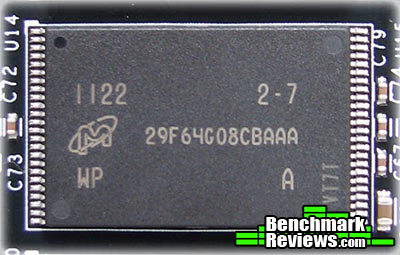
Micron/Intel 29F64G08CBAAA NAND Flash
SandForce enables support for advanced 30nm- and 20nm-class NAND flash from all leading flash vendors with Asynch/ONFi1/ONFi2/Toggle interfaces with data transfer rates up to 166 Mega Transfers per second. Their latest generation of controllers also offers advanced ECC engine correcting up to 55 bits per 512-byte sector to assure high data integrity and support for future generations of flash memory. On the OCZ RevoDrive 3 X2 PCI-Express SSD, sixty-four multi layer cell Micron/Intel 29F64G08CBAAA NAND flash modules are joined to four SandForce SF-2281 controllers.
OCZ RevoDrive 3 X2 Features
- Available in 240GB, 480GB and 960GB capacities
- PCI-Express Gen. 2 x4 interface
- MLC NAND flash
- Full height form factor
- OCZ SuperScale Storage Controller
- Virtualized Controller Architecture 2.0
- Bootable as a direct-attach device
- 128-bit & 256-bit AES-compliant data encryption
- SMART monitoring
- 167.64 (L) x 98.42 (W) x 15.25mm (H)
- Weight: 114g
- Shock Resistance: 1500g
- Operating Temp: 0°C ~ 70°C
- Ambient Temp: 0°C ~ 55°C
- Storage Temp: -45°C ~ 85°C
- Power Consumption: 7.5W idle, 8.3W active
- MTBF: 1,000,000 hours
- 3-Year Warranty
- Compatible with Windows Vista 32/64, Windows 7 32/64
240GB Max Performance
- Read: Up to 1500 MB/s
- Write: Up to 1225 MB/s
- Max Random Write 4KB (Aligned): 200,000 IOPS
480GB Max Performance
- Read: Up to 1500 MB/s
- Write: Up to 1250 MB/s
- Max Random Write 4KB (Aligned): 230,000 IOPS
960GB Max Performance
- Read: Up to 1500 MB/s
- Write: Up to 1300 MB/s
- Max Random Write 4KB (Aligned): 230,000 IOPS
Part Numbers
- 240GB: RVD3X2-FHPX4-240G $764 Amazon / $720 Newegg
- 480GB: RVD3X2-FHPX4-480G $1660 Amazon / $1660 Newegg
- 960GB: RVD3X2-FHPX4-960G $3300 Amazon / $3300 Newegg
Source: OCZ Technology
SF-2281 Specifications
|
DuraClass Technology: |
|
|---|---|
|
Flash Memory Support: |
|
|
Power Consumption: |
|
|
Security: |
|
|
Protection: |
|
|
Reliability: |
|
|
Operating Temperature: |
0°C to 55°C ambient |
|
Package: |
256-pin BGA in 14x14mm @ 0.80mm pitch |
|
Compliance: |
RoHS, Halogen-Free, Green |
Source: SandForce
SSD Testing Methodology
Solid State Drives have traveled a long winding course to finally get where they are today. Up to this point in technology, there have been several key differences separating Solid State Drives from magnetic rotational Hard Disk Drives. While the DRAM-based buffer size on desktop HDDs has recently reached 64 MB and is ever-increasing, there is still a hefty delay in the initial response time. This is one key area in which flash-based Solid State Drives continually dominates because they lack moving parts to "get up to speed".
However the benefits inherent to SSDs have traditionally fallen off once the throughput begins, even though data reads or writes are executed at a high constant rate whereas the HDD tapers off in performance. This makes the average transaction speed of a SSD comparable to the data burst rate mentioned in HDD tests, albeit usually lower than the HDD's speed.
Comparing a Solid State Disk to a standard Hard Disk Drives is always relative; even if you're comparing the fastest rotational spindle speeds. One is going to be many times faster in response (SSDs), while the other is usually going to have higher throughput bandwidth (HDDs). Additionally, there are certain factors which can affect the results of a test which we do our best to avoid.
SSD Testing Disclaimer
Early on in our SSD coverage, Benchmark Reviews published an article which detailed Solid State Drive Benchmark Performance Testing. The research and discussion that went into producing that article changed the way we now test SSD products. Our previous perceptions of this technology were lost on one particular difference: the wear leveling algorithm that makes data a moving target. Without conclusive linear bandwidth testing or some other method of total-capacity testing, our previous performance results were rough estimates at best.
Our test results were obtained after each SSD had been prepared using DISKPART or Sanitary Erase tools. As a word of caution, applications such as these offer immediate but temporary restoration of original 'pristine' performance levels. In our tests, we discovered that the maximum performance results (charted) would decay as subsequent tests were performed. SSDs attached to TRIM enabled Operating Systems will benefit from continuously refreshed performance, whereas older O/S's will require a garbage collection (GC) tool to avoid 'dirty NAND' performance degradation.
It's critically important to understand that no software for the Microsoft Windows platform can accurately measure SSD performance in a comparable fashion. Synthetic benchmark tools such as HD Tach and PCMark are helpful indicators, but should not be considered the ultimate determining factor. That factor should be measured in actual user experience of real-world applications. Benchmark Reviews includes both bandwidth benchmarks and application speed tests to present a conclusive measurement of product performance.
Test System
- Motherboard: ASUS P8P67 EVO (Intel P67 Sandy Bridge Platform, B3 Stepping)
- Processor: Intel Core i7-2600K 3.4 GHz Quad-Core CPU
- System Memory: 4GB Dual-Channel DDR3 1600MHz CL6-6-6-18
- SATA 6Gb/s Storage HBA: Integrated Intel P67 Controller
- AHCI mode - Intel Rapid Storage Technology Driver 10.1.0.1008
- SATA 3Gb/s Storage HBA: Integrated Intel P67 Controller
- AHCI mode - Intel Rapid Storage Technology Driver 10.1.0.1008
- Operating System: Microsoft Windows 7 Ultimate Edition 64-Bit with Service Pack 1
Storage Hardware Tested
The following storage hardware has been used in our benchmark performance testing, and may be included in portions of this article:
- ACARD ANS-9010 DDR2 SATA RAM-Drive
- Crucial RealSSD-C300 CTFDDAC256MAG-1G1 256GB MLC SSD
- Crucial m4 CT256M4SSD2 256GB SATA 6Gb/s MLC SSD
- Intel X25-E Extreme SSDSA2SH032G1GN SATA SLC SSD
- Intel SSD 311 Series Larson Creek SSDSA2VP020G2E
- Intel SSD 320 Series MLC Solid State Drive SSDSA2CW160G3
- Kingston SSDNowV+ SNVP325-S2 128GB SATA MLC SSD
- LiteOn LA-32M1S Strong-Page 32GB MLC SSD
- OCZ Agility OCZSSD2-1AGT120G 120GB SATA MLC SSD (Firmware version 1.5)
- OCZ Agility-EX OCZSSD2-1AGTEX60G 64GB SATA SLC (Firmware version 1.5)
- OCZ Agility 2 'Extended' OCZSSD2-2AGTE120G 120GB MLC SSD
- OCZ Agility 3 AGT3-25SAT3-240G 240GB MLC SSD (Firmware version 2.06)
- OCZ RevoDrive OCZSSDPX-1RVD0120 120GB MLC PCI-Express SSD
- OCZ RevoDrive X2 OCZSSDPX-1RVDX0240 240GB MLC PCI-E SSD
- OCZ Vertex OCZSSD2-1VTX120G 120GB SATA SSD (Firmware 1.5)
- OCZ Vertex-EX OCZSSD2-1VTX120G 120GB SATA SLC SSD (Firmware version 1.5)
- OCZ Vertex Turbo OCZSSD2-1VTXT120G 120GB SATA SSD (Firmware version 1.5)
- OCZ Vertex 2 'Extended' OCZSSD2-2VTXE120G 120GB MLC SSD (Firmware version 1.2)
- OCZ Vertex 3 VTX3-25SAT3-240G 240GB MLC SSD (Firmware 1.1)
- OCZ Vertex 3 Max IOPS VTX3MI-25SAT3-240G MLC SSD (Firmware 2.06)
- Patriot Torqx 2 PT2128GS25SSDR 128GB MLC SSD
- Seagate Momentus-XT Solid State Hybrid Drive ST95005620AS
- Seagate Barracuda-XT ST32000641AS 2TB 7200RPM SATA 6Gb/s Hard Drive
- Western Digital VelociRaptor WD3000HLFS 300GB 10,000 RPM SATA Hard Disk Drive
- WD SiliconEdge-Blue SSC-D0256SC-2100 256GB SATA SSD
Test Tools
- AS SSD Benchmark 1.6.4067.34354: Multi-purpose speed and operational performance test
- ATTO Disk Benchmark 2.46: Spot-tests static file size chunks for basic I/O bandwidth
- CrystalDiskMark 3.0.1a by Crystal Dew World: Sequential speed benchmark spot-tests various file size chunks
- Iometer 1.1.0 (built 08-Nov-2010) by Intel Corporation: Tests IOPS performance and I/O response time
- Lavalys EVEREST Ultimate Edition 5.50: Disk Benchmark component tests linear read and write bandwidth speeds
- Futuremark PCMark Vantage 1.02: HDD Benchmark Suite tests real-world drive performance
Test Results Disclaimer
This article utilizes benchmark software tools to produce operational IOPS performance and bandwidth speed results. Each test was conducted in a specific fashion, and repeated for all products. These test results are not comparable to any other benchmark application, neither on this website or another, regardless of similar IOPS or MB/s terminology in the scores. The test results in this project are only intended to be compared to the other test results conducted in identical fashion for this article.
AS-SSD Benchmark
Alex Schepeljanski of Alex Intelligent Software develops the free AS SSD Benchmark utility for testing storage devices. The AS SSD Benchmark tests sequential read and write speeds, input/output operational performance, and response times. Because this software receives frequent updates, Benchmark Reviews recommends that you compare results only within the same version family.
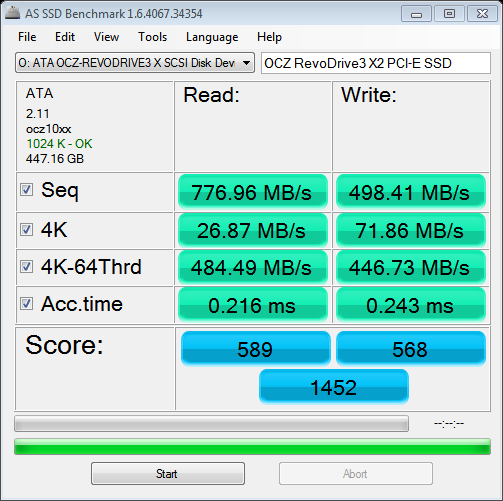
Beginning with sequential read and write performance, the OCZ RevoDrive 3 X2 PCI-E SSD produced 776.96 MB/s read speed, and 498.41 MB/s write performance. Because this benchmark uses compressed data, sequential file transfer speeds are reported lower than with other tools using uncompressed data. For this section, we will concentrate on the operational IOPS performance using compressed data. Single-threaded 4K IOPS performance delivers 26.87 MB/s read and 71.86 MB/s write, while the 64-thread 4K reads recorded 484.49 MB/s and write performance was 446.73 MB/s.
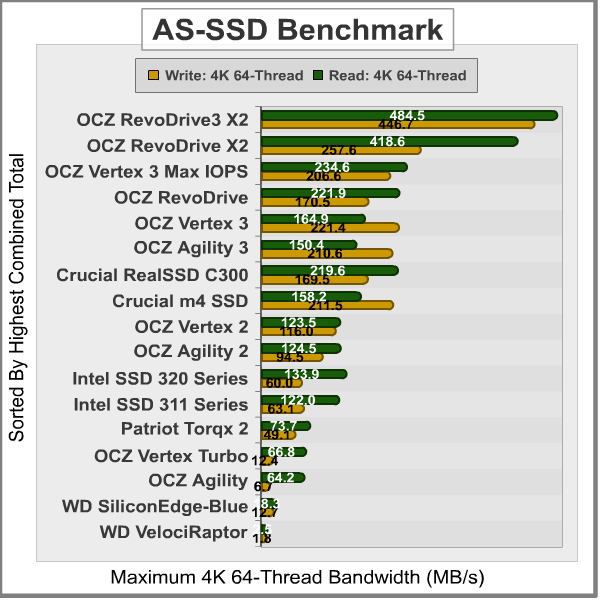
AS-SSD 64-thread 4KB IOPS performance results are displayed in the chart below, which compares several enthusiast-level storage products currently on the market. In these 64-thread 4KB IOPS performance tests the OCZ RevoDrive 3 X2 PCI-E SSD outperformed all previous RevoDrive SSDs as well as all SATA-based drives. The chart is sorted by total combined performance, which helps to illustrate which products offer the best operational input/output under load:
In the next section, Benchmark Reviews tests transfer rates using ATTO Disk Benchmark.
ATTO Disk Benchmark
The ATTO Disk Benchmark program is free, and offers a comprehensive set of test variables to work with. In terms of disk performance, it measures interface transfer rates at various intervals for a user-specified length and then reports read and write speeds for these spot-tests. There are some minor improvements made to the 2.46 version of the program that allow for test lengths up to 2GB, but all of our benchmarks are conducted with 256MB total length. ATTO Disk Benchmark requires that an active partition be set on the drive being tested. Please consider the results displayed by this benchmark to be basic bandwidth speed performance indicators.
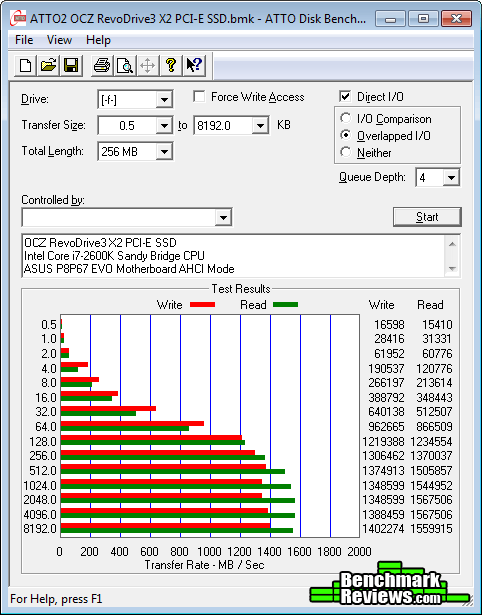
ATTO Disk Benchmark: Queue Depth 4 (Default)
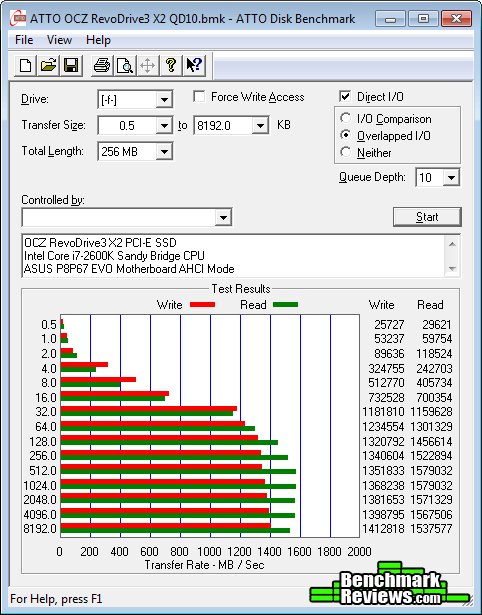
ATTO Disk Benchmark: Queue Depth 10
Our basic bandwidth speed tests begin with the OCZ RevoDrive 3 X2 PCI-E SSD installed into the Intel P67-Express motherboard's 8x PCI-Express port. Using the ATTO Disk Benchmark tool, the test drive performs file transfers ranging from 0.5 KB to 8192 KB. This 480GB model RVD3X2-FHPX4-480G reveals 1568 MBps maximum read speed that plateaus from 1024-8192 KB file chunks, and 1402 MBps peak write bandwidth plateaus from 512-8192 KB. These results both exceed OCZ's own specifications of 1500/1250 MB/s for the RevoDrive 3 X2. Using a recommended ATTO queue depth of 10 the performance results increase to 1580 MBps read and 1413 MBps write.
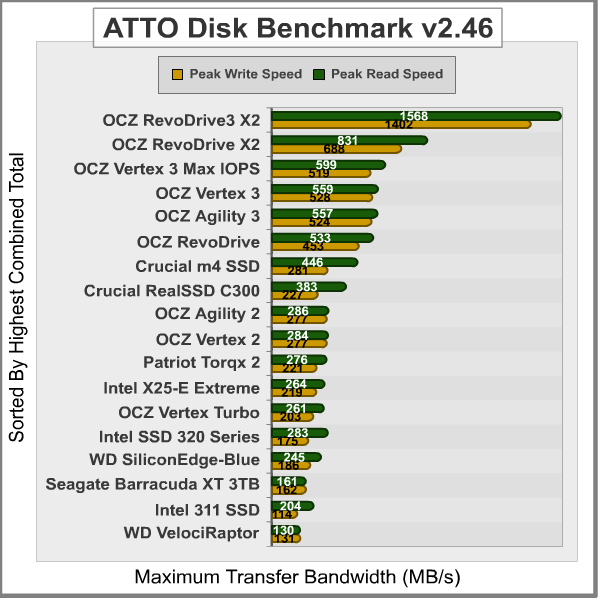
In the next section, Benchmark Reviews tests sequential performance using the CrystalDiskMark 3.0 software tool...
CrystalDiskMark 3.0 Tests
CrystalDiskMark 3.0 is a file transfer and operational bandwidth benchmark tool from Crystal Dew World that offers performance transfer speed results using sequential, 512KB random, and 4KB random samples. For our test results chart below, the 4KB 32-Queue Depth read and write performance was measured using a 1000MB space. CrystalDiskMark requires that an active partition be set on the drive being tested, and all drives are formatted with NTFS on the Intel P67 chipset configured to use AHCI-mode. Benchmark Reviews uses CrystalDiskMark to illustrate operational IOPS performance with multiple threads. In addition to our other tests, this benchmark allows us to determine operational bandwidth under heavy load.
Each of our tests with the OCZ RevoDrive 3 X2 PCI-E Solid State Drive were consistent, and the best results obtained were used in the chart below. Because this benchmark uses compressed data, sequential file transfer (write) speeds are reported lower than with other tools using uncompressed data. CrystalDiskMark 3.0 reports sequential speeds at 703.3 MB/s read and 517.7 MB/s write. 512K results reached 600.4 MB/s read and 525.9 MB/s write performance.
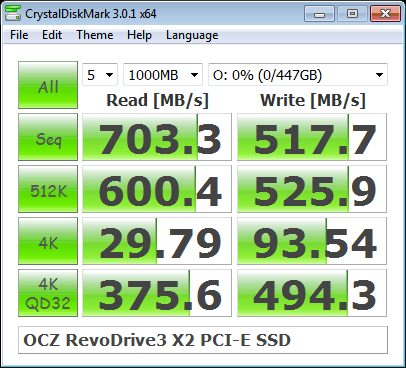
For this section, we will concentrate on the operational IOPS performance using compressed data. 4K tests produced 29.79 read and 93.54 write performance. Displayed in the chart below, the maximum 4KB queue depth 32 IOPS performance results for several enthusiast-level storage products illustrate which products offer the best operation under load:
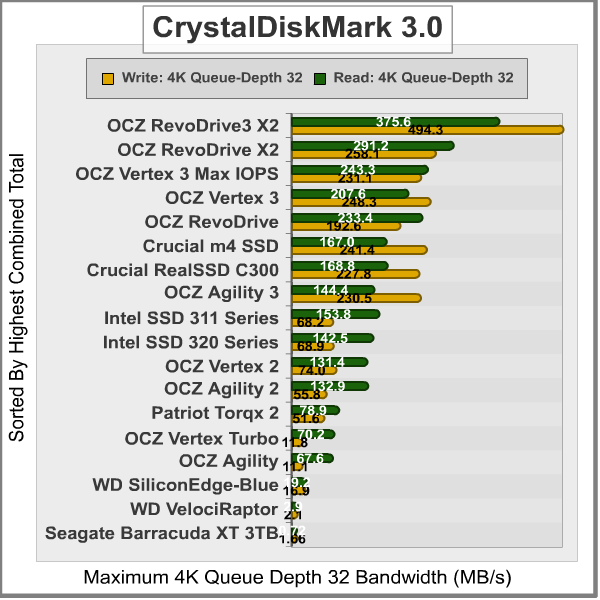
In the next section, we continue our testing using Iometer to measure input/output performance...
Iometer IOPS Performance
Iometer is an I/O subsystem measurement and characterization tool for single and clustered systems. Iometer does for a computer's I/O subsystem what a dynamometer does for an engine: it measures performance under a controlled load. Iometer was originally developed by the Intel Corporation and formerly known as "Galileo". Intel has discontinued work on Iometer, and has gifted it to the Open Source Development Lab (OSDL). There is currently a new version of Iometer in beta form, which adds several new test dimensions for SSDs.
Iometer is both a workload generator (that is, it performs I/O operations in order to stress the system) and a measurement tool (that is, it examines and records the performance of its I/O operations and their impact on the system). It can be configured to emulate the disk or network I/O load of any program or benchmark, or can be used to generate entirely synthetic I/O loads. It can generate and measure loads on single or multiple (networked) systems.
To measure random I/O response time as well as total I/O's per second, Iometer is set to use 4KB file size chunks over a 100% random sequential distribution at a queue depth of 32 outstanding I/O's per target. The tests are given a 50% read and 50% write distribution. While this pattern may not match traditional 'server' or 'workstation' profiles, it illustrates a single point of reference relative to our product field.
All of our SSD tests used Iometer 1.1.0 (build 08-Nov-2010) by Intel Corporation to measure IOPS performance, using a SandForce-created QD30 configuration: 4KB 100 Random 50-50 Read and Write.icf. The chart below illustrates combined random read and write IOPS over a 120-second Iometer test phase, where highest I/O total is preferred:
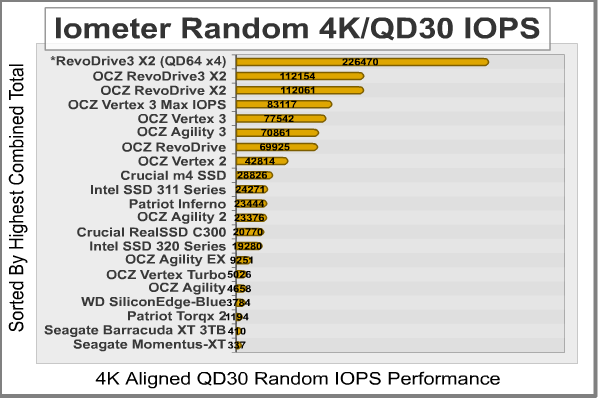
In our standard Iometer test which uses 32 outstanding I/O's per target and a random 50/50 read/write distribution, SandForce SSDs generally outperform the competition when tested which a larger queue depth. PCI-Express storage solutions lead the pack, followed by the latest SATA 6Gb/s SSDs. Using a single Iometer target with 32 I/Os didn't separate performance results for the RevoDrive (X2) series by very much, which is why OCZ offered a suggested setting that increases the workload with two workers on two managers using 64 I/O's each. Using two workers on two managers and increasing workload to 64 outstanding I/O's produced a massive 226,470 combined IOPS with the OCZ RevoDrive 3 X2 PCI-E SSD, effectively doubling output over our standard Iometer test configuration for SandForce SSDs.
* Since there are multiple managers and workers assigned, we're unable to save an Iometer configuration file for visitors to compare with. Here are the steps given by OCZ:
-
Launch Iometer 2010 (version 1.1.0-rc1)
-
Disk Targets tab:
a. Create two managers with two workers for each manager
b. Enter 16000000 into the "Maximum Disk Size" field
c. Change "# of Outstanding I/Os" to 64 to emulate multi-core CPUs
d. Keep "Write I/O Data Pattern" at "Repeating bytes" to represent a typical database data pattern. -
Access Specifications tab: create a 4KB 100% write, 100% random test profile
a. Create 4KB transfer request size.
b. Select 100% random distribution.
c. Select 100% write distribution.
d. Set I/O alignment on 4KB.
e. Add the test profile to "Assigned Access Specifications."
f. Make sure that you assign this access specification to each worker - Test Setup tab: Change Test Setup
a. Choose 5 minute run time.
b. Select "Cycle # Outstanding I/Os - run step outstanding I/Os on all disks at a time.
c. Change "# of Outstanding I/Os, Start #1, End # 64 or 128".
d. Under "Result Display" move the bar to 30 second update frequency.
In our next section, we test linear read and write bandwidth performance and compare its speed against several other top storage products using EVEREST Disk Benchmark. Benchmark Reviews feels that linear tests are excellent for rating SSDs, however HDDs are put at a disadvantage with these tests whenever capacity is high.
EVEREST Disk Benchmark
Many enthusiasts are familiar with the Lavalys EVEREST benchmark suite, but very few are aware of the Disk Benchmark tool available inside the program. The EVEREST Disk Benchmark performs linear read and write bandwidth tests on each drive, and can be configured to use file chunk sizes up to 1MB (which speeds up testing and minimizes jitter in the waveform). Because of the full sector-by-sector nature of linear testing, Benchmark Reviews endorses this method for testing SSD products, as detailed in our Solid State Drive Benchmark Performance Testing article. However, Hard Disk Drive products suffer a lower average bandwidth as the capacity draws linear read/write speed down into the inner-portion of the disk platter. EVEREST Disk Benchmark does not require a partition to be present for testing, so all of our benchmarks are completed prior to drive formatting.
Linear disk benchmarks are superior bandwidth speed tools in my opinion, because they scan from the first physical sector to the last. A side affect of many linear write-performance test tools is that the data is erased as it writes to every sector on the drive. Normally this isn't an issue, but it has been shown that partition table alignment will occasionally play a role in overall SSD performance (HDDs don't suffer this problem).
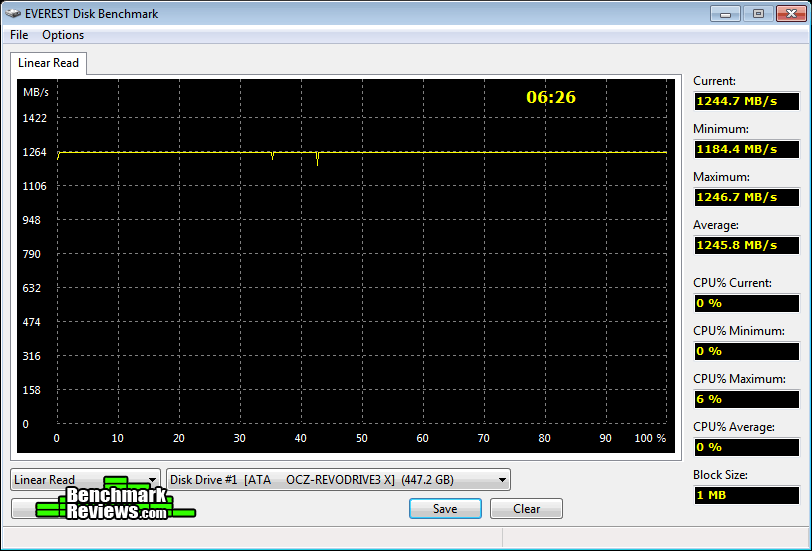
The high-performance storage products tested with EVEREST Disk Benchmark are connected either onto the Intel P67 SATA 6Gb/s controller or 8x PCI-Express bus and use a 1MB block size option. Read performance on the OCZ RevoDrive 3 X2 PCI-E SSD measured an average 1245.8 MBps bandwidth with an extremely close maximum peak speed of 1246.7 MBps. The Linear Read chart illustrates that SandForce read-speed throttling is not an issue with PCI-Express SSDs, as evidenced by the consistently flat transfer speed throughout the range of capacity. Everest linear write-to tests were next...
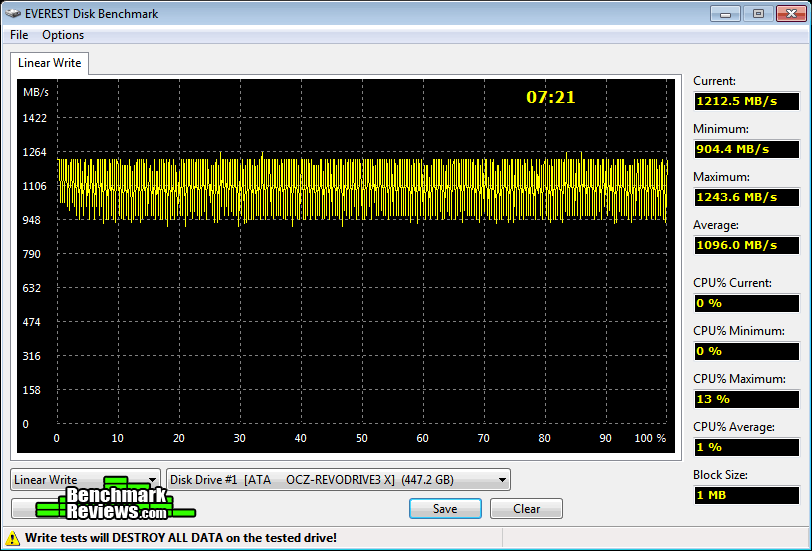
The waveform chart below illustrates how the integrated buffer space manages file transfers, and makes linear write performance appears relatively even. The results seen here are still consistent when compared to most other SSD products we've tested in the past. The OCZ RevoDrive 3 X2 PCI-E SSD recorded an average linear write-to speed of 1096.0 MBps, with a maximum write performance of 1243.6 MBps.
The chart below shows the average linear read and write bandwidth speeds for a cross-section of storage devices tested with EVEREST:
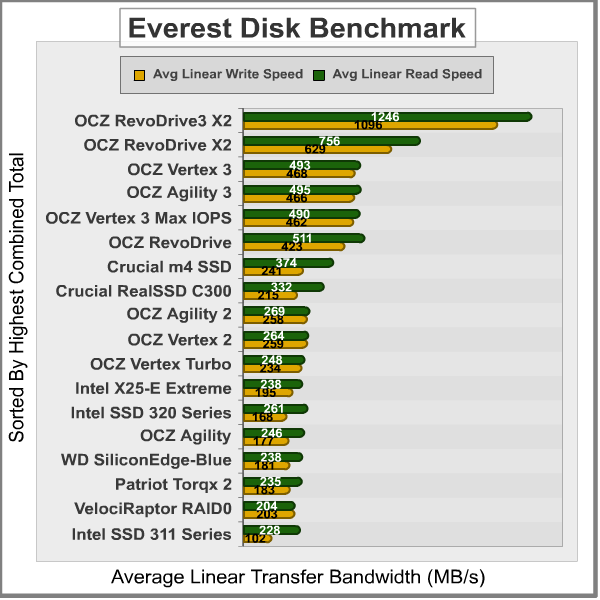
Linear tests are an important tool for comparing bandwidth speed between storage products - although HDD products suffer performance degradation over the span of their areal storage capacity. Linear bandwidth certainly benefits the Solid State Drive, since there's very little fluctuation in transfer speed. This is because Hard Disk Drive products decline in performance as the spindle reaches the inner-most sectors on the magnetic platter, away from the fast outer edge.
In the next section we use PCMark Vantage to test real-world performance...
PCMark Vantage HDD Tests
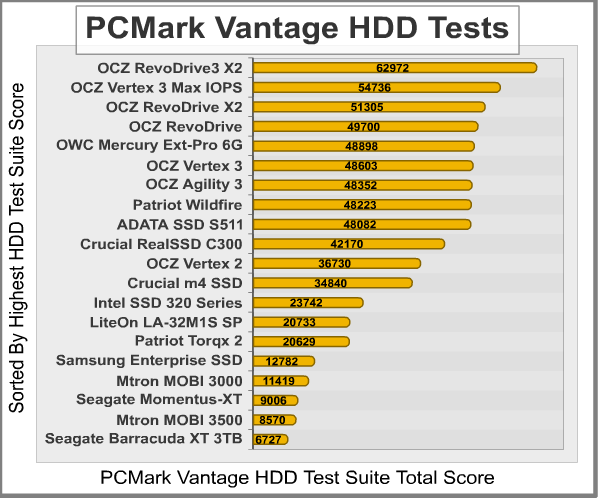
PCMark Vantage is an objective hardware performance benchmark tool for PCs running 32- and 64-bit versions of Microsoft Windows Vista or Windows 7. PCMark Vantage is well suited for benchmarking any type of Microsoft Windows Vista/7 PC: from multimedia home entertainment systems and laptops, to dedicated workstations and high-end gaming rigs. Benchmark Reviews has decided to use the HDD Test Suite to demonstrate simulated real-world storage drive performance in this article.
PCMark Vantage runs eight drive tests, each with a specific purpose. Once the benchmarking test were complete, the results are given a PCMark score while the detailed result show actual transaction speeds. The 480GB OCZ RevoDrive 3 X2 PCI-E Solid State Drive produced a total HDD Test Suite score of 62972 in PCMark Vantage:
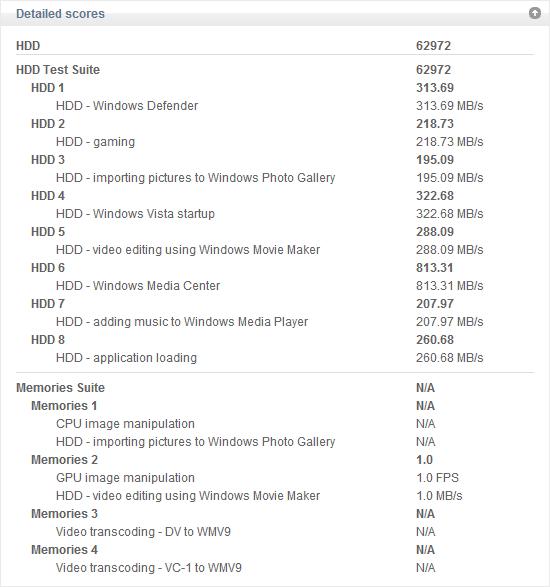
Our tests were conducted on an Intel P67 Sandy Bridge motherboard using the onboard SATA 6Gb/s controller and 8x PCI-Express bus with 64-bit Windows 7. Results are displayed in the chart below:
In the next section I share my conclusion and share the final product rating.
OCZ RevoDrive 3 X2 Conclusion
IMPORTANT: Although the rating and final score mentioned in this conclusion are made to be as objective as possible, please be advised that every author perceives these factors differently at various points in time. While we each do our best to ensure that all aspects of the product are considered, there are often times unforeseen market conditions and manufacturer changes which occur after publication that could render our rating obsolete. Please do not base any purchase solely on our conclusion, as it represents our product rating specifically for the product tested which may differ from future versions. Benchmark Reviews begins our conclusion with a short summary for each of the areas that we rate.
NOTE: Solid state drive owners experiencing stability issues with their product are encouraged to use the latest OCZ SSD firmware available.
SandForce SSDs have taken the market by storm, which has helped companies like OCZ to expand their reach deep into the high-performance storage hardware segment. The OCZ RevoDrive 3 X2 firmly places test-proven SandForce solid state drive technology onto an extremely fast PCI-Express interface, capable of delivering unmatched operational performance and flash component durability. The OCZ RevoDrive 3 X2 PCI-Express SSD combines four powerful SandForce SF-2281 controllers to 25nm Micron-Intel NAND flash using their proprietary SuperScale technology.
Our performance rating considers how effective the OCZ RevoDrive 3 X2 PCI-E SSD RVD3X2-FHPX4 performs in benchmark operations directly against competing solid state storage solutions, especially the original RevoDrive and RevoDrive X2 series. In our SSD benchmark performance tests, the OCZ RevoDrive 3 X2 delivered 1568/1402 MBps peak read and write speeds using ATTO Disk Benchmark - surpassing the manufacturer's specified maximum speeds of 1500/1250 MBps. Everest Disk Benchmark tests produced 1246/1096 MB/s, soaring far beyond the older RevoDrive X2 and confirming OCZ's RevoDrive 3 X2 as the fastest solid state product Benchmark Reviews has tested to date.
The 480GB retail kit (model RVD3X2-FHPX4-480G) that OCZ sent to us for testing is advertised to deliver 200,000 maximum combined IOPS. By using an OCZ-provided configuration optimized with dual workers on two managers each set to a queue depth of 64 outstanding I/O's per target, our own Iometer operational performance tests measured 226,470 combined IOPS performance... again surpassing OCZ's own suggested maximum performance specification. Comparing performance with 4K 32QD tests with AS-SSD and CrystalDiskMark, the OCZ RevoDrive 3 X2 PCI-E SSD topped our charts by swiftly overtaking the original RevoDrive X2 to became the new leader for high-performance consumer storage devices. With the results we've received in our tests, professionals dependent on efficient productivity can expect extremely high operational performance and storage functionality from demanding applications and extreme I/O environments.
SSDs are not prone to mechanical failure, but if any RevoDrive-series products happen to fail during the 3-year warranty period end-users may contact OCZ via the company website or extensive support forums. Fortunately, there's also a toll-free telephone number (800-459-1816) for free technical support and customer service questions. OCZ has been proven to be one of the best companies in the business when it comes to customer service, and replacement parts are often sent with priority delivery.
OCZ rightfully designated their RevoDrive 3 X2 a workstation-grade SSD, as the price tag is more acceptable to corporate enterprise environments where productivity could mean a contract. OCZ still offers the RevoDrive and RevoDrive X2 to enthusiasts, as well as SATA-based Agility and Vertex SSD series. What you get with RevoDrive 3 X2 is raw full-throttle performance without limitation. It's my opinion that the RevoDrive 3 X2 PCI-E SSD would best fit the performance profile of demanding computer systems, such as those running highly-accessed database structures or virtualized environments.
240GB: RVD3X2-FHPX4-240G $737 Amazon / $720 Newegg480GB: RVD3X2-FHPX4-480G $1660 Amazon / $1660 Newegg
960GB: RVD3X2-FHPX4-960G $3300 Amazon / $3300 Newegg
While not the most affordable SSD on the market, the OCZ RevoDrive 3 X2 PCI-E SSD RVD3X2-FHPX4 maintains a fair asking price For its intended application. It might be out of range for some consumers, which is why the OCZ RevoDrive 3 X2 is geared towards corporate/professional environments. The OCZ RevoDrive 3 X2 PCI-E SSD offers prolonged MLC NAND flash lifetime and delivers data redundancy, thanks to four powerful SandForce SF-2281 integrated controllers and OCZ Virtualized Controller Architecture technology. SandForce-specific RAISE and DuraWrite features allow the RevoDrive 3 X2 to fit nicely into several roles: virtual machine server, remote-access application server, high-transaction database server, and extreme-traffic web servers.
While the SandForce SSD controller fully supports TRIM, the OCZ RevoDrive 3 X2 is based on SCSI architecture which Microsoft Windows StorPort does not currently support with either TRIM or SCSI UNMAP. Since these controller commands are therefore not generated by the Microsoft Windows OS as a result, OCZ's VCA 2.0 is prevented from executing them. OCZ are working with Microsoft to have this functionality enabled as soon as possible, however the older RevoDrive enthusiast series shares a similar issue and still lacks support. Unlike other PCI-E SSDs however, the OCZ RevoDrive 3 X2 can be assigned as the primary boot drive for the operating system - instead of being relegated to a secondary storage drive.
In conclusion, professionals in need of maximum performance potential are recommended to consider the OCZ RevoDrive 3 X2. PCI-Express has been standard on most motherboards since 2007, so upgrading an existing system with this SSD should pose no problem. In addition to impressive transfer speeds that reached 1568 MB/s, and with 226,470 combined IOPS the OCZ RevoDrive 3 X2 produced the highest 4K performance we've ever seen from a consumer storage device. If your business can afford the asking price, I'm confident your increased productivity will make up the difference.
Pros:
+ Delivers 226,470 IOPS in Iometer tests
+ Outstanding 1568/1402 MBps read/write speed with ATTO
+ Provides primary boot drive PCI-E SSD capability
+ TCG OPAL security with 256-bit AES encryption
+ SandForce SF-2281 processor supports TRIM, SMART, and RAISE
+ DuraWrite technology extends NAND lifetime
+ Top-level enthusiast operational I/O performance
+ 3-Year OCZ product warranty support
+ 240/480/960GB SSD storage capacities
+ Compact single-slot PCI-E storage solution
+ Low power consumption compared to HDDs
Cons:
- SCSI architecture prohibits TRIM with Windows OS
- Expensive high-performance storage product
Ratings:
- Performance: 9.75
- Appearance: 9.25
- Construction: 9.50
- Functionality: 9.50
- Value: 7.00
Final Score: 9.0 out of 10.
Excellence Achievement: Benchmark Reviews Golden Tachometer Award.
Benchmark Reviews invites you to leave constructive feedback below, or ask questions in our Discussion Forum.
Reader comments from the original article
17 comments were posted before commenting closed. They are preserved as written. Original avatars no longer resolve and are shown as a placeholder.
RE: OCZ RevoDrive3 X2 SuperScale PCI-E SSD Adam Permalink:
Those speeds are absolutely insane, can't wait for this level of SSD to filter down into the more affordable drives. Not that it's of any real importance but would be interested to know just how quickly this could boot into Win7.
pres Rick Permalink:
hello @ OCZ They say three min. Wow
RE: pres Adam Permalink:
Ehm, do you mean seconds rather then minutes? In which case, hot # that's fast.
it is fast Ray Permalink:
i bought the first gen 120GB (x1) last year which is only 1xRAID0 (550MB/sec) ... windows 7 64 boots in around 24seconds (ASUS Rampage III Extreme & Intel Core I7 980x at 4GHz) Also bought several X2 series for my workstations at office, they do almost the same startup times for windows - don't think it will get any faster than this but hey - getting my fist coffe takes longer than 24secs so i don't care!
RE: OCZ RevoDrive3 X2 SuperScale PCI-E SSD Athlonite Permalink:
240GB: RVD3X2-FHPX4-240G $2,549.95NZD 480GB: RVD3X2-FHPX4-480G $3,304.81NZD for that sort of money I could buy 4x 120GB SSD's + an x4 PCIe SAS/SATA6Gbps raid controller for $1,866.07 and I'd still have plenty of money left over for a really descent PC to put it in
RE: RE: OCZ RevoDrive3 X2 SuperScale PCI-E SSD Yokoyhama Permalink:
The 240GB is here around ?580,- that should be around 970NZD. #tweakers.net/pricewatch/287789/ocz-revodrive-3-x2-pci-express-ssd-240gb-240gb.html#tab:prices I don't know how much they will charge you for shipping it to New Zealand:P
RE: RE: RE: OCZ RevoDrive3 X2 SuperScale PCI-E SSD Athlonite Permalink:
tweakers.net is in German and they show ?590 which = NZD $1,021.68 and that's still stupidly more than I'm willing to spend even without PnP added
RE: RE: OCZ RevoDrive3 X2 SuperScale PCI-E SSD Doug Dallam Permalink:
LMAO! That's funny and on point.
RE: OCZ RevoDrive3 X2 SuperScale PCI-E SSD Athlonite Permalink:
so this is a plus "+ SandForce SF-2281 processor supports TRIM, SMART, and RAISE" but this is a minus "- SCSI architecture prohibits TRIM with Windows OS" why even mention the + if it doesn't work
RE: RE: OCZ RevoDrive3 X2 SuperScale PCI-E SSD Olin Coles Permalink:
It works, just not with the current Microsoft Windows driver. There are other operating systems that could be used, and Windows could offer support in the future.
RE: RE: RE: OCZ RevoDrive3 X2 SuperScale PCI-E SSD Athlonite Permalink:
So isn't that another minus ie: hopeless for use with Windows as it won't last long without the use of Trim
Not really that fast Bill Permalink:
In real use, a computer would rarely if ever reach 64 que depth. Usually its just 1 or 2 but mostly 1 with a quick SSD. The quicker the drive the lower the QDepth in real use. So the real number is probably a QDepth of 1, testing with a high QDepth gives irrelevant numbers if your focus is real use. This Revo drive is no faster than my Vertex 2 SSD in "real use".
RE: Not really that fast David Ramsey Permalink:
It depends on what your "real use" is. Sitting in your desktop machine, probably not much difference. Sitting in a database server being hit by 100 users, yeah, it's going to make a difference.
RE: RE: Not really that fast MORINGA Permalink:
Yeah, damn right! However, in this article, I wonder which SATA controller would throw up 3 or 6 GB/s...it's 3 or 6 Gb/s afaik. On the other hand, the 8 GB/s of an 8x v2.0 PCI-x are more or less enough for those beasts...
RE: RE: RE: Not really that fast MORINGA Permalink:
PCI-e, not PCI-x. I'm falling asleep this morning.
lofty acquisition indeed realneil Permalink:
Would really like to own one of these, but it's so far out of the range of my spending that I'll probably not have one until they're old news, replaced by something far larger and much faster. I do have a few OCZ 'Agility' and 'Solid' SSD's and I'm happy with their performance and prices. I see OCZ as a good choice in SSD technology.
OCZ RevoDrive3 X2 Killy Permalink:
Pretty good review on this drive. I've been considering this one for my first SSD based i7 2600 desktop and you guys have sold me one.Costs only about AU $660 (for the 240 GB one). I expect this to be a very good asset for a video editing app. Cheers.