
Sapphire 100315L Radeon HD 6850 Video Card
Sapphire Radeon HD 6850 Video Card Review
Custom-cooled Sapphire 100315L model offers overclocking headroom with 960 shader cores.
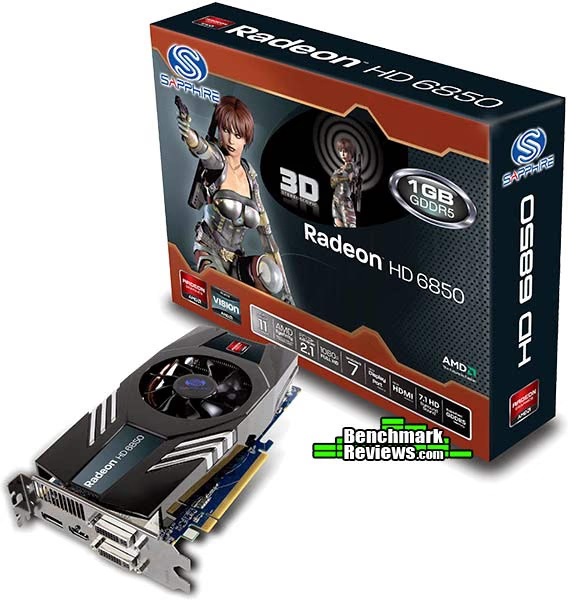
The Sapphire Radeon HD 6850 is AMD's latest DirectX-11 video card, and uses an updated Cypress back-end to offer 'Barts' GPU architecture. Built to deliver improved performance to the value-hungry mainstream gaming market, the $180 Sapphire 100315L Radeon HD 6850 video card supplements the 5800-series. The most notable new feature is Bart's 3rd-generation Unified Video Decoder with added support for DisplayPort 2.1a. AMD's UVD3 accelerates multimedia playback and transcoding, while introducing AMD HD3D stereoscopic technology with multi-view CODEC (MVC) support for playing 3D Blu-ray over HDMI 1.4a.
In this article Benchmark Reviews tests the Sapphire 100315L Radeon HD 6850 video card, a 960 shader core DirectX-11 graphics solution that competes at the $180 price point with the 768MB NVIDIA GeForce GTX 460 video card and the Radeon HD 5830/5770 to a lesser extent. Graphical frame rate performance is tested using the most demanding PC video game titles and benchmark software available. DirectX-10 favorites such as Crysis Warhead, Battlefield: Bad Company 2, and PCMark Vantage are all included, in addition to DX11 titles such as Aliens vs Predator, BattleForge, Lost Planet 2, Mafia II, Metro 2033, and the Unigine Heaven 2.1 benchmark.
According to information presented at the AMD Editor's Day event in Los Angeles on October 14th, approximately 33% of all AMD graphics solutions are sold for the desktop platform, with over 25-million AMD Radeon DirectX-11 compatible products shipped to date. In many ways this data reinforces my position in the recent Desktop Platform article series, but it could also mean that manufacturers are listening ever more intently to the changing needs of their remaining consumer base. This doesn't always leave room for innovation, but AMD manages to introduce emerging technologies nevertheless.
For those who have been patiently waiting for news on ATI Stream technology, it's been re-tasked as AMD Accelerated Parallel Processing, or APP technology. AMD Eye-Definition represents their commitment to PC gamers, PC game developers, and the PC gaming industry. Through Eye-Definition AMD delivers their "Gamers Manifesto", which they assert will enable the best experience possible regardless of hardware manufacturer.
Visitors have proven they're impatient and want everything up front and in small doses. Keeping in that spirit, I'll reveal that Sapphire's Radeon HD 6850 video card offers improved PC gaming performance while also including innovative new technologies at an affordable price point. This has become the repetitive central thesis with each new graphics card launch, running opposite the excitement manufacturers often build up. Marketing departments do their best to tout these fresh changes, all the while knowing that the more things change the more they remain the same. And so it begins once again: consumers are given more for less, and the Sapphire Radeon HD 6850 affords them this opportunity. Thankfully, it's the glory of these details that makes a new product launch much more interesting.
Benchmark Reviews has previously gone to great lengths to provide comprehensive details within each of the video card project we've published, however these overly verbose articles are going to be modified the modern online audience. In each review, we test a large selection of comparison products and provide more than twenty pages of introspective details. We enjoy doing it, mostly, and feel that our more experienced readers deserve the added illustration to fully explore newly revealed technology. Beginning with this project, the topic is delivered in three separate portions: this video card review, a separate editorial piece on AMD HD3D stereocopic technology, along with AMD's own whitepaper documents on their new display and video technologies (Adobe PDF). Now everyone should be happy, and the world can be a better place.
Manufacturer: Sapphire Technology
Product Name: Radeon HD 6850
Product: 100315L
SKU: 11180-00-40R
Suggested Tested: $199.99 at Amazon or NewEgg
Full Disclosure: The product sample used in this article has been provided by Sapphire.
Sapphire 6850 Closer Look
The Sapphire Radeon HD 6850 (model 100315L) comes equipped with 960 shader cores clocked to 775 MHz, and 1GB of GDDR5 dialed up to 1000 MHz. Sapphire has made a few changes to their design that separate this Sapphire 11180-00-40R SKU from the other reference AMD designs.

While the AMD reference design allows for two digital mini-DVI ports, Sapphire incorporates only one of them in full-size form on their Radeon HD 6850. Doing so also returns dual-link DVI support to both ports, enabling AMD HD3D technology on either interface. AMD's HD3D technology currently supports only one 3D display, with plans for multi-monitor 3D available in future products.

The Sapphire Radeon HD 6850 measures 9.0" inches long, by 1.25" tall and 3.75" wide. This is slightly shorter than the Radeon HD 5850 model, which also occupied two expansion bay slots. For reference, the Radeon HD 6870 measures 9.75" inches long, by 1.25" tall and 3.75" wide.

Sapphire's Radeon HD 6850 uses a custom cooling solution, which forces most of the heated air out through the rear of the video card shroud. In my opinion, AMD's reference cooling solution was the most ideal choice. That design allows the cooling fan to externally exhaust heated air outside of the computer case, which improves stability on overclocked systems dependant of controlled temperatures. We'll see if Sapphire's custom solution improves over the performance on AMD's reference design in our overclocking and temperature section.
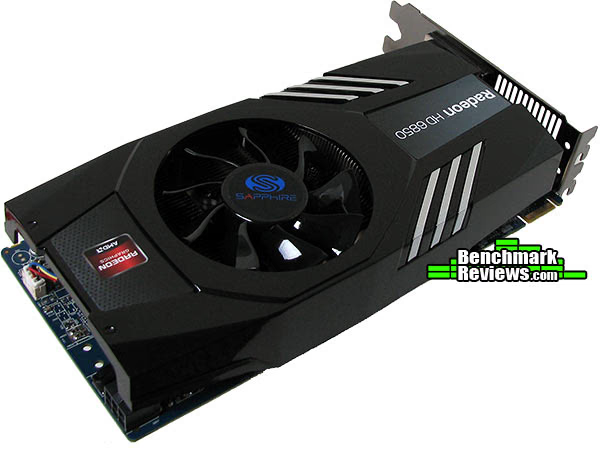
The Sapphire Radeon HD 6850 video card requires only a single 6-pin PCI-Express power connection for full operation. AMD suggests that the TDP power demands are less than 127 watts for the Barts GPU, which we'll confirm in our power consumption section.

Sapphire's exposed printed circuit board on the Radeon HD 6850 looks very Spartan, as a result of having all power and memory components located at the GPU side of the PCB.
Radeon Features
- Microsoft DirectX 11 Support
- AMD Eyefinity Technology
- AMD Accelerated Parallel Processing (APP) Technology Designed for DirectCompute 5.0 and OpenCL
- Accelerate Video Transcoding
- 40 nm Process Technology
- Advanced GDDR5 Memory Technology
- 3rd Generation TeraScale Engine
- Microsoft Windows 7 Support
- AMD CrossFireX Technology
- Enhanced Anisotropic Filtering
- Accelerated Video Transcoding
- Display Flexibility, Supports DL-DVI, DP, HDMI and D-Sub
- HDMI 1.4a support with Deep Color and 7.1 High Bitrate Audio
- On chip HDCP Support
- AMD CrossFireX multi-GPU support for highly scalable performance. (Use up to four discrete cards with an AMD 790FX based motherboard)
- AMD Avivo HD Support
- ATI Unified Video Decoder 3 (UVD3) for 3D Blu-ray and HD Video.
- Accelerated Video Transcoding (AVT)
- DVD Upscaling
- Dynamic Contrast
- Built-in HDMI with 7.1 surround sound support
- Dynamic power management with ATI PowerPlay technology including memory clocks
- Dolby TrueHD and DTSHD Master Audio Support
AMD Barts GPU Details
- ATI Radeon HD 6850 has a size of 336 sq.mm, perf/sq.mm = 22.0
- AMD Radeon HD 6870 has a size of 255 sq.mm, perf/sq.mm = 30.3
Radeon HD Specifications
| Reference Design Attribute | Radeon HD 5850 | Radeon HD 5870 | Radeon HD 6850 | Radeon HD 6870 |
|---|---|---|---|---|
|
Process |
40nm |
40nm |
40nm |
40nm |
| Transistors |
2.15B |
2.15B |
1.7B | 1.7B |
|
Engine Clock |
725 MHz |
850 MHz |
775 MHz | 900 MHz |
|
Stream Processors |
1440 |
1600 |
960 | 1120 |
|
Compute Performance |
2.09 TFLOPS |
2.72 TFLOPs |
1.50 TFLOPs | 2.00 TFLOPs |
|
Texture Units |
72 |
80 |
48 | 56 |
|
Texture Fillrate |
52.2 GTexels/s |
68.0 GTexel/s |
37.2 GTexel/s | 50.4 GTexel/s |
|
ROPs |
32 |
32 |
32 | 32 |
|
Pixel Fillrate |
23.2 Gpixel/s |
27.2 GPixel/s |
24.8 GPixel/s |
28.8 GPixel/s |
|
Z/Stencil |
92.8 GSamples/s |
108.8 GSamples/s |
99.2 GSamples/s | 128.0 GSamples/s |
|
Memory Type |
GDDR5 |
GDDR5 |
GDDR5 |
GDDR5 |
|
Memory Clock |
1000 MHz |
1200 MHz |
1000 MHz |
1050 MHz |
|
Memory Data Rate |
4.0 Gbps |
4.8 Gbps |
4.0 Gbps |
4.2 Gbps |
|
Memory Bandwidth |
128.0 GB/s |
153.6 GB/s |
128.0 GB/s |
134.4 GB/s |
|
Maximum Board Power |
170W |
188W |
127W | 151W |
|
Idle Board Power |
27W |
27W |
19W | 19W |
VGA Testing Methodology
The Microsoft DirectX-11 graphics API is native to the Microsoft Windows 7 Operating System, and will be the primary O/S for our test platform. DX11 is also available as a Microsoft Update for the Windows Vista O/S, so our test results apply to both versions of the Operating System. The majority of benchmark tests used in this article are comparative to DX11 performance, however some high-demand DX10 tests have also been included.
According to the Steam Hardware Survey published for the month ending September 2010, the most popular gaming resolution is 1280x1024 (17-19" standard LCD monitors). However, because this 1.31MP resolution is considered 'low' by most standards, our benchmark performance tests concentrate on higher-demand resolutions: 1.76MP 1680x1050 (22-24" widescreen LCD) and 2.30MP 1920x1200 (24-28" widescreen LCD monitors). These resolutions are more likely to be used by high-end graphics solutions, such as those tested in this article.
In each benchmark test there is one 'cache run' that is conducted, followed by five recorded test runs. Results are collected at each setting with the highest and lowest results discarded. The remaining three results are averaged, and displayed in the performance charts on the following pages.
A combination of synthetic and video game benchmark tests have been used in this article to illustrate relative performance among graphics solutions. Our benchmark frame rate results are not intended to represent real-world graphics performance, as this experience would change based on supporting hardware and the perception of individuals playing the video game.
Cost to Performance Ratio
For this article Benchmark Reviews has included cost per FPS for graphics performance results. An average of the five least expensive product prices are calculated, which do not consider tax, freight, promotional offers, or rebates into the cost. All prices reflect product series components, and do not represent any specific manufacturer, model, or brand. The median retail prices for each product were obtained from NewEgg.com and current as of 22-October-2010:
- $142 Radeon HD 5770 1GB
- $167 GeForce GTX 460 768MB
- $180 Radeon HD 6850 1GB
- $188 Radeon HD 5830 1GB
- $220 GeForce GTX 460 1GB
- $240 Radeon HD 6870 1GB
- $260 EVGA GTX 460 FTW 1GB
- $262 Radeon HD 5850 1GB
- $292 GeForce GTX 470 1GB
Intel X58-Express Test System
- Motherboard: ASUS P6X58D-E (Intel X58/ICH10R/Marvell SE9128)
- Processor: Intel Core i7-920 Nehalem 2.66 GHz (BX80601920)
- CPU Cooler: Prolimatech Megahalems
- System Memory: Kingston HyperX DDR3 KHX2000C8D3T1K3 (3x2GB @ 1333 CL6-6-6-18)
- Primary Drive: OCZ Vertex-2 Extended Solid State Drive
- Power Supply Unit: OCZ Z-Series Gold 850W OCZZ850
- Monitor: 26-Inch Widescreen LCD (up to 1920x1200@60Hz)
DirectX-10 Benchmark Applications
- 3DMark Vantage v1.02
- Extreme Settings: (Extreme Quality, 8x Multisample Anti-Aliasing, 16x Anisotropic Filtering, 1:2 Scale)
- Crysis Warhead v1.1 with HOC Benchmark
- Extreme Settings: (Very High Quality, 4x AA, 16x AF, Airfield Demo)
DirectX-11 Benchmark Applications
- Aliens vs Predator
- Extreme Settings: (Very High Quality, 4x AA, 16x AF, SSAO, Tessellation, Advanced Shadows)
- BattleField: Bad Company 2
- Extreme Settings: (Highest Quality, HBAO, 8x AA, 16x AF, 180s Fraps Single-Player Intro Scene)
- BattleForge v1.2
- Extreme Settings: (Very High Quality, 8x Anti-Aliasing, Auto Multi-Thread)
- Lost Planet 2
- Extreme Settings: (2x AA, Low Shadow Detail, High Texture, High Render, High DirectX 11 Features)
- Mafia II
- Extreme Settings: (Antialiasing, 16x AF, High Shadow Quality, High Detail, High Geometry, Ambient Occlusion)
- Metro 2033
- Extreme Settings: (Very-High Quality, AAA, 16x AF, Advanced DoF, Tessellation, 180s Fraps Chase Scene)
- Unigine Heaven Benchmark 2.1
- Extreme Settings: (High Quality, Normal Tessellation, 16x AF, 4x AA)
Video Card Test Products
| Graphics Card | Radeon 5770 | Radeon 5830 | GeForce GTX460 | Radeon 6850 | GeForce GTX460 | Radeon HD6870 | EVGA GTX460 FTW | Radeon HD5850 |
|---|---|---|---|---|---|---|---|---|
| GPU Cores | 800 | 1120 | 336 | 960 | 336 | 1120 | 336 | 1440 |
| Core Clock (MHz) | 850 | 800 | 675 | 775 | 675 | 900 | 850 | 725 |
| Shader Clock (MHz) | N/A | N/A | 1350 | N/A | 1350 | N/A | 1700 | N/A |
| Memory Clock (MHz) | 1200 | 1000 | 900 | 1000 | 900 | 1050 | 1000 | 1000 |
| Memory Amount | 1GB GDDR5 | 1GB GDDR5 | 768MB GDDR5 | 1GB GDDR5 | 1GB GDDR5 | 1GB GDDR5 | 1GB GDDR5 | 1GB GDDR5 |
| Memory Interface | 128-bit | 256-bit | 192-bit | 256-bit | 256-bit | 256-bit | 256-bit | 256-bit |
- NVIDIA GeForce 9800 GTX+ / GTS 250 (740 MHz GPU/1836 MHz Shader/1100 MHz vRAM - Forceware 260.89)
- ATI Radeon HD 4890 Reference Design (850 MHz GPU/975 MHz vRAM - ATI Catalyst Driver 10.9a)
- ASUS GeForce GTX 285 ENGTX285 TOP (670 MHz GPU/1550 MHz Shader/1330 MHz vRAM - Forceware 260.89)
- ATI Radeon HD 5770 Reference Design (850 MHz GPU/1200 MHz vRAM - ATI Catalyst Driver 10.9a)
- NVIDIA GeForce GTX 460 768MB (675 MHz GPU/1350 MHz Shader/900 MHz vRAM - Forceware 260.89)
- Sapphire Radeon HD 6850 1GB (775 MHz GPU/1000 MHz vRAM - AMD Catalyst Driver 10.9a)
- ATI Radeon HD 5830 Reference Design (800 MHz GPU/1000 MHz vRAM - AMD Catalyst Driver 10.9a)
- NVIDIA GeForce GTX 460 1GB (675 MHz GPU/1350 MHz Shader/900 MHz vRAM - Forceware 260.89)
- AMD Radeon HD 6870 1GB (900 MHz GPU/1050 MHz vRAM - AMD Catalyst Driver 10.9a)
- EVGA GeForce GTX 460 FTW 01G-P3-1377-TR (850 MHz GPU/1700 MHz Shader/1000 MHz vRAM - Forceware 260.89)
- ATI Radeon HD 5850 Reference Design (725 MHz GPU/1000MHz vRAM - AMD Catalyst Driver 10.9a)
DX10: 3DMark Vantage
3DMark Vantage is a PC benchmark suite designed to test the DirectX10 graphics card performance. FutureMark 3DMark Vantage is the latest addition the 3DMark benchmark series built by FutureMark corporation. Although 3DMark Vantage requires NVIDIA PhysX to be installed for program operation, only the CPU/Physics test relies on this technology.
3DMark Vantage offers benchmark tests focusing on GPU, CPU, and Physics performance. Benchmark Reviews uses the two GPU-specific tests for grading video card performance: Jane Nash and New Calico. These tests isolate graphical performance, and remove processor dependence from the benchmark results.
- 3DMark Vantage v1.02
- Extreme Settings: (Extreme Quality, 8x Multisample Anti-Aliasing, 16x Anisotropic Filtering, 1:2 Scale)
3DMark Vantage GPU Test: Jane Nash
Of the two GPU tests 3DMark Vantage offers, the Jane Nash performance benchmark is slightly less demanding. In a short video scene the special agent escapes a secret lair by water, nearly losing her shirt in the process. Benchmark Reviews tests this DirectX-10 scene at 1680x1050 and 1920x1200 resolutions, and uses Extreme quality settings with 8x anti-aliasing and 16x anisotropic filtering. The 1:2 scale is utilized, and is the highest this test allows. By maximizing the processing levels of this test, the scene creates the highest level of graphical demand possible and sorts the strong from the weak.

Jane Nash Extreme Quality Settings
Cost Analysis: Jane Nash (1680x1050)
- $142 Radeon HD 5770 1GB costs $7.89 per FPS
- $167 GeForce GTX 460 768MB costs $7.36 per FPS
- $180 Radeon HD 6850 1GB costs $7.69 per FPS
- $188 Radeon HD 5830 1GB costs $7.97 per FPS
- $220 GeForce GTX 460 1GB costs $9.09 per FPS
- $240 Radeon HD 6870 1GB costs $8.08 per FPS
- $260 EVGA GTX 460 FTW 1GB costs $8.18 per FPS
- $262 Radeon HD 5850 1GB costs $9.00 per FPS
- $292 GeForce GTX 470 1GB costs $9.97 per FPS
3DMark Vantage GPU Test: New Calico
New Calico is the second GPU test in the 3DMark Vantage test suite. Of the two GPU tests, New Calico is the most demanding. In a short video scene featuring a galactic battleground, there is a massive display of busy objects across the screen. Benchmark Reviews tests this DirectX-10 scene at 1680x1050 and 1920x1200 resolutions, and uses Extreme quality settings with 8x anti-aliasing and 16x anisotropic filtering. The 1:2 scale is utilized, and is the highest this test allows. Using the highest graphics processing level available allows our test products to separate themselves and stand out (if possible).

New Calico Extreme Quality Settings
Cost Analysis: New Calico (1680x1050)
- $142 Radeon HD 5770 1GB costs $10.44 per FPS
- $167 GeForce GTX 460 768MB costs $8.70 per FPS
- $180 Radeon HD 6850 1GB costs $10.11 per FPS
- $188 Radeon HD 5830 1GB costs $10.74 per FPS
- $220 GeForce GTX 460 1GB costs $10.63 per FPS
- $240 Radeon HD 6870 1GB costs $10.76 per FPS
- $260 EVGA GTX 460 FTW 1GB costs $9.42 per FPS
- $262 Radeon HD 5850 1GB costs $12.13 per FPS
- $292 GeForce GTX 470 1GB costs $11.59 per FPS
Test Summary: Based on the 3dMark Vantage Jane Nash and Calico performance tests, it appears the Radeon HD 6850 competes directly against the Radeon HD 5830 and 768MB GeForce GTX 460. As far as price to performance value, the Radeon HD 6850 beats the Radeon HD 5830 but fails to match value with a 768MB GeForce GTX 460. At 1680x1050 resolution with extreme quality settings, the Radeon HD 5770 produced 18.0 FPS in Jane Nash compared to 23.6 FPS with the Radeon HD 5830, while the Radeon HD 6850 produced 23.4 FPS. In New Calico the Radeon HD 5770 produced 13.6 FPS compared to 17.5 FPS with the Radeon HD 5830, while the Radeon HD 6850 produced 17.8 FPS. Compared with a similarly priced EVGA GeForce GTX 460 FTW video card ($260), there's a substantial performance lead over the Radeon HD 6850, as well as the Radeon HD 6870. Unfortunately for Radeon fans, 3dMark Vantage doesn't make a strong argument in favor of the Radeon HD 6850 based on these results.
| Graphics Card | Radeon 5770 | Radeon 5830 | GeForce GTX460 | Radeon 6850 | GeForce GTX460 | Radeon HD6870 | EVGA GTX460 FTW | Radeon HD5850 |
|---|---|---|---|---|---|---|---|---|
| GPU Cores | 800 | 1120 | 336 | 960 | 336 | 1120 | 336 | 1440 |
| Core Clock (MHz) | 850 | 800 | 675 | 775 | 675 | 900 | 850 | 725 |
| Shader Clock (MHz) | N/A | N/A | 1350 | N/A | 1350 | N/A | 1700 | N/A |
| Memory Clock (MHz) | 1200 | 1000 | 900 | 1000 | 900 | 1050 | 1000 | 1000 |
| Memory Amount | 1GB GDDR5 | 1GB GDDR5 | 768MB GDDR5 | 1GB GDDR5 | 1GB GDDR5 | 1GB GDDR5 | 1GB GDDR5 | 1GB GDDR5 |
| Memory Interface | 128-bit | 256-bit | 192-bit | 256-bit | 256-bit | 256-bit | 256-bit | 256-bit |
DX10: Crysis Warhead
Crysis Warhead is an expansion pack based on the original Crysis video game. Crysis Warhead is based in the future, where an ancient alien spacecraft has been discovered beneath the Earth on an island east of the Philippines. Crysis Warhead uses a refined version of the CryENGINE2 graphics engine. Like Crysis, Warhead uses the Microsoft Direct3D 10 (DirectX-10) API for graphics rendering.
Benchmark Reviews uses the HOC Crysis Warhead benchmark tool to test and measure graphic performance using the Airfield 1 demo scene. This short test places a high amount of stress on a graphics card because of detailed terrain and textures, but also for the test settings used. Using the DirectX-10 test with Very High Quality settings, the Airfield 1 demo scene receives 4x anti-aliasing and 16x anisotropic filtering to create maximum graphic load and separate the products according to their performance.
Using the highest quality DirectX-10 settings with 4x AA and 16x AF, only the most powerful graphics cards are expected to perform well in our Crysis Warhead benchmark tests. DirectX-11 extensions are not supported in Crysis: Warhead, and SSAO is not an available option.
- Crysis Warhead v1.1 with HOC Benchmark
- Extreme Settings: (Very High Quality, 4x AA, 16x AF, Airfield Demo)
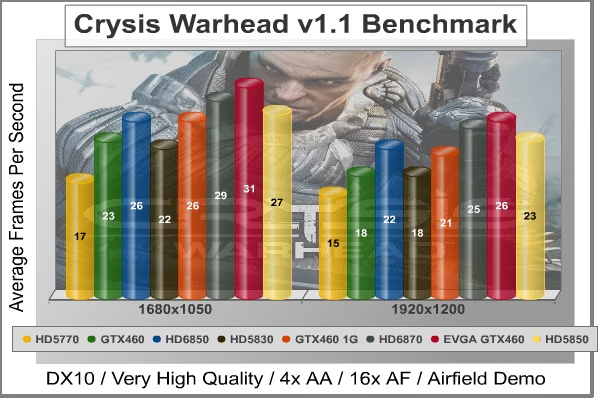
Crysis Warhead Extreme Quality Settings
Cost Analysis: Crysis Warhead (1680x1050)
- $142 Radeon HD 5770 1GB costs $8.35 per FPS
- $167 GeForce GTX 460 768MB costs $7.26 per FPS
- $180 Radeon HD 6850 1GB costs $6.92 per FPS
- $188 Radeon HD 5830 1GB costs $8.55 per FPS
- $220 GeForce GTX 460 1GB costs $8.46 per FPS
- $240 Radeon HD 6870 1GB costs $8.28 per FPS
- $260 EVGA GTX 460 FTW 1GB costs $8.39 per FPS
- $262 Radeon HD 5850 1GB costs $9.70 per FPS
- $292 GeForce GTX 470 1GB costs $8.59 per FPS
Test Summary: The CryENGINE2 graphics engine used in Crysis Warhead allows the Radeon HD 6850 to match up with the 1GB GeForce GTX 460, and seriously outperform its price point ($6.92 vs $8.46). While the Radeon HD 5770 and 5830 both performed very well in 3dMark Vantage, they've produced miserable frame rates in Crysis and have no comparison to the Radeon HD 6850. At 1680x1050 resolution with extreme quality settings, the Radeon HD 5770 produced 40.0 FPS in Battlefield Bad Company 2 compared to 46.1 FPS with the Radeon HD 5830, while the Radeon HD 6850 produced 56.1 FPS.
| Graphics Card | Radeon 5770 | Radeon 5830 | GeForce GTX460 | Radeon 6850 | GeForce GTX460 | Radeon HD6870 | EVGA GTX460 FTW | Radeon HD5850 |
|---|---|---|---|---|---|---|---|---|
| GPU Cores | 800 | 1120 | 336 | 960 | 336 | 1120 | 336 | 1440 |
| Core Clock (MHz) | 850 | 800 | 675 | 775 | 675 | 900 | 850 | 725 |
| Shader Clock (MHz) | N/A | N/A | 1350 | N/A | 1350 | N/A | 1700 | N/A |
| Memory Clock (MHz) | 1200 | 1000 | 900 | 1000 | 900 | 1050 | 1000 | 1000 |
| Memory Amount | 1GB GDDR5 | 1GB GDDR5 | 768MB GDDR5 | 1GB GDDR5 | 1GB GDDR5 | 1GB GDDR5 | 1GB GDDR5 | 1GB GDDR5 |
| Memory Interface | 128-bit | 256-bit | 192-bit | 256-bit | 256-bit | 256-bit | 256-bit | 256-bit |
DX11: Aliens vs Predator
Aliens vs. Predator is a science fiction first-person shooter video game, developed by Rebellion, and published by Sega for Microsoft Windows, Sony PlayStation 3, and Microsoft Xbox 360. Aliens vs. Predator utilizes Rebellion's proprietary Asura game engine, which had previously found its way into Call of Duty: World at War and Rogue Warrior. The self-contained benchmark tool is used for our DirectX-11 tests, which push the Asura game engine to its limit.
In our benchmark tests, Aliens vs. Predator was configured to use the highest quality settings with 4x AA and 16x AF. DirectX-11 features such as Screen Space Ambient Occlusion (SSAO) and tessellation have also been included, along with advanced shadows.
- Aliens vs Predator
- Extreme Settings: (Very High Quality, 4x AA, 16x AF, SSAO, Tessellation, Advanced Shadows)

Aliens vs Predator Extreme Quality Settings
Cost Analysis: Aliens vs Predator (1680x1050)
- $142 Radeon HD 5770 1GB costs $7.36 per FPS
- $167 GeForce GTX 460 768MB costs $6.71 per FPS
- $180 Radeon HD 6850 1GB costs $6.41 per FPS
- $188 Radeon HD 5830 1GB costs $8.14 per FPS
- $220 GeForce GTX 460 1GB costs $7.67 per FPS
- $240 Radeon HD 6870 1GB costs $7.27 per FPS
- $260 EVGA GTX 460 FTW 1GB costs $7.54 per FPS
- $262 Radeon HD 5850 1GB costs $7.92 per FPS
- $292 GeForce GTX 470 1GB costs $8.13 per FPS
Test Summary: Aliens vs Predator may use the well-known Asura game engine, but DirectX-11 extensions push the graphical demand on this game to levels eclipsed only by Mafia-II or Metro 2033 (and possibly equivalent to DX10 Crysis). With an unbiased appetite for raw DirectX-11 graphics performance, Aliens vs Predator accepts AMD and NVIDIA products as equal contenders. When high-strain SSAO is called into action, the Radeon HD 6850 compares to the 1GB GeForce GTX 460 at stock speeds, and while the EVGA GeForce GTX 460 FTW video card is well out of reach, the Radeon HD 5830 and 5770 are easily surpassed. At 1680x1050 resolution with extreme quality settings, the Radeon HD 5770 produced 17 FPS in Crysis compared to 22 FPS with the Radeon HD 5830, while the Radeon HD 6850 produced 26 FPS.
| Graphics Card | Radeon 5770 | Radeon 5830 | GeForce GTX460 | Radeon 6850 | GeForce GTX460 | Radeon HD6870 | EVGA GTX460 FTW | Radeon HD5850 |
|---|---|---|---|---|---|---|---|---|
| GPU Cores | 800 | 1120 | 336 | 960 | 336 | 1120 | 336 | 1440 |
| Core Clock (MHz) | 850 | 800 | 675 | 775 | 675 | 900 | 850 | 725 |
| Shader Clock (MHz) | N/A | N/A | 1350 | N/A | 1350 | N/A | 1700 | N/A |
| Memory Clock (MHz) | 1200 | 1000 | 900 | 1000 | 900 | 1050 | 1000 | 1000 |
| Memory Amount | 1GB GDDR5 | 1GB GDDR5 | 768MB GDDR5 | 1GB GDDR5 | 1GB GDDR5 | 1GB GDDR5 | 1GB GDDR5 | 1GB GDDR5 |
| Memory Interface | 128-bit | 256-bit | 192-bit | 256-bit | 256-bit | 256-bit | 256-bit | 256-bit |
DX11: Battlefield Bad Company 2
The Battlefield franchise has been known to demand a lot from PC graphics hardware. DICE (Digital Illusions CE) has incorporated their Frostbite-1.5 game engine with Destruction-2.0 feature set with Battlefield: Bad Company 2. Battlefield: Bad Company 2 features destructible environments using Frostbit Destruction-2.0, and adds gravitational bullet drop effects for projectiles shot from weapons at a long distance. The Frostbite-1.5 game engine used on Battlefield: Bad Company 2 consists of DirectX-10 primary graphics, with improved performance and softened dynamic shadows added for DirectX-11 users.
At the time Battlefield: Bad Company 2 was published, DICE was also working on the Frostbite-2.0 game engine. This upcoming engine will include native support for DirectX-10.1 and DirectX-11, as well as parallelized processing support for 2-8 parallel threads. This will improve performance for users with an Intel Core-i7 processor. Unfortunately, the Extreme Edition Intel Core i7-980X six-core CPU with twelve threads will not see full utilization.
In our benchmark tests of Battlefield: Bad Company 2, the first three minutes of action in the single-player raft night scene are captured with FRAPS. Relative to the online multiplayer action, these frame rate results are nearly identical to daytime maps with the same video settings. The Frostbite-1.5 game engine in Battlefield: Bad Company 2 appears to equalize our test set of video cards, and despite AMD's sponsorship of the game it still plays well using any brand of graphics card.
- BattleField: Bad Company 2
- Extreme Settings: (Highest Quality, HBAO, 8x AA, 16x AF, 180s Fraps Single-Player Intro Scene)

Battlefield Bad Company 2 Extreme Quality Settings
Cost Analysis: Battlefield: Bad Company 2 (1680x1050)
- $142 Radeon HD 5770 1GB costs $3.59 per FPS
- $167 GeForce GTX 460 768MB costs $3.46 per FPS
- $180 Radeon HD 6850 1GB costs $3.21 per FPS
- $188 Radeon HD 5830 1GB costs $4.08 per FPS
- $220 GeForce GTX 460 1GB costs $4.04 per FPS
- $240 Radeon HD 6870 1GB costs $3.72 per FPS
- $260 EVGA GTX 460 FTW 1GB costs $3.47 per FPS
- $262 Radeon HD 5850 1GB costs $4.23 per FPS
- $292 GeForce GTX 470 1GB costs $3.93 per FPS
Test Summary: Our extreme-quality tests use maximum settings for Battlefield: Bad Company 2, and so users who dial down the anti-aliasing or use a lower resolution will have much better frame rate performance. All of these video cards produced playable frame rates up to 1920x1200, where the Radeon HD 6850 really began to pull ahead of both 768MB and 1GB GeForce GTX 460 video cards and completely surpassed anything the Radeon HD 5830 or 5770 could produce. The similarly priced EVGA GeForce GTX 460 FTW outperforms the Radeon HD 6870 in both frame rate and value (also matches GTX 470), but then the 6870 clears past the Radeon HD 5850 without much trouble.
| Graphics Card | Radeon 5770 | Radeon 5830 | GeForce GTX460 | Radeon 6850 | GeForce GTX460 | Radeon HD6870 | EVGA GTX460 FTW | Radeon HD5850 |
|---|---|---|---|---|---|---|---|---|
| GPU Cores | 800 | 1120 | 336 | 960 | 336 | 1120 | 336 | 1440 |
| Core Clock (MHz) | 850 | 800 | 675 | 775 | 675 | 900 | 850 | 725 |
| Shader Clock (MHz) | N/A | N/A | 1350 | N/A | 1350 | N/A | 1700 | N/A |
| Memory Clock (MHz) | 1200 | 1000 | 900 | 1000 | 900 | 1050 | 1000 | 1000 |
| Memory Amount | 1GB GDDR5 | 1GB GDDR5 | 768MB GDDR5 | 1GB GDDR5 | 1GB GDDR5 | 1GB GDDR5 | 1GB GDDR5 | 1GB GDDR5 |
| Memory Interface | 128-bit | 256-bit | 192-bit | 256-bit | 256-bit | 256-bit | 256-bit | 256-bit |
DX11: BattleForge
BattleForge is free Massive Multiplayer Online Role Playing Game (MMORPG) developed by EA Phenomic with DirectX-11 graphics capability. Combining strategic cooperative battles, the community of MMO games, and trading card gameplay, BattleForge players are free to put their creatures, spells and buildings into combination's they see fit. These units are represented in the form of digital cards from which you build your own unique army. With minimal resources and a custom tech tree to manage, the gameplay is unbelievably accessible and action-packed.
Benchmark Reviews uses the built-in graphics benchmark to measure performance in BattleForge, using Very High quality settings (detail) and 8x anti-aliasing with auto multi-threading enabled. BattleForge is one of the first titles to take advantage of DirectX-11 in Windows 7, and offers a very robust color range throughout the busy battleground landscape. The charted results illustrate how performance measures-up between video cards when Screen Space Ambient Occlusion (SSAO) is enabled.
- BattleForge v1.2
- Extreme Settings: (Very High Quality, 8x Anti-Aliasing, Auto Multi-Thread)

BattleForge Extreme Quality Settings
Cost Analysis: BattleForge (1680x1050)
- $142 Radeon HD 5770 1GB costs $5.57 per FPS
- $167 GeForce GTX 460 768MB costs $4.76 per FPS
- $180 Radeon HD 6850 1GB costs $5.10 per FPS
- $188 Radeon HD 5830 1GB costs $6.96 per FPS
- $220 GeForce GTX 460 1GB costs $5.71 per FPS
- $240 Radeon HD 6870 1GB costs $5.93 per FPS
- $260 EVGA GTX 460 FTW 1GB costs $5.34 per FPS
- $262 Radeon HD 5850 1GB costs $6.74 per FPS
- $292 GeForce GTX 470 1GB costs $5.41 per FPS
Test Summary: With BattleForge graphics settings turned to their highest quality, the Radeon HD 6850 is reduced to competing with the less-expensive 768MB GeForce GTX 460 and loses the cost per frame value. Alternatively, the Radeon HD 6850 achieves a better cost per frame value than the 1GB EVGA GeForce GTX 460 FTW, but gets trampled in terms of frame rate performance. Compared with the older Radeon HD 5770 and price-appropriate 5830, the Radeon HD 6850 enjoys a significant lead in both value and performance. At 1680x1050 resolution with extreme quality settings, the Radeon HD 5770 produced 19.3 FPS in Alien vs Predator compared to 23.1 with the Radeon HD 5830, while the Radeon HD 6850 produced 28.1 FPS.
| Graphics Card | Radeon 5770 | Radeon 5830 | GeForce GTX460 | Radeon 6850 | GeForce GTX460 | Radeon HD6870 | EVGA GTX460 FTW | Radeon HD5850 |
|---|---|---|---|---|---|---|---|---|
| GPU Cores | 800 | 1120 | 336 | 960 | 336 | 1120 | 336 | 1440 |
| Core Clock (MHz) | 850 | 800 | 675 | 775 | 675 | 900 | 850 | 725 |
| Shader Clock (MHz) | N/A | N/A | 1350 | N/A | 1350 | N/A | 1700 | N/A |
| Memory Clock (MHz) | 1200 | 1000 | 900 | 1000 | 900 | 1050 | 1000 | 1000 |
| Memory Amount | 1GB GDDR5 | 1GB GDDR5 | 768MB GDDR5 | 1GB GDDR5 | 1GB GDDR5 | 1GB GDDR5 | 1GB GDDR5 | 1GB GDDR5 |
| Memory Interface | 128-bit | 256-bit | 192-bit | 256-bit | 256-bit | 256-bit | 256-bit | 256-bit |
DX9+SSAO: Mafia II
Mafia II is a single-player third-person action shooter developed by 2K Czech for 2K Games, and is the sequel to Mafia: The City of Lost Heaven released in 2002. Players assume the life of World War II veteran Vito Scaletta, the son of small Sicilian family who immigrates to Empire Bay. Growing up in the slums of Empire Bay teaches Vito about crime, and he's forced to join the Army in lieu of jail time. After sustaining wounds in the war, Vito returns home and quickly finds trouble as he again partners with his childhood friend and accomplice Joe Barbaro. Vito and Joe combine their passion for fame and riches to take on the city, and work their way to the top in Mafia II.
Mafia II is a DirectX-9/10/11 compatible PC video game built on 2K Czech's proprietary Illusion game engine, which succeeds the LS3D game engine used in Mafia: The City of Lost Heaven. In our Mafia-II Video Game Performance article, Benchmark Reviews explored characters and gameplay while illustrating how well this game delivers APEX PhysX features on both AMD and NVIDIA products. Thanks to DirectX-11 APEX PhysX extensions that can be processed by the system's CPU, Mafia II offers gamers is equal access to high-detail physics regardless of video card manufacturer.
- Mafia II
- Extreme Settings: (Antialiasing, 16x AF, High Shadow Quality, High Detail, High Geometry, Ambient Occlusion)

Mafia II Extreme Quality Settings
Cost Analysis: Mafia II (1680x1050)
- $142 Radeon HD 5770 1GB costs $3.99 per FPS
- $167 GeForce GTX 460 768MB costs $3.80 per FPS
- $180 Radeon HD 6850 1GB costs $3.73 per FPS
- $188 Radeon HD 5830 1GB costs $4.77 per FPS
- $220 GeForce GTX 460 1GB costs $4.70 per FPS
- $240 Radeon HD 6870 1GB costs $4.20 per FPS
- $260 EVGA GTX 460 FTW 1GB costs $4.55 per FPS
- $262 Radeon HD 5850 1GB costs $4.81 per FPS
- $292 GeForce GTX 470 1GB costs $5.21 per FPS
Test Summary: Of all the video games presently available for DirectX-11 platforms, Mafia II is by far one of the most detailed and feature-rich. The AMD Radeon HD 6850 easily outperforms the Radeon HD 5830 and both 768MB and 1GB versions of the GeForce GTX 460, while offering the best value of the entire group. The Radeon HD 6870 also performs extremely well on Mafia II, and surpasses both the EVGA GeForce GTX 460 FTW and Radeon HD 5850 video cards in both performance and value. At 1680x1050 resolution with extreme quality settings, the Radeon HD 5770 produced 25.5 FPS in BattleForge compared to 27.0 FPS with the Radeon HD 5830, while the Radeon HD 6850 produced 35.3 FPS. It seems that Mafia II performs extremely well for AMD Barts GPUs when APEX PhysX effects are disabled, however these effects really help make the game more realistic.
| Graphics Card | Radeon 5770 | Radeon 5830 | GeForce GTX460 | Radeon 6850 | GeForce GTX460 | Radeon HD6870 | EVGA GTX460 FTW | Radeon HD5850 |
|---|---|---|---|---|---|---|---|---|
| GPU Cores | 800 | 1120 | 336 | 960 | 336 | 1120 | 336 | 1440 |
| Core Clock (MHz) | 850 | 800 | 675 | 775 | 675 | 900 | 850 | 725 |
| Shader Clock (MHz) | N/A | N/A | 1350 | N/A | 1350 | N/A | 1700 | N/A |
| Memory Clock (MHz) | 1200 | 1000 | 900 | 1000 | 900 | 1050 | 1000 | 1000 |
| Memory Amount | 1GB GDDR5 | 1GB GDDR5 | 768MB GDDR5 | 1GB GDDR5 | 1GB GDDR5 | 1GB GDDR5 | 1GB GDDR5 | 1GB GDDR5 |
| Memory Interface | 128-bit | 256-bit | 192-bit | 256-bit | 256-bit | 256-bit | 256-bit | 256-bit |
DX11: Metro 2033
Metro 2033 is an action-oriented video game with a combination of survival horror, and first-person shooter elements. The game is based on the novel Metro 2033 by Russian author Dmitry Glukhovsky. It was developed by 4A Games in Ukraine and released in March 2010 for Microsoft Windows. Metro 2033 uses the 4A game engine, developed by 4A Games. The 4A Engine supports DirectX-9, 10, and 11, along with NVIDIA PhysX and GeForce 3D Vision.
The 4A engine is multi-threaded in such that only PhysX had a dedicated thread, and uses a task-model without any pre-conditioning or pre/post-synchronizing, allowing tasks to be done in parallel. The 4A game engine can utilize a deferred shading pipeline, and uses tessellation for greater performance, and also has HDR (complete with blue shift), real-time reflections, color correction, film grain and noise, and the engine also supports multi-core rendering.
Metro 2033 featured superior volumetric fog, double PhysX precision, object blur, sub-surface scattering for skin shaders, parallax mapping on all surfaces and greater geometric detail with a less aggressive LODs. Using PhysX, the engine uses many features such as destructible environments, and cloth and water simulations, and particles that can be fully affected by environmental factors.
NVIDIA has been diligently working to promote Metro 2033, and for good reason: it is the most demanding PC video game we've ever tested. When their flagship GeForce GTX 480 struggles to produce 27 FPS with DirectX-11 anti-aliasing turned two to its lowest setting, you know that only the strongest graphics processors will generate playable frame rates. All of our tests enable Advanced Depth of Field and Tessellation effects, but disable advanced PhysX options.
- Metro 2033
- Extreme Settings: (Very-High Quality, AAA, 16x AF, Advanced DoF, Tessellation, 180s Fraps Chase Scene)

Metro 2033 Extreme Quality Settings
Cost Analysis: Metro 2033 (1680x1050)
- $142 Radeon HD 5770 1GB costs $8.88 per FPS
- $167 GeForce GTX 460 768MB costs $8.88 per FPS
- $180 Radeon HD 6850 1GB costs $7.20 per FPS
- $188 Radeon HD 5830 1GB costs $9.95 per FPS
- $220 GeForce GTX 460 1GB costs $10.68 per FPS
- $240 Radeon HD 6870 1GB costs $8.42 per FPS
- $260 EVGA GTX 460 FTW 1GB costs $9.89 per FPS
- $262 Radeon HD 5850 1GB costs $11.29 per FPS
- $292 GeForce GTX 470 1GB costs $10.21 per FPS
Test Summary: There's no way to ignore the graphical demands of Metro 2033, and only the most powerful GPUs will deliver a decent visual experience unless you're willing to seriously tone-down the settings. Even when these settings are turned down, Metro 2033 is a power-hungry video game that crushes frame rates. Although Metro 2033 offers advanced PhysX options, these settings are available only to NVIDIA GeForce video cards and disabled for our tests.
As demonstrated in Mafia II, the AMD Barts GPUs truly thrive on the newest DirectX-11 video games - so long as PhysX special effects is disabled. With all settings being equal, the Radeon HD 6850 again outperforms both the 768MB and 1GB versions of the GeForce GTX 460 as well as the Radeon HD 5850 that's been competing with the 6870. At 1680x1050 resolution with extreme quality settings, the Radeon HD 5770 produced 16.0 FPS in Metro 2033 compared to 18.9 with the Radeon HD 5830, while the Radeon HD 6850 produced 25.0 FPS. As for the Radeon HD 6870, it surpassed the factory-overclocked EVGA GeForce GTX 460 FTW video card as well as the much more expensive GeForce GTX 470.
| Graphics Card | Radeon 5770 | Radeon 5830 | GeForce GTX460 | Radeon 6850 | GeForce GTX460 | Radeon HD6870 | EVGA GTX460 FTW | Radeon HD5850 |
|---|---|---|---|---|---|---|---|---|
| GPU Cores | 800 | 1120 | 336 | 960 | 336 | 1120 | 336 | 1440 |
| Core Clock (MHz) | 850 | 800 | 675 | 775 | 675 | 900 | 850 | 725 |
| Shader Clock (MHz) | N/A | N/A | 1350 | N/A | 1350 | N/A | 1700 | N/A |
| Memory Clock (MHz) | 1200 | 1000 | 900 | 1000 | 900 | 1050 | 1000 | 1000 |
| Memory Amount | 1GB GDDR5 | 1GB GDDR5 | 768MB GDDR5 | 1GB GDDR5 | 1GB GDDR5 | 1GB GDDR5 | 1GB GDDR5 | 1GB GDDR5 |
| Memory Interface | 128-bit | 256-bit | 192-bit | 256-bit | 256-bit | 256-bit | 256-bit | 256-bit |
DX11: Unigine Heaven 2.1
The Unigine "Heaven 2.1" benchmark is a free publicly available tool that grants the power to unleash the graphics capabilities in DirectX-11 for Windows 7 or updated Vista Operating Systems. It reveals the enchanting magic of floating islands with a tiny village hidden in the cloudy skies. With the interactive mode, emerging experience of exploring the intricate world is within reach. Through its advanced renderer, Unigine is one of the first to set precedence in showcasing the art assets with tessellation, bringing compelling visual finesse, utilizing the technology to the full extend and exhibiting the possibilities of enriching 3D gaming.
The distinguishing feature in the Unigine Heaven benchmark is a hardware tessellation that is a scalable technology aimed for automatic subdivision of polygons into smaller and finer pieces, so that developers can gain a more detailed look of their games almost free of charge in terms of performance. Thanks to this procedure, the elaboration of the rendered image finally approaches the boundary of veridical visual perception: the virtual reality transcends conjured by your hand.
Although Heaven-2.1 was recently released and used for our DirectX-11 tests, the benchmark results were extremely close to those obtained with Heaven-1.0 testing. Since only DX11-compliant video cards will properly test on the Heaven benchmark, only those products that meet the requirements have been included.
- Unigine Heaven Benchmark 2.1
- Extreme Settings: (High Quality, Normal Tessellation, 16x AF, 4x AA

Heaven 2.1 Extreme Quality Settings
Cost Analysis: Unigine Heaven (1680x1050)
- $142 Radeon HD 5770 1GB costs $8.30 per FPS
- $167 GeForce GTX 460 768MB costs $6.12 per FPS
- $180 Radeon HD 6850 1GB costs $7.03 per FPS
- $188 Radeon HD 5830 1GB costs $8.91 per FPS
- $220 GeForce GTX 460 1GB costs $7.59 per FPS
- $240 Radeon HD 6870 1GB costs $7.95 per FPS
- $260 EVGA GTX 460 FTW 1GB costs $7.26 per FPS
- $262 Radeon HD 5850 1GB costs $10.08 per FPS
- $292 GeForce GTX 470 1GB costs $8.23 per FPS
Test Summary: Reviewers like to say "Nobody plays a benchmark", but it seems evident that we can expect to see great things come from a graphics tool this detailed. For now though, those details only come by way of DirectX-11 video cards. Our 'extreme' test results with the Unigine Heaven benchmark tool appear to deliver fair comparisons of DirectX-11 graphics cards when set to higher quality levels. Heaven 2.1 is a very demanding benchmark tool, which is why tessellation is set to normal levels and antialiasing is reduced to 4x.
Unigine's Heaven 2.1 benchmark delivered performance results similar to 3dMark Vantage, Aliens vs Predator, and BattleForge. Using Heaven 2.1, the Radeon HD 6850 trails behind the 768MB GeForce GTX 460 and really fails to match the value, yet still surpasses the Radeon HD 5830 by a significant margin. At 1680x1050 resolution with extreme quality settings, the Radeon HD 5770 produced 17.1 FPS in Unigine Heaven 2.1 compared to 21.1 with the Radeon HD 5830, while the Radeon HD 6850 produced 25.6 FPS. The Radeon HD 6870 surpasses the 1GB GeForce GTX 460 by a small margin, costing it more the value rating, but outperforms the older Radeon HD 5850 and offers a much better value. In this test, the GeForce GTX 470 was actually outmatched by the less-expensive EVGA GeForce GTX 460 FTW video card.
| Graphics Card | Radeon 5770 | Radeon 5830 | GeForce GTX460 | Radeon 6850 | GeForce GTX460 | Radeon HD6870 | EVGA GTX460 FTW | Radeon HD5850 |
|---|---|---|---|---|---|---|---|---|
| GPU Cores | 800 | 1120 | 336 | 960 | 336 | 1120 | 336 | 1440 |
| Core Clock (MHz) | 850 | 800 | 675 | 775 | 675 | 900 | 850 | 725 |
| Shader Clock (MHz) | N/A | N/A | 1350 | N/A | 1350 | N/A | 1700 | N/A |
| Memory Clock (MHz) | 1200 | 1000 | 900 | 1000 | 900 | 1050 | 1000 | 1000 |
| Memory Amount | 1GB GDDR5 | 1GB GDDR5 | 768MB GDDR5 | 1GB GDDR5 | 1GB GDDR5 | 1GB GDDR5 | 1GB GDDR5 | 1GB GDDR5 |
| Memory Interface | 128-bit | 256-bit | 192-bit | 256-bit | 256-bit | 256-bit | 256-bit | 256-bit |
AMD Barts GPU Overclocking
AMD's Cypress GPU was well-known for accepting massively overclocked speeds. The new Barts GPU is based on Cypress, and should in theory yield a similar overclock. This presumes that AMD hasn't already stretched the Radeon HD 6850 and 6870 as far as they could go. For this project, we used MSI's free Afterburner program to overclock the video cards.
The MSI Afterburner "Graphics Card Performance Booster" application offers several adjustable variables to reach the desired overclock. Afterburner allows for voltage changes (increase/decrease), but this project aimed to stretch the AMD Barts GPU as far as it could go without any extra power applied. Beginning with the maximum stable GPU clock speed, I slowly increased the settings until I began to see tearing or the driver crashed. Once I reached the most stable speeds for both GPU and GDDR5, I put the video card back into action with high-demand video games for additional benchmark tests. Here are the results:
AMD Radeon HD 6850 Overclocking Results
| Test Item | Standard | Overclocked | Improvement | |||
|---|---|---|---|---|---|---|
| Radeon HD 6850 | 775/1000 MHz | 850/1075 MHz | 75/75 MHz | |||
| DX10: Crysis Warhead | 22 | 24 | 9.0% | |||
| DX11: Aliens vs Predator | 23.1 | 25.0 | 8.2% | |||
| DX11: BattleForge | 30.1 | 32.4 | 7.6% | |||
| DX11: Heaven 2.1 | 22.5 | 23.6 | 4.9% | |||
| DX11: Lost Planet 2 | 25.5 | 28.1 | 10.2% | |||
| DX9+SSAO: Mafia II | 39.9 | 43.2 | 8.3% |
AMD Radeon HD 6870 Overclocking Results
| Test Item | Standard | Overclocked | Improvement | |||
|---|---|---|---|---|---|---|
| Radeon HD 6870 | 900/1050 MHz | 950/1200 MHz | 50/150 MHz | |||
| DX10: Crysis Warhead | 25 | 27 | 8.0% | |||
| DX11: Aliens vs Predator | 27.0 | 29.5 | 9.3% | |||
| DX11: BattleForge | 34.3 | 37.4 | 9.0% | |||
| DX11: Heaven 2.1 | 26.5 | 28.6 | 7.9% | |||
| DX11: Lost Planet 2 | 31.0 | 33.0 | 6.5% | |||
| DX9+SSAO: Mafia II | 47.5 | 50.7 | 6.7% |
Radeon HD 6850 Temperatures
Benchmark tests are always nice, so long as you care about comparing one product to another. But when you're an overclocker, gamer, or merely a PC hardware enthusiast who likes to tweak things on occasion, there's no substitute for good information. Benchmark Reviews has a very popular guide written on Overclocking Video Cards, which gives detailed instruction on how to tweak a graphics cards for better performance. Of course, not every video card has overclocking head room. Some products run so hot that they can't suffer any higher temperatures than they already do. This is why we measure the operating temperature of the video card products we test.
To begin my testing, I use GPU-Z to measure the temperature at idle as reported by the GPU. Next I use FurMark's "Torture Test" to generate maximum thermal load and record GPU temperatures at high-power 3D mode. The ambient room temperature remained at a stable 20°C throughout testing, while the inner-case temperature hovered around 37°C.
FurMark does two things extremely well: drive the thermal output of any graphics processor higher than applications of video games realistically could, and it does so with consistency every time. Furmark works great for testing the stability of a GPU as the temperature rises to the highest possible output. The temperatures discussed below are absolute maximum values, and not representative of real-world performance.
| Video Card | Idle Temp | Loaded Temp | Ambient | |||
|---|---|---|---|---|---|---|
| ATI Radeon HD 5850 Reference | 39°C | 73°C | 20°C | |||
| AMD Radeon HD 6850 Reference | 42°C | 77°C | 20°C | |||
| Sapphire Radeon HD 6850 1GB | 36°C | 80°C | 20°C | |||
| AMD Radeon HD 6870 Reference | 39°C | 74°C | 20°C | |||
| ATI Radeon HD 5870 Reference | 33°C | 78°C | 20°C |
VGA Power Consumption
Life is not as affordable as it used to be, and items such as gasoline, natural gas, and electricity all top the list of resources which have exploded in price over the past few years. Add to this the limit of non-renewable resources compared to current demands, and you can see that the prices are only going to get worse. Planet Earth is needs our help, and needs it badly. With forests becoming barren of vegetation and snow capped poles quickly turning brown, the technology industry has a new attitude towards turning "green". I'll spare you the powerful marketing hype that gets sent from various manufacturers every day, and get right to the point: your computer hasn't been doing much to help save energy... at least up until now.
For power consumption tests, Benchmark Reviews utilizes the 80-PLUS GOLD certified OCZ Z-Series Gold 850W PSU, model OCZZ850. This power supply unit has been tested to provide over 90% typical efficiency by Chroma System Solutions. To measure isolated video card power consumption, Benchmark Reviews uses the Kill-A-Watt EZ (model P4460) power meter made by P3 International.
A baseline test is taken without a video card installed inside our test computer system, which is allowed to boot into Windows-7 and rest idle at the login screen before power consumption is recorded. Once the baseline reading has been taken, the graphics card is installed and the system is again booted into Windows and left idle at the login screen. Our final loaded power consumption reading is taken with the video card running a stress test using FurMark. Below is a chart with the isolated video card power consumption (not system total) displayed in Watts for each specified test product:
VGA Product Description(sorted by combined total power) |
Idle Power |
Loaded Power |
|---|---|---|
NVIDIA GeForce GTX 480 SLI Set |
82 W |
655 W |
NVIDIA GeForce GTX 590 Reference Design |
53 W |
396 W |
ATI Radeon HD 4870 X2 Reference Design |
100 W |
320 W |
AMD Radeon HD 6990 Reference Design |
46 W |
350 W |
NVIDIA GeForce GTX 295 Reference Design |
74 W |
302 W |
ASUS GeForce GTX 480 Reference Design |
39 W |
315 W |
ATI Radeon HD 5970 Reference Design |
48 W |
299 W |
NVIDIA GeForce GTX 690 Reference Design |
25 W |
321 W |
ATI Radeon HD 4850 CrossFireX Set |
123 W |
210 W |
ATI Radeon HD 4890 Reference Design |
65 W |
268 W |
AMD Radeon HD 7970 Reference Design |
21 W |
311 W |
NVIDIA GeForce GTX 470 Reference Design |
42 W |
278 W |
NVIDIA GeForce GTX 580 Reference Design |
31 W |
246 W |
NVIDIA GeForce GTX 570 Reference Design |
31 W |
241 W |
ATI Radeon HD 5870 Reference Design |
25 W |
240 W |
ATI Radeon HD 6970 Reference Design |
24 W |
233 W |
NVIDIA GeForce GTX 465 Reference Design |
36 W |
219 W |
NVIDIA GeForce GTX 680 Reference Design |
14 W |
243 W |
Sapphire Radeon HD 4850 X2 11139-00-40R |
73 W |
180 W |
NVIDIA GeForce 9800 GX2 Reference Design |
85 W |
186 W |
NVIDIA GeForce GTX 780 Reference Design |
10 W |
275 W |
NVIDIA GeForce GTX 770 Reference Design |
9 W |
256 W |
NVIDIA GeForce GTX 280 Reference Design |
35 W |
225 W |
NVIDIA GeForce GTX 260 (216) Reference Design |
42 W |
203 W |
ATI Radeon HD 4870 Reference Design |
58 W |
166 W |
NVIDIA GeForce GTX 560 Ti Reference Design |
17 W |
199 W |
NVIDIA GeForce GTX 460 Reference Design |
18 W |
167 W |
AMD Radeon HD 6870 Reference Design |
20 W |
162 W |
NVIDIA GeForce GTX 670 Reference Design |
14 W |
167 W |
ATI Radeon HD 5850 Reference Design |
24 W |
157 W |
NVIDIA GeForce GTX 650 Ti BOOST Reference Design |
8 W |
164 W |
AMD Radeon HD 6850 Reference Design |
20 W |
139 W |
NVIDIA GeForce 8800 GT Reference Design |
31 W |
133 W |
ATI Radeon HD 4770 RV740 GDDR5 Reference Design |
37 W |
120 W |
ATI Radeon HD 5770 Reference Design |
16 W |
122 W |
NVIDIA GeForce GTS 450 Reference Design |
22 W |
115 W |
NVIDIA GeForce GTX 650 Ti Reference Design |
12 W |
112 W |
ATI Radeon HD 4670 Reference Design |
9 W |
70 W |
The Radeon HD 6850 requires only a single six-pin PCI-E power connection for proper operation. Resting at idle, the Sapphire Radeon HD 6850 consumed 21W by our measure. Compensating for a small margin of error, this falls roughly in-line with AMD's 19W expected power draw. Once 3D-applications begin to demand power from the GPU, electrical power consumption climbed to full-throttle. Measured with 3D 'torture' load using FurMark, the Sapphire Radeon HD 6850 required 146W. This is slightly more than the reference product consumed, and falls between the ATI Radeon HD 5830 and Radeon HD 5850 - or between the GeForce GTS 450 and GTX 460 on NVIDIA's side.
Sapphire Radeon HD 6850 Conclusion
IMPORTANT: Although the rating and final score mentioned in this conclusion are made to be as objective as possible, please be advised that every author perceives these factors differently at various points in time. While we each do our best to ensure that all aspects of the product are considered, there are often times unforeseen market conditions and manufacturer changes which occur after publication that could render our rating obsolete. Please do not base any purchase solely on our conclusion, as it represents our product rating specifically for the product tested which may differ from future versions. Benchmark Reviews begins our conclusion with a short summary for each of the areas that we rate.
Beginning with frame rate performance, the Sapphire Radeon HD 6850 produces frame rates above the Radeon HD 5830 and just below the Radeon HD 5850. In our testing, Radeon HD 6850 performance was all over the place. There were times when it matched the more expensive Radeon HD 5850 and a few where it matched the 5830, but it always performed well above 5770 levels. It surpassed NVIDIA's 1GB GeForce GTX 460 in Battlefield BC2, Mafia 2, and Metro 2033, and matched performance in Crysis and Aliens vs Predator. In 3DMark Vantage, BattleForge, and Unigine Heaven, the Radeon HD 6850 was even with the 768MB GeForce GTX 460.
We didn't test AMD HD3D technology, or its impact on video game frame rates, primarily because the middleware was not made available and there are only two monitors that currently exist to support it: the Zalman Trimon 3D and iZ3D H220z1. At the time of launch Viewsonic had announced their 120Hz Fuhzion 3D monitor, but the product had not yet shipped. AMD HD3D technology presently supports one display, using either DL-DVI and DP monitors or a HDMI 1.4a-enabled 3D HDTV, so 3D movie playback on one of the few compatible 3D TVs is a more likely application of this feature.

Appearance is a more subjective matter, since the rating doesn't have any benchmark scores to fall back on. Partners traditionally offer their own unique twist on the reference design, and Sapphire has contributed their own custom cooling solution to the Radeon HD 6850 model 100315L. While our temperature results prove that AMD's reference design ultimately delivers function ahead of fashion by allowing heated air to externally exhaust outside of the computer case, Sapphire's solution offered cooler idle temps. This remains critically important to overclockers, but because the transition to 32nm wasn't achieved with Northern Islands the heat output with standard clock speeds is still considered moderately high.
I consider the constant move towards a smaller die process rather insignificant in the grand scheme of things, as NVIDIA once proved when their GeForce GTX 280 successfully launched at 65nm instead of 55nm. Taiwan Semiconductor Manufacturing Company (TSMC) is already building 32nm processors for other clientele, and AMD has noted that Moore's Law still applies - just not in regard to the Barts GPU. They claim that as a die processes become smaller, it also becomes much more costly to develop and produce.
There are six PLX display channel bridges on the Radeon HD 6850 video card, which opens up the functionality to various combinations of video connectivity. Four are dedicated to both dual-link DVI ports on the Sapphire 11180-00-40R SKU, while the reference design leaves one DVI port in single-link mode to enable two mini-DP outputs. HDMI 1.4a uses one channel, and a single full-size DisplayPort 1.2 output uses the sixth and final channel. The real innovation comes with DP 1.2, which can use a Multi-Stream Transport Hub to drive multiple displays at different resolutions, refresh rates, and color depth in Eyefinity.
Value is a fast moving target, and please believe me when I say that it changes by the minute in this industry. Delivering better performance and additional features at a lower cost to consumers has been the cornerstone of AMD's business philosophy for more than a decade, and they've repeatedly demonstrated this resolve in each of their many battles with Intel CPUs and NVIDIA GPUs. We've illustrated the cost per frame performance in the charts below:

As of 06 December 2010, the Sapphire Radeon HD 6850 (1GB GDDR5 model 100315L) sells for $199.99 at Amazon or NewEgg.
In conclusion, the Sapphire Radeon HD 6850 introduces more flexibility for display devices, especially where Eyefinity is used, plus it enables stereoscopic 3D gaming and Blu-ray or 3D DVD playback for the first time. The reconfigured Cypress-turned-Barts GPU offers decent gaming performance that rivals NVIDIA GeForce GTX 460, and occasionally competes with the older Radeon HD 5850. The $180 price point is fierce with competition, and the Radeon HD 6850 might better benefit from discounts or rebates to succeed. AMD touted Barts' improved filtering performance, but test using 3DCenter Filter Tester showed that anisotropic texture filtering still remains an issue.
Overall I consider the Sapphire 100315L Radeon HD 6850 to be a noteworthy PC gaming product, stereoscopic 3D or otherwise, but overclockers could be disappointed with the lack of headroom and Sapphire's internally-exhausted cooling solution. This is AMD's first self-branded video card, retiring nearly twenty years of ATI brand name recognition, so while it's done well to demonstrate modest mainstream performance capabilities there are still a few green areas. I'm not convinced the Radeon HD 6850 is going to impress consumers with improved Eyefinity support or added stereoscopic 3D functionality until these technologies become more mature, but this doesn't hold back the Sapphire Radeon HD 6850 from delivering solid mid-range gaming performance.
What do you think of the Sapphire Radeon HD 6850 video card? Leave comments below, or ask questions in our Forum.
Pros:
+ Modest mainstream DX11 graphics performance
+ Barts GPU Introduces stereoscopic 3D functionality
+ Reduced heat output enables very quiet cooling fan
+ UVD3 Adds multi-view CODEC for 3D Blu-ray playback
+ Improves DisplayPort to 1.2 with display chaining
+ Supports CrossFire functionality
Cons:
- Fan exhausts all heated air back inside case
- Limited initial AMD HD3D product support
- Fails to fix anisotropic texture filtering
- Barts GPU yields minimal overclock
Ratings:
- Performance: 8.75
- Appearance: 9.00
- Construction: 9.00
- Functionality: 9.25
- Value: 7.25
Reader comments from the original article
5 comments were posted before commenting closed. They are preserved as written. Original avatars no longer resolve and are shown as a placeholder.
RE: Sapphire 100315L Radeon HD 6850 Video Card Josh Permalink:
How is exhausting all heated air outside of the case a CON? This is a PRO if anything! I'm lost now.. Otherwise a pretty decent review. Thanks!
RE: RE: Sapphire 100315L Radeon HD 6850 Video Card Olin Coles Permalink:
Nearly everyone agrees that hot air does not belong inside the computer case, heating up the processor and other components. We want the video card to exhaust the hot air outside the case, so everything stays cool and lasts longer.
RE: Sapphire 100315L Radeon HD 6850 Video Card Josh Permalink:
"Cons: - Fan exhausts all heated air outside of case" It says - OUTSIDE of case.. that's why I was confused. If this "We want the video card to exhaust the hot air outside the case, so everything stays cool and lasts longer." is the case, then why is it listed as con that's all... I too, as an avid overclocker, agree and understand that hot air does not belong in the case, thank you.
RE: RE: Sapphire 100315L Radeon HD 6850 Video Card Olin Coles Permalink:
Exactly one year later, and I'm making a typo correction. It now reads "Con - Fan exhausts all heated air back inside case"
RE: Sapphire 100315L Radeon HD 6850 Video Card Josh Permalink:
Lol... still relevant, lots of people are still purchasing this card, including myself - two of them in crossfire can keep up with a 580 - and for less money and less wattage. Thanks for the review and the clarification on the cons! Hopefully my going overkill with case fans will help to negate this issue..