
Sapphire Radeon HD 4670 Video Card
Sapphire Radeon HD 4670
So you want to be a rock star huh? Well just like the Stones say, you can't always get what you want. Some of us realize we are just normal people and must settle for our daily mundane tasks and push on day after day. The same holds true for computer graphics cards, or does it? Today Benchmark Reviews will look at a mainstream card with a bit of an identity problem: The Sapphire Radeon HD4670 GDDR4 graphics card. This little guy thinks its a rock star! Maybe it thinks that "6" in it's name is an "8"? It does have 512mb of GDDR4 RAM. Well, I'm positive this card is no HD4870 but that hasn't stopped this little fella from rockin'! Let's see if the Sapphire 100255DDR4 has what it takes to be a real star.
The ATi HD4670 has been around for some months now, but until recently only available with GDDR3 memory. The addition of GDDR4 is not a game maker or breaker but should result in the very least a measurable boost of performance over its GDDR3 brethren.

The HD4670 does have a similar core with its bigger brothers the 48xx series cards and even with only 320 stream processors should do fairly well for gamers on a budget.
About the company: Sapphire Technology
Pioneers in a new era of how data is displayed and games are played, Sapphire shepherds the performance oriented with ground-breaking solutions to an environment that remains in a constant state of flux and ultimate evolution. For over ten years Sapphire has held true to its unwavering commitment, the commitment to deliver the most feature rich and soundly engineered products. Because of Sapphire's firm position on achieving excellence with each product that leaves our ISO9001 and ISO14001 certified factories, you can rest assured that your customers will recognize YOUR commitment to selling only the highest of quality components.
"Sapphire is ATI's largest and best performing partner World Wide" Dave Orton, CEO ATI
Since ATI announced its manufacturing & distribution relationships with ODMs and AiBs in June of 2001, SAPPHIRE has been THE key ATI Graphics Boards Supplier worldwide and now stands poised and ready to capture the mainboard audience of those who seek a stable platform for their mission critical operations.
Captured within the circuitry of each of SAPPHIRE's graphic cards and mainboards can be found the collective feedback from generations of enthusiasts in every market niche. Brought to life through performance oriented innovation and an emphasis on quality control, SAPPHIRE designs, manufactures and distributes the most complete range of ATI video boards and mainboards--from the mainstream products that afford the casual user the opportunity to enjoy enriched graphics and affordable platform solutions to the state-of-the-art technological marvels that drive fantasies to before unattainable thresholds of realism, and offer the pinnacle of stability and performance! SAPPHIRE refuses to compromise quality by cutting corners at the expense of its customers experience with their products. All ATI board designs undergo a stringent layout inspection by our staff of engineers to guarantee that they represent the usual high-quality image of ATI original boards. We also enjoy the resources of a highly innovative technical department that layout complex designs to accommodate different market niches as they arise. SAPPHIRE ATI video boards have long been the reliable choice for a great number of OEMs and large System Integrators in Europe, North America, Asia and Latin America based largely on our ability to meet a fast paced technical markets advancements as well as our means to produce large quantities of product.
All SAPPHIRE ATI video boards are manufactured under 100% ATI production criteria including QC and outgoing system. Our monthly video board production capacity can reach a lofty 1.8 million and often topples this landmark figure. Our factory has always been the major manufacturer on ATI boards for most of the top ten tier 1 OEMs worldwide. With this background, you should undoubtedly be guaranteed of the impeccable quality, production capacity and product reliability of all ATI video boards and mainboards from SAPPHIRE. Be they business oriented or something just off center of the crosshairs, Sapphire has a solution for you and we look forward to an exciting and prosperous relationship with you!
Saphhire HD 4600 Series Features
Loaded with the latest features, the ATI RadeonTMHD 4600 Series graphics cards deliver a level of gaming performance previously only found in high-end graphics cards. Redefine the way you play HD games and enjoy unprecedented levels of graphics realism powered by 320 stream processing units, up to 1GB of memory and support for Microsoft DirectX10.1 games. Upgrade your graphics card and watch Blu-ray movies and play HD content with incredible visual fidelity1or take your experience to another level with new multimedia capabilities. Do it all with break-through energy efficiency that doesn't compromise performance.

| DirectX 10.1 |
| 320 stream processing units, 128-bit memory interface |
| 24x custom filter anti-aliasing (CFAA) and high performance anisotropic filtering |
| Dual mode ATI CrossFireXTM multi-GPU support for highly scalable performance |
| PCI Express 2.0 support |
| Dynamic geometry acceleration, Game physics processing capability |
| ATI AvivoTM HD video and display technology* |
| Unified Video Decoder 2 (UVD 2) for Blu-rayTMand HD Video |
| Accelerated Video Transcoding(AVT) |
| DVD Upscaling, Dynamic Contrast, Built-in HDMI with 7.1 surround sound support |
| Optimized GDDR4 design |
| Ultra Low Noise Cooler(<20dBA) |
| DirectX 10.1 |
| 320 stream processing units |
| 128-bit memory interface |
| 24x custom filter anti-aliasing (CFAA) and high performance anisotropic filtering |
| Dual mode ATI CrossFireXTM multi-GPU support for highly scalable performance |
| PCI Express 2.0 support |
| Dynamic geometry acceleration |
| Game physics processing capability |
100255DDR4 Specifications
The new SAPPHIRE HD 4670 GDDR4 has been production engineered by SAPPHIRE to bring new levels of performance to the mainstream previously associated only with high end cards. With its 320 stream processors and carrying 512MB of GDDR4 memory the SAPPHIRE HD 4670 GDDR4 is now the best product in its class. Clock speeds are 750MHz for the core and 1100MHz (2.2GHz effective) for the memory making this the fastest HD 4670 card available. The card is cooled by a new large diameter fan based cooler which keeps noise levels to the minimum (<20dBA).
- I/O Output: DL-DVI-I/HDMI/VGA
- Core Clock: 750 MHz & 320 Stream Processors
- Shader Model 4.1 support
- Memory Clock: 1100MHz, 2200 Mbps.
- PCI Express 2.0 x16 bus interface
- 512MB /128bit GDDR4 memory interface
- Ultra Low Noise Dual Slot Active Cooler
- On-board HDMI.
- 7.1 Audio Channel Support
- Microsoft DirectX 10.1 support
Redefine HD Gaming
-
320 Stream Processing Units
Enough power to tackle the most demanding HD games and applications. -
Microsoft DirectX10.1
Play today while preparing for tomorrow with state-of-the-art DirectX 10.1 graphics capabilities. -
Enhanced Anti-Aliasing (AA) & Anisotropic Filtering (AF)
High performance anisotropic filtering and anti-aliasing (4X AA) smooth jagged edges and create true-to- life graphics, for everything from grass to facial features -
ATI CrossFireXTM Technology
ATI CrossFireXTM technology with up to quad GPU support offers superior scalability so your system is ready to level up when you are. -
PCI Express 2.0
Support for PCI Express 2.0 will prepare you for bandwidth-hungry games and 3D applications.
Go Beyond HD Video
-
Unified Video Decoder 2
UVD 2 frees up your CPU for other tasks so you get The Ultimate Visual ExperienceTM for the most processing- intensive content. Take full advantage of Blu-ray functionality with dual-stream, picture in picture capabilities. -
Accelerated Video Transcoding(AVT)
Edit and transfer your videos to a portable video player with new Accelerated Video Transcoding (AVT) technology.1 -
Upscale Beyond 1080p
Watch the hottest Blu-ray movies or other HD content at full 1080p display resolution and beyond.2 -
Enhanced DVD Upscaling
Watch standard DVD movies in near high-definition quality with DVD upscaling.3 The GPU uses post processing algorithms to enhance standard and low resolution videos and movies on your HD display. -
Dynamic Contrast
Dynamic Contrast automatically adjusts the contrast and brightness during scenes to consistently deliver a crisp, vibrant picture. -
HDMI
Enjoy the latest audio technologies using HDMI with 7.1 digital surround sound support. Also, xvYCC support allows the user to enjoy a wider range of color when connected to a capable HDTV.
Break-through Efficiency
-
Dynamic Power Managemen
ATI Radeon HD 4600 Series graphics cards feature ATI PowerPlayTM technology, delivering high performance when needed and conserving power when the demand on the graphics processor is low.1 -
More Performance Per Watt
ATI Radeon HD 4600 series deliver up to 3x the performance per watt of AMD's previous generation GPUs.2 -
Energy Efficient Manufacturing Process
Second generation 55nm chip uses the industry's most energy efficient manufacturing process.
System Requirements
Closer Look: Sapphire HD4670
The box is done in typical ATi fashion with black and red. Sapphire does their norm with a scantily clad woman on the cover ready to do battle of one sort or another. The box art is almost identical to Sapphire's other HD 4670 cards with two exceptions. A sticker with "Ultra SilentCooler" and the bottom half of the red/silver oval states "GDDR4". Thankfully, the box is bigger and arranged horizontally compared to the GDDR3 models vertical box but again they do share the same artwork so be sure of what you are buying if you pick one of these up.

Inside the box you'll find the HD 4670 VGA card, a generous user manual with several languages, one Crossfire bridge, a Sapphire case badge sticker and four CD/DVDs. One being a VGA driver disc, two being Cyberlink DVD Suite and PowerDVD and the last being Ruby Rom volume 1.1.
Now the first 3 discs are pretty self explanatory, but new to me is the Ruby Rom. Intrigued by this disc I opened it and placed it in my DVD ROM drive before even touching the card! On it is three full games: Call of Juarez, Dungeon Runners, and John Woo Presents: Stranglehold. Now Dungeon Runners is a free game available via download, but hey the other two are actual games I've heard of. There are a couple other apps and some screen savers and wallpapers based on the included games.
The games are not a deal maker or breaker for most but for gamers on a budget free games are AWESOME!
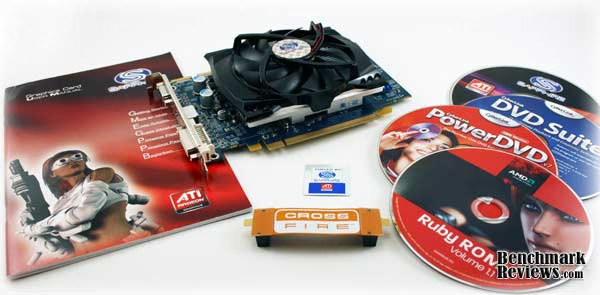
Here you can see the card itself is not nearly as long as some of the more recent higher end cards released by both camps, this one measures only approximately 6.5". That is at least 3 inches shorter than even the smaller non reference design 9800GTX+ cards. This will help those users that can't fit the monster sized cards in their case. On top is a simple all aluminum heat sink and large 80mm fan encased in a molded shroud. The plastic shroud snaps onto the heat sink with no screws required. Not so much the shroud, but that fan looks familiar to me...
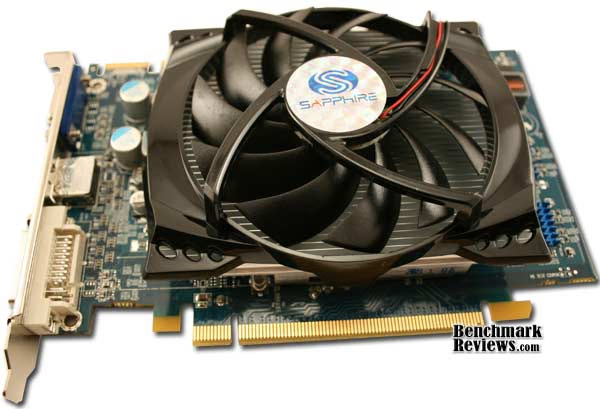
From the top you can again see the size of the heat sink/fan combination. It covers roughly 3/4 the length of the card. Notice how the heat sink extends up and out from the core to cover most components on the board. Depending on the rpm, this fan should be very quiet, it almost seems like overkill on a card of this type and looks just a bit out of place.
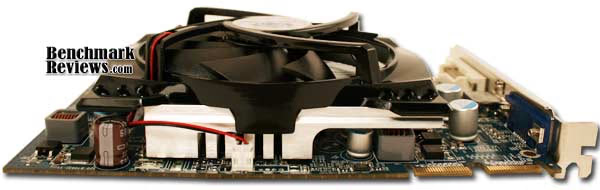
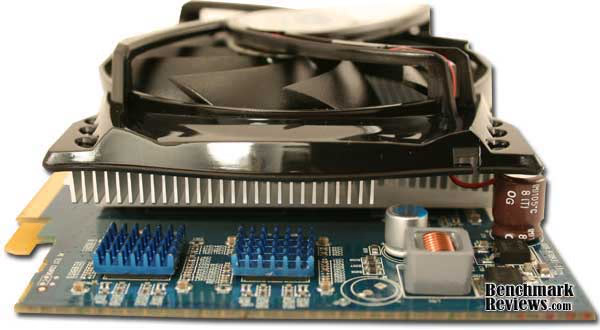
There are four RAM chips on the rear of the card. Each one is covered with a blue anodized aluminum heat sink. The blue anodization serves two purposes; for the gamer, it adds bling, for the scientist it adds protection against oxidation. At the top of the card you can see the Crossfire connectors. Gone is the typical ATi spring steel x-brace to hold the heat sink on. In it's place are four spring loaded screws. Make up our minds already! While I feel the x-brace typical of so many ATi cards does make for better pressure heat sink to core and should offer better heat transfer; if the screws work so be it. I like the aesthetics of the screws much better. The screws also offer less chance of damage or shorting on the backside of the card as well as cutting production time.
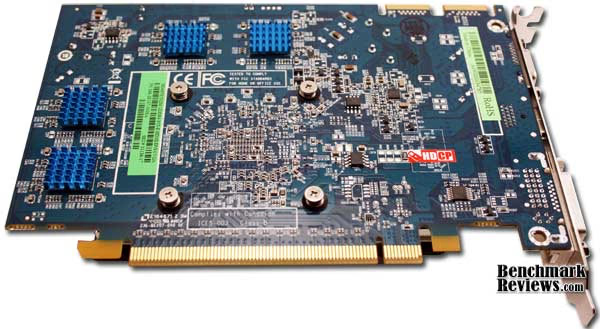
That's a quick look at the main layout and design of the card. The next section will take a closer look at some individual parts of the card.
100255DDR4 Detailed Features
The heart of the beast. The RV730 core. 514 million transistors, 320 unified shaders on a 145mm2 Die with 55nm fabrication process. It offers DX10.1 and shader model 4.1 support and a factory default speed of 750mhz.

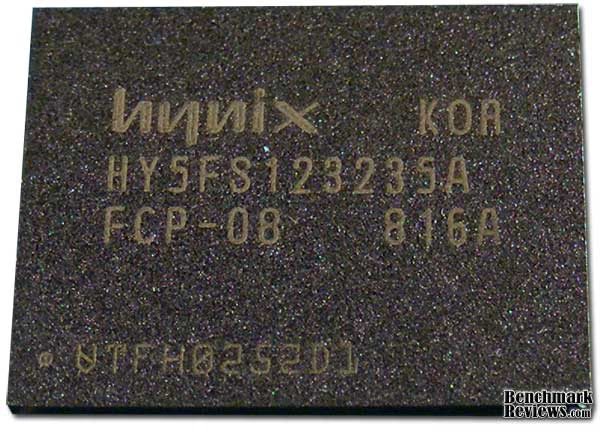
Some years ago hynix made a push to become a player in the GDDR4 arena. It seems they've made it. The RAM of choice on the Sapphire Radeon HD 4670 is hynix HY5FS123235A GDDR4 rated at 1200mhz on a 128 bit bus. With Sapphire setting the default speed at 1100mhz, it seems we might have a little room to overclock. We'll look at that in the testing section. There are only two RAM chips that do not have heat sinks attached. The two directly above the core. The heat sink does have slots perpendicular to the fins that direct air down over these two RAM chips so cooling should not be an issue.
The individual RAM heat sinks are anodized aluminum. Besides adding a little bling to the card the blue anodization actually protects the aluminum from oxidation. These would actually come in handy for over clocking, besides the bling they are truly functional. They would really help this card if it ends up in any of those tight cramped OEM micro ATX boxes as I think a lot of these HD4670s will. They're perfect for those!

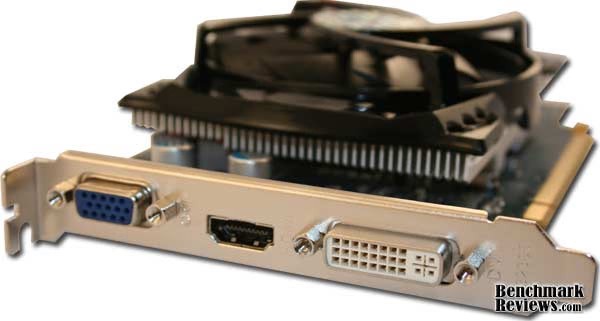
The business end of any graphics card. The outputs include a VGA connector, a dual-link DVI connector and a full HDMI connector complete with up to 7.1 audio. All without the need for an adapter or extra sound wire... cough, nvidia, cough... The HDMI sports full 1080p resolution with the GPU offering HD up converting of DVD as well. Seems an excellent choice for an HTPC. Keep in mind this is a full height card so if you plan on using it in an HTPC you'll need a full height case. From this angle it's quite clear this card is a dual slot card. As such it covers the first PCI slot below the PCI-E slot. An oddity I think for a mid range card. A small price to pay for silent and cool running I think. This may be a deciding factor for those with smaller cases or limited PCI slots.
From the rear of the card one of the easiest things to notice is one (or two) things that are not there. No auxiliary PCIe connections needed to run this card. Also here you can clearly see the massive size of the heat sink/fan, at least compared to other HD 4670s. Again, when you are talking about budget gaming, most times you are talking about small micro atx cases or cramped and stuffy OEM cases. The small card size with the large heat sink/fan equals a cool running card in almost any case.
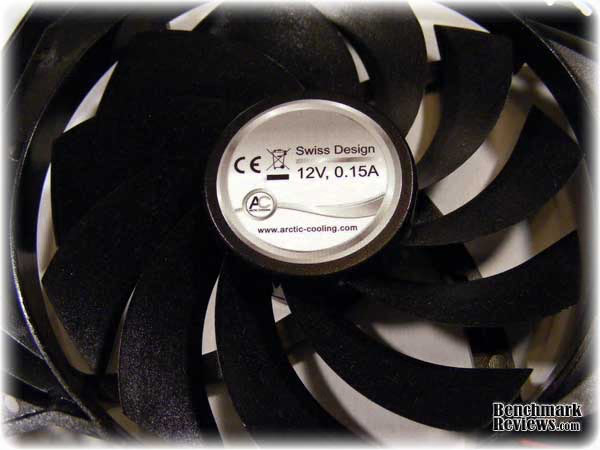
By the way, this fan is quiet. I mean quiet. At idle it is not noticeable. At 100% it is about as loud as any other card at idle. Remember when I said this fan looked somewhat familar? Check it out. The cooler/fan is made by arctic-cooling. Nice. This fan is so quiet actually that I had to double and triple check that it ramped up as heat increased. It in fact did ramp up speeds but I could only tell due to hardware monitoring software. I never saw the fan go above 54% and default is 34%. You cannot make out a difference in sound output with just your ears. I sit with my case on top of my desk to my immediate right and approximately 12 inches away.
Well you've had a peak at the physical characteristics of the Sapphire Radeon HD 4670, let's get to the real goods on this graphics card, the benchmarks where we stack this card up against two cards that really are in a performance tier above this card. We like good hard competition here at Benchmark Reviews and I for one love rooting for the underdog.
Video Card Testing Methodology
At the start of all tests, the previous display adapter driver is uninstalled and trace components are removed using Driver Cleaner Pro.We then restart the computer system to establish our display settings and define the monitor. Once the hardware is prepared, we begin our testing. The synthetic benchmark tests in 3DMark06 will utilize shader models 2.0 and 3.0. In our higher-end VGA products we conduct tests at the following resolutions: 1280x1024 (19" Standard LCD), 1680x1050 (22-24" Widescreen LCD), and 1920x1200 (24-28" Widescreen LCD). In some tests we utilized widescreen monitor resolutions, since more users are beginning to feature these products for their own computing.
Each benchmark test program begins after a system restart, and the very first result for every test will be ignored since it often only caches the test. This process proved extremely important in the World in Conflict and Supreme Commander benchmarks, as the first run served to cache maps allowing subsequent tests to perform much better than the first. Each test is completed five times, with the average results displayed in our article.
Our site polls and statistics indicate that the over 90% of our visitors use their PC for playing video games, and practically every one of you are using a screen resolutions mentioned above. Since all of the benchmarks we use for testing represent different game engine technology and graphic rendering processes, I feel that this battery of tests will provide a diverse range of results for you to gauge performance on your own computer system. Since most gamers and enthusiasts are still using Windows XP, it was decided that DirectX 9 would be used for all tests until demand and software support improve for Windows Vista.
Test System
-
Motherboard: EVGA nforce 750i SLI FTW 123-YW-E175-A1
-
Processor: Intel E8400 Core 2 Duo 3.0 GHz (Overclocked to 3.6 GHz)
-
System Memory: Corsair Dominators DDR2 1066mhz 2 x 2GB
-
Audio: Onboard
-
Disk Drive: Seagate ST325041 250GB 16MB Cache SATA
-
Optical Drive 1: Samsung SH-S203N SATA DVD R/W
-
Optical Drive 2: Samsung SH-S203N SATA DVD R/W
-
Enclosure: Lian Li PC7B Plus II Black Aluminum Mid-Tower ATX Case
-
PSU: Corsair TX750 SLI Ready 80 Plus Active PFC Power Supply
-
Monitor: Apple 23" Cinema HD Display
-
Operating System: Windows XP Professional SP-3 and Vista Ultimate x64 SP-1
Benchmark Applications
-
3DMark06 v1.1.0 (8x Anti Aliasing & 16x Anisotropic Filtering)
-
Devil May Cry 4 (8x AA Super High Settings)
-
Crysis v1.21 Benchmark (High Settings, 0x and 4x Anti-Aliasing)
-
FarCry 2 Ranch Medium Benchmark (0x and 4x Anti-Aliasing, Ultra settings)
Video Card Test Products
-
EVGA 9600GT KO 512-P3-N865-AR (Forceware v180.48)
-
EVGA 8800GT SC 512-P3-N802-AR (Forceware v180.48)** equal performance and directly comparible to 9800GT
-
Sapphire Radeon HD 4670 288-2E107-300SA (Catalyst 8.12)
3DMark06 Benchmark Results
3DMark is a computer benchmark by Futuremark (formerly named Mad Onion) to determine the DirectX 9 performance of 3D game performance with graphics cards. 3DMark06 uses advanced real-time 3D game workloads to measure PC performance using a suite of DirectX 9 3D graphics tests, CPU tests, and 3D feature tests.
3DMark06 tests include all new HDR/SM3.0 graphics tests, SM2.0 graphics tests, AI and physics driven single and multiple cores or processor CPU tests and a collection of comprehensive feature tests to reliably measure next generation gaming performance today. Some enthusiasts may note that Benchmark Reviews does not include CPU-bound tests in our benchmark battery, and that only graphic-bound tests are included.
Here at Benchmark Reviews, we believe that synthetic benchmark tools are just as valuable as video games, but only so long as you're comparing apples to apples. Since the same test is applied in the same controlled method with each test run, I believe 3DMark is a very reliable tool for comparing graphic cards against one-another.
More visitors to Benchmark Reviews operate at 1280x1024 resolution than any other, as it represents the native resolution of 19" LCD monitors. Using this resolution as a starting point, the maximum settings were applied to 3dMark06 which for these tests include 8x Anti-Aliasing and 16x Anisotropic Filtering. Low-resolution testing allows the graphics processor to plateau maximum output performance, which thereby shifts demand onto the system components to keep up. At the lower resolutions 3DMark will reflect the GPU's top-end speed in the composite score, indicating full-throttle performance with little load. This makes for a less GPU-dependant test environment, and is helpful in measuring the maximum output performance in the test results.
The following results reflect the average frames per second for the combined Shader Model 2.0 and Shader Model 3.0 tests, rather than a generic score.
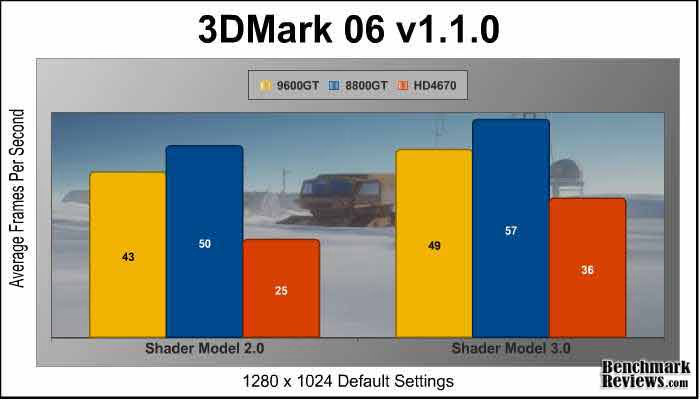
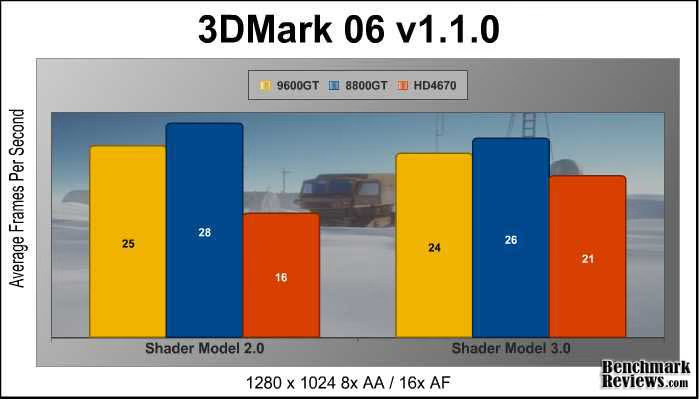
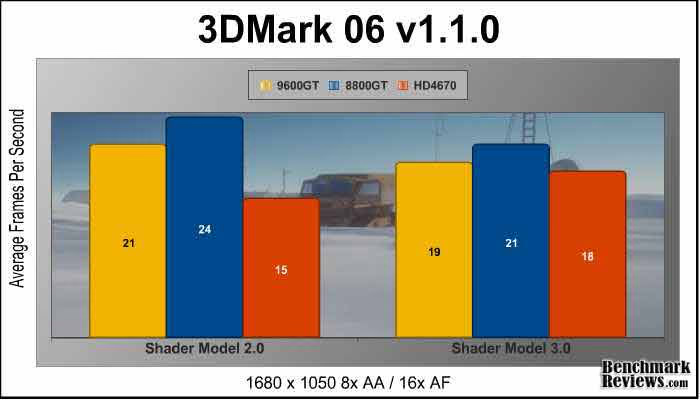
These results show that although this card has a tougher time with Shader Model 2.0 it compares fairly well considering the competion in Shader Model 3.0. This sits just fine with me as most new games are using Shader Model 3.0 to pull off the realistic graphics. For what it's worth, the HD 4670 took less of a hit when AA and AF are applied. Even so it does bring up the rear in scores. This is not surprising as I said earlier this card was never meant to compete with these cards from nvidia. Also, as with any synthetic benchmark it is truly hard to gauge how the HD 4670 might play any actual game. Use this for comparison sake alone.
Next lets move on to some actual game benchmarks.
Devil May Cry 4 Benchmark
Devil May Cry 4 was released on PC in early 2007 as the fourth installment to the Devil May Cry video game series. DMC4 is a direct port from the PC platform to console versions, which operate at the native 720P game resolution with no other platform restrictions. Devil May Cry 4 uses the refined MT Framework game engine, which has been used for many popular Capcom game titles over the past several years.
MT Framework is an exclusive seventh generation game engine built to be used with games developed for the PlayStation 3 and Xbox 360, and PC ports. MT stands for "Multi-Thread", "Meta Tools" and "Multi-Target". Originally meant to be an outside engine, but none matched their specific requirements in performance and flexibility. Games using the MT Framework are originally developed on the PC and then ported to the other two console platforms.
On the PC version a special bonus called Turbo Mode is featured, giving the game a slightly faster speed, and a new difficulty called Legendary Dark Knight Mode is implemented. The PC version also has both DirectX 9 and DirectX 10 mode for Microsoft Windows XP and Vista Operating Systems.
It's always nice to be able to compare the results we receive here at Benchmark Reviews with the results you test for on your own computer system. Usually this isn't possible, since settings and configurations make it nearly difficult to match one system to the next; plus you have to own the game or benchmark tool we used.
Devil May Cry 4 fixes this, and offers a free benchmark tool available for download. Because the DMC4 MT Framework game engine is rather low-demand for today's cutting edge multi-GPU video cards, Benchmark Reviews uses the 1920x1200 resolution to test with 8x AA (highest AA setting available to Radeon HD video cards) and 16x AF. The benchmark runs through four test scenes, but scene #2 and #4 are the ones that usually offer a challenge. Displayed below is our result for the test.
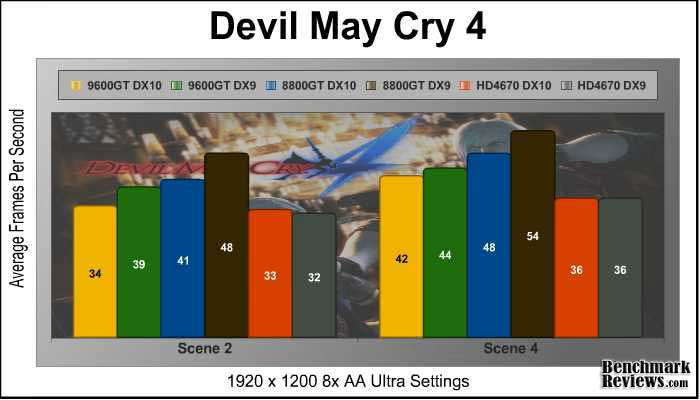
In Devil May Cry 4, the HD 4670 is pretty consistent between DX9 and DX10. It get's ok scores in both scenes and comes close to the 9600GT in scene 2 but overall it just does not have the muscle to compete here with the 8800GT. Most gamers looking at this card will be using less than 1920 x 1200 so this card should handle DMC4 or similar games just fine under 1920 x 1200 resolution, even at the ultra settings.
Crysis Benchmark Results
Crysis uses a new graphics engine: the CryENGINE2, which is the successor to Far Cry's CryENGINE. CryENGINE2 is among the first engines to use the Direct3D 10 (DirectX10) framework of Windows Vista, but can also run using DirectX9, both on Vista and Windows XP.
Roy Taylor, Vice President of Content Relations at NVIDIA, has spoken on the subject of the engine's complexity, stating that Crysis has over a million lines of code, 1GB of texture data, and 85,000 shaders. To get the most out of modern multicore processor architectures, CPU intensive subsystems of CryENGINE 2 such as physics, networking and sound, have been re-written to support multi-threading.
Crysis offers an in-game benchmark tool, which is similar to World in Conflict. This short test does place some high amounts of stress on a graphics card, since there are so many landscape features rendered. For benchmarking purposes, Crysis can mean trouble as it places a high demand on both GPU and CPU resources. Benchmark Reviews uses the Crysis Benchmark Tool by Mad Boris to test frame rates in batches, which allows the results of many tests to be averaged.
Low-resolution testing allows the graphics processor to plateau its maximum output performance, which thereby shifts demand onto the other system components. At the lower resolutions Crysis will reflect the GPU's top-end speed in the composite score, indicating full-throttle performance with little load. This makes for a less GPU-dependant test environment, and is helpful in creating a baseline for measuring maximum output performance in the next few test results. At the 1280x1024 resolution used by some newer 17" and most 19" monitors, all of the video cards tested performed at very respectable levels considering the earth shattering demand of Crysis.

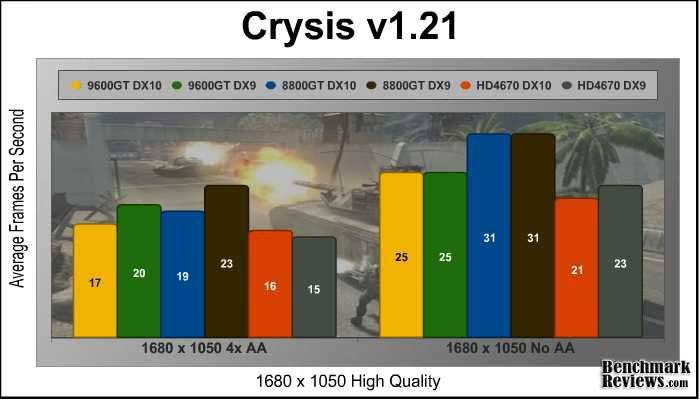
In DX10 the HD 4670 stays within 10% of the 9600GT when 4x AA is applied in Crysis. Seems this card scales better in DX10 with AA applied compared to the nvidia cards but it still just lacks the raw muscle to put up truly playable frames in Crysis. I'll not bother to post results for 1900 x 1200 but all cards lost an average of 5 frames per second which mimics the results shown.
FarCry 2 Benchmark Results
The newest game benchmark tool to Benchmark Reviews: Far Cry 2 is one of the newest First Person Shooter games out there. The game is playable in both DX9 and DX10.
FarCry 2 uses a brand new game engine call the Dunia Engine. Taken from UBI.com: DUNIA ENGINE The Dunia Engine was built specifically for Far Cry 2 by the award-winning Ubisoft Montréal development team. It delivers the most realistic destructible environments, amazing special effects such as dynamic fire propagation and storm effects, real-time night-and-day cycle, dynamic music system, non-scripted enemy A.I. and so much more...
This benchmark tool is very similar in setup and usage to the Mad Boris Crysis benchmark tool. It allows batch runs to be used and gives you maximum and minimum frame rates as well as average frame rates for each individual run as well as average rates for the entire batch. This benchmark tool can also stress your system fairly hard as it runs through many types of terrain and many different types of effects. The test used for this review was Ranch Medium with both 4x AA and 0xAA and Ultra quality everywhere else for each resolution.
Based on the test results charted below it's clear that Far Cry 2 is one game that actually favors DX10 at least when some anti-aliasing is applied. The average frame rate is shown for each resolution in the charts below.
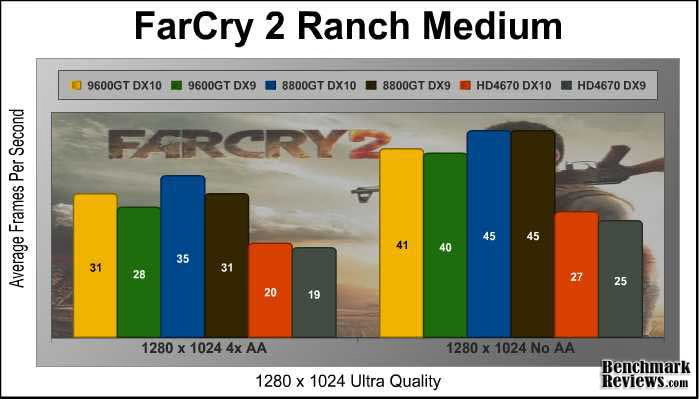

From these results it's clear that although this little rocker doesn't do too bad compared with other more serious cards as it sits it just can't keep up. The HD 4670 does seem to lose less ground when 4x AA is applied but it's just not enough at these clocks to be playable at these resolutions.
I do want to add that for consistency sake these benchmarks are run at the same settings as every other card here at Benchmark Reviews. I'm a bit at odds with that and am unsure it gives a true representation for anything but high end cards. In a pure science reasoning it has it's merits, but to the lay person, the kids, the casual gamer I'm not sure it shows them useful data.
Having said that, lets look at one last benchmark chart. This time I overclocked the HD 4670 to 790mhz core and 1190mhz memory.
FarCry 2 - HD4670 Overclocked
I wanted to give this card a fair chance and as our research shows the majority of our readers as well approximately 62% of Steam users have a screen resolution of 1280 x 1024 or less I've only run the overclock benchmark in 1280 x 1024. These benchmark setting are identical to the previous FarCry 2 1280 x 1024 benchmark with the inclusion of the HD 4670 overclocked to 760mhz core and 1190mhz memory speed.
As you can see the results are nothing less than astounding. With the HD 4670 actually hanging with and in some cases beating the Geforce 9600GT. It also comes within 2 frames per second of the 8800GT when 4x AA is applied in DX9 and within 4-5 frames without AA in both DX9 or DX10. Amazing. Yeah my jaw dropped too.

I know what some will say: Why not put it up against overclocked 9600GTs and 8800GTs; guess what? They are! The 9600GT is actually an EVGA 9600GT KO edition, the 8800GT is actually an EVGA 8800GT SC edition so these aren't just basic cards either.
Ok, while you're mulling that information over let's move onto the next section; VGA Power Consumption.
VGA Power Consumption
Life is not as affordable as it used to be, and items such as gasoline, natural gas, and electricity all top the list of resources which have exploded in price over the past few years. Add to this the limit of non-renewable resources compared to current demands, and you can see that the prices are only going to get worse. Planet Earth is needs our help, and needs it badly. With forests becoming barren of vegetation and snow capped poles quickly turning brown, the technology industry has a new attitude towards suddenly becoming "green". I'll spare you the powerful marketing hype that I get from various manufacturers every day, and get right to the point: your computer hasn't been doing much to help save energy... at least up until now.
To measure isolated video card power consumption, Benchmark Reviews uses the Kill-A-Watt EZ (model P4460) power meter made by P3 International. A baseline test is taken without a video card installed inside our computer system, which is allowed to boot into Windows and rest idle at the login screen before power consumption is recorded. Once the baseline reading has been taken, the graphics card is installed and the system is again booted into Windows and left idle at the login screen. Our final loaded power consumption reading is taken with the video card running a stress test using FurMark. Below is a chart with the isolated video card power consumption (not system total) displayed in Watts for each specified test product:
VGA Product Description(sorted by combined total power) |
Idle Power |
Loaded Power |
|---|---|---|
NVIDIA GeForce GTX 480 SLI Set |
82 W |
655 W |
NVIDIA GeForce GTX 590 Reference Design |
53 W |
396 W |
ATI Radeon HD 4870 X2 Reference Design |
100 W |
320 W |
AMD Radeon HD 6990 Reference Design |
46 W |
350 W |
NVIDIA GeForce GTX 295 Reference Design |
74 W |
302 W |
ASUS GeForce GTX 480 Reference Design |
39 W |
315 W |
ATI Radeon HD 5970 Reference Design |
48 W |
299 W |
NVIDIA GeForce GTX 690 Reference Design |
25 W |
321 W |
ATI Radeon HD 4850 CrossFireX Set |
123 W |
210 W |
ATI Radeon HD 4890 Reference Design |
65 W |
268 W |
AMD Radeon HD 7970 Reference Design |
21 W |
311 W |
NVIDIA GeForce GTX 470 Reference Design |
42 W |
278 W |
NVIDIA GeForce GTX 580 Reference Design |
31 W |
246 W |
NVIDIA GeForce GTX 570 Reference Design |
31 W |
241 W |
ATI Radeon HD 5870 Reference Design |
25 W |
240 W |
ATI Radeon HD 6970 Reference Design |
24 W |
233 W |
NVIDIA GeForce GTX 465 Reference Design |
36 W |
219 W |
NVIDIA GeForce GTX 680 Reference Design |
14 W |
243 W |
Sapphire Radeon HD 4850 X2 11139-00-40R |
73 W |
180 W |
NVIDIA GeForce 9800 GX2 Reference Design |
85 W |
186 W |
NVIDIA GeForce GTX 780 Reference Design |
10 W |
275 W |
NVIDIA GeForce GTX 770 Reference Design |
9 W |
256 W |
NVIDIA GeForce GTX 280 Reference Design |
35 W |
225 W |
NVIDIA GeForce GTX 260 (216) Reference Design |
42 W |
203 W |
ATI Radeon HD 4870 Reference Design |
58 W |
166 W |
NVIDIA GeForce GTX 560 Ti Reference Design |
17 W |
199 W |
NVIDIA GeForce GTX 460 Reference Design |
18 W |
167 W |
AMD Radeon HD 6870 Reference Design |
20 W |
162 W |
NVIDIA GeForce GTX 670 Reference Design |
14 W |
167 W |
ATI Radeon HD 5850 Reference Design |
24 W |
157 W |
NVIDIA GeForce GTX 650 Ti BOOST Reference Design |
8 W |
164 W |
AMD Radeon HD 6850 Reference Design |
20 W |
139 W |
NVIDIA GeForce 8800 GT Reference Design |
31 W |
133 W |
ATI Radeon HD 4770 RV740 GDDR5 Reference Design |
37 W |
120 W |
ATI Radeon HD 5770 Reference Design |
16 W |
122 W |
NVIDIA GeForce GTS 450 Reference Design |
22 W |
115 W |
NVIDIA GeForce GTX 650 Ti Reference Design |
12 W |
112 W |
ATI Radeon HD 4670 Reference Design |
9 W |
70 W |
As you can see the HD 4670 sports the lowest wattage out of any other card charted. Only 9 Watts at idle. This card would pay for itself over time. Even at full load the card is only using 70 Watts. That is nearly 1/2 of the power consumption of the lowest ranked card on that chart. You've seen the benchmark charts and now this chart. Add them together and you can assume this card gets 66%-100% of their performance with about 50% of the electric bill. Power/watt is very good for this card. This equals money savings over the other cards compared every month, not just once at the point of purchase. This seems to be a new thing for ATi as their top cards seem to the opposite.
Sapphire HD4670 Final Thoughts
I'd like to add some final thoughts. I've spent sometime playing a few games with this card and I've had wonderful experiences with it. It truly surprised me. For Valve games such as Team Fortress 2, Half Life 2 and Left 4 Dead, this card will play all of them pretty much at max settings. I've played Left 4 Dead at 1920 x 1200 with all eye candy turned up and it was just a tiny bit slow. Just enough to annoy me but playable. I played a full round of versus. I don't think I would want to sustain that at such a high resolution but lower resolutions would be fine all day long. I've played Crysis at 1280 x 1024 all on high and saw frames per second from 35 to about 28. It was playable. I then went to 1024 x 768 and left the card scale the image to 1280 x 1024 with no noticeable loss in image quality and saw frames from 40 to 35 - very playable. I played FarCry 2 on High settings at 1280 x 1024, again very playable. This was all done at factory clocks. 
I'll be honest I was very surprised with the performance of the HD 4670 GDDR4 card. I played quite a few games with this card, but not until after I ran the benchmark tests. I was like "what? This card isn't supposed to be so much fun! What's going on here?" I love to give out positive reviews but I hate to find no faults. After all nothing is perfect. I feel I'm either not doing my job or I'm not observant enough. I'm trying very hard to find something wrong with this card, but I'm not finding much. True the HD 4670 did come in last place overall in my comparisons but given the chance I'm sure this card would stomp a mud hole in it's true competition. The card nvidia has right now to compete with the HD 4670 is the 9500GT. I honestly don't believe the 9500GT would stand a chance against this.
The only real fault I'm seeing in this card right now is price. This card can compete performance wise but to be honest if it wants to compete it has to compete fully, performance and price. As of writing I'm not seeing any prices published for this upgraded HD 4670 but the GDDR3 versions are selling from $80 to $125 on www.newegg.com with the Geforce 9600GT selling from $90 to $130. Strictly speaking on game playing muscle I just don't see the value in this card compared to say a 9600GT at basically the same price. Performance wise this card sits between the 9600GT and the 9500GT and yet sells for at least the same if not more than the higher performing 9600GT.
Given all of that, this card may be the better multi-tasker. If you are looking for a dead silent card with enough power to play most games and still take it easy on your electric bill this card may fit your ticket. If you need integrated hassle free HDMI output card with enough power to push a full 1080p TV this card could be your choice. If you are a gamer on a budget with an OEM pc with integrated graphics and no PCI-E power plug, maybe this card should be your choice.
I hope the information I've given you can help you make a better choice for your needs.
Sapphire 100255DDR4 Conclusion
Sapphire is ATi's premiere partner and they follow ATi's lead with artwork, but with their unique spin. Sapphire does a good job and their marketing is never too dull or never too over the top. Their boxes are always easily recognizable and they have very good brand recognition. I do think it may be time for them to give the women warriors a break and come up with something fresh though.
We're asked to rate the appearance of the product which can be very subjective, afterall beauty is in the eyes of the beholder. I think in this case the simplicity of design and cleanliness of the heat sink application on the card is hard to argue with. The card looks good. With the large heat sink/fan it looks like it may be something more than it is.
The HD 4670 appears to be constructed as good as any card I've seen. Sapphire has used all solid capacitors throughout except for one single other. The heatsink and fan are top rate and made very well. With most cards lately offering full coverage of the board by a shroud one might not like this card with some open areas on it. Given it's target audience I think the card will be fine, most won't tinker too much inside once the card is installed.
This card runs solid. I put up a good fight against some stiff competition and faired well given that competition. However as I've stated above the pricing structure currently on the HD4600 line I'm afraid this card may price itself right out of contention. With this being the top of the HD 4670 line, NewEgg's $82.99 price tag seems appropriate. This saddens me just a little because this is a really great little card. It's price redeeming factors may very well be the silent and cool operation coupled with low power consumption and excellent HDMI options. The value mark for this card is tough to put a point on...
I'll finish with these simple thoughts:
If you strictly game and want the most bang for your buck, your money might better serve you with a 9600GT or a 9800GT.
If you want something a little more sophisticated for say HTPC use and good gaming at resonable resolutions with energy savings and silence being important to you, this card will not disappoint you.
Keep in mind my scores below are for this card based on it's position in the market, not it's position or stature in the overall graphics card market.
Pros:
+ Great in game performance at moderate resolutions
+ Low power consumption
+ Silent operation
+ Small footprint
+ Integrated HDMI and 7.1 audio
Cons:
- Price
- Dual slot cooler
- It won't heat my room
- Price
Ratings:
-
Presentation: 8.5
-
Appearance: 9.25
-
Construction: 9.25
-
Functionality: 9.5
-
Value: 8.0
Final Score: 8.9 out of 10.
Quality Recognition: Benchmark Reviews Silver Tachometer Award.
Questions? Comments? Benchmark Reviews really wants your feedback. We invite you to leave your remarks in our Discussion Forum.