
SimpleTech PC3-10600 DDR3 1333MHz S1024R5NP2QA
SimpleTech S1024R5NP2QA
System memory (RAM) manufacturers are in a tough position these days. Everybody wants the latest technology, which runs faster and operates more efficiently, but nobody wants the price tag that comes with it. Because DDR2 fabrication assembly plants are nearing obsolescence, the equipment depreciation has caused DDR2 prices to drop below the actual cost of production. This is bad news for the manufacturer, while conversely it means great savings to the consumer. So while manufacturers try to squeeze the last drops of revenue out of DDR2, along comes DDR3.
At the very recent 2008 International CES, there was a common attitude among memory manufacturers: 2008 isn't going to be the great year they hoped for. In fact, the consensus feeling was that Intel had really strained them with unnecessary development costs when DDR3 was so far from being a real "standard" within the industry.
Of all the RAM kits we have reviewed thus far in our High-Speed DDR3 Overclocking and Review Series, practically every set has been aimed towards performance enthusiasts and overclockers. But Benchmark Reviews isn't going to ignore our roots within the system builder and reseller community. SimpleTech offers OEM system builders and GSA suppliers with a solid PC3-10600 DDR3 1333MHz S1024R5NP2QA RAM kit for the Intel P35/X38/P45/X48 chipsets.
Benchmark Reviews continues our DDR3 Review Series, and today we focus on the system builder and enthusiast user. Many of the kits we have tested so far have helped achieve extremely uncommon overclock speeds right out of the box, and even though some of the kits aren't trying to set new speed records they still manage to impress us with their combination of performance and value. In this review we test the SimpleTech PC3-10600 DDR3 1333MHz S1024R5NP2QA system memory kit,a product that is aimed directly at the OEM and system builder sector.
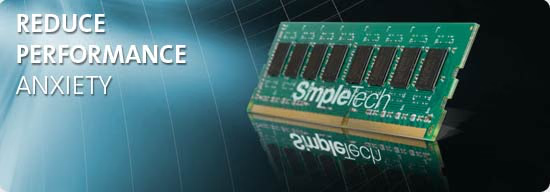
DDR3 starts where DDR2 stops, with speeds as high as 2000MHz. Higher performance with lower power consumption is the major benefit, since operating voltage is only 1.5V for DDR3 compared to 1.8V for DDR2. Lower heat is generated, which means that systems will run cooler. Ultimately the new technology will result in higher capacity modules: Up to 8GB modules (Using 4Gb Chips) to help lower server/workstation system costs.
The Patriot DDR3 1866MHz kit we reviewed not long ago presently holds the record for fastest DDR3 module produced, and the Corsair DDR3 1800MHz kit overclocked to 1900MHz which is simply incredible. But to no surprise the price for this product alone is nearly enough to build a nice computer system. It is for this very reason that system builders have been slow to build off of the DDR3 platform: everything looks expensive. Well, with the Kingston KHX13000D3LLK2/2G kit that doesn't have to be the case.
EDITORS NOTE: Benchmark Reviews has also published the article DDR3 RAM: System Memory Technology Explained
SimpleTech's DDR3 SDRAM is the high-density, high bandwidth memory solution that provides cutting edge technology to transition from DDR2. SimpleTech's world-class engineering, design, test and volume manufacturing expertise provides a complete solution for any system platform.
About the company: SimpleTech/Fabrik
SimpleTech, a Fabrik Inc. company, delivers innovative portable and external backup and storage solutions to consumers and professional users. By blending simplicity, style and function, SimpleTech’s consumer storage solutions have become one of the leading consumer brands on the market today. SimpleTech’s professional storage solutions combine the fastest interfaces available for lightning fast data transfer rates and Fabrik Ultimate Backup for professional grade safety and security.
The company also offers a full line of high-speed memory upgrades including the latest DDR, DDR2, DDR3 and SDRAM technologies that support business and consumer applications including desktops and laptops, consumer electronics, servers, networking and telecommunications. With more than 2,000 memory upgrades, SimpleTech’s easy-to-use Upgrade Navigator ensures you get the right memory for the right solution.

Fabrik's mission is to simplify a user's digital experience whether at home, on the Web or on the road by delivering a blend of online services, software and devices that help consumers store, access, manage, protect and share their growing collections of digital content. The company's online service, www.myfabrik.com, is marketed directly to consumers and through partnerships with global market leaders. Fabrik's line of SimpleTech-branded products include external, portable and network storage solutions as well as full line of memory upgrades for desktops, laptops, servers, printers. For more information, please visit www.fabrik.com.
SimpleTech DDR3 Features
-
Non-ECC, Unbuffered
-
Enhanced low power features and thermal design
-
100% Tested and Verified
-
RoHS Compliant
-
Guaranteed compatible
-
Superior quality premium components
-
Individually tested
-
Easy to install
-
Free and unlimited technical support
-
Lifetime warranty
There's no better way to maximize your computer's performance than with SimpleTech memory. SimpleTech memory products are designed to meet or exceed industry standard specifications as well as those specifications established by the computer and motherboard manufacturers. SimpleTech memory products are manufactured and tested for 100% compatibility.
S1024R5NP2QA Specifications
-
SimpleTech Part #: S1024R5NP2QA
-
UPC: 705487175257
-
1333MHz Speed DDR3
-
2GB kit (2x 128Mx64)
-
SPD: DDR3-1333 CL9-10-10-25 latency
-
Chip Architecture: 64MBx8 IC chips, 128MBx64
-
2x 240-pin DDR3 DIMMs
-
PC3-10600 (10.6 GB/sec)
-
1.5V Voltage Setting
Closer Look: SimpleTech DDR3
While the SimpleTech PC3-10600 S1024R5NP2QA DDR3 1333 kit is packaged for retail sale, the single-module container is more appropriate for upgrade fulfillment and individual SKU placement. SimpleTech is a large player in OEM system building and tier-one manufacturer supplies. With direct RAM supply to manufacturers such as: HP, Gateway, Apple, Dell, Toshiba, Acer, and Sony, the SimpleTech name is more common inside the box than on store shelves. IBM works directly with SimpleTech, which allows SimpleTech DDR to become a directly implemented part in server platform builds.
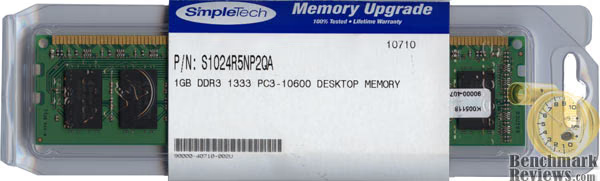
Unlike nearly every other DDR3 kit we have reviewed thus far, the S1024R5NP2QA DDR3 1333 kit is the only product to actually use the JEDEC appointed standards without any additional tweaking. Designed to operate with the 1333MHz SPD specifications CL9-10-10-25, there isn't much room for instability or incompatibility.
Since this is not a high-speed DDR3 component that operates outside of the 1.5V JEDEC specification, SimpleTech has no reason to use a special heat spreader. Some manufacturers such as OCZ set the bar for appearance rather high with their Reaper HPC design, and then lift that bar even higher with their recently announced ReaperX HPC Enhanced Bandwidth DDR3. I must confide a "secret" to you though: the extra cooling is really a waste. I have touched Corsair DDR3 overclocked to 1900MHz while it was running stress tests, and the modules were barely warm if at all.
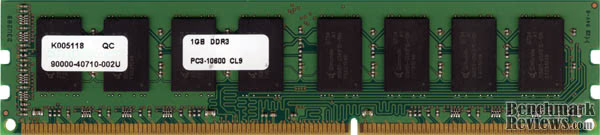
Because SimpleTech has maintained the standard module profile, this kit can fit into any system. The small profile can be especially helpful to system builders, too. In our recent reviews, the larger heatspreaders found on the Winchip 64A0TRHN8G17E, Super Talent W1800UX2GP, and Corsair TWIN3X2048-1800C7DF G kits have found themselves too tall to fit in a full range spectrum of system applications. This translates into higher compatibility for the PC3-10600 S1024R5NP2QA kit in compact computer builds, such as shallow HTPC systems or 1U servers.
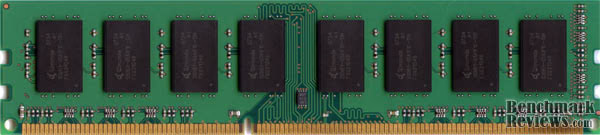
A closer look at the IC's used on the SimpleTech DDR3 module indicate that they are supplied from Qimonda, one of the world's largest IC manufacturers. This particular kit utilizes the Qimonda IDSH51-03A1F1C-13H DRAM part number components, which is certified by Intel for CL9-9-9 operation.
During normal operation, I discovered that the SimpleTech PC3-10600 DDR3 1333MHz system memory kit generated a temperature only a few degrees over the ambient room temperature. Even with the very best DDR2 kits running at a lowly 800MHz, it is nearly impossible to touch the module during normal operation. This drastic reduction in operating temperature is likely the result of the efficient DDR3 process or possibly the very low 1.5V used with this S1024R5NP2QA kit.
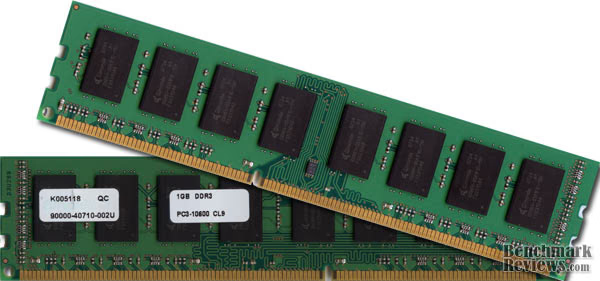
So while the performance is yet to be tested, the appearance is fairly mundane. It certainly appears that the SimpleTech DDR3 part caters directly to the OEM builder who supplies the enterprise product chain. With many of the product applications resting in government contracts and larger corporate industries, SimpleTech can focus on making a product that is functional without fail, instead of a particularly pretty toy for hardware enthusiasts and overclockers.
In the next section, Benchmark Reviews covers the finer points of DDR3 and the changes it brings. The overall progress of this DDR3 series is also updated, along with overclocking results.
DDR3 Comparison Review Progress
Ultimately DDR3 offers a faster design which allows all hardware enthusiasts to take advantage of it. Current high-speed DDR3 memory doesn't offer any benefit when installed into computers running at the stock JEDEC standard speeds of 400 (800), 533 (1066), 666 (1333), and 800 (1600).
Instead, the new generation of DDR3 is meant to avoid a bottleneck between the CPU and the system memory; especially in highly overclocked scenarios. With the high-speed variety of DDR3, which presently includes everything beyond the highest 1333MHz JEDEC standard, you increase the Front Side Bus (FSB) and CPU clock speed without being forced to slow the system memory to remain stable. It should be noted that as of late October 2007 the JEDEC 1600MHz speed is still in draft in standard JESD79-3A, but once finalized high-speed DDR3 will include parts beyond this new speed.
System Memory is labeled with a new generation for each interval of Front Side Bus development. In terms of DDR, or double data rate memory, the first generation was designed for 100 MHz to 200 MHz speeds (DDR-200 to DDR-400). Later, DDR2 arrived and started production at 266 MHz (DDR2-533) and officially ended (by JEDEC standards) at 400 MHz (DDR2-800). This is where DDR3 begins, starting with 533 MHz (DDR-1066), and scale up to 800 MHz (DDR3-1600).
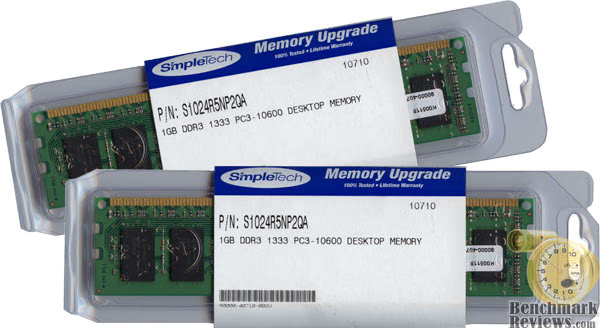
Each generation of DDR is more than just an update to the memory speed, it is also a more technologically advanced production process and a lower operating voltage and better heat dissipation. The previous generation of DDR2 is manufactured on a 110nm node, whereas the new DDR3 has receives a fab process shrink down to a 90nm node (although some use 80nm) with either 55/45nm prepared for later into 2008. Together, this all helps the hardware enthusiast reach higher clock speeds at the expense of higher latencies. This is why the new DDR3 generation of memory needs a significantly higher clock speed deliver better performance than the preceding generation of DDR2 technology.
In additional to the logically progressive changes, there are also improvements made to the architectural design of the memory. One particularly important change introduced with DDR3 is in the prefetch buffer: up from DDR2's four bits to an astounding eight bits per cycle. This translates to a full 100% increase in the prefetch payload; not just a small incremental improvement as there have been in the other area's.
DDR2-400 Memory is equal in performance to DDR-400, which is why it must operate at DDR2-667 speed to carry incentive. The same scenario is true with DDR3 when compared to DDR2. While in theory DDR2-1066 offers the same performance as DDR3-1066, this generally means that DDR3 requires a DDR3-1333 speed to show any benefit over DDR2-800. Memories within the same generation (DDR/DDR2/DDR3) are downwards compatible, meaning that if you have DDR3-1600 RAM, you can configure it to operate at 1066 and 1333 MHz speeds.
Unfortunately, without the proper chipset to support high-speed DDR3 memory, anything beyond DDR3-1333 (the fastest selectable memory multiplier setting with most motherboards) will be relegated to overclocking. Intel has designed the entire 3 Series of motherboards to be DDR3 compatible; but even though the G33, P35, X38, and the upcoming X48 chipsets all support the newer standard they are still encouraging DDR2 support. This is going to be a power struggle between standards until Intel launches yet another new Front Side Bus.
But aren't we forgetting someone? Oh, that's right, Advanced Micro Devices. These days it's almost as if AMD has been late to dinner so often they don't even get a table setting anymore. While little brother (AMD) may have made claims back in 2006 to support DDR3 in their products launched in early 2007, they appear to be eating their words as the move toward the new platform has been stalled until the Q4 2008 when they will likely introduce the 45nm AM3. Which is what brings about the purpose of this article... is it all worth it?
DDR3 Test Products:
One of the nice benefits of owning a computer sales and service company is that I get to have my hands on a whole lot of inventory that I would never purchase for myself. The other benefit is that I get to make contact with many of the top names in the industry, and can often persuade them to lend us product for testing. Over the next several weeks, you can expect to see top-tier names like: Aenenon, Corsair, Crucial, GeIL, Kingston, SimpleTech, Mushkin, OCZ, Patriot, Winchip, and Super Talent in our featured DDR3 reviews for this mega-comparison round-up. The list below is just the beginning...
- A-Data PC3-12800 CL7-7-7-20 AD31600X002GU DDR3 1600MHz 1.75-1.85V 2x1GB RAM Kit
- Aeneon PC3-10666 CL8-8-8-15 AXH760UD00-13GA98X DDR3 1333MHz 1.5V 2x1GB RAM Kit
- Aeneon PC3-12800 CL9-9-9-28 AXH860UD20-16H DDR3 1600MHz 1.5V 2x2GB RAM Kit
- Corsair PC3-14400 CL7-7-7-20 TWIN3X2048-1800C7DF G DDR3 1800MHz 2.0V 2x1GB RAM Kit
- Crucial PC3-12800 CL8-8-8-24 BL2KIT12864BA1608 Ballistix DDR3 1600MHz 1.8V 2x1GB RAM Kit
- GeIL PC3-8500 CL6-6-6-15 G31GB1066C6PDCA DDR3 1066MHz 1.5V 2x512MB RAM Kit
- Kingston PC3-13000 CL7-7-7-20 KHX13000D3LLK2/2G DDR3 1625MHz 1.9V 2x1GB RAM Kit
- Mushkin PC3-10666 CL6-7-6-18 HP3-10666 DDR3 1333MHz 1.8V 1GBx2 RAM Kit
- OCZ PC3-12800 CL7-7-7-24 OCZ3P16002GK Platinum Series DDR3 1600MHz 1.9V 2x1GB RAM Kit
- Patriot PC3-15000 CL8-8-8-24 PDC32G1866LLK DDR3 1866MHz 1.9V 2x1GB RAM Kit
- Qimonda PC3-8500 CL7-7-7-20 Aeneon AEH760UD00-10FA98X DDR3 1066MHz 1.5V 2x1GB RAM Kit
- SimpleTech PC3-10600 S1024R5NP2QA DDR3 1333MHz 2x1GB RAM Kit
- Super Talent PC3-14400 CL7-7-7-20 W1800UX2GP DDR3 1800MHz 2.0V 2x1GB RAM Kit
- Winchip PC3-10666 CL8-8-8-15 64A0TRHN8G17E DDR3 1333MHz 1.65V 2x1GB RAM Kit
This review focuses on the SimpleTech PC3-10600 S1024R5NP2QA DDR3 1333MHz CL9 2x1GB RAM kit, but as soon as the individual series of reviews have been completed I will address the collective conclusions in a single finale article. The comparison results displayed below are updated in real time as they are completed.
Test System
-
Motherboard: ASUS P5K3 Deluxe (Intel P35 chipset) with BIOS 810 (11/02/2007)
-
Processor: Intel E6550 Core 2 Duo 2.33GHz with 1333MHz Front Side Bus
-
Video: FOXCONN GeForce 8800 GTS 640MB overclocked to 600MHz Core / 900MHz RAM
-
Hard Disk 1: Western Digital WD360GD 10,000 RPM SATA
-
Optical Drive: Toshiba Samsung SH-S203 SATA 20x DVD R/W
-
Enclosure: Antec P182 Performance One ATX Case with 2x120mm cooling fans
-
Operating System: Windows XP Professional SP-2 (optimized to 16 processes at idle)
Testing Methodology: DDR3 RAM
Before the testing really begins, there are several settings to be adjusted in the BIOS. Many combinations of the CPU's front side bus are matched to a specific memory multiplier, giving us the desired RAM (and CPU) operating speed. When high-speed DDR3 is tested, a 1:1 memory multiplier is combined with the highest CPU front side bus speed available to obtain baseline readings; the fastest FSB is presently 1333MHz found in select Intel Conroe and Kentsfield series desktop processors. When I first begin this process and start benchmarking for a baseline, the memory voltage and timing are always left at the manufacturer's default values.

After each and every change to the BIOS, the system is restarted and all RAM modules are automatically tested with MemTest86+ for one full pass. Since the modules are not yet overclocked, one pass is usually sufficient to determine if a bad part exists. Later, once I begin to overclock the memory, these tests are a good way of quickly pre-screening stable configurations. Once the test pass is complete, I move onto the synthetic benchmark tests. Here at Benchmark Reviews we use the following test suites and applications:
-
SiSoft Sandra Lite v2008.1.12.34
-
Lavalys EVEREST v4.20.1170
-
Passmark Performance Test v6.01.1001
-
RightMark Memory Analyzer v3.72
-
World in Conflict v1.0.0.5 (Build 85)
After all of the tests have been performed at the default memory clock speed (or highest JEDEC standard), which establishes the baseline reading for our comparisons, I then increase the front side bus to overclock the RAM without adding any additional voltage. My theory is this: a module that overclocks without additional voltage is going to perform better than a module which requires you to potentially damage it or void the warranty. Another way of looking at this is that if a module overclocks well without added voltage, it is likely that there will be more headroom if additional voltage is applied.
I am fully aware that many sites turn up the voltage and apply dangerous amounts of power to the modules so that they can unlock that last megahertz; but if I begin down that road where will it end? Do I then start writing reviews where I apply liquid nitrogen cooling to the RAM? Do I volt-mod the motherboard and apply so much power I ruin expensive parts and equipment? In the end, I decided that overclocking will be done at the stock voltage for benchmarks, because I believe most enthusiasts are going to aim for the same goal. If on some rare occasion I determine that adding voltage would potentially return large performance gains, then I will add up to 0.2V to the default volt rating.
In each synthetic benchmark test Windows XP was booted fresh and the application was opened. Task manager was then utilized to end the explorer.exe (Windows) process so that only the most essential services were running and a trim 16 processes total were consuming system memory. This procedure allowed the RAM to be as isolated as possible for our testing. Once the system was ready, I performed a single test-run of the benchmark, followed by three recorded tests. At the end of the series, I averaged the three results for the final score.
Sometimes it is very difficult to get broad results between the memory modules tested, so we use several different speeds of memory from participating manufacturers. Benchmark Reviews is very serious about performance, which is why we test the products against as many benchmarks as reasonably possible. Not every test suite is effective in these reviews, and some often calculate processor and other system components into the score. This is what makes a RAM review difficult: unless all of the modules compared have the exact same rating and the CPU operates at the exact same speed for each and every test, the comparison is always going to be subjective.
Test Results: S1024R5NP2QA
Testing RAM is a subject which requires a bit of technical knowledge. I have recently found a few other sites using nothing except video games to benchmark the RAM product they are reviewing, and this whole practice made no sense at all to me. Video games are GPU and CPU dependant, and RAM has a very small impact on framerate performance - as I will prove to you in my own tests. So keeping all of this in mind, I use the tools that belong in a system memory review; I use system memory tests for my benchmarks. Additionally, I don't spend three (usually tiny) pages discussing how I overclocked or how I made it to tighter timings. Every memory module comes with its very own limit, so one size doesn't fit all and this kit may not be the same as the next.
As it turned out, the SimpleTech PC3-10600 S1024R5NP2QA DDR3 1333MHz CL9 2x1GB RAM kit could overclock to from 1333MHz to an a mere 1421MHz without adding any additional voltage. Throughout our testing, we used the CL9-9-9-24 memory latency settings. Keep in mind that the default memory voltage is only 1.5V for this RAM, which means that there still plenty of room left over for any safe voltage increases.
Our first results were recorded from Lavalys EVEREST using the Cache and Memory Benchmark tool. The results shown below represent the average measurement obtained from the Aeneon AEH760UD00-10FA98X DDR3 kit at 1066MHz. After testing the default speed, I then installed the SimpleTech PC3-10600 kit at the 1:1 RAM-to-CPU multiplier of 1333MHz and the front side bus set to 333MHz to produce 1333MHz RAM. After the baselone tests are done, this kit is overclocked to a speed of 1421MHz with a 355MHz FSB. The results for the average read, write, and copy bandwidth from EVEREST are displayed below.
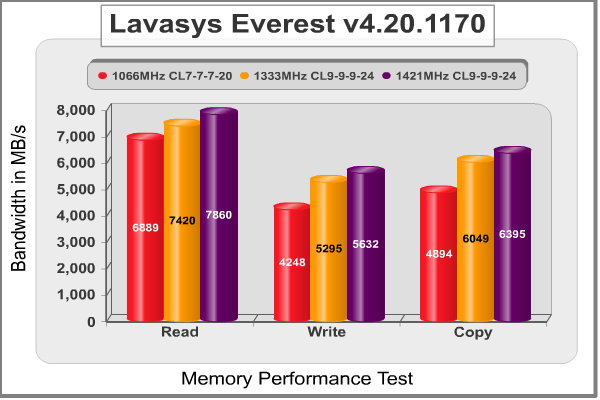
Everest is among my most trusted benchmark programs, and the Cache and Benchmark tool is one of the more reliable in terms of consistent results. The chart above shows that the extra 88MHz over the stock 1333MHz speed amounted to a marginal increase in added bandwidth; the most notable improvement is over the baseline reading was the read bandwidth, which improved by nearly 6%.
With both CPU-Z and EVEREST reporting memory clocks at CL9-9-9-24, I will believe that the ASUS P5K3 BIOS settings were configured correctly.
Next up was the PassMark Performance Test benchmark which runs several different system memory tests in a row. Although some of the tests are specific to the performance of the RAM, others take the CPU clock speed and front side bus into account when developing a score. Most important are the memory read and write tests, and the score based tests are bias towards CPU speed and other hardware factors.

Passmark's Performance Test offers the most consistent memory test results of the entire group, with each of the test runs resulting in a score nearly identical to the previous test run. Ideally, all of these programs should be this consistent, but until they are I would consider Performance Test to be the best tool available for testing system memory bandwidth.
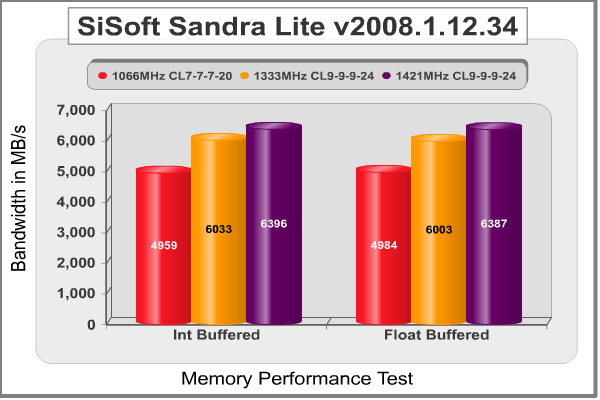
SiSoftware Sandra Lite XIIc offered identical results nearly the same in regards to increased performance; according to the chart above. Although the bandwidth tests are of a different nature, the improvement from 1333MHz to 1421MHz still resulted in nearly 6% in both the integer bandwidth and float buffered tests.
The last of our memory testing applications to run is RightMark Memory Analyzer. This program may not offer the same level of consistent test results that Performance Test does, but instead it offers a more technical approach to testing the system memory. Plus, this is a Benchmark Reviews favorite - because it's free.

RightMark Memory Analyzer offer nearly the same tests that EVEREST and Performance Test have, and could be considered a bit redundant, but then again this is a technology article and us geeks like our redundancy. While it's true that Memory Analyzer hasn't been updated in over a year and seems out of development, it's still not a bad tool since it gives the second most consistent results every single run (unlike Sandra). It also offers an average "real" RAM read and write bandwidth result which most enthusiasts don't appreciate because it combines the results of dozens of tests. This is the layman's alternative to the Sciencemark v2.0 test suite, which is also gone but not forgotten.
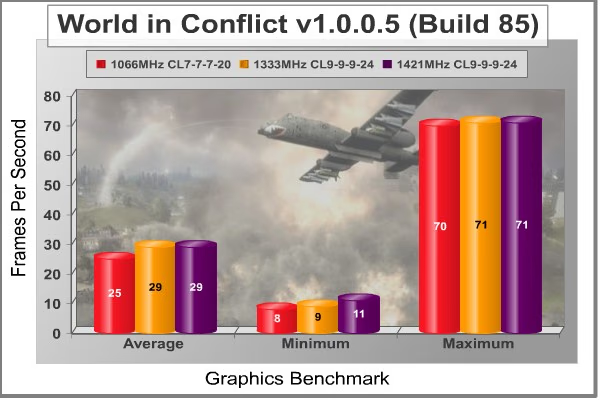
Finally, I tested with the memory multiplier set at 1:1 for 1333MHz and then later overclocked the RAM to 1421MHz for the game World in Conflict. Realizing that games can be either CPU or GPU bound, this made it difficult for me to compare all of the memory sets since the clock speed of the processor would change as I adjust the front side bus for the desired RAM speed. In the end a 88MHz system memory improvement over the 1333MHz setting gave the framerate in World in Conflict only 2 FPS more in the minimum framerate. This mediocre improvement is evidence of how insignificant the system memory speed is in relation to video game performance.
Final Thoughts
SimpleTech isn't trying to cater their product to the enthusiast crowd, like every other manufacturer we have tested in our High-Speed DDR3 Overclocking and Review Series. Instead, SimpleTech looks for the bigger fish which reside in the enterprise sector of the industry. Compound this to the fact that Fabrik is free to choose their DRAM partner (presently Qimonda, and you can see the versatility they have within the market. This isn't such a bad move really, because in all practicality they are now less likely to suffer from the unnecessarily-early adoption of DDR3 by Intel.
Fresh with two more chipsets in Q1 2008, Intel repeats it's previous innovations with virtual clones of the last generation. Taken to task, they seem to have avoided the DDR3 standard which they helped pioneer and develop as well as push onto the industry. Their overzealous move to create and promote a new standard and then issue four generations of chipsets which do not adhere to that standard have actually started to hurt add-in partners like OCZ, Super Talent, Patriot, Mushkin and Corsair. Perhaps by the time Intel releases the P55 chipset, which could be as soon as Q3 2008 if they follow their present pace, DDR3 will be the only DRAM supported... which seems incremental enough to issue a new chipset these days.
Some of the faster kits we reviewed won't appeal to system builders and casual users like this SimpleTech kit will. Primarily purposed for "vanilla" workstation and server systems, you can expect to find this product to be a very stable RAM components in new DDR3 systems.
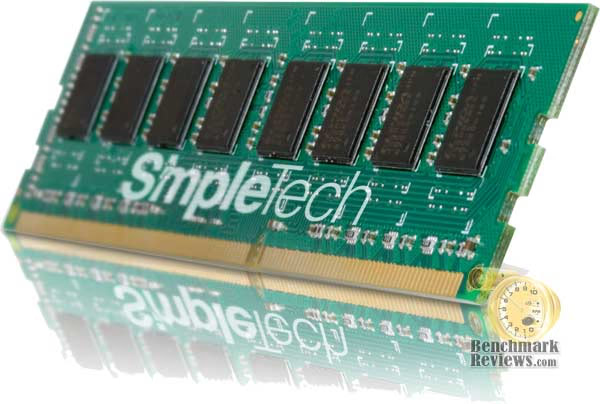
All SimpleTech memory modules come with a lifetime warranty backed by SimpleTech's reputation for quality and support. These DDR3 modules are manufactured with a lead-free and RoHS-compliant manufacturing process by Qimonda, which is part of Fabrik's commitment to provide environmental-friendly solutions to the market.
SimpleTech S1024R5NP2QA Conclusion
Since beginning this DDR3 series, the former presentation rating has been replaced with a new performance score. In our system memory reviews, we offer this score to represent the overclocking potential and memory timing capability of the product tested. The SimpleTech PC3-10600 S1024R5NP2QA DDR3 1333MHz RAM successfully overclocked to a stable 1421MHz while maintaining CL9-9-9-24 timings at 1.5 volts. While this system memory is probably not going to be used in systems which allow overclocking, it's good to know it has some headroom.
In regards to the product appearance rating, I find it difficult to ignore that this in one of only two DDR3 products tested that doesn't incorporate some kind of cooling enhancement. Heatspreaders are standard equipment on just about everything anymore; even if the module runs so cool it doesn't need it. So with respect to the very low operating temperature of the S1024R5NP2QA kit, I can be somewhat lenient and forgive the missing add-on. Nevertheless, it would have still been possible for SimpleTech to use a unique color in their PCB; something red, blue, or even orange.
With regard to product construction, SimpleTech's PC3-10600 S1024R5NP2QA kit offers very little additional durability because it lacks IC protection. With no heatspreader to cover the IC's, these modules are very delicate and extremely susceptible to electrical static and handling damage. With no PCB protection, the IC chips could come into direct contact with something that might damage them if they are ever dropped or bumped with a sharp object (such as a tool). This DDR3 system memory will not survive abuse, so I still recommend static protection and careful handling at all times.
Functionality is something that SimpleTech can guarantee with the S1024R5NP2QA DDR3 module. Designed for corporate environment, these modules must simply be reliable and efficient; and they do both very well. Although you would squeeze high-performance bandwidth from them, they certainly offer stability beyond other products designed for gamers and overclockers.
Because DDR3 is still very much a new standard to the industry, pricing has not been as discounted as you see with DDR2. I explained earlier how manufacturers have dropped DDR2 retail prices to match production costs, if only to help dodge the depreciation of a fabrication factory with a looming expiration date. This leaves DDR3 with a price slightly higher than cost, which appears expensive in comparison. At this early stage of introduction, the SimpleTech PC3-10600 DDR3 1333MHz CL9 RAM is listed for sale by only a limited number of online retailers. Since the S1024R5NP2QA part contains a single DRAM module, two products were combined to create a 2GB kit for testing; which would presently cost $463... hardly a bargain compared to the other kits we have tested.
In conclusion, I find it very difficult to recommend the SimpleTech PC3-10600 S1024R5NP2QA DDR3 1333MHz CL9 RAM. While SimpleTech has the benefit of listing this item for GSA contract purchase by the US Government and other Federal institutions operated by tax dollars, it is unnerving to see such a low-performance module sold at a price higher than almost every other competing product available. This module will offer hardware enthusiasts and overclockers nearly no incentive at all, yet it may still be an attractive OEM solution for enterprise system builders.
Pros:
+ Guaranteed system compatibility
+ Memory overclocks to 1421MHz at default voltage and timing
+ Lifetime Product Warranty
+ Reasonably affordable early adoption pricing
+ Standard module profile offers multi-platform compatibility
+ Very cool running DIMM's at 1.5V
Cons:
- Poor product value
- Only 88MHz of memory overclocking headroom
- Not a XMP ready memory kit
- Generic appearance
- Very high latency memory
Ratings:
-
Performance: 8.00
-
Appearance: 6.00
-
Construction: 7.00
-
Functionality: 8.00
-
Value: 5.75
Final Score: 6.95 out of 10.
Questions? Comments? Benchmark Reviews really wants your feedback. We invite you to leave your remarks in our Discussion Forum.
EDITORS NOTE: Benchmark Reviews has also published the article DDR3 RAM: System Memory Technology Explained