
OCZ Reaper HPC PC2-9200 DDR2 1150MHz RAM Kit
OCZ Reaper HPC DDR2
Ever since Intel released the 3 series chipset, DDR2 has had the wind taken from its sails so that DDR3 could make waves. This was meant with the best intentions, but as DDR3 was released to the public it didn't take long for people to realize it was still too immature to compete against DDR2 in regards to performance. This put the weight of the world back on the shoulders of DDR2, which has just earned a reprieve from execution. But now that manufacturers are tooling up for DDR3 production, there are only a few names remaining on the shrinking list which are still releasing high-performance system memory for the DDR2 platform. OCZ recognizes that DDR2 has performance potential left in it, and offers the 1150MHz PC2-9200 2GB Reaper HPC OCZ2RPR11502GK DDR2 RAM Kit to Benchmark Reviews for testing.

The Reaper HPC is an innovative patent-pending cooling solution developed by OCZ to effectively minimize heat produced by high-speed memory. As heat rises into the thermo-conductive copper heat pipe conduit, it is dissipated through the strategically-placed compact aluminum fin array. By guiding performance-robbing heat away from key memory components, the unique Reaper HPC design helps facilitate improved overclocking performance, while improving longevity and stability of the modules.
The first modules to be incorporated with the new Reaper heatsink are rated at 1150MHz and run at CL 5-5-5. As part of OCZ’s line-up of premium memory, PC2-9200 modules are backed by a Lifetime Warranty and industry-leading technical support.
The Reaper HPC series uses heat pipe technology to rapidly remove heat from the main body of the memory modules and conduct the thermal load to the extended radiator fin array. The addition of the extended fin array nearly doubles the total surface area available for heat dissipation while the heat pipes warrant near isothermicity throughout the entire design. The result is a doubling in effective heat dissipation at equal delta t or, in real systems, a significantly lower operating temperature of the memory modules.

OCZ EVP (Extended Voltage Protection) is a feature that allows performance enthusiasts to use a VDIMM of 2.35V without invalidating their OCZ Lifetime Warranty.
About the company: OCZ Technology
Entering the memory market in August 2000, OCZ Technology was built around the determination to manufacture the best high speed DDR and RDRAM. OCZ was founded by enthusiasts, for enthusiasts, and their commitment to the end-user has not digressed. OCZ Technology has been an innovator in many areas.
We were the first manufacturer to make Dual Channel optimized memory available to the public, which originally took advantage of nVidia's Twinbank or Dual DDR architecture, found in their nForce chipset. We have now taken that technology and tailored it for the Canterwood, and Granite Bay chipset's. OCZ developed and was the first to implement ULN technology, which has been a critical element in the manufacturing process for some time.
We at OCZ diligently work to improve communication with CPU and motherboard chipset manufacturers prior to the release of their products. Only in this manner can we fine-tune the memory's SPD settings, ensuring a synergistic relationship between the memory module, memory controller, and microprocessor. In today's rapidly evolving semiconductor industry, such communication is not simply research, but a necessary component of the manufacturing process.

OCZ2RPR11502GK Features
-
Patent-pending Reaper HPC Heatsink
-
2.35V EVP
-
EPP-Ready (Enhanced Performance Profiles) setting is rated at 1142MHz
OCZ Specifications
OCZ Reaper HPC PC2-9200 DDR2 1150MHz RAM Kit OCZ2RPR11502GK
-
1150MHz DDR2
-
CL 5-5-5-18
-
Detailed Settings:
-
i965 Chipset: CAS 5, TRDC 5, TRP 5, TRAS 18, TWR 6, TRRC 42, TRRD 11, TRTR 11, TRTP 11, TWTP 11
-
i680 Chipset: CAS 5, TRDC 5, TRP 5, TRAS 18, TRRD 6, TRC 33, TWR 6, TWTR 11, TREF 3.9
-
-
Available in 2GB (2x1024) Dual Channel Kits Unbuffered
-
OCZ Lifetime Warranty
-
2.3 Volts
-
240 Pin DIMM
Closer Look: OCZ Reaper HPC
Most RAM modules aren't worth spending the time discussing their looks. But then again OCZ isn't like most manufacturers; they have designed the Reaper HPC series with something different in mind. Operating at 2.3V means that this 1150MHz DDR2 RAM (Kit OCZ2RPR11502GK) is naturally going to have some heat build-up, and they want to handle it before it causes a problem.
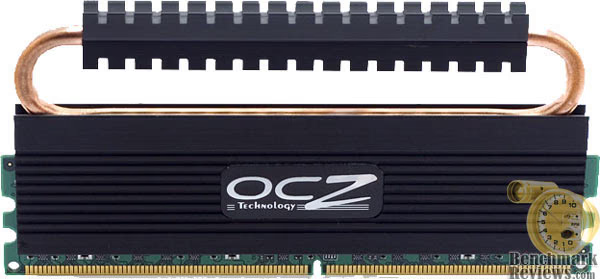
The industry doesn't have too many PC2-9200 DDR2 1150MHz RAM kits, primarily because of the odd clock speed (although the true EPP speed is 1142MHz). It seems as if almost everyone aims for a speed consistent with Intel's front side bus, or some multiplier thereof when they market their product.

Within each heat-spreader of the OCZ Reaper HPC module lies a single copper heatpipe rod. This rod utilizes an inner-wall powder coating for wicking away the liquid element, allowing the cool liquid formed from heated vapor to run back down the pipe.
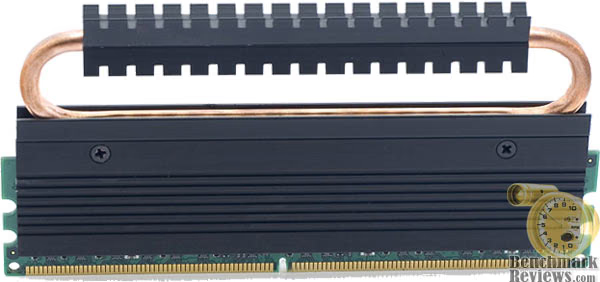
Atop each of the PC2-9200 DDR2 1150MHz OCZ Reaper HPC RAM modules in the OCZ2RPR11502GK kit is an aluminum alloy heatsink. Upon close inspection, I think that OCZ could have better designed the heatpipe by raising an apex point in the center and utilized the open inner space for a larger heatsink. Hopefully the Reaper kit is never pushed with so much voltage that this design becomes inadequate.
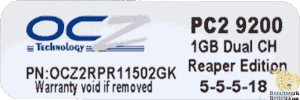
The image above is the product label attached to the packaging. OCZ asserts that Reaper HPC PC2-9200 can reach DDR2 speeds of 1150MHz with timings of 5-5-5-18. We'll see about that. Just reaching 1150MHz alone means either over- or under-clocking is required, because this speed is not a result of natural FSB and memory multiplier combinations. Using the EPP you would need to set the RAM to operate at 571MHz, which means a 286MHz FSB to most.
Testing Methodology: DDR2 RAM
Before the testing really begins, there are several settings we adjust in the BIOS. Many combinations of the CPU's front side bus are matched to a specific memory multiplier, giving us the desired RAM (and CPU) operating speed. This is important because I have learned that a module set to 3.33 multiplier with a 344MHz FSB will fail every test, but that same module set to a 3.2 multiplier with 357MHz FSB will run stable all day. When we begin this process and begin benchmarking for a baseline reading, the memory voltage and clock speed is always left at the manufacturer's default values. However, later into the testing I may (rarely) decide to raise the voltage if it looks like it will allow me to reach higher overclocked speeds.
After each and every change to the BIOS, the system is restarted and all RAM modules are automatically tested with MemTest86+ for one full pass. Since the modules are not overclocked, one pass is usually sufficient to determine if a bad part exists. Later, once I begin to overclock the memory, these tests are a good way of quickly pre-screening stable configurations. Once the test pass is complete, I move onto the synthetic benchmark tests. Here at Benchmark Reviews we use the following test suites and applications:
-
SiSoft Sandra Lite v2008.1.12.34
-
Lavalys EVEREST v4.00.976
-
Passmark Performance Test v6.01.1001
-
World in Conflict v1.0.0.1 (Build 81)
After all of the tests have been performed at the default memory clock speeds, which establishes the baseline reading for our comparisons, I then increase the front side bus to overclock the RAM without adding any additional voltage. My theory is this: a module that will overclock without additional voltage is going to perform better than a module which requires you to potentially damage it or void the warranty. I am fully aware that many sites turn up the voltage and apply dangerous amounts of power to the modules so that they can unlock that last megahertz; but if I begin down that road where will it end? Do I then start writing reviews where I apply liquid nitrogen cooling to the RAM? Do I volt-mod the motherboard and apply so much power I ruin expensive parts and equipment? In the end, I decided that overclocking will be done at the stock voltage for benchmarks, because I believe most enthusiasts are going to aim for the same goal. If at some point I feel like adding voltage would potentially return performance gains, then I will add up to 0.2V to the default volt rating.

In each synthetic benchmark test Windows XP was booted fresh and the application was opened. Task manager was then utilized to end the explorer.exe (Windows) process so that only the most essential services were running and a trim 16 processes total were consuming system memory. This procedure allowed the RAM to be as isolated as possible for our testing.
Test System
- Motherboard: Gigabyte GA-P35C-DS3R (Intel P35 chipset) with F4 (07/09/2007) BIOS
- Processor: Intel E6550 Core 2 Duo 2.33GHz 1333MHz Front Side Bus
- Cooling: OCZ Vendetta Exposed HDT CPU Cooler
- Video: FOXCONN GeForce 8800 GTS 640MB overclocked to 600MHz Core / 900MHz RAM
- Audio: HT OMEGA CLARO 7.1 Channel 24-bit 192KHz PCI Sound Card
- Hard Disk 1: Western Digital WD360GD 10,000 RPM SATA
- Optical Drive: Toshiba Samsung SH-S203 SATA 20x DVD R/W
- Enclosure: Cooler Master Cosmos RC-1000 Mid-Tower ATX Case with 3x120mm cooling fans
- PSU: OCZ ModXStream 780W Modular PSU OCZ780MXS
- Operating System: Windows XP Professional SP-2 (optimized to 16 processes at idle)
Test Products:
-
OCZ PC2-9200 CL 5-5-5-18 Reaper HPC OCZ2RPR11502GK DDR2 1150MHz RAM Kit (Featured Product)
Sometimes it is very difficult to get broad results between the memory modules tested, so we use several different speeds of memory from participating manufacturers. Benchmark Reviews is very serious about performance, which is why we test the products against as many benchmarks as reasonably possible. Not every test suite is effective in these reviews, and some often calculate processor and other system components into the score. This is what makes a RAM review difficult: unless all of the modules compared have the exact same rating and the CPU operates at the exact same speed for each and every test, the comparison is always going to be subjective.
OCZ2RPR11502GK Test Results
I am going to begin this section by stating that the OCZ Reaper HPC OCZ2RPR11502GK memory kit is not going to be something system builders and casual users should purchase for vanilla systems. Not to sound like an OCZ salesman, but one visit to their website and you will discover that they make a memory kit for every single application imaginable. Seriously, with well over fifty different SKU's I think there's a perfect match for every system. The Reaper series however is for the overclocker, enthusiast, and anyone else who wants to modify settings. I say this because of one simple fact: you cannot reach 1150MHz without changing something in your BIOS.
As it turned out, this Reaper HPC DDR2 1150MHz RAM kit could overclock to 1178MHz without adding additional voltage. This isn't much in the big scheme of things, but it's worth noting that I spent a few days trying to reach farther but nothing ever tested completely stable regardless of voltage. Keep in mind that the default memory voltage for this kit is already 2.3V, and OCZ maintains that the warranty is safe up to 2.35V. So basically, you can add a whopping 0.05V and be safe. Unfortunately, none of the DDR-2 motherboards I have available to me offer RAM voltage increments in less than 0.1V steps. After checking with OCZ, there are a few in existence: the abit IP35 Pro, EVGA 680i, ASUS P5B-Deluxe and P5K-Deluxe, none of which I have on hand or will ever own since DDR-3 is the new standard. What I do have is the abit AB9 Pro (i965) and the Gigabyte GA-P35C-DS3R (P35), and they both work in 0.1V increments. So anyways...
Our first results were recorded from Lavalys EVEREST using the cache and memory benchmark tools. The results shown below represent the average measurement obtained from the OCZ PC2-9200 CL 5-5-5-18 Reaper HPC OCZ2RPR11502GK DDR2 1150MHz RAM Kit while overclocked to 1178MHz.

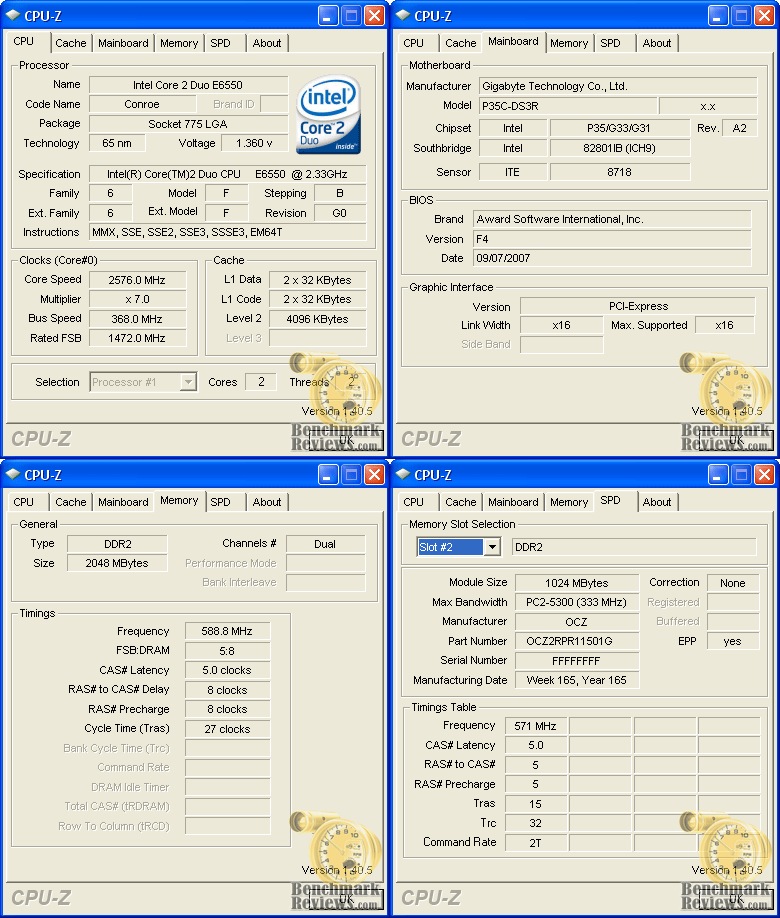
With both CPU-Z and EVEREST reporting memory clocks at 5-8-8-27, it's a safe bet they are correct. While OCZ rates the Reaper with 5-5-5-18, I have discovered that my Gigabyte GA-P35C-DS3R motherboard is not the best tool for uber-tweakers because it lacks the ability to manually adjust memory strobe timing. Too bad, because the ASUS P5K3 DELUXE I am prepping to replace it does. I also noticed that the Gigabyte GA-P35C-DS3R BIOS did not pick up an Enhanced Performance Profile (EPP) for some reason, as it had done with the Aeneon Xtune PC2-8500 CL5 1066MHz DDR2 RAM Kit I just reviewed. I suppose the serious hardware enthusiast would prefer to climb around the BIOS and custom set these parameters, but nothing makes me happier than hardware that does exactly what it's supposed to do.
Next up was the PassMark PerformanceTest benchmark which runs several different system memory tests in a row. Although some of the tests are specific to the performance of the RAM, others take the CPU clock speed and front side bus into account when developing a score. Most important are the memory read and write tests. In all honesty, I dislike this test because of the external bias it gives attached hardware, but the memory results are still worth noting.
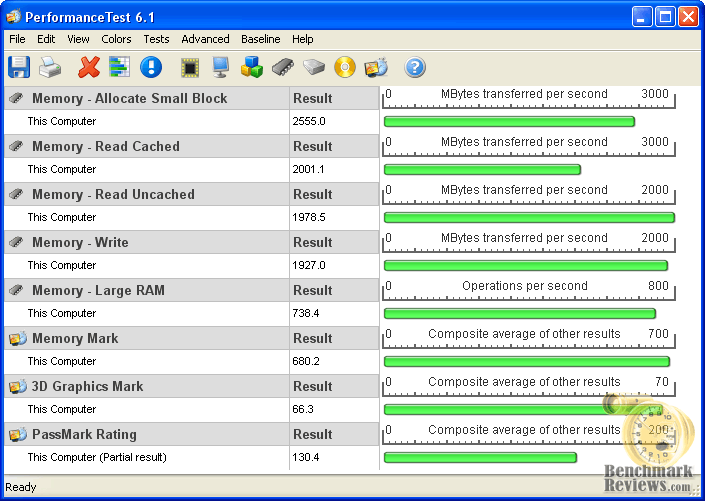
It's also very important that I note how the scores will always be relative to the system components used. For example, PerformanceTest recorded 680.2 Memory Mark points to the OCZ Reaper running at 1278MHz and the Intel E6550 operating at 2576MHz. Conversely, this same program gave the Aeneon Xtune PC2-8500 a score of 670.5 Memory Mark points with the Gigabyte GA-P35C-DS3R motherboard and E6600 @ 2.7GHz., and yet just a few months ago I reviewed the Crucial PC2-8500 CL5 Ballistix DDR2 RAM and it scored 837 Memory Mark points with the Intel P865-based abit AB9-Pro with E6600 operating at 3.2GHz. Obviously the CPU and system board have a lot more to do with Memory Mark points than the actual memory, which is why "score" based tests are often less useful than benchmark readings. Eventually I will probably dump this program, or at least remove everything but the memory specific readings from the image.
During my bandwidth tests with Lavalys EVEREST v4.00.976 I discovered that each round of test results were not very consistent. For practical purposes, I ran the test series three times and averaged the results in the chart. The results for the average read, write, and copy bandwidth from EVEREST are displayed below.
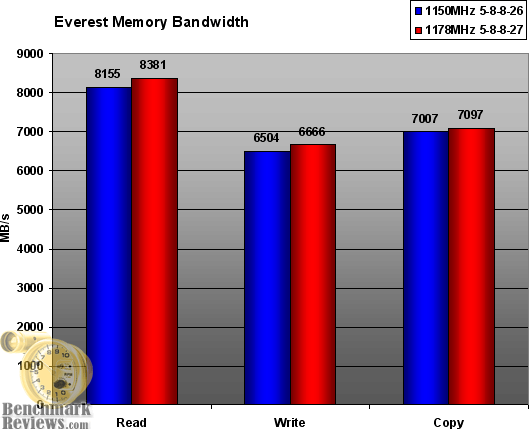
The average read test showed a 2.8% improvement of 226MB/s when the OCZ Reaper HPC was overclocked from 1150MHz to 1178MHz. In the average write bandwidth tests, the overclock yielded a 2.5% improvement of 162MB/s. The 28MHz (2.4%) overclock doesn't seem like much of a difference, and the copy bandwidth test seemed to agree.
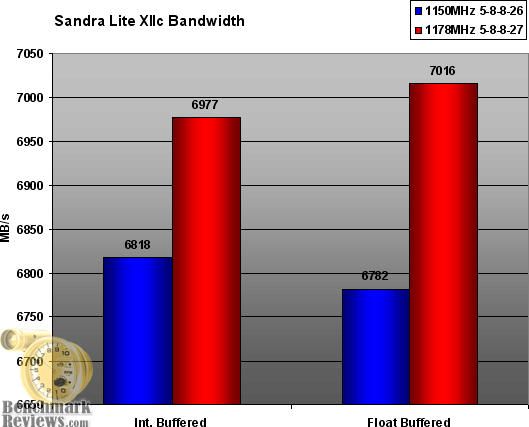
SiSoftware Sandra Lite XIIc saw things a little differently; or at least the chart below really makes it look that way. Although a 2.3% benefit given to the overclocked Reaper RAM with 159MB/s in the integer bandwidth test, the float buffered test gives a 3.5% benefit of 234MB/s.
RightMark Memory Analyzer was removed from our results, since the tests were more than a little redundant. I think that in future memory reviews, namely our upcoming DDR3 mega-roundup, I will try to replace one of the other tests with the results of Memory Analyzer. It hasn't been updated in over a year and seems out of development, but it's still not a bad tool since it gives consistent results every single run (unlike EVEREST and Sandra). It offers an average "real" RAM read and write bandwidth result which most enthusiasts don't appreciate because it combines the results of dozens of tests. This is the layman's alternative to the Sciencemark v2.0 test suite, which is also gone but not forgotten.
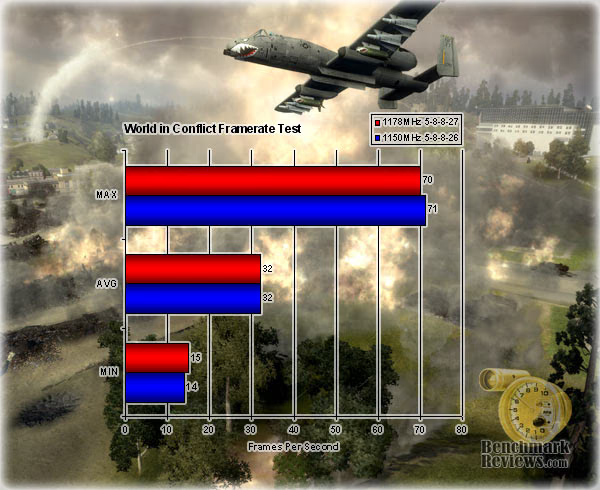
We also tested the stock settings against the overclocked settings in the game World in Conflict, but realizing that games can be both CPU and GPU bound made it difficult to compare the different memory sets since the clock speed of the processor would change with the front side bus. For what it's worth, World in Conflict did register a full 1 FPS difference in the minimum and maximum frame rates. Obviously, if you are using 1150/1178MHz DDR2 RAM, you aren't going to keep the CPU at the stock speed, and you probably use a video card that more than makes up for the small gains of overclocked system memory. But in the world of benchmarks, it would make comparing the difference in a game somewhat pointless.
Final Thoughts
When it comes down to it, OCZ doesn't make memory... they make it better. The handily combined the Kunyu Tech model KO-8046 PCB with Micron D9GMH IC modules, and presto: the Reaper HPC OCZ2RPR11502GK DDR2 1150MHz RAM kit is born. We recently reviewed the Winchip DDR2 1200MHz PC2-9600 2GB RAM which was the fastest DDR2 kit we had tested, but it had no overclocking potential and ran as hot as a blowtorch. It seems that OCZ has mixed the ingredients carefully and the finished result is a highly affordable enthusiast-grade performance DDR2 solution.

OCZ Reaper Conclusion
Sold in a well-designed and very informative blister pack, the OCZ OCZ2RPR11502GK kit gives the consumer more than enough data to make an informed buying decision. The presentation, like most all OCZ products, is top notch. Many readers probably wonder why we even rate the presentation, but when you see a manufacturer offering product with plenty of visible data and alluring artwork and compare it to another offering nothing but a logo, you begin to understand why we do it.
In regards to the product appearance, I can't honestly think of another RAM module or kit which features copper heatpipe cooling. Someone let me know if there is, but for as far as I can research OCZ is the pioneer. And let's face it, heatpipes are hot, in their own brilliantly-shiny copper-sexy way.
With aluminum alloy construction in the heat-spreaders and heatpipe heatsink, this is one rugged product. While I would hope that these module never see harsh handling, they are build strong enough to withstand it. One additional benefit of the heatpipe is that it acts as a very handy tool for installing these modules into the DIMM slots.
Functionality is a bit mixed. With a mere 28MHz (2.4%) overclock at native voltage, there isn't a lot of headroom. Even when I pushed the Reaper HPC kit to 2.6V, which was well beyond the warranty rated 2.35V, I couldn't get much more than 1226MHz worth of instability. Sure, it's good up to 1178MHz, and that's pretty amazing, but all that extra cooling should have made a larger impact.
I initially did a little price shopping and found the OCZ OCZ2RPR11502GK kit for under $220. But for some reason PriceGrabber didn't list the largest computer hardware e-tailer in America, so I wend directly to the source. To my surprise, the Reaper HPC PC2-9200 DDR2 1150MHz RAM Kit is listed at NewEgg for only $205.99. With the astronomical price of DDR3, it looks like there may still be some serious value left in the DDR2 market.
In conclusion, the OCZ Reaper HPC PC2-9200 DDR2 1150MHz RAM kit offers hardware enthusiasts a great value at 5.72MHz/$1.00. The overclock is not going to set records, but if you are willing to assign an Enhanced Performance Profile you can still take advantage of low latency and tighter timings. Additionally, if you are the extreme overclocking type, the copper heatpipe cooling system is going to open some doors to over-voltage cooling that don't exist anywhere else.
Pros:
+ Copper heatpipe cooling
+ 28MHz/2.4% native voltage overclock
+ Lifetime warranty
+ Great high-end value
+ Averaged 8381MB/s Read bandwidth
+ Extremely durable construction
+ Attractive design and finish
+ Runs cool at 2.3V
Cons:
- Doesn't overclock very high despite added voltage
- Not for compact installations and certain CPU coolers
Ratings:
-
Presentation: 9.0
-
Appearance: 9.5
-
Construction: 9.5
-
Functionality: 9.5
-
Value: 8.25
Final Score: 9.15 out of 10.
Excellence Achievement: Benchmark Reviews Golden Tachometer Award.
Questions? Comments? Benchmark Reviews really wants your feedback. We invite you to leave your remarks in our Discussion Forum.