
Kingston HyperX Genesis 16GB DDR3-2133
Kingston HyperX Genesis 16GB DDR3-2133 Memory
Manufacturer: Kingston Technology
Product Name: HyperX Genesis DDR3-2133 Memory Kit
Model Number: KHX2133C11D3K4/16GX
Price As Tested: $318.00 (Amazon)
Full Disclosure: The product sample used in this article has been provided by Kingston Technology.
With the introduction of Intel's X79 Express chipset, enthusiasts must now consider quad-channel memory kits, and vendors like Kingston are rushing to assert themselves in this new market. Pushing 4GB DDR3 modules to a very high 2133MHz frequency, Kingston's new KHX2133C11D3K4 kit offers 16GB of high-performance memory for your new LGA 2011 rig. Benchmark Reviews runs it through our test suite to see how it performs.
High performance memory is one facet of a high performance system; a balanced approach to system performance considers processor speed, the amount of memory (as well as the speed), the GPU (for gamers), and the storage device (hard disk or SSD). Enthusiasts commonly concentrate on one or two of these items to the exclusion of others, which leads to systems that produce great benchmarks scores in some instances but drag in others.

HyperX Genesis Specifications
-
CAS Latency (IDD) 9 cycles
-
Row Cycle Time (tRCmin) 49.5ns (min.)
-
Refresh to Active/RefreshCommand Time 160ns (min.)
-
Row Active Time (tRASmin) 36ns (min.)
-
Power (Operating) 1.410 W* (per module)
-
UL Rating 94 V - 0
-
Operating Temperature 0 C to 85 C
- Storage Temperature -55 C to +100 C
HyperX DDR3-2133 Features
- JEDEC standard 1.5V (1.425V ~ 1.575V) Power Supply
- VDDQ = 1.5V (1.425V ~ 1.575V)
- 667MHz fCK for 1333Mb/sec/pin
- 8 independent internal banks
- Programmable CAS Latency: 9, 8, 7, 6
- Posted CAS
- Programmable Additive Latency: 0, CL - 2, or CL - 1 clock
- Programmable CAS Write Latency(CWL) = 7 (DDR3-1333)
- 8-bit pre-fetch
- Burst Length: 8 (Interleave without any limit, sequential with starting address "000" only), 4 with tCCD = 4
- Bi-directional Differential Data Strobe
- Internal(self) calibration : Internal self calibration through ZQ pin (RZQ : 240 ohm ± 1%)
- On Die Termination using ODT pin
- Average Refresh Period 7.8us at lower than TCASE 85°C, 3.9us at 85°C < TCASE < 95°C
- Asynchronous Reset
- PCB : Height 1.18" (30mm) w/ heat spreader, double sided component
Increasing CPU speed and on-chip cache memory has reduced the performance impact of high-speed system memory relative to older systems. Kingston's DDR3-2133 quad channel 16GB kit is much more expensive than the more common DDR3-1600 kits. Does this extra money buy a commensurate amount of extra performance? Let's run the tests.
Closer Look: Kingston HyperX Genesis
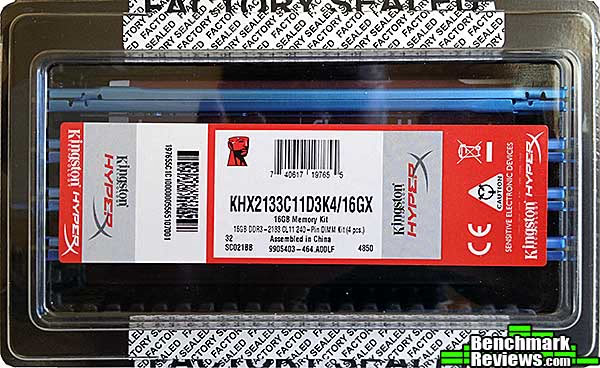
The Kingston KHX2133C11D3K4/16GX memory kit is delivered in a plastic tray with slots that hold the modules upright. I prefer this to the more standard practice of enclosing each module in an individual plastic shell. The Kingston tray has slots for 10 DIMMs and can be used to store memory you're not using.
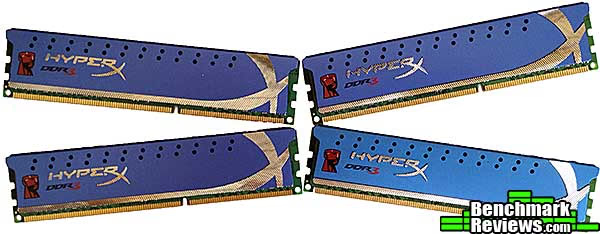
The individual modules use blue-anodized low-profile aluminum heat spreaders. Kingston specs these at 30mm high, but I measure just under 32mm as shown below. I recommend low-profile memory for X79 Express systems since many CPU air coolers will extend over one or both sets of DIMM sockets.

The label provides most of the information on the memory, although it lists only the second XMP profile frequency (2133MHz) and voltage (1.65V). You can also opt to run at the JEDEC standard 1333MHz, 1.50V, or the first XMP profile of1866MHz, 1.65V. But who would want to run this memory at anything but its best?

Overall, Kingston's blue anodized heat spreaders with bright accents make for an attractive package. Too bad they won't be visible installed in your system! One of the four DIMMs (at the lower right in this image) was a slightly lighter hue than the others.
These memory modules have two XMP profiles: 1866MHz at 10-11-10-30 and 2133MHz at 11-12-11-30. Although you wouldn't expect 4GB modules to be able to run timings as tight as 2GB modules, these are still rather loose, and several competitive DDR3-2133 16GB kits advertise better timing values.
Join me as I explain my test methodology in the next section.
Testing & Results
Testing Methodology
I rounded up several new quad-channel memory kits to provide a basis for comparison. All kits comprised four 4GB DIMMs for a total of 16GB of memory. There was one DDR3-1333 kit, two DDR3-1600 kits, and the Kingston HyperX kit that's the subject of this review. I ran all the memory kits at their XMP profile speeds (the Kingston memory that's the subject of this test had two XMP profiles, one for 1866MHz and one for 2133MHz, so I tested with both) on an Intel X79 Express system using an ASUS X79 Sabertooth motherboard and an Intel Core i7 3960X processor running at its stock clock speeds.
For this test I used three synthetic benchmarks to measure memory performance, and three application-based benchmarks to assess real-world performance.

Test System
-
Motherboard: ASUS X79 Sabertooth
-
System Memory
-
Generic DDR3-1333 9-9-9-25
-
Corsair Vengeance LP DDR3-1600 8-8-8-24
-
G.SKILL Ripjaws DDR3-1600 9-9-9-24
-
Kingston HyperX DDR3-1866 (XMP Profile 1) 10-11-10-30
-
Kingston HyperX DDR3-2133 (XMP Profile 2) 11-12-11-30
-
-
Processor: Intel Core i7-3960X
-
Video: AMD Radeon HD6850
-
Operating System: Windows 7 Home Premium 64-bit
Test Software
-
AIDA64 1.85.1600
-
SiSoft Sandra Lite 2011.10.17.79
-
Euler 3D 2.2
-
CINEBENCH R11.5
-
Blender 3D Rendering
-
Handbrake 0.95
Let's start with the synthetic testing...
AIDA64 Memory Test
Benchmark Reviews has used AIDA64 and its predecessor Lavalys Everest for years, mainly for its processor benchmarks and CPU stress-testing features. But it also includes a "Cache and Memory Benchmark" that performs read, write, and copy bandwidth tests on a system's installed memory.

The Kingston HyperX memory beats all the other memory in this test, although the "Write" results are very close (about half a percent difference between the lowest and highest scores). Quad-channel memory brings a whole new level of memory bandwidth performance to desktop systems, as you can see in the scores above. In the Read test, the Kingston HyperX memory at 2133MHz beats the generic 1333MHz memory by 20%.
NOTE: In my original tests C states were enabled because the test machine operated with the default BIOS settings. I re-ran the AIDA64 tests on the same motherboard and CPU used in this review with Kingston HyperX Genesis DDR3-2133 memory at enthusiast-level speeds.
C states enabled: read 18924, write 14995, copy 16914, latency 48.8ns
C states disabled: read 18897, write 15082, copy 17101, latency 48.9ns
The difference in write performance is a fraction over 1%, well within the margin of error of these tests. I conclude that at least with this motherboard and CPU, whether or not C states are enabled makes no difference in memory performance as measured by AIDA64's tests.
SiSoft Sandra Memory Test
SiSoft's Sandra Lite is a free version of SiSoftware's "Sandra" benchmarking utility. Its comprehensive memory benchmark tests report a number of items, but we're interested memory throughput tests. Unlike some other benchmarks that merely perform straight sequential reads and writes, Sandra reads and writes different areas of memory, using integer as well as floating point data, all in SMP mode.

The Kingston HyperX memory wins again here, with 2133MHz scores that are 38% better than 1333MHz memory and 15% better than 1600MHz memory.
Euler 3D
Euler 3D is a Computational Fluid Dynamics (CFD) program that is multi-threaded and computationally very intensive. The benchmark version by Case Labs is built with the Intel FORTRAN compiler and uses 8-byte double precision floating point math. The test case simulates a Mach 0.5 airflow over a NACA 65A004 airfoil section. The benchmark score is the CFD cycle frequency, with higher scores being better.

This benchmark kind of straddles with "synthetic" and "application" benchmark worlds. While the DDR3-2133 HyperX memory still wins, it's by a much narrower margin than on the pure synthetic tests.
Join me in the next section as I run the application benchmarks.
CINEBENCH 11.5 Multi-Core Rendering Test
Maxon CINEBENCH is a real-world test suite that assesses the computer's performance capabilities. CINEBENCH is based on Maxon's award-winning animation software, Cinema 4D, which is used extensively by studios and production houses worldwide for 3D content creation. Maxon software has been used in blockbuster movies such as Spider-Man, Star Wars, The Chronicles of Narnia, and many more. CINEBENCH Release 11.5 includes the ability to more accurately test the industry's latest hardware, including systems with up to 64 processor threads, and the testing environment better reflects the expectations of today's production demands. For this test I ran the multi-core rendering test, which resulted in 12 threads rendering the test scene. The CINEBENCH score is a dimensionless number that's only useful for comparison to other CINEBENCH results.

Here we see results that will be mirrored in the remaining two application benchmarks...virtually no difference in performance between the various quad-channel memory kits.
Blender/Icetest
Blender is an open-source, free content creation suite of 3D modeling, rendering, and animation capabilities. Originally released in 2002, it's available in versions for Mac OS X, Windows, Linux, and several Unix distributions. It supports rigid and soft-body objects and can handle the draping and animation of cloth, as well as the rendering and animation of smoke, water, and general particle handling.
Our Blender test renders multiple frames of an animation of a rotating chunk of ice, with translucency and reflections. Rendering of this model uses ray-tracing algorithms and the program reports the rendering time for each of the animation's 25 frames. The results are a summation of the rendering times for all frames and the lower the score, the better.

The G.SKILL DDR3-1600 kit very narrowly edges out the Kingston 2133MHz kit in this test. But the test scores are so close (less than a 2% difference between the best and worst scores) that any differences are within the margin of error.
Handbrake 0.95
The immense power (and cost!) of Intel's Sandy Bridge Extreme Core i7-3960X CPU virtually ensure that it will see a lot of video rendering and transcoding work, since this is one of the few applications that can really use the resources this processor has. My standard Handbrake test transcodes a standard-definition video of a Family Guy episode to the "iPhone and iPod Touch" presets. I report the time it took to perform the transcode in seconds; lower scores are better.

Here again we see razor-thin differences: the Kingston HyperX 2133MHz memory is a mere 0.8 seconds faster than the generic DDR3-1333MHz memory.
Kingston HyperX Final Thoughts
A common mistake for enthusiasts to make is to concentrate on only a single aspect of system performance: a fast CPU can be hobbled by a low-end video card, or too little memory or hard drive space. Hard drive prices have skyrocketed in recent months due to the flooding in Thailand, which makes SSDs more attractive (although there's still a huge price differential).
But while hard disk prices are up, memory has become absurdly cheap in the last couple of years, with prices as much as 80% lower than prices just two years ago. This is good news for computer users: it's now possible to buy 16GB of good memory for well under a hundred dollars from top-tier vendors like Corsair and Kingston. In fact Kingston's own 16GB DDR3-1600 memory kit has an MSRP of only $94.00! This is an incredible value by any standard...which makes the HyperX DDR3-2133 16GB kit's MSRP of $318.00 all the more startling. Yes, this would have been an amazing price a couple of years ago, but it's going to be a very tough sell, especially since the real-world performance improvements it buys you are virtually nonexistent.
Modern processors contain megabytes of cache memory. While the Core i7-3960X I used in this test has 15MB of internal cache, even lower-end CPUs will have 2-4M or more. This means that most memory accesses are handled from the processor cache, and continuous accessing of system memory rarely happens except in synthetic benchmarks designed to do just that...which is why you see memory performance differences in these benchmarks, and not in applications.
KHX2133C11D3K4 Conclusion
The whole point behind paying more for high-performance components, be they fast CPUs, killer graphics cards, SSDs, or performance memory, is to see this better performance in your system. While the Kingston HyperX DDR3-2133 memory showed its mettle in benchmark tests, application tests show that there's little of any real-world benefit to be had from this very expensive memory.
HyperX is Kingston's enthusiast memory brand, and all HyperX memory is dressed with heat spreaders. The low-profile anodized aluminum spreaders on this kit look good, but the heat spreader on one of the four DIMMs didn't precisely match the color of the other three.
Construction quality was good; there were no obvious physical flaws on the DIMMs and the performance was reliable.
As of December 2011, the 16GB Kingston HyperX Genesis 2133MHz Quad-Channel DDR3 Memory Kit KHX2133C11D3K4 sold at Amazon for $318.00.
Functionality is excellent: the user can choose to run the memory at 1333MHz, 1866MH, or 2133MHz by selecting the appropriate XMP profile in their computer's BIOS, with no overclocking or guesswork needed. That said, I don't know why you'd ever choose to run this expensive high performance memory at less than its full rated speed. The low profile heat spreaders eliminate the possibility of heat sink interference, which I expect to be a significant problem as Intel X79 Express systems become more popular.
The value proposition for this memory isn't good. It runs reliably at its maximum rated speed and synthetic benchmarks clearly demonstrate the performance improvement over conventional 1333 and 1600MHz memory. However, at more than triple the cost of a visually identical 1600MHz kit from the same vendor, the fact that I couldn't discern any performance improvements at the application level has to bring the rationale for buying this memory into question. Unless you're an overclocker looking to post the absolute highest benchmark scores, there's no reason to pay the substantial premium for this memory.
Pros:
+ Low-profile heat spreaders won't present cooler clearance problems
+ Two XMP profiles make setting the speed you want easy
+ Lifetime warranty
+ Comes in a useful memory storage bin
Cons:
- Very expensive enthusiast-level product
- DDR3-2133MHz timings of 11-12-11-30 are looser than the competition
- Performance not commensurate with cost in most applications
Ratings:
-
Performance: 9.50
-
Appearance: 9.00
-
Construction: 9.00
-
Functionality: 7.75
-
Value: 7.00
Final Score: 8.45 out of 10.
Benchmark Reviews invites you to leave constructive feedback below, or ask questions in our Discussion Forum.
Reader comments from the original article
2 comments were posted before commenting closed. They are preserved as written. Original avatars no longer resolve and are shown as a placeholder.
RE: Kingston HyperX Genesis 16GB DDR3-2133 Ron Permalink:
Thank you for the review. I was looking how strong is 2133Mhz compared to 1600Mhz. Not to much apparently and not worth the extra cost. Surely it will get cheaper.
RE: Kingston HyperX Genesis 16GB DDR3-2133 David Ramsey Permalink:
It has gotten cheaper. In fact if you'll check the Amazon link at the start of this review you'll see the price has dropped by more than half since this was written.