
PNY GeForce GTX 460 OC XLR8 Video Card
PNY GTX460-OC XLR8 Video Card Review
NVIDIA's GeForce GTX 460 graphics solution has convincingly dominated the mid-range price point, and its GF104 Fermi architecture threatens several competing high-performance products. Our benchmark tests have concluded that both the 768MB and 1GB version can offer great gaming performance, along with outstanding overclocking headroom. Combined into a SLI set, two stock-speed GeForce GTX 460's compete with the Radeon HD 5870 in terms of frame rate performance. In this article, Benchmark Reviews takes the highly overclocked PNY 'XLR8 Black Box' video card (model VCGGTX4601XPB-OC) and compares it against a field of DirectX-11 graphics solutions. If you're shopping for a powerful middle-market video card, this externally-exhausting 1GB GeForce GTX 460 product could be the perfect fit.
NVIDIA's GeForce GTX 460 1GB-GDDR5 graphics card empowers DirectX-11 video games to deliver unmatched geometric realism at the $200 price point. Based on the same Fermi architecture that powers their high-end GeForce GTX 480 model, the NVIDIA GeForce GTX 460 delivers mid-range performance for gamers on a budget. The PNY GeForce GTX 460 OC 'XLR8 Black Box' comes armed with NVIDIA's GF104 Fermi graphics processor, and packs seven Streaming Multiprocessors for a total of 336 CUDA Cores and 56 Texture Units. NVIDIA's 1GB GTX 460 price tag ($220) fits in nicely between the $200 Radeon HD 5830 and $250 GeForce GTX 465, but could deliver even more performance for the value. On the following pages, Benchmark Reviews demonstrates how well a factory-overclocked GeForce GTX 460 performs against these other DirectX-11 video card products.
PC video games are still the best way to experience realistic effects and immerse yourself in the battle. Gaming consoles do their part, but only high-precision video cards offer the sharp clarity and definition needed to enjoy detailed graphics. Given a heavy overclock at the PNY factory, this particular GeForce GTX 460 delivers a healthy helping of graphical power at an affordable price. The PNY GeForce GTX 460 XLR8 Black Box model arrives with a 765MHz GPU and 925MHz GDDR5 vRAM, leaving plenty of additional headroom for overclockers to drive out hidden FPS performance with their favorite hardware-tweaking utility. Benchmark Reviews will test the PNY GeForce GTX 460 XLR8 Black Box edition against some of the best video cards within the price segment by using several of the most demanding PC video game titles and benchmark software available: Aliens vs Predator, Battlefield: Bad Company 2, BattleForge, Crysis Warhead, Far Cry 2, Resident Evil 5, and Metro 2033.

PNY GeForce GTX 460 Overclocked XLR8 Black Box
It used to be that PC video games such as Crysis and Far Cry 2 were as demanding as you could get, but that was all back before DirectX-11 brought tessellation and to the forefront of graphics. DX11 now adds heavy particle and turbulence effects to video games, and titles such as Metro 2033 demand the most powerful graphics processing available. NVIDIA's GF100 GPU is their first graphics processor to support DirectX-11 features such as tessellation and DirectCompute, and the GeForce GTX-460 offers an excellent combination of performance and value for games and professional applications alike.
At the center of every new technology is purpose, and NVIDIA has designed their Fermi GF104 GPU with an end-goal of redefining the video game experience through significant graphics processor innovations. Disruptive technology often changes the way users interact with computers, and the GeForce GTX-460 family of video cards are complex tools built to arrive at one simple destination: immersive entertainment, especially when paired with NVIDIA GeForce 3D Vision. The experience is further improved with NVIDIA System Tools software, which includes NVIDIA Performance Group for GPU overclocking and NVIDIA System Monitor which displays real-time temperatures. These tools help gamers and overclockers get the most out of their investment.
For reference, Benchmark Reviews has already tested the stock-speed 1GB NVIDIA GeForce GTX-460 in both single-card and SLI.
Manufacturer: PNY Technologies, Inc.
Product Name: GeForce GTX 460 XLR8 Black Box
Model Number: VCGGTX4601XPB-OC
Price As Tested:$235 Online ($254.97 at Amazon - More Retailers)
Full Disclosure: The product sample used in this article has been provided by PNY.
NVIDIA Fermi Features
In today's complex graphics, tessellation offers the means to store massive amounts of coarse geometry, with expand-on-demand functionality. In the NVIDIA GF104 GPU (GF100 series), tessellation also enables more complex animations. In terms of model scalability, dynamic Level of Detail (LOD) allows for quality and performance trade-offs whenever it can deliver better picture quality over performance without penalty. Comprised of three layers (original geometry, tessellation geometry, and displacement map), the final product is far more detailed in shade and data-expansion than if it were constructed with bump-map technology. In plain terms, tessellation gives the peaks and valleys with shadow detail in-between, while previous-generation technology (bump-mapping) would give the illusion of detail.

Stages of Tessellation with NVIDIA Fermi Graphics
Using GPU-based tessellation, a game developer can send a compact geometric representation of an object or character and the tessellation unit can produce the correct geometric complexity for the specific scene. Consider the "Imp" character illustrated above. On the far left we see the initial quad mesh used to model the general outline of the figure; this representation is quite compact even when compared to typical game assets. The two middle images of the character are created by finely tessellating the description at the left. The result is a very smooth appearance, free of any of the faceting that resulted from limited geometry. Unfortunately this character, while smooth, is no more detailed than the coarse mesh. The final image on the right was created by applying a displacement map to the smoothly tessellated third character to the left.
What's new in Fermi?
With any new technology, consumers want to know what's new in the product. The goal of this article is to share in-depth information surrounding the Fermi architecture, as well as the new functionality unlocked in GF100. For clarity, the 'GF' letters used in the GF100 GPU name are not an abbreviation for 'GeForce'; they actually denote that this GPU is a Graphics solution based on the Fermi architecture. The next generation of NVIDIA GeForce-series desktop video cards will use the GF100 to promote the following new features:
- Third Generation Streaming Multiprocessor (SM)
o 32 CUDA cores per SM, 4x over GT200
o 8x the peak double precision floating point performance over GT200
o Dual Warp Scheduler simultaneously schedules and dispatches instructions from two independent warps
o 64 KB of RAM with a configurable partitioning of shared memory and L1 cache - Second Generation Parallel Thread Execution ISA
o Unified Address Space with Full C++ Support
o Optimized for OpenCL and DirectCompute
o Full IEEE 754-2008 32-bit and 64-bit precision
o Full 32-bit integer path with 64-bit extensions
o Memory access instructions to support transition to 64-bit addressing
o Improved Performance through Predication - Improved Memory Subsystem
o NVIDIA Parallel DataCache hierarchy with Configurable L1 and Unified L2 Caches
o First GPU with ECC memory support
o Greatly improved atomic memory operation performance - NVIDIA GigaThread Engine
o 10x faster application context switching
o Concurrent kernel execution
o Out of Order thread block execution
o Dual overlapped memory transfer engines
Tessellation in DirectX-11
Control hull shaders run DX11 pre-expansion routines, and operates explicitly in parallel across all points. Domain shaders run post-expansion operations on maps (u/v or x/y/z/w) and is also implicitly parallel. Fixed function tessellation is configured by Level of Detail (LOD) based on output from the control hull shader, and can also produce triangles and lines if requested. Tessellation is something that is new to NVIDIA GPUs, and was not part of GT200 because of geometry bandwidth bottlenecks from sequential rendering/execution semantics.
In regard to the GF100-series graphics processor, NVIDIA has added a new PolyMorph and Raster engines to handle world-space processing (PolyMorph) and screen-space processing (Raster). There are eight PolyMorph engines and two Raster engines on the GF104, which depend on an improved L2 cache to keep buffered geometric data produced by the pipeline on-die.
Four-Offset Gather4
The texture unit on previous processor architectures operated at the core clock of the GPU. On GF104, the texture units run at a higher clock, leading to improved texturing performance for the same number of units. GF104's texture units now add support for DirectX-11's BC6H and BC7 texture compression formats, reducing the memory footprint of HDR textures and render targets.
The texture units also support jittered sampling through DirectX-11's four-offset Gather4 feature, allowing four texels to be fetched from a 128×128 pixel grid with a single texture instruction. NVIDIA GF100 series GPUs implements DirectX-11 four-offset Gather4 in hardware, greatly accelerating shadow mapping, ambient occlusion, and post processing algorithms. With jittered sampling, games can implement smoother soft shadows or custom texture filters efficiently. The previous GT200 GPU did not offer coverage samples, while the GF100-series can deliver 32x CSAA.
GF104 Compute for Gaming
As developers continue to search for novel ways to improve their graphics engines, the GPU will need to excel at a diverse and growing set of graphics algorithms. Since these algorithms are executed via general compute APIs, a robust compute architecture is fundamental to a GPU's graphical capabilities. In essence, one can think of compute as the new programmable shader. GF100's compute architecture is designed to address a wider range of algorithms and to facilitate more pervasive use of the GPU for solving parallel problems. Many algorithms, such as ray tracing, physics, and AI, cannot exploit shared memory-program memory locality is only revealed at runtime. GF104's cache architecture was designed with these problems in mind. With up to 48 KB of L1 cache per Streaming Multiprocessor (SM) and a global L2 cache, threads that access the same memory locations at runtime automatically run faster, irrespective of the choice of algorithm.
NVIDIA Codename NEXUS brings CPU and GPU code development together in Microsoft Visual Studio 2008 for a shared process timeline. NEXUS also introduces the first hardware-based shader debugger. NVIDIA GF100-series GPUs are the first to ever offer full C++ support, the programming language of choice among game developers. To ease the transition to GPU programming, NVIDIA developed Nexus, a Microsoft Visual Studio programming environment for the GPU. Together with new hardware features that provide better debugging support, developers will be able enjoy CPU-class application development on the GPU. The end results is C++ and Visual Studio integration that brings HPC users into the same platform of development. NVIDIA offers several paths to deliver compute functionality on the GF104 GPU, such as CUDA C++ for video games.
Image processing, simulation, and hybrid rendering are three primary functions of GPU compute for gaming. Using NVIDIA GF100-series GPUs, interactive ray tracing becomes possible for the first time on a standard PC. Ray tracing performance on the NVIDIA GF100 is roughly 4x faster than it was on the GT200 GPU, according to NVIDIA tests. AI/path finding is a compute intensive process well suited for GPUs. The NVIDIA GF100 can handle AI obstacles approximately 3x better than on the GT200. Benefits from this improvement are faster collision avoidance and shortest path searches for higher-performance path finding.
NVIDIA GigaThread Thread Scheduler
One of the most important technologies of the Fermi architecture is its two-level, distributed thread scheduler. At the chip level, a global work distribution engine schedules thread blocks to various SMs, while at the SM level, each warp scheduler distributes warps of 32 threads to its execution units. The first generation GigaThread engine introduced in G80 managed up to 12,288 threads in real-time. The Fermi architecture improves on this foundation by providing not only greater thread throughput, but dramatically faster context switching, concurrent kernel execution, and improved thread block scheduling.
NVIDIA GF104 GPU Fermi Architecture
Based on the Fermi architecture, NVIDIA's latest GPU is codenamed GF104 and is equipped on the GeForce GTX 460. In this article, Benchmark Reviews explains the technical architecture behind NVIDIA's GF104 graphics processor and offers an insight into upcoming Fermi-based GeForce video cards. For those who are not familiar, NVIDIA's GF100 GPU was their first graphics processor to support DirectX-11 hardware features such as tessellation and DirectCompute, while also adding heavy particle and turbulence effects. The GF100 GPU is also the successor to the GT200 graphics processor, which launched in the GeForce GTX 280 video card back in June 2008. NVIDIA has since redefined their focus, and GF100/GF104 proves a dedication towards next generation gaming effects such as raytracing, order-independent transparency, and fluid simulations. The new GF104 GPU is still more powerful than GT200, and delivers DirectX-11 performance for NVIDIA's mid-range Fermi-based video card family.
GF100 was not another incremental GPU step-up like we had going from G80 to GT200. While processor cores have grown from 128 (G80) and 240 (GT200), they reach 512 in the GF100 and earn the title of NVIDIA CUDA (Compute Unified Device Architecture) cores. GF104 features up to 336 CUDA cores. The key here is not only the name, but that the name now implies an emphasis on something more than just graphics. Each Fermi CUDA processor core has a fully pipelined integer arithmetic logic unit (ALU) and floating point unit (FPU). GF104 implements the IEEE 754-2008 floating-point standard, providing the fused multiply-add (FMA) instruction for both single and double precision arithmetic. FMA improves over a multiply-add (MAD) instruction by doing the multiplication and addition with a single final rounding step, with no loss of precision in the addition. FMA minimizes rendering errors in closely overlapping triangles.

NVIDIA Fermi GF104 Block Diagram (click for high-resolution)
Based on Fermi's third-generation Streaming Multiprocessor (SM) architecture, GF104 could be mistaken as a divided GF100. NVIDIA GeForce GF100-series Fermi GPUs are based on a scalable array of Graphics Processing Clusters (GPCs), Streaming Multiprocessors (SMs), and memory controllers. NVIDIA's GF100 GPU implemented four GPCs, sixteen SMs, and six memory controllers. Conversely, GF104 implements two GPCs. eight SMs, and four memory controllers. Where each SM contained 32 CUDA cores in the GF100, NVIDIA now configures the GF104 to deliver 48 cores per SM. As expected, NVIDIA GF100-series products are launching with different configurations of GPCs, SMs, and memory controllers to address different price points.
CPU commands are read by the GPU via the Host Interface. The GigaThread Engine fetches the specified data from system memory and copies them to the frame buffer. GF104 implements four 64-bit GDDR5 memory controllers (256-bit total) to facilitate high bandwidth access to the frame buffer. The GigaThread Engine then creates and dispatches thread blocks to various SMs. Individual SMs in turn schedules warps (groups of 48 threads) to CUDA cores and other execution units. The GigaThread Engine also redistributes work to the SMs when work expansion occurs in the graphics pipeline, such as after the tessellation and rasterization stages.
GF104 implements 336 CUDA cores, organized as 8 SMs of 48 cores each. Each SM is a highly parallel multiprocessor supporting up to 32 warps at any given time (four Dispatch Units per SM deliver two dispatched instructions per warp for four total instructions per clock per SM). Each CUDA core is a unified processor core that executes vertex, pixel, geometry, and compute kernels. A unified L2 cache architecture (384KB on 768MB version or 512KB on 1GB cards) services load, store, and texture operations. GF104 is designed to offer a total of 32 ROP units (768MB=24 / 1GB=32) for pixel blending, antialiasing, and atomic memory operations. The ROP units are organized in four groups of eight. Each group is serviced by a 64-bit memory controller. The memory controller, L2 cache, and ROP group are closely coupled-scaling one unit automatically scales the others.
GF104 Specifications
- Up to 336 CUDA Cores
- 8 Geometry Units
- 2 Raster Units
- 64 Texture Units
- 32 ROP Units
- 256-bit GDDR5
- DirectX-11 API Support
GeForce GTX 400 Specifications
|
Graphics Card |
GeForce GTX 460 |
GeForce GTX 465 |
GeForce GTX 470 |
GeForce GTX 480 |
|---|---|---|---|---|
| GPU Transistors | 1.95 Billion | 3.2 Billion | 3.2 Billion | 3.2 Billion |
|
Graphics Processing Clusters |
2 |
4 |
4 |
4 |
|
Streaming Multiprocessors |
7 | 11 |
14 |
15 |
|
CUDA Cores |
336 | 352 |
448 |
480 |
|
Texture Units |
56 | 44 |
56 |
60 |
|
ROP Units |
768MB=24 / 1GB=32 | 32 |
40 |
48 |
|
Graphics Clock |
675 MHz |
607 MHz |
607 MHz |
700 MHz |
|
Processor Clock |
1350 MHz |
1215 MHz |
1215 MHz |
1401 MHz |
|
Memory Clock |
900/3600 MHz |
837/3348 MHz |
837/3348 MHz |
924/3696 MHz |
|
Total Video Memory |
768MB / 1GB |
1024 MB |
1280 MB |
1536 MB |
|
Memory Interface |
768MB=192 / 1GB=256-Bit |
256-Bit |
320-Bit |
384-Bit |
|
Total Memory Bandwidth |
86.4 / 115.2 GB/s |
102.6 GB/s |
133.9 GB/s |
177.4 GB/s |
|
Texture Filtering Rate |
37.8 GigaTexels/s |
26.7 GigaTexels/s |
34.0 GigaTexels/s |
42.0 GigaTexels/s |
|
GPU Fabrication Process |
40 nm |
40 nm |
40 nm |
40 nm |
|
Output Connections |
2x Dual-Link DVI-I |
2x Dual-Link DVI-I |
2x Dual-Link DVI-I |
2x Dual-Link DVI-I |
|
Form Factor |
Dual-Slot |
Dual-Slot |
Dual-Slot |
Dual-Slot |
|
Power Input |
2x 6-Pin |
2x 6-Pin |
2x 6-Pin |
6-Pin + 8-Pin |
|
Thermal Design Power (TDP) |
768MB=150W / 1GB=160W |
200 Watts |
215 Watts |
250 Watts |
|
Recommended PSU |
450 Watts |
550 Watts |
550 Watts |
600 Watts |
|
GPU Thermal Threshold |
104°C |
105°C |
105°C |
105°C |
|
GeForce Fermi Chart Courtesy of Benchmark Reviews |
First Look: PNY GTX460-OC XLR8
Game developers have had an exciting year thanks to Microsoft DirectX-11 introduced with Windows 7 and updated on Windows Vista. This has allowed video games (released for the PC platform) to look better than ever. DirectX-11 is the leap in video game software development we've been waiting for. Screen Space Ambient Occlusion (SSAO) is given emphasis in DX11, allowing some of the most detailed computer textures gamers have ever seen. Realistic cracks in mud with definable depth and splintered tree bark make the game more realistic, but they also make new demands on the graphics hardware. This new level of graphical detail requires a new level of computer hardware: DX11-compliant hardware. Tessellation adds a tremendous level of strain on the GPU, making previous graphics hardware virtually obsolete with new DX11 game titles.
The PNY XLR8 Black Box Edition video card offers gamers a potent dose of graphics processing power for their money, thanks to a massive factory overclock to the Fermi GF104 architecture. Aside from a powerful video card, the PNY GTX460-OC kit also includes a few bonus items. PNY Technologies delivers two Sony movie downloads from their pny.com/movies website, which allows you to replay movies as many times as you want from up to two different PCs. That's nice, but I think most of us are really after games more than movies... which is why the second freebie is especially helpful: a three-month subscription to the ESEA (E-Sports Entertainment) premium CS/TF2 video game network. When all else fails, PNY offers their limited lifetime warranty (one year standard - extended for the lifetime of the original purchaser upon completion of a registration form on PNY's website).

The PNY GeForce GTX 460 XLR8 Black Box VCGGTX4601XPB-OC is a 2.67" tall double-bay, 4.376-inches (111.15mm) wide graphics card with a 8.25-inch (209.55mm) long profile. There are two varieties of GTX 460: one with 768MB, and another with 1GB of GDDR5 memory. NVIDIA's reference cooler design uses a center-mounted 75mm finsink, which is more than adequate for this midrange-output Fermi GF104 GPU.
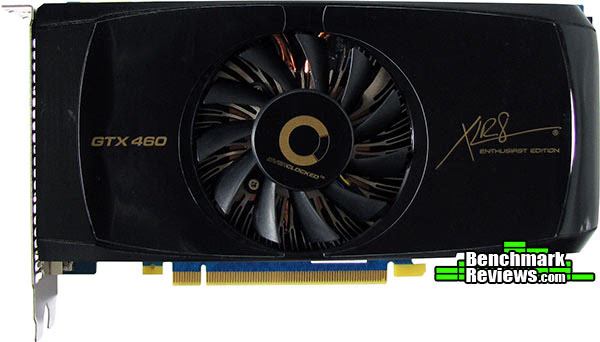
As with most past GeForce video cards, the Fermi GPU offers two output 'lanes', so all three output devices cannot operate at once. ASUS has retained the two standard DVI outputs on the GeForce GTX 460, so dual-monitor configurations can be utilized. By adding a second video card users can enjoy GeForce 3D-Vision Surround functionality. But the GeForce GTX 460 series is more than just a tool for video games; it's also a tool for professional environments that make use of GPGPU-accelerated compute-friendly software, such as Adobe Premier Pro and Photoshop, both of which make use of muli-monitor output.

Other changes occur in more subtle ways, such as replacing the S-Video connection with a more relevant (mini) HDMI 1.3a A/V output. In past GeForce products, the HDMI port was limited to video-only output and required a separate audio output. Native HDMI 1.3 support is available to the GeForce GTX 460, which allows direct output to HDTVs and compatible monitors. Selling at an affordable $200 price point, NVIDIA was wise to support dual-card SLI sets on the GTX 460. Triple-SLI capability is not supported, since the $600 cost of three video cards would be better used to purchase either two GTX 470's or one GTX 480.

The new 40nm fabrication process opens the die for more transistors; by comparison there are 1.4-billion in GT200 GPU (GeForce GTX 285), compared to 1.95-billion in GF104 for the GTX 460. While the GTX 460's GF104 disables one of its eight Streaming Multiprocessor Units (SMU's), a heavy-duty thermal management system is still utilized for optimal temperature control. On both the PNY XLR8 Black Box Edition video card and with reference versions, the entire heatsink and shroud portion are attached to the circuit board by four screws surrounding the GPU.

Aside from the factory overclock, PNY's XLR8 Black Box uses the same design as NVIDIA's reference model. This turns out to be a good thing, since the reference design is the only one to use external exhausting of heated air. PNY uses a blue printed circuit board (PCB) on their VCGGTX4601XPB-OC model, and adds labels over the fan shroud and I/O bezel.
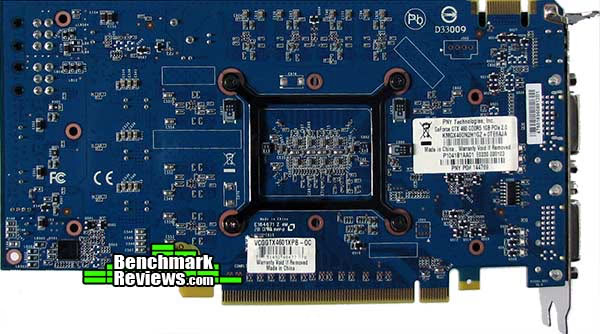
PNY employs a dual-slot cooling system on their XLR8 Black Box model, similar to the reference NVIDIA GTX 460 video card (shown below). Two copper heat-pipe rods span away from the copper base into two opposite sets of aluminum fins. The entire unit is cooled with a 75mm fan, which kept our test samples extremely cool at idle and maintained very good cooling once the card received unnaturally high stress loads with FurMark (covered later in this article).

Even with its mid-range intentions, the PCB is a busy place for the GeForce GTX 460. There are eight positions for DRAM ICs on the circuit board, which combine for 1GB of GDDR5 video frame buffer memory - or 768MB when only six modules are utilized. Many of the electronic components have been located to the 'top' side of the PCB, so to better accommodate the large scale GF104 GPU and its 1.95-billion transistors. 336 CUDA cores operate at 1350 MHz, which keeps a firm lead over ATI's 850 MHz Cypress GPU that measures 334 mm2.
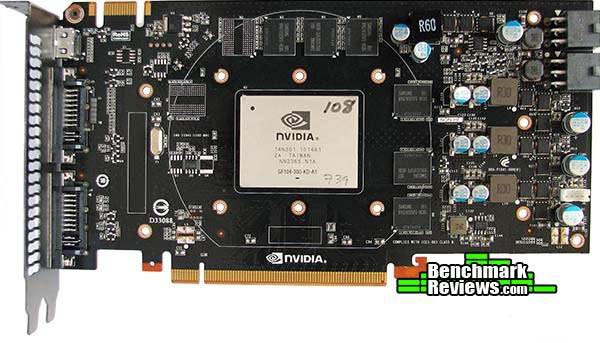
In the next several sections Benchmark Reviews will explain our video card test methodology, followed by a performance comparison of the PNY GeForce GTX 460 XLR8 Black Box video card VCGGTX4601XPB-OC against several of the most popular mid-range graphics accelerators available. The GeForce GTX 460 will compete against the ATI Radeon HD 5830 and several other middle-market video cards; so we'll be keeping a close eye on comparative performance and value.
VGA Testing Methodology
The Microsoft DirectX-11 graphics API is native to the Microsoft Windows 7 Operating System, and will be the primary O/S for our test platform. DX11 is also available as a Microsoft Update for the Windows Vista O/S, so our test results apply to both versions of the Operating System. The majority of benchmark tests used in this article are comparative to DX11 performance, however some high-demand DX10 tests have also been included.
According to the Steam Hardware Survey published for the month ending May 2010, the most popular gaming resolution is 1280x1024 (17-19" standard LCD monitors). However, because this 1.31MP resolution is considered 'low' by most standards, our benchmark performance tests concentrate on higher-demand resolutions: 1.76MP 1680x1050 (22-24" widescreen LCD) and 2.30MP 1920x1200 (24-28" widescreen LCD monitors). These resolutions are more likely to be used by high-end graphics solutions, such as those tested in this article.
 In each benchmark test there is one 'cache run' that is conducted, followed by five recorded test runs. Results are collected at each setting with the highest and lowest results discarded. The remaining three results are averaged, and displayed in the performance charts on the following pages.
A combination of synthetic and video game benchmark tests have been used in this article to illustrate relative performance among graphics solutions. Our benchmark frame rate results are not intended to represent real-world graphics performance, as this experience would change based on supporting hardware and the perception of individuals playing the video game.
DX11 Cost to Performance Ratio
For this article Benchmark Reviews has included cost per FPS for graphics performance results. Only the least expensive product price is calculated, and does not consider tax, freight, promotional offers, or rebates into the cost. All prices reflect product series components, and do not represent any specific manufacturer, model, or brand. These retail prices for each product were obtained from online retailers on 01-September-2010:
-
$150 Radeon HD 5770
-
$220 GeForce GTX 460 1GB
-
$235PNY GTX 460 XLR8 Black Box
-
$200 Radeon HD 5830
- $250 GeForce GTX 465
-
$290 Radeon HD 5850
-
$320 GeForce GTX 470
Intel X58-Express Test System
- Motherboard: ASUS P6X58D-E (Intel X58/ICH10R/Marvell SE9128)
- Processor: Intel Core i7-920 Nehalem 2.66 GHz (BX80601920)
- CPU Cooler: Prolimatech Megahalems
- System Memory: Kingston HyperX 2000MHz CL8-8-8-24-1 DDR3 KHX2000C8D3T1K3 (3x2GB)
- Primary Drive: OCZ Agility-EX SLC SSD OCZSSD2-1AGTEX60G firmware 1.50
- Power Supply Unit: OCZ Z-Series Gold 850W OCZZ850
- Monitor: 26-Inch Widescreen LCD (up to 1920x1200@60Hz)
DirectX-10 Benchmark Applications
-
3DMark Vantage v1.02 (Extreme Quality, 8x Multisample Anti-Aliasing, 16x Anisotropic Filtering, 1:2 Scale)
- Crysis Warhead v1.1 with HOC Benchmark (DX10, Very High Quality, 4x Anti-Aliasing, 16x Anisotropic Filtering, Airfield Demo)
- Far Cry 2 v1.02 (DX10, Very High Performance, Ultra-High Quality, 8x Anti-Aliasing, HDR + Bloom)
-
Resident Evil 5 Benchmark (DX10, Super-High Quality, 8x MSAA)
DirectX-11 Benchmark Applications
- Aliens vs Predator (Very High Quality, 4x AA, 16x AF, SSAO, Tessellation, Advanced Shadows)
- BattleField: Bad Company 2 (High Quality, HBAO, 8x Anti-Aliasing, 16x Anisotropic Filtering, Single-Player Intro Scene)
- BattleForge v1.2 (Very High Quality, 8x Anti-Aliasing, Auto Multi-Thread)
- Metro 2033 (Very-High Quality, DirectX-11, AAA, 16x AF, Advanced DoF, Tessellation, 180s Scene 1 Fraps)
- Unigine Heaven Benchmark 2.1 (DX11, Normal Tessellation, 16x AF, 4x AA)
Video Card Test Products
| Graphics Card | GeForce 9800 GTX+ | Radeon HD4890 | GeForce GTX285 | Radeon HD5770 | GeForce GTX460 | Radeon HD5830 | GeForce GTX465 | Radeon HD5850 | GeForce GTX470 |
|---|---|---|---|---|---|---|---|---|---|
| GPU Cores | 128 | 800 | 240 | 800 | 336 | 1120 | 352 | 1440 | 448 |
| Core Clock (MHz) | 740 | 850 | 670 | 850 | 675 | 800 | 608 | 725 | 608 |
| Shader Clock (MHz) | 1836 | N/A | 1550 | N/A | 1350 | N/A | 1215 | N/A | 1215 |
| Memory Clock (MHz) | 1100 | 975 | 1300 | 1200 | 900 | 1000 | 802 | 1000 | 837 |
| Memory Amount | 512 MB GDDR3 | 1024 MB GDDR5 | 1024MB GDDR3 | 1024MB GDDR5 | 1024MB GDDR5 | 1024MB GDDR5 | 1024MB GDDR5 | 1024MB GDDR5 | 1280MB GDDR5 |
| Memory Interface | 256-bit | 256-bit | 512-bit | 128-bit | 256-bit | 256-bit | 256-bit | 256-bit | 320-bit |
-
NVIDIA GeForce 9800 GTX+ / GTS 250 (740 MHz GPU/1836 MHz Shader/1100 MHz vRAM - Forceware 258.96)
-
ATI Radeon HD 4890 Reference Design (850 MHz GPU/975 MHz vRAM - ATI Catalyst Driver 10.7)
-
ASUS GeForce GTX 285 ENGTX285 TOP (670 MHz GPU/1550 MHz Shader/1330 MHz vRAM - Forceware 258.96)
-
ATI Radeon HD 5770 Reference Design (850 MHz GPU/1200 MHz vRAM - ATI Catalyst Driver 10.7)
-
NVIDIA GeForce GTX 460 1GB (675 MHz GPU/1350 MHz Shader/900 MHz vRAM - Forceware 258.96)
-
PNY GeForce GTX 460 OC VCGGTX4601XPB-OC (765 MHz GPU/1530 MHz Shader/925 MHz vRAM - Forceware 258.96)
-
ATI Radeon HD 5830 Reference Design (800 MHz GPU/1000 MHz vRAM - ATI Catalyst Driver 10.7)
-
ASUS GeForce GTX 465 (608 MHz GPU/1215 MHz Shader/802 MHz vRAM - Forceware 258.80)
-
ATI Radeon HD 5850 Reference Design (725 MHz GPU/1000MHz vRAM - ATI Catalyst Driver 10.7)
- ZOTAC GeForce GTX 470 ZT-40201-10P (608 MHz GPU/1215 MHz Shader/837 MHz vRAM - Forceware 258.96)
DX10: 3DMark Vantage
3DMark Vantage is a PC benchmark suite designed to test the DirectX10 graphics card performance. FutureMark 3DMark Vantage is the latest addition the 3DMark benchmark series built by FutureMark corporation. Although 3DMark Vantage requires NVIDIA PhysX to be installed for program operation, only the CPU/Physics test relies on this technology.
3DMark Vantage offers benchmark tests focusing on GPU, CPU, and Physics performance. Benchmark Reviews uses the two GPU-specific tests for grading video card performance: Jane Nash and New Calico. These tests isolate graphical performance, and remove processor dependence from the benchmark results.
3DMark Vantage GPU Test: Jane Nash
Of the two GPU tests 3DMark Vantage offers, the Jane Nash performance benchmark is slightly less demanding. In a short video scene the special agent escapes a secret lair by water, nearly losing her shirt in the process. Benchmark Reviews tests this DirectX-10 scene at 1680x1050 and 1920x1200 resolutions, and uses Extreme quality settings with 8x anti-aliasing and 16x anisotropic filtering. The 1:2 scale is utilized, and is the highest this test allows. By maximizing the processing levels of this test, the scene creates the highest level of graphical demand possible and sorts the strong from the weak.

Cost Analysis: Jane Nash (1680x1050)
- $150 Radeon HD 5770 costs $8.33 per FPS
- $220 GeForce GTX 460 costs $9.09 per FPS
- $235 PNY GTX 460 XLR8 costs $8.67 per FPS
- $200 Radeon HD 5830 costs $8.78 per FPS
- $250 GeForce GTX 465 costs $11.11 per FPS
- $290 Radeon HD 5850 costs $10.18 per FPS
- $320 GeForce GTX 470 costs $11.15 per FPS
3DMark Vantage GPU Test: New Calico
New Calico is the second GPU test in the 3DMark Vantage test suite. Of the two GPU tests, New Calico is the most demanding. In a short video scene featuring a galactic battleground, there is a massive display of busy objects across the screen. Benchmark Reviews tests this DirectX-10 scene at 1680x1050 and 1920x1200 resolutions, and uses Extreme quality settings with 8x anti-aliasing and 16x anisotropic filtering. The 1:2 scale is utilized, and is the highest this test allows. Using the highest graphics processing level available allows our test products to separate themselves and stand out (if possible).

Cost Analysis: New Calico (1680x1050)
- $150 Radeon HD 5770 costs $11.11 per FPS
- $220 GeForce GTX 460 costs $10.63 per FPS
- $235 PNY GTX 460 XLR8 costs $10.22 per FPS
- $200 Radeon HD 5830 costs $11.43 per FPS
- $250 GeForce GTX 465 costs $13.23 per FPS
- $290 Radeon HD 5850 costs $13.24 per FPS
- $320 GeForce GTX 470 costs $13.17 per FPS
Test Summary: According to 3dMark Vantage, the reference NVIDIA GeForce GTX 460 1GB model leads slightly ahead of the ATI Radeon HD 5830 in the Jane Nash GPU test, and then overtakes it by 3-FPS in New Calico tests. Alternatively, the GTX460-OC leads the entire bunch, and also offers the best cost value of all video cards. The Jane Nash test yields 23.0 FPS, which scores 2.3 FPS ahead of the standard version. New Calico tests produced 18.1 FPS, which becomes nearly 2-FPS more than the reference design and also surpasses the ATI Radeon HD 5850 for performance. Once you take 3D-Vision, PhysX, CUDA, and 32x MSAA into consideration, the choice between a HD5850 and GTX 460 XLR8 leans towards PNY.
| Graphics Card | GeForce 9800 GTX+ | Radeon HD4890 | GeForce GTX285 | Radeon HD5770 | GeForce GTX460 | Radeon HD5830 | GeForce GTX465 | Radeon HD5850 | GeForce GTX470 |
|---|---|---|---|---|---|---|---|---|---|
| GPU Cores | 128 | 800 | 240 | 800 | 336 | 1120 | 352 | 1440 | 448 |
| Core Clock (MHz) | 740 | 850 | 670 | 850 | 675 | 800 | 608 | 725 | 608 |
| Shader Clock (MHz) | 1836 | N/A | 1550 | N/A | 1350 | N/A | 1215 | N/A | 1215 |
| Memory Clock (MHz) | 1100 | 975 | 1300 | 1200 | 900 | 1000 | 802 | 1000 | 837 |
| Memory Amount | 512 MB GDDR3 | 1024 MB GDDR5 | 1024MB GDDR3 | 1024MB GDDR5 | 1024MB GDDR5 | 1024MB GDDR5 | 1024MB GDDR5 | 1024MB GDDR5 | 1280MB GDDR5 |
| Memory Interface | 256-bit | 256-bit | 512-bit | 128-bit | 256-bit | 256-bit | 256-bit | 256-bit | 320-bit |
DX10: Crysis Warhead
Crysis Warhead is an expansion pack based on the original Crysis video game. Crysis Warhead is based in the future, where an ancient alien spacecraft has been discovered beneath the Earth on an island east of the Philippines. Crysis Warhead uses a refined version of the CryENGINE2 graphics engine. Like Crysis, Warhead uses the Microsoft Direct3D 10 (DirectX-10) API for graphics rendering.
Benchmark Reviews uses the HOC Crysis Warhead benchmark tool to test and measure graphic performance using the Airfield 1 demo scene. This short test places a high amount of stress on a graphics card because of detailed terrain and textures, but also for the test settings used. Using the DirectX-10 test with Very High Quality settings, the Airfield 1 demo scene receives 4x anti-aliasing and 16x anisotropic filtering to create maximum graphic load and separate the products according to their performance.
Using the highest quality DirectX-10 settings with 4x AA and 16x AF, only the most powerful graphics cards are expected to perform well in our Crysis Warhead benchmark tests. DirectX-11 extensions are not supported in Crysis: Warhead, and SSAO is not an available option.

Cost Analysis: Crysis Warhead (1680x1050)
- $150 Radeon HD 5770 costs $8.82 per FPS
- $220 GeForce GTX 460 costs $8.80 per FPS
- $235 PNY GTX 460 XLR8 costs $8.39 per FPS
- $200 Radeon HD 5830 costs $9.09 per FPS
- $250 GeForce GTX 465 costs $9.62 per FPS
- $290 Radeon HD 5850 costs $10.74 per FPS
- $320 GeForce GTX 470 costs $9.70 per FPS
Test Summary: The CryENGINE2 graphics engine used in Crysis Warhead responds well to both ATI and NVIDIA products, which allows the reference 1GB GeForce GTX 460 to exceed performance of ATI's Radeon HD 5830 at 1680x1050 and again at 1920x1200. Offered with a fierce factory overclock, the PNY GTX 460 XLR8 climbs past the competition and once again surpasses the ATI Radeon HD 5850. For die-hard fans of Crysis, the GTX 460 XLR8 also offers the very best price to performance ratio of all graphics solutions tested in this article.
| Graphics Card | GeForce 9800 GTX+ | Radeon HD4890 | GeForce GTX285 | Radeon HD5770 | GeForce GTX460 | Radeon HD5830 | GeForce GTX465 | Radeon HD5850 | GeForce GTX470 |
|---|---|---|---|---|---|---|---|---|---|
| GPU Cores | 128 | 800 | 240 | 800 | 336 | 1120 | 352 | 1440 | 448 |
| Core Clock (MHz) | 740 | 850 | 670 | 850 | 675 | 800 | 608 | 725 | 608 |
| Shader Clock (MHz) | 1836 | N/A | 1550 | N/A | 1350 | N/A | 1215 | N/A | 1215 |
| Memory Clock (MHz) | 1100 | 975 | 1300 | 1200 | 900 | 1000 | 802 | 1000 | 837 |
| Memory Amount | 512 MB GDDR3 | 1024 MB GDDR5 | 1024MB GDDR3 | 1024MB GDDR5 | 1024MB GDDR5 | 1024MB GDDR5 | 1024MB GDDR5 | 1024MB GDDR5 | 1280MB GDDR5 |
| Memory Interface | 256-bit | 256-bit | 512-bit | 128-bit | 256-bit | 256-bit | 256-bit | 256-bit | 320-bit |
DX10: Far Cry 2
Ubisoft has developed Far Cry 2 as a sequel to the original, but with a very different approach to game play and story line. Far Cry 2 features a vast world built on Ubisoft's new game engine called Dunia, meaning "world", "earth" or "living" in Farci. The setting in Far Cry 2 takes place on a fictional Central African landscape, set to a modern day timeline.
The Dunia engine was built specifically for Far Cry 2, by Ubisoft Montreal development team. It delivers realistic semi-destructible environments, special effects such as dynamic fire propagation and storms, real-time night-and-day sun light and moon light cycles, dynamic music system, and non-scripted enemy A.I actions.
The Dunia game engine takes advantage of multi-core processors as well as multiple processors and supports DirectX 9 as well as DirectX-10. Only 2 or 3 percent of the original CryEngine code is re-used, according to Michiel Verheijdt, Senior Product Manager for Ubisoft Netherlands. Additionally, the engine is less hardware-demanding than CryEngine 2, the engine used in Crysis.
However, it should be noted that Crysis delivers greater character and object texture detail, as well as more destructible elements within the environment. For example; trees breaking into many smaller pieces and buildings breaking down to their component panels. Far Cry 2 also supports the amBX technology from Philips. With the proper hardware, this adds effects like vibrations, ambient colored lights, and fans that generate wind effects.
There is a benchmark tool in the PC version of Far Cry 2, which offers an excellent array of settings for performance testing. Benchmark Reviews used the maximum settings allowed for DirectX-10 tests, with the resolution set to 1920x1200. Performance settings were all set to 'Very High', Render Quality was set to 'Ultra High' overall quality, 8x anti-aliasing was applied, and HDR and Bloom were enabled.
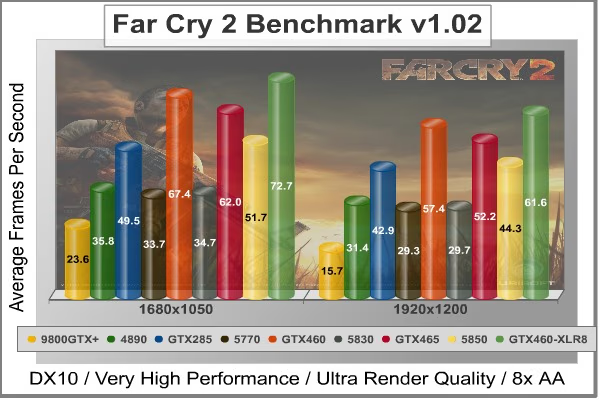
Although the Dunia engine in Far Cry 2 is slightly less demanding than CryEngine 2 engine in Crysis, the strain appears to be extremely close. In Crysis we didn't dare to test AA above 4x, whereas we used 8x AA and 'Ultra High' settings in Far Cry 2. The end effect was a separation between what is capable of maximum settings, and what is not. Using the short 'Ranch Small' time demo (which yields the lowest FPS of the three tests available), we noticed that there are very few products capable of producing playable frame rates with the settings all turned up.
Cost Analysis: Far Cry 2 (1680x1050)
- $150 Radeon HD 5770 costs $4.45 per FPS
- $220 GeForce GTX 460 costs $3.26 per FPS
- $235 PNY GTX 460 XLR8 costs $3.23 per FPS
- $200 Radeon HD 5830 costs $5.76 per FPS
- $250 GeForce GTX 465 costs $4.03 per FPS
- $290 Radeon HD 5850 costs $5.61 per FPS
- $320 GeForce GTX 470 costs $4.16 per FPS
Test Summary: The Dunia game engine in Far Cry 2 demonstrates a preference towards NVIDIA products over ATI, which allows the reference NVIDIA GeForce GTX 460 to dominate performance over the Radeon HD 5830, and also beat ATI's Radeon HD 5850 by a significant margin. Of course, the overclocked PNY GTX 460 XLR8 video card only improves the already substantial lead and adds 5.3-FPS more performance beyond the stock version. Because of the major differences in performance with Far Cry 2, the GeForce GTX 460 (and all other GeForce cards) offered the best performance and cost per FPS of any DX11 video card.
| Graphics Card | GeForce 9800 GTX+ | Radeon HD4890 | GeForce GTX285 | Radeon HD5770 | GeForce GTX460 | Radeon HD5830 | GeForce GTX465 | Radeon HD5850 | GeForce GTX470 |
|---|---|---|---|---|---|---|---|---|---|
| GPU Cores | 128 | 800 | 240 | 800 | 336 | 1120 | 352 | 1440 | 448 |
| Core Clock (MHz) | 740 | 850 | 670 | 850 | 675 | 800 | 608 | 725 | 608 |
| Shader Clock (MHz) | 1836 | N/A | 1550 | N/A | 1350 | N/A | 1215 | N/A | 1215 |
| Memory Clock (MHz) | 1100 | 975 | 1300 | 1200 | 900 | 1000 | 802 | 1000 | 837 |
| Memory Amount | 512 MB GDDR3 | 1024 MB GDDR5 | 1024MB GDDR3 | 1024MB GDDR5 | 1024MB GDDR5 | 1024MB GDDR5 | 1024MB GDDR5 | 1024MB GDDR5 | 1280MB GDDR5 |
| Memory Interface | 256-bit | 256-bit | 512-bit | 128-bit | 256-bit | 256-bit | 256-bit | 256-bit | 320-bit |
DX10: Resident Evil 5
Built upon an advanced version of Capcom's proprietary MT Framework game engine to deliver DirectX-10 graphic detail, Resident Evil 5 offers gamers non-stop action similar to Devil May Cry 4, Lost Planet, and Dead Rising. The MT Framework is an exclusive seventh generation game engine built to be used with games developed for the PlayStation 3 and Xbox 360, and PC ports. MT stands for "Multi-Thread", "Meta Tools" and "Multi-Target". Games using the MT Framework are originally developed on the PC and then ported to the other two console platforms.
On the PC version of Resident Evil 5, both DirectX 9 and DirectX-10 modes are available for Microsoft Windows XP and Vista Operating Systems. Microsoft Windows 7 will play Resident Evil with backwards compatible Direct3D APIs. Resident Evil 5 is branded with the NVIDIA The Way It's Meant to be Played (TWIMTBP) logo, and receives NVIDIA GeForce 3D Vision functionality enhancements.
NVIDIA and Capcom offer the Resident Evil 5 benchmark demo for free download from their website, and Benchmark Reviews encourages visitors to compare their own results to ours. Because the Capcom MT Framework game engine is very well optimized and produces high frame rates, Benchmark Reviews uses the DirectX-10 version of the test at 1920x1200 resolution. Super-High quality settings are configured, with 8x MSAA post processing effects for maximum demand on the GPU. Test scenes from Area #3 and Area #4 require the most graphics processing power, and the results are collected for the chart illustrated below.

Resident Evil 5 has really proved how well the proprietary Capcom MT Framework game engine can look with DirectX-10 effects. The Area 3 and 4 tests are the most graphically demanding from this free downloadable demo benchmark, but the results make it appear that the Area #3 test scene performs better with NVIDIA GeForce products compared to the Area #4 scene that favors ATI Radeon GPUs.
Cost Analysis: Resident Evil 5 (Area 4)
- $150 Radeon HD 5770 costs $2.73 per FPS
- $220 GeForce GTX 460 costs $3.28 per FPS
- $235 PNY GTX 460 XLR8 costs $2.70 per FPS
- $200 Radeon HD 5830 costs $3.39 per FPS
- $250 GeForce GTX 465 costs $3.21 per FPS
- $290 Radeon HD 5850 costs $3.54 per FPS
- $320 GeForce GTX 470 costs $3.81 per FPS
Test Summary: It's unclear if Resident Evil 5 graphics performance fancies ATI or NVIDIA, especially since two different test scenes alternate favoritism. Although this benchmark tool is distributed directly from NVIDIA, and Forceware drivers likely have optimizations written for the Resident Evil 5 game, there doesn't appear to be any decisive tilt towards GeForce products over ATI Radeon counterparts from within the game itself. Test scene #3 certainly favors Fermi GPU's, and they leads ahead of every other product tested. In test scene #4 the Radeon video card series appears more competitive, but this didn't prevent the stock 1GB GeForce GTX 460 from outperforming ATI's Radeon HD 5830 by a 8-FPS margin. The Radeon HD 5850 produced 82 FPS, which is easily outdone by the PNY GTX 460 XLR8 that produces 87 FPS. Additionally, the GTX460-OC earns respect for providing the absolute best cost per frame value.
| Graphics Card | GeForce 9800 GTX+ | Radeon HD4890 | GeForce GTX285 | Radeon HD5770 | GeForce GTX460 | Radeon HD5830 | GeForce GTX465 | Radeon HD5850 | GeForce GTX470 |
|---|---|---|---|---|---|---|---|---|---|
| GPU Cores | 128 | 800 | 240 | 800 | 336 | 1120 | 352 | 1440 | 448 |
| Core Clock (MHz) | 740 | 850 | 670 | 850 | 675 | 800 | 608 | 725 | 608 |
| Shader Clock (MHz) | 1836 | N/A | 1550 | N/A | 1350 | N/A | 1215 | N/A | 1215 |
| Memory Clock (MHz) | 1100 | 975 | 1300 | 1200 | 900 | 1000 | 802 | 1000 | 837 |
| Memory Amount | 512 MB GDDR3 | 1024 MB GDDR5 | 1024MB GDDR3 | 1024MB GDDR5 | 1024MB GDDR5 | 1024MB GDDR5 | 1024MB GDDR5 | 1024MB GDDR5 | 1280MB GDDR5 |
| Memory Interface | 256-bit | 256-bit | 512-bit | 128-bit | 256-bit | 256-bit | 256-bit | 256-bit | 320-bit |
DX11: Aliens vs Predator
Aliens vs. Predator is a science fiction first-person shooter video game, developed by Rebellion, and published by Sega for Microsoft Windows, Sony PlayStation 3, and Microsoft Xbox 360. Aliens vs. Predator utilizes Rebellion's proprietary Asura game engine, which had previously found its way into Call of Duty: World at War and Rogue Warrior. The self-contained benchmark tool is used for our DirectX-11 tests, which push the Asura game engine to its limit.
In our benchmark tests, Aliens vs. Predator was configured to use the highest quality settings with 4x AA and 16x AF. DirectX-11 features such as Screen Space Ambient Occlusion (SSAO) and tessellation have also been included, along with advanced shadows.

Cost Analysis: Aliens vs Predator (1680x1050)
- $150 Radeon HD 5770 costs $8.02 per FPS
- $220 GeForce GTX 460 costs $8.00 per FPS
- $235 PNY GTX 460 XLR8 costs $7.97 per FPS
- $200 Radeon HD 5830 costs $8.66 per FPS
- $250 GeForce GTX 465 costs $10.00 per FPS
- $290 Radeon HD 5850 costs $9.80 per FPS
- $320 GeForce GTX 470 costs $9.44 per FPS
Test Summary: Aliens vs Predator may use a well-known game engine, but DirectX-11 pushes graphical demand on this game second to only Metro 2033 (and possibly equivalent to DX10 Crysis). With an unbiased appetite for raw DirectX-11 graphics performance, Aliens vs Predator accepts ATI and NVIDIA products as equal contenders, even despite sponsorship from NVIDIA. When high-strain SSAO is called into action, the stock-speed 1GB GeForce GTX 460 demonstrates how well Fermi is suited for DX11... besting ATI's Radeon HD 5830 by several frames per second and even surpassing the GTX 465. Only slightly out-performed by the GeForce GTX 470 (which costs $100 more), the PNY GTX 460 XLR8 finds itself beside the ATI Radeon HD 5850 the same as it did in many of the DirectX-10 tests. High-stress graphics have tested performance on the reference GeForce GTX 460, and certainly impacts GTX 460 XLR8 frame rates, yet the relative price to performance ratio is actually quite high in Aliens vs Predator and wins big in the value rating. In fact, the PNY GTX 460 XLR8 offered the very best cost per FPS and was the only graphics card to keep below the $8 marker.
| Graphics Card | GeForce 9800 GTX+ | Radeon HD4890 | GeForce GTX285 | Radeon HD5770 | GeForce GTX460 | Radeon HD5830 | GeForce GTX465 | Radeon HD5850 | GeForce GTX470 |
|---|---|---|---|---|---|---|---|---|---|
| GPU Cores | 128 | 800 | 240 | 800 | 336 | 1120 | 352 | 1440 | 448 |
| Core Clock (MHz) | 740 | 850 | 670 | 850 | 675 | 800 | 608 | 725 | 608 |
| Shader Clock (MHz) | 1836 | N/A | 1550 | N/A | 1350 | N/A | 1215 | N/A | 1215 |
| Memory Clock (MHz) | 1100 | 975 | 1300 | 1200 | 900 | 1000 | 802 | 1000 | 837 |
| Memory Amount | 512 MB GDDR3 | 1024 MB GDDR5 | 1024MB GDDR3 | 1024MB GDDR5 | 1024MB GDDR5 | 1024MB GDDR5 | 1024MB GDDR5 | 1024MB GDDR5 | 1280MB GDDR5 |
| Memory Interface | 256-bit | 256-bit | 512-bit | 128-bit | 256-bit | 256-bit | 256-bit | 256-bit | 320-bit |
DX11: Battlefield Bad Company 2
The Battlefield franchise has been known to demand a lot from PC graphics hardware. DICE (Digital Illusions CE) has incorporated their Frostbite-1.5 game engine with Destruction-2.0 feature set with Battlefield: Bad Company 2. Battlefield: Bad Company 2 features destructible environments using Frostbit Destruction-2.0, and adds gravitational bullet drop effects for projectiles shot from weapons at a long distance. The Frostbite-1.5 game engine used on Battlefield: Bad Company 2 consists of DirectX-10 primary graphics, with improved performance and softened dynamic shadows added for DirectX-11 users.
At the time Battlefield: Bad Company 2 was published, DICE was also working on the Frostbite-2.0 game engine. This upcoming engine will include native support for DirectX-10.1 and DirectX-11, as well as parallelized processing support for 2-8 parallel threads. This will improve performance for users with an Intel Core-i7 processor. Unfortunately, the Extreme Edition Intel Core i7-980X six-core CPU with twelve threads will not see full utilization.
In our benchmark tests of Battlefield: Bad Company 2, the first three minutes of action in the single-player raft night scene are captured with FRAPS. Relative to the online multiplayer action, these frame rate results are nearly identical to daytime maps with the same video settings.

The Frostbite-1.5 game engine in Battlefield: Bad Company 2 appears to equalize our test set of video cards, and despite AMD's sponsorship of the game it still plays well using any brand of graphics card.
Cost Analysis: Battlefield: Bad Company 2 (1680x1050)
- $150 Radeon HD 5770 costs $3.75 per FPS
- $220 GeForce GTX 460 costs $4.04 per FPS
- $235 PNY GTX 460 XLR8 costs $4.00 per FPS
- $200 Radeon HD 5830 costs $4.39 per FPS
- $250 GeForce GTX 465 costs $4.82 per FPS
- $290 Radeon HD 5850 costs $4.77 per FPS
- $320 GeForce GTX 470 costs $4.97 per FPS
Test Summary: The 1GB frame buffer on a standard-speed GeForce GTX 460 video card helps post an 8.3-FPS gain ahead of ATI's Radeon HD 5830, but the additional overclock of the PNY GTX 460 XLR8 adds another 4.3-FPS above and beyond. At 1680x1050 the PNY GTX 460 XLR8 also comes close to matching performance of the Radeon HD 5850. The relative price per frame for the GTX460-OC delivers the best value of nearly all cards tested, and is considerably less than the Radeon HD 5830. While a stock GeForce GTX 460 slightly edges out the Radeon HD 5830, the test results thus far are beginning to position the PNY GTX 460 XLR8 against the ATI Radeon HD 5850.
| Graphics Card | GeForce 9800 GTX+ | Radeon HD4890 | GeForce GTX285 | Radeon HD5770 | GeForce GTX460 | Radeon HD5830 | GeForce GTX465 | Radeon HD5850 | GeForce GTX470 |
|---|---|---|---|---|---|---|---|---|---|
| GPU Cores | 128 | 800 | 240 | 800 | 336 | 1120 | 352 | 1440 | 448 |
| Core Clock (MHz) | 740 | 850 | 670 | 850 | 675 | 800 | 608 | 725 | 608 |
| Shader Clock (MHz) | 1836 | N/A | 1550 | N/A | 1350 | N/A | 1215 | N/A | 1215 |
| Memory Clock (MHz) | 1100 | 975 | 1300 | 1200 | 900 | 1000 | 802 | 1000 | 837 |
| Memory Amount | 512 MB GDDR3 | 1024 MB GDDR5 | 1024MB GDDR3 | 1024MB GDDR5 | 1024MB GDDR5 | 1024MB GDDR5 | 1024MB GDDR5 | 1024MB GDDR5 | 1280MB GDDR5 |
| Memory Interface | 256-bit | 256-bit | 512-bit | 128-bit | 256-bit | 256-bit | 256-bit | 256-bit | 320-bit |
DX11: BattleForge
BattleForge is free Massive Multiplayer Online Role Playing Game (MMORPG) developed by EA Phenomic with DirectX-11 graphics capability. Combining strategic cooperative battles, the community of MMO games, and trading card gameplay, BattleForge players are free to put their creatures, spells and buildings into combination's they see fit. These units are represented in the form of digital cards from which you build your own unique army. With minimal resources and a custom tech tree to manage, the gameplay is unbelievably accessible and action-packed.
Benchmark Reviews uses the built-in graphics benchmark to measure performance in BattleForge, using Very High quality settings (detail) and 8x anti-aliasing with auto multi-threading enabled. BattleForge is one of the first titles to take advantage of DirectX-11 in Windows 7, and offers a very robust color range throughout the busy battleground landscape. The charted results illustrate how performance measures-up between video cards when Screen Space Ambient Occlusion (SSAO) is enabled.

Cost Analysis: BattleForge (1680x1050)
- $150 Radeon HD 5770 costs $6.47 per FPS
- $220 GeForce GTX 460 costs $5.71 per FPS
- $235 PNY GTX 460 XLR8 costs $5.54 per FPS
- $200 Radeon HD 5830 costs $7.41 per FPS
- $250 GeForce GTX 465 costs $6.00 per FPS
- $290 Radeon HD 5850 costs $7.51 per FPS
- $320 GeForce GTX 470 costs $6.07 per FPS
Test Summary: With an unbiased appetite for raw DirectX-11 graphics performance BattleForge appears to be ambiguous towards ATI and NVIDIA products, even despite advertised sponsorship from AMD. When high-strain SSAO and 8x anti-aliasing applied, the reference NVIDIA GeForce GTX 460 trumps ATI's Radeon HD 5830 at both test resolutions by nearly 12-FPS. Overclock the GF104 by 90MHz and you get the PNY GTX 460 XLR8, which goes on to topple the ATI Radeon HD 5850 yet again. An improved FPS performance gives the 1GB GeForce GTX 460 excellent value of the bunch, but the PNY GTX 460 XLR8 offers the best value... again. Two consistent trends have been established, proving that the GTX460-OC beats the ATI Radeon HD 5850 video card while providing the best value of them all.
| Graphics Card | GeForce 9800 GTX+ | Radeon HD4890 | GeForce GTX285 | Radeon HD5770 | GeForce GTX460 | Radeon HD5830 | GeForce GTX465 | Radeon HD5850 | GeForce GTX470 |
|---|---|---|---|---|---|---|---|---|---|
| GPU Cores | 128 | 800 | 240 | 800 | 336 | 1120 | 352 | 1440 | 448 |
| Core Clock (MHz) | 740 | 850 | 670 | 850 | 675 | 800 | 608 | 725 | 608 |
| Shader Clock (MHz) | 1836 | N/A | 1550 | N/A | 1350 | N/A | 1215 | N/A | 1215 |
| Memory Clock (MHz) | 1100 | 975 | 1300 | 1200 | 900 | 1000 | 802 | 1000 | 837 |
| Memory Amount | 512 MB GDDR3 | 1024 MB GDDR5 | 1024MB GDDR3 | 1024MB GDDR5 | 1024MB GDDR5 | 1024MB GDDR5 | 1024MB GDDR5 | 1024MB GDDR5 | 1280MB GDDR5 |
| Memory Interface | 256-bit | 256-bit | 512-bit | 128-bit | 256-bit | 256-bit | 256-bit | 256-bit | 320-bit |
DX11: Metro 2033
Metro 2033 is an action-oriented video game with a combination of survival horror, and first-person shooter elements. The game is based on the novel Metro 2033 by Russian author Dmitry Glukhovsky. It was developed by 4A Games in Ukraine and released in March 2010 for Microsoft Windows. Metro 2033 uses the 4A game engine, developed by 4A Games. The 4A Engine supports DirectX-9, 10, and 11, along with NVIDIA PhysX and GeForce 3D Vision.
The 4A engine is multi-threaded in such that only PhysX had a dedicated thread, and uses a task-model without any pre-conditioning or pre/post-synchronizing, allowing tasks to be done in parallel. The 4A game engine can utilize a deferred shading pipeline, and uses tessellation for greater performance, and also has HDR (complete with blue shift), real-time reflections, color correction, film grain and noise, and the engine also supports multi-core rendering.
Metro 2033 featured superior volumetric fog, double PhysX precision, object blur, sub-surface scattering for skin shaders, parallax mapping on all surfaces and greater geometric detail with a less aggressive LODs. Using PhysX, the engine uses many features such as destructible environments, and cloth and water simulations, and particles that can be fully affected by environmental factors.

NVIDIA has been diligently working to promote Metro 2033, and for good reason: it is the most demanding PC video game we've ever tested. When their flagship GeForce GTX 480 struggles to produce 27 FPS with DirectX-11 anti-aliasing turned two to its lowest setting, you know that only the strongest graphics processors will generate playable frame rates. All our tests disable advanced PhysX options.
Cost Analysis: Metro 2033 (1680x1050)
- $150 Radeon HD 5770 costs $9.43 per FPS
- $220 GeForce GTX 460 costs $10.68 per FPS
- $235 PNY GTX 460 XLR8 costs $10.44 per FPS
- $200 Radeon HD 5830 costs $10.58 per FPS
- $250 GeForce GTX 465 costs $11.96 per FPS
- $290 Radeon HD 5850 costs $12.50 per FPS
- $320 GeForce GTX 470 costs $11.85 per FPS
Test Summary: There's no way to ignore the graphical demands of Metro 2033, and only the most powerful GPUs will deliver a decent visual experience unless you're willing to seriously tone-down the settings. These demands make our selection of DX11 video cards appear flat, especially since two GeForce GTX 480's combined into a SLI set produce a mere 46 FPS. While the quality settings will likely need to be reduced to medium levels for adequate game play performance, and advanced depth of field disabled, the stock-speed NVIDIA GeForce GTX 460 still extends itself past the Radeon HD 5830. Although FPS performance is close, the PNY GTX 460 XLR8 costs less per frame than the ATI Radeon HD 5850. Although performance was close with the 5850, the overclocked GTX 460 series can utilize PhysX where the entire Radeon brand is crippled. Metro 2033 offers advanced PhysX options only to NVIDIA GeForce video cards.
| Graphics Card | GeForce 9800 GTX+ | Radeon HD4890 | GeForce GTX285 | Radeon HD5770 | GeForce GTX460 | Radeon HD5830 | GeForce GTX465 | Radeon HD5850 | GeForce GTX470 |
|---|---|---|---|---|---|---|---|---|---|
| GPU Cores | 128 | 800 | 240 | 800 | 336 | 1120 | 352 | 1440 | 448 |
| Core Clock (MHz) | 740 | 850 | 670 | 850 | 675 | 800 | 608 | 725 | 608 |
| Shader Clock (MHz) | 1836 | N/A | 1550 | N/A | 1350 | N/A | 1215 | N/A | 1215 |
| Memory Clock (MHz) | 1100 | 975 | 1300 | 1200 | 900 | 1000 | 802 | 1000 | 837 |
| Memory Amount | 512 MB GDDR3 | 1024 MB GDDR5 | 1024MB GDDR3 | 1024MB GDDR5 | 1024MB GDDR5 | 1024MB GDDR5 | 1024MB GDDR5 | 1024MB GDDR5 | 1280MB GDDR5 |
| Memory Interface | 256-bit | 256-bit | 512-bit | 128-bit | 256-bit | 256-bit | 256-bit | 256-bit | 320-bit |
DX11: Unigine Heaven 2.1
The Unigine "Heaven 2.1" benchmark is a free publicly available tool that grants the power to unleash the graphics capabilities in DirectX-11 for Windows 7 or updated Vista Operating Systems. It reveals the enchanting magic of floating islands with a tiny village hidden in the cloudy skies. With the interactive mode, emerging experience of exploring the intricate world is within reach. Through its advanced renderer, Unigine is one of the first to set precedence in showcasing the art assets with tessellation, bringing compelling visual finesse, utilizing the technology to the full extend and exhibiting the possibilities of enriching 3D gaming.
The distinguishing feature in the Unigine Heaven benchmark is a hardware tessellation that is a scalable technology aimed for automatic subdivision of polygons into smaller and finer pieces, so that developers can gain a more detailed look of their games almost free of charge in terms of performance. Thanks to this procedure, the elaboration of the rendered image finally approaches the boundary of veridical visual perception: the virtual reality transcends conjured by your hand. The "Heaven" benchmark excels at providing the following key features:
-
Native support of OpenGL, DirectX 9, DirectX-10 and DirectX-11
-
Comprehensive use of tessellation technology
-
Advanced SSAO (screen-space ambient occlusion)
-
Volumetric cumulonimbus clouds generated by a physically accurate algorithm
-
Dynamic simulation of changing environment with high physical fidelity
-
Interactive experience with fly/walk-through modes
-
ATI Eyefinity support

Although Heaven-2.1 was recently released and used for our DirectX-11 tests, the benchmark results were extremely close to those obtained with Heaven-1.0 testing. Since only DX11-compliant video cards will properly test on the Heaven benchmark, only those products that meet the requirements have been included.
Cost Analysis: Unigine Heaven (1680x1050)
- $150 Radeon HD 5770 costs $8.24 per FPS
- $220 GeForce GTX 460 costs $7.67 per FPS
- $235 PNY GTX 460 XLR8 costs $7.34 per FPS
- $200 Radeon HD 5830 costs $9.48 per FPS
- $250 GeForce GTX 465 costs $9.47 per FPS
- $290 Radeon HD 5850 costs $11.79 per FPS
- $320 GeForce GTX 470 costs $10.53 per FPS
Test Summary: Our test results with the Unigine Heaven benchmark tool appear to deliver fair comparisons of DirectX-11 graphics cards. Reviewers like to say "Nobody plays a benchmark", but it seems evident that we can expect to see great things come from a graphics tool this detailed. For now though, those details only come by way of DirectX-11 video cards.
While the reference 1GB NVIDIA GeForce GTX 460 clears past the Radeon HD 5830 by nearly 8-FPS, as well as the GeForce GTX 465, it's the PNY GTX 460 XLR8 that steals the thunder away from all of the graphics solutions tested. In this test, the GTX460-OC even surpassed the GeForce GTX 470 by a solid margin. If there was a cost involved with Unigine's Heaven benchmark, the GeForce GTX 460 would cost $1.81 less per frame than the Radeon HD 5830, and the PNY GTX 460 XLR8 would cost $4.45 less per frame than the Radeon HD 5850 while still offering a better value than all other DirectX-11 video cards.
| Graphics Card | GeForce 9800 GTX+ | Radeon HD4890 | GeForce GTX285 | Radeon HD5770 | GeForce GTX460 | Radeon HD5830 | GeForce GTX465 | Radeon HD5850 | GeForce GTX470 |
|---|---|---|---|---|---|---|---|---|---|
| GPU Cores | 128 | 800 | 240 | 800 | 336 | 1120 | 352 | 1440 | 448 |
| Core Clock (MHz) | 740 | 850 | 670 | 850 | 675 | 800 | 608 | 725 | 608 |
| Shader Clock (MHz) | 1836 | N/A | 1550 | N/A | 1350 | N/A | 1215 | N/A | 1215 |
| Memory Clock (MHz) | 1100 | 975 | 1300 | 1200 | 900 | 1000 | 802 | 1000 | 837 |
| Memory Amount | 512 MB GDDR3 | 1024 MB GDDR5 | 1024MB GDDR3 | 1024MB GDDR5 | 1024MB GDDR5 | 1024MB GDDR5 | 1024MB GDDR5 | 1024MB GDDR5 | 1280MB GDDR5 |
| Memory Interface | 256-bit | 256-bit | 512-bit | 128-bit | 256-bit | 256-bit | 256-bit | 256-bit | 320-bit |
NVIDIA APEX PhysX Enhancements
Mafia II is the first PC video game title to include the new NVIDIA APEX PhysX framework, a powerful feature set that only GeForce video cards are built do deliver. While console versions will make use of PhysX, only the PC version supports NVIDIA's APEX PhysX physics modeling engine, which adds the following features: APEX Destruction, APEX Clothing, APEX Vegetation, and APEX Turbulence. PhysX helps make object movement more fluid and lifelike, such as cloth and debris. In this section, Benchmark Reviews details the differences made with- and without APEX PhysX enabled.
We begin with a scene from the Mafia II benchmark test, which has the player pinned down behind a brick column as the enemy shoots at him. Examine the image below, which was taken with a Radeon HD 5850 configured with all settings turned to their highest and APEX PhysX support disabled:

No PhysX = Cloth Blending and Missing Debris
Notice from the image above that when PhysX is disabled there is no broken stone debris on the ground. Cloth from foreground character's trench coat blends into his leg and remains in a static position relative to his body, as does the clothing on other (AI) characters. Now inspect the image below, which uses the GeForce GTX 460 with APEX PhysX enabled:

Realistic Cloth and Debris - High Quality Settings With PhysX
With APEX PhysX enabled, the cloth neatly sways with the contour of a characters body, and doesn't bleed into solid objects such as body parts. Additionally, APEX Clothing features improve realism by adding gravity and wind effects onto clothing, allowing for characters to look like they would in similar real-world environments.

Burning Destruction Smoke and Vapor Realism
Flames aren't exactly new to video games, but smoke plumes and heat vapor that mimic realistic movement have never looked as real as they do with APEX Turbulence. Fire and explosions added into a destructible environment is a potent combination for virtual-world mayhem, showcasing the new PhysX APEX Destruction feature.
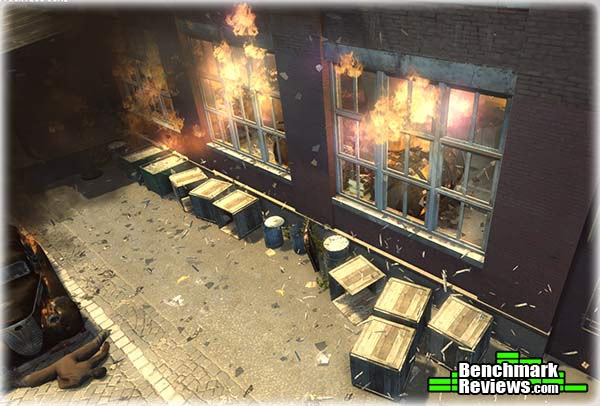
Exploding Glass Shards and Bursting Flames
NVIDIA PhysX has changed video game explosions into something worthy of cinema-level special effects. Bursting windows explode into several unique shards of glass, and destroyed crates bust into splintered kindling. Smoke swirls and moves as if there's an actual air current, and flames move out towards open space all on their own. Surprisingly, there is very little impact on FPS performance with APEX PhysX enabled on GeForce video cards, and very little penalty for changing from medium (normal) to high settings.
NVIDIA 3D-Vision Effects
Readers familiar with Benchmark Reviews have undoubtedly heard of NVIDIA GeForce 3D Vision technology; if not from our review of the product, then for the Editor's Choice Award it's earned or the many times I've personally mentioned it in out articles. Put simply: it changes the game. 2010 has been a break-out year for 3D technology, and PC video games are leading the way. Mafia II is expands on the three-dimensional effects, and improves the 3D-Vision experience with out-of-screen effects. For readers unfamiliar with the technology, 3D-Vision is a feature only available to NVIDIA GeForce video cards.

The first thing gamers should be aware of is the performance penalty for using 3D-Vision with a high-demand game like Mafia II. Using a GeForce GTX 480 video card for reference, currently the most powerful single-GPU graphics solution available, we experienced frame rate speeds up to 33 FPS with all settings configured to their highest and APEX PhysX set to high. However, when 3D Vision is enabled the video frame rate usually decrease by about 50%. This is no longer the hardfast rule, thanks to '3D Vision Ready' game titles that offer performance optimizations. Mafia II proved that the 3D Vision performance penalty can be as little as 30% with a single GeForce GTX 480 video card, or a mere 11% in SLI configuration. NVIDIA Forceware drivers will guide players to make custom-recommended adjustments specifically for each game they play, but PhysX and anti-aliasing will still reduce frame rate performance.
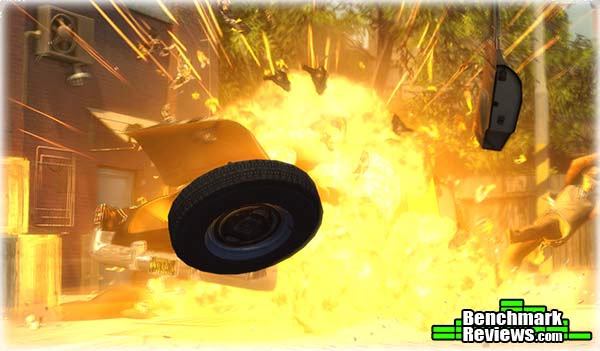
Of course, the out-of-screen effects are worth every dollar you spend on graphics hardware. In the image above, an explosion sends the car's wheel and door flying into the players face, followed by metal debris and sparks. When you're playing, this certainly helps to catch your attention... and when the objects become bullets passing by you, the added depth of field helps assist in player awareness.

Combined with APEX PhysX technology, NVIDIA's 3D-Vision brings destructible walls to life. As enemies shoot at the brick column, dirt and dust fly past the player forcing stones to tumble out towards you. Again, the added depth of field can help players pinpoint the origin of enemy threat, and improve response time without sustaining 'confusion damage'.
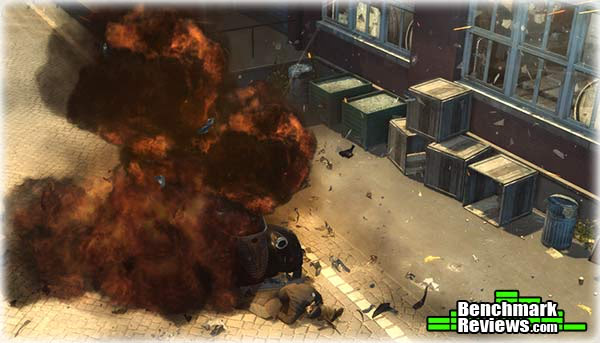
NVIDIA APEX Turbulence, a new PhysX feature, already adds an impressive level of realism to games (such as with Mafia II pictured in this section). Watching plumes of smoke and flames spill out towards your camera angle helps put you right into the thick of action.

NVIDIA 3D-Vision/3D-Vision Surround is the perfect addition to APEX PhysX technology, and capable video games will prove that these features reproduce lifelike scenery and destruction when they're used together. Glowing embers and fiery shards shooting past you seem very real when 3D-Vision pairs itself APEX PhysX technology, and there's finally a good reason to overpower the PCs graphics system.
PNY GTX 460 XLR8 Temperatures
Benchmark tests are always nice, so long as you care about comparing one product to another. But when you're an overclocker, gamer, or merely a PC hardware enthusiast who likes to tweak things on occasion, there's no substitute for good information. Benchmark Reviews has a very popular guide written on Overclocking Video Cards, which gives detailed instruction on how to tweak a graphics cards for better performance. Of course, not every video card has overclocking head room. Some products run so hot that they can't suffer any higher temperatures than they already do. This is why we measure the operating temperature of the video card products we test.
To begin my testing, I use GPU-Z to measure the temperature at idle as reported by the GPU. Next I use FurMark's "Torture Test" to generate maximum thermal load and record GPU temperatures at high-power 3D mode. The ambient room temperature remained at a stable 20°C throughout testing, while the inner-case temperature hovered around 34°C.
FurMark does two things extremely well: drive the thermal output of any graphics processor higher than applications of video games realistically could, and it does so with consistency every time. Furmark works great for testing the stability of a GPU as the temperature rises to the highest possible output. The temperatures discussed below are absolute maximum values, and not representative of real-world performance.
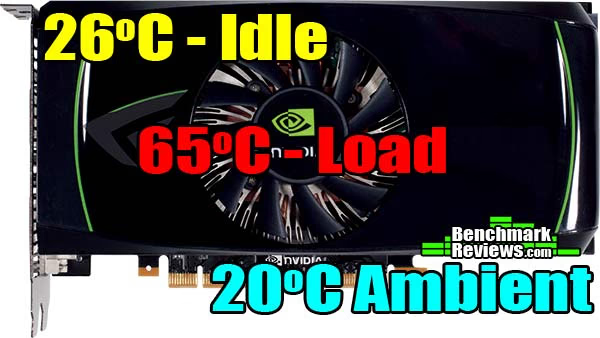
NVIDIA GeForce GTX 460 1GB Video Card Temperatures
Beginning with the stock-speed NVIDIA reference design, the 1GB GeForce GTX 460 kept to a cool 26°C at idle and produced no audible fan noise. After a lengthy FurMark stress test warmed the GF104 GPU to a mere 65°C, fan noise was still silent and nearly inaudible. Compared to other Fermi products, the GeForce GTX 460 is a chilly alternative. NVIDIA-supplied product specifications state that the GeForce GTX 460 has a maximum GPU thermal threshold of 104°C. We've noted that this new GF104 threshold is one degree less than GF100 Fermi products.
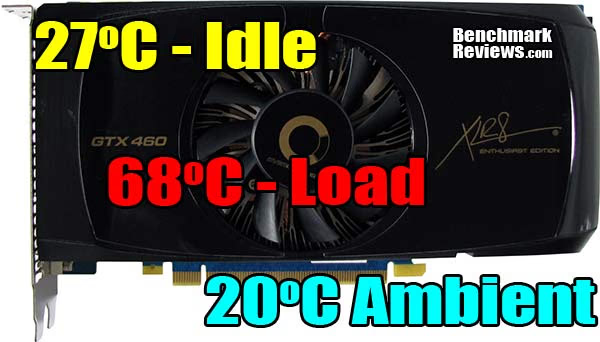
In a room with 20°C ambient temperature, the PNY GeForce GTX 460 OC produced a near-ambient 27°C at idle a mere 68°C under load. Overclockers should keep in mind that the PNY XLR8 is an external-exhausting video card, which means that heated air is discharged outside of the computer case and improves system component stability.
PNY GTX 460 XLR8 Black Box Temperatures
Most new graphics cards from NVIDIA and ATI will expel heated air out through exhaust vents, which does not increase the internal case temperature. Our test system is an open-air chassis that allows the video card to depend on its own cooling solution for proper thermal management. Most gamers and PC hardware enthusiasts who use an aftermarket computer case with intake and exhaust fans will usually create a directional airflow current and lower internal temperatures a few degrees below the measurements we've recorded. To demonstrate this, we've built a system to illustrate the...
Best-Case Scenario
Traditional tower-style computer cases position internal hardware so that heat is expelled out through the back of the unit. This is better than nothing, but there's a fundamental problem: heat rises. Using the transverse mount design on the SilverStone Raven-2 chassis, Benchmark Reviews re-tested the PNY GTX 460 XLR8 video card to determine the 'best-case' scenario.
Sitting idle at the Windows 7 desktop with a 20°C ambient room temperature, the GeForce GTX 460 rested at 28°C, which was actually one degree higher than measured in a regular computer case. Pushed to abnormally high levels using the FurMark torture test, the PNY GeForce GTX460-OC operated at 70°C with a very quiet cooling fan. After some investigation, it seems that the reference thermal cooling solution is better suited to a horizontal orientation. Although the well-designed Raven-2 computer case offers additional cooling features and has helped to make a difference in other video cards, this wasn't the case with the XLR8 model... not that it matters at this low of a temperature.
NVIDIA GeForce GTX 460 Thermal Cooling Solution Heatsink
In the traditional (horizontal) position, the slightly angled heat-pipe rods use gravity and sintering to draw cooled liquid back down to the base. When positioned in a transverse mount case such as the SilverStone Raven-2, the reference PNY GTX 460 XLR8 heatsink loses optimal effective properties in the lowest heat-pipe rod, because gravity takes keeps the cool liquid in the lowest portion of the rod within the finsink.
VGA Power Consumption
Life is not as affordable as it used to be, and items such as gasoline, natural gas, and electricity all top the list of resources which have exploded in price over the past few years. Add to this the limit of non-renewable resources compared to current demands, and you can see that the prices are only going to get worse. Planet Earth is needs our help, and needs it badly. With forests becoming barren of vegetation and snow capped poles quickly turning brown, the technology industry has a new attitude towards turning "green". I'll spare you the powerful marketing hype that gets sent from various manufacturers every day, and get right to the point: your computer hasn't been doing much to help save energy... at least up until now.
For power consumption tests, Benchmark Reviews utilizes the 80-PLUS GOLD certified OCZ Z-Series Gold 850W PSU, model OCZZ850. This power supply unit has been tested to provide over 90% typical efficiency by Chroma System Solutions, however our results are not adjusted for consistency. To measure isolated video card power consumption, Benchmark Reviews uses the Kill-A-Watt EZ (model P4460) power meter made by P3 International.
A baseline test is taken without a video card installed inside our test computer system, which is allowed to boot into Windows-7 and rest idle at the login screen before power consumption is recorded. Once the baseline reading has been taken, the graphics card is installed and the system is again booted into Windows and left idle at the login screen. Our final loaded power consumption reading is taken with the video card running a stress test using FurMark. Below is a chart with the isolated video card power consumption (not system total) displayed in Watts for each specified test product:
VGA Product Description(sorted by combined total power) |
Idle Power |
Loaded Power |
|---|---|---|
NVIDIA GeForce GTX 480 SLI Set |
82 W |
655 W |
NVIDIA GeForce GTX 590 Reference Design |
53 W |
396 W |
ATI Radeon HD 4870 X2 Reference Design |
100 W |
320 W |
AMD Radeon HD 6990 Reference Design |
46 W |
350 W |
NVIDIA GeForce GTX 295 Reference Design |
74 W |
302 W |
ASUS GeForce GTX 480 Reference Design |
39 W |
315 W |
ATI Radeon HD 5970 Reference Design |
48 W |
299 W |
NVIDIA GeForce GTX 690 Reference Design |
25 W |
321 W |
ATI Radeon HD 4850 CrossFireX Set |
123 W |
210 W |
ATI Radeon HD 4890 Reference Design |
65 W |
268 W |
AMD Radeon HD 7970 Reference Design |
21 W |
311 W |
NVIDIA GeForce GTX 470 Reference Design |
42 W |
278 W |
NVIDIA GeForce GTX 580 Reference Design |
31 W |
246 W |
NVIDIA GeForce GTX 570 Reference Design |
31 W |
241 W |
ATI Radeon HD 5870 Reference Design |
25 W |
240 W |
ATI Radeon HD 6970 Reference Design |
24 W |
233 W |
NVIDIA GeForce GTX 465 Reference Design |
36 W |
219 W |
NVIDIA GeForce GTX 680 Reference Design |
14 W |
243 W |
Sapphire Radeon HD 4850 X2 11139-00-40R |
73 W |
180 W |
NVIDIA GeForce 9800 GX2 Reference Design |
85 W |
186 W |
NVIDIA GeForce GTX 780 Reference Design |
10 W |
275 W |
NVIDIA GeForce GTX 770 Reference Design |
9 W |
256 W |
NVIDIA GeForce GTX 280 Reference Design |
35 W |
225 W |
NVIDIA GeForce GTX 260 (216) Reference Design |
42 W |
203 W |
ATI Radeon HD 4870 Reference Design |
58 W |
166 W |
NVIDIA GeForce GTX 560 Ti Reference Design |
17 W |
199 W |
NVIDIA GeForce GTX 460 Reference Design |
18 W |
167 W |
AMD Radeon HD 6870 Reference Design |
20 W |
162 W |
NVIDIA GeForce GTX 670 Reference Design |
14 W |
167 W |
ATI Radeon HD 5850 Reference Design |
24 W |
157 W |
NVIDIA GeForce GTX 650 Ti BOOST Reference Design |
8 W |
164 W |
AMD Radeon HD 6850 Reference Design |
20 W |
139 W |
NVIDIA GeForce 8800 GT Reference Design |
31 W |
133 W |
ATI Radeon HD 4770 RV740 GDDR5 Reference Design |
37 W |
120 W |
ATI Radeon HD 5770 Reference Design |
16 W |
122 W |
NVIDIA GeForce GTS 450 Reference Design |
22 W |
115 W |
NVIDIA GeForce GTX 650 Ti Reference Design |
12 W |
112 W |
ATI Radeon HD 4670 Reference Design |
9 W |
70 W |
A reference-design NVIDIA GeForce GTX 460 requires two six-pin PCI-E power connections, and this remains unchanged in the PNY GTX 460 XLR8 version. Resting at idle, the power draw consumed only 19 watts of electricity... 1W more than the stock design and still 7W less than the ATI Radeon HD 5830. This is also exactly half the amount of power required for the GeForce GTX 465. Once 3D-applications begin to demand power from the GPU, electrical power consumption climbed to full-throttle. Measured with a abnormally high 'torture test' load using FurMark, the PNY GeForce GTX 460 Overclocked video card consumed 199 watts. Compared to the reference design with stock speeds (167 watts), the XLR8 model uses slightly less than the 219W consumed by the GTX 465. Although GF104 Fermi GPU features the same 40nm fabrication process as the GF100, it's clear that NVIDIA's GTX 460 is better suited for 'Green' enthusiasts.
PNY GTX460 XLR8 Overclocking
If there's one particular message this article should impress upon the reader, it would be that the NVIDIA GeForce GTX 460 is an overclocker's dream. The GF104-equipped GTX 460 already comes with an impressive stock clock speed of 675/1350 MHz, with the GDDR5 running at 900 MHz (1800 DDR). Putting this into perspective, these speed fall between the GeForce GTX 470 and GTX 480 (closer to the latter). Now comes the fun: overclocking the GeForce GTX 460 is as easy as its ever been.
Back in the day, software overclocking tools were few and far between. Benchmark Reviews was literally put on the map with my first article: Overclocking the NVIDIA GeForce Video Card. Although slightly dated, that article is still relevant for enthusiasts wanting to permanently flash their overclock onto the video cards BIOS. Unfortunately, most users are not so willing to commit their investment to such risky changes, and feel safer with temporary changes that can be easily undone with a reboot. That's the impetus behind the sudden popularity for software-based GPU overclocking tools.
NVIDIA offers one such tool with their System Tools suite, formerly available as NVIDIA nTune. While the NVIDIA Control Panel interface is very easy to understand an navigate, it's downfall lies in the limited simplicity of the tool. It's also limited, and doesn't offer the overclocking potential that AIC partners offer in their own branded software tools. For example, using the NVIDIA System Tools utility to further overclock the PNY GTX480 XLR8, I was able to set the graphics clock up to 1350MHz (which is way out of realistic range) but the memory clock was limited to 2160. As it turns out, overclocking the GTX 460's GDDR5 from 1800 to well past 2160 MHz was possible. I needed more...

NVIDIA System Tools Overclocking Utility
After hitting a brick wall with the NVIDIA System Tools utility (formerly nTune), I turned to the MSI Afterburner utility (based on Riva Tuner). Knowing that the GeForce GTX 460 would need a wider range of clock speeds, I began overclocking with MSI Afterburner 1.6.1. My mission was simple: locate the highest possible overclock without adding any additional voltage. Starting with memory, I slowly raised the GDDR5 clock speed... until I once again reached the limit of this tool: 1170 MHz (2340 MHz data rate). While I would have liked to go further, and take the GeForce GTX 460's 1GB GDDR5 memory as far as it could possibly go, the jump from 900 to 1170 MHz equaled very little frame rate improvement. Using only a memory overclock, Aliens vs Predator performance jumped from 22.2 to 23.5 FPS at 1920x1200. Far Cry 2 performance was bumped from 57.36 to 58.85. Now it was time to work some magic on the GF104 GPU.

MSI AfterBurner Overclocking Utility
As a best practice, it's good to find the maximum stable GPU clock speed and then drop back 10 MHz or more. While the GeForce GTX 460 was stable in many tests up to 885 MHz, there was an occasional graphics defect. In the end, I decided that 855 MHz with full-time stability is a far better proposition than crashing out midway through battle. Adding the 855/1710 MHz GPU overclock onto the 1170 MHz GDDR5 overclock resulted in some very impressive gains!
Far Cry 2 video frame rate performance increased from 57.36 FPS to 71.67, equaling a 25% bump in performance for this DirectX-10 video game. That's a nice start, but DirectX-11 is really where the market's at these days... so I turned to AvP for another series of test runs.
Aliens vs Predator jumped from 22.2 FPS at stock/default settings to 28.3 FPS, resulting in nearly 28% performance gain. What does that 28% mean to you? For $235 the PNY GeForce GTX460-OC continues to dominate the Radeon HD 5850, but also competes with the $400 ATI Radeon HD 5870. ATI should be concerned, especially after the results we received in our SLI tests.
In the next section, I offer my opinion on Fermi's updated architecture...
Editor's Opinion: NVIDIA Fermi
My opinion of NVIDIA's Fermi architecture has changed over the past several months, as they've developed their graphics processor to fully embody the originally unclear long-term plan. Testing with NVIDIA's GF100 GPU held its own set of challenges, and many times the video cards based on this graphics processor seemed condemned by the inherited legacy of problems. From the flagship GeForce GTX 480 down to the GTX 465, Fermi impressed gamers with strong FPS performance... and that was about it. Thermal output and power consumption were unfashionably high, to which ATI constantly and consistently focused their marketing attacks. Then along comes GF104 on the GeForce GTX 460.
NVIDIA's GeForce GTX 460 not only changes the collective opinion of their Fermi architecture, it also changes the GPU landscape. ATI held the upper hand by releasing a DirectX-11 video card first, but they've painted themselves into a corner with their Evergreen GPU. Unlike NVIDIA's Fermi architecture, which can shape-shift as desired, ATI's Cedar, Redwood, and Juniper GPUs are all simply slices of the same processor: Cypress. This is where intelligent consumers will spot the flaw: ATI came to the (video) card game and showed their entire hand from the first deal, while NVIDIA had a few spare aces up their sleeves. NVIDIA's GeForce GTX 480 is only 15/16 of the complete GF100 package, and we're just beginning to see what's possible with a 7/8-whole GF104 GPU. It's unknown what NVIDIA has planned for GF102 or GF108... although the speculation is rampant.
So now ATI and NVIDIA are even-Steven in the running for DirectX-11, and all that they need are video games to increase demand for their product. This becomes a real problem (for them both) because very few existing games demand any more graphical processing power than games demanded back in 2006. Video cards have certainly gotten bigger and faster, but video games has lacked fresh development. DirectX-10 helped the industry, but every step forward received two steps back because of the dislike for Microsoft's Windows Vista O/S. Introduced with Windows 7 (and also available for Windows Vista with an update), enthusiasts now have DirectX-11 detail and special effects in their video games.
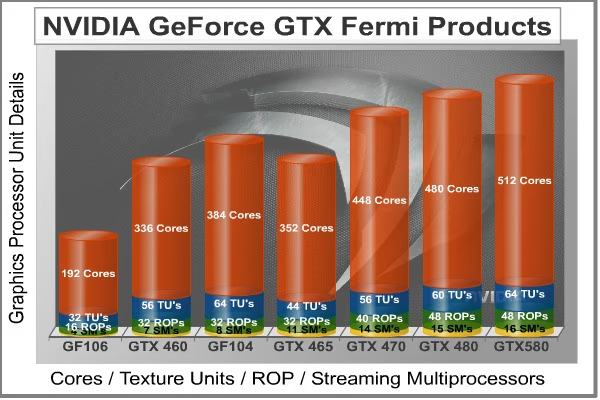
NVIDIA GeForce Fermi Graphics Card Family
Even if you're only after raw gaming performance and have no real-world interest in CUDA, there's reason to appreciate the GF100 GPU. New enhancement products, such as the NVIDIA GeForce 3D Vision Gaming Kit, double the demands on frame rate output and hence require more powerful graphics processing. This is where products like the GeForce GTX470 and GTX480 deliver the performance necessary to enjoy the extended gaming experience. I'm a huge fan of GeForce 3D-Vision, which is why it's earned our Editor's Choice Award, and Fermi delivers the power necessary to drive up to three monitors. The newly dubbed NVIDIA 3D-Vision Surround (stereo) requires three 3D-Vision capable LCD, projector, or DLP devices and offers bezel correction support. Alternatively, NVIDIA Surround (non-stereo) supports mixed displays with common resolution/timing.
Even some older game titles benefit by the Fermi architecture, beyond just an increase in frame rates. For example, Far Cry 2 will receive 32x CSAA functionality native to the game, but future NVIDIA Forceware driver updates could also further add new features into existing co-developed video games. Additionally, NVIDIA NEXUS technology brings CPU and GPU code development together in Microsoft Visual Studio 2008 for a shared process timeline. NEXUS also introduces the first hardware-based shader debugger. NVIDIA's GF100 is the first GPU to ever offer full C++ support, the programming language of choice among game developers.
Fermi is also the first GPU to support Error Correcting Code (ECC) based protection of data in memory. ECC was requested by GPU computing users to enhance data integrity in high performance computing environments. ECC is a highly desired feature in areas such as medical imaging and large-scale cluster computing. Naturally occurring radiation can cause a bit stored in memory to be altered, resulting in a soft error. ECC technology detects and corrects single-bit soft errors before they affect the system. Fermi's register files, shared memories, L1 caches, L2 cache, and DRAM memory are ECC protected, making it not only the most powerful GPU for HPC applications, but also the most reliable. In addition, Fermi supports industry standards for checking of data during transmission from chip to chip. All NVIDIA GPUs include support for the PCI Express standard for CRC check with retry at the data link layer. Fermi also supports the similar GDDR5 standard for CRC check with retry (aka "EDC") during transmission of data across the memory bus.
The true potential of NVIDIA's Fermi architecture has still yet to be seen. Sure, we've already poked around at the inner workings for our NVIDIA GF100 GPU Fermi Graphics Architecture article, but there's so much more that goes untested. Well into 2010, only a beta version of the Folding@Home client is available. The difference between work unit performance on the GeForce GTX 400-series is going to surpass ATI's Radeon HD 5000 series equivalents without much struggle, but it's uncertain how much better the performance will be compared to the previous-generations.
PNY GTX460-OC Conclusion
IMPORTANT: Although the rating and final score mentioned in this conclusion are made to be as objective as possible, please be advised that every author perceives these factors differently at various points in time. While we each do our best to ensure that all aspects of the product are considered, there are often times unforeseen market conditions and manufacturer changes which occur after publication that could render our rating obsolete. Please do not base any purchase solely on our conclusion, as it represents our product rating specifically for the product tested which may differ from future versions. Benchmark Reviews begins our conclusion with a short summary for each of the areas that we rate.
Gaming performance has already delivered a big win for the GeForce GTX 460 over ATI's Radeon HD 5830 video card, regardless of 768MB and 1GB variety. Given a modest factory overclock, the $235 PNY GTX 460 XLR8 Black Box Edition video card was able to outperform the ATI Radeon HD 5850, which sells for $55 more. Taking all of the collected test results into consideration, there were a few occasions when the PNY GTX460-OC also surpassed Radeon HD 5870 performance levels. It's also important for gamers to remember that only NVIDIA's GeForce GTX 460 video card can offer APEX PhysX and 3D-Vision functionality, and does so while producing less heat and requiring less power at idle. The PNY GTX 460 XLR8 easily captured the best price to performance ratio in most games tested, occasionally offering better value than the stock GeForce GTX 460. At the end of our test gauntlet, these results prove that PNY GTX460-OC is great choice at $235... and also a better choice than the GeForce GTX-465.
PNY GeForce GTX 460 Overclocked 1024MB GDDR5
Appearance is a more subjective matter since the rating doesn't have benchmark scores to fall back on. Many of NVIDIA's AIC partners have used custom cooling solutions in many of their own models, yet PNY decided to keep the reference look. Fortunately, the reference design is also the only one to expel heated air out through an externally exhausting vent. In my opinion, the PNY VCGGTX4601XPB-OC model sacrifices some fashion in place of added functionality.
In terms of NVIDIA video card pecking order, the GeForce GTX 460 occupies the #4 spot just barely behind the GTX 465 in the product lineup. Performance position is a difference matter, and the GTX 460 has proven itself a better product than the GTX 465. While the stock-clocked 1GB version settles between the ATI Radeon HD 5830 and 5850 for performance, the PNY GTX460-OC earned itself a position between the 5850 and $400 Radeon HD 5870. With so much power in a mid-level graphics board, this often creates an interest in a paired SLI set. Unfortunately, triple-SLI is not an option... but NVIDIA 3D-Vision Surround certainly is. As the first GF104 product (and fourth Fermi iteration), the GeForce GTX 460 has been designed with the same solid construction as its predecessors. There are exposed electronics on the back of the PCB, but nothing that protrudes enough to require a metal back-plate for protection. The top-side of the graphics card features a protective plastic fan shroud, which receives a recessed concave opening for the 75mm fan and allows for airflow in SLI configurations.
While most PC gamers and hardware enthusiasts buy a discrete graphics card for the sole purpose of playing video games, there's a very small niche who depend on the extra features beyond video fast frame rates. NVIDIA is the market leader in GPGPU functionality, and it's no surprise to see CPU-level technology available in their GPU products. NVIDIA's Fermi architecture is the first GPU to ever support Error Correcting Code (ECC), a feature that benefits both personal and professional users. Proprietary technologies such as NVIDIA Parallel DataCache and NVIDIA GigaThread Engine further add value to GPGPU functionality. Additionally, applications such as Adobe Photoshop or Premier can take advantage of GPGPU processing power. In case the point hasn't already been driven home, don't forget that 3D Vision and PhysX are technologies only available through NVIDIA.
As of 01 September 2010 the PNY VCGGTX4601XPB-OC model is not available at NewEgg, but it's appeared elsewhere for as low as $235 (Amazon lists for $254.97, but there are More Retailers with inventory). This price adds approximately $15 to the cost of a stock-reference GeForce GTX 460 model with no overclock. As an added perk, for a limited time PNY Technologies is offering a 25% discount for BFG Tech Customers.
Defining product value means something different to everyone. Some readers take heat and power consumption into consideration, while others are only concerned with FPS performance. With regard to value, there are several ways to look at this video card and compare it to the closest rivals: such as the $290 ATI Radeon HD 5850. In terms of product price to FPS performance, the GeForce GTX 460 is already one of the most affordable DirectX-11 video card products available. Here's a breakdown of the average cost (USD) per FPS recorded for the ten tests conducted for this article:
- $150 Radeon HD 5770 costs $7.14 per FPS
- $200 GeForce GTX 460 costs $7.03 per FPS (768MB version)
- $220 GeForce GTX 460 costs $7.12 per FPS (1GB version)
- $235 PNY GTX 460 XLR8 costs $6.85 per FPS (1GB version)
- $200 Radeon HD 5830 costs $7.90 per FPS
- $250 GeForce GTX 465 costs $8.35 per FPS
- $290 Radeon HD 5850 costs $8.97 per FPS
- $320 GeForce GTX 470 costs $8.49 per FPS
To the delight of many, operating temperatures are way down and suggest that this could be the coolest-running mid-range GeForce video card in a very long time. Idle power draw was a mere 19 watts by our measure, demonstrating that even an overclocked GeForce GTX 460 is more efficient than ATI's Radeon HD 5830 - and also demands half the power of the GTX 465. NVIDIA's Fermi GF104 GPU has done just as much for their professional image as it has for gamers and overclockers. PNY further extends our positive opinion with their GTX460-OC video card with a lifetime warranty (once registered), and two bundled extra's.
In conclusion, NVIDIA's GF104 Fermi GPU is exactly what the mid-range discreet graphics market needed. The 768MB version of the GeForce GTX 460 already beats the ATI Radeon HD 5830 at the $200 price point, the 1GB version deepens the divide, and now the PNY GeForce GTX 460 XLR8 overtakes the Radeon HD 5850 to help consumers save $55 in the process. It's been great to see NVIDIA offer budget-minded gamers so much value with the GTX 460, primarily because this video card series wins over the segment, but also because it overclocks well into the next level of graphics products. PNY has a solid winner on their hands with the XLR8 Black Box Edition, and gamers reap the benefits.
 Pros:
Pros:
+ PNY Lifetime product warranty
+ Extremely cool operating temperatures!
+ Consumes only 19 watts at idle
+ Best performer at $235 - easily beats Radeon HD 5850
+ Outstanding price-to-performance cost ratio
+ Fermi Introduces Error Correcting Code (ECC)
+ Massive overclock performance matches Radeon HD 5870
+ Quiet cooling fan under loaded operation
+ Includes native HDMI audio/video output
+ Adds 32x CSAA post-processing detail
+ Surpasses GeForce GTX 465 performance in most tests
+ Supports combined SLI functionality
+ Bundles two movie downloads and ESEA membership
Cons:
- Triple-SLI not supported
- PNY lacks overclocking software
Ratings:
- Performance: 9.00
- Appearance: 8.75
- Construction: 9.75
- Functionality: 9.50
- Value: 8.75
Final Score: 9.15 out of 10.
Excellence Achievement: Benchmark Reviews Golden Tachometer Award.
Benchmark Reviews encourages you to leave comments (below), or ask questions and join the discussion in our Forum.
Reader comments from the original article
36 comments were posted before commenting closed. They are preserved as written. Original avatars no longer resolve and are shown as a placeholder.
Apples vs apples ehume Permalink:
This looks like a promising card, especially with its cooling solution. I would appreciate a comparison between this card and the ASUS GTX 460 DirectCU TOP, which you also reviewed. How do they compare in performance and noise?
RE: Apples vs apples Olin Coles Permalink:
The PNY GeForce GTX 460 OC XLR8 is a great card, and performs roughly 5% behind the ASUS GTX 460 DirectCU TOP. They both cost about the same depending on where you shop, but the PNY version is externally exhausting and offers a lifetime warranty. Considering you could always further OC the PNY card, it seems like the better deal. In terms of noise, there's almost none... as in no audible sound. Even with the fan turned to 100% power, the PNY cooler is extremely quiet.
RE: PNY GeForce GTX 460 OC XLR8 Video Card Doug Permalink:
Meh! I'll upgrade my GTX 295 when I see a GTX 485 (x2) come out. Dual GPUs in one card is definitely the way to go. Triple monitor support, FTW!
RE: RE: PNY GeForce GTX 460 OC XLR8 Video Card Adam Permalink:
Keep a fire extinguisher on standby then.
It Works For Me RealNeil Permalink:
Two of these cards in SLI will be sufficient for me. I'm no world class gamer, I just like to do a little shooting on occasion and want to see good performance for a decent price. These things seem to have the low power consumption and heat output of the Radeon solutions, but they also support PhysX and Radeon doesn't yet. At this point, it's a no-brainer decision. Also, PNY has a RMA graphics card promotion specifically for BFG customers. Send in your BFG card, whether it works or not, and you'll receive a 25 percent discount on select PNY video cards. They'll also throw-in "Just Cause 2" from Square Enix by way of an online download redemption code. So those of you left holding the bag with BFG cards that malfunctioned, can get a better deal than the rest of us with PNY, and a free game. Visit PNY.com or call PNY directly at 1-888-316-1193. The promotion runs until October 31, 2010.
Wrong Memory Interface for 5770 Colton Permalink:
The 5770 has 128-bit not 256.
RE: Wrong Memory Interface for 5770 Olin Coles Permalink:
Yes, it does. I'll fix that typo right away. Thanks!
RE: RE: Wrong Memory Interface for 5770 Colton Permalink:
Also just noticed, the 4890 memory interface is wrong too. It's supposed to be 256-bit.
VS. MSI GTX 460 Hawk? jeffredo Permalink:
I've been hoping for a review of a reference GTX 460 1GB. Everyone seems to concentrate of third party cooling models and I was genuinely interested in seeing how the reference cooler fairs in a decently overclocked situation from a noise and temperature perspective. Now I see MSI is introducing the GTX 460 Hawk with its "Twin Frozr" type cooler. Any thoughts on if its more effective than the reference (both noise and cooling)?
RE: VS. MSI GTX 460 Hawk? Olin Coles Permalink:
We've already reviewed two versions of the reference design, and they're linked in each of our articles. The 1GB GTS 460 is located here: /index.php?option=com_content&task=view&id=558&Itemid=72 The GTX 460 Hawk review will be posted soon.
RE: VS. MSI GTX 460 Hawk? Servando Silva Permalink:
Just for your information, Twin Frozr performs better than reference heatsink, but it seems that Cyclone's cooler performs similar. Overall, GTX460 don't have temperature problems even with reference cooler unless mounting an SLI or having poor air-flow on your case.
RE: PNY GeForce GTX 460 OC XLR8 Video Card John Hack Permalink:
Love your reviews need noise measurements
RE: RE: PNY GeForce GTX 460 OC XLR8 Video Card jeffredo Permalink:
I agree. I would like to have as quiet a GTX 460 as possible and sound comparisons with the other graphics cards would help.
RE: RE: RE: PNY GeForce GTX 460 OC XLR8 Video Card Olin Coles Permalink:
This will be very difficult, since the last few video cards (GTX 465, GTX 460, GTS 450) have all been completely silent. Most sound level meters pick-up noise above 40 dBA, which is above where these products operate. For reference, my quiet Noctua 120mm fan is more audible than these video cards. You're right though, I haven't been making mention of the sound levels. I'll update my articles to make note of this. Thanks.
RE: PNY GeForce GTX 460 OC XLR8 Video Card dlb Permalink:
On page 13 of the review (the Metro2033 page), there are 2 graphs shown side-by-side in the single image. What does each graph represent? Obviously, they're showing frames-per-second, and I'm assuming that each graph represents a different group of settings, but what are the settings for each graph? Or is it a Min/Max type of thing? Also, under the graph (also on page 13), we find this statement: "When their flagship GeForce GTX 480 struggles to produce 27 FPS" but the GTX480 is not represented in any of the graphs on page 13.
RE: PNY GeForce GTX 460 OC XLR8 Video Card dlb Permalink:
I guess I can't edit my comment above - I wanted to add that in the chart at the bottom of page 13 (and several other pages), numerous video cards are listed with their individual specs. The GTX460 is listed as having 1024mb DDR5 (1gb) and 192-bit bus. Don't all 1gb GTX460s have a 256-bit bus? And the 768mb models have the 192-bit bus?
RE: RE: PNY GeForce GTX 460 OC XLR8 Video Card Olin Coles Permalink:
It seems that my specifications chart got buggered when one row was deleted, pushing the values over for all cards. This chart was then copied to each test result page, unfortunately repeating the error. They've since been fixed. In Metro 2033, the two results are 1920x1200 and 1680x1050. I've since replaced the chart with an updated image.
Fan Speed problems Antonio Permalink:
I have this very same card from PNY (1GB version). Two of them actually. And for the life of me I cannot get the fan speed to go past 70%. I have checked everywhere for a PNY one, and even called PNY and they had no idea what I was talking about. I even tried to use the EVGA update that fixes it for the EVGA cards and none of them detect the cards. Does anyone with these same cards know a way to get the fan speed to 100%? People mention noise a lot with cards, I don't mind noise, i want the fan speed. Any help would be appreciated.
RE: Fan Speed problems Antonio Permalink:
As a note, I don't have the overclocked version. My bad.
RE: RE: Fan Speed problems Olin Coles Permalink:
Like most NVIDIA cards since the 400-series, you cannot always reach 100% fan output. Some of the higher-end products that need it will reach this level (GTX 480), but most will not. This isn't a problem with the video card, but rather a programmed function of the BIOS.
Fan Speed problems Jeff Permalink:
Same for me as well (just checked with MSI Afterburner). I haven't had mine on anything but auto since I bought it (also have the regular 675 Mhz version, not OC). Even clocked at 825 Mhz its stays quite cool - no hotter than 68C.
RE: RE: RE: Fan Speed problems Antonio Permalink:
Thanks for the response guys. Yeah. EVGA and Gigabyte have released BIOS for their respective cards. Their BIOS allow the cards to go to "maximum" speed (theirs is stuck at 70% before the update)while PNY hasn't. Initially my card would stay about 68C before. Even while the card was overclocked. But for a couple of days now, even with my same overclock settings, the card will get to 80C and crash the game out. I purchased the card the Friday after Thanksgiving. So I got them recently. Note, when not overclocked the temps get about 70C under a full load.
RE: RE: RE: RE: Fan Speed problems Olin Coles Permalink:
Presuming the speeds were similar (but preferrably the same), you could flash the BIOS from of the unlocked fan to the PNY card. We even have a guide showing you how: /index.php?option=com_content&task=view&id=205
Fan Speed problems Jeff Permalink:
Yeah, flashing using Nvflash is pretty easy and I would think a BIOS from a reference GTX 460 of any brand should work. I'm leaving mine alone though. It runs cool and is incredibly quiet on 40% (which it never goes above on auto). I bought mine in late September and its been doing great.
RE: PNY GeForce GTX 460 OC XLR8 Video Card Antonio Permalink:
Correction from the post above, "theirs WERE stuck at 70% before the update." is what I meant to say.
RE: PNY GeForce GTX 460 OC XLR8 Video Card Raymond Permalink:
Can anyone tell me if this card supports 3 monitors and what card would support 3 monitors the best. Thank You-
RE: RE: PNY GeForce GTX 460 OC XLR8 Video Card Olin Coles Permalink:
You would need a second (identical) GeForce video card to power three monitors at once, or one AMD Radeon 6800/6900 video card if all monitors used DisplayPort connections.
Card problems Antonio Permalink:
I was still unable to fix the fan speed. The PNY card does not come with bios and nibitor 5.9 does not detect any display adapter on my PC.
RE: PNY GeForce GTX 460 OC XLR8 Video Card Wolfos Permalink:
2x PCI-e slots, does that mean it won't fit into my motherboard?
Just the Card + Cooler is that wide BruceBruce Permalink:
It doesn't actually fit into two PCI-E slots, it just takes up that much space, since the cooler is so thick. Almost all mid level and higher gaming cards are like this.
RE: Just the Card + Cooler is that wide Wolfos Permalink:
Good, I noticed that I do have 2 PCI-e slots, but only one is 16 pin. Since I've seen this card for as little as ?130 I think I'll be trying this one out.
Upgraded but now what? Shawn Permalink:
I just upgraded from two 9800GTs in SLI to two GTX 460's. Problem is I only have two PCIE 6-pin power connectors. That was fine with the 9800GTs because they only required one each but the GTX 460s require 2 PCIE 6-pin connectors each. I know I have more than enough power available in my 700Watt PS. Are there splitters available that can take a single 6-pin and make it two 6-pins? Any suggestions?
RE: Upgraded but now what? Olin Coles Permalink:
Not advisable. You'll want to get a PSU that offers four 6-pin (or breakable 8-pin) PCI-E connectors.
Use the Molex to PCI-E adapters BruceBruce Permalink:
In a pinch, you can use the 4-pin Molex (Think old HDD Power connector)to PCI-E adapters. Try to use different branches from the PSU to feed the two cards, don't daisy-chain everything together if you don't have to. Most video cards come with a couple of them included in the accessories. DON'T try to double up on the existing PCI-E connectors.
RE: Use the Molex to PCI-E adapters Shawn Permalink:
I only have two available 4 pin Molex connectors. The adapter that came with the card uses the two Molex adapters to power one PCIE 6-pin connecter. That leaves me one short, still no good. So the moral of the story is don't purchase these cards to replace your 9800GTs in SLI unless you are sure you have enough connectors from your existing PS, or unless you are replacining your PS as well.
Col John D Permalink:
Noted the question about splitting voltage source. When voltage is spread over added loops, the current (amperage) is deivided amonst them. This can lead to underpowered units, if the current ratings, required by the card (s) is based on each having full available PS. The switching PS may accommodate or adjust for this config, but to insure tht all units get the required amperage, you should check the connections on the PSS. The modular PSS seems to be applicable, as you can add lines PRN (as needed) with, hopefully, each getting its full share of the power. I just learned that the MOBO nad the BIOS can also have some effect or limitations on what you put into them. i.e. CPU2-Quads may require 105 watt MOBO, and the Intel DG965RY (mine) is only rated at 95 watts, hence the Quad may not be an option for this mobo. which leads to more questions...Watch the power dividing, as it can lead to underpowered unit