
Radeon HD5830 DirectX-11 Gaming Performance
Most of the discussion surrounding the Radeon HD5830 video card has been about its performance relative to its two nearest neighbors in the ATI lineup. People are falling over backwards trying to get a fix on its which side of the fence the 5830 belongs: closer to the HD5770, or nearer to the HD5850.
During Benchmark Reviews' recent evaluation of the Radeon HD 5830, we compared it to a wide variety of video cards, including several that are not compatible with Microsoft's DirectX-11 graphics API. Our graphics testing was designed to provide a level playing field for all the video cards, so we could compare apples-to-apples. It's the only way to make a fair comparison with older cards that readers may currently be using, and the current models from NVIDIA that are limited to DX10. Still, I was itching to see how the new crop of cards would fare with DX11 titles.
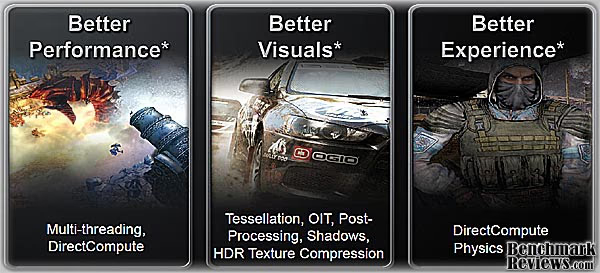
If we have the time, most reviewers will benchmark more test configurations than we report on, just so we can have the data available if we need it in the future. For instance, I wanted to be able to compare the Radeon HD 5830 to some lower mid-range cards in future reviews, so I also ran the test protocols that Benchmark Reviews has been using for more modestly priced graphics cards. That led me to think, about how the relative performance levels between two or three cards might shift around a bit, as some of the eye candy settings were cranked up and down.
The other motivator for running these additional tests was the fact that I really wanted to see how these upper-middle-class cards performed in the DirectX-11 environment. In my opinion, once the option to use DX11 is available, few people are going to want to turn it off, particularly after they see the results. It's just human nature; no one likes losing what they've already got. That's especially true with disruptive technologies like tessellation.
Please follow along as we take a deep dive into DirectX-11 performance for the ATI Radeon A-Team.
About the company: ATI
Over the course of AMD's four decades in business, silicon and software have become the steel and plastic of the worldwide digital economy. Technology companies have become global pacesetters, making technical advances at a prodigious rate - always driving the industry to deliver more and more, faster and faster.
However, "technology for technology's sake" is not the way we do business at AMD. Our history is marked by a commitment to innovation that's truly useful for customers - putting the real needs of people ahead of technical one-upmanship. AMD founder Jerry Sanders has always maintained that "customers should come first, at every stage of a company's activities." We believe our company history bears that out.
ATI Radeon HD 5830 Specifications
If we just talk about the HD 5830 GPU, and the architecture that supports it, then this section is the second most important part of this review. There has been endless conjecture throughout the industry and among enthusiasts about how ATI was going to tweak the basic ingredients in order to hit the sweet spot that exists in the fairly wide performance gap between the HD 5770 and HD 5850. By way of introduction, I'll just say that when a group of journalists recently saw this chart, they had more questions after they saw it than they did before. Fortunately, ATI was very open with us and gave us some insights into the development process, which you can read about in the launch-day feature we did on the ATI Radeon HD 5830.
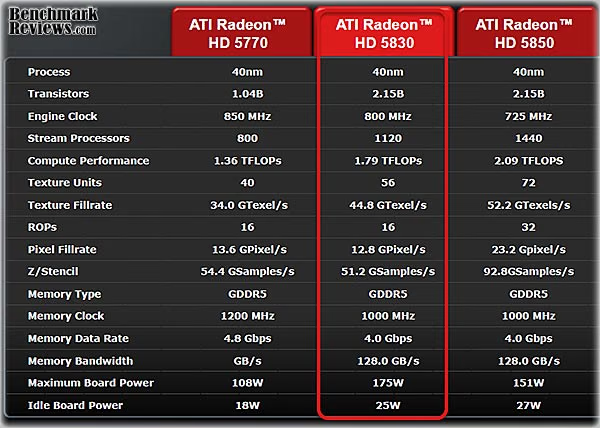
Specs are very important for this product, because they tell a vital part of the story. However, I believe the most important part is the testing section, where we finally get to see how the HD 5830 performs. Although you might think that pricing belongs in the top two, it has a life of its own, and it's very difficult to accurately predict where the price will eventually settle. The video card market has always been very dynamic, and with the upcoming (we all hope...) introduction of FERMI-based products from NVIDIA, there are going to be some major wrinkles in the market pricing structure that will have to be ironed out pretty quickly. For now, take a look at where the various versions of the HD5000 series end up relative to one another on this price v. performance chart, and remember this is all based on launch pricing...

The HD 5830 is likely built with chips that had a defect that killed one or more of the stream processor units. As anyone who has followed the AMD product line knows, modern processors are designed with the capability of disabling portions of the die. Sometimes, it's done because there are defects on the chip (usually a small particle of dust that ruins a transistor) and all the internal sections don't pass testing. Sometimes it's done with perfectly good chips because the manufacturer needs to meet production requirements for lower cost market segments. Given the well publicized issues with 40nm manufacturing yields at TSMC, I seriously doubt that ATI is crippling perfectly good chips, just to sell more lower-spec cards. With the release of this minor variant, ATI finally has all the major bases covered for cards based on the Cypress class GPUs.
ATI made the decision to reduce the number of Stream Processors a little more aggressively than they did when they created the HD 5850. They "took away" 320 Shaders this time, instead of only 160. This accomplishes two very important things; it keeps the HD 5830 far enough away from the HD 5850 to prevent cannibalizing sales of that very popular card. It also helps ATI "recover" more defective Cypress GPU chips, which is very helpful when your supplier is having extended manufacturing yield problems with their latest technology node. The downside to only having 1120 Stream Processors is that the GPU had to run a fairly high clock rate in order to hit the performance target that was the whole reason behind this product's very existence. ATI wanted the HD 5830 to hit the exact middle of the performance gap between the 5770 and 5850, too far one way or the other and you haven't really filled the gap. Based on their internal testing, ATI feels they hit the mark. Pay attention to the scaling of this chart....the key takeaway is how close to the middle, between the high and low bars on the left and right, that the HD 5830 bar lands.

So, the stock clock for the HD 5830 came to be set at 800 MHz, and we have the strange situation where the lower performing HD 5830 actually needs more power than the HD 5850, which normally runs at a relatively slow clock rate of 725 MHz when it leaves the factory. This turns out to have the unintended consequence of requiring the HD 5830 boards to have a more robust power supply than the HD 5850. Indeed, the guidance given to the AIB partners was to use the power supply specs from the HD 5870 when designing their boards for the HD 5830. I'm sure the Electrical Engineers understood what had happened, but I'm just as sure that the Product Marketing people were having a cow over this thought.
So now we know a little more about why it's built the way it is. Let's look at how it performs with the latest and most sophisticated graphics API Microsoft has released to date. First, a few words about testing methodology.
Video Card Testing Methodology
A word about Benchmarks Review's testing philosophy is in order, here. In almost all of our test protocols, we select the most advanced and challenging settings that are available for each benchmark. We realize that this may not represent the best setting for a user's experience with the game, e.g. no one would choose to run Crysis at 10 FPS if they didn't have to. It's hard enough to watch some of the benchmarks run at that frame rate; actual game play would be just about pointless. Nevertheless, the history of computing, and particularly that of CPUs and GPUs, has shown that hardware always catches up, and then passes the software. So, it makes sense to set the bar high from the beginning, when setting up benchmarks that will have to span multiple generations of hardware.
Our site polls and statistics indicate that the over 90% of our visitors use their PC for playing video games. Since all of the benchmarks we use for testing represent different game engine technology and graphic rendering processes, this battery of tests will provide a diverse range of results for you to gauge performance on your own computer system. The benchmark applications are capable of utilizing lower versions of DirectX, but all testing in this article was completed using DirectX-11, since that was the primary purpose for this follow-up test.
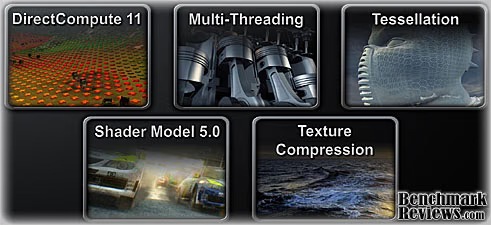
At the start of all tests, the previous display adapter driver is uninstalled and trace components are removed using Driver Cleaner Pro. We were able to use the same driver for all testing in this case, Catalyst 8.703.0.0, which was a point release that occurred to support the release of the HD5830. We then restart the computer system to establish our display settings and define the monitor. Once the hardware is prepared, we begin our testing. According to the Steam Hardware Survey published at the time of Windows 7 launch, the most popular gaming resolution is 1280x1024 (17-19" standard LCD monitors) closely followed by 1024x768 (15-17" standard LCD). However, because these resolutions are considered 'low' by gaming standards, our benchmark performance tests in this follow-up article relied strictly on the native monitor resolution of 1920x1200.
Each benchmark test program begins after a system restart, and the very first result for every test will be ignored since it often only caches the test. This process proved extremely important in the DiRT 2 benchmarks, as the first run served to cache maps allowing subsequent tests to perform much better than the first. This was most evident on the Minimum FPS results, but it had a measureable effect on the average as well. Each test is completed five times, the high and low results are discarded, and the average of the three remaining results is displayed in our article.
Test System
-
Motherboard: ASUS M4A79T Deluxe (2205 BIOS)
-
System Memory: 2x 2GB OCZ Reaper HPC DDR3 1600MHz (7-7-7-24)
-
Processor: AMD Phenom II 720 Black Edition (Overclocked to 3.6 GHz)
-
CPU Cooler: CoolerMaster Hyper Z600
-
Video: ATI Radeon HD 5830, Engineering Sample
-
Drive 1: OCZ Summit SSD, 60GB
-
Optical Drive: Sony NEC Optiarc AD-7190A-OB 20X IDE DVD Burner
-
Enclosure: CM STORM Sniper Gaming Case
-
PSU: Corsair CMPSU-750TX ATX12V V2.2 750Watt
-
Monitor: SOYO 24"; Widescreen LCD Monitor (DYLM24E6) 1920X1200
-
Operating System: Windows 7 Ultimate Version 6.1 (Build 7600)
Benchmark Applications
-
Unigine Heaven Benchmark (DX11, High Shaders, Tessellation, 16x AF)
-
S.T.A.L.K.E.R. Call of Pripyat Benchmark (Ultra-Quality, Enhanced DX11 lighting, SSAO Default-High)
-
DiRT 2 Demo Benchmark (DX11, Preset-Ultra, Tessellation, 16x AF)
Video Card Test Products
| Product Series | Stream Processors | Core Clock (MHz) | Shader Clock (MHz) | Memory Clock (MHz) | Memory Amount | Memory Interface |
|---|---|---|---|---|---|---|
| ATI Radeon HD 5770 (Engineering Sample) | 800 | 850 | N/A | 1200 | 1.0GB GDDR5 | 128-bit |
| ATI Radeon HD 5830 (Engineering Sample) | 1120 | 800 | N/A | 1000 | 1.0GB GDDR5 | 256-bit |
| XFX Radeon HD 5850 (21162-00-50R) | 1440 | 725 | N/A | 1000 | 1.0GB GDDR5 | 256-bit |
| ATI Radeon HD 5870 (Engineering Sample) | 1600 | 850 | N/A | 1200 | 1.0GB GDDR5 | 256-bit |
- ATI Radeon HD 5770 (Engineering Sample - Catalyst 8.703.0.0)
-
ATI Radeon HD 5830 (Engineering Sample - Catalyst 8.703.0.0)
-
XFX Radeon HD 5850 (21162-00-50R - Catalyst 8.703.0.0)
- ATI Radeon HD 5870 (Reference Design - Catalyst 8.703.0.0)
Unigine Heaven DX11 Benchmark Results
Unigine Corp. released the first DirectX-11 benchmark "Heaven", based on its proprietary UnigineTM engine. The company has already made a name among the overclockers and gaming enthusiasts for uncovering the realm of true GPU capabilities with previously released "Sanctuary" and "Tropics" demos. Their benchmarking capabilities are coupled with striking visual integrity of the refined graphic art.
The "Heaven" benchmark provides the following key features:
-
Native support of OpenGL, DirectX-9, DirectX-10 and DirectX-11
-
Comprehensive use of tessellation technology
-
Advanced SSAO (screen-space ambient occlusion)
-
Volumetric cumulonimbus clouds generated by a physically accurate algorithm
-
Dynamic simulation of changing environment with high physical fidelity
-
Interactive experience with fly/walk-through modes
-
ATI EyeFinity support
The distinguishing feature of the benchmark is a hardware tessellation that is a scalable technology aimed for automatic subdivision of polygons into smaller and finer pieces, so that developers can gain a more detailed look of their games almost free of charge in terms of performance.
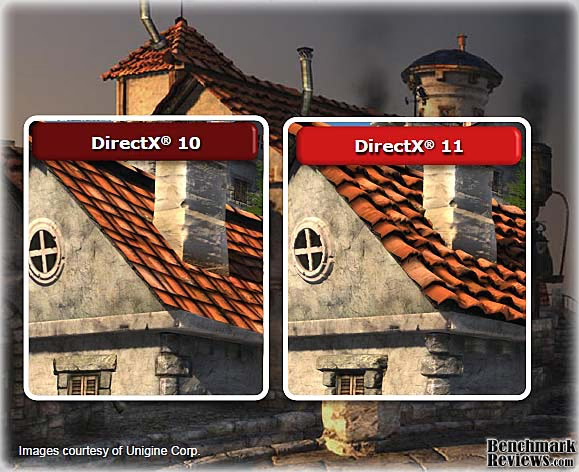
Unigine Corp. is an international company focused on top-notch real-time 3D solutions. The development studio is located in Tomsk, Russia. Main activity of Unigine Corp. is development of UnigineTM, a cross-platform engine for virtual 3D worlds. Since the project started in 2004, it has attracted the attention of many different companies and groups of independent developers, because Unigine is always on the cutting edge of real-time 3D visualization and physics simulation technologies.

The Heaven benchmark from Unigine offers the best evidence for explaining how the HD 5830 came to be seen as a weak offering in some testing scenarios. As the amount of multi-sampling anti-aliasing is increased, from zero to 8x, performance of the 5830 moves closer and closer to that of the 5770. In fact, the 5770 loses the least amount of fps performance with increasing MSAA; the 5850, 5830, and 5770 lose 11.1, 10.3 and 8.8 fps respectively. This seems counter-intuitive, until you remember that the lowly 5770 has the highest GPU clock rate and the highest memory clock. True, it has a memory bus that's only half as wide as the 58xx series cards, but for MSAA apparently, speed matters. Regardless of the reasons why, the fact is that without MSAA, the HD 5830 covers 43% of the gap between the 5770 and 5850, and with 8x MSAA in play, it only covers 33% of the gap between the cards above and below it. We're not talking huge differences here, but people have been hyper-critical of the HD 5830. Anything less than splitting the gap exactly, or better, has been called a failure by the on-line community, as far as I can tell.
So, depending on how you measure the HD 5830, you get two different versions of reality. Neither of them is right or wrong, they're just different. ATI feels that they hit their performance target of splitting the gap as precisely as possible, but the data they present to back it up has this foot note: "Games are measured at standard settings with AF and AA off unless otherwise noted." There is some variation among review sites, but most of them show at least some benchmarks that have both AF and AA enabled, if not maxed out. As I mentioned earlier, Benchmark Reviews generally publishes results that are obtained with the most demanding settings available in each benchmark program. You can see how this may have impacted the results for the HD 5830 and placed it at a performance disadvantage, relative to the HD 5850 in some tests.
| Product Series | Stream Processors | Core Clock (MHz) | Shader Clock (MHz) | Memory Clock (MHz) | Memory Amount | Memory Interface |
|---|---|---|---|---|---|---|
| ATI Radeon HD 5770 (Engineering Sample) | 800 | 850 | N/A | 1200 | 1.0GB GDDR5 | 128-bit |
| ATI Radeon HD 5830 (Engineering Sample) | 1120 | 800 | N/A | 1000 | 1.0GB GDDR5 | 256-bit |
| XFX Radeon HD 5850 (21162-00-50R) | 1440 | 725 | N/A | 1000 | 1.0GB GDDR5 | 256-bit |
| ATI Radeon HD 5870 (Engineering Sample) | 1600 | 850 | N/A | 1200 | 1.0GB GDDR5 | 256-bit |
Let's take a look at another benchmark, a decidedly less cheerful scenario in a post-apocalyptic "Zone", which is traversed by mercenary guides called Stalkers.
S.T.A.L.K.E.R.: Call of Pripyat Benchmark DX11 Results
The events of S.T.A.L.K.E.R.: Call of Pripyat unfolds shortly after the end of S.T.A.L.K.E.R.: Shadow of Chernobyl. Having discovered about the open path to the Zone center, the government decides to hold a large-scale military "Fairway" operation aimed to take the CNPP under control. According to the operation's plan, the first military group is to conduct an air scouting of the territory to map out the detailed layouts of anomalous fields location. Thereafter, making use of the maps, the main military forces are to be dispatched. Despite thorough preparations, the operation fails. Most of the avant-garde helicopters crash. In order to collect information on reasons behind the operation failure, Ukraine's Security Service sends their agent into the Zone center.
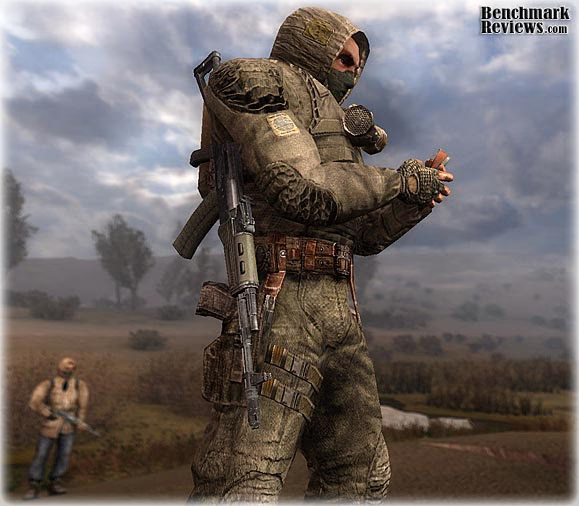
S.T.A.L.K.E.R.: CoP is developed on X-Ray game engine v.1.6, and implements several ambient occlusion (AO) techniques including one that AMD has developed. AMD's AO technique is optimized to run on efficiently on Direct3D11 hardware. It has been chosen by a number of games (e.g. BattleForge, HAWX, or the new Aliens vs. Predator) for the distinct effect in it adds to the final rendered images. This AO technique is called HDAO which stands for ‘High Definition Ambient Occlusion' because it picks up occlusions from fine details in normal maps.
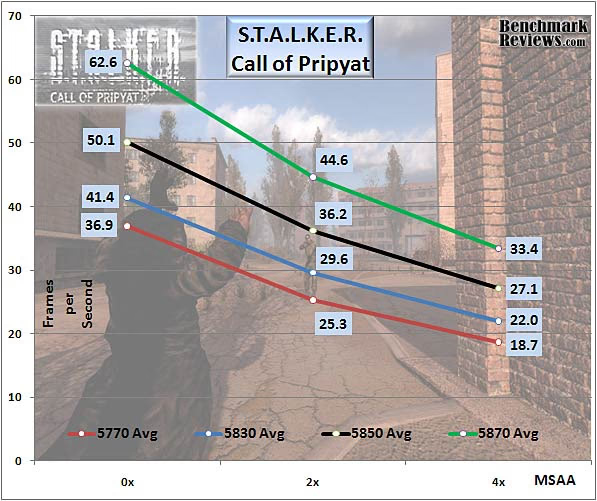
S.T.A.L.K.E.R.: Call of Pripyat is very sensitive to MSAA, and has a very steep decline in frame rates when going from zero MSAA to the maximum value of 4X. The other two benchmarks went up to 8x, remember and neither of them suffered anywhere near this 49% decline in fps, as MSAA was increased to the max. In S.T.A.L.K.E.R.: CoP, we also see a reversal from the results of Heaven, as the HD 5830 actually improves its standing as MSAA is increased. My personal names for these two benchmarks are "Heaven and Hell", so it's not surprising that they contradict one another.
Without MSAA, the 5830 bridges 34% of the difference in performance between the HD 5770 and HD 5850, and at 4x MSAA it achieves 39%. Again, not a big difference between the two extremes, but it just goes to show that performance is ultimately dependant on the software in use. Whether it's the game application itself, or the benchmarking instance, or the driver package, there's no getting around and no predicting how the software will influence the test results.
| Product Series | Stream Processors | Core Clock (MHz) | Shader Clock (MHz) | Memory Clock (MHz) | Memory Amount | Memory Interface |
|---|---|---|---|---|---|---|
| ATI Radeon HD 5770 (Engineering Sample) | 800 | 850 | N/A | 1200 | 1.0GB GDDR5 | 128-bit |
| ATI Radeon HD 5830 (Engineering Sample) | 1120 | 800 | N/A | 1000 | 1.0GB GDDR5 | 256-bit |
| XFX Radeon HD 5850 (21162-00-50R) | 1440 | 725 | N/A | 1000 | 1.0GB GDDR5 | 256-bit |
| ATI Radeon HD 5870 (Engineering Sample) | 1600 | 850 | N/A | 1200 | 1.0GB GDDR5 | 256-bit |
In our next section, we look at DirectX-11 performance in my favorite new game, DiRT 2.
DiRT-2 Demo DX11 Benchmark Results
DiRT 2 features a roster of contemporary off-road events, taking players to diverse and challenging real-world environments. This World Tour has players competing in aggressive multi-car, and intense solo races at extraordinary new locations. Everything from canyon racing and jungle trails to city stadium-based events. Span the globe as players unlock tours in stunning locations spread across the face of the world. USA, Japan, Malaysia, Baja Mexico, Croatia, London, and more venues await, as players climb to the pinnacle of modern competitive off-road racing.
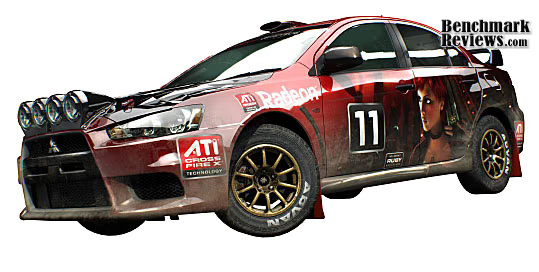
In addition to the World Tour, DiRT 2 will come complete with full online functionality that will be core to the overall experience, with head-to-head competitive online play and new social features to engage the racing community. Prepare for mud, gravel, dust and dirt too, in DiRT 2.

The relative performance of the Radeon HD 5830 in the DIRT 2 Demo is pretty consistent as MSAA is first introduced, and then increased to a maximum of 8x. The 5830 reaches just 23% of the way into the gap with no MSAA, and achieves 20% at 8x MSAA. Both ends of the chart (and the middle, too) tell the same story; that the 5830 falls short of splitting the 5770-5850 performance gap in this benchmark. Fortunately, two things work in your favor with this game. One, the falloff in performance as MSAA is increased is relatively small. You only lose 11% on the HD 5830 as you go from zero to 8x MSAA. Two, both the actual game and the demo are easy loads for the graphics hardware, and the average frame rates never dipped below 30fps no matter what I did with any of the cards. Minimum frame rates are pretty high, compared to the average, as well. Once the application had been loaded into cache, minimum frame rates went up by about 10fps, and I experienced no stuttering during the benchmark.
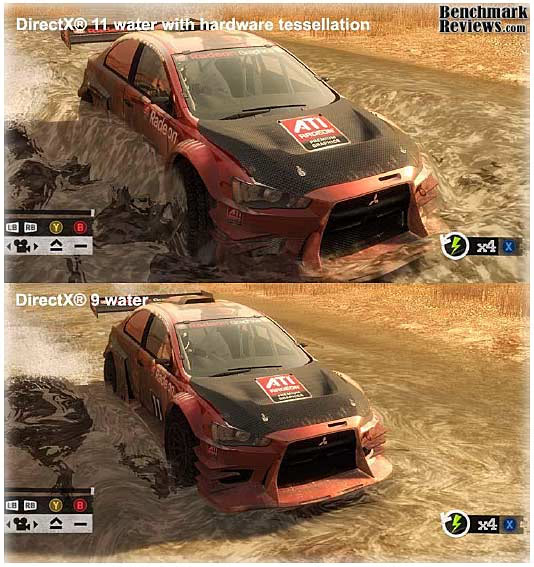
The primary contribution that DirectX-11 makes to the DiRT 2 Demo benchmark is in the way water is displayed when a car is passing through it, and in the way cloth items are rendered. The water graphics are pretty obvious, and there are several places in the Moroccan race scene where cars are plowing through large and small puddles. Each one is unique, and they are all believable, especially when more than one car is in the scene. The cloth effects are not as obvious, except in the slower-moving menu screens; when there is a race on, there's precious little time to notice the realistic furls in a course-side flag. I should also note that the flags are much more noticeable in the actual game than in the demo, so they do add a little more to the realism there, that is absent from the benchmark. On a side note, I appreciate the fact that the built-in benchmark has variable game play. I know it's lame, but I most always watch it intently, just to see how high "my" car places. So far, my best telekinetic efforts yielded a second place finish!
Radeon HD5830 DX11 Final Thoughts
Why did ATI leave such a big hole in their product line, for so long? The flagship ATI video cards made a huge splash last September, but according to Mercury Research, cards costing over $200 only make up 7% of the market, and the 57xx series landed in the $100-$200 range, which makes up 27% of the market. That leaves a huge opening in the sub-$100 market, and ATI was busy filling in the gaps with all new, DirectX-11 capable cards in this segment. Enthusiasts may laugh at the diminutive HD55xx series and the HD5450, with its 80 shaders, but they provide a much-needed revenue stream for ATI. Don't begrudge them that, it's what pays for the entire R&D effort that produced the 58xx series in the first place.
Each of the three benchmarks I used for these tests implements the new DirectX-11 features in a unique way. For instance, there is an immense difference in the visual representation of the landscape in Unigine-Heaven when switching from DX10 to DX11. It's not too far from the truth to say that "The stones come alive..." in this benchmark when tessellation is turned on. The difference is many times more impressive than any change in Anisotropic Filtering or Multi-Sample Anti-Aliasing. For this benchmark, presuming it represented an actual game, my recommendation for optimal graphics performance would be to turn on DX11 with tessellation, then adjust the MSAA to get a playable frame rate. Of all the current benchmarks that are capable of displaying DX11 graphics, this one is the most dramatic in its demonstration of the available technology. I believe it's the best example we have today, of the level of improvements in graphics design that are just over the horizon. I can only say, based on what I see here, that DirectX-11 is here to stay and it's worth slowing down some of the other processing tasks in order to take advantage of it.

The DiRT 2 Demo benchmark is a bit of an anomaly, in that the demo was released well before the actual game, and it does not showcase the true graphics capability in the final product. Codemasters was hard at work until the very last second; incorporating the new DX11 features into the product, knowing that they had the chance to be one of the first gaming titles available with DirectX-11. Unlike Heaven, which is a pure technology demonstration, the developers of DIRT 2 had a full game to code, so they were not able to fully utilize all of the techniques available in Microsoft's new graphics API. I'm sure they wish it had been available from the beginning of the project, as DX11 has a number of new tools that make life easier for the developer. That's one of the reasons most of the studios were actively approaching Microsoft to get on board as quickly as possible; a major shift in attitude from when DX10 and DX10.1 were released. Microsoft had to go out and sell those toolsets to the industry; with DX11, people were practically begging for it.

Overall, the visual impact of DirectX-11 technology to the DiRT 2 Demo is much less than what is seen in Unigine-Heaven. There was only so much the developers could fit in, given the schedule pressures. There is no "switch" to use DX10 or DX11 in the benchmark, the benchmark automatically defaults to DX9 if all the pieces aren't in place to use DX11. A wide variety of rendering features, including Tessellation and Cloth, are individually selectable, and most have quality levels that you can choose. There is also a handy little FPS estimator built into the graphics configuration menu that shows the approximate impact on frame rates in real-time, as you make your menu picks.
S.T.A.L.K.E.R.: Call of Pripyat has a very grainy look to it, almost like old film stock. As older photographers know, there is actually a wealth of information embedded in those jagged textures that is hard to capture in a meaningful way with the regular, monotonic array of pixels in a digital image. Because the grains in film are self-organizing, they have the ability to create an additional level of detail that can only be captured by a digital image that has a resolution an order of magnitude higher. Just ask anyone who has tried to scan their old photos with their brand new flatbed scanner... To the degree that some of us grew up watching movies in the cinema, instead of our living room, that "film" look triggers some deeply ingrained thought processes in our brain. It's a trick that will lose its Mojo in a couple of generations, but for now, it adds some realism to this video game. If you doubt this, ask yourself why almost all the graphic artists in the gaming industry add lens flare to the sunny scenes. That oblique line-up of 10-20 pale yellow disks, arranged in groups of five or six, is an artifact from the complex zoom lenses used in filmmaking. Somehow, it looks natural to most viewers, even though it is completely artificial.

It's not in my general nature to be satisfied for long; every new answer always seems to beg a new question. In this case, I met the goals I had at the beginning of the project, and the questions that remain after this exercise all relate to what-if scenarios. What if FERMI had been released in 2009? What if 40nm chips had been in plentiful supply? What if the chip pricing from TSMC didn't have to make up for the cost of all the defective wafers? What if ATI had chosen the Large-Die strategy? What if DirectX-11 had been buggy? What if the 5830 had been able to keep all its ROP units? All questions that are likely to go unanswered; like I said, it's not in my nature to be satisfied. I am happy, however, in anticipation of some wonderful new graphics that are still in the works right now, in studios around the world. And I'm confident that the hardware we have today will be able to take full advantage of the latest rendering techniques that will be put on display in the very near future.
Radeon HD5830 DirectX-11 Conclusion
I didn't have any preconceived notions going into these tests; I did have two goals, though. I wanted to see how well these cards worked in DirectX-11, and I wanted to see if the relative performance of the HD 5830 shifted around as a result of using DX11. The enthusiast community has been very vocal about the performance they wanted to see in the Radeon HD 5830. Right or wrong, their expectations were pretty tightly defined, and I think it's a fair assessment to say those expectations were not exceeded on launch day. Given the increasing role DirectX-11 is going to play in future gaming titles, it looked like a good idea to benchmark the DX11 performance of these cards a little deeper than has been done by anyone else, to date.

First off, the performance of all the cards in DirectX-11 was generally in line with the DX10 results. All three benchmarks took a minor hit to the average frame rate, but there were no major degradations in rendering speed. It's nothing like some of the results we saw earlier this year, when Benchmark Reviews switched all our testing from DX9 to DX10. Crysis took about a 50% hit then, for very little gain in image quality. In contrast, the visual enhancements from fully developed DirectX-11 techniques are nothing short of stunning. Heaven's just not Heaven without it, IMHO.
The relative performance between the three Radeon HD 5xxx options in the $150-$300 range was not shifted consistently one way or the other when using the DirectX-11 graphics API. To me, that's a good sign, because it indicates that DX11 is what's called "hardware agnostic". But, perhaps I'm being a little too optimistic, since almost all DX11 coding was done by developers working on an ATI Radeon platform. We will have to do the same type of testing when the Fermi platform finally hits the market, with a wide enough range of video cards to see a difference. Please, no G92 re-brand jokes.

Anti-Aliasing has always been handled a little differently by the Red and Green teams. That's one reason I chose to test every single MSAA setting with this batch of cards. Once we have competitive cards from NVIDIA, I want to be able to compare the performance penalties across product lines. There were major differences between the individual benchmarks in how much performance was traded away as Multi-Sample Anti-Aliasing was increased. S.T.A.L.K.E.R.: Call of Pripyat suffered the worst, with a 49% decline in frame rates, as MSAA was increased to the maximum of 4x. Certain components of image quality are completely subjective, but there's no way that I would say that image quality improved by the same 49%, when using the maximum allowable MSAA. I say, stick with 2x MSAA unless you have GPU power to burn. It's just not worth the penalty to go any higher.
I'm happy with the DirectX-11 performance of the ATI Radeon HD 5830 in the DX11 benchmarks that I normally use. There isn't the same performance hit that we saw when upgrading from DX9 to DX10, and the increase in visual quality is definitely a major step forward. I'm also confident that the relative performance ranking of the 5770, 5830 and 5850 remain unaffected by the introduction of DX11. Some have said, in Washington DC terms, that the HD 5830 leans to the left; i.e. it promises more than it delivers, and it costs too much. I say that it will quickly seek its own level in the market, an institution that has a better track record than any marketing department for calculating and assigning value.
What can we conclude from these few tests with DirectX-11 benchmarks and ATI's latest Radeon 5xxx video card? 1.) DirectX-11 offers the opportunity for a significant step up in image quality. Once people get a taste of it, they will not want to go back to DX9 or DX10. 2.) DirectX-11 techniques like tessellation offer a more efficient way of improving image quality than older techniques like Anisotropic Filtering and Multi-Sample Anti-Aliasing. S.T.A.L.K.E.R.: Call of Pripyat offers the most compelling evidence: 8x MSAA basically reduces the frame rate in half, for a moderate increase in visual quality. That's not a very efficient use of technology, IMHO. 3.) Every game and benchmark is different. There are just so many variables in the way video graphics are constructed and then optimized, that it's impossible to accurately predict the performance of a new hardware product, even if it is built on a familiar architecture. 4.) The HD 5830 is a victim of the HD 5850's success. Sometimes the DNA strands just snap into place, and a star is born; the 5850 is an Olympic medalist in a family of college all-stars.
Introducing DirectX-11 into the comparison does nothing to change the outcome of a friendly game of one-on-one between the Radeon 5xxx siblings. 5.) Testing video cards with different levels of MSAA is a good idea, since it can affect the relative performance levels between two or more cards. By relaxing the MSAA in the Heaven benchmark, the HD 5830 picked up 10 percentage points against the competition. 6.) Consequently, it looks like there is still room for fine tuning of in-game settings in order to maximize the total experience. That's always been a part of PC gaming, the opportunity for diligent tyros to make their box run the latest titles better than everyone else's, even with the same hardware. The more things change, the more they remain the same.
The ATI Radeon HD 5830 is avialable in many speeds and cooling options. The PowerColor PCS+ version offers better cooling and a factory overclock for $240, and as of March 2010 this is the most affordable model. Gigabyte ($250) and Sapphire ($250) also offer reference models at a decent price.
Questions? Comments? Benchmark Reviews really wants your feedback. We invite you to leave your remarks in our Discussion Forum.
Reader comments from the original article
1 comment were posted before commenting closed. They are preserved as written. Original avatars no longer resolve and are shown as a placeholder.
Great article Corey Permalink:
Awesome! I to was wondering these same things about these cards after I bought 5770, thaNKS FOR the great comparision, looking forward to that Nvidia fermi release later this month and will be back for your review!