
OCZ RevoDrive X2 PCI-Express SSD
OCZ RevoDrive X2 PCI-Express SSD Review
Over the past several years, OCZ have transformed themselves from an enthusiast system memory brand into a recognized name for high-performance storage devices. They've earned consumer praise for their ability to deliver Solid State Drive technology at a reasonable price, and they push the boundaries with their High Speed Data Link project. There's a solid middle ground between SATA and HSDL, and that's the PCI Express bus. Not long ago Benchmark Reviews tested the SandForce-driven OCZ RevoDrive, and now we're back with the high-level version of that product: OCZ RevoDrive X2. Now using four SF1200 SSDs in RAID-0, the RevoDrive X2 series is capable of up to 120,000 IOPS at speeds up to 740 MB/s.
Solid State Drive technology has become the high-performance option for SATA-drive upgrades, yet these ultra-fast NAND components are capable of so much more. Most computers are capable of offering 3.0 GB/s bandwidth via second-generation SATA controllers, which is fast enough for most general power-users. Although the latest desktop motherboards have incorporated third-generation SATA controllers good for up to 6.0 GB/s bandwidth, there's currently only one SSD storage product capable of utilizing this speed (as of September 2010). PCI-Express is an ideal alternative, since it doesn't require an add-on chip to support a new standard and still offers 5.0 GB/s bandwidth.
Storage standards and bandwidth aside, it's understandable why SSDs were developed on a drive profile first: notebook and desktop hard disk drive upgrades offered a tremendous user-base. Unfortunately, SSDs were introduced with premium prices that rendered many consumers numb with sticker shock. As the technology became more prevalent, prices have also become more affordable and power-users have embraced the performance SSDs are known to offer. Now the market is ready for the next step: high-performance PCI-Express SSDs built for hardware enthusiasts. Enter the OCZ RevoDrive X2 PCI-E SSD series.

SSDs have the power to transform slow computers into blazing-fast speed machines, and PCI-E SSDs can further amplify these improvements. The SandForce SF-1200 has quickly become the de facto SSD controller for companies seeking recognition, and for good reason. The OCZ RevoDrive X2 embraces four independent SandForce SF-1222TA3-SBH (SF-1200) processors in RAID-0 to produce up to 120,000 combined IOPS (with only 7% over-provisioning) to generate maximum performance with optimal capacity. SandForce RAISE technology provides redundant protection for single SSD computer systems, while data is automatically secured with AES-128 encryption on 240GB of hand-picked high-performance Intel NAND flash memory modules. In this article, Benchmark Reviews tests the 240GB OCZ RevoDrive X2 SSD (model OCZSSDPX-1RVDX0240) against the fastest storage solutions on the market.
The biggest mistake PC hardware enthusiast make with SSDs is grading them by their speed. File transfer speed is important, but only so long as the operational IOPS performance can sustain that bandwidth under load. Benchmark Reviews tests the OCZ Revo SSD against some of the most popular storage devices available and demonstrates that 4K IOPS performance is more important than bandwidth speed. Additionally, Benchmark Reviews has previously tested two similar SSDs to publish our SandForce SF1200 RAID-0 SSD Performance review.
Manufacturer: OCZ Technology Group, Inc.
Product Name: RevoDrive X2 PCI-E SSD
Model Number: OCZSSDPX-1RVDX0240
Price As Tested: $648.40 at Amazon / $679 at NewEgg
Full Disclosure: The product sample used in this article has been provided by OCZ Technology Group, Inc.
Bandwidth Speed vs Operational Performance
As we've explained in our SSD Benchmark Tests: SATA IDE vs AHCI Mode guide, Solid State Drive performance revolves around two dynamics: bandwidth speed (MB/s) and operational performance (IOPS). These two metrics work together, but one is more important than the other. Consider this analogy: operational IOPS performance determines how much cargo a ship can transport in one voyage, and the bandwidth speed is to fast the ship moves. By understanding this and applying it to SSD storage, there is a clear importance set on each variable depending on the task at hand.
For casual users, especially those with laptop or desktop computers that have been upgraded to use an SSD, the naturally quick response time is enough to automatically improve the user experience. Bandwidth speed is important, but only to the extent that operational performance meets the minimum needs of the system. If an SSD has a very high bandwidth speed but a low operational performance, it will take longer to load applications and boot the computer into Windows than if the SSD offered a higher IOPS performance.
Closer Look: OCZ RevoDrive X2 SSD
Benchmark Reviews tests the OCZ RevoDrive X2 PCI-Express SSD for this article, which is expected to reach maximum speeds of 740 MB/s for sequential reads and 720 MB/s sequential writes. The 240GB RevoDrive X2 kit (OCZSSDPX-1RVDX0240) builds its capacity by using four SandForce SF-1222 controllers with 7% over-provisioning, meaning that 240GB out of 256GB NAND flash contained in this SSD are allocated for data use. The OCZ RevoDrive X2 PCI-E SSD comes in 100/1600/240/360/480/960GB capacities, and all models receive OCZ's three-year warranty.
Most modern motherboards with PCI-Express 2.0 slots will support RevoDrive X2 as a boot device, especially Intel's 5x series and AMD's 8xx series, but older motherboards may require a BIOS update. OCZ offers a list of compatible motherboards on their product website.
SSDs are catching on quickly because they work equally well in PC, Linux, or Apple Mac computers, but the RevoDrive series is different. Instead of packaging the NAND and drive controller into a SATA-connected enclosure, OCZ has built the RevoDrive series to utilize a single 4x PCI-Express 1.1 slot. Because it requires a 4x PCI-Express 1.1 slot to operate, the OCZ RevoDrive X2 SSD is best suited for workstation computer systems and performance-orientated application servers where 120,000 IOPS could really make an impact. SandForce SF-1200 series SSD controllers have been designed with a focus on high-performance operational and data transfer speeds, and include encrypted data protection and improved NAND wear-leveling through their proprietary DuraWrite technology.

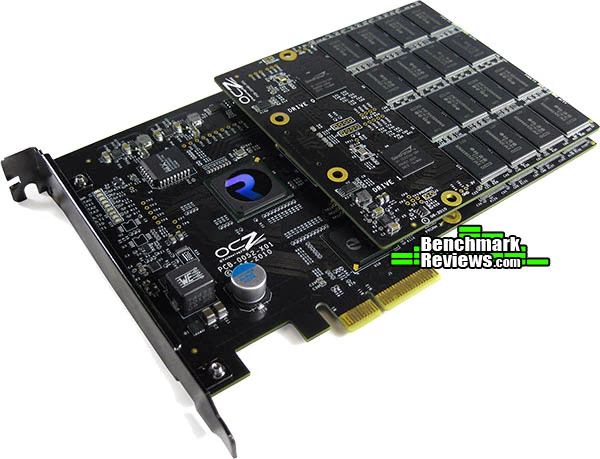
While PCIe effectively rules out attention from notebook consumers, it opens up a market to users in need of Hot-Plug drive support. Additionally, OCZ's PCB-0052-X02 printed circuit board allows for modular component placement, which turns the standard RevodDrive into the RevoDrive X2 platform with four storage controllers and even faster data processing. An elevated daughter board connects to the Revo's motherboard, housing supplemental NAND flash and two additional storage controllers.

OCZ utilizes a Pericom PI7C9X130 PCIe-to-PCIx reversible bridge chip on their RevoDrive SSD series, which connects one x4 PCI-Express port to one standard 64-bit /133 MHz PCIx port. The Pericom PI7C9X130 bridge features a 10KB buffer: 4KB for upstream reads with 2KB for upstream writes, and 2KB for downstream reads with another 2KB for downstream writes. From the PCI-Express bus, data travels through the Pericom PI7C9X130 located on the printed circuit board (PCB) directly above the gold-fingers into a Sil3124 RAID controller chip by Silicon Image (covered with a R sticker).

Silicon Image defines their SiI3124 chip as a PCI-Express to SATA-3GB/s controller capable of driving four ports. The original version of OCZ's RevoDrive SSD incorporates the Sil3124 chip to drive only two of the four available channels, while the RevoDrive X2 uses a total of four channels. Using four independent SandForce SF-1200 controllers combined into a RAID-0 array helps to produce peak performance before reaching a collection of NAND flash components. A more detailed explanation of architecture is given in the next section...
SandForce PCI-E SSD Anatomy
The SandForce SF-1200 SATA-3GBps controller is a durable component. SandForce features DuraClass technology on their SF-1200 processor, which claims to provide best-in-class endurance, performance, and lower power consumption. DuraWrite technology extends the endurance of MLC-NAND memory by providing at least five year lifecycles measured with 3000-5000 cycle MLC flash. Additionally, SandForce RAISE technology provides RAID-like protection for single SSD computer systems, and data is secured with AES-128 automatic encryption.
It's easy to mistake the OCZ RevoDrive X2 as merely having four SandForce SF-1200 SSDs combined into RAID-0, which oversimplifies things. There are two primary components to the average SandForce-driven SSD: a single storage controller and flash memory. The OCZ RevoDrive X2 is comprised of four primary components: PCI-Express bridge, RAID controller, dual storage controllers, and flash memory. Some might consider these differences minor semantics, but in truth they contrast a simple storage device (SSD) against a more complex RAID system on the PCI-Express platform.
The first evidence that this isn't your average SSD comes when you boot-up the computer and are given the opportunity to enter the Silicon Image RAID Configuration Utility. Since the SiI3124 chip used on RevoDrive series is identical to those used on many desktop motherboards and RAID controllers, users will find it very familiar. The OCZ RevoDrive has two 'drives' permanently attached, so many of the RAID options are available but unusable (RAID-5/10). Users can destroy the RAID set and rebuild it using smaller or larger stripe sizes, although our SandForce SF1200 RAID-0 SSD Performance article has demonstrated that larger stripes are better for SSDs.
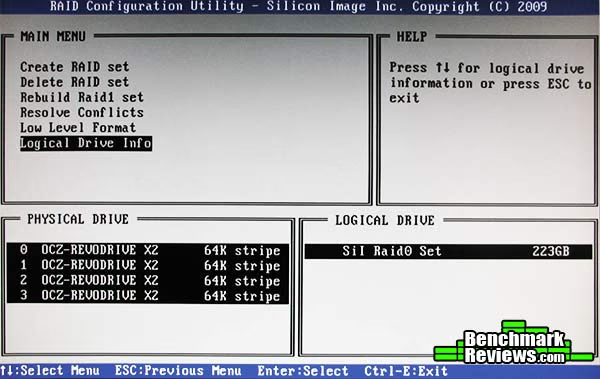
Silicon Image SiI3124 RAID Configuration Utility
When the OCZ RevoDrive X2 SSD is installed into a Windows 7 (64-bit) computer system as a secondary drive, the device manager prompts for driver installation which indicates a lack of Plug-n-Play compliance. OCZ includes the necessary SiI3124 drivers with the RevoDrive series SSD kit, as well as their website. As of November 2010 these drivers were identical to the latest package available direct from Silicon Image (si3124r5_15230_x64_Logo).

Windows 7 Device Manager
SandForce-driven SATA SSDs are capable of connecting to various controller hosts, such as those from Marvell or Intel, which retain TRIM garbage collection functionality as well as AHCI mode features. SandForce-driven PCI-Express form factor devices have their own host controller, and lose this functionality as a result. This is why the SandForce PCI-E SSD anatomy becomes important to understand.
The Pericom PI7C9X130 PCIe-to-PCIx reversible bridge chip is straight-forward in purpose and functionality, as it connects the PCI-Express x4 port to one standard 64-bit /133 MHz PCIx port which messages the Sil3124 RAID controller chip. This is where the magic happens, as Silicon Image defines their SiI3124 chip as a PCI-Express to SATA-3GB/s controller capable of driving four ports. The current version of OCZ's RevoDrive X2 SSD incorporates the Sil3124 chip to drive two of the four available channels, using four SandForce SF-1200 controllers combined into a RAID-0 array to produce peak performance before reaching a collection of NAND flash components.

SiI3124 Block Diagram (Courtesy Silicon Image)
The SATA 3Gb/s SandForce SF-1222TA3-SBH processor utilizes a Tensilica Diamond Core DC_570T internal CPU. SandForce-driven SSDs include either a SF-1200 processor for retail consumer products, or the SF-1500 for enterprise storage devices. While all SandForce SSDs offer native TRIM garbage collection (Microsoft Windows 7), Native Command Queuing (NCQ) with 32 command slots, and Self-Monitoring, Analysis, and Reporting Technology (SMART) command set, they cannot be passed-through to the Silicon Image SiI3124 RAID chip with current driver support unlike Intel's ICH10 does with the Rapid Storage Technology software. Regardless, the SF-1200 controller does an excellent job of minimizing re-write delays associated with dirty NAND.
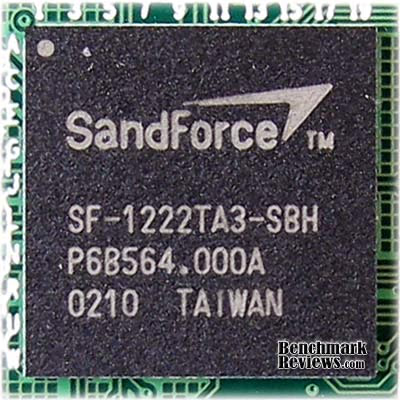
SandForce SF-1222TA3-SBC Processor
A key benefit to SandForce's SF-1200 architecture is that the SSD keeps all information on the NAND grid and removes the need for a separate cache buffer DRAM module by using the SandForce DuraClass technology. This results in a faster transaction, albeit at the expense of total storage capacity. SandForce SSDs also utilize over-provisioning technology, which allocates a portion of NAND for data storage and the remainder reserved for transaction and cache buffer space.
The SF-1200 SSD processor provides ECC data protection and includes SandForce's unique RAISE (Redundant Array of Independent Silicon Elements) technology. RAISE provides the protection and reliability of RAID on a single SSD drive, thanks to flash architecture, without the significant write overhead of parity. The SandForce DuraClass technology automatically stores data in AES-128 encrypted format, preventing data extraction directly from the physical flash memory modules.
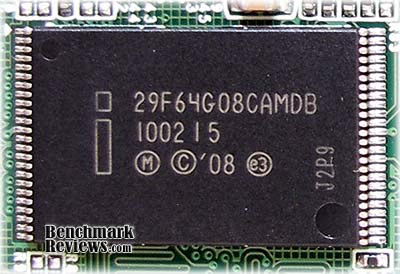
Intel 29F64G08CAMDB NAND Flash IC
Several multi-layer cell (MLC) Intel 29F64G08CAMDB NAND flash modules are joined to the SandForce SF-1200 controllers. On the 240GB RevoDrive X2 SSD model these NAND modules combine for 256GB of physical storage space, yet only 240GB of this capacity is designated for data. Consumer-level SandForce SSDs receive 7% over-provisioning which is why 128GB devices will yield 120GB of usable storage space.
SandForce SF-1200 Features
SandForce SF-1200 SSD Processors enable commodity flash memory to reliably operate in cost and power sensitive client computing environments. The SF-1200 is a true single-chip SSD Processor designed for volume manufacturing and outstanding performance. Innovative DuraClass technology delivers world class reliability, endurance, performance and power consumption.
Endurance and Longevity
As each generation of flash memory evolves and the silicon geometries shrink - performance, reliability, endurance, and data retention are negatively impacted. DuraWrite technology extends the life of the SSD over conventional controllers, by optimizing writes to the flash memory and delivering a write amplification below 1, without complex DRAM caching requirements.
Performance and Power Optimization
SSDs are capable of significantly outperforming traditional HDDs, but typical controllers haven't delivered the compelling value necessary for mainstream adoption. SandForce DuraClass technology enables the SSD to maximize both the endurance and performance for the life of the drive fulfilling the promise of high speed flash memory in client computing applications and improving system performance by up to 50% as measured by the SYSmark Benchmark.
Mobile Computing Security
The SF-1200 has built in AES-128 bit encryption controllable by a configurable user password. This feature prevents would-be thieves from extracting data directly from the flash memory should they ever have access to the drive.
Data Protection and Reliability
SF-1200 SSD Processors provide up to 100x greater data protection than today's SSDs, and leading enterprise HDDs. This is a result of superior ECC protection and unique RAISE (Redundant Array of Independent Silicon Elements) technology. RAISE provides the protection and reliability of RAID on a single drive without the significant write overhead.
Source: SandForce, Inc.
OCZ RevoDrive X2 SSD Specifications
The RevoDrive family gets its edge by eliminating the SATA II (3Gbps) bottleneck and leveraging a PCIe x4 interface to exploit the full potential of current flash technology. Like the original RevoDrive, the X2 uses an onboard RAID 0 design, but it also employs four SandForce-1200 controllers versus two in the original to maximize data access and bandwidth. In addition to promoting a faster, more responsive PC experience, the RevoDrive X2 is bootable, unlike competing PCIe solutions, to ensure quicker start-ups and load times compared to mechanical hard drives, a major plus for workstation PCs. The RevoDrive X2 thrives in a wide range of computing environments including demanding database and server applications as well as multi-media creation and management. Available in 100GB to 960GB capacities, the OCZ RevoDrive X2 provides ample room for data warehousing, applications, multimedia files, and operating systems. Additionally, the X2 provides the superior durability, energy efficiency, and reliability of SSDs.
The RevoDrive X2 PCI-Express SSD is an innovative storage solution that focuses on increased performance and capacity to serve high-performance computing consumers, upgrading the original by delivering unprecedented speeds and incredible capacities for enthusiasts and prosumers to make the most of their desktops and workstations. Available in 100GB to 960GB capacities, the OCZ RevoDrive X2 provides ample room for data warehousing, applications, multimedia files, and operating systems. The RevoDrive X2 is backed by a 3-year warranty and tech support for the ultimate peace of mind for your high-performance hardware investment.
Source: OCZ Technology Group, Inc.
|
DuraClass Technology: |
|
|---|---|
|
Host Interface: |
|
|
Capacity Supported: |
|
|
Performance: |
100GB-160GB Max Performance
240GB-960GB Max Performance
|
|
Power Consumption: |
|
|
Security: |
|
|
Protection: |
|
|
Reliability: |
|
|
Operating Temperature: |
0°C to 70°C ambient |
|
Dimensions: |
181.07 (L) x 21.59 (W) x 125.08mm (H) |
|
Certifications: |
RoHS, CE, FCC |
|
Chart Courtesy of Benchmark Reviews |
SSD Testing Methodology
Solid State Drives have traveled a long winding course to finally get where they are today. Up to this point in technology, there have been several key differences separating Solid State Drives from magnetic rotational Hard Disk Drives. While the DRAM-based buffer size on desktop HDDs has recently reached 32 MB and is ever-increasing, there is still a hefty delay in the initial response time. This is one key area in which flash-based Solid State Drives continually dominates because they lack moving parts to "get up to speed".
However the benefits inherent to SSDs have traditionally fallen off once the throughput begins, even though data reads or writes are executed at a high constant rate whereas the HDD tapers off in performance. This makes the average transaction speed of a SSD comparable to the data burst rate mentioned in HDD tests, albeit usually lower than the HDD's speed.
Comparing a Solid State Disk to a standard Hard Disk Drives is always relative; even if you're comparing the fastest rotational spindle speeds. One is going to be many times faster in response (SSDs), while the other is usually going to have higher throughput bandwidth (HDDs). Additionally, there are certain factors which can affect the results of a test which we do our best to avoid.
SSD Testing Disclaimer
Early on in our SSD coverage, Benchmark Reviews published an article which detailed Solid State Drive Benchmark Performance Testing. The research and discussion that went into producing that article changed the way we now test SSD products. Our previous perceptions of this technology were lost on one particular difference: the wear leveling algorithm that makes data a moving target. Without conclusive linear bandwidth testing or some other method of total-capacity testing, our previous performance results were rough estimates at best.
Our test results were obtained after each SSD had been prepared using DISKPART or Sanitary Erase tools. As a word of caution, applications such as these offer immediate but temporary restoration of original 'pristine' performance levels. In our tests, we discovered that the maximum performance results (charted) would decay as subsequent tests were performed. SSDs attached to TRIM enabled Operating Systems will benefit from continuously refreshed performance, whereas older O/S's will require a garbage collection (GC) tool to avoid 'dirty NAND' performance degradation.
It's critically important to understand that no software for the Microsoft Windows platform can accurately measure SSD performance in a comparable fashion. Synthetic benchmark tools such as HD Tach and PCMark are helpful indicators, but should not be considered the ultimate determining factor. That factor should be measured in actual user experience of real-world applications. Benchmark Reviews includes both bandwidth benchmarks and application speed tests to present a conclusive measurement of product performance.
Test System
-
Motherboard: Gigabyte GA-X58A-UD7 (Intel X58-Express)
-
Processor: Intel Core i7-920 BX80601920 @ 2.667 GHz
-
System Memory: 6GB Triple-Channel DDR3 1600MHz CL6-6-6-18
-
SATA 3Gb/s Storage HBA: Integrated Intel ICH10R Controller
-
AHCI mode - Intel Rapid Storage Technology Driver 9.6.0.1014
-
-
SATA 6Gb/s Storage HBA: Integrated Marvell SE9128 Controller
-
AHCI mode - Marvell Magni Driver Marvell Magni Driver 1.0.0.1036
-
-
Operating System: Microsoft Windows 7 Ultimate Edition 64-Bit
Drive Hardware Tested
The following storage hardware has been used in our benchmark performance testing, and may be included in portions of this article:
-
Corsair X256 CMFSSD-256D1 256GB SATA MLC SSD (Firmware version 1.1)
-
Intel X25-E Extreme SSDSA2SH032G1GN SATA SLC SSD
- OCZ Agility OCZSSD2-1AGT120G 120GB SATA MLC SSD (Firmware version 1.5)
-
OCZ Agility-EX OCZSSD2-1AGTEX60G 64GB SATA SLC (Firmware version 1.5)
-
OCZ RevoDrive X2 OCZSSDPX-1RVDX0240 240GB MLC PCI-E SSD
-
OCZ Vertex OCZSSD2-1VTX120G 120GB SATA SSD (Firmware v1.5)
-
OCZ Vertex-EX OCZSSD2-1VTX120G 120GB SATA SLC SSD (Firmware version 1.5)
-
OCZ Vertex Turbo OCZSSD2-1VTXT120G 120GB SATA SSD (Firmware version 1.5)
-
OCZ Vertex 2 'Extended' OCZSSD2-2VTXE120G 120GB MLC SSD (Firmware version 1.2)
Test Tools
- AS SSD Benchmark 1.5.3784.37609: Multi-purpose speed and operational performance test
-
ATTO Disk Benchmark 2.46: Spot-tests static file size chunks for basic I/O bandwidth
- Iometer 2008.06.28 by Intel Corporation: Tests IOPS performance and I/O response time
-
AIDA64: Disk Benchmark component tests linear read and write bandwidth speeds
-
CrystalDiskMark 3.0.0 by Crystal Dew World: Sequential speed benchmark spot-tests various file size chunks
Test Results Disclaimer
This article utilizes benchmark software tools to produce operational IOPS performance and bandwidth speed results. Each test was conducted in a specific fashion, and repeated for all products. These test results are not comparable to any other benchmark application, neither on this website or another, regardless of similar IOPS or MB/s terminology in the scores. The test results in this project are only intended to be compared to the other test results conducted in identical fashion for this article.
AS-SSD Benchmark
Alex Schepeljanski of Alex Intelligent Software develops the free AS SSD Benchmark utility for testing storage devices. The AS SSD Benchmark tests sequential read and write speeds, input/output operational performance, and response times. Because this software receives frequent updates, Benchmark Reviews recommends that you compare results only within the same version family.
Beginning with sequential read and write performance, the 240GB OCZ RevoDrive X2 PCI-E Solid State Drive produced 691.41 MB/s read speed and 279.44 MB/s write performance, compared to 393.05 MB/s read and 185.54 MB/s write on the 120GB RevoDrive. The sequential file transfer speeds have traditionally been low with this benchmark tool because of uncompressed data, especially with SandForce controllers, which is why we will concentrate on the operational IOPS performance for this section.
Single-threaded 4K IOPS performance delivers 26.66 MB/s read and 62.98 MB/s write, which is considerably higher than a single SandForce-driven SSD and still among the highest results we've recorded. 64-thread 4K reads recorded 418.64 MB/s while write performance was 257.61 MB/s... both earning the OCZ RevoDrive X2 SSD a spot among the top performance results in our charts. This compares well against the original RevoDrive with 221.92 MB/s reads and 170.45 MB/s writes.

Displayed in the chart below, the 64-thread 4KB IOPS performance results for several enthusiast-level storage products helps to illustrate which products offer the best operational input/output under load:

Compared to the 228/143 MBps 64-thread 4KB IOPS that two separate SandForce SF-1200 SSDs in RAID-0 produced, the OCZ RevoDrive and RevoDrive X2 offer exceedingly impressive read performance and heavily outperform in write operations.
Drive Hardware
-
OCZ Agility OCZSSD2-1AGT120G 120GB SATA MLC SSD (Firmware version 1.5)
-
OCZ RevoDrive X2 OCZSSDPX-1RVDX0240 240GB MLC PCI-E SSD
-
OCZ Vertex Turbo OCZSSD2-1VTXT120G 120GB SATA SSD (Firmware version 1.5)
-
OCZ Vertex 2 'Extended' OCZSSD2-2VTXE120G 120GB MLC SSD (Firmware version 1.2)
In the next section, Benchmark Reviews tests transfer rates using ATTO Disk Benchmark.
ATTO Disk Benchmark
The ATTO Disk Benchmark program is free, and offers a comprehensive set of test variables to work with. In terms of disk performance, it measures interface transfer rates at various intervals for a user-specified length and then reports read and write speeds for these spot-tests. There are some minor improvements made to the 2.46 version of the program that allow for test lengths up to 2GB, but all of our benchmarks are conducted with 256MB total length. Additionally, ATTO Disk Benchmark offers a queue depth range of 2-10, however our tests use the default value of 4. ATTO Disk Benchmark requires that an active partition be set on the drive being tested, which is formatted to the NTFS file system. Please consider the results displayed by this benchmark to be basic bandwidth speed performance indicators.

Our basic bandwidth speed tests begin with the OCZ RevoDrive X2 SSD installed onto the X58-Express motherboard, as the ATTO Disk Benchmark tool performs file transfers ranging from 0.5 KB to 8192 KB. The 240GB model we received reveals 831 MB/s maximum read speed that plateaus from 128-8192 KB file chunks at a queue depth of 4, and 688 MBps peak write bandwidth which plateaus from 64-8192 KB.
OCZ's reviewer guide suggests that ATTO be tested with a queue depth of 10, which offered slightly different results:
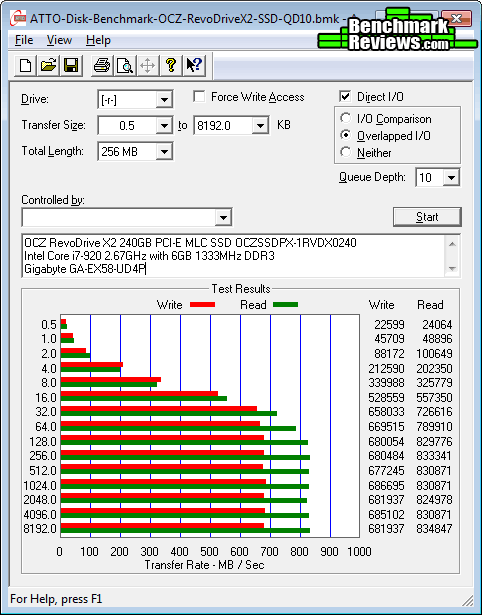
At QD-10 the OCZ RevoDrive X2 improves 4 MBps to 835 MBps maximum read speed that plateaus from 128-8192 KB file chunks, and a nearly identical 687 MBps peak write bandwidth plateaus from 64-8192 KB. Since all previous ATTO tests were conducted with the default queue depth of 4, here's how the collection stacks up:

Although not charted above, a pair of SandForce-driven SF-1200 SSDs configured with 128K-stripes in a RAID-0 set produced 579 MBps peak read speeds, and 545 MBps peak write bandwidth.
Drive Hardware
-
Intel X25-E Extreme SSDSA2SH032G1GN SATA SLC SSD
-
OCZ Agility OCZSSD2-1AGT120G 120GB SATA MLC SSD (Firmware version 1.5)
-
OCZ Agility-EX OCZSSD2-1AGTEX60G 64GB SATA SLC (Firmware version 1.5)
-
OCZ RevoDrive X2 OCZSSDPX-1RVDX0240 240GB MLC PCI-E SSD
-
OCZ Vertex-EX OCZSSD2-1VTX120G 120GB SATA SLC SSD (Firmware version 1.5)
-
OCZ Vertex Turbo OCZSSD2-1VTXT120G 120GB SATA SSD (Firmware version 1.5)
-
OCZ Vertex 2 'Extended' OCZSSD2-2VTXE120G 120GB MLC SSD (Firmware version 1.2)
In the next section, Benchmark Reviews tests sequential performance using the CrystalDiskMark 3.0 software tool...
CrystalDiskMark 3.0 Tests
CrystalDiskMark 3.0 is a file transfer and operational bandwidth benchmark tool from Crystal Dew World that offers performance transfer speed results using sequential, 512KB random, and 4KB random samples. For our test results chart below, the 4KB 32-Queue Depth read and write performance was measured using a 1000MB space. CrystalDiskMark requires that an active partition be set on the drive being tested, and all drives are formatted with NTFS on the Intel ICH10 controller set to AHCI-mode. Benchmark Reviews uses CrystalDiskMark to illustrate operational IOPS performance with multiple threads. In addition to our other tests, this benchmark allows us to determine operational bandwidth under heavy load.
Sequential tests on the OCZ RevoDrive X2 SSD produced a maximum read speed of 680.9 MB/s, while the write speed was 279.0 MB/s. The sequential file transfer speeds have traditionally been low with this benchmark tool because of uncompressed data, especially in regard to SandForce controllers, which is why we concentrate on the operational IOPS performance for this section.
CrystalDiskMark 3.0 reported 512K results of 580.3 MB/s read and 279.1 MB/s write performance. 4K tests produced 28.32 read and 77.56 write performance. 4KB queue depth 32 IOPS is one area where SandForce-driven SSDs truly excel, and performance for the 240GB OCZ RevoDrive X2 leads the other SandForce SSDs with 291.2 MBps read and 258.1 MBps write.

Displayed in the chart below, the maximum 4KB queue depth 32 IOPS performance results for several enthusiast-level storage products illustrate which products offer the best operation under load:

Compared with two separate SandForce SF-1200 SSDs in RAID-0 that produce 231/150 MBps maximum IOPS at 4KB queue depth 32, both the standard OCZ RevoDrive and RevoDrive X2 exceed read performance and heavily outperforms in write operations.
Drive Hardware
- ADATA S599 100GB SATA MLC SSD
- Corsair Nova V128 CMSSSD-V128GB2 SATA MLC SSD
- Corsair Force F100 CSSD-F100GB2 SATA MLC SSD
- Crucial RealSSD-C300 CTFDDAC256MAG-1G1 256GB SATA 6Gb/s MLC SSD
- G.Skill Phoenix Pro 60GB SATA MLC SSD FM-25S2S-60GBP2
- Kingston SSDNowV+ SNVP325-S2 128GB SATA MLC SSD
- LiteOn LA-32M1S Strong-Page 32GB MLC SSD
- OCZ Agility OCZSSD2-1AGT120G 120GB SATA MLC SSD (Firmware version 1.5)
- OCZ RevoDrive OCZSSDPX-1RVD0120 120GB MLC PCI-Express SSD
- OCZ RevoDrive X2 OCZSSDPX-1RVDX0240 240GB MLC PCI-E SSD
- OCZ Vertex Turbo OCZSSD2-1VTXT120G 120GB SATA SSD (Firmware version 1.5)
- OCZ Vertex 2 'Extended' OCZSSD2-2VTXE120G 120GB MLC SSD (Firmware version 1.2)
- OWC Mercury Extreme Pro-RE SSDMXRE100 100GB MLC SSD
- Patriot Inferno PI100GS25SSDR 100GB MLC SSD
- RunCore Pro-V RCP-V-S2520-MCN 200GB SATA SLC SSD
- Seagate Barracuda-XT ST32000641AS 2TB 7200RPM SATA 6Gb/s Hard Drive
- Western Digital VelociRaptor WD3000HLFS 300GB 10,000 RPM SATA Hard Disk Drive
- WD SiliconEdge-Blue SSC-D0256SC-2100 256GB SATA SSD
Iometer IOPS Performance
Iometer is an I/O subsystem measurement and characterization tool for single and clustered systems. Iometer does for a computer's I/O subsystem what a dynamometer does for an engine: it measures performance under a controlled load. Iometer was originally developed by the Intel Corporation and formerly known as "Galileo". Intel has discontinued work on Iometer, and has gifted it to the Open Source Development Lab (OSDL).
Iometer is both a workload generator (that is, it performs I/O operations in order to stress the system) and a measurement tool (that is, it examines and records the performance of its I/O operations and their impact on the system). It can be configured to emulate the disk or network I/O load of any program or benchmark, or can be used to generate entirely synthetic I/O loads. It can generate and measure loads on single or multiple (networked) systems.
To measure random I/O response time as well as total I/O's per second, Iometer is set to use 4KB file size chunks over a 100% random sequential distribution at a queue depth of 32 outstanding I/O's per target. The tests are given a 50% read and 50% write distribution. While this pattern may not match traditional 'server' or 'workstation' profiles, it illustrates a single point of reference relative to our product field.
The chart below illustrates combined random read and write IOPS over a 120-second Iometer test phase, where highest I/O total is preferred:

There's no question that OCZ has created the perfect tool for extreme IOPS environments. The OCZ RevoDrive X2 reached 112,061 combined total read and write IOPS in our tests, trailed only by the original RevoDrive with 69925 IOPS. From here on, single SATA SSDs trail far behind.
From the onset, SandForce SSDs clearly outperform the competition when tested which a larger queue depth. In our Iometer tests, which use 32 outstanding I/O's per target and a random 50/50 read/write distribution, only the 'unrestricted' SandForce SSDs approach 50,000 IOPS. OCZ's Agility 2 promises 10,000 IOPS each way, and yet it delivers 23,376 total - outperforming their specification once again. The SandForce-Driven SSDs demonstrate the highest IOPS performance we've ever seen on a consumer storage device, and the 'unlocked' firmware further extends the performance level to as high as 50,000 IOPS. Benchmark Reviews discusses this topic in more detail in our SandForce SF-1200 SSD Firmware Comparison article.
Drive Hardware
- Corsair Nova V128 CMSSSD-V128GB2 SATA MLC SSD
- Kingston SSDNowV+ SNVP325-S2 128GB SATA MLC SSD
-
OCZ Agility OCZSSD2-1AGT120G 120GB SATA MLC SSD (Firmware version 1.5)
-
OCZ Agility-EX OCZSSD2-1AGTEX60G 64GB SATA SLC (Firmware version 1.5)
-
OCZ RevoDrive X2 OCZSSDPX-1RVDX0240 240GB MLC PCI-E SSD
-
OCZ Vertex Turbo OCZSSD2-1VTXT120G 120GB SATA SSD (Firmware version 1.5)
-
OCZ Vertex 2 'Extended' OCZSSD2-2VTXE120G 120GB MLC SSD (Firmware version 1.2)
- WD SiliconEdge-Blue SSC-D0256SC-2100 256GB SATA SSD
In our next section, we test linear read and write bandwidth performance and compare its speed against several other top storage products using AIDA64 Disk Benchmark. Benchmark Reviews feels that linear tests are excellent for rating SSDs, however HDDs are put at a disadvantage with these tests whenever capacity is high.
AIDA64 Disk Benchmark
When development ended for Lavalys EVEREST the team picked up with AIDA64, an industry leading system diagnostics and benchmarking solution for enthusiasts PC users. Very few are aware of the Disk Benchmark tool available inside the program, which operates entirely on x64 instruction. The AIDA64 Disk Benchmark performs linear read and write bandwidth tests on each drive, and can be configured to use file chunk sizes up to 1MB (which speeds up testing and minimizes jitter in the waveform). Because of the full sector-by-sector nature of linear testing, Benchmark Reviews endorses this method for testing SSD products, as detailed in our Solid State Drive Benchmark Performance Testing article. However, Hard Disk Drive products suffer a lower average bandwidth as the capacity draws linear read/write speed down into the inner-portion of the disk platter. EVEREST Disk Benchmark does not require a partition to be present for testing, so all of our benchmarks are completed prior to drive formatting.
Linear disk benchmarks are superior bandwidth speed tools in my opinion, because they scan from the first physical sector to the last. A side affect of many linear write-performance test tools is that the data is erased as it writes to every sector on the drive. Normally this isn't an issue, but it has been shown that partition table alignment will occasionally play a role in overall SSD performance (HDDs don't suffer this problem). The high-performance storage products tested with AIDA64 Disk Benchmark use a 1MB block size option.
SPECIAL NOTE: Before we look over the results, it's important to mention that the RevoDrive series cannot make use of TRIM support because of the Silicon Image RAID controller. Standard measures to manually reset the NAND condition are not possible because of this architecture, and erase tools do not have the same effect. As a direct consequence of this, the SandForce SF1200 controllers are forced to manage write-block cleaning themselves. With the help of OCZ, we've discovered this could take weeks or longer depending on NAND density and write cycles. Due to the full sector-by-sector write process by AIDA64, the RevoDrive X2 demonstrated serious performance degradation near the end of the first test and in all subsequent tests.
Beginning with linear read performance, the OCZ RevoDrive X2 PCI-E SSD measured an average 755.7 MBps with a maximum peak speed of 774.4 MBps. This easily surpasses the original RevoDrive, which produced 510.5 MBps read speed and peaked at 511.6 MBps. Linear write-to tests were next...

The waveform chart below illustrates how well the integrated quad-SandForce SF-1200 DuraWrite buffers on the Revo SSD managed file transfers, and made linear write performance appears relatively even. This is even more impressive when you consider that this drive lacks TRIM support, and these tests followed after some of the others. Since the other tests use spot-testing methods to determine performance, the SandForce SSD controllers route our AIDA64 writes to 'clean' NAND sectors. This works well until it reaches the end of the run, where performance drops off.
This 240GB RevoDrive X2 produced an average linear write-to speed of 629, with a maximum performance of 665.1 MBps. The NAND condition in this test forces the X2 to compare nicely against the original RevoDrive, which recorded write-to speeds of 422.8 MBps with a 429.6 MBps maximum. For comparison, a set of SandForce-driven SSDs in RAID-0 produced 437.7 MBps read speeds, and 470.5 MBps with larger 128KB RAID-0 stripe sizes. The OCZ Revo PCI-Express SSD was much faster at read and write transactions.

The chart below shows the average linear read and write bandwidth speeds for a cross-section of storage devices tested with AIDA64 :
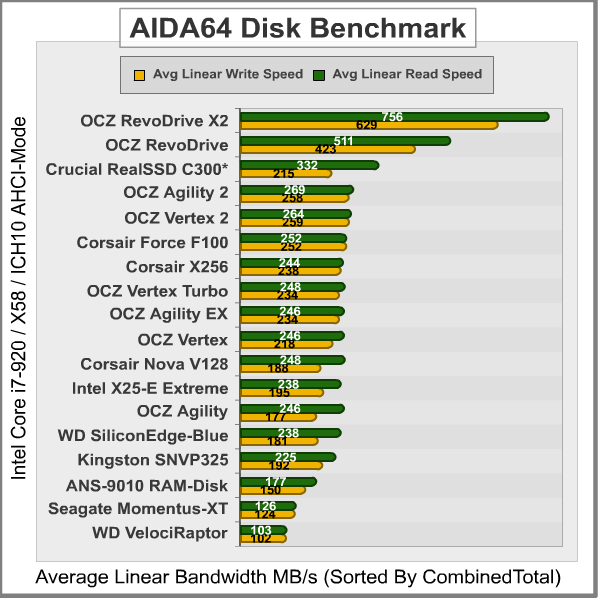
Linear tests are an important tool for comparing bandwidth speed between storage products - although HDD products suffer performance degradation over the span of their areal storage capacity. Linear bandwidth certainly benefits the Solid State Drive, since there's very little fluctuation in transfer speed. This is because Hard Disk Drive products decline in performance as the spindle reaches the inner-most sectors on the magnetic platter, away from the fast outer edge.
Drive Hardware
-
Corsair X256 CMFSSD-256D1 256GB SATA MLC SSD (Firmware version 1.1)
-
Intel X25-E Extreme SSDSA2SH032G1GN SATA SLC SSD
-
OCZ Agility OCZSSD2-1AGT120G 120GB SATA MLC SSD (Firmware version 1.5)
-
OCZ Agility-EX OCZSSD2-1AGTEX60G 64GB SATA SLC (Firmware version 1.5)
-
OCZ RevoDrive X2 OCZSSDPX-1RVDX0240 240GB MLC PCI-E SSD
-
OCZ Vertex OCZSSD2-1VTX120G 120GB SATA SSD (Firmware v1.5)
-
OCZ Vertex-EX OCZSSD2-1VTX120G 120GB SATA SLC SSD (Firmware version 1.5)
-
OCZ Vertex Turbo OCZSSD2-1VTXT120G 120GB SATA SSD (Firmware version 1.5)
-
OCZ Vertex 2 'Extended' OCZSSD2-2VTXE120G 120GB MLC SSD (Firmware version 1.2)
In the next section I share my final thoughts on the struggle between SSD and HDD technology, as well as their new hybrid counterpart, before delivering my conclusion and final product rating.
HDD vs Hybrid Drive vs SSD
It's been the same argument for over two years now: SSDs offer the best performance, but HDDs still offer the best capacity and price. Now that Solid State Hybrid drives are available, that argument changes. While the optimal blend of bandwidth speed, operational performance, storage capacity, and value has yet to be delivered, products like the Seagate Momentus-XT offer an ultra-affordable start in the right direction Installed as a primary drive for notebook and value-conscious enthusiasts, the Solid State Hybrid Drive delivers up high-capacity storage space while starting Windows and opening programs like a SSD.
The last days of old technology are always better than the first days of new technology. Never has this saying been more true than with the topic of storage technology, specifically in regard to the introduction of Solid State Drive technology a few years ago. The only things standing in the way of widespread Solid State Drive (SSD) adoption are high storage capacity and affordable price of Hard Disk Drive (HDD) devices. Because NAND flash-based SSD technology costs more per gigabyte of capacity than traditional magnetic hard drives, the benefits of immediate response time, transfer speeds, and operational input/output performance often get overlooked. Like most consumer products, it wasn't a question of how much improvement was evident in the new technology, it was price. I'll discuss product costs more in just a moment, but for now consider how each new series of SSD product employs greater performance than the one before it, convincing would-be consumers into waiting for the right time to buy.
There's also a gray area surrounding SSD performance benchmarks that has me concerned. You might not know this, but SSDs can be very temperamental towards the condition of their NAND flash. My experience testing dozens of Solid State Drives is that a freshly cleaned device (using an alignment tool) will always outperform the same device once it's been formatted and used. A perfect example are Indilinx Barefoot-based SSDs, which suffers severely degraded performance when writing to 'dirty' NAND flash. The reason that all of this will matter is simple: the performance results reported to consumers in product reviews (such as this one) often report the very best performance scores, and the process used to obtain these results is not applicable to real-world usage. This is where garbage collection techniques such as TRIM become important, so that end-users will experience the same performance levels as we do in our tests.
| Manufacturer | Indilinx | Intel | JMicron | Samsung | Toshiba | SandForce | Marvell |
|---|---|---|---|---|---|---|---|
| Controller | IDX110M00-FC | PC29AS21AA0 | JMF612 | S3C29RBB01-YK40 | T6UG1XBG | SandForce SF-1200 | 88SS9174-BJP2 |
| Max Cache | 64MB | 16MB | 128KB+256MB | 128MB | 128MB | Integrated | 128MB |
| Max Capacity | 256GB | 160GB | 256GB | 256GB | 512GB | 512GB | 256GB |
| Read/Write Speed | 230/170 MBps | 250/70 MBps | 250/200 MBps | 220/200 MBps | 230/180 MBps | 260/260 MBps | 355/215 MBps |
| Interface | SATA-II 3-Gbps | SATA-II 3-Gbps | SATA-II 3-Gbps | SATA-II 3-Gbps | SATA-II 3-Gbps | SATA-II 3-Gbps | SATA-III 6-Gbps |
| Garbage Collection | GC/TRIM | None | TRIM | GC/TRIM | GC/TRIM | GC/TRIM | GC/TRIM |
|
Chart By: |
BmR |
Garbage Collection (GC) is the current solution for keeping NAND flash in 'clean' condition, while maintaining optimal performance. Windows 7 offers native TRIM support, and most retail SSDs also include this special GC function or at least offer a firmware update that brings the drive up-to-date. For anyone using an Operating System or SSD that does not offer Garbage Collection functionality, you'll be using 'dirty' NAND flash modules and suffering sub-optimal performance for each write-to request. A few SSD manufacturers offers free tools to help restore peak-level performance by scheduling GC to 'clean' used NAND sectors, but these tools add excessive wear to the NAND the same way disk defragmenting tools would. SLC flash modules may resist wear much better than MLC counterparts, but come at the expense of increased production cost. The best solution is a more durable NAND module that offers long-lasting SLC benefits at the cost of MLC construction. Adoption is further stalled because keen consumers aware of this dilemma further continue their delay into the SSD market.
Getting back to price, the changes in cost per gigabyte have come as often as changes to the technology itself. At their inception, high-performance models such the 32GB MemoRight GT cost $33 per gigabyte while the entry-level 32GB Mtron MOBI 3000 sold for $14 per gigabyte. While an enjoyable decline in NAND component costs forced consumer SSD prices down low in 2009, the price of SSD products has been on the rise during 2010. Nevertheless, Solid State Drives continue to fill store shelves despite price or capacity, and there are a few SSD products now costing only $2.03 per gigabyte. Although the performance may justify the price, which is getting dangerously close to the $0.79 per gigabyte for the WD VelociRaptor hard drive, costs may still close some buyers out of the market. Price notwithstanding, the future is in SSD technology - or possibly a SSD hybrid - and the day when HDDs are obsolete is nearing.
OCZ RevoDrive Conclusion
IMPORTANT: Although the rating and final score mentioned in this conclusion are made to be as objective as possible, please be advised that every author perceives these factors differently at various points in time. While we each do our best to ensure that all aspects of the product are considered, there are often times unforeseen market conditions and manufacturer changes which occur after publication that could render our rating obsolete. Please do not base any purchase solely on our conclusion, as it represents our product rating specifically for the product tested which may differ from future versions. Benchmark Reviews begins our conclusion with a short summary for each of the areas that we rate.
Our performance rating considers how effective the 240GB OCZ RevoDrive X2 performs in operations against direct competing SSD storage solutions, especially the original RevoDrive. In our benchmark tests, the RevoDrive X2 delivered 831/688 MBps peak read and write speeds using ATTO Disk Benchmark. 831 MB/s measured in ATTO clearly exceeds the manufacturer's 740 MB/s specified maximum read speed, making this the fastest storage solution Benchmark Reviews has ever tested. Operational performance measured 112061 IOPS when tested with a queue depth of 32 using Iometer. Developers needing top-end operational speeds and functionality for their demanding applications can certainly expect as much from the OCZ RevoDrive X2 PCI-Express SSD. Linear speed tests with the AIDA64 Disk Benchmark produced a solid 756 MBps read speed, which is above spec, yet dirty NAND combined with lacking TRIM support still offered 629 MBps peak write speed when the drive was filled.
Benchmark Reviews also tested the OCZ RevoDrive X2 SSD against many of its closest competitors, including a SandForce RAID-0 SSD set, and the performance results were still very impressive. In fact, the OCZ RevoDrive X2 offered incredibly fast speeds compared to the other SSDs, including the SATA-based RAID-0 set of separate SandForce SF1200's. Operational performance tests place the RevoDrive X2 at the very top of our charts, well ahead of other single and RAID-0 SSDs. High-performance computer enthusiasts will enjoy the immediate response time that assures instant reactions when called upon. Based around the SandForce SF-1222TA3-SBH processor, DuraClass technology adds proprietary RAISE and DuraWrite features not available to other SSDs. The end result is a product that could last up to five times longer with less wear on NAND flash modules due to 7% over-provisioning.
SSDs are not prone to mechanical failure, but if any RevoDrive products happen to fail during the 3-year warranty period end-users may contact OCZ via the company website or extensive support forums. Fortunately, there's also a toll-free telephone number (800-459-1816) for free technical support and customer service questions. OCZ has been proven to be one of the best companies in the business when it comes to customer service, and replacement parts are often sent with priority delivery.
The OCZ RevoDrive X2 PCI-E SSD series offers a prolonged MLC NAND flash lifetime and delivers data redundancy thanks to the powerful SandForce SF-1222 solid state processor that has innovated the SSD industry. PCI-Express form factor or otherwise, SandForce SSDs have taken the storage market by storm. This helped products like OCZ's Vertex 2 SSD to dominate the high-performance PC hardware segment, and will likely lend support to the OCZ RevoDrive series for ultra-performance enthusiasts. SandForce-driven Solid State Drives are already extremely fast and offer SLC-level NAND durability at MLC cost, but combining two SF-1200 controllers onto a single-platform in RAID-0 delivers unprecedented operational I/O performance.
As of 19 November 2010, OCZ's 240GB RevoDrive X2 PCI-Express SSD series sells for $648.40 at Amazon / $679 at NewEgg with various capacities available. Considering that users get roughly twice the performance, there definitely a competitive argument to be made with regard to value. List below is the current OCZ product line of SandForce-driven SSDs:
| OCZ RevoDrive X2 | OCZ RevoDrive | OCZ Agility 2 Extended |
OCZ Vertex 2 Extended |
||
| $459 - 100GB - OCZSSDPX-1RVDX0100 $549 - 160GB - OCZSSDPX-1RVDX0160 $679 - 240GB - OCZSSDPX-1RVDX0240 $1159 - 360GB - OCZSSDPX-1RVDX0360 $1439 - 480GB - OCZSSDPX-1RVDX0480 $3359 - 960GB - OCZSSDPX-1RVDX0960 |
$199 - 50GB - OCZSSDPX-1RVD0050
$239 - 80GB - OCZSSDPX-1RVD0080
$300 - 120GB - OCZSSDPX-1RVD0120
$400 - 180GB - OCZSSDPX-1RVD0180
$500 - 240GB - OCZSSDPX-1RVD0240
$1019 - 360GB - OCZSSDPX-1RVD0360
$1249 - 480GB - OCZSSDPX-1RVD0480
|
$139 - 60GB - OCZSSD2-2AGTE60G
$190 - 90GB - OCZSSD2-2AGTE90G
$235 - 120GB - OCZSSD2-2AGTE120G
$410 - 180GB - OCZSSD2-2AGTE180G
$449 - 240GB - OCZSSD2-2AGTE240G
|
$140 - 60GB - OCZSSD2-2VTXE60G $190 - 90GB - OCZSSD2-2VTXE90G $245 - 120GB - OCZSSD2-2VTXE120G $400 - 180GB - OCZSSD2-2VTXE180G $450 - 240GB - OCZSSD2-2VTXE240G |
OCZ isn't vying for the value play with their RevoDrive X2 series, and they don't need to. The OCZ Agility 2 and OCZ Vertex 2 SSDs offer outstanding value for their respective performance levels. What you get with RevoDrive is performance, raw full-throttle performance. The RevoDrive X2 SSD is a great fit for systems that require extreme-performance, or enthusiasts wanting the fastest speeds and best operational performance money can buy. While I'm hesitant to recommend any RAID-0 storage solution for business environments (even with routine backups), the SandForce-specific RAISE and DuraWrite features alleviate these concerns and make allow the RevoDrive series to fit-in well with any: virtual machine server, remote-access application server, high-transaction database server, and extreme-traffic web servers.
In conclusion, OCZ's RevoDrive X2 PCI-Express SSD offers two things not available in any other consumer SSD: bandwidth speeds well beyond SATA-6.0 GB/s capabilities, and absolutely incredible operational IOPS performance. As expected, these perks come at the expense of several coveted storage utilities: TRIM garbage collection, Native Command Queuing (NCQ), and Self-Monitoring Analysis and Reporting Technology (SMART) functionality. Until Silicon Image is able to incorporate these features into their driver so they'll pass through to the SSD, users will depend on SandForces' otherwise noteworthy NAND management to keep up these lightning-fast transfer speeds.
Pros:
+ Delivers approximately 120,000 4K IOPS in Iometer
+ Best IOPS performance available to consumers
+ Blazing fast 831/688 MBps read/write speed with ATTO
+ DuraWrite technology extends NAND lifetime
+ Top-level operational I/O performance for application servers
+ 3-Year OCZ product warranty
+ Several high-speed SSD storage capacities available
+ AES-128 Automatic encryption and password data protection
+ Less expensive than four separate SandForce-driven SSDs
Cons:
- SiI3124 RAID controller lacks NCQ, SMART, and TRIM pass-through
Ratings:
- Performance: 10.0
- Appearance: 8.75
- Construction: 9.25
- Functionality: 8.50
- Value: 7.25
Final Score: 8.75 out of 10.
Quality Recognition: Benchmark Reviews Silver Tachometer Award.
Benchmark Reviews invites you to leave constructive feedback below, or ask questions in our Discussion Forum.
Reader comments from the original article
7 comments were posted before commenting closed. They are preserved as written. Original avatars no longer resolve and are shown as a placeholder.
Thumper RealNeil Permalink:
This thing really rocks. The 'real world' experience using a computer with one of these things inside of it must be sweet indeed. Can't afford one of them and may never be able to. But it's good to see that they're out there.
RE: Thumper Servando Silva Permalink:
Any SSD will make you notice a super-boost in real world experience against HDDs. I'm sure you'll not notice a difference between controllers, but I'm not sure if the RevoDrive X2 could make THE difference.
RE: OCZ RevoDrive X2 PCI-Express SSD Adam Permalink:
Bloody hell that's fast, you sure as hell pay for it though... I'm yet to upgrade to any SSD yet unfortunately, still waiting for the technology to move on a bit / become more affordable.
C300 in raid or this? aberkae Permalink:
This by far is the best performers on the market. I'm debating weather to get an extra c300 (256 gig) for raid 0,(total 500gigs >700 mb/sec read/500 rights) extra $525 Vs Revodrive x2 256gig one, extra $699. (aren't the Sandforce 2500, 2600 controllers out soon as well?)
RE: C300 in raid or this? Olin Coles Permalink:
You can expect the next generation of SandForce products in Q1 2011, but not sooner. This particular product, while being extremely fast, lacks TRIM support because of the RAID controller. In my opinion, you shouldn't buy an SSD without TRIM support. In this case however, there recovery time wouldn't be an issue unless you did constant fills.
RE: RE: C300 in raid or this? Khaosus Permalink:
Although this is an old post, I felt the need to clarify. TRIM is not needed for Revodrive X2 due to the garbage collecting algorithms built into SandForce. TRIM is a sloppy patch job on a problem that should of never existed and on any good drive will not be needed.
RE: OCZ RevoDrive X2 PCI-Express SSD Daryl Greene Permalink:
WOW! Those things are ridiculously expensive!