
Intel X25-M SATA 80GB MLC SSD
Intel X25-M 80GB SSD
Most computer enthusiasts will acknowledge the fact that one of the biggest deterrents to a truly blazing rig is the bottleneck created by the traditional storage devices of the day. This is not to say that there haven't been major improvements in the performance of storage devices over the last few years. While these improvements in many cases showed quite a bit of promise, the were still not the extent where lag time and read and write speeds were adjusted to the point that they could keep up with today's other modern components. For the last three years since the first rumors of a full-blown solid state drive first surfaced, I and a number of my colleagues have rested our hopes on a truly fast solid state drive being the saving grace for this issue.
In late 2007 a smattering of the long awaited and highly anticipated solid state drives began to trickle on to the marketplace. Many of these early offerings showed somewhat less than stellar performance while a small percentage set the groundwork for what was to come. As with any new product the launch of this magnitude time is generally the best equalizer as it gives manufacturers real world feedback to help them make necessary product improvements. In June, 2008 Intel announced that it would be joing the ranks of other manufacturers that would diversify their product line to include solid state drives. This announcement from a company of the magnitude of Intel served as validation that at some point in the future the use of solid state drives would grow to a point where they would dominate the market.
In early September, 2008 Intel released their mainstream series of solid state drives. In its initial offfering Intel brought two drives to market, the X18-M and the X25-M built respectively on the 1.8" and 2.5" form factors. The initial capacity of these drives was 80 GB and recently a 160 GB version was released. Solid State Drives are rapidly changing the computing landscape, and many enthusiasts are using SSD technology in their primary systems to help boost performance. Benchmark Reviews has tested nearly all of the products available to the retail market in this sector, and several have done quite well while others fall flat. It used to be that performance was the largest hurdle for mass storage NAND Solid State Drives, followed by stability, and later price. In this review, we will give a thorough overview as well as benchmark test the linear bandwidth performance of the Intel X25-M 80 GB SSDSA2MH080G15E solid state SATA drive and compares it against the top competition.

That time has come to pass, and our collection of SSD reviews is proof. Back in March (2008) we tested the lightning-fast MemoRight GT SSD which finally put the Western Digital Raptor in its place... to the tune of almost $2000. But since that time Benchmark Reviews has tested several SSDs which outperform HDDs. The struggle to finally replace the Hard Disk as the primary drive is getting much closer to victory.
According to a Q1 2008 report by the semiconductor market research firm iSuppli, the SSD market will grow at an annualized average of 124 percent during the four-year period from 2008 until 2012. iSuppli now projects SSD sales to increase by an additional 35 percent in 2009 over what it projected last year, 51 percent more in 2010, and 89 percent more in 2011, and continue to show dramatic increases in subsequent years.
Benchmark Reviews recently published an article that detailed Solid State Drive (SSD) Benchmark Performance Testing. The research and discussion that went into this article changed the way we new test SSD products. Our previous perceptions of the technology were lost on one critically important difference: the wear leveling algorithm that makes data a moving target. Without conclusive linear bandwidth testing, our previous performance results were rough estimates at best. This review is the second to use a new testing methodology, and also introduces real-world performance into the results.
About the Company: Intel
Intel Corporation is the world's largest semiconductor company founded by semiconductor pioneers Robert Noyce and Gordon Moore, and widely associated with the executive leadership and vision of Andrew Grove, Intel combines advanced chip design capability with a leading-edge manufacturing capability. Originally known primarily to engineers and technologists, Intel's successful "Intel Inside" advertising campaign of the 1990s made it and its Pentium processor household names.
Intel pushes the boundaries of innovation so our work can make people's lives more exciting, fulfilling, and manageable. And our work never stops. We never stop looking for the next leap ahead-in technology, education, culture, manufacturing, and social responsibility. And we never stop striving to deliver solutions with greater benefits for everyone. Intel is making PCs more accessible and affordable through innovative PC purchase programs. Through public and private collaboration, Intel has worked closely with government and industry leaders to develop more than 200 programs in 60 countries. With the onslaught of wireless broadband communication technologies like WiMAX, Wi-Fi, and 3G and wireline ADSL and cable, Intel in collaboration with local governments is connecting more people in more places than ever before-no matter how remote.
Intel is committed to improving education on a global scale. With an ongoing focus on students and teachers, we're making an impact with technology solutions that support the development of 21st Century skills, including digital literacy, problem solving, and critical thinking. As citizens use the Internet, the need to create localized content is the key. Intel-sponsored programs provide localized content and services to connect technologies to villages, suburbs, and cities around the world to deliver access to community information, education, and healthcare.
Intel XM25-M Features
The Intel X18-M/X25-M SATA Solid State Drive (SSD) delivers leading performance in industry standard 1.8” and 2.5” form factors while simultaneously improving system responsiveness for mobile applications over standard rotating drive media or hard disk drives. By combining Intel’s leading NAND flash memory technology with our innovative high performance controller, Intel delivers an SSD for Native Serial Advanced Technology Attachment (SATA) hard disk drive drop-in replacement with enhanced performance, reliability, ruggedness and power savings. Since there are no rotating platters, moving heads, fragile actuaters, or unnecessary delays due to spin-up time or positional seek time that can slow down the storage subsystem significantly, the Intel X18-M/X25-M SATA SSD enables fast read/write access times and a significant I/O and throughput performance improvement as compared to rotating media or hard disk drives.
The Intel X18-M/X25-M SATA SSDs primarily target SATA based laptop PCs, highly rugged mobile client devices, as well as thin and light, mini/sub-notebooks. Key attributes include high performance, low power, increased system responsiveness, high reliability and enhanced ruggedness as compared to standard mobile SATA hard drives. Intel X18-M/X25-M SATA SSDs are available in 1.8” and 2.5” form factors that are electrically, mechanically, and software compatible with existing 1.8” and 2.5” Serial ATA slots and cables. Our flexible design allows interchangeability with existing mobile hard drives based on the SATA interface standard.
Nonrecoverable Read Errors
The nonrecoverable read error rate will not exceed one sector in the specified number of bits read. In the extremely unlikely event of a nonrecoverable read error, the drive will report it as a read failure to the host; the sector in error is considered corrupt and is not returned to the host.
Mean Time Between Failure
The Mean Time Between Failure (MTBF) is 1,200,000 hours and is calculated based on a Part Stress Analysis. It assumes nominal voltage, with all other parameters within specified range.
Power On/Off Cycles
The power on/off cycles of the X25-M is rated at 50,000 cycles. A cycle is defined as power being removed from the drive, and then restored. Most host systems remove power from the drive when entering suspend and hibernate as well as on a system shutdown.
Minimum Useful Life
A typical client usage of 20 GB writes per day is assumed. Should the host system attempt to exceed 20 GB writes per day by a large margin for an extended period, the drive will enable the endurance management feature to adjust write performance. By efficiently managing performance, this feature enables the device to have, at a minimum, a five year useful life. Under normal operation conditions, the drive will not invoke this feature.

Intel SSDSA2MH080G15E Specifications
| Model Name | Intel X25-M Mainstream SATA Solid-State Drive |
| Capacity | 80GB and 160GB |
| NAND Flash Components | Intel Multi-Level Cell (MLC) NAND Flash Memory 10 Channel Parallel Architecture with 50nm MLC ONFI 1.0 NAND |
| Bandwidth | Up to 250MB/s Read Speeds Up to 70MB/s Write Speeds |
| Read Latency | 85 microseconds |
| Interface | SATA 1.5 Gb/s and 3.0 Gb/s |
| Form Factor | X25-M: 2.5" Industry Standard Hard Drive Form Factor |
| Compatibility | Intel Matrix Storage Manager SATA Revision 2.6 compliant, compatible with SATA 1.5 Gb/s and 3 Gb/s interface rate ATA/ATAPI-7 Compliant SSD Enhanced SMART ATA feature set Native Command Queuing (NCQ) command set |
| Life Expectancy | 1.2 million hours Mean Time Before Failure (MTBF) |
| Power Consumption | Active: 150mW Typical Idle (DIPM): 0.06W Typical |
| Power Management | 3.3 V (1.8”) or 5 V (2.5”) SATA Supply Rail Supports ATA Power Management and Advanced Power Management Specifications SATA Interface Power Management OS-Aware Hot Plug/Removal |
| Operating Shock | 1,000G / 0.5ms |
| Vibration | Operating: 2.17 G (7-800 Hz) Non-operating: 3.13 G (10-500 Hz) |
| Temperature | Operating: 0°C to +70°C Non-operating: -55°C to 95°C |
| RoHS Compliance | Meets the requirements of EU RoHS Compliance Directives |
| Product Health Monitoring | Self-Monitoring, Analysis and Reporting Technology (S.M.A.R.T.) commands plus additional SSD monitoring |
| Certifications | UL CE C-Tick BSMI MIC Microsoft WHQL RoHS |
Intel X25-M First Look
There is little doubt that at some time in the not to distant future storage devices based on solid state design will literally dominate most venues of the computer market. This bold statement has recently been further validated by Intel entering the SSD market. As we alluded to in the introduction, Intel initially brought two drives to market, the X18-M and the X25-M built respectively on the 1.8" and 2.5" form factors. The initial capacity of these drives was 80 GB and recently a 160 GB version was released. Intel also released an extreme version of the of the their SSD in the 2.5" form factor which is currently only available in 32 GB and 64 GB capacities. The primary difference between the Mainstream and Extreme series of drives is the Mainstream version utilizes Multi-level Cell (MLC) NAND flash memory as opposed to the faster Single-level Cell (SLC) NAND flash memory exhibited in the Extreme edition. When doing a heads up comparison between the SLC and MLC the primary differences lie in the superior write speeds of SLC flash memory with read speeds and access time being approximately the same.
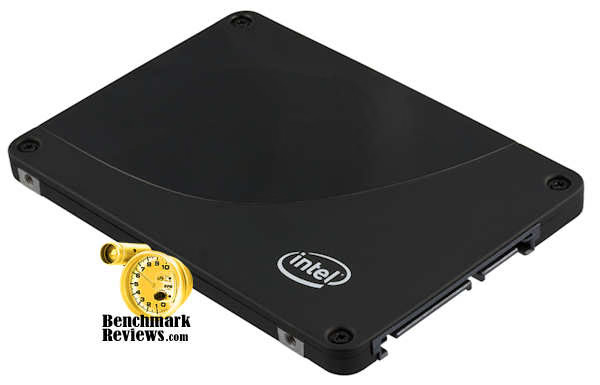
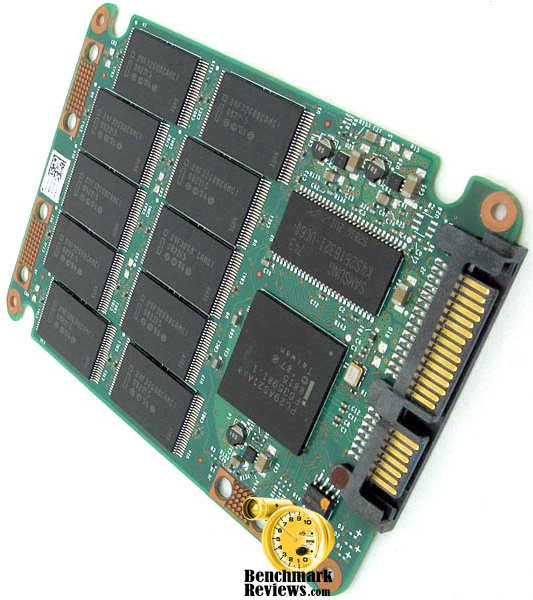
A question that has been raised is how did Intel produce an 80 GB and 160GB SSD when current flash memory is primarily available in 32 GB, 64 GB, and 128 GB lots? After doing a bit of research we found that Intel uses 50nm NAND chips which currently store 32 GB or 4GB per chip. By using 20 flash memory chips (2 for each of the 10 channels) you do the math and I believe you'll come up with 80 GB of storage for the X25-M. As you can see in the image below there are ten flash memory modules on front side of the drive along with a 16MB DRAM chip from Samsung to provide the cache.
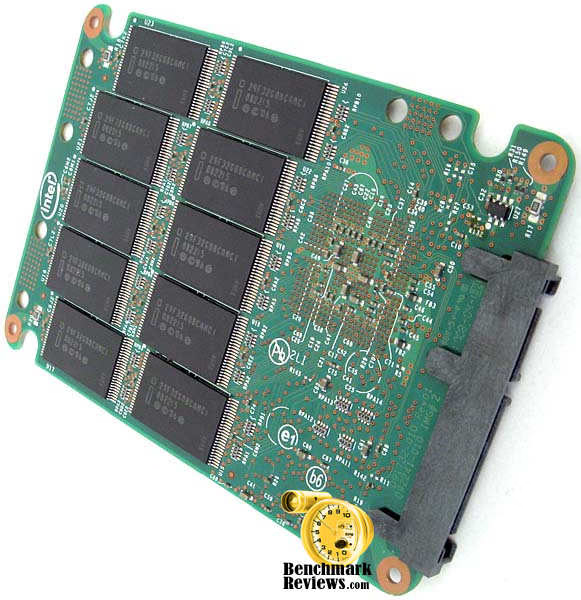
On the rear of the drive you also find ten flash memory modules making a total of the 20 modules we referred to. We also learned that Intel uses its own proprietary designed SATA controller which uses 16 MB of cache and addresses 10 different MLC channels at one time. This is in no small part responsible for the incredible read speeds the X25-M is capable of providing.
From a durability standpoint, the Intel X25-M is quite rugged with a solid metal casing. The drive is designed to endure an operating shock of up to 1,000 g over a 5 ms time frame. The one element that sets solid state drives apart from all others is that there are no moving parts and the response time is almost instantaneous.
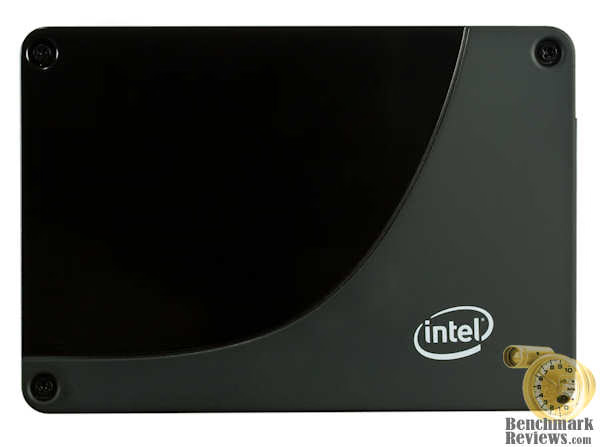
Power consumption is also very low with the drive only demanding 150 mW while in full operation. Intel has provided mounting holes for adapters that accommodate either a horizontal or vertical mounting scheme.
SSD Testing Methodology
Benchmark Reviews recently published an article that detailed SSD Benchmark Performance Testing. The research and discussion that went into this article changed the way we new test SSD products. Our previous perceptions of the technology were lost on one critically important difference: the wear leveling algorithm that makes data a moving target. Without conclusive linear bandwidth testing, our previous performance results were rough estimates at best.
Solid State Drives have traveled a long winding course to finally get where they are today. Up to this point in technology, there have been several key differences separating Solid State Drives from magnetic rotational Hard Disk Drives. While the DRAM-based buffer size on desktop HDD's has recently reached 32 MB and is ever-increasing, there is still a hefty delay in the initial response time. This is one key area in which flash-based Solid State Drives continually dominates because they lack moving parts to "get up to speed".
However the benefits inherent to SSD's have traditionally fallen off once the throughput begins, even though data reads or writes are executed at a high constant rate whereas the HDD tapers off in performance. This makes the average transaction speed of a SSD comparable to the data burst rate mentioned in HDD tests, albeit usually lower than the HDD's speed. It should also be noted that all of our testing for this review was performed using SATA ports controlled by the integrated ICH10R Southbridge chip.

Test System
-
Motherboard: Asus P6T Deluxe(Intel X58 Chipset) with BIOS 1102
-
Processor: Intel Core i7-965 BX80601965 3.2 GHz
-
System Memory: Qimonda 3GB Tri-Channel DDR3
-
Operating System: Windows XP Professional SP-3
Disk Hardware
- Crucial / Lexar 32GB 2.5" SATA-2 SSD CT32GBFAB0
- G.Skill 64GB 2.5" SATA-2 SSD FM-25S2S-64GB
- Hitachi Travelstar 7K100 2.5" 60GB SATA 7,200 RPM HDD HTS721060G9SA00
- MemoRight GT 64GB 2.5" SATA SSD MR25.2-064S
- Mtron Pro 7500 32GB SATA-II SSD MSP-SATA7525
- Mtron Pro 7000 16GB 2.5-Inch 16GB SSD SATA7025
- Mtron MOBI 3000 16GB 2.5" SATA SSD MSD-SATA3025
- Mtron MOBI 3500 64GB 3.5" SATA SSD MSD-SATA3535-064
- OCZ 64GB 2.5" SATA SSD OCZSSD64GB
- OCZ SATA-II 32GB 2.5" SSD OCZSSD2-1S32G
- OCZ Core Series SATA-II SSD OCZSSD2-1C64G
- OCZ SATA-II 64GB 2.5" SSD OCZSSD2-1S64G
- Patriot Warp 128GB SATA-II SSD PE128GS25SSDR
- Samsung 64GB 2.5" SATA-2 SSD MCCOE64G5MPP-0VA
- Seagate 7200.11 500GB 3.5" ST3500320AS 7,200 RPM SATA-II Hard Disk Drive (32MB Cache Buffer)
- Super Talent MasterDrive MX 60GB 2.5" SATA-II SSD FTM60GK25H
- Silicon Power 64GB 2.5" SATA SSD SP064GBSSD25SV10
- Silicon Power 32GB SLC SATA-II SSD SP032GBSSD750S25
- Western Digital Raptor 74GB 3.5" WD740ADFD 10,000 RPM SATA Hard Disk Drive (16MB Cache Buffer)
Test Tools
-
Lavalys EVEREST Ultimate Edition v4.60.1597: Disk Benchmark component tests linear read and write bandwidth speed
-
ATTO Disk Benchmark v2.34: Spot-tests static file size chunks for IOPS benchmarking
-
System Speed Test v4.78 by Vladimir Afanasiev: Accurately measures response time
Comparing a Solid State Disk to a standard Hard Disk Drives is always relative; even if you're comparing the fastest rotational spindle speeds. One is going to be many times faster in response (SSD's), while the other is usually going to have higher throughput bandwidth (HDD's). Additionally, there are certain factors which can effect the results of a test which we do our best to avoid.
Benchmark Reviews highly recommends reading the Solid State Drive Benchmark Performance Testing article, which articulates the various mistakes made when testing SSD products.
System Speed Test Benchmarks
It's show time! All claims to performance are either made real or proven false in our testing, and although SSD's clearly offer some advantages it sometimes takes seeing a product compared to the performance of others to prove the point. Not very long ago I decided to take action and get System Speed Test v4.78 back in our test rotation. This software is solid, and the results are more accurate than any others available that I have used.
I doubt that when DOS was put to rest, Vladimir Afanasiev ever thought he would see his System Speed Test software used again in professional reviews. This program offers comprehensive system information, but it also has a powerful benchmarking tool for memory, processor, and disks. In terms of disk performance, it measures interface and physical transfer rates, seek and access times at the hardware level, and it does so without delay or interference from Operating System software or running processes. This is why Benchmark Reviews will continue to use this test: it polls its results directly from the hardware without the need for Windows!
To detect the Random Access Time of each device, we ran full test routines on all products a total of five times. The highest and lowest scores were ignored, and the remainder was averaged. This would be pointless however, because in every single access time benchmark the test results were identical. In the bandwidth tests the results were extremely close to the others, and therefore required averaging.

With the Intel X25-M boasting a read speed in the 250 MB/sec range our initial feelings at Benchmark Reviews was that something would have to give along the way in testing. We initially felt that "something" would most likely be access times. To our sheer and utter delight we were very wrong as the X25-M we were very wrong about that prognostication as this SSD proved to be among the fastest drives we had tested for access time. It joined the elite, sub one tenth of a millisecond club with the Mtron Pro 7500 32GB SATA-II SSD MSP-SATA7525being he only faster drive that we have tested to date. It's also worth keeping in mind that our Hard Disk Drive alternatives are a much slower to react: Western Digital's Raptor took 8.53ms to respond, followed by 12.99ms for the Seagate 7200.11, and 15.39ms for the 7200 RPM (most are 4800 RPM) Hitachi Travelstar 7K100 notebook drive.
Disk Hardware Tested:
-
Crucial / Lexar 32GB 2.5" SATA-2 SSD CT32GBFAB0
-
Hitachi Travelstar 7K100 2.5" 60GB SATA 7,200 RPM HDD HTS721060G9SA00
-
Samsung 64GB 2.5" SATA-2 SSD MCCOE64G5MPP-0VA
-
Seagate 7200.11 500GB 3.5" ST3500320AS 7,200 RPM SATA-II Hard Disk Drive (32MB Cache Buffer)
-
Western Digital Raptor 74GB 3.5" WD740ADFD 10,000 RPM SATA Hard Disk Drive (16MB Cache Buffer)
ATTO Disk Benchmark Results
EDITORS NOTE: ATTO Disk Benchmark is not designed for accurate bandwidth readings on SSD products. Benchmark Reviews continues to use ATTO Disk Benchmark as a tool for illustrating IOPS load performance. Please read the Solid State Drive Benchmark Performance Testing article to understand how the benchmarks used in this article should be interpreted.
The ATTO Disk Benchmark program is free, and offers a comprehensive set of test variables to work with. In terms of disk performance, it measures interface transfer rates at various intervals for a user-specified length and then reports read and write speeds for these spot-tests. There are some minor improvements made to the 2.34 version of the program, but the benchmark is still limited to non-linear samples up to 256MB. While the bandwidth results are no realistic for determining the maximum drive speeds, ATTO Disk Benchmark is still a good tool for illustrating the bandwidth at different file size chunks. Please consider the results displayed by this benchmark to be basic IOPS performance indicators.
The Intel X25-M performs transfers with files ranging from 0.5 KB to 8192 KB. The SSDSA2MH080G15E shows an incredible 266.2 MBps read plateau from 128-8192 KB file chunks, while showing a slightly less than stellar 80.5 MBps write performance plateaus from 32-8192 KB.

The chart below shows a representative sample from all of the drives that we have tested. For purposes of comparison we used the 8192 KB transfer rates for both read and write as that level appeared to give a fair, median representation of each drives performance using ATTO v. 2.34.

In our next section, we test linear read and write bandwidth performance of the MSD-SATA3535-064 and compare speeds with several other SSD products. Benchmark Reviews feels that linear tests are the only legitimate method for testing SSD products, as detailed in our Solid State Drive Benchmark Performance Testing article.
EVEREST Disk Benchmark
Many enthusiasts are very familiar with the EVEREST benchmark suite by Lavalys, but not many are aware of the Disk Benchmark tool available inside the program. The EVEREST Disk Benchmark (version 2.05.36) performs linear read and write bandwidth tests on each drive, and can be configured to use file chunk sizes up to 1MB (which speeds up testing and minimizes jitter in the waveform). Benchmark Reviews feels that linear tests are the only legitimate method for testing SSD products, as detailed in our Solid State Drive Benchmark Performance Testing article.
The average read speed for the Intel X25-M SSD on the ICH10R controller was a phenomenal 243.5 MBps.
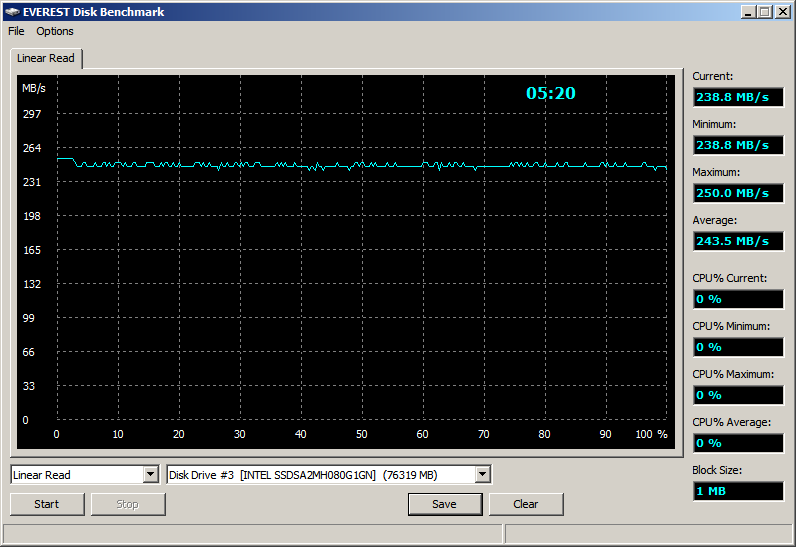
Linear write performance averaged 72.8 MBps on the Intel ICH10R Southbridge. This is approximately 10% lower than our test results in ATTO Disk Benchmark, supporting our claim to use ATTO Disk Benchmark as a tool for illustrating IOPS load performance and spot-checking only.

The chart below shows the average linear read and write bandwidth for a cross-section of drives attached to the Intel ICH10 Southbridge. This is the single most important chart in this review, in our estimation.
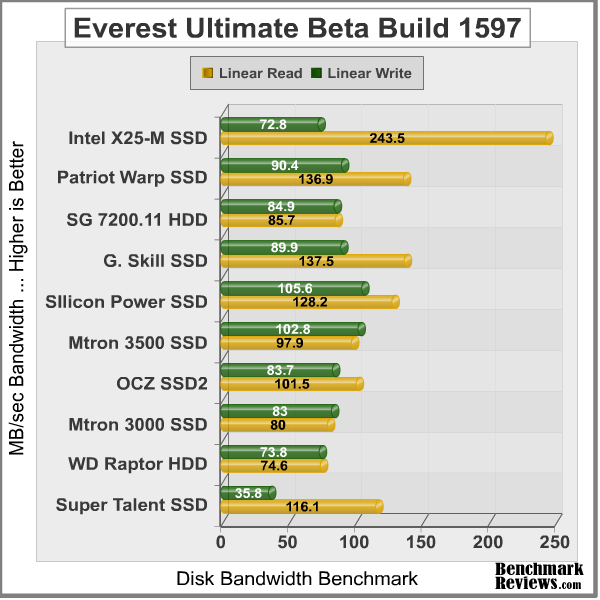
Linear bandwidth certainly benefits the Solid State Drive, since there's very little fluctuation in transfer speed. Hard Disk Drive products decline in performance as the spindle reaches the inner-most sectors on the magnetic platter.
Intel X25-M Final Thoughts
So far we have only talked about the Intel X25-M 80 GB SSD in general terms. Mind you we've included the best benchmarks currently possible to use in testing solid state drives, but what does all of this diatribe actually equal in a real world scenario. First lets examine the two strongest benchmarks and how they translate into use of the product. A read time of 250 MBps is almost double that of the best performing SSD that we have reviewed thus far which was the Patriot Warp 128GB SATA-II SSD PE128GS25SSDRwhich weighed in at 136.9 MBps. In our day-to-day use of the X25-M we noticed an incredible difference in just how fast everything loaded in the system and was ready for use, this ranged from our operating systems Windows XP SP 3 and Vista 64 SP1 to extremely large games. For the general consumer all the way to the information technology manager this will be the most desirable area of performance this drive brings to the table.
Next lets look at the system access time. The Intel X25-M was also at the top of the heap in this category with and incredible 0.09 ms which was only topped by the Mtron MOBI 3500 64GB 3.5" SATA SSD MSD-SATA3535-064which came in at 0.08 ms. It should also be noted that the MtronMobi 3500 is an SLC based drive as opposed to the MLC design of the X25-M. Access times this fast only serve to further enhance your system's performance. We noticed that whatever we requested our test rig to perform began almost instantaneously upon clicking the start button. In other words there was no perceivable lag noticed whatsoever. Again, another major plus for all types of users, but especially the computer enthusiast and information technology manager.
Now on to the write speeds for the Intel X25-M which averaged 72.8 MBps. Although not abysmal, these results were bested by all of the other drives we tested with the one exception, the Super Talent MasterDrive MX 60GB 2.5" SATA-II SSD FTM60GK25H which was truly abysmal with a write speed of only 35.8 MBps. The standard Western Digital Raptor even barely eked out a win by just 1 MBps. For the general consumer and even the computer enthusiast write speeds in this range are not much of a problem. For the information technology manager though this would likely be a deal breaker, but then again they would most likely opt for the extreme version of this drive based on an SLC configuration and sporting write speeds in range of 170 MBps. We would have been able to call this drive perfect had it shown better write performance, but for the consumer group we cater to the X25-M is still likely to be as good as it gets at this point in time.
Now lets take a gander at the price of the Intel X25-M. Newegg currently lists the price for the Intel X25-M SSDSA2MH080G1C5 80GB SATA Internal Solid state disk (SSD) at $499.95 or $6.25 per gigabyte. A few months ago this would have been considered cheap for a drive of this caliber. Current top dog SSD's range anywhere from $4.50 per GB to well over $7.00 per GB. I should state that with the exception of the write speed there is no other traditional or solid state drive on the market currently that can even come close to matching the blaance of the X25-M's performance capabilities at any price.
SSDSA2MH080G15E Conclusion
While we at Benchmark Reviews thoroughly enjoyed testing the Intel X25-M 80 GB SSD we would be totally remiss if we didn't make mention of the current American economy. Manufacturers such as Intel are having to become extremely creative when it comes to bringing their products to market and keeping the bottom line purchase price to the consumer as low as feasibly possible while still producing a quality product. Intel has kept the appearance of the X25-M as simplistic as possible while still producing a product that meets the needs of the mainstream market for which it is intended.
Product appearance for SSD's is no easy task to master successfully. We're talking about a product that either hides inside a server of desktop computer, and is usually only seen just once at installation. Intel has opted for a very simplistc flat black appearance, which under the circumstances of use is probably most appropriate. While some reviewers feel that a plastic framework for an SSD is most appropriate due to metal being heavier and less durable, I have a differing opinion. I feel that the metal case adds to the strength and durability of the X25-M and most likely aids in passive heat dissipation, which is most certainly an issue even with solid state drives. Granted plastic may help to decrease the products cost ever so slightly but in this case I feel metal to be the most appropriate solution.
Construction is probably the strongest feature credited to the entire SSD product line! Intel has always produced some of the strongest and most resillient products available, with the X25-M certainly not being an exception to this trend. Solid State Drives are by nature immune to most abuses, but add to this a hard metal shell and you have to wonder what it would take to make this drive fail. If an Intel X25-M does fail the consumer had a 3-year warranty period, in which the drive can either be replaced or repaired through Intel's extremely robust support network.
Based on the collection of benchmark tests we conducted, the Intel X25-M MLC SSD performs at almost double the rate of its competition in the linear read category boasting an average read speed of 243.5 MBps. Probably the most incredible performance feat is the drives access time which is 0.09 ms, a speed that is almost unheard of in drives that utilize MLC memory modules. Linear write performance reported a maximum bandwidth of 72.8 MBps, which is the only real shortcoming in this drives repertoire. While the write speeds are certainly less than stellar we must remember that this product is targeted for the mainstream market where write speeds are certainly much less important than either read speeds or access time.
In conclusion, the Intel X25-M MLC 80 GB Solid State Drive offers an excellent balance of linear read bandwidth coupled with an astonishingly fast response time. Boasting a near-instant 0.09 ms, the Intel X25-M is roughly 88x more responsive than Western Digital's Raptor HDD. The linear read-from performance was nearly 100% faster than the Western Digital Raptor. MLC construction causes a definitive decrease in write performance where the drive is actually outperformed by the original Wester Digital Raptor. The price of this drive is one of the highest in the category of drives it competes with. However, one must remember that you are getting 16 additional gigabytes of storage for that price. Taking that fact into consideration, the average price per gigabyte beccomes a bit more palatable.
Pros:
+ Phenomenal linear read speed of 243.5 MBps
+ Extremely swift 0.09 ms response time
+ Low power consumption may reduce data center energy costs
+ Resistant to extreme shock impact
+ Up to 80 GB of SSD capacity
+ 5-Year Intel product warranty
Cons:
- $6.25 per gigabyte of MLC SSD storage space
- Poor linear write speed in comparison to the competition
Ratings:
-
Presentation: 9.00
-
Appearance: 9.00
-
Construction: 9.75
-
Functionality: 8.75
-
Value: 7.00
Final Score: 8.75 out of 10.
Recommended: Benchmark Reviews Silver Tachometer Award.
Questions? Comments? Benchmark Reviews really wants your feedback. We invite you to leave your remarks in our Discussion Forum.
{mos_ri}