
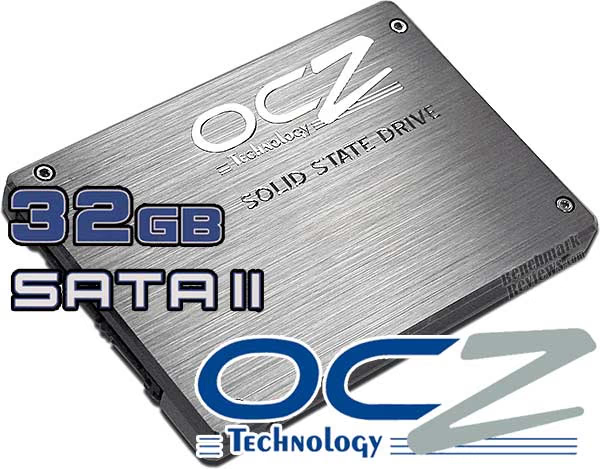
OCZ SATA-II 32GB 2.5-Inch SSD OCZSSD2-1S32G
OCZ 32GB SSD OCZSSD2
EDITORS NOTE: Please read Solid State Drive (SSD) Benchmark Performance Testing to understand how the benchmarks used in this article should be interpreted.
Perhaps Benchmark Reviews likes to ride the edge of technology just a little too close, since we've tested more DDR3 and SSD's than almost everyone else on the web. The bleeding edge is where most enthusiasts like to live, but most avoid the price tag. OCZ allowed us to test their first Solid State Drive product, the OCZSSD64GB, and while the pricing very affordable the performance wasn't so impressive. Now just a short three months later, OCZ has returned with one of the industries very first SATA-II SSD products, the OCZSSD2. It would be a shame to give away the details, but it appears that the extra time at the design table was very well spent. OCZ's new Solid State Drive offers industry leading performance matched by ultra-affordable pricing, and sets a new record.
This is going to be one of the more difficult articles for me to write, primarily because I began my experience with the OCZSSD2-1S32G with testing before I did anything else. Logistically, It's easier to test a review product first, prior to starting to form the article. As a technical writer however, this becomes a different proposition. Even more so when you are trying not to reveal the results right from the start. So in a rare example of me caving in to the pressure, I have decided not to hold back: OCZ's latest 32GB 2.5-Inch Solid State Drive is everything their first SSD wasn't.
Ironically, I wasn't very optimistic coming into this project. Experience has taught me that approaching a review with any level of judgment towards the product will usually lead to a less-than-enthusiastic article... usually from the feeling of let-down. So perhaps it works to the advantage of OCZ for me to have started this project with a rather low level of expectation. I may have been unintentional, but it seems to have worked nicely.
Benchmark Reviews has been hard at work trying to ride the wave of innovation into the next big technology. It only took a few years of development, but Solid State Drives can now offer superior speed over Hard Disk Drives; but they are still extremely expensive. OCZ is very well known for their push towards high performance enthusiast products, however this article is going to expose a different side of their dimension. You might be familiar with their system memory kits, and you may even know of their PC Power & Cooling PSU's, but it's their SSD product line that impresses me most of all. Benchmark Reviews has tested the new OCZ 32GB SATA-II Solid State Drive OCZSSD2-1S32G 32GB, and we're ready to share some very impressive results.
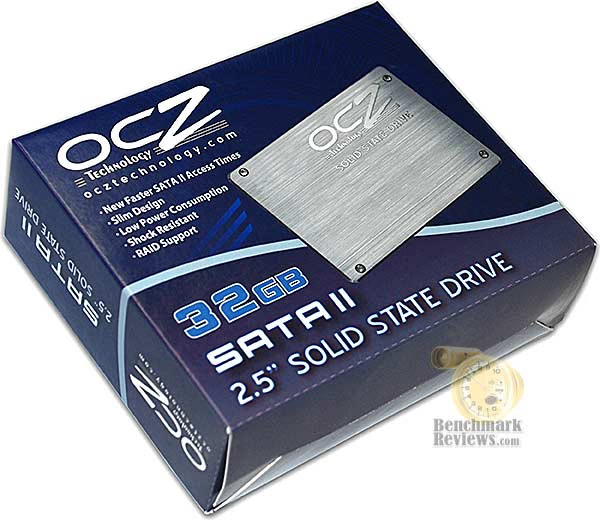
Since first making a commercial public debut at the 2007 Consumer Electronics Show, Solid State Drives (SSD's) have been a topic of hot discussion among performance enthusiasts. With virtually no access time delay, these nonvolatile flash memory-based drives were quick to promise a more reliable storage device with greater performance while operating at a fraction of the power level. Moving further into 2008 they have become a reality for many performance-minded power users. I suppose it's been a slow ramp-up for consumers to accept Solid State Drive technology, similar to the struggle DDR3 SDRAM has seen. But it wasn't supposed to be this way, and I personally blame Microsoft for a large portion of this delay. Almost two years ago, and still months prior to the retail release, Windows Vista was supposed to require Hybrid Hard Drives if you wanted the new Operating System on a notebook. However, once Microsoft caved in to manufacturer pressure the development quickly slowed to a halt.
At the start of January we visited with OCZ during the 2008 Consumer Electronics Show and learned of their upcoming product releases. From my perspective, one of their most anticipated items was the OCZ 64GB SATA 2.5" Solid State Drive OCZSSD64GB. While most of the other SSD products we have tested aim for the highest performance numbers possible with no limit to the cost on consumers, OCZ has successfully delivered a value-strong line of SSD's.
According to a Q1 2008 report by the semiconductor market research firm iSuppli, the SSD market will grow at an annualized average of 124 percent during the four-year period from 2008 until 2012. iSuppli now projects SSD sales to increase by an additional 35 percent in 2009 over what it projected last year, 51 percent more in 2010, and 89 percent more in 2011, and continue to show dramatic increases in subsequent years.
OCZ SSD Features
Featuring high capacities, excellent reliability, and low power consumption, OCZ SATA SSD series are an efficient, fast, and durable alternative to conventional hard disc drives. Compatible with standard SATA interface, SSD drives offer higher real-life transfer rates that result in faster boot and application launch times to boost any high-performance system. The OCZ SSD does not contain any moving parts that are subject to wear and tear, making it a top choice when replacing your hard drive. Top it off with a 1 year warranty, and you will have an excellent memory drive that won't let you down
The OCZ SATA II drive is designed to stay abreast of the performance features of high-end notebooks, and is ideal for energy-efficient mobile computing. With blazing access times combined with excellent reliability, the OCZ SATA II 2.5" SSD is the answer for enthusiasts demanding the most advanced storage for their notebooks and systems.
At incredible capacities of 32GB and 64GB and premier speeds of 100MB/s read and 80MB/s write, OCZ SATA II SSDs enable enhanced productivity in your everyday computing and intensive multi-tasking applications. Featuring durable yet lightweight brushed alloy housing, OCZ SATA II 2.5" SSDs have no moving parts that are prone to damage from common mishandling. Designed for ultimate reliability, these SSDs have an excellent two million hour mean time before failure (MTBF) ensuring peace of mind over the long term.

OCZSSD2-1S32G Specifications
-
Read up to 100MB / sec
-
Write up to 80MB / sec
-
Slim 2.5" Design
-
100.2 x 70 x 9.5mm
-
Lightweight 77g
-
Low Power Consumption
-
Shock Resistant 1500G
-
High-Capacity 32GB
-
Component SSD: Samsung MCBQE32G5MPP-0VA
-
RAID Support
-
MTBF 2 million hours
-
1 year warranty
About the company: OCZ Technology
Entering the memory market in August 2000, OCZ Technology was built around the determination to manufacture the best high speed DDR and RDRAM. OCZ was founded by enthusiasts, for enthusiasts, and their commitment to the end-user has not digressed. OCZ Technology has been an innovator in many areas.
We were the first manufacturer to make Dual Channel optimized memory available to the public, which originally took advantage of nVidia's Twinbank or Dual DDR architecture, found in their nForce chipset. We have now taken that technology and tailored it for the Canterwood, and Granite Bay chipset's. OCZ developed and was the first to implement ULN technology, which has been a critical element in the manufacturing process for some time.
We at OCZ diligently work to improve communication with CPU and motherboard chipset manufacturers prior to the release of their products. Only in this manner can we fine-tune the memory's SPD settings, ensuring a synergistic relationship between the memory module, memory controller, and microprocessor. In today's rapidly evolving semiconductor industry, such communication is not simply research, but a necessary component of the manufacturing process.
OCZ SSD Support Addendum
EDITORS NOTE: Please read Solid State Drive (SSD) Benchmark Performance Testing to understand how the benchmarks used in this article should be interpreted.
Solid State Drives are not always a direct replacement to Hard Disk technology, because there are a few differences between products that make it important to properly configure your hardware for the best possible performance and stability. OCZ SSD's are not identical to other Solid State industry offerings, which is why they include a detailed guide for proper set-up on the OCZ support forum. Following their expert advice can help you avoid data write failures and delayed write data corruption errors on the OCZ SSD. Here are some important excerpts from their guide:
Known Issues
The original release of Microsoft Vista has problems with properly using SSDs that are resolved with Service Pack1. Installation of SP1 results in a substantial performance boost in synthetic benchmarks and smoother operation of the system in standard usage. Before using, please ensure that Service Pack1 (Vista32 and 64) is installed. Also, despite the fact that Vista contains generic chipset drivers, those drivers do not correctly enable any of the SATA controllers used on current motherboards, regardless of chipset manufacturer. Please make sure to install the latest chipset drivers, otherwise, especially the burst transfers will show a dramatic degradation and this will also affect sequential read and write performance.
HDTune uses fixed strides across the array to measure small block sizes. If these blocks fall on page or chip boundaries, the time delays result in atypically low "calculated" performance spot data that are not representative of the drive's real performance but an artifact stemming from inadequate testing methodology.
HDTach's fixed strides between sample points causes similar issues as those outlined in HDTune, in this case, the periodicities of the stride pattern and the flash memory address space cause some wave-like interference patterns of the benchmark results that are also measuring artifacts rather than being indicative of performance.
AHCI
the Advanced Host Controller Interface allows Hot-Plugging and Native Commands Queuing as well as multithreaded access of the drive by applications. Enabling AHCI results in conflicts between the controller and the drive that are apparent as sluggish overall system performance.
Benchmarks that actually work are those that are not geared towards quick and dirty assessment of a HDDs performance based on optimization of the test algorithms to meet the typical HDD architecture. Examples are PCMark Vantage, Winbench 99 2.0 "Drive Inspection Test" or ATTO.
This is just a very small example of the information OCZ provides consumers in their Setup and Testing Guide: Configuring and setting up SSDs. Visit the OCZ support forum for more information and the complete guide.
OCZ 64GB SSD Closer Look
For a little over a year now Benchmark Reviews has anxiously awaited the fabled Solid State Drive that could replace our current list of preferred Hard Disk Drives. Making this wait seem even longer was the fact that HDD manufacturers were constantly improving there product and adding new enhancements to the technology. First there was perpendicular storage technology, then came fluid bearings, and finally there was the increase in cache buffer DRAM to speed-up the burst data transfer. Performance has always been the hurdle that SSD's have had a tough time clearing, with read and write bandwidth creating the largest obstacles. Response time and reduced power consumption has long become the key arguments for owning an SSD, but without the bandwidth throughput to measure up against HDD's they became an expensive niche item. That time has passed.
A few months ago we tested the lightning-fast MemoRight GT SSD, which finally put the Western Digital Raptor in its place... to the tune of almost $2000. In that round, the Solid State Drive won the speed and bandwidth victory, but it had a long way to go befor surpassing the value of a Hard Disk Drive. This is a new chapter in the history of the Solid State Drives struggle to replace the Hard Disk Drive. Power consumption is still astonishing low, even when compared to the newest series of efficient HDD's available. Access time has only got better with new revisions, as nearly all SSD's register less than .1 ms delay. Bandwidth has dramatically improved as controller components have been refined and redesigned. Even the previous setback of SATA-I controller limitation has been recently overcome with commercially available SATA-II solutions. All that remains on the list of items holding back the widespread use is... cost.
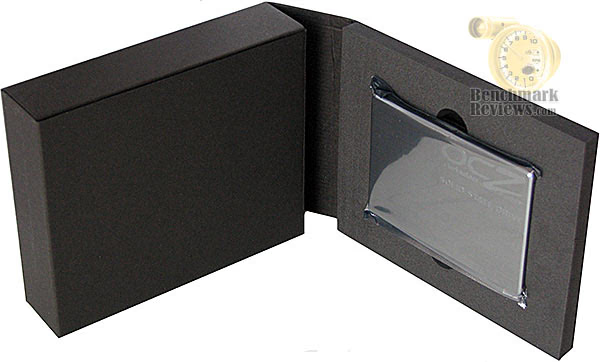
While the solid hue of orange covered the original OCZ SATA Solid State Drive, the palette has made a shift toward blue for this product version. Neither retail package excited me much, further impressing the let-down I felt after testing the OCZSSD64GB months back. But then I discovered a touch of class as I opened the box. At first glance, the new OCZ SATA-II SSD appears to have more protection than the average Hard Drive receives. I was a little stunned, especially since Crucial/Lexar showed me a paint-mixer demonstration of an SDD being shaken while a video game was being played be a CES convention-goer. Nevertheless, OCZ has safely nested the OCZSSD2in a foam enclosure with the care a flight data recorder might receive - and for good reason. Solid State Drives are very popular items in military and aerospace technology, primarily because of their ability to withstand shock in excess of 1500 G's. The OCZSSD2 offers the same rugged longevity, which amounts to safer data even after the worst disasters.

As a professional system builder of higher-end computer systems, I have learned some very important lessons in regards to system performance over the past eight years. While gamers constantly leap for higher frame rates out of their video card, there is something more important than a faster processor, memory, or even front side bus. The real backbone to overall system speed and performance is the primary boot drive. In today's world, that usually means the hard disk drive for nearly all computers. After hundreds of performance computers built and sold, I have seen a 10,000 RPM drive make a 2GHz CPU seemingly perform twice as fast, whereas a 5,400 RPM drive makes that same CPU run like it was only half as fast.
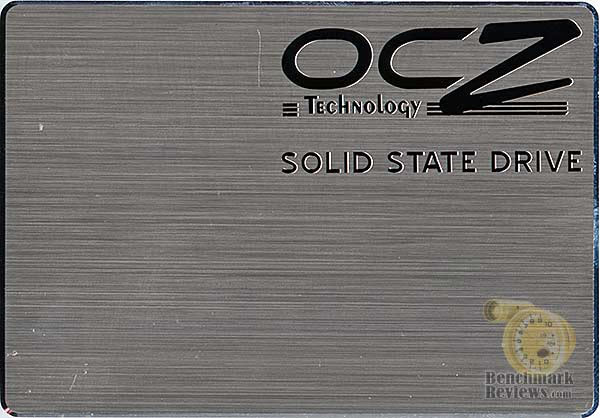
The OCZ OCZSSD2 Solid State Drive is encased in an aluminum half shell, which fastens from the underside with counter-sunk screws. As much as I would have liked to disassemble the OCZSSD2-1S32G 32GB 2.5-Inch Solid State Drive I received for testing, my desire to ruin a perfectly good product sample kept me in check. Based on the information displayed in Windows Device Manager, the Samsung MCBQE32G5MPP-0VA is the internal component SSD used in OCZ's second generation product.
Standard 2.5" drive bay mounting points are pre-drilled and threaded in the OCZ OCZSSD2, which allows for quick upgrade or addition to any existing notebook or desktop system. The mounting positions matched up to the drive bracket on my Dell Inspiron laptop, and without any trouble at all I was quickly loading the operating system on this 32GB SATA SSD Solid State Drive.
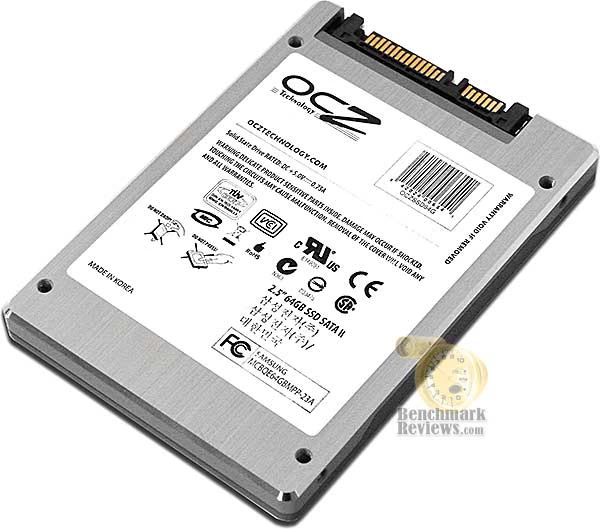
The underside of the OCZ SSD reveals standard SATA power and data interface connections. Unlike desktop computers which utilize a SATA cable system to connect drive to motherboard, nearly all notebooks allow the 2.5" drive to simply slide directly into a connection bay within the system. In addition to notebooks and desktop computer usage, this OCZ SATA-II Solid State Drive can be utilized for mission-critical backups or high-abuse data systems.
Solid State Drives are not for everyone. Similar to the evolution towards DDR3 system memory, a gradual replacement of the Hard Disk Drive (HDD) by the Solid State Drive (SDD) is going to move very slow. The cost of purchase for SSD's is the primary cause, since most drives cost more than an purchase price of an entire computer system. But what if the price was within reach? What if the data throughput was comparable? This is where Benchmark Reviews comes in to answer the tough questions, as we test the OCZ SATA-II OCZSSD2-1S32G 32GB 2.5-Inch Solid State Drive.
SSD Testing Methodology
EDITORS NOTE: Please read Solid State Drive (SSD) Benchmark Performance Testing to understand how the benchmarks used in this article should be interpreted.
Solid State Drives have traveled a winding course to get where they are today. Up to this point in technology, there have been several key differences separating Solid State Drives from magnetic rotational Hard Disk Drives. While the DRAM-based buffer size on desktop HDD's has recently reached 32 MB and is ever-increasing, there is still a delay in the initial response time. This is one key area in which flash-based Solid State Drives continually dominates because they lack moving parts.
However the benefits inherent to SSD's have traditionally fallen off once the throughput begins, even though data reads or writes are executed at a high constant rate whereas the HDD tapers off in performance. This makes the average transaction speed of a SSD comparable to the data burst rate mentioned in HDD tests, albeit usually lower than the HDD's speed.

Test System
-
Motherboard: Gigabyte GA-X48T-DQ6 (Intel X48 Chipset) with F4 BIOS
-
System Memory: Corsair PC3-14400 DDR3 1800MHz
-
Processor: Intel E8200 Core 2 Duo 2.66GHz
-
Optical Drive: ASUS BC-1205PT SATA Blu-ray Disc
-
Operating System: Windows XP Professional SP-2 (optimized to 16 processes at idle)
Disk Hardware
-
OCZ SATA-II OCZSSD2-1S32G 32GB 2.5-Inch Solid State Drive
-
Western Digital Raptor 74GB WD740ADFD 10,000 RPM SATA Hard Disk Drive (16MB Cache Buffer)
-
Seagate 7200.11 500GB ST3500320AS 7,200 RPM SATA-II Hard Disk Drive (32MB Cache Buffer)
Benchmark Reviews is aware that all Intel ICH9 and ICH9R chipsets which come on the 3 and 4 series motherboards exhibit a bandwidth limit defect on SSD's of approximately 80MBps when not operating in ACHI mode (BIOS configuration). Since the Gigabyte GA-X48T-DQ6 motherboard we used for testing also comes equipped with a JMicron JMB363 SATA controller for two additional SATA-II ports, all tests were conducted on this drive controller.
Test Tools
-
HD Tach RW v3.0.4.0 by Simpli Software
-
ATTO Disk benchmark v2.02
-
System Speed Test v4.78
Comparing a Solid State Disk to a standard Hard Disk Drives is always relative; even if you're comparing the fastest rotational spindle speeds. One is going to be many times faster in response (SSD's), while the other is usually going to have higher throughput bandwidth (HDD's). Additionally, there are certain factors which can effect the results of a test which we do our best to avoid. Nevertheless there will be some tests which will not be completely representative of the individual product tested, but a combination of the product and supporting system hardware. An excellent example of such a test is the write-to bandwidth benchmarks, which rely on other system components to force data onto the drive along with the bus bandwidth to support it. This dependency on system hardware is why you will see Benchmark Reviews place an emphasis on read bandwidth over write tests.
System Speed Test Benchmarks
EDITORS NOTE: Please read Solid State Drive (SSD) Benchmark Performance Testing to understand how the benchmarks used in this article should be interpreted.
It's show time! All claims to performance are either made real or proven false in our testing, and although SSD's clearly offer some advantages it sometimes takes seeing a product compared to the performance of others to prove the point. During our re-testing process, I decided to take action and get System Speed Test v4.78 back in our test rotation. This software is solid, and the results are more accurate than any others available.
I doubt that when DOS died, Vladimir Afanasiev ever thought he would see his System Speed Test software used again in professional reviews. This program offers comprehensive system information, but it also has a powerful benchmarking tool for memory, processor, and disks. In terms of disk performance, it measures interface and physical transfer rates, seek and access times at the hardware level, and it does so without delay or interference from Operating System software or running processes. This is why Benchmark Reviews will continue to use this test: it polls its results directly from the hardware!
To detect the Random Access Time of each device, we ran full test routines on all products a total of five times. In nearly every benchmark the result was extremely close to the collection, thus our charts represent the average of all readings. Very obvious in our results was the distinct difference in potential notebook access time at the start of our chart, compared to the current notebook access time on the far right.

Bandwidth is a whole other consideration once you record the results. In our tests, Seagate's 7200.11 drive with 32MB cache buffer really showed its strength as it narrowly outperformed the Western Digital Raptor. Close on the Raptors' tail (pun) was the OCZ SATA-II Solid State Drive. Following closely behind the OCZSSD2 is the remainder of SSD's, finished off by the original OCZ SSD.
Looked at a different way, and ignoring the dominant buffered read speed results trend set by the Hard Disk Drives, the OCZSSD2 actually did well to hold ground against the Raptor, and is well ahead of the other SSD's. The 32MB buffer in the 7200.11 is not within reach, but the OCZ SATA-II SSD still shows real promise in the linear read speed tests.

Although Benchmark Reviews completely endorses the test results of System Speed Test for our benchmarking, it's always good to have other sources. We decided to then test the 32GB OCZ SATA-II SSD OCZSSD2-1S32G 2.5-Inch Solid State Drive using the HD Tach RW and ATTO Disk Benchmark tool in the following sections. Please continue to see if our results were a fluke or not.
HD Tach RW Benchmark Results
EDITORS NOTE: Please read Solid State Drive (SSD) Benchmark Performance Testing to understand how the benchmarks used in this article should be interpreted.
In the tests below, Benchmark Reviews utilizes the HD Tach RW tool to compare the OCZ SATA-II OCZSSD2-1S32G 32GB 2.5-Inch Solid State Drive against the fastest collection of desktop drives and competing SSD's we can get our hands on.
HD Tach is a software program for Microsoft Windows that tests the sequential read, random access and interface burst speeds of the attached storage device. For the record. every single product tested was brand new and never used. HD Tach allows write-bandwidth tests only if no partition is present. Additionally, each and every product was tested five times with the average result displayed here. The graphical user interface (GUI) of the Windows-based benchmark tool HD Tach is very convenient. and allows the test product to be compared against others collected on your system or those registered into the Simpli Software database.
Comparing the OCZSSD2 to the Western Digital Raptor may amount to the largest factor of influence for most enthusiasts considering the new SSD technology in their performance desktop computers. Right away, the burst speed of OCZ's new SATA-II SSD is phenomenal! 160.7 MBps burst is the fastest we've seen out of any SSD or HDD tested thus far, and completely dominates the Raptor's 127.9 MBps burst. Even the sequential write speed is faster than the Raptor's read speed, which over the span of capacity begins to fall off in performance even further. While not shown in our charts, we have tested all four variations of the Raptor and choose to display the results of the 74GB version because of the widespread popularity among gamers. All four Raptor hard drives performed nearly identical, with only very negligible differences in burst and average speeds. Suffice it to say, the Western Digital Raptor series is no longer a threat to current-generation SSD's.

Next, we compare the second generation OCZ SATA-II SSD against Mtron's MOBI SSD. The MOBI 3000 Solid State Drive is a budget-minded product for entry-level needs, yet it performs nearly as well as Mtron's top offerings. In the chart below, the MOBI was left trailing by a very large margin to the comparably priced OCZSSD2-1S32G. I used to give the MOBI MSD-SATA3025 full credit for being such a well-performing SSD with plenty of value, but it looks like my opinion has just been changed. Judging from the collection of waveform graphs below, the OCZ SATA-II SSD might just be the new king of the hill... but let's not be too hasty.

Comparing OCZ's best SSD against Mtron's budget model isn't exactly fair, despite matching price tages. So in our next match-up we compared the OCZ SATA-II SSD OCZSSD2 head-to-head against Mtron's fastest model: the Mtron Pro 7000 2.5-Inch 16GB SSD SATA7025. At first I was a little concerned about my test results, since the 7000 Pro seemed to be producing results very similar to the MOBI 3000. But after nine total tests I was convinced that the Mtron 7000 Pro really wasn't much different, and hardly worth the extra cost.
While the results were close, the OCZ SATA-II SSD produced a far superior burst speed which outperforms the Mtron 7000 Pro's respectable 113.0 MBps. Looking over the sustained read and write speeds, it became clear that the Mtron 7000 Pro's 112.2 MBps best speed was nowhere near the same level of performance. At this point, it seems that Mtron had better improve its technology very soon, or they won't be a contender in the SSD market for much longer.

The last chart I present to you pits our former speed champion, the MemoRight GT MR25.2-064S SSD, against the OCZ SATA-II SSD OCZSSD2-1S32G. A few months back when I tested the MemoRight GT it produced such impressive results I wondered how long it would be before the market would catch up. Apparently, it takes less than two months. Looking at the results below, the MemoRight GT still reigns supreme in sequential write speed, offering the best bandwidth we've seen at an impressive 122.8 MBps.
But opening up applications and loading programs doesn't call upon the sequential write speeds, and most users would never notice a difference unless they were compiling video or large audio files. Some of the most critical performance areas are in the read speed; both the burst and sequential sustained read. To this end, the OCZ OCZSSD2 has set the bar high, producing a sustained read speed of 156.4 MBps and setting another new record. Samsung's MCBQE32G5MPP-0VA is clearly a much-improved version of their former SSD component line, and this time around OCZ has redeemed themselves.

Just for good measure I have included a chart to compare the test results of OCZ SATA-II SSD OCZSSD2 against several of the other drives we tested, including Seagate's newest 7200.11 Hard Disk Drive. The 7200.11 features a cache buffer twice the size of previous hard disks, totaling 32MB. This comes into play early on in the tests, as the Seagate 7200.11 actually beats out the Western Digital Raptor in sequential read speed performance by a long shot.
Pressing along with its 160.7 MBps burst, the OCZSSD2-1S32G 32GB 2.5-Inch Solid State Drive was left untouched by Seagate's 7200.11 burst of 120.0 MBps; which is considerably close to the MemoRight GT's 123.7 and Raptor's 127.9 MBps. Unlike the previous comparison however, the Seagate 7200.11 puts all 32MB worth of cache buffer to use as sequential read speed reaches 88.8 MBps on average, compared to the already phenomenal 156.4 MBps produced by the OCZSSD2 and the less-impressive 117.9 MBps offered by the MemoRight GT. Just one good look at this chart, and you can see that history has been written.
EDITORS NOTE 05/14/08: During our initial tests, we discovered that HD Tach produced different results for our test subjects when we changed BIOS settings from ACHI to IDE mode for the JMicron SATA controller. Although our initial tests only represent standard IDE mode, re-testing is underway.
UPDATE 05/16/08: After several different re-tests of the OCZSSD2, the HD Tach results seem to show a very different story. Until we receive a response from OCZ, I will simply state that the HD Tach results should be lightly weighted with this particular product. In our last series of tests the burst speed was 272 MBps on average, which seems to me on the high side of things, and is so dramatically different from the 161 MBps seen from our initial tests that I cannot draw a solid conclusion. The sustained read speeds from the re-test average 93 MBps, and the sustained write speeds are averaging 74 MBps.
OCZ RESPONSE 05/19/08:OCZ does not give consideration to the HD Tach burst speed result, because each cell of the NAND flash chips are very different so that the burst speed reading does not mean anything in regards to performance. Sometimes burst speed can be accessible in 5-nano secs and sometimes it can be 20-nano secs, which is why the NAND maker guarantees 20-nano seconds. That is why the burst speed does not have any important role in SSD products in particular. The important role is how fast it can be accessed and sector read and write time.
In the next section, ATTO Disk Benchmark compares our range of drives and offers a different perspective from a unique test tool.
ATTO Disk Benchmark Results
EDITORS NOTE: Please read Solid State Drive (SSD) Benchmark Performance Testing to understand how the benchmarks used in this article should be interpreted.
Normally ATTO Disk Benchmark is not my first choice for drive testing tools. To be honest, I think it makes for a poor scientific comparison of products because the settings allow for a large range of results. But since the Intel ICH9 and ICH9R southbridge has a bug that prohibits SSD bandwidth beyond 80 MBps I cannot use my all-time favorite System Speed Test software. The ICH chipset has an available DOS driver, but the JMicron JMB363 controller used for testing does not which left us without our favorite testing tool.
The ATTO Disk Benchmark program is free, and offers a comprehensive set of test variables to work with. In terms of disk performance, it measures interface transfer rates at several different user-specified intervals and reports read and write speeds. The drives seek and access times are not statistics made available in this application, which makes this a considerably basic tool. Bandwidth results are indicated as the transfer rate in the images below.
Our testing starts with the Western Digital Raptor (WD740ADFD) 10,000 RPM Hard Disk Drive. Based on the transfer size results, the Raptor HDD reaches a plateau around 16 KB and remains steady up to 1 MB. Western Digital's Raptor is a very good product for the money, but its time has come. With a performance delta around 16 Kb, the Raptor doesn't offer much performance to users wanting to move larger file chunks.

Next up, we tested the MemoRight GT MR25.2-064S. The GT does very well at performing very near to the 120 MBps advertised maximum rate throughout the bandwidth test results. From 64.0 KB to 1 MB the read and write transfer bandwidth is virtually identical, with the 64 Kb file size appearing to be the delta. Since most applications have taken advantage of larger drive capacity, the size of program files has also grown. This makes drives such as Western Digital's Raptor less desirable than the MemoRight GT shown below.

As I mentioned in the beginning of this section, ATTO Disk Benchmark is not among my favorite test tools. A clear example is shown below, which dramatically reduces the read bandwidth results for OCZ's SATA-II SSD compared to those of HD Tach, and raises the OCZSSD2's write bandwidth numbers. Take it for what it's worth, since we've chose to include this information for your comparison.
Based on this results, the OCZ SATA-II SSD plateau's around 64 KB transfer chucks, and produces nearly identical read and write transfer rates of 94 MBps.

Since there are bandwidth results for each transfer file size from .5 KB to 1 MB, we decided to use the 1 MB statistic in our chart below. In this chart, I have organized the products using the sum of their read and write bandwidth speeds. The MemoRight GT MR25.2-064S appears well ahead of the pack, but the Seagate 7200.11 hard drive gets the closest in terms of performance. Training behind is the Mtron Pro and MOBI, followed by the Raptor in last place. Access time is the key benefit for Raptor owners, but with 32MB of cache buffer in the 7200.11 it won't be long before other hard drives are within reach. For now it looks like there is some real promise in the linear read and write speeds of MemoRight's GT.

Originally I hadn't planned on including the ATTO Disk Benchmark results in this article. While the software is decent enough to mention, it was merely included because almost all SSD manufacturers test with it... and for very good reason. After several tests had been completed, I began to see why they decided on this particular software for benchmarks. What I like least about this software is how you can manipulate the settings to produce extremely different results. As an example, if you reduce the total test length size from 32 MB (used in our testing configuration) to one of the smaller sizes the benchmark results are more than 30% different. That reason alone is enough for manufacturers to tweak their own tests for self-benefit.
Nevertheless, in regard to our ATTO tests the MemoRights GT series has proven itself capable of producing superior performance on every level... at a cost of nearly $2000. Yet with cache buffers growing larger and larger, perhaps there's a reasonable middle ground that will provide the best of both worlds. I suspect that hybrid drives could play an important role in this argument very soon.
In our next section, we address the collection of test results and give our conclusion on the OCZ SATA-II 32 GB SSD OCZSSD2.
SSD Final Thoughts
EDITORS NOTE: Please read Solid State Drive (SSD) Benchmark Performance Testing to understand how the benchmarks used in this article should be interpreted.
As a product analyst, I often get to have my hands on product that I would otherwise never spend my own money to purchase. Certainly without argument, Solid State Drives might fall into this category. There are many products which I feel are so new that it's better to let them ripen on the vine, so to say. However early adopters never follow the pack, and scoff at the notion of waiting out the next technologies maturity. So when Benchmark Reviews began testing SSD's last year en masse, it seemed like we were doing very little more than toying with the untouchable.
But a lot has changed since then. Would you believe that the 32 GB OCZ SATA-II SSD OCZSSD2-1S32G we tested has a $17 per gigabyte price ratio? That might seem high, especially to a product like the Western Digital Raptor which is available for about $2 per gigabyte of storage. However, if you're in the market for an SSD, and traditional Hard Disk Drives won't suit your needs, than the time of the Solid State Drive is very near. Consider for a moment that before now, SSD's such the 32 GB MemoRight GT cost on the level of $33 per gigabyte. Even the entry-level 32 GB Mtron MOBI 3000 will run nearly $22 per gigabyte.
So while OCZ is certainly taking on a lot of new ground, they are also providing performance at a more reasonable cost to consumers. Not only are they less than 5% dedicated towards the flash-based side of their product line, but they join a very small collection of not more than ten other manufacturers producing the technology at a retail level.
For the year, or at least since Reno Hosted the SuperComputing Conference SC07, I have been on the prowl to test every SSD I could get my hands onto. It seemed that every time I requested a sample, I was given the run-around. Some manufacturers like to issue press release statements announcing their latest SSD product and specification ratings, and then give the excuse that they are in development even after a full six months after product announcement (shame on you, Transcend). It's nice to see that some companies still deliver what they promise... and can do so on the same day they release a statement. Perhaps OCZ will inspire other companies to actually release what they advertise, or at a minimum release a product that meets the stated specifications when it finally is made public.
OCZSSD2-1S32G Conclusion
EDITORS NOTE: Please read Solid State Drive (SSD) Benchmark Performance Testing to understand how the benchmarks used in this article should be interpreted.
With the American economy in the midst of a recession, manufacturers are having to pull out some very creative ideas to help market their products. Add onto this the fact that SSD technology carries a premium, and the need for extremely eye-catching product packaging becomes more of a requirement. Despite this, most of the product packaging we have seen for SSD products has been more tipid than anything else. OCZ does a fair job with a "consumer electronics" blue retail box but with the uncertain economic climate it might make sense to add a bit of sparkle to help edge out the competition.
In regards to product appearance, you would never know that OCZ is capturing the value portion of the SSD market. The Alloy case with brushed finish is well beyond the plastic card case I've seen the competition using. It can look expensive, and it does, but thankfully the price tag is nowhere near the competition's level.
Construction is probably the strongest feature credited to the OCZ SATA-II SSD. Solid State Drives are by nature immune to most abuses, but add to this a hard shell and you have to wonder what it would take to make this drive fail. Keep wondering, because I'm not in a position to wreck one of these just yet. Suffice it to say, OCZ doesn't plan on handling many RMA's because of shock failure; and if your notebook or UMPC suffered enough abuse to cause the SSD to fail, then you've got much bigger problems.
Based off of the HD Tach results, OCZ's new SATA-II SSD OCZSSD2-1S32G has just set two new records: producing a data burst read speed of 160.7 MBps and a sustained read bandwidth of 156.4 MBps. Thus far, the only other Solid State Drive to come near to this performance has been the MemoRight GT for roughly four times the cost. It seems that updating the interface controller up to SATA-II standards has made a generous difference in performance.
Value is a relative term, especially when you discuss bleeding edge technology. People ridicule the thought of making the high-dollar purchase of an SSD over a standard hard drive, but then they get into their Hummer's and Porsche's and drive to Starbucks. At the ends of every emerging technology are two sides: one which will buy the technology and one that will not. Thankfully, Solid State Disk technology is made more affordable by OCZ's value play. At the time of this writing, the 32 GB version of OCZ's SATA-II SSD is available at NewEgg for $315. Other online retailers are selling the OCZSSD2-1S32G 32GB for a few dollars more or less, so it's always best to shop around. Not an inexpensive storage solution, but still much less costly than the others by far.
In conclusion, the OCZ SATA-II Solid State Drive is an excellent product for extending notebook battery life and increasing overall system performance. With prices much closer to affordable, gamers and hardware enthusiasts may also benefit from the new technology, and utilize the OCZSSD2 to power their high-performance computer system. The performance is difinately there, and the price has become less of an issue; so it might be time to give Solid State Drives a try! I highly recommend the OCZ SATA-II OCZSSD2-1S32G 32GB 2.5-Inch Solid State Drive, as it has set read speed records at a cost more in-line with enthusiast expectations.
Pros:
+ 156.4 MBps sustained read bandwidth in HD Tach
+ Low power consumption extends battery life
+ Lightweight storage solution
+ Resistant to extreme shock impact
+ Up to 64GB of SSD capacity
+ 1 Year OCZ full warranty
+ Best cost:gigabyte SSD price ratio
+ Alloy casing adds to appearance and appeal
+ Very accurate product specifications
Cons:
- Still on the expensive side. Even with the best cost:gigabyte ratio.
- Alloy case is heavier than plastic SSD cases
Ratings:
-
Presentation: 8.50
-
Appearance: 9.50
-
Construction: 9.75
-
Functionality: 9.75
-
Value: 7.50
Final Score: 9.0 out of 10.
Excellence Achievement: Benchmark Reviews Golden Tachometer Award.
Questions? Comments? Benchmark Reviews really wants your feedback. We invite you to leave your remarks in our Discussion Forum.