
Mtron Pro 7500 32GB SATA-II SSD MSP-SATA7525
Mtron Pro 7500 SSD
EDITORS NOTE: Please read Solid State Drive (SSD) Benchmark Performance Testing to understand how the benchmarks used in this article should be interpreted.
Solid State Drives have become a subject of keen familiarity for me over the past year. After testing more than a dozen SSDs, I have watched the industry opinion of these cutting-edge products sway from luxury item to performance hardware necessity. While it cannot be denied that SSDs are still a pricey gadget best suited for the affluent enthusiast, there have been so many new developments that now cost is sharply on the decline while performance is continually rising. With prices being much more affordable, and performance having surpassed the best HDD products long ago, it all boils down to a good price-to-performance ratio. In this article Benchmark Reviews tests the premium MSP-SATA7525 SATA-II SSD from Mtron, a company that has become the grandfather of Solid State Drives.
By now it should be considered common knowledge that Solid State Drives are based on DRAM memory components, similar to the system memory kits for your PC. This makes them much faster than the magnetic spinning media inside a Hard Disk Drive, and much more durable. But what most people don't know is that not all SSD's are created equal, and the DRAM modules used can make a night-and-day difference to both cost and performance. Just like the RAM inside your computer, the parts inside the SSD are just as important in delivering ultimate performance.
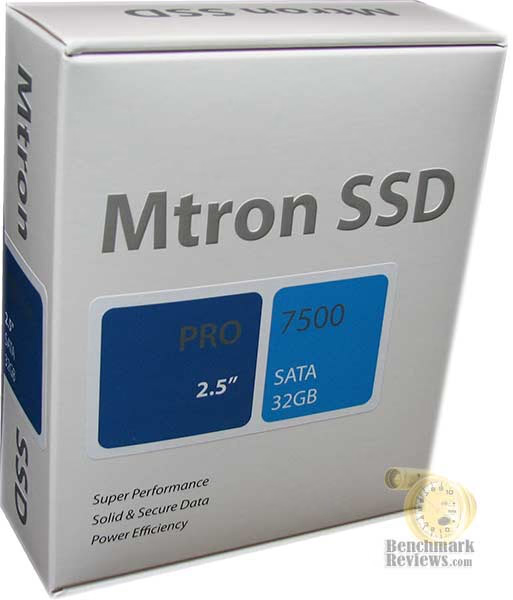
Ever since the first Solid State Drive arrived to retail shelves, the marketing spin-doctors have had to work overtime at justifying their new product. Because SSDs are (still) considered a premium product, there have been no shortage of performance claims creating the image of a high-priced product that is worth its price in gold. I've already seen a few discussion get ugly, especially when it comes to power consumption and savings. In this article, we are going to sort fact from fiction as the Mtron Pro 7500 (MSP-SATA7525) is tested for bandwidth, power, and temperature performance. Through testing, we also prove that Intel's ICH10 controller is still not ready for Solid State Drive performance.
Solid State Drives are not for everyone. Similar to the evolution towards DDR3 system memory, a gradual replacement of the Hard Disk Drive (HDD) by the Solid State Drive (SDD) is going to happen very slowly. The retail cost of SSD's is the primary reason, since there are several ultra-performance SSDs being sold for more than the cost of an entire computer system. Other factors that contributed to the slow gain in popularity include the less than premium bandwidth yielded by some flash-based SSD's. But what if the price was within reach? What if the data throughput was better than anything else? This is where Benchmark Reviews comes in to answer the tough questions, as we test to determine if the Mtron Pro 7500 32GB SATA-II SSD is going to change the face of computing.
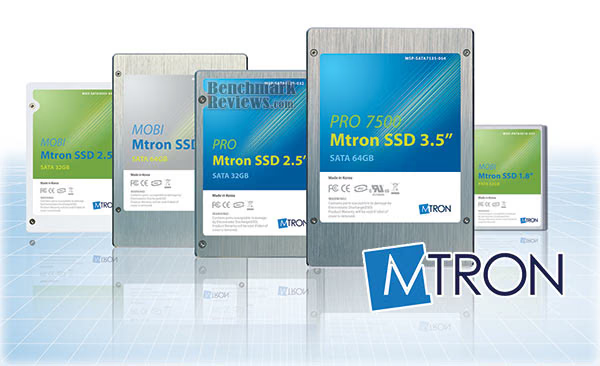
Mtron utilizes the Serial ATA (SATA) 2.0 interface for easy replacement of hard disk drives in both desktop and laptop computers with their Pro 7500 series SSD. The Mtron MSP-SATA7525-032-N-A has an especially great advantage for notebook computers and ultra-mobile portable computers (UMPC) because it uses flash memory for less power consumption with no operational noise, and has strong protection against outside environmental effects.
According to the research by expert market analyst, Web-Feet, the current SSD market has grown 74% every year, and it is expected to total $10 billion by 2012. The consumer SSD market is also expected grow significantly from 42 million in 2006 to $7.5 billion in 2012, replacing current hard disk with SSD.

About the company: Mtron Co.,Ltd.
Established in 2005, Mtron is the pioneer in Flash memory solution world by using their technology on storage, server systems, and security systems. Mtron merged with Digital First in 2008 and changed their official name to Mtron storage Technology. As worldwide leader in Flash memory SSD, Mtron focuses on R&D and market research in order to develop new SSD products for consumers and improve SSD industry around the world.
For more information, please visit the Mtron company website.
Mtron Pro 7500 Features
Mtron's new PRO 7500 series supports SATA II interface and provide the maximum read speed of 130MB/s and write speed of 120MB/s, becoming the fastest SSD in the market. With the development of their new PRO 7500 series, Mtron created another innovation to the SSD technology and proved once again that they are the leading manufacturer of SSD products in the highly competitive market.
Mtron's new PRO 7500 series is targeted for enterprise market to provide servers and storages with 10~20% improved performance from Mtron's SATA I SSD. It includes Random Read IOPS (Data input/output speed) of 19,000, a speed that is 65 times faster than current industrial purpose SAS HDD, in order to deliver much-improved performance in the situations with heavy volume transactions. Also, it consumes 60% less electricity than HDD, has maximum energy efficiency with no noise and less heat, and contributes to environmental-friendly green IT technology. Mtron will be producing their new PRO 7500 series with 32 GB ~ 128 GB capacities in 2.5 inch and 3.5 inch sizes.
Architecture
Solid State Disk (SSD) Drives are completely interchangeable with industry standard hard disk drives. SSDs conform to the same physical dimensions as hard drives, so they can fit in the standard drive bays and enclosures used by millions of computers. And SSDs use the same Serial ATA (SATA) or IDE interface as hard drives, making them functionally identical. This 100% physical and electrical compatibility and interchangeability with hard drives makes it very easy to design SSDs into systems and storage appliances.
Low Power Consumption
A major disadvantage of hard drives is the amount of power they consume. Most of the power in a hard drive is used by the server motor that has to spin the disk. Faster performance in a hard drive requires faster rotational speeds of the disk, up to 10,000 rpm's for high performance hard drives. The SSD offers an enormous advantage over hard drives in power efficiency. Thanks to the lack of motors and to the efficiency of flash IC's, SSDs consume a fraction of the power a conventional hard drive demands. When idle, SSDs use about 95% less power than hard drives; and when active, 50 to 85% less power.
Lower power consumption means less heat produced inside the chassis that needs to be expelled, which results in cooler components and a lighter need for chassis ventilation. And more important, in mobile computing less power means longer battery life. Furthermore, each SSD can save up to 21.9 Kilowatt-Hours of power per year compared to a hard drive, making SSDs the ultimate choice for eco-friendly computing.
Fast Performance
Hard drives and flash technology have very different performance characteristics. With Access times in the 4-12ms range, hard drives are very slow to locate data. Flash has the advantage of lightning fast access time, usually between 0.06-0.4ms. Therefore, SSDs are far superior to hard drives for small random reads and writes.
Hard drives are relatively fast for burst transfers of large sequential blocks of data. But the fastest SSD drives support even faster sustained read and write speeds than the fastest hard drives. High speed SSDs are the best choice for maximum throughput. Another considerable advantage flash has over hard drives is that they do not suffer from delay waking from sleep mode because with no moving parts, they have no need to spin down like a conventional hard drive.
Remarkable Reduction of Booting Time
The booting speed is determined by the time required for the hard disk to read the data required for OS operation, regardless of CPU or memory performance. Accordingly, it is difficult to expect fundamental improvement in booting speed without addressing the structural problem associated with the hard disk. The Mtron Pro 7500 SSD uses the flash memory to resolve the problem. With a maximum read speed of 130MB/s, data is read three times faster than a hard disk, remarkably expediting your booting process.
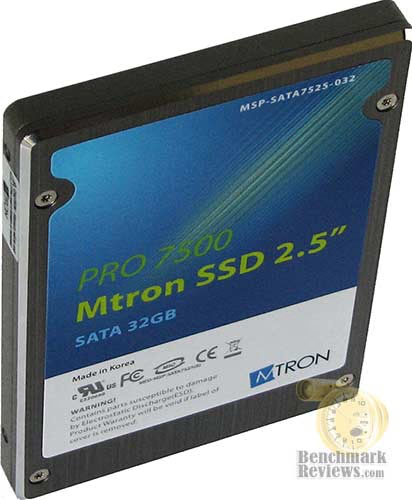
Outstanding Durability Optimized for the Pro 7500 System
Thanks to the ubiquitous environment that allows networking regardless of time and place, various types of mobile devices have become essential part of our lives. However, it is not easy to maintain data security in the mobile and portable devices that are always on the move. Mtron's Pro 7500 series is a semiconductor storage device built with flash memories. It is light and sturdy, minimizing the risk of damaging the data against drops, impact or vibration.
Improved Work Efficiency for Heavy Load Tasks including Photoshop, Premiere and CAD
Applications that involve large-scale images or videos such as Photoshop, Premiere and CAD require substantial amounts of time for rendering and storing data. Mtron Pro 7500 reduces the work time so that professional photographers, graphic designers, video professionals and architects conduct tasks efficiently and maximize cost reduction.
Seamless Game Experience
Online and PC games such as Lineage and Battle Field involve large scale data exceeding 1GB, extending the time required to load the game and read new data when accessing a new map. Mtron Pro 7500 expedites the loading process and allows users to experience uninterrupted, optimal game environments.
MSP-SATA7525 Specifications
| Host Interface | Interface | SATA 3.0 Gb |
|---|---|---|
| Transfer Mode | PIO mode (0~4), DMA mode (0~2), Ultra DMA mode(0~6) |
|
| Capacity (GB) | 16, 32, 64, 128(GB) | |
| Form Factor | 2.5" | |
| Performance | Average Access Time* | 0.1 msec |
| Sustained Read** | 130 | |
| Sustained Write** | 120 | |
| IOPS*** (Sequential/ Random) | 83,000 / 19,000 | |
| Power | Input Voltage | 5VCC¡¾5% |
| Endurance | Write Endurance | >140 years @ 50GB write per day**** |
| Read Endurance | Unlimited | |
| Wear-leveling algorithm | Dynamic and static wear-leveling | |
| Data Retention | 10 years at 25¡É | |
| Reliability | MTBF | 1,000,000 hours |
| ECC | 7-bit Error Correction Code (ECC) | |
| Bad Block Management algorithm | ||
| Environment | Operating Temperature | 0~70¡É |
| Test Environment | 1. Test Item : MSP-SATA7525 ( 2.5 , 32GB, SATAII ) 2. Test PC : AMD AthlonXP 4800+ Dual Core (2.4GHz) 1GB RAM, NVIDIA nForce 570 Ultra MCP (UDMA133), Window XP SP2 * HD Tach 3.0.1 ** ATTO Disk benchmark 2.41 *** IOMeter 2006.02.2704 **** based on the guaranteed 100,000 program and erase cycle of flash memory from vendors and assumption, Sequential write |
|
Wear-leveling
Mtron SSD supports both static and dynamic wear-leveling. These two algorithms guarantee the use of all flash memory at the same level of write/erase cycles to improve lifetime limitation of NAND based storage.
Power Consumption
|
Parameter |
Value |
Unit |
|---|---|---|
|
Idle |
1.44 |
W |
|
Sustained Read |
2.05 |
W |
|
Random Read |
2.04 |
W |
|
Sustained Write |
3.50 |
W |
|
Random Write |
3.42 |
W |
Physical Dimensions and Weight
|
Parameter |
Value |
Unit |
|---|---|---|
|
Height |
9.5 ±0.25 |
mm |
|
Width |
69.8 ±0.20 |
mm |
|
Length |
100.2 ±0.25 |
mm |
|
Maximum Weight |
85 |
g |
Interface
The interface of MSP-SATA7525 complies with the standard serial ATA revision 2.0
Recommended Chipsets
-
Intel ICH8/8R*
-
NVIDIA nForce 4, 5, 6, 7
-
JMICRON JMB36x
-
AMD/ATI SB600, SB700, ID439D
*Intel ICH9/9R and ICH10/10R chipsets have been tested and will function with SSD products, however certain controller features and performance are limited or disabled.
Transfer modes:
-
PIO mode 0, 1, 2, 3, 4
-
DMA mode 0, 1, 2
-
UDMA mode 0, 1, 2, 3, 4, 5, 6
Pro 7500 SSD Closer Look
Modern day personal computers have been heading into two very different directions for many years now. Desktop computer systems have been pushing the performance envelope with each new hardware release, and everything from designer cases to extremely powerful graphics cards have kept components large scale. At the other end of the spectrum, notebook computers are in a constant struggle to get more out of less; less power, less size, less weight. Very recently Apple announced the new MacBook Air notebook, which offers the optional upgrade to include a Solid State Drive. Not coincidentally, the Mtron Pro 7500 MSP-SATA7525 SSD offers the best to both worlds, and manufacturers are beginning to take notice.
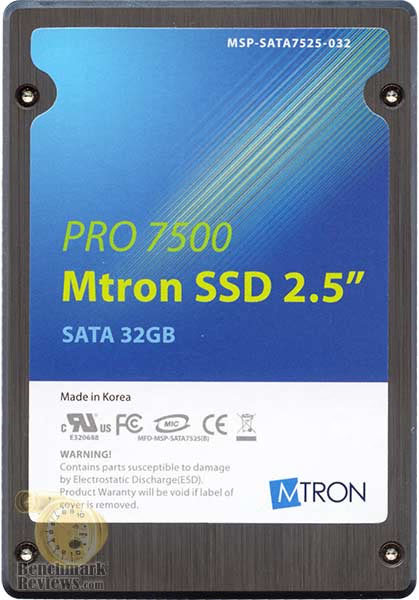
I know for a fact that consumers are often times persuaded by looks over performance, which is just a natural tragedy that has repeated itself for centuries. Take for example the average desktop Hard Disk Drive, which is relatively unchanged in appearance for over a decade now. The only practical innovations in the hard disk sector have both been from Western Digital: the see-through window of the RaptorX and the unique heatsink of the VelociRaptor. Ultimately, the saying "function before fashion" is something you'll want to hold very near and dear to you - especially when it comes to the products trusted with your most important data.

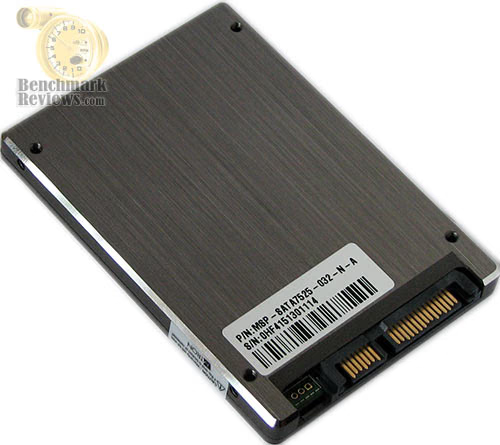
Internal storage drives are a low-visibility item that usually go unnoticed, primarily because the drive often installed and forgotten. To this extent, Mtron has given some effort to dressing up the exterior appearance for a product that will only be seen during installation. The Pro series is encased into a metal chassis nearly identical to the OCZSSD2, which will unfortunately make sharp impacts a bit more powerful than if the chassis was plastic (as it was with the Mtron MOBI 3000). Additionally, the metal chassis is also exposed to electrical shock which may come into play if the device is ever submerged or doused with a liquid.
I would like to digress for a moment and identify a vicious circle that consumers have created. You see, a plastic SSD enclosure would provide improved impact and electrical shock protection over a metal chassis because dropping an ultra-lightweight plastic shell on a hard surface creates far less of an impact than a heavier metal-encased SSD. Yet, most people I discussed this topic with felt that a plastic drive housing would make the product look and feel cheap. Additionally, since consumers are so attached to the traditional look and feel of internal drives, manufacturers haven't had any demand to change them. Until consumers can recognize that function would best be placed ahead of fashion, we're going to see antiquated appearance pressed onto new technology.

Mtron uses a directionally scored alloy metal cover to encase the Pro 7500 SSD, which offers a rugged lightweight shell to the inner components. While most Solid State Drive applications were previously for military and aerospace use, the retail consumer market is beginning to really open up doors for performance-orientated resellers. Because of the military specifications inherent to the design, many manufacturers have utilized a metal case to sell the idea of rugged protection.
There are two different mounting locations on the chassis: the traditional side points and the alternative bottom mounting location. All of the mounting points come pre-threaded, and fit with standard 2.5" mounting installations.
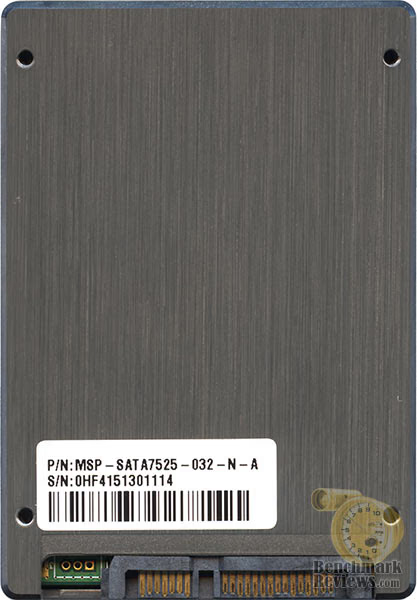
The standard notebook architecture layout is observed for SATA power and data connections. On the SATA7525 there seems to be a small opening beside the data connection (on the left side as illustrated above) which exposes a portion of the drives PCB. There shouldn't be too much concern over atmospheric humidity, however there is absolutely no protection if this product is submerged in liquid.
Mtron's Pro 7500 series consists of only semiconductors and NAND flash memory inside, which helps to give the MSP-SATA7525 a level of rugged durability against shock and vibration not available to hard disk drives. Furthermore, the Pro series is equipped with a very elaborate flash memory management algorithm to guarantee high data integrity and even wear patterns.
In our next section, Benchmark Reviews takes a detailed look at what makes the Mtron Pro 7500 SSD tick. We let Mtron disassemble their own SSD to illustrate this, but we explain the concepts involved so you know what you're looking at.
MSP-SATA7525 Detailed Features
The Mtron Pro 7500-series SSD uses SLC (Single Level Cell) flash memory to provide the maximum claimed read speed of 130 MB per second, maximum claimed write speed of 120 MB per second, and random access time of 0.1 ms. The SLC memory modules provide a longer product lifetime with nearly ten times as many read and write cycles, however MLC (Multi-Level Cell) technology presently yields much higher capacities with faster performance.
Because of the nearly-instant response time, the boot-up speed is nearly twice as fast as current hard disk drives - as we later prove in our testing section. The Pro 7500-series allows you to work at significantly faster speeds for large rendering tasks such as AutoCAD, Photoshop, and Premier.

As a consumer, you might think that Solid State Drives are little more than a 2.5" or 3.5" case with flash memory loaded inside. Take a nice long look at the diagram below, and your misunderstanding of the technology will be quickly corrected. A lot more than memory modules go into the construction of your average Solid State Drive, although they are still at the core.
Solid State Disks are not created by simply assembling flash memory into a unit; there's a lot more to it. The difference in SSD technology depends on the controller that manages the flash memories used for storage. The Mtron Pro 7500 SSD uses the proprietary Multi-Channel Parallel Array controller technology to achieve maximum read and write speeds of 130MB/s and 120MB/s, respectively, which is three times faster than most conventional hard disks.

But to begin the explanation of SSD technology you have to start at the Host Interface Connector, which in the case of the Mtron Pro 7500 series is Serial ATA generation 2.0. From the Host Interface Logic controller, which interprets the interface commands and transfer codes, data is moved onto the first-in-first-out controller before reaching a SDRAM buffer. This buffer works in a fashion similar to the cache buffer found on a Hard Disk Drive, however the SDRAM buffer is merely a hold and store location for additional algorithm processors and task-balancing controllers. In the final step, data is split and stored in multiple flash memory modules and kept secure using a memory management algorithm.
Mtron SSD's support both static and dynamic wear-leveling. Together, these two algorithms guarantee all flash memory will be at same level of erase cycles to improve lifetime limitation of NAND based storage.
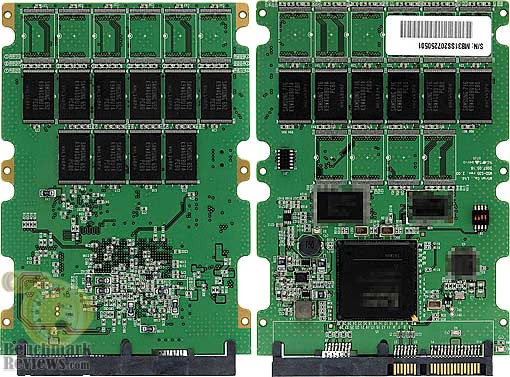
Please continue on to our testing and results section, where Benchmark Reviews will determine if the Pro 7500 32GB SATA-II 2.5-Inch Solid State Drive MSP-SATA7525-032-N-A offers the superior performance, reliability and durability, Mtron claims. We will also see if this SSD increases overall performance and value for personal computer systems and enterprise server environments.
SSD Testing Methodology
EDITORS NOTE: Please read Solid State Drive (SSD) Benchmark Performance Testing to understand how the benchmarks used in this article should be interpreted.
Solid State Drives have traveled a long winding course to finally get where they are today. Up to this point in technology, there have been several key differences separating Solid State Drives from magnetic rotational Hard Disk Drives. While the DRAM-based buffer size on desktop HDD's has recently reached 32 MB and is ever-increasing, there is still a hefty delay in the initial response time. This is one key area in which flash-based Solid State Drives continually dominates because they lack moving parts to "get up to speed".
Test System
-
Motherboard: Gigabyte GA-X48T-DQ6 (Intel X48 Chipset) with version F5 BIOS
-
Processor: Intel E8400 Core 2 Duo 3.0 GHz (Overclocked to 3.6 GHz)
-
System Memory: Corsair PC3-14400 DDR3 1800MHz
-
Optical Drive: ASUS BC-1205PT SATA Blu-ray Disc Optical Drive
-
Graphics: Sapphire Radeon HD 4850 Video Card
-
Operating System: Windows XP Professional SP-3 (optimized to 16 processes at idle)
Disk Hardware
-
Crucial / Lexar 32GB 2.5" SATA-II SSD CT32GBFAB0
- Mtron MOBI 3000 16GB 2.5" SATA SSD MSD-SATA3025
- Mtron Pro 7000 16GB 2.5" SATA SSD MSP-SATA7025
-
Samsung 64GB 2.5" SATA-II SSD MCCOE64G5MPP-0VA
-
Seagate 7200.11 500GB 3.5" 7,200 RPM SATA-II HDD ST3500320AS (32MB Cache Buffer)
-
Western Digital Raptor 74GB 3.5" 10,000 RPM SATA HDD WD740ADFD (16MB Cache Buffer)
Benchmark Reviews is aware that all Intel ICH9/9R and ICH10/10R chipsets featured on 3- and 4- series motherboards exhibit a bandwidth limit defect for most SSDs of approximately 80MBps when not operating in ACHI mode (BIOS configuration). Since the Gigabyte GA-X48T-DQ6 motherboard we used for testing also comes equipped with a JMicron JMB363 SATA controller for two additional SATA-II ports, all tests were conducted using this drive controller. In our tests, we also demonstrate how Intel has failed to cope with the problems of past Southbridge chipsets in their latest ICH10 MCH.
Test Tools
-
HD Tach RW v3.0.4.0 by Simpli Software
-
ATTO Disk benchmark v2.02
-
System Speed Test v4.78 by Vladimir Afanasiev
-
PCMark05 by Futurmark Corporation
Comparing a Solid State Disk to a standard Hard Disk Drives is always relative; even if you're comparing the fastest rotational spindle speeds. One is going to be many times faster in response (SSD's), while the other is usually going to have higher throughput bandwidth (HDD's). Additionally, there are certain factors which can effect the results of a test which we do our best to avoid.
Nevertheless there will be some tests which will not be completely representative of the individual product tested, but a combination of the product and supporting system hardware. An excellent example of such a test is the write-to bandwidth benchmarks, which rely on other system components to force data onto the drive along with the bus bandwidth to support it. This dependency on system hardware is why you will see Benchmark Reviews place an emphasis on read bandwidth over write tests.
System Speed Test
EDITORS NOTE: Please read Solid State Drive (SSD) Benchmark Performance Testing to understand how the benchmarks used in this article should be interpreted.
It's show time! All claims to performance are either made real or proven false in our testing, and although SSD's clearly offer some advantages it sometimes takes seeing a product compared to the performance of others to prove the point. Not very long ago I decided to take action and get System Speed Test v4.78 back in our test rotation. This software is solid, and the results are more accurate than any others available that I have used.
I doubt that when DOS died, Vladimir Afanasiev ever thought he would see his System Speed Test software used again in professional reviews. This program offers comprehensive system information, but it also has a powerful benchmarking tool for memory, processor, and disks. In terms of disk performance, it measures interface and physical transfer rates, seek and access times at the hardware level, and it does so without delay or interference from Operating System software or running processes. This is why Benchmark Reviews will continue to use this test: it polls its results directly from the hardware without the need for Windows!
To detect the Random Access Time of each device, we ran full test routines on all products a total of five times. The highest and lowest scores were ignored, and the remainder was averaged. This would be pointless however, because in every single access time benchmark the test results were identical. In the bandwidth tests the results were extremely close to the others, and therefore required averaging.

To my complete surprise, System Speed Test access time benchmarks places the Mtron Pro 7500 SSD at the very top of our results. With a lightning-fast 0.08 ms access time, every other SSD is forced to live in the shadow that the MSP-SATA7525 has just created. The sub-0.1ms group of top performers also includes the MemoRight GT, Mtron Pro 7000, and Mtron MOBI 3000. Clearly, Mtron knows a little something about keeping random access time to a bare minimum in their Solid State Drives.
The OCZ SATA-II SSD, Samsung MCCOE64G5MPP, and original OCZ OCZSSD64GB maintain the midrange level or random access times. At the slower end of our SSD response time chart is the Silicon Power SP064GBSSD25SV10, OCZ Core Series, Crucial's CT32GBFAB0, and the Super Talent MasterDrive MX finishing out the list. In reality you couldn't begin to perceive these subtle differences, but technology should get better with time and not the other way around.
Bandwidth is a whole other consideration once you record the results. In our tests, both the Western Digital Raptor and Seagate 7200.11 Hard Disk Drives showed strength as only a select few SSD's could meet or exceed the buffered read performance. A larger 32MB buffer in the 7200.11 makes a 7200 RPM HDD difficult to keep pace with, and the 10,000 RPM spindle speed offer enough of an advantage to keep the Raptor on top. Close on the Raptors' tail was the OCZ OCZSSD2-1S32G and OCZSSD2-1S64G, which is based off of the Samsung MCCOE64G5MPP-0VA SSD. The Seagate 7200.11 HDD was nearly matched in buffered read bandwidth by the Super Talent FTM60GK25H and Mtron Pro 7500, which marked the end our high-bandwidth finishers.

At the upper-midrange portion of our SSD group was the Silicon Power SP064GBSSD25SV10 SSD, which fell directly between the high-bandwidth six-digit performers and the midrange products. The Crucial/Lexar CT32GBFAB0 trailed close behind, while the OCZ's CORE SSD performed at the same level as the Crucial/Lexar SATA-II SSD, while the OCZ Core Series SSD, Mtron Pro 700, and Mtron MOBI 3000 complete the midrange list. The low-end portion of our drive performance chart is occupied by the original OCZ SSD, which lasted mere minutes on the market after being released earlier this year.
Looked at a different way, and ignoring the dominant buffered read speed results trend set by the Hard Disk Drives, the top SSD's actually did well to hold ground against the Raptor and 7200.11, which are at the very top-end of HDD performance.
Disk Hardware Tested:
- Crucial / Lexar 32GB 2.5" SATA-II SSD CT32GBFAB0
- MemoRight GT 64GB 2.5" SATA SSD MR25.2-064S
- Mtron MOBI 3000 16GB 2.5" SATA SSD MSD-SATA3025
- Mtron Pro 7000 16GB 2.5" SATA SSD MSP-SATA7025
- Mtron Pro 7500 32GB 2.5" SATA-II SSD MSP-SATA7525-032-N-A
- OCZ 64GB 2.5" SATA SSD OCZSSD64GB
- OCZ 32GB 2.5" SATA-II SSD OCZSSD2-1S32G
- OCZ 64GB 2.5" SATA-II SSD OCZSSD2-1S64G
- OCZ Core Series 64GB 2.5" SATA-II SSD OCZSSD2-1C64G
- Samsung 64GB 2.5" SATA-II SSD MCCOE64G5MPP-0VA
- Seagate 7200.11 500GB 3.5" 7,200 RPM SATA-II HDD ST3500320AS (32MB Cache Buffer)
- Silicon Power 64GB 2.5" SATA SSD SP064GBSSD25SV10
- Super Talent MasterDrive MX 60GB 2.5" SATA-II SSD FTM60GK25H
- Western Digital Raptor 74GB 3.5" 10,000 RPM SATA HDD WD740ADFD (16MB Cache Buffer)
Although Benchmark Reviews completely endorses the test results of System Speed Test for our benchmarking, it's always good to have other sources. We decided to then test our collection of SSD products using the HD Tach RW and ATTO Disk Benchmark tool in the following sections. Please continue to see if our results were a fluke or not.
HD Tach RW Results
EDITORS NOTE: Please read Solid State Drive (SSD) Benchmark Performance Testing to understand how the benchmarks used in this article should be interpreted.
HD Tach is a software program for Microsoft Windows that tests the sequential read, random access and interface burst speeds of the attached storage device. For the record. every single product tested was brand new and never used. HD Tach allows write-bandwidth tests only if no partition is present. Additionally, each and every product was tested five times with the highest and lowest results removed before having the average result displayed here. The graphical user interface (GUI) of the Windows-based benchmark tool HD Tach is very convenient. and allows the test product to be compared against others collected on your system or those registered into the Simpli Software database.
In the tests below, Benchmark Reviews utilizes the HD TachRW tool to compare the Mtron Pro 7500 Solid State Drive against the fastest collection of desktop drives and competing SSD's we can get our hands on. In our first chart we offer the test results of the MSP-SATA7525 when tested on the JMicron JMB363 SATA controller, and the Intel ICH10R chipset is referenced in the second chart (as tested on the Gigabyte GA-EP45T-EXTREME P45 Motherboard)
Using the JMB363 controller on the Gigabyte GA-X48T-DQ6, HD Tach recorded a 120.3 MBps burst speed for the Mtron Pro 750, which for Solid State Drives should be ignored due to the memory controller architecture. There are times where this number will be extremely high, such as the 260+ MBps we recorded while testing the OCZ SATA-II 32GB 2.5" SSD OCZSSD2-1S32G. The important numbers are the average read and write bandwidth speeds, which indicate the true performance level of the product. Our featured test item, the Mtron Pro 7500, performed at 119.4 MBps sustained read bandwidth and an impressive 113.6 MBps sustained write bandwidth.
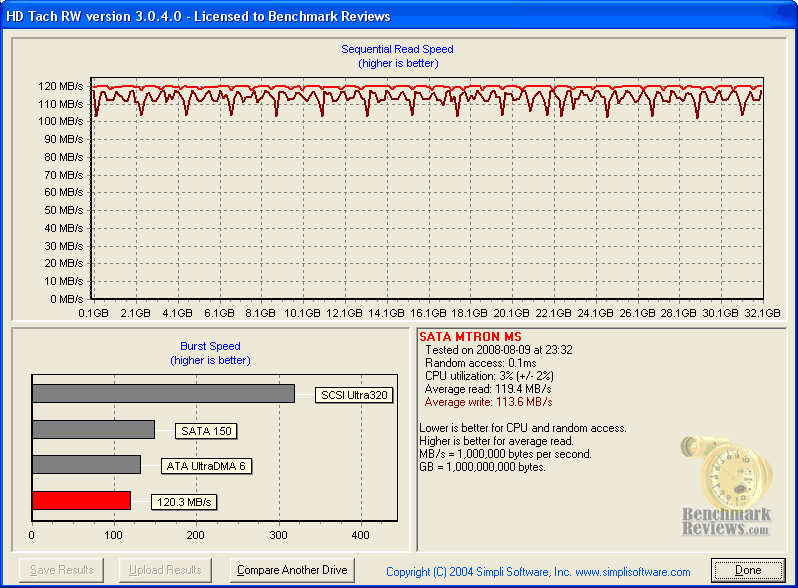
In the HD Tach illustration below, the Intel ICH10R Southbridge was utilized to test the MSP-SATA7525. This is provided as a benefit to our readers, so they may better understand how the latest motherboard chipsets perform with the latest solid state hardware.
Similar to the bandwidth restrictions evidenced in the older Intel ICH9/9R series of Southbridge SATA controllers, the new ICH10/10R MCH is not faring much better. It's nice to note that the read bandwidth is unaffected, and records a virtually identical 120.8 MBps when compared to the JMB363 controller. However, when it comes to sustained write bandwidth, the ICH10 controller falls quite short of the mark. The JMicron controller offered 113.6 MBps, while the Intel Southbridge could only sustain 67.3 MBps. Keep this in mind if you're planning to incorporate SSD technology into your high-end desktop system.

The chart below illustrates the collected benchmark results for HD Tach RW on the JMicron SATA controller, with the read and write bandwidth results added together to determine placement. Without question, the MemoRight GT MR25.2-064S SSD enjoys a substantial lead over the entire field of storage products with an impressive 117.9 MBps read and 122.8 MBps write bandwidth speed (240.7 MBps collectively). In second place with a collective total of 233.0 MBps is the Mtron Pro 7500, which produced results only 3% behind the leader. After these two products, the collective bandwidth falls off.
Unlike the System Speed Test benchmarks that placed the OCZ CORE SSD near the lower portion of our charts, HD Tach positions the OCZSSD2-1C64G in third place for our results. Even still, at 192.5 MBps collectively the 118.7 read and 73.8 MBps write bandwidth for the OCZ Core Series SSD trails behind the leader by a full 25%.

Our chart indicates that the midrange portion is occupied by OCZ's SATA-II SSD, which trails a decent distance behind with 94.3 MBps read and 85.9 MBps write, followed by the Seagate 7200.11 HDD with 88.8 and 78.8 MBps respectively. Mtron's Pro 7000 and Samsung's SATA-II SSD are trailed by the Crucial SATA-II SSD and Mtron MOBI 3000, which both feature great read speed paired with less-desirable write bandwidth.
At the bottom half of our chart is the Western Digital Raptor 74GB 3.5" WD740ADFD 10,000 RPM SATA Hard Disk Drive. Sustained speeds seem to taper out after the initial burst for this drive, which by no means is a slouch - but just not as high-bandwidth as the others in our test group. The Super Talent MasterDrive MX SATA-II SSD seems to also suffer from a very poor write bandwidth matched against very good read performance. Finally, the Silicon Power 64GB SATA SSD SP064GBSSD25SV10 offers the second worst performance out of an SSD we've ever seen, only to be under-performed by OCZ's original SSD product which arrived to market almost a year ago.
Disk Hardware Tested:
-
Crucial / Lexar 32GB 2.5" SATA-II SSD CT32GBFAB0
-
Samsung 64GB 2.5" SATA-II SSD MCCOE64G5MPP-0VA
-
Seagate 7200.11 500GB 3.5" 7,200 RPM SATA-II HDD ST3500320AS (32MB Cache Buffer)
-
Western Digital Raptor 74GB 3.5" 10,000 RPM SATA HDD WD740ADFD (16MB Cache Buffer)
In the next section, ATTO Disk Benchmark compares our range of drives and offers a different perspective from a unique test tool.
ATTO Disk Benchmark
EDITORS NOTE: Please read Solid State Drive (SSD) Benchmark Performance Testing to understand how the benchmarks used in this article should be interpreted.
The ATTO Disk Benchmark program is free, and offers a comprehensive set of test variables to work with. In terms of disk performance, it measures interface transfer rates at several different user-specified intervals and reports read and write speeds. The drives seek and access times are not statistics made available in this application, which makes this a considerably basic tool, although the adjustable test settings allow for a large range of differing results. Manufacturers seems to like this tool because it offers them the ability to reduce the test length load size to produce high benchmark results. Conversely, Benchmark Reviews uses this tool with the largest (32 MB) test chuck used to produce our test results.
Bandwidth results from our tests are illustrated as the transfer rate in the images below, showing the performance curve for the Mtron Pro 7500 SSD from 512 Bytes up to 1 MB test chunks. Mtron specifies bandwidth expectations as 130 MBps read and 120 MBps write for their MSP-SATA7525-032-N-A, and so far our own bandwidth test results indicate that these are optimistic yet possible figures.
Beginning with the JMB363 SATA controller, our results are shown in the first chart pictured below. Read performance begins to plateau from 64.0 KB to 1024 KB and generates a 121,574 KBps (119 MBps) bandwidth around 64 KB, indicating a high performance throughput for most file size chunks. The same is true for the write bandwidth, which sustains a 102 MBps bandwidth beginning at the 64 KB test chunk range.

Next, we tested the same Mtron Pro 7500 32GB SATA-II SSD MSP-SATA7525 on the Gigabyte GA-EP45T-EXTREME P45 Motherboard so we could obtain Intel ICH10R Southbridge results. At a glance, the differences between ICH10 (below) and JMB363 controller (above) are very small, and not indicative of the trend we witnessed with HD Tach. Compared to the 119 MBps read and 103 MBps write bandwidth of the JMicron chipset, the latest Intel MCH chipset performed at 125 MBps read and 101 MBps write. Taking into consideration a small margin of error, these results are seemingly identical. Perhaps we were wrong about the ICH10 chipset and its ability to work with SSD products; or perhaps HD Tach is in need of an update.

Since ATTO Disk Benchmark offers test settings for each transfer file size from .5 KB to 1 MB, Benchmark Reviews decided on using the largest (1 MB) statistic to build the chart shown below. In this illustration, I have organized the products using the sum of their read and write bandwidth speeds to determine position rank.
Once again, the MemoRight GT SSD demonstrates that an optimized generation 1.0a SATA controller can outperform even the latest generation 2.0 SATA controllers. The Mtron Pro 7500 trails behind, with the Seagate 7200.11 hard drive directly behind to finish out the top-level performance section. OCZ's CORE Series SSD leads the upper-mid performance section, and not very far behind was the OCZ 64GB SATA-II SSD, Mtron Pro 7000 16GB SSD, and Samsung SSD.
The mid-range of performance is filled by the Mtron MOBI 3000 SSD and Western Digital Raptor, which aren't really all that far off from the products positioned above them. On the other hand, the low-end of performance is a noticeable distance away. The Crucial / Lexar CT32GBFAB0 SATA-II SSD takes a major dip in write-bandwidth performance, which is mirrored by the Super Talent MasterDrive MX SSD and Silicon Power 64GB SATA SSD. I'm not entirely clear on the technology each of these lower-end SSD's contain, but considering that two of them are SATA-II and match the performance of our slowest SATA-I SSD's I would contend that a design improvement is in order.

Originally I hadn't planned on including the ATTO Disk Benchmark results in this article. While the software is decent enough to mention, it was merely included because almost all SSD manufacturers test with it... and for very good reason I have learned. After several tests had been completed, I began to see why they decided on this particular software for benchmarks. What I like least about ATTO Disk Benchmark is how you can manipulate the settings to produce extremely wide range results from the same product.
As an example, if you reduce the total test length size from 32 MB (used in our testing configuration) to one of the smaller sizes the benchmark results are more than 30% different (as in higher bandwidth). This reason alone is enough for manufacturers to tweak their own test configurations for self-benefit. Nevertheless, in regard to our ATTO tests the entire range of SSD products is very well represented with our configuration. It should be noted that with cache buffers growing larger and larger, perhaps there's a reasonable middle ground that will provide the best of both worlds. I suspect that hybrid drives could play an important role in this argument very soon.
Disk Hardware Tested:
-
Crucial / Lexar 32GB 2.5" SATA-II SSD CT32GBFAB0
-
Samsung 64GB 2.5" SATA-II SSD MCCOE64G5MPP-0VA
-
Seagate 7200.11 500GB 3.5" 7,200 RPM SATA-II HDD ST3500320AS (32MB Cache Buffer)
-
Western Digital Raptor 74GB 3.5" 10,000 RPM SATA HDD WD740ADFD (16MB Cache Buffer)
In our next section, we use PCMark05 to compare the Mtron Pro 7500 Solid State Drive on the ICH10 and JMB363 SATA controller platforms.
PCMark05 Results
EDITORS NOTE: Please read Solid State Drive (SSD) Benchmark Performance Testing to understand how the benchmarks used in this article should be interpreted.
PCMark is a series of computer benchmark tools developed by Futurmark Corporation. The tools are designed to test the performance of the user's CPU, read/write speeds of RAM and hard drives. For this article, we are concerned with only the HDD Test Suite, which measures the MBps performance of: Windows XP Startup, Application Loading, General Usage, Virus Scan, and File Writing.
Our first results were obtained from the JMicron SATA controller resident on the Gigabyte GA-X48T-DQ6 motherboard. On this JMB363 chipset the Mtron Pro 7500 performed its best, offering nearly 58 MBps of bandwidth for the Windows XP startup test. Application loading was given 41 MBps, while general usage received 37 MBps. The PCMark05 Virus Scan test recorded almost 114 MBps of throughput, while the File Write test scored 96 MBps.
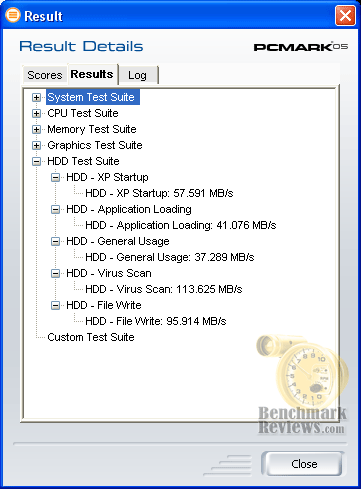
The results begin to look very different as we switched to the Gigabyte GA-EP45T-EXTREME P45 Motherboard. Intel's ICH10R chipset doesn't seem to offer any consistency that I can pinpoint, because once again the results yielded by Mtron Pro 7500 on this controller were beneath those of the JMicron controller.
Compared to 58 MBps on the JMB363, the ICH10R Southbridge reported 23 MBps of bandwidth for the Windows XP startup test. On the JMicron controller Application loading was given 41 MBps and only 18 MBps on the Intel ICH10. General Usage test scores received 37 MBps at the JMB363 and scored a miserable 16 MBps on the Intel MCH. The PCMark05 Virus Scan test recorded almost 114 MBps of throughput for the JMicron SATA controller, and for the first time was beaten by Intel's chipset with 116 MBps. Although the JMB363 controller scored another lead in the File Write test with 96 MBps, the Intel controller managed to come very close with almost 95 MBps.

HD Tach proved that the SSD products we've tested don't appreciate Intel's ICH9 and ICH10 Southbridge MCH controllers. In ATTO Disk Benchmark, the story was a little different, or indifferent rather. But with PCMark05, the suspicions are confirmed: ICH9/9R and ICH10/10R SATA controllers exhibit a notable degree of performance loss when compared to third-party MCH manufacturers.
Heat Output Results
Solid State Drives are not yet a household technology, and because of this the marketing propaganda has become high-pressure. Benchmark Reviews has tested SSD products from: OCZ, Super Talent, Mtron, MemoRight, Samsung, Crucial, and Silicon Power, and each of these manufacturers has taken full advantage of the vast new technology improvements offered by their products. Some manufacturers have made claims that other websites have taken to the mat and wrestled with, only to later be criticized for improperly testing the hardware. Well, we don't intend on repeating the mistakes of our mega-site affiliates, which is why we plan to approach this in small bites.
There have been television shows made famous on the principal of dispelling rumors and myth. This section is not exactly meant to imitate that concept, although we do separate fact from fiction. The first myth we challenge is the claim that Solid State Drives produce no heat. Nearly every manufacturer has claimed that SSD products do not produce heat, which on many levels is believable because there are no moving parts. Well, chances are very good that you have already peeked at the illustration below, so I won't delay in explaining what we've found.
Using a some spare Styrofoam I constructed a small unit to shield two 2.5" notebook drives from the nearby power supply. Although not pictured, there was also an open-top wall section that surrounded this unit, further insulating it from thermal effects of any nearby environment. Since there was no data connection made, these tests are what I would consider idle. The power leads were connected, and power was delivered for twenty minutes before temperatures were taken with a non-contact IR thermometer. The rooms ambient temperature as measured directly at the test site was exactly 19.0°C at the time I recorded the results for the units pictured.

In the image above there are only two devices pictured of a four-cell test platform. On the left side is the Hitachi Travelstar 7K100 60GB HTS721060G9SA00 7,200 RPM SATA 2.5" Hard Disk Drive, and on the right is the Mtron Pro 7500 32GB SATA-II 2.5-Inch SSD Solid State Drive MSP-SATA7525-032-N-A. The Hitachi 7K100 is one of the few 7200 RPM notebook hard drives available, since these faster spinning disks use more power and thus create more heat. Although not pictured because of camera direction, my test rig setup compares up to four products at once. The results are shown in the chart below.
Temperature Readings at 18.0°C
| Device Name | Ambient | Drive Temp |
|---|---|---|
| Hitachi Travelstar 7K100 HDD | 18.0°C | 25°C |
| Mtron Pro 7500 SSD | 18.0°C | 30°C |
| SSD OCZSSD2 SSD | 18.0°C | 21°C |
| Silicon Power SP064GBSSD25SV10 SSD | 18.0°C | 26°C |
| Super Talent FTM60GK25H SSD | 18.0°C | 26°C |
| Mtron MOBI 3000 SSD | 18.0°C | 25°C |
Temperature Readings at 19.0°C
| Device Name | Ambient | Drive Temp |
|---|---|---|
| Hitachi Travelstar 7K100 HDD | 19.0°C | 27°C |
| Mtron Pro 7500 SSD | 19.0°C | 31°C |
| SSD OCZSSD2 SSD | 19.0°C | 21°C |
| Silicon Power SP064GBSSD25SV10 SSD | 19.0°C | 27°C |
| Super Talent FTM60GK25H SSD | 19.0°C | 27°C |
| Mtron MOBI 3000 SSD | 19.0°C | 27°C |
Disk Hardware Tested:
-
Crucial / Lexar 32GB 2.5" SATA-II SSD CT32GBFAB0
-
Hitachi Travelstar 7K100 2.5" 60GB SATA 7,200 RPM HDD HTS721060G9SA00
-
Samsung 64GB 2.5" SATA-II SSD MCCOE64G5MPP-0VA
-
Seagate 7200.11 500GB 3.5" 7,200 RPM SATA-II HDD ST3500320AS (32MB Cache Buffer)
-
Western Digital Raptor 74GB 3.5" 10,000 RPM SATA HDD WD740ADFD (16MB Cache Buffer)
Windows XP Startup
After several SSD product reviews in which I recorded Windows XP startup time data, I have repeatedly omitted my results from the article for lack of enough comparison data. In all honesty, I cannot make this an interesting subject. Most of you reading this article have already watched the video of a Windows computer starting up in mere seconds when it used a Solid State Drive, so it wouldn't be very exciting to show this again. Instead, I have recorded the length of time it took for my Dell Inspiron 6400 notebook computer to startup with each drive. Here are the specifications on the notebook:
-
Dell Inspiron 6400 Notebook
-
Intel Core Duo T2300 @ 1.66 GHz
-
2GB DDR2 667 MHz System Memory
-
Windows XP Professional SP3 (identical image cloned to each drive)

This "test" is going to be useful to laptop computer users only, primarily because I did not test the desktop hard drives. The only hard drive included was the high-performance 7200 RPM Hitachi Travelstar 7K100, which recorded a 28-second load time from the moment I pressed the power button to the moment the Windows Login screen was displayed. It's important to note that this particular Dell notebook consumes almost 11 seconds on the POST routine and pre-loading prior to starting Windows, so it's not realistic to think that my results would match another system identically.
The primary purpose of this test was to demonstrate that a Solid State Drive could in fact cut the Windows load time in half. In regards to the Mtron Pro 7500, I could subtract the preloading time for POST and other BIOS routines and be left with a 6-second boot-up time. Conversely, with the same benefit given to the Hitachi Travelstar 7K100, the resulting boot-up time is still 18 seconds - 300% longer.
Disk Hardware Tested:
-
Crucial / Lexar 32GB 2.5" SATA-II SSD CT32GBFAB0
-
Hitachi Travelstar 7K100 2.5" 60GB SATA 7,200 RPM HDD HTS721060G9SA00
-
Samsung 64GB 2.5" SATA-II SSD MCCOE64G5MPP-0VA
In the next section, I begin to summarize my final thoughts on the Mtron Pro 7500 series as well as Solid State Drives in general. Please continue on to see what I think of SSD technology.
SSD Final Thoughts
EDITORS NOTE: Please read Solid State Drive (SSD) Benchmark Performance Testing to understand how the benchmarks used in this article should be interpreted.
New technology always faces a major hurdle: the consumer. I have long maintained my opinion that that DDR3 system memory is every bit an excellent replacement to the aging DDR2 standard, but the argument of high price and limited adoption by manufacturers has hushed my position. Faced with a similar situation, Solid State Drive technology has suffered the same difficult transition towards widespread use. Like most electronics, it wasn't a question of how much of a technology improvement was evident, it was price.
For the past year, or at least since Reno Hosted the SuperComputing Conference SC07, I have been on the prowl to test every SSD I could get my hands onto. For all intent and purpose, the biggest obstacle was actually getting my hands around these expensive products. What I later understood about this problem is that if a popular computer hardware website was having a difficult time securing samples, then how is the average consumer going to approach these products?
So when OCZ mentioned that their 64GB Core Series SSD would sell for $259, I really wasn't sure what to think. It didn't take long to realize these claims were all true, because shortly after the launch NewEgg began to sell the 64GB CORE series SSD for only $259.00. This in itself should have started the dawn of widespread consumer acceptance for SSD products... but there's always a catch. As it turned out, the OCZ Core Series SSD I touted in my review was prone to data corruption and the mail-in rebate nullified any consumers ability to return the defective product for a refund. Nothing hurts progress more than an angry customer, and this incident created plenty.
Around this same time, a certain well-respected hardware website published an article that claimed SSDs didn't consume less power after all. Although this report was later recanted on account of testing errors, I have to wonder what kind of impact my news of higher heat output will cause the adoption process? After all, I like these products, and completely endorse the technology. But the bad publicity, even when it's disproven, still has a lasting effect thanks to the angst a premium price tag creates. Which raises a lasting concern for me and the rest of the consumer market: price.
As a product analyst, I often get to have my hands on expensive product that I would otherwise never spend my own money to purchase. Certainly without argument, Solid State Drives fit perfectly into this category. There are many products which I feel are so new that it's better to let them ripen on the vine, and with a little time they will mature into something everyone wants. However early adopters never follow the pack, and scoff at the notion of waiting out the next technologies maturity. So when Benchmark Reviews began testing SSD's last year en mass, it seemed like we were doing very little more than toying with the untouchable. But that was before you could replace your existing high-performance Hard Disk Drive for a SSD product for almost the same cost (sacrificing a small degree of capacity, of course).
As I previously mentioned, OCZ has managed the "impossible" by offering top-performance SSD products at only $4 (less after rebate) per gigabyte of storage space. Even if I consider this to be a fluke occurence, the Super Talent MasterDrive MX hits a reasonable $6 per gigabyte ratio their own SSD. Both of these product perform well, even if they do not occupy the very top-most position in our benchmark results. These particular prices are getting very near to the Western Digital Raptor compared in this article, which is available for about $2 per gigabyte of storage. So why are there still Solid State Drives for sale at twice the cost? That's a very good question that only a particular group of manufacturers can answer.
Back when I reviewed the OCZ SATA-II 32GB SSD it seemed like $17 per gigabyte was a relatively good price for SSDsat the time. Consider for a moment that before now, SSD's such the elite-level 32 GB MemoRight GT cost on the level of $33 per gigabyte. Even products like the entry-level 32 GB Mtron MOBI 3000 still cost $14 per gigabyte, making the price of admission seem quite high for even the lower-level SKU's. So will consumers still accept a $24 per gigabyte price tag on SSD products like the Mtron Pro 7500 MSP-SATA7525? Probably not. In fact, it's pricing like this that will cause the market to flood with less expensive items like the OCZ CORE series SSD, even despite its flaws.
The good news is that Samsung is planning to launch 64 GB DRAM IC chips based on a 30 nm fabrication process some time in 2009. I see this as writing on the wall: get competitive or get out of the business. Samsungs MLC IC's already created the foundation for vastly more affordable SSD products, and now they're about to only get better... especially with the price of DRAW in decline.
Mtron Pro 7500 Conclusion
EDITORS NOTE: Please read Solid State Drive (SSD) Benchmark Performance Testing to understand how the benchmarks used in this article should be interpreted.
With the American economy in the midst of a recession, many manufacturers are having to pull out some very creative ideas to help market their products. Add onto this the fact that SSD technology carries a hefty premium, there needs to be extremely eye-catching product packaging to help sales along. Mtron has pulled-off an impressive package appearance and presentation even though they use an ordinary white base color. I think it works, at least as far as defining an elegant aura, but it still lacks critical product information and specifications for the untrained consumer.
Product appearance for SSD's is no easy task to master successfully. We're talking about a product that either hides inside a notebook computer and is usually only seen just once at installation, or it gets lost in depths of an oversized tower computer case. Mtron has kept with their traditional green on blue label, which might be ready for an update. I personally think that they got it right with the simple white plastic enclosure used on the Mtron MOBI 3000, which I lightly associated with the Apple iPod or MacBook Air. For a product that gets no real limelight, it's unnecessary to add shine and glimmer to the finish. Then again, the Pro 7500 series is no value-segment product.
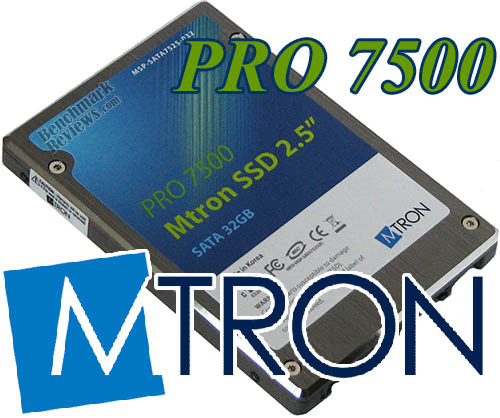
Construction is probably the strongest feature asset credited towards any SSD product. Solid State Drives are by nature immune to most abuses, but add to this a hard shell and you have to wonder what it would take to make this drive fail. The steel enclosure used to protect the Mtron MSP-SATA7525-032-N-A SSD may not keep this drive safe from electrical shock like a plastic enclosure would, but it can certainly take a beating. Chances are
Now on to performance... HD Tach reports 119.4 MBps read and 113.6 MBps write bandwidth performance, while ATTO suggests 118.7 MBps read and 101.7 MBps write performance. Taken as a whole, it's safe to say that 120 MBps read and 110 MBps write is closely accurate to Mtron's claim of 130 MBps and 120. Although the Mtron lab uses similar tests and settings, system hardware can account for the differences in bandwidth - which are certainly plausible maximum specifications you can expect to achieve. The read speed is excellent on the Mtron Pro 7500, placing it second only to a far more expensive product. At the same time, write performance is incredibly impressive and among the fastest we've tested.
Value is a relative term, especially when you discuss bleeding edge technology. Server farms and Enterprise-level computing environments can handle the premium price tag much better than individual consumers. At the ends of every emerging technology are two sides: one which will buy the technology and one that will not. Solid State Disk technology should be more affordable because of the dropping price of DRAM, yet Korean manufacturer Mtron doesn't seem to show much concern because they lock their distributors down with minimum pricing restraints. At the time of this writing the most affordable source for Mtron products was Neo Store, which lists the 32 GB version of the Pro 7500 series SSD for $779. The 64 GB version sells for $1369, and a 128 GB version is available for $2599.
In conclusion, Mtron has created an excellent premium-performance product which offers the highest levels of read and write bandwidth performance. Solid State Drives are good products for extending notebook battery life and increasing overall system performance, but reducing the operating temperature is not among the many qualities featured by the Mtron Pro 7500 as I discovered. The read speeds are near to 120 MBps and write-to speeds recorded close to 110 MBps, relegating even the fastest HDDs behind in performance. Although the Pro 7500 series of SSDs is going to keep data moving quicker than any Hard Disk can, consumers may not be impressed with premium level pricing. If you're looking for the perfect drive for your companies SQL server or operate a large web hosting server farm, the Mtron Pro 7500 series will fit your needs perfectly. However, if you're an enthusiast or gamer, expect to find more reasonable deals elsewhere. The MSP-SATA7525 SSD offers excellent SATA-II performance best suited for heavily burdened I/O applications.
Pros:
+ Very low power consumption extends battery life
+ Lightweight storage solution
+ Resistant to extreme shock impact
+ Available up to 128 GB of SSD capacity
+ 5-Year Mtron warranty
+ Long-lasting SLC technology
+ Very accurate product specifications
Cons:
- Steel case does not protect from electrical shock damage
- Expensive $24 per gigabyte price ratio
- SSD enclosure opening does not protect against liquid or high humidity
- Produces more heat at idle than the hottest notebook HDDs
Ratings:
-
Presentation: 8.00
-
Appearance: 9.00
-
Construction: 9.75
-
Functionality: 9.50
-
Value: 6.00
Final Score: 8.45 out of 10.
Questions? Comments? Benchmark Reviews invites you to leave your remarks in our Discussion Forum.