
Super Talent MasterDrive MX 60 GB SATA-II SSD
Super Talent MasterDrive MX SSD
EDITORS NOTE: Please read Solid State Drive (SSD) Benchmark Performance Testing to understand how the benchmarks used in this article should be interpreted.
Super Talent is very well known for their enthusiast-grade system memory kits, such as PC3-14400 DDR3 1800MHz ProjectX kit we reviewed several months back. So when a product such as Solid State Drives (SSD's) arrived to market, it makes perfect sense to build off of their existing reputation to introduce new high-performance storage devices. The Super Talent MasterDrive MX is an example of this, which features SATA-II controller architecture and high capacities. Early SSD products offered very small capacity, leaving them out of reach for primary drive usage. Super Talent solves this problem, and introduces the 60 GB FTM60GK25H.
Since first making an initial commercial debut to the public at the 2007 Consumer Electronics Show, Solid State Drives have been a topic of hot discussion among performance enthusiasts. With virtually no access time delay, these nonvolatile flash memory-based drives were quick to promise a more reliable storage device with greater performance while operating at a fraction of the power level. Moving further into 2008 they have become a reality for many performance-minded power users. I suppose it's been a slow ramp-up for consumers to accept Solid State Drive technology, similar to the struggle DDR3 SDRAM has seen.

Solid State Drives are a perceived as the new animal in the computer hardware kingdom. They've been around for several years already, yet a very slow consumer acceptance has made the Solid State Drive (SSD) an elusive product to spot in the wild. There really hasn't been a heavy appetite for these premium-priced products; especially since they haven't exactly pushed the Hard Disk Drive (HDD) into extinction. However, the big-game hunters are beginning to see SSDs really crowd the habitat, and their performance has often times eclipsed that of the HDD.
But it wasn't supposed to be this way, and I personally blame Microsoft for a large portion of this delay. Almost two years ago, and still months prior to the retail release, Windows Vista was supposed to require Hybrid Hard Drives if you wanted the new Operating System on a notebook. However, once Microsoft caved in to manufacturer pressure the development quickly slowed to a halt.

Benchmark Reviews has been hard at work trying to ride the wave of innovation into the next big technology. It only took a few years of development, but Solid State Drives can now offer superior speed over Hard Disk Drives; but they are still extremely expensive.
According to a Q1 2008 report by the semiconductor market research firm iSuppli, the SSD market will grow at an annualized average of 124 percent during the four-year period from 2008 until 2012. iSuppli now projects SSD sales to increase by an additional 35 percent in 2009 over what it projected last year, 51 percent more in 2010, and 89 percent more in 2011, and continue to show dramatic increases in subsequent years.
MasterDrive MX Features
Our new line of consumer grade SSDs offer high performance, low power consumption and light weight combined with reliability that is far superior to hard drives. Enjoy dramatically faster system startup and application load times in comparison to a hard drive. These drives consume up to 85% less power than a typical spinning hard disk drive so users can enjoy an extended battery life and less heat build-up. MasterDrive MX SSDs use MLC NAND Flash to offer the best possible price/performance value to mobile enthusiasts.
Overview, Benefits, and Use Cases
Recent advances in Flash memory design and production processes have made Flash the hottest new storage technology. Now, new Flash-based solid-state disk drives, or SSDs, are poised to bring enhanced driver experiences to notebook, server, and enthusiast computers. This paper reviews the SSD architecture and its Flash memory chip, examines the benefits of flash-based SSDs, and lists the potential users of this technology.
Architecture
Solid State Disk (SSD) Drives are completely interchangeable with industry standard hard disk drives. SSDs conform to the same physical dimensions as hard drives, so they can fit in the standard drive bays and enclosures used by millions of computers. And SSDs use the same Serial ATA (SATA) or IDE interface as hard drives, making them functionally identical. This 100% physical and electrical compatibility and interchangeability with hard drives makes it very easy to design SSDs into systems and storage appliances.
In short, an SSD is a storage device that is based on semiconductors rather than rotating magnetic platters. Most SSDs, including Super Talent's offerings, are based on NAND Flash chips because they are fast, highly reliable, widely available and are non-volatile, meaning they save data even without a power source.
Flash vs. DRAM
SSDs based on DRAM components are lower cost than their NAND Flash based siblings. But DRAM is volatile storage, meaning it will lose all data if the power supply is removed. In a power outage, all the data stored on a DRAM based SSD would be permanently lost. Some DRAM based SSDs get around this limitation by including built-in rechargeable batteries. The obvious disadvantages of this solution are that batteries are heavy, have a limited life, and result in a unit that is far less reliable than an SSD based on non-volatile NAND Flash components.
Flash Cost
Currently, the main disadvantage is that flash-based drives cost more per gigabyte than hard drives. However, flash memory is decreasing in price around 20%-30% per year. Currently, NAND flash is sold around $8/GB and SSD is sold around $17/GB. Thus, as the price of the NAND flash chip decreases, the price of the SSD will decrease.
Flash Reliability
Flash endurance has increased due to a few techniques that have been implemented gradually in the past few years. The write/erase mechanism in Flash causes the Silicon to wear down over time. The procedure to program Flash can be done one word (byte) at a time and the procedure to erase is done on a per-block-basis. The degradation of the semiconductor material causes Flash to have a limit of 100,000-300,000 write/erase cycles. When a block reaches this threshold, the device can become unreliable and failure can occur.
Since it only takes one block to cause the entire Flash device to fail, wear leveling is incorporated to ensure that write/erase mechanisms are evenly distributed over all blocks. The technique does not allow one block to reach this limit sooner than other blocks. For example, if block A is written to 10x times and other blocks are written to x times, the algorithm will stop writing to block A and will write to other blocks. Thus, this will increase the endurance of the Flash device.
Low Power Consumption
A major disadvantage of hard drives is the amount of power they consume. Most of the power in a hard drive is used by the motor that has to spin the disk. Faster performance in a hard drive requires faster rotational speeds of the disk, up to 10,000 rpm's for high performance hard drives. The SSD offers an enormous advantage over hard drives in power efficiency. Thanks to the lack of motors and to the efficiency of flash IC's, SSDs consume a fraction of the power a conventional hard drive demands. When idle, SSDs use about 95% less power than hard drives; and when active, 50 to 85% less power. Lower power consumption means less heat produced inside the chassis that needs to be expelled, which results in cooler components and a lighter need for chassis ventilation. And more important, in mobile computing less power means longer battery life. Furthermore, each SSD can save up to 21.9 Kilowatt-Hours of power per year compared to a hard drive, making SSDs the ultimate choice for eco-friendly computing.
Fast Performance
Hard drives and flash technology have very different performance characteristics. With Access times in the 10-20ms range, hard drives are very slow to locate data, Flash has the advantage of lightning fast access time, well below 1ms. Therefore, SSDs are far superior to hard drives for small random reads and writes.
Hard drives are relatively fast for burst transfers of large sequential blocks of data. But the fastest SSD drives support even faster sustained read and write speeds than the fastest hard drives. High speed SSDs are the best choice for maximum throughput. Another considerable advantage flash has over hard drives is that they do not suffer from delay waking from sleep mode because with no moving parts, they have no need to spin down like a conventional hard drive.
MasterDrive MX SATA-II SSD Features
-
Compatible with SATA interface(SATA SSD)
-
Fully compatible with notebooks and PCs
-
High reliability assured based on the internal ECC
-
ROHS Compliant
-
Low Power Consumption
-
High performance and reliability
-
Shock resistance
-
No noise, No latency delay and No seek error
FTM60GK25H Specifications
Super Talent MasterDrive MX 60GB 2.5-Inch SATA-II SSD FTM60GK25H
-
Form Factor: 2.5''
-
Capacity: 60 GB
-
Dimension: 69.85mm x 100.20mm x 9.50mm
-
Interface: SATA-II
-
NAND Flash: MLC
-
Power Supply: 5.0Vcc ± 5%
-
Package: Complete metal housing
-
Write Endurance: 32.88 yrs @ 50GB write-erase/day
-
MTBF: +1,000,000 hours
-
Data Reliability: Built-in EDC/ECC function
-
Data Integrity: 10 years
-
Sequential Read Rate: 120 MB/sec (max)
-
Sequential Write Rate: 40 MB/sec (max)
-
Access Time: 0.1 ms
-
Operating Shock: 1500G
-
Operating Vibration: 16G
-
Operating Temp: 0°C to +70°C

About the company: Super Talent Technology
Super Talent Technology, headquartered in San Jose, California, designs and manufactures a full range of DDR, DDR2, and DDR3 memory modules and Flash based storage devices for computers and consumer electronics. An ISO 9001 certified company, Super Talent utilizes its state-of-the art factory and leading-edge components to produce award winning products with outstanding reliability. Super Talent is an active member of JEDEC and ONFI standards bodies, and holds over 200 patents in Flash and DRAM technology.
Super Talent's Silicon Valley based electrical, mechanical, and software Engineering teams develop leading-edge DRAM and Flash memory solutions for a multitude of applications. Our US-based engineering enables Super Talent to bring advanced new products and technologies to market well ahead of the competition. A leading innovator, Super Talent holds over 200 patents on DRAM and Flash module design and manufacturing processes, making Super Talent one of the world's chief patent holders in memory device categories. Super Talent is an active member of JEDEC, the association that defines future memory standards. The company is a technical leader in producing industry standard memory modules as well as in developing custom memory solutions.
With state-of-the-art ISO 9001 certified manufacturing facilities in both USA and China, Super Talent has over 20 highly automated surface mount (SMT) assembly lines. The company relies on its 20-years of experience making memory products and adherence to strict quality standards to produce high quality products with outstanding reliability.
Our memory modules are rigorously qualified in Super Talent's compatibility labs, and are then tested and approved by top motherboard manufacturers and other industry partners. Every memory product from the production line is subject to essential hardware and software testing standards for consistency and functionality. Our intensive quality control and testing procedures are designed to ensure the highest possible product quality. Super Talent's extensive statistical analysis of manufacturing data helps drive constant improvement in operations.
Super Talent SSD Closer Look
I won't expect any of you to care, but it has taken me nearly a year to finally secure a SSD product sample from Super Talent for testing. I first approached them at the SC07 SuperComputing Convention back in November of 2007. Back then, Super Talent had recently launched their SATA-I SSD and most solid state products demanded a very high price tag. What a difference a year makes, and I'm happy to have waited. Their latest product, the MasterDrive MX, offers SATA-II compatibility paired to impressive specified bandwidth speeds.
Perhaps Benchmark Reviews likes to ride the edge of technology just a little too close, since we've tested more DDR3 and SSDs than almost everyone else on the web. The bleeding edge is where most enthusiasts like to live, but seldom enjoy the price tag. Because I am in a position where cutting edge technology are within my reach (if only for a few weeks of testing), my experience is valuable to the small niche of consumers that might actually want these premier products.

For a little over a year now Benchmark Reviews has anxiously awaited the fabled Solid State Drive that could replace our current list of preferred Hard Disk Drives. Making this wait seem even longer was the fact that HDD manufacturers were constantly improving there product and adding new enhancements to the technology. First there was perpendicular storage technology, then came fluid bearings, and finally there was the increase in cache buffer DRAM to speed-up the burst data transfer. Performance has always been the hurdle that SSDs have had a tough time clearing, with read and write bandwidth creating the largest obstacles. Response time and reduced power consumption has long become the key arguments for owning an SSD, but without the bandwidth throughput to measure up against HDDs they became an expensive niche item. That time has passed.
A few months ago we tested the lightning-fast MemoRight GT SSD, which finally put the Western Digital Raptor in its place... to the tune of almost $2000. In that round, the Solid State Drive won the speed and bandwidth victory, but it had a long way to go befor surpassing the value of a Hard Disk Drive. This is a new chapter in the history of the Solid State Drives struggle to replace the Hard Disk Drive. Power consumption is still astonishing low, even when compared to the newest series of efficient HDDs available. Access time has only got better with new revisions, as nearly all SSDs register less than .1 ms delay. Bandwidth has dramatically improved as controller components have been refined and redesigned. Even the previous setback of SATA-I controller limitation has been recently overcome with commercially available SATA-II solutions. All that remains on the list of items holding back the widespread use is... cost.
As a professional system builder of higher-end computer systems, I have learned some very important lessons in regards to system performance over the past eight years. While gamers constantly leap for higher frame rates out of their video card, there is something more important than a faster processor, memory, or even front side bus. The real backbone to overall system speed and performance is the primary boot drive. In today's world, that usually means the hard disk drive for nearly all computers. After hundreds of performance computers built and sold, I have seen a 10,000 RPM drive make a 2GHz CPU seemingly perform twice as fast, whereas a 5,400 RPM drive makes that same CPU run like it was only half as fast.

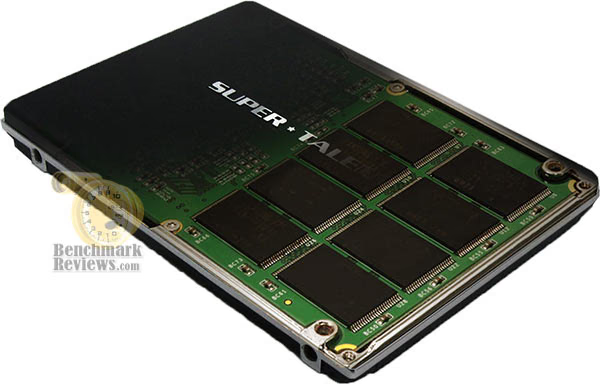
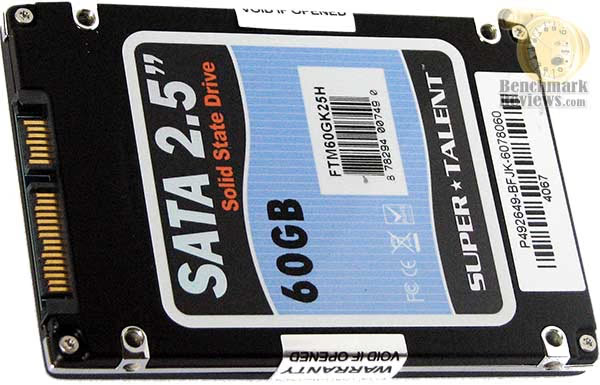
Super Talent has given their MasterDrive MX series a touch of class and elegance. Each SSD is finished with a flat black metal upper and lower enclosure package, with a polished and chromed middle frame layer exposed to show the a contrasting color. Standard 2.5" drive bay mounting points are pre-drilled and threaded in the MasterDrive MX, which allows for quick upgrade or addition to any existing notebook or desktop system. The mounting positions matched up to the drive bracket on my Dell Inspiron laptop, and without any trouble at all I was quickly loading the operating system on this 60 GB SATA SSD Solid State Drive. The entire unit fastens together from the underside with counter-sunk screws, and as much as I would have liked to disassemble the FTM60GK25H sample unit I received for testing, I wasn't quite ready to ruin a nice new product. If you're really interested in how it looks inside these SSDs, feel free to visit our Silicon Power 64GB SATA Solid State Drive review.
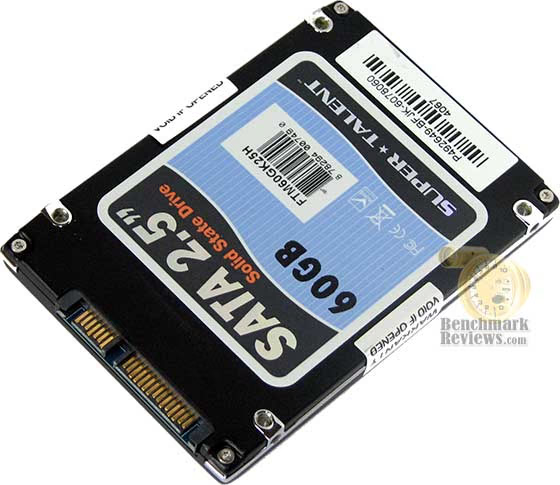
If you're an alert ready, you may have already noticed how this is a 60 GB drive, and not the standard 64 GB capacity definition. Before you yawn and press the button to go onto the next page, you might want to consider this little item for a moment. You see, a few years back there were a several major hard drive manufacturers who lost a class-action law suite because of they misinformed the public that a gigabyte equals 1000 megabytes. This is incorrect, as the correct term for 1000 megabytes is a gibibyte; a true gigabyte is equal to 1024 megabytes. So essentially, Super Talent has used a "what you see is what you get" position with their product, and decided not to surprise consumers with a few missing gigabytes once the drive has been formatted.
The underside of the MasterDrive MX reveals standard SATA power and data interface connections. Unlike desktop computers which utilize a SATA cable system to connect drive to motherboard, nearly all notebooks allow the 2.5" drive to simply slide directly into a connection bay within the system. In addition to notebooks and desktop computer usage, this Super Talent SATA-II Solid State Drive can be utilized for mission-critical backups or high-abuse data systems.
Solid State Drives are not for everyone. Similar to the evolution towards DDR3 system memory, a gradual replacement of the Hard Disk Drive (HDD) by the Solid State Drive (SDD) is going to move very slow. The cost of purchase for SSDs is the primary cause, since most drives cost more than an purchase price of an entire computer system. But what if the price was within reach? What if the data throughput was comparable? This is where Benchmark Reviews comes in to answer the tough questions, as we test the Super Talent MasterDrive MX 60GB 2.5-Inch SATA-II SSD FTM60GK25H.
SSD Testing Methodology
EDITORS NOTE: Please read Solid State Drive (SSD) Benchmark Performance Testing to understand how the benchmarks used in this article should be interpreted.
Solid State Drives have traveled a winding course to get where they are today. Up to this point in technology, there have been several key differences separating Solid State Drives from magnetic rotational Hard Disk Drives. While the DRAM-based buffer size on desktop HDD's has recently reached 32 MB and is ever-increasing, there is still a delay in the initial response time. This is one key area in which flash-based Solid State Drives continually dominates because they lack moving parts.
However the benefits inherent to SSD's have traditionally fallen off once the throughput begins, even though data reads or writes are executed at a high constant rate whereas the HDD tapers off in performance. This makes the average transaction speed of a SSD comparable to the data burst rate mentioned in HDD tests, albeit usually lower than the HDDs speed. 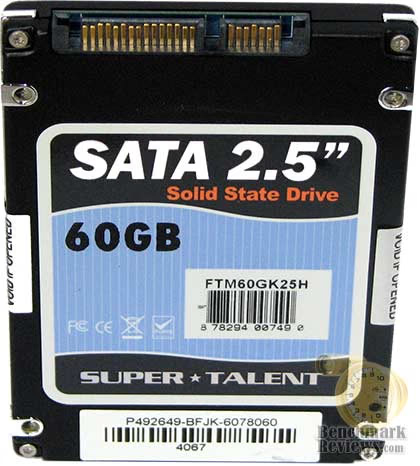
Test System
-
Motherboard: Gigabyte GA-X48T-DQ6 (Intel X48 Chipset) with version F4 BIOS
-
Processor: Intel E8400 Core 2 Duo 3.0 GHz (Overclocked to 3.6 GHz)
-
System Memory: Corsair PC3-14400 DDR3 1800MHz
-
Disk Drive 1: OCZ SATA-II 32GB 2.5-Inch SSD OCZSSD2-1S32G
-
Disk Drive 2: (Paging File) Mtron MOBI 3000 2.5-Inch 16GB SSD MSD-SATA3025
-
Optical Drive: ASUS BC-1205PT SATA Blu-ray Disc Optical Drive
-
Graphics: Sapphire Radeon HD 4850 Video Card
-
Operating System: Windows XP Professional SP-3 (optimized to 16 processes at idle)
Disk Hardware
-
Crucial / Lexar 32GB 2.5" SATA-2 SSD CT32GBFAB0
-
Samsung 64GB 2.5" SATA-2 SSD MCCOE64G5MPP-0VA
-
Western Digital Raptor 74GB 3.5" WD740ADFD 10,000 RPM SATA Hard Disk Drive (16MB Cache Buffer)
-
Seagate 7200.11 500GB 3.5" ST3500320AS 7,200 RPM SATA-II Hard Disk Drive (32MB Cache Buffer)
Benchmark Reviews is aware that all Intel ICH9 and ICH9R chipsetswhich come on the 3 and 4 series motherboards exhibit a bandwidth limit defect on SSD's of approximately 80MBps when not operating in ACHI mode (BIOS configuration). Since the Gigabyte GA-X48T-DQ6 motherboard we used for testing also comes equipped with a JMicron JMB363 SATA controller for two additional SATA-II ports, all tests were conducted on this drive controller.
Test Tools
-
HD Tach RW v3.0.4.0 by Simpli Software
-
ATTO Disk benchmark v2.02
-
System Speed Test v4.78 by Vladimir Afanasiev
Comparing a Solid State Disk to a standard Hard Disk Drives is always relative; even if you're comparing the fastest rotational spindle speeds. One is going to be many times faster in response (SSD's), while the other is usually going to have higher throughput bandwidth (HDD's). Additionally, there are certain factors which can effect the results of a test which we do our best to avoid. Nevertheless there will be some tests which will not be completely representative of the individual product tested, but a combination of the product and supporting system hardware. An excellent example of such a test is the write-to bandwidth benchmarks, which rely on other system components to force data onto the drive along with the bus bandwidth to support it. This dependency on system hardware is why you will see Benchmark Reviews place an emphasis on read bandwidth over write tests.
System Speed Test Benchmarks
EDITORS NOTE: Please read Solid State Drive (SSD) Benchmark Performance Testing to understand how the benchmarks used in this article should be interpreted.
It's show time! All claims to performance are either made real or proven false in our testing, and although SSD's clearly offer some advantages it sometimes takes seeing a product compared to the performance of others to prove the point. During our re-testing process, I decided to take action and get System Speed Test v4.78 back in our test rotation. This software is solid, and the results are more accurate than any others available.
I doubt that when DOS died, Vladimir Afanasiev ever thought he would see his System Speed Test software used again in professional reviews. This program offers comprehensive system information, but it also has a powerful benchmarking tool for memory, processor, and disks. In terms of disk performance, it measures interface and physical transfer rates, seek and access times at the hardware level, and it does so without delay or interference from Operating System software or running processes. This is why Benchmark Reviews will continue to use this test: it polls its results directly from the hardware!
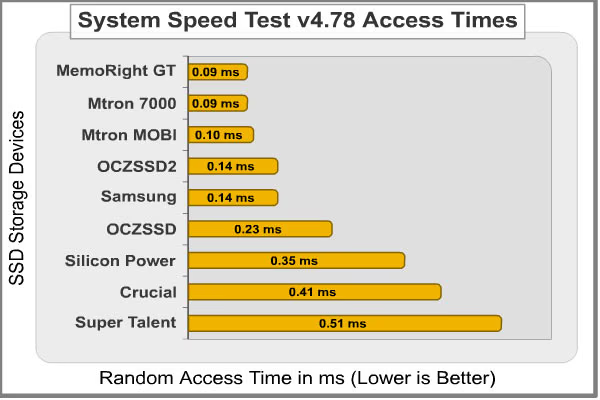
To detect the Random Access Time of each device, we ran full test routines on all products a total of five times. In nearly every benchmark the result was extremely close to the collection, thus our charts represent the average of all readings. Very obvious in our results was the distinct difference in potential notebook access time at the start of our chart, compared to the current notebook access time on the far right.
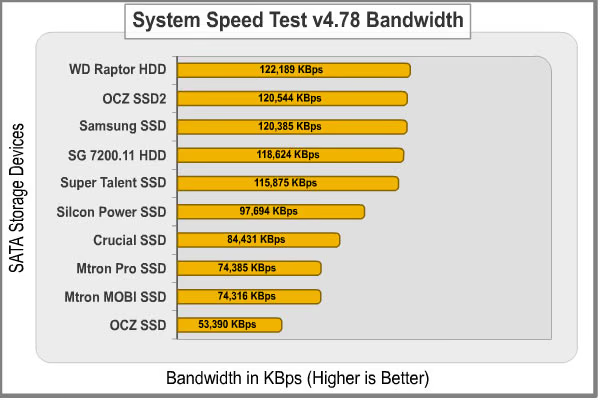
Bandwidth is a whole other consideration once you record the results. In our tests, both the Western Digital Raptor and Seagate 7200.11 Hard Disk Drives showed strength as only a few SSD's could match or beat the buffered read performance. Close on the Raptors' tail was the OCZ OCZSSD2-1S32G which is based off of the Samsung MCCOE64G5MPP-0VA. The Seagate 7200.11 HDD was nearly matched in buffered read bandwidth by the Super Talent FTM60GK25H and Silicon Power SP064GBSSD25SV10. The remainder of SSD's finish off our results, ending with the original OCZ SSD.
Looked at a different way, and ignoring the dominant buffered read speed results trend set by the Hard Disk Drives, the top SSD's actually did well to hold ground against the Raptor and 7200.11, which are at the very top-end of HDD performance. The 32MB buffer in the 7200.11 makes a 7200 RPM HDD difficult to keep pace with, and the 10,000 RPM spindle speed offer enough of an advantage to keep the Raptor on top.
Disk Hardware Tested:
-
Crucial / Lexar 32GB 2.5" SATA-2 SSD CT32GBFAB0
-
Samsung 64GB 2.5" SATA-2 SSD MCCOE64G5MPP-0VA
-
Western Digital Raptor 74GB 3.5" WD740ADFD 10,000 RPM SATA Hard Disk Drive (16MB Cache Buffer)
-
Seagate 7200.11 500GB 3.5" ST3500320AS 7,200 RPM SATA-II Hard Disk Drive (32MB Cache Buffer)
Although Benchmark Reviews completely endorses the test results of System Speed Test for our benchmarking, it's always good to have other sources. We decided to then test the Super Talent MasterDrive MX 60GB 2.5" SATA-II SSD FTM60GK25H using the HD Tach RW and ATTO Disk Benchmark tool in the following sections. Please continue to see if our results were a fluke or not.
HD Tach RW Benchmark Results
EDITORS NOTE: Please read Solid State Drive (SSD) Benchmark Performance Testing to understand how the benchmarks used in this article should be interpreted.
In the tests below, Benchmark Reviews utilizes the HD TachRW tool to compare the Silicon Power 64GB SATA Solid State Drive against the fastest collection of desktop drives and competing SSD's we can get our hands on.
HD Tach is a software program for Microsoft Windows that tests the sequential read, random access and interface burst speeds of the attached storage device. For the record. every single product tested was brand new and never used. HD Tach allows write-bandwidth tests only if no partition is present. Additionally, each and every product was tested five times with the average result displayed here. The graphical user interface (GUI) of the Windows-based benchmark tool HD Tach is very convenient. and allows the test product to be compared against others collected on your system or those registered into the Simpli Software database.
HD Tach recorded a 60.6 MBps burst speed, which for Solid State Drives should be ignored due to the memory controller architecture. There are times where this number will be extremely high, such as the 260+ MBps we recorded while testing the OCZ SATA-II 32GB 2.5" SSD OCZSSD2-1S32G. The important numbers are the average read and write bandwidth speeds, which indicate the true performance level of the product. Our featured test item, the Super Talent MasterDrive MX SATA-II SSD FTM60GK25H, performed at 59.3 MBps sustained read bandwidth and 48.5 MBps sustained write bandwidth.

The chart below illustrates the collected benchmark results for HD Tach RW, with the read and write bandwidth results added together to determine placement. Without question, the MemoRight GT MR25.2-064S SSD enjoys a large lead over the entire field of storage products, with an impressive 117.9 MBps read and 122.8 MBps write bandwidth speed. The OCZ SATA-II SSD trails a decent distance behind with 94.3 MBps read and 85.9 MBps write, followed by the Seagate 7200.11 HDD with 88.8 and 78.8 MBps respectively. Mtron's Pro 7000 and Samsung's SATA-II SSD are trailed by the Crucial SATA-II SSD and Mtron MOBI 3000, which both feature great read speed paired with pathetic write bandwidth.
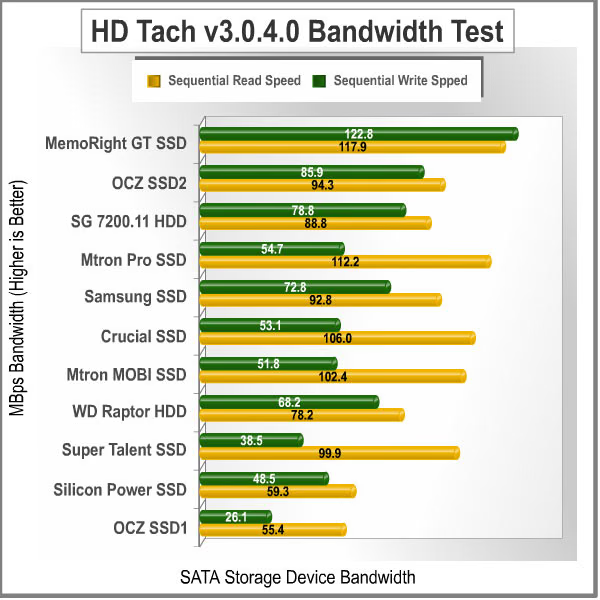
At the bottom half of our chart is the Western Digital Raptor 74GB 3.5" WD740ADFD 10,000 RPM SATA Hard Disk Drive. Sustained speeds seem to taper out after the initial burst for this drive, which by no means is a slouch - but just not as high-bandwidth as the others in our test group. The Super Talent MasterDrive MX SATA-II SSD seems to also suffer from a very poor write bandwidth matched against very good read performance. Finally, the Silicon Power 64GB SATA SSD SP064GBSSD25SV10 offers the second worst performance out of an SSD we've ever seen, only to be under-performed by OCZ's original SSD product which arrived to market almost a year ago.
Disk Hardware Tested:
-
Crucial / Lexar 32GB 2.5" SATA-2 SSD CT32GBFAB0
-
Samsung 64GB 2.5" SATA-2 SSD MCCOE64G5MPP-0VA
-
Western Digital Raptor 74GB 3.5" WD740ADFD 10,000 RPM SATA Hard Disk Drive (16MB Cache Buffer)
-
Seagate 7200.11 500GB 3.5" ST3500320AS 7,200 RPM SATA-II Hard Disk Drive (32MB Cache Buffer)
In the next section, ATTO Disk Benchmark compares our range of drives and offers a different perspective from a unique test tool.
ATTO Disk Benchmark Results
EDITORS NOTE: Please read Solid State Drive (SSD) Benchmark Performance Testing to understand how the benchmarks used in this article should be interpreted.
The ATTO Disk Benchmark program is free, and offers a comprehensive set of test variables to work with. In terms of disk performance, it measures interface transfer rates at several different user-specified intervals and reports read and write speeds. The drives seek and access times are not statistics made available in this application, which makes this a considerably basic tool, although the adjustable test settings allow for a large range of differing results. Manufacturers seems to like this tool because it offers them the ability to reduce the test length load size to produce high benchmark results. Conversely, Benchmark Reviews uses this tool with the largest (32 MB) test chuck used to produce our test results.
Bandwidth results are indicated as the transfer rate in the image below, showing the performance curve for the MasterDrive MX from 512 Bytes up to 1 MB test chunks. Super Talent specifies 120 MBps maximum read and 40 MBps maximum write bandwidth for the FTM60GK25H SSD, which appears to be very realistic measurements based on our own test results. From 64.0 KB to 1 MB the read and write transfer bandwidth is virtually identical, with the 64 Kb file size appearing to be the file size plateau. The same is true for the write bandwidth, which sustains a 46 MBps bandwidth throughout the 64 KB to 1 MB test chunk range.

Since ATTO Disk Benchmark offers test settings for each transfer file size from .5 KB to 1 MB, we used the largest (1 MB) statistic to build the chart located below. In this chart, I have organized the products using the sum of their read and write bandwidth speeds to determine position rank. Once again, the MemoRight GT SSD demonstrates that an optimized SATA-I controller can outperform SATA-II controllers. The Seagate 7200.11 hard drive gets the closest in terms of performance, followed by the OCZ 64GB SATA SSD, Mtron Pro 7000 16GB SSD, and Samsung SSD.
The mid-range of performance is filled by the Mtron MOBI 3000 SSD and Western Digital Raptor, which aren't really all that far off from the products positioned above them. On the other hand, the low-end of performance is a noticeable distance away. The Crucial / Lexar CT32GBFAB0 SATA-II SSD takes a major dip in write-bandwidth performance, which is mirrored by the Super Talent MasterDrive MX SSD and Silicon Power 64GB SATA SSD. I'm not entirely clear on the technology each of these lower-end SSD's contain, but considering that two of them are SATA-II and match the performance of our slowest SATA-I SSD's I would contend that a design improvement is in order.

Originally I hadn't planned on including the ATTO Disk Benchmark results in this article. While the software is decent enough to mention, it was merely included because almost all SSD manufacturers test with it... and for very good reason I have learned. After several tests had been completed, I began to see why they decided on this particular software for benchmarks. What I like least about ATTO Disk Benchmark is how you can manipulate the settings to produce extremely wide range results from the same product.
As an example, if you reduce the total test length size from 32 MB (used in our testing configuration) to one of the smaller sizes the benchmark results are more than 30% different (as in higher bandwidth). This reason alone is enough for manufacturers to tweak their own test configurations for self-benefit. Nevertheless, in regard to our ATTO tests the entire range of SSD products is very well represented with our configuration. It should be noted that with cache buffers growing larger and larger, perhaps there's a reasonable middle ground that will provide the best of both worlds. I suspect that hybrid drives could play an important role in this argument very soon.
Disk Hardware Tested:
-
Crucial / Lexar 32GB 2.5" SATA-2 SSD CT32GBFAB0
-
Samsung 64GB 2.5" SATA-2 SSD MCCOE64G5MPP-0VA
-
Western Digital Raptor 74GB 3.5" WD740ADFD 10,000 RPM SATA Hard Disk Drive (16MB Cache Buffer)
-
Seagate 7200.11 500GB 3.5" ST3500320AS 7,200 RPM SATA-II Hard Disk Drive (32MB Cache Buffer)
In our next section, we address the collection of test results and give our conclusion on the Super Talent MasterDrive MX 60GB 2.5" SATA-II SSD FTM60GK25H.
MasterDrive MX SSD Final Thoughts
EDITORS NOTE: Please read Solid State Drive (SSD) Benchmark Performance Testing to understand how the benchmarks used in this article should be interpreted.
For the past year, or at least since Reno Hosted the SuperComputing Conference SC07, I have been on the prowl to test every SSD I could get my hands onto. It seemed that every time I requested a sample, I was given the run-around. Some manufacturers like to issue press release statements announcing their latest SSD product and specification ratings, and then give the excuse that they are in development even after a full six months after product announcement (shame on you, Transcend). It's nice to see that some companies still deliver what they promise... and can do so on the same day they release a statement. Super Talent may not have released the fastest product on the market, but this SSD was available in retail form the day it was announced at the end of April.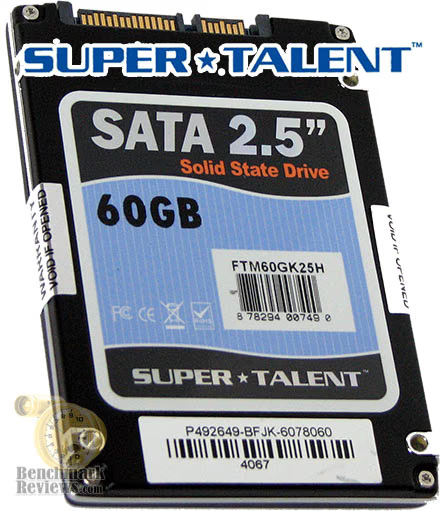
As a product analyst, I often get to have my hands on product that I would otherwise never spend my own money to purchase. Certainly without argument, Solid State Drives might fall into this category. There are many products which I feel are so new that it's better to let them ripen on the vine, so to say. This is one of them unfortunately. However early adopters never follow the pack, and scoff at the notion of waiting out the next technologies maturity. So when Benchmark Reviews began testing SSD's last year en mass, it seemed like we were doing very little more than toying with the untouchable.
Back when I reviewed the OCZ SATA-II 32GB SSD it seemed like $17 per gigabyte was a good price for SSDs at the time. Consider for a moment that before now, SSD's such the 32 GB MemoRight GT cost on the level of $33 per gigabyte. Even the entry-level 32 GB Mtron MOBI 3000will run nearly $22 per gigabyte. Of course, these prices all seem high compared to the Western Digital Raptor which is available for about $2 per gigabyte of storage. But guess what? Super Talent hits the $6 per gigabyte ratio with their MasterDrive MX SSD. I guess that line in the sand separating the two technologies is beginning to disappear.
Super Talent's MasterDrive MX series allows the modest consumer to experience the performance and feature benefits of solid state technology without the serious set-back that some SSD products will cost. Since their product line extends to 120 GB, there's really no hold-back from taking on their new technology as a primary partition for the Operating System.
Super Talent FTM60GK25H Conclusion
EDITORS NOTE: Please read Solid State Drive (SSD) Benchmark Performance Testing to understand how the benchmarks used in this article should be interpreted.
There are occasions when I begin my presentation conclusion with nothing out of the ordinary to report, but this isn't one of those. With the American economy in the midst of a recession, manufacturers are having to pull out some very creative ideas to help market their products. Add onto this the fact that SSD technology carries a premium, and the need for extremely eye-catching product packaging becomes more of a requirement. Despite this, most of the product packaging we have seen for SSD products has been more tipid than anything else. Super Talent does a fair job with a "consumer electronics" blue retail box, but with the uncertain economic climate it might make sense to add a bit of sparkle to help edge out the competition.
Then there is my conclusion for the product appearance... you might not even realize that Super Talent is trying to capturing the value portion of the SSD market. The MasterDrive MX uses an alloy metal case with a contrasting finish and chrome accents. It can look expensive, and it does, but thankfully the price tag is nowhere near the level of some manufacturers product.
Construction is probably the strongest feature credited to the SSD. Solid State Drives are by nature immune to most abuses, but add to this a hard shell and you have to wonder what it would take to make this drive fail. Keep wondering, because I'm not in a position to wreck one of these just yet. However, if you're really concerned, take a look at this video.
At almost 106 MBps of read bandwidth, the MasterDrive MX is very close to the 120 MBps stated maximum specification. The read speed is excellent on the MasterDrive MX, while at the same time write performance is not incredibly impressive. The Super Talent FTM60GK25H SSD matches the stated write performance of 40 MBps, so I can't really fault Super Talent too much. They didn't exactly claim the MasterDrive MX would have blazing fast write performance, but in reality it probably should since it uses a SATA-II controller.
Value is a relative term, especially when you discuss bleeding edge technology. People ridicule the thought of making the high-dollar purchase of an SSD over a standard hard drive, but then they get into their Hummer's and Porsche's and drive to Starbucks. At the ends of every emerging technology are two sides: one which will buy the technology and one that will not. Thankfully, Solid State Disk technology is made more affordable by the dropping price of DRAM (for the moment) and Super Talents ability to deliver a product within fair range. At the time of this writing, the 60 GB version of Super Talents FTM60GK25H SATA-II MasterDrive MX SSD is available at NewEgg for $215. Other online retailers are selling the FTM60GK25H for a few dollars more, so it's always best to shop around. Not an inexpensive storage solution, but still much less costly than the others by far.
In conclusion, the Super Talent SATA-II Solid State Drive is an excellent product for extending notebook battery life and increasing overall system performance. The read speeds are excellent, with write-to speeds becoming an issue when saving very large files to the drive. With prices much closer to affordable, gamers and hardware enthusiasts may also benefit from the new technology, and utilize the FTM60GK25H to power their high-performance computer system. The performance is definitely there, and the price has become far less of an issue; so it might be time to give Solid State Drives a try! I highly recommend the Super Talent MasterDrive MX 60GB 2.5-Inch SATA-II FTM60GK25H Solid State Drive, as it offers top-level read speed performance at a cost comparable to enthusiast hard drives.
Pros:
+ 100 MBps sustained read bandwidth in HD Tach
+ Low power consumption extends battery life
+ Lightweight storage solution
+ Resistant to extreme shock impact
+ Up to 120 GB of SSD capacity
+ Limited lifetime warranty
+ $6 per gigabyte price ratio
+ Alloy casing adds to appearance and appeal
+ Very accurate product specifications
Cons:
- Alloy case is heavier than plastic SSD cases
- Very poor sustained write-to performance for a SATA-II SSD
- Highest response time of all SSDs tested
Ratings:
-
Presentation: 8.50
-
Appearance: 9.50
-
Construction: 9.50
-
Functionality: 8.75
-
Value: 8.25
Final Score: 8.9 out of 10.
Quality Recognition: Benchmark Reviews Silver Tachometer Award.
Questions? Comments? Benchmark Reviews really wants your feedback. We invite you to leave your remarks in our Discussion Forum.
MasterDrive MX Addendum
Only a few days after this article was published, Super Talent issued a press release that indicates all newly manufactured products from the MasterDrive line will have improved bandwidth speeds. The press release reads:
San Jose, California - July 22, 2008 - Super Talent Technology, a leading manufacturer of Flash storage solutions and DRAM memory modules, today announced that the company has dramatically improved the write speeds of its MasterDrive DX, MasterDrive KX and MasterDrive MX solid state drives (SSDs).
These three series of SSDs already boast exceptionally fast read speeds of up to 120 MB/sec. But, fast write speeds are important in applications such as video editing and encoding, image processing, compressing and extracting files, installing applications and copying files to the drive. These newly revised SSDs categorically outpace the fastest hard drives in the world.
|
MasterDrive Series |
Description |
Max Read/Write Speed |
||
|---|---|---|---|---|
|
Old |
New (low cap) |
New (high cap) |
||
|
DX |
2.5-inch SATA-II w/ SLC Flash |
120/70 MB/sec |
120/80 MB/sec |
120/100 MB/sec |
|
KX |
1.8-inch Micro SATA w/ MLC Flash |
120/40 MB/sec |
120/60 MB/sec |
120/80 MB/sec |
|
MX |
2.5-inch SATA-II w/ MLC Flash |
120/40 MB/sec |
120/60 MB/sec |
120/80 MB/sec |
MasterDrive series SSDs now support much faster read and write speeds and faster seek and access times than the speediest hard drives. Other SSD advantages over hard drives are:
-
Superior resistance to shock and vibration;
-
Use less power in both active and standby modes, and produce less heat;
-
Completely silent
The 60GB and 120GB models support slightly faster write speeds than 15GB and 30GB models.
Reader comments from the original article
3 comments were posted before commenting closed. They are preserved as written. Original avatars no longer resolve and are shown as a placeholder.
RE: Super Talent MasterDrive MX 60 GB SATA-II SSD cgorange Permalink:
NAND flash typically has a P/E (Program / Erase) limitation of 3K-10K, not 100K-300K.
RE: RE: Super Talent MasterDrive MX 60 GB SATA-II SSD Olin Coles Permalink:
These are the manufacturer's stated specifications, as provided by Super Talent at the time of publication.
RE: Super Talent MasterDrive MX 60 GB SATA-II SSD cgorange Permalink:
The reason that SuperTalent quotes 60GB instead of 64GB isn't because of some "truth in advertising" spirit. It's because they use the extra 4GB for overprovisioning.