
RunCore Pro-V SandForce SF1200 SSD
RunCore Pro-V SSD Review
SandForce is the hot ticket in SSD controller technology for 2010, offering outstanding bandwidth speed and operational performance. RunCore utilizes the SandForce SF-1222TA3-SBH (SF-1200) processor in their Pro-V prosumer MLC SSD series, and the SF-1565TA2-SBH (SF-1500) processor equips their business-level RunCore Kylin-II SLC SSD series. SandForce RAISE technology provides redundant protection for single SSD computer systems, while data is automatically secured with AES-128 encryption. The SandForce SF-1200 controller has already found its way into many of the fastest SSDs available: ADATA S599, Corsair Force F100, RunCore Pro-V, PhotoFast G-Monster 2, OCZ Agility-2, and Mach Xtreme. With transfer speeds nearly saturating the SATA-3GB/s interface, and operational IOPS performance reaching SLC-NAND levels, it makes sense for RunCore to use the new industry leader.
The biggest mistake PC hardware enthusiast make with SSDs is grading them by their speed. File transfer speed is important, but only so long as the operational IOPS performance can sustain that bandwidth under load. Benchmark Reviews tests the 200GB RunCore Pro-V SSD, model RCP-V-S2520-MCN, against some of the most popular storage devices available and demonstrates that 4K IOPS performance is more important than speed.
In a very short time span the entire SSD market has created and recreated itself many times over. Counting the generations of SSD processors has become difficult for experienced experts, and keeping-up with controller architecture has come with its own set of challenges. Benchmark Reviews has tested many Solid State Drive products, and we've seen everything from dual-SATA controllers in RAID-0 to extremely large cache buffer modules used inside of them. While the SSD industry grows daily, only a few select manufacturers offer popularly-accepted Flash NAND SSD controllers. As of May 2010 the most popular consumer SSD controllers are designed by: Indilinx, Intel, JMicron, Toshiba, Samsung, SandForce, and Marvell.
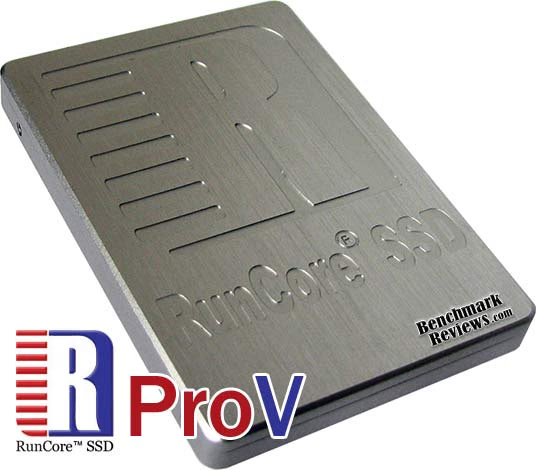
For decades, the slowest component in any computer system was the hard drive. Most modern processors operate within approximately 1-ns (nanosecond = one billionth of one second) response time, while system memory responds between 30-90 ns. Traditional Hard Disk Drive (HDD) technology utilizes magnetic spinning media, and even the fastest spinning desktop storage products exhibit a 9,000,000 ns - or 9 ms (millisecond = one thousandth of one second) initial response time. In more relevant terms, The processor receives the command and waits for system memory to fetch related data from the storage drive. This is why any computer system is only as fast as the slowest component in the data chain; which is usually the hard drive.
The theoretical goal for achieving optimal performance is for system memory to operate as quickly as the central processor, and the storage drive to operate as fast as memory. With present technology this is an impossible task, so enthusiasts try to close the speed gaps between components as much as possible. Although system memory is up to 90x (9000%) slower than most processors, just consider that the hard drive is an added 1000x (100,000%) slower than that same memory. Essentially, these three components are as different in speed as walking is to driving and flying.
Solid State Drive technology bridges the largest gap. The difference a SSD makes to operational reaction times and program speeds is dramatic, and takes the storage drive from a slow 'walking' speed to a much faster 'driving' speed. Solid State Drive technology improves initial response times by more than 450x (45,000%) for applications and Operating System software, when compared to their HDD counterparts.
EDITOR'S NOTE: Benchmark Reviews has used this SSD to publish our SandForce SF1200 RAID-0 SSD Performance review.
Bandwidth Speed vs Operational Performance
As we've explained in our SSD Benchmark Tests: SATA IDE vs AHCI Mode guide, Solid State Drive performance revolves around two dynamics: bandwidth speed (MB/s) and operational performance (IOPS). These two metrics work together, but one is more important than the other. Consider this analogy: operational IOPS performance determines how much cargo a ship can transport in one voyage, and the bandwidth speed is to fast the ship moves. By understanding this and applying it to SSD storage, there is a clear importance set on each variable depending on the task at hand.
For casual users, especially those with laptop or desktop computers that have been upgraded to use an SSD, the naturally quick response time is enough to automatically improve the user experience. Bandwidth speed is important, but only to the extent that operational performance meets the minimum needs of the system. If an SSD has a very high bandwidth speed but a low operational performance, it will take longer to load applications and boot the computer into Windows than if the SSD offered a higher IOPS performance.
Hunan RunCore Innovation Technology Co, Ltd.
RunCore, based in the Changsha Hunan province of China, is a global leader in the research, development, production, and distribution of high-end solid-state storage products. RunCore SSD is founded on 10 years of research at the National University of Defense Technology and currently offers three solid-state storage series products aimed at optimizing and harnessing speed, quality, value, simplicity and power for prosumer, industrial and military solid-state drive markets. These products are electronic solid-state hard disk, E-drive speed disk, and the run-storage solid-state storage arrays which are used in military equipment, industrial control, commercial servers, embedded computers, and personal computers.
SandForce SF-1200 Features
SandForce SF-1200 SSD Processors enable commodity flash memory to reliably operate in cost and power sensitive client computing environments. The SF-1200 is a true single-chip SSD Processor designed for volume manufacturing and outstanding performance. Innovative DuraClass technology delivers world class reliability, endurance, performance and power consumption.
Endurance and Longevity
As each generation of flash memory evolves and the silicon geometries shrink - performance, reliability, endurance, and data retention are negatively impacted. DuraWrite technology extends the life of the SSD over conventional controllers, by optimizing writes to the flash memory and delivering a write amplification below 1, without complex DRAM caching requirements.
Performance and Power Optimization
SSDs are capable of significantly outperforming traditional HDDs, but typical controllers haven't delivered the compelling value necessary for mainstream adoption. SandForce DuraClass technology enables the SSD to maximize both the endurance and performance for the life of the drive fulfilling the promise of high speed flash memory in client computing applications and improving system performance by up to 50% as measured by the SYSmark Benchmark.
Mobile Computing Security
The SF-1200 has built in AES-128 bit encryption controllable by a configurable user password. This feature prevents would-be thieves from extracting data directly from the flash memory should they ever have access to the drive.
Data Protection and Reliability
SF-1200 SSD Processors provide up to 100x greater data protection than today's SSDs, and leading enterprise HDDs. This is a result of superior ECC protection and unique RAISE (Redundant Array of Independent Silicon Elements) technology. RAISE provides the protection and reliability of RAID on a single drive without the significant write overhead.
RunCore ProV Specifications
|
DuraClass Technology: |
|
|---|---|
|
Host Interface: |
|
|
Max Capacity Supported: |
512GB* (using 32Gb/die components) |
|
Performance (sustained): |
|
|
Flash Memory Support: |
MLC from numerous top flash memory manufacturers |
|
Power Consumption: |
|
|
Security: |
|
|
Protection: |
|
|
Reliability: |
|
|
Operating Temperature: |
0°C to 70°C ambient |
|
Package: |
361-Pin TFBGA - 13x13mm, 0.65mm pitch |
|
Compliance: |
RoHS, Halogen-Free, Green |
First Look: RunCore Pro-V
Keeping pace with their growing product line of storage products, RunCore has introduced the Pro-V (MLC) and Kylin-II (SLC) series of SSDs. Benchmark Reviews is testing the 200GB RunCore Pro-V SSD for this article, which is expected to reach speeds of 260 MB/s for sequential reads and 260 MB/s sequential writes. The RunCore RCP-V-S2520-MCN kit is built from the SandForce SF-1200 controller on the inside; outside, the RunCore Pro-V shows off a rough aluminum grain finish on a metal casing that gives the drive a durable look.
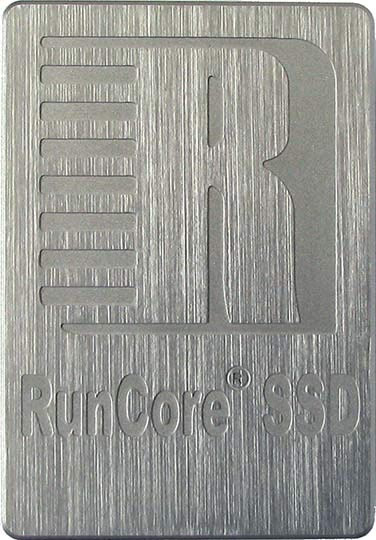
Best suited for notebook and desktop computer installations, the RunCore Pro-V SSD could also be utilized for mission-critical backups or high-abuse data systems. RunCore ProV-series Solid State Drives have been designed with a focus on high-performance operational and data transfer speeds, and includes encrypted data protection and improved NAND wear-leveling through the SandForce SF-1200 controller. Although RunCore Pro-V SSDs do not offer any integrated USB Mini-B port, there are several new 2.5" SATA enclosures that utilize SuperSpeed USB-3.0 standard for high-performance portable file transfers.

Standard 2.5" drive bay mounting points are pre-drilled and threaded into the RunCore SSD chassis, which allows for quick upgrade or addition into any existing notebook or desktop system. The mounting positions matched up to the drive bracket on my notebook computer, and after only a few minutes of drive cloning I was quickly loading the Microsoft Windows-7 O/S without a hitch.
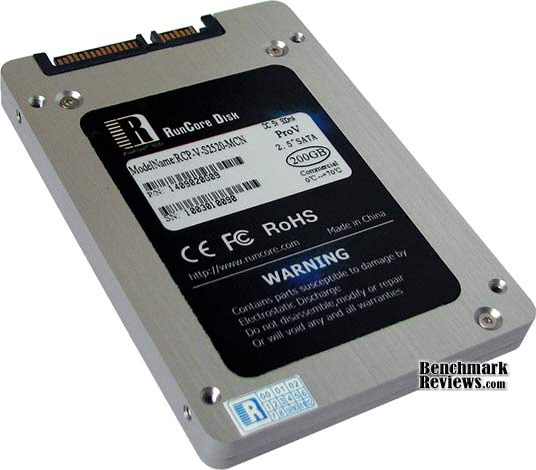
Unlike most Hard Disk Drive (HDD) storage products, SSDs are nearly impervious to impact damage and do not require (or benefit from) any kind of special vibration dampening or shock-proof enclosures. RunCore utilizes a standard two-piece metal enclosure for their Pro-V models, which reveals the internal components after removing four small counter-sunk Phillips-head screws located at the bottom of this SSD. RunCore SSDs have a label covering one of the chassis screws, and removing the enclosure cover will remove consumer protection with it. Benchmark Reviews will reveal all of the internal components on our next section anyway, so just be patient and save your product warranty.

Thanks to the SandForce SF-1200 SSD controller architecture (detailed in the next section), the RunCore Pro-V Solid State Drive suggests transfer speeds of 260/260 MBps read/write for high-performance enthusiasts. Now that you're acquainted with the basic exterior features for this RunCore SSD, it's time to peek inside the metal enclosure and inspect the Pro-V's internal components...
SandForce SF-1200 SSD Controller
The SandForce SF-1200 SATA-3GBps controller is new to the industry, but many manufacturers are already hailing it as the replacement for Indilinx's industry-leading Barefoot processor. Both are second-generation SATA products limited to 3.0 GB/s transfer speeds, and both offer similar specifications. SandForce adds DuraClass technology to their SF-1200 processor, which claims to provide best-in-class endurance, performance, and lower power consumption. DuraWrite technology extends the endurance of MLC-NAND memory by providing at least five year lifecycles measured with 3000-5000 cycle MLC flash. Additionally, SandForce RAISE technology provides RAID-like protection for single SSD computer systems, and data is secured with AES-128 automatic encryption.
SandForce has hit the 2010 SSD industry with full force, much the same way that Indilinx did back in 2009. Finished-goods companies can utilize the SandForce SF1200 processor in their own product line, which then receives a "SandForce Driven" badge. The SandForce SF-1222 processor is presently available in the ADATA S599, Corsair Force, RunCore Pro-V, Patriot Inferno, OWC Mercury Extreme Pro-RE, G.Skill Phoenix Pro, OCZ Vertex-2, PhotoFast G-Monster 2, OCZ Agility-2, and Mach Xtreme SSD series.

From the view above the printed circuit board (PCB), it doesn't look like there's anything dramatically innovative on the SandForce Solid State Drive. Eight flash NAND modules make a horseshoe around the SandForce SF-1200 SSD processor, and plenty of electronics fill in the remaining space atop the printed circuit board. But once the SandForce SSD board is turned to expose the underside, the difference is obvious: SandForce has used their DuraClass technology to remove the DRAM buffer.
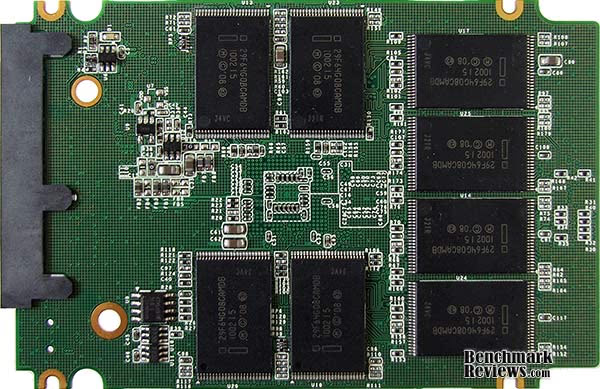
The 2nd-generation SATA-3.0GBps SandForce SF-1222TA3-SBH processor is part of their SF-1200 family of SSD controller chips, and SSDs will utilize either the SF-1200 processor for retail consumers or SF-1500 for enterprise devices. All SandForce SSD controllers offer native TRIM support in Microsoft Windows-7, Native Command Queuing (NCQ) with 32 command slots, and Self-Monitoring, Analysis, and Reporting Technology (SMART) command set. While not directly important to transfer speeds or operational performance, SandForce utilizes a Tensilica Diamond Core DC_570T CPU inside the SF-1200 processor.
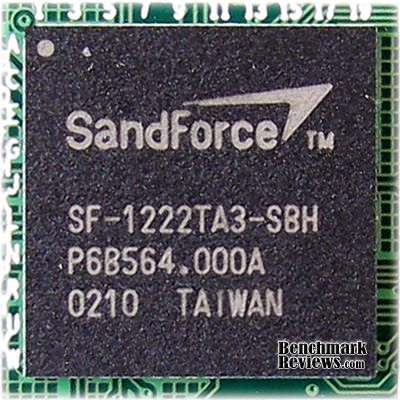
Another benefit of SandForce's SF-1200 architecture is that the SSD keeps all information on the NAND grid and removes the need for a separate cache buffer DRAM module. The result is a faster transaction, albeit at the expense of total storage capacity. SandForce SSDs utilize over-provisioning technology, which allocates a portion of NAND for data storage and the remainder reserved for transaction and cache buffer space. SandForce has also marketing custom firmware to the finished-goods companies that sell their SSDs, which remove performance restrictions.
The SF-1200 SSD processor provides ECC data protection and includes SandForce's unique RAISE (Redundant Array of Independent Silicon Elements) technology. RAISE provides the protection and reliability of RAID on a single SSD drive, thanks to flash architecture, without the significant write overhead of parity. The SandForce DuraClass technology automatically stores data in AES-128 encrypted format, preventing data extraction directly from the physical flash memory modules.
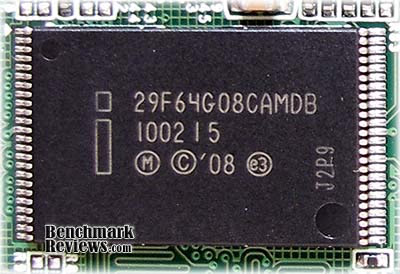
Sixteen multi-layer cell Intel 29F64G08CAMDB flash NAND modules are joined to the SandForce SF-1200 controller. On professional-level 28% over-provisioned SandForce SSDs, these NAND modules may combine for 128GB of physical storage space yet only 100GB of this capacity is designated for data. Consumer-level SandForce SSDs receive 7% over-provisioning and 128GB devices will yield 120GB of usable storage space.
Because the SandForce SF-1200 SSD processor inside the many SSDs is a non-exclusive component available market-wide, Benchmark Reviews expects to see many new solid state storage products using this controller in the near future. Please continue on for details and performance results for this Solid State Drive...
SSD Testing Methodology
Solid State Drives have traveled a long winding course to finally get where they are today. Up to this point in technology, there have been several key differences separating Solid State Drives from magnetic rotational Hard Disk Drives. While the DRAM-based buffer size on desktop HDDs has recently reached 32 MB and is ever-increasing, there is still a hefty delay in the initial response time. This is one key area in which flash-based Solid State Drives continually dominates because they lack moving parts to "get up to speed".
However the benefits inherent to SSDs have traditionally fallen off once the throughput begins, even though data reads or writes are executed at a high constant rate whereas the HDD tapers off in performance. This makes the average transaction speed of a SSD comparable to the data burst rate mentioned in HDD tests, albeit usually lower than the HDD's speed.
Comparing a Solid State Disk to a standard Hard Disk Drives is always relative; even if you're comparing the fastest rotational spindle speeds. One is going to be many times faster in response (SSDs), while the other is usually going to have higher throughput bandwidth (HDDs). Additionally, there are certain factors which can affect the results of a test which we do our best to avoid.
SSD Testing Disclaimer
Early on in our SSD coverage, Benchmark Reviews published an article which detailed Solid State Drive Benchmark Performance Testing. The research and discussion that went into producing that article changed the way we now test SSD products. Our previous perceptions of this technology were lost on one particular difference: the wear leveling algorithm that makes data a moving target. Without conclusive linear bandwidth testing or some other method of total-capacity testing, our previous performance results were rough estimates at best.
Our test results were obtained after each SSD had been prepared using DISKPART or Sanitary Erase tools. As a word of caution, applications such as these offer immediate but temporary restoration of original 'pristine' performance levels. In our tests, we discovered that the maximum performance results (charted) would decay as subsequent tests were performed. SSDs attached to TRIM enabled Operating Systems will benefit from continuously refreshed performance, whereas older O/S's will require a garbage collection (GC) tool to avoid 'dirty NAND' performance degradation.
It's critically important to understand that no software for the Microsoft Windows platform can accurately measure SSD performance in a comparable fashion. Synthetic benchmark tools such as HD Tach and PCMark are helpful indicators, but should not be considered the ultimate determining factor. That factor should be measured in actual user experience of real-world applications. Benchmark Reviews includes both bandwidth benchmarks and application speed tests to present a conclusive measurement of product performance.
Test System
- Motherboard: Gigabyte GA-X58A-UD7 (Intel X58-Express)
- Processor: Intel Core i7-920 BX80601920 @ 2.667 GHz
- System Memory: 6GB Triple-Channel DDR3 1600MHz CL6-6-6-18
- SATA 3Gb/s Storage HBA: Integrated Intel ICH10R Controller
- AHCI mode - Intel Rapid Storage Technology Driver 9.6.0.1014
- SATA 6Gb/s Storage HBA: Integrated Marvell SE9128 Controller
- AHCI mode - Marvell Magni Driver Marvell Magni Driver 1.0.0.1036
- Operating System: Microsoft Windows 7 Ultimate Edition 64-Bit
Drive Hardware Tested
The following storage hardware has been used in our benchmark performance testing, and may be included in portions of this article:
-
Corsair X256 CMFSSD-256D1 256GB SATA MLC SSD (Firmware version 1.1)
-
Intel X25-E Extreme SSDSA2SH032G1GN SATA SLC SSD
- OCZ Agility OCZSSD2-1AGT120G 120GB SATA MLC SSD (Firmware version 1.5)
-
OCZ Agility-EX OCZSSD2-1AGTEX60G 64GB SATA SLC (Firmware version 1.5)
-
OCZ Vertex OCZSSD2-1VTX120G 120GB SATA SSD (Firmware v1.5)
-
OCZ Vertex-EX OCZSSD2-1VTX120G 120GB SATA SLC SSD (Firmware version 1.5)
-
OCZ Vertex Turbo OCZSSD2-1VTXT120G 120GB SATA SSD (Firmware version 1.5)
Test Tools
- AS SSD Benchmark 1.4.3704.27281: Multi-purpose speed and operational performance test
-
ATTO Disk Benchmark 2.34: Spot-tests static file size chunks for basic I/O bandwidth
- Iometer 2008.06.28 by Intel Corporation: Tests IOPS performance and I/O response time
-
Lavalys EVEREST Ultimate Edition 5.50: Disk Benchmark component tests linear read and write bandwidth speeds
-
CrystalDiskMark 3.0.0b by Crystal Dew World: Sequential speed benchmark spot-tests various file size chunks
Test Results Disclaimer
This article utilizes benchmark software tools to produce operational IOPS performance and bandwidth speed results. Each test was conducted in a specific fashion, and repeated for all products. These test results are not comparable to any other benchmark application, neither on this website or another, regardless of similar IOPS or MB/s terminology in the scores. The test results in this project are only intended to be compared to the other test results conducted in identical fashion for this article.
AS-SSD Benchmark
Alex Schepeljanski of Alex Intelligent Software develops the free AS SSD Benchmark utility for testing storage devices. The AS SSD Benchmark tests sequential read and write speeds, input/output operational performance, and response times. Because this software receives frequent updates, Benchmark Reviews recommends that you compare results only within the same version family.
Beginning with sequential read and write performance, the RunCore Pro-V Solid State Drive produced 208.62 MB/s read speed, and 88.81 MB/s write performance. The sequential file transfer speeds have traditionally been low with this benchmark tool, especially for SandForce controllers, which is why we will concentrate on the operational IOPS performance for this section.
Single-threaded 4K IOPS performance delivers 16.01 MB/s read and 61.45 MB/s write, which is among the highest results we've recorded. Similarly, the 64-thread 4K reads recorded 123.48 MB/s while write performance was 92.99... both earning the RunCore Pro-V SSD a spot at the top of our charts.

Displayed in the chart below, the 64-thread 4KB IOPS performance results for several enthusiast-level storage products illustrates which products offer the best operation under load:

Drive Hardware
- ADATA S599 100GB SATA MLC SSD
- Corsair Nova V128 CMSSSD-V128GB2 SATA MLC SSD
- Corsair Force F100 CSSD-F100GB2 SATA MLC SSD
- Crucial RealSSD-C300 CTFDDAC256MAG-1G1 256GB SATA 6Gb/s MLC SSD
- Kingston SSDNowV+ SNVP325-S2 128GB SATA MLC SSD
- LiteOn LA-32M1S Strong-Page 32GB MLC SSD
- OCZ Agility OCZSSD2-1AGT120G 120GB SATA MLC SSD (Firmware version 1.5)
- OCZ Vertex Turbo OCZSSD2-1VTXT120G 120GB SATA SSD (Firmware version 1.5)
- RunCore Pro-V RCP-V-S2520-MCN 200GB SATA SLC SSD
- Seagate Barracuda-XT ST32000641AS 2TB 7200RPM SATA 6Gb/s Hard Drive
- Western Digital VelociRaptor WD3000HLFS 300GB 10,000 RPM SATA Hard Disk Drive
- WD SiliconEdge-Blue SSC-D0256SC-2100 256GB SATA SSD
In the next section, Benchmark Reviews tests transfer rates using ATTO Disk Benchmark.
ATTO Disk Benchmark
The ATTO Disk Benchmark program is free, and offers a comprehensive set of test variables to work with. In terms of disk performance, it measures interface transfer rates at various intervals for a user-specified length and then reports read and write speeds for these spot-tests. There are some minor improvements made to the 2.34 version of the program, but the benchmark is still limited to non-linear samples up to 256MB. ATTO Disk Benchmark requires that an active partition be set on the drive being tested. Please consider the results displayed by this benchmark to be basic bandwidth speed performance indicators.

Our basic bandwidth speed tests begin with the RunCore Pro-V SSD connected to the Intel ICH10 controller in AHCI mode, as the ATTO Disk Benchmark tools performs file transfers ranging from 0.5 KB to 8192 KB. The 200GB model we received reveals 286 MBps maximum read speed that plateaus from 32-8192 KB file chunks, and 277 MBps peak write bandwidth plateaus from 64-8192 KB. These exceeds the 260/260-MBps speeds suggested by SandForce and RunCore.

Drive Hardware
- ADATA S599 100GB SATA MLC SSD
- Corsair X256 CMFSSD-256D1 256GB SATA MLC SSD (Firmware version 1.1)
- Corsair Nova V128 CMSSSD-V128GB2 SATA MLC SSD
- Corsair Force F100 CSSD-F100GB2 SATA MLC SSD
- Crucial RealSSD-C300 CTFDDAC256MAG-1G1 256GB SATA 6Gb/s MLC SSD
- Intel X25-E Extreme SSDSA2SH032G1GN SATA SLC SSD
- Kingston SSDNowV+ SNVP325-S2 128GB SATA MLC SSD
- Mtron MOBI 3500 MSD-SATA3535-064 64GB SATA MLC SSD
- OCZ Agility OCZSSD2-1AGT120G 120GB SATA MLC SSD (Firmware version 1.5)
- OCZ Agility-EX OCZSSD2-1AGTEX60G 64GB SATA SLC (Firmware version 1.5)
- OCZ Vertex OCZSSD2-1VTX120G 120GB SATA SSD (Firmware v1.5)
- OCZ Vertex-EX OCZSSD2-1VTX120G 120GB SATA SLC SSD (Firmware version 1.5)
- OCZ Vertex Turbo OCZSSD2-1VTXT120G 120GB SATA SSD (Firmware version 1.5)
- RunCore Pro-V RCP-V-S2520-MCN 200GB SATA SLC SSD
- Seagate Barracuda-XT ST32000641AS 2TB 7200RPM SATA 6Gb/s Hard Drive
- Western Digital VelociRaptor WD3000HLFS 300GB 10,000 RPM SATA Hard Disk Drive
- WD SiliconEdge-Blue SSC-D0256SC-2100 256GB SATA SSD
In the next section, Benchmark Reviews tests sequential performance using the CrystalDiskMark 3.0 software tool...
CrystalDiskMark 3.0 Tests
CrystalDiskMark 3.0 is a file transfer and operational bandwidth benchmark tool from Crystal Dew World that offers performance transfer speed results using sequential, 512KB random, and 4KB random samples. For our test results chart below, the 4KB 32-Queue Depth read and write performance was measured using a 1000MB space. CrystalDiskMark requires that an active partition be set on the drive being tested, and all drives are formatted with NTFS on the Intel ICH10 controller set to AHCI-mode. Benchmark Reviews uses CrystalDiskMark to illustrate operational IOPS performance with multiple threads. In addition to our other tests, this benchmark allows us to determine operational bandwidth under heavy load.
Our tests of the RunCore Pro-V Solid State Drive were each consistent, but only the maximum speeds were charted below. Sequential tests on the Pro-V produced a maximum read speed of 215.3 MB/s, while the write speed was only 108.5 MB/s. Oddly enough, reported sequential write speed actually increased with each test. The sequential file transfer speeds have traditionally been low with this benchmark tool, especially for SandForce controllers, which is why we will concentrate on the operational IOPS performance for this section.
CrystalDiskMark 3.0 reported 512K results of 203.0 MB/s read and 116.0 MB/s write performance. 4K tests produced 17.64 read and 72.81 write performance. 4KB queue depth 32 IOPS is one area where the RunCore Pro-V SSD excels, and climbs to the top of our performance charts.
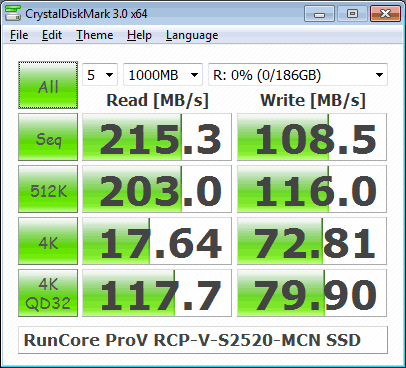
Displayed in the chart below, the maximum 4KB queue depth 32 IOPS performance results for several enthusiast-level storage products illustrate which products offer the best operation under load:

Drive Hardware
- Corsair X256 CMFSSD-256D1 256GB SATA MLC SSD (Firmware version 1.1)
- Corsair Nova V128 CMSSSD-V128GB2 SATA MLC SSD
- Corsair Force F100 CSSD-F100GB2 SATA MLC SSD
- Crucial RealSSD-C300 CTFDDAC256MAG-1G1 256GB SATA 6Gb/s MLC SSD
- Intel X25-E Extreme SSDSA2SH032G1GN SATA SLC SSD
- Kingston SSDNowV+ SNVP325-S2 128GB SATA MLC SSD
- LiteOn LA-32M1S Strong-Page 32GB MLC SSD
- OCZ Agility OCZSSD2-1AGT120G 120GB SATA MLC SSD (Firmware version 1.5)
- OCZ Agility-EX OCZSSD2-1AGTEX60G 64GB SATA SLC (Firmware version 1.5)
- OCZ Vertex OCZSSD2-1VTX120G 120GB SATA SSD (Firmware v1.5)
- OCZ Vertex-EX OCZSSD2-1VTX120G 120GB SATA SLC SSD (Firmware version 1.5)
- OCZ Vertex Turbo OCZSSD2-1VTXT120G 120GB SATA SSD (Firmware version 1.5)
- RunCore Pro-V RCP-V-S2520-MCN 200GB SATA SLC SSD
- Seagate Barracuda-XT ST32000641AS 2TB 7200RPM SATA 6Gb/s Hard Drive
- Western Digital VelociRaptor WD3000HLFS 300GB 10,000 RPM SATA Hard Disk Drive
- WD SiliconEdge-Blue SSC-D0256SC-2100 256GB SATA SSD
Iometer IOPS Performance
Iometer is an I/O subsystem measurement and characterization tool for single and clustered systems. Iometer does for a computer's I/O subsystem what a dynamometer does for an engine: it measures performance under a controlled load. Iometer was originally developed by the Intel Corporation and formerly known as "Galileo". Intel has discontinued work on Iometer, and has gifted it to the Open Source Development Lab (OSDL).
Iometer is both a workload generator (that is, it performs I/O operations in order to stress the system) and a measurement tool (that is, it examines and records the performance of its I/O operations and their impact on the system). It can be configured to emulate the disk or network I/O load of any program or benchmark, or can be used to generate entirely synthetic I/O loads. It can generate and measure loads on single or multiple (networked) systems.
To measure random I/O response time as well as total I/O's per second, Iometer is set to use 4KB file size chunks over a 100% random sequential distribution. The tests are given a 50% read and 50% write distribution. While this pattern may not match traditional 'server' or 'workstation' profiles, it illustrates a single point of reference relative to our product field.
Our charts show the Read and Write IOPS performance as well as I/O response time (measured in ms). Iometer was configured to test for 120 seconds, and after five tests the average is displayed in our benchmark results. The first tests included random read and write IOPS performance, where a higher I/O is preferred.

In the Random IOPS performance tests the single layer cell (SLC) OCZ Agility EX (3982/3988), Intel X25-E Extreme (3543/3548), and OCZ Vertex EX (3106/3091) outperformed all other products by a wide margin.
SandForce SF-1200 SSDs lead the MLC results, with the ADATA S599 producing 2087/2081 I/O's, Corsair F100 delivers 2077/2076, and the RunCore Pro-V with 2021/2015. Indilinx-based MLC SSDs start with the Corsair Nova delivering 1982/1995, then the OCZ Vertex Turbo SSD rendered 1774/1770, while the Corsair recorded 1769/1773; both of which are just slightly ahead of a single Vertex SSD that produced 1702 for read and write IOPS. Finishing out the second-tier IOPS performance is the WD SiliconEdge-Blue with 1625/1632 and OCZ Agility SSD with 1625/1618 IOPS.
The SATA 6Gb/s Crucial RealSSD-C300 produced 1070 read-IOPS with 1069 write, and creates a third-level tier of operational performance suitable for personal computer systems. Kingston's SSDNow V+ SNVP325 offered 826/829 IOPS. Every other product thereafter responded with low IOPS operational performance, and are not suggested for high input/output applications or performance-orientated computer systems.

The Iometer random IOPS average response time test results were nearly an inverse order of the IOPS performance results. It's no surprise that SLC drives perform I/O processes far better than their MLC versions, but that gap is slowly closing as controller technology improves the differences and enhances cache buffer space. The Read/Write IOPS performance for the 64GB OCZ Agility-EX SLC SSD was 0.19/0.06 ms, with the Intel X25-E Extreme SSD measuring 0.22/0.06 ms, while the OCZ Vertex-EX achieved 0.26/0.06 ms. Bridging the gap between SLC and MLC construction was the ADATA S599, Corsair F100, RunCore Pro-V (all SandForce SF-1200 SSDs), which produced 0.25/0.25 ms.
The Corsair X256 and OCZ Vertex Turbo SSD both scored 0.50/0.06ms, while the Vertex SSD offered 0.52/0.06ms. The mainstream Agility SSD produced 0.55/0.06ms while Western Digital's SiliconEdge-Blue offered 0.51/0.11ms, the Corsair Nova delivered 0.57/0.09ms, Crucial's 256GB RealSSD C300 responded in 0.87/0.06ms, and the second-generation Kingston SSDNow V+ SNVP325 responded to read requests in 0.27ms while write requests were a bit slower at 0.93ms. The Western Digital VelociRaptor did very well compared against SSD products, producing 6.59/0.82ms. These times were collectively the best available, as each product measured hereafter performed much slower.
Drive Hardware
- ADATA S599 100GB SATA MLC SSD
- Corsair X256 CMFSSD-256D1 256GB SATA MLC SSD (Firmware version 1.1)
- Corsair Nova V128 CMSSSD-V128GB2 SATA MLC SSD
- Corsair Force F100 CSSD-F100GB2 SATA MLC SSD
- Crucial RealSSD-C300 CTFDDAC256MAG-1G1 256GB SATA 6Gb/s MLC SSD
- Intel X25-E Extreme SSDSA2SH032G1GN SATA SLC SSD
- Kingston SSDNowV+ SNVP325-S2 128GB SATA MLC SSD
- LiteOn LA-32M1S Strong-Page 32GB MLC SSD
- OCZ Agility OCZSSD2-1AGT120G 120GB SATA MLC SSD (Firmware version 1.5)
- OCZ Agility-EX OCZSSD2-1AGTEX60G 64GB SATA SLC (Firmware version 1.5)
- OCZ Vertex OCZSSD2-1VTX120G 120GB SATA SSD (Firmware v1.5)
- OCZ Vertex-EX OCZSSD2-1VTX120G 120GB SATA SLC SSD (Firmware version 1.5)
- OCZ Vertex Turbo OCZSSD2-1VTXT120G 120GB SATA SSD (Firmware version 1.5)
- RunCore Pro-V RCP-V-S2520-MCN 200GB SATA SLC SSD
- Seagate Momentus 5400.6 320GB ST9320325AS 2.5" 5,400 RPM SATA-II Hard Disk Drive
- Seagate Barracuda-XT ST32000641AS 2TB 7200RPM SATA 6Gb/s Hard Drive
- Western Digital VelociRaptor WD3000HLFS 300GB 10,000 RPM SATA Hard Disk Drive
- WD SiliconEdge-Blue SSC-D0256SC-2100 256GB SATA SSD
In our next section, we test linear read and write bandwidth performance and compare its speed against several other top storage products using EVEREST Disk Benchmark. Benchmark Reviews feels that linear tests are excellent for rating SSDs, however HDDs are put at a disadvantage with these tests whenever capacity is high.
EVEREST Disk Benchmark
Many enthusiasts are familiar with the Lavalys EVEREST benchmark suite, but very few are aware of the Disk Benchmark tool available inside the program. The EVEREST Disk Benchmark performs linear read and write bandwidth tests on each drive, and can be configured to use file chunk sizes up to 1MB (which speeds up testing and minimizes jitter in the waveform). Because of the full sector-by-sector nature of linear testing, Benchmark Reviews endorses this method for testing SSD products, as detailed in our Solid State Drive Benchmark Performance Testing article. However, Hard Disk Drive products suffer a lower average bandwidth as the capacity draws linear read/write speed down into the inner-portion of the disk platter. EVEREST Disk Benchmark does not require a partition to be present for testing, so all of our benchmarks are completed prior to drive formatting.
The high-performance storage products tested with EVEREST Disk Benchmark are connected to the Intel ICH10 controller on the Gigabyte GA-X58A-UD7 motherboard. Using the 1MB block size, read performance of the 200GB RunCore Pro-V Solid State Drive measured an average 252.7 MBps with a similar maximum peak of 256.4 MBps. Linear write-to tests were next...

Linear disk benchmarks are superior tools in my opinion, because they scan from the first physical sector to the last. A side affect of many linear write-performance test tools is that the data is erased as it writes to every sector on the drive. Normally this isn't an issue, but it has been shown that partition table alignment will occasionally play a role in overall SSD performance (HDDs don't suffer this problem).
The waveform chart below illustrates how the integrated buffer manages file transfers, and makes linear write performance appear even yet unsteady. The results seen here are still relatively consistent compared to most other SSD products we've tested in the past. The RunCore Pro-V SSD recorded an average linear write-to speed of 247.9 MBps, with a maximum performance of 251.3 MBps.

The chart below shows the average linear read and write bandwidth speeds for a cross-section of SATA storage devices tested with EVEREST:

I personally consider linear tests to be the single most important comparison of storage drive products, although HDD products suffer performance degradation over the span of their storage capacity. Linear bandwidth certainly benefits the Solid State Drive, since there's very little fluctuation in transfer speed. This is because Hard Disk Drive products decline in performance as the spindle reaches the inner-most sectors on the magnetic platter, away from the fast outer edge.
Drive Hardware
- ACARD ANS-9010 DDR2 SATA RAM-Drive
- ADATA S599 100GB SATA MLC SSD
- Corsair X256 CMFSSD-256D1 256GB SATA MLC SSD (Firmware version 1.1)
- Corsair Nova V128 CMSSSD-V128GB2 SATA MLC SSD
- Corsair Force F100 CSSD-F100GB2 SATA MLC SSD
- Crucial RealSSD-C300 CTFDDAC256MAG-1G1 256GB SATA 6Gb/s MLC SSD
- Intel X25-E Extreme SSDSA2SH032G1GN SATA SLC SSD
- Kingston SSDNowV+ SNVP325-S2 128GB SATA MLC SSD
- LiteOn LA-32M1S Strong-Page 32GB MLC SSD
- OCZ Agility OCZSSD2-1AGT120G 120GB SATA MLC SSD (Firmware version 1.5)
- OCZ Agility-EX OCZSSD2-1AGTEX60G 64GB SATA SLC (Firmware version 1.5)
- OCZ Vertex OCZSSD2-1VTX120G 120GB SATA SSD (Firmware v1.5)
- OCZ Vertex-EX OCZSSD2-1VTX120G 120GB SATA SLC SSD (Firmware version 1.5)
- OCZ Vertex Turbo OCZSSD2-1VTXT120G 120GB SATA SSD (Firmware version 1.5)
- RunCore Pro-V RCP-V-S2520-MCN 200GB SATA SLC SSD
- Western Digital VelociRaptor WD3000HLFS 300GB 10,000 RPM SATA Hard Disk Drive
- WD SiliconEdge-Blue SSC-D0256SC-2100 256GB SATA SSD
In the next section, I share my final thoughts on the struggle between SSD and HDD technology before delivering my conclusion and final product rating.
SSD vs Hard Disk Drive
The last days of old technology are always better than the first days of new technology. Never has this saying been more true than with the topic of storage technology, specifically in regard to the introduction of Solid State Drive technology a few years ago. The only things standing in the way of widespread Solid State Drive (SSD) adoption are high storage capacity and affordable price of Hard Disk Drive (HDD) devices. Because NAND flash-based SSD technology costs more per gigabyte of capacity than traditional magnetic hard drives, the benefits of immediate response time, transfer speeds, and operational input/output performance often get overlooked. Like most consumer products, it wasn't a question of how much improvement was evident in the new technology, it was price. I'll discuss product costs more in just a moment, but for now consider how each new series of SSD product employs greater performance than the one before it, convincing would-be consumers into waiting for the right time to buy.
There's also a gray area surrounding SSD performance benchmarks that has me concerned. You might not know this, but SSDs can be very temperamental towards the condition of their flash NAND. My experience testing dozens of Solid State Drives is that a freshly cleaned device (using an alignment tool) will always outperform the same device once it's been formatted and used. A perfect example is Indilinx Barefoot-based SSDs, which suffers severely degraded performance when writing to 'dirty' flash NAND. The reason that all of this will matters is simple: the performance results reported to consumers in product reviews (such as this one) often report the very best performance scores, and the process used to obtain these results is not applicable to real-world usage. This is where garbage collection techniques such as TRIM become important, so that end-users will experience the same performance levels as we do in our tests.
| Manufacturer | Indilinx | Intel | JMicron | Samsung | Toshiba | SandForce | Marvell |
|---|---|---|---|---|---|---|---|
| Controller | IDX110M00-FC | PC29AS21AA0 | JMF612 | S3C29RBB01-YK40 | T6UG1XBG | SandForce SF-1200 | 88SS9174-BJP2 |
| Max Cache | 64MB | 16MB | 128KB+256MB | 128MB | 128MB | Integrated | 128MB |
| Max Capacity | 256GB | 160GB | 256GB | 256GB | 512GB | 512GB | 256GB |
| Read/Write Speed | 230/170 MBps | 250/70 MBps | 250/200 MBps | 220/200 MBps | 230/180 MBps | 260/260 MBps | 355/215 MBps |
| Interface | SATA-II 3-Gbps | SATA-II 3-Gbps | SATA-II 3-Gbps | SATA-II 3-Gbps | SATA-II 3-Gbps | SATA-II 3-Gbps | SATA-III 6-Gbps |
| Garbage Collection | GC/TRIM | None | TRIM | GC/TRIM | GC/TRIM | GC/TRIM | GC/TRIM |
|
Chart By: |
BmR |
Garbage Collection (GC) is the current solution for keeping flash NAND in 'clean' condition, while maintaining optimal performance. Windows 7 offers native TRIM support, and most retail SSDs also include this special GC function or at least offer a firmware update that brings the drive up-to-date. For anyone using an Operating System or SSD that does not offer Garbage Collection functionality, you'll be using 'dirty' flash NAND modules and suffering sub-optimal performance for each write-to request. A few SSD manufacturers offers free tools to help restore peak-level performance by scheduling GC to 'clean' used NAND sectors, but these tools add excessive wear to the NAND the same way disk defragmenting tools would. SLC flash modules may resist wear much better than MLC counterparts, but come at the expense of increased production cost. The best solution is a more durable NAND module that offers long-lasting SLC benefits at the cost of MLC construction. Adoption is further stalled because keen consumers aware of this dilemma further continue their delay into the SSD market.
Getting back to price, the changes in cost per gigabyte have come as often as changes to the technology itself. At their inception, high-performance models such the 32GB MemoRight GT cost $33 per gigabyte while the entry-level 32GB Mtron MOBI 3000 sold for $14 per gigabyte. While an enjoyable decline in NAND component costs forced consumer SSD prices down low in 2009, the price of SSD products has been on the rise during 2010. Nevertheless, Solid State Drives continue to fill store shelves despite price or capacity, and there are a few SSD products now costing only $2.03 per gigabyte. Although the performance may justify the price, which is getting dangerously close to the $1.00 per gigabyte WD VelociRaptor hard drive, costs may still close some buyers out of the market. Price notwithstanding, the future is in SSD technology and the day when HDDs are obsolete is nearing; but there are still a few bumps in the road to navigate.
RunCore Pro-V SSD Conclusion
Although the rating and final score mentioned in this conclusion are made to be as objective as possible, please be advised that every author perceives these factors differently at various points in time. While we each do our best to ensure that all aspects of the product are considered, there are often times unforeseen market conditions and manufacturer changes which occur after publication that could render our rating obsolete. Please do not base any purchase solely on our conclusion, as it represents our product rating for the sample received which may differ from retail versions. Benchmark Reviews begins our conclusion with a short summary for each of the areas that we rate.
Our performance rating considers how effective the RunCore Pro-V SSD performs in operations against direct competitor SATA storage solutions. For reference, SandForce specifies the SF-1200 at 260 MB/s read and write, and RunCore mirrors these performance expectations. In our benchmark tests, the RunCore RCP-V-S2520-MCN performed at or above this rating. The 200GB RunCore Pro-V SSD delivered 286/277 MBps peak read and writes speeds using ATTO Disk Benchmark and trailed by 253/248 MBps in Everest, making this one the fastest SATA-3GBps MLC SSDs we've tested. Operational performance was extremely good in Iometer, and the Pro-V outperformed other MLC SSDs and competed with SLC models. Based on these results, enthusiasts can expect high operational speeds and functionality for demanding applications.

Solid State Drives are low-visibility products: you see them just long enough to install and then they're forgotten. Like their Hard Disk Drive counterparts, Solid State Drives are meant to place function before fashion. Anything above and beyond a simple metal shell is already more than what's expected in terms of the appearance. RunCore has maintained an attractive look on the Pro-V by using a brush-aluminum metal chassis for their SSDs. As solid state controllers become faster and more advanced, heat dissipation through the enclosure walls may become more critical, making chassis design more important that it previously needed to be.
Construction is probably the strongest feature credited to any solid state product line, and the RunCore Pro-V is no exception. Solid State Drives are by nature immune to most abuses because of their architecture and technology, but the hard metal shell adds a superfluous level of protection. If any RunCore SSD happens to fail during the standard two-year product warranty period, end-users have very few service options. Consumers seeking warranty protection may contact RunCore through their website or interactive chat. Unfortunately, there aren't any toll-free telephone support numbers for customer service questions. Benchmark Reviews recommends that end-users first contact the retail outlet where they purchased the RunCore product.
Benchmark Reviews has tested the 200GB RunCore Pro-V SSD against many of its closest competitors, and the performance results were impressive. High-performance enthusiasts will enjoy the a noteworthy 0.16 ms response time, which assures a nearly-instant reactions when called upon. Based on the SATA-3.0 SandForce SF-1222TA3-SBH processor, the Pro-V series delivers native TRIM garbage collection (in Windows 7) and SMART support with impressive transfer speeds. More importantly, SandForce DuraClass technology adds their proprietary RAISE and DuraWrite features not available to other SSDs, and the end result is a product that lasts up to five times longer with less wear on NAND flash modules.
As of June 2010, RunCore is beginning to ship Pro-V SSD inventory to online retailers. RunCore suggests a few North American retailers for their products, but online stores such as NewEgg are not included. If one of our readers spots the RunCore Pro-V series for sale online, please be kind and drop us a line. Use the part numbers below to locate the RunCore Pro-V series online:
-
50GB RunCore Pro-V SSD: Model RCP-V-S2550-MCN
-
100GB RunCore Pro-V SSD: Model RCP-V-S2510-MCN
-
200GB RunCore Pro-V SSD: Model RCP-V-S2520-MCN
SandForce SSDs are taking the storage market by storm, which could help products like the RunCore Pro-V dominate the high-performance hardware market. Not only are these Solid State Drives extremely fast, but more importantly they're capable of SLC-level operational performance I/O. The RunCore Pro-V series builds from the powerful SandForce SF-1200 solid state processor, which innovates the SSD industry by prolonging MLC NAND flash module lifetime and delivering RAID-like data redundancy. While most new SSDs coming to market are likely to be compliant with 3rd-generation SATA standards, the 200GB RunCore Pro-V produced 286/277 MBps read and write speeds fast enough push the envelope of second-generation SATA performance. While the current retail price relegates the Pro-V series into the premium storage category, consumers could eventually expect price discounts as new SATA-6G SSDs join the market and drive down costs. Like other brands, RunCore made a wise decision to partner with SandForce. The RunCore Pro-V easily outperforms Indilinx-based SSDs and competes head-on with Enterprise-level MLC storage solutions. For hardcore gamers and performance computer enthusiasts, the RunCore Pro-V makes a world of difference.
EDITOR'S NOTE: Benchmark Reviews has used this SSD to publish our SandForce SF1200 RAID-0 SSD Performance review.
Pros:
+ Outstanding 286/277 MBps read/write speed with ATTO
+ SandForce SF-1200 processor supports TRIM, SMART, and RAISE
+ DuraWrite technology extends NAND lifetime
+ Top-level enthusiast operational I/O performance
+ 2-Year RunCore full product warranty
+ 100GB/200GB of high-speed SSD storage capacity
+ AES-128 Automatic encryption and password data protection
+ Lightweight compact storage solution
+ Resistant to extreme shock impact
+ Low power consumption may extend battery life
Cons:
- Lacks integrated USB Mini-B data connection
- Not 3rd-Generation SATA-6.0 compliant
- No public firmware updates available
Ratings:
- Performance: 9.75
- Appearance: 9.50
- Construction: 9.50
- Functionality: 9.50
- Value: 6.75
Final Score: 9.0 out of 10.
Comments? Questions? Benchmark Reviews appreciates constructive feedback, so leave your comment below are ask questions in our Discussion Forum.
Reader comments from the original article
1 comment were posted before commenting closed. They are preserved as written. Original avatars no longer resolve and are shown as a placeholder.
BAD COMPANY adrien Permalink:
Hello, Don't buy RunCore, its really a bad brand. they change anytime the price, there don't have any support. The worst company in SSD SLC. they are not serious, many seller are bored by the attitude of their commercial, tom particulary. Its not a intelligent political and they have change the controller by SMI controller, really bad quality for amazing price. if you want buy this brand you know the situation. there is many other brand like supertalent, CoreRise or intel, its really better.