
SandForce SF-1200 SSD Firmware Comparison
Believe it or not, SSDs often undergo the 'Duck Test'. That test goes 'when I see a bird that walks like a duck and swims like a duck and quacks like a duck, I call that bird a duck'. So by that measure if several SandForce SF-1200 SSDs are each tested and produce the same result, we call them similar SSDs. But there are also those rare occasions when a similar walk, swim, and quack, do not make something a duck. Likewise, not all identical SandForce SSDs are the same: the firmware can create a whole new animal. In this article, Benchmark Reviews investigates how firmware can alter the SF-1222 SSD processor into something neither fish nor fowl.
To understand the basis of this article, you'll need to rewind the clocks back to before SandForce-based SSDs filled the store shelves. When SandForce was first marketing their upcoming architecture to finished goods manufacturers such as ADATA, Corsair, OWC, Patriot, and RunCore (to name only a few), each company was given the opportunity to license special firmware for the SandForce-based products they produce. SSD firmware can make or break a product, as we discovered with the OCZ Vertex-2 Pro SSD engineering sample that died in the middle of testing. Since that time, SandForce has released several versions of SSD firmware that either empowers or cripples retail SF-1200 Solid State Drives.

Very recently Benchmark Reviews has tested several Solid State Drive products based on the SandForce SF-1222 controller. The specifications for each product were each very similar, if not identical. Throughout all of our benchmark SSD tests the results were also very close, and nothing seemed to stand out until we concentrated in one particular area. The differences were made evident as we experimented with a new benchmark setting for upcoming SSD reviews.
Working directly with SandForce to re-shape Iometer testing, our random 50/50 read and write test was altered to use a queue depth of 32 instead of only 1 outstanding I/O per target. In past articles, we've kept a low queue depth to eliminate bias between projects. However, as SSDs become more relevant to storage than HDD technology, it was time to update our procedure. Armed with a new Iometer configuration, Benchmark Reviews began (re)testing as many SSDs as possible to see how well it worked. The results were a little surprising, and prompted me to write SandForce and several of their OEMs. Despite my best attempts, there was too much confusion to ignore and enough raw date to create this article.
Sharing in our confusion, several other websites have covered the SandForce firmware debacle. For this article we'll concentrate on 100GB SandForce-based SSDs that utilize 28% over-provisioning (OP), which apply to 100/200/400GB models with firmware revision 3.0.8 (308A13F0) and earlier. SandForce-based SSDs that offer 120/240/480GB capacity are coming to market and use 13% over-provisioning, beginning with firmware version 3.0.9 (309A13F0).
SandForce SF-1200 SSD Controller
The SandForce SF-1200 SATA-3GBps controller is new to the industry, but many manufacturers are already hailing it as the replacement for Indilinx's industry-leading Barefoot processor. Both are second-generation SATA products limited to 3.0 GB/s transfer speeds, and both offer similar specifications. SandForce adds DuraClass technology to their SF-1200 processor, which claims to provide best-in-class endurance, performance, and lower power consumption. DuraWrite technology extends the endurance of MLC-NAND memory by providing at least five year lifecycles measured with 3000-5000 cycle MLC flash. Additionally, SandForce RAISE technology provides RAID-like protection for single SSD computer systems, and data is secured with AES-128 automatic encryption.
SandForce has hit the 2010 SSD industry with full force, much the same way that Indilinx did back in 2009. Finished-goods companies can utilize the SandForce SF1200 processor in their own product line, which then receives a "SandForce Driven" badge. The SandForce SF-1222 processor is presently available in the ADATA S599, Corsair Force, RunCore Pro-V, Patriot Inferno, OWC Mercury Extreme Pro-RE, G.Skill Phoenix Pro, OCZ Vertex-2, PhotoFast G-Monster 2, OCZ Agility-2, and Mach Xtreme SSD series.

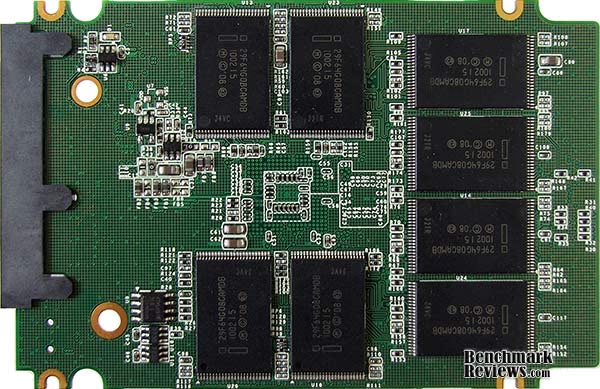
From the view above the printed circuit board (PCB), it doesn't look like there's anything dramatically innovative on the SandForce Solid State Drive. Eight flash NAND modules make a horseshoe around the SandForce SF-1200 SSD processor, and plenty of electronics fill in the remaining space atop the printed circuit board. But once the SandForce SSD board is turned to expose the underside, the difference is obvious: SandForce has used their DuraClass technology to remove the DRAM buffer.
The 2nd-generation SATA-3.0GBps SandForce SF-1222TA3-SBH processor is part of their SF-1200 family of SSD controller chips, and SSDs will utilize either the SF-1200 processor for retail consumers or SF-1500 for enterprise devices. All SandForce SSD controllers offer native TRIM support in Microsoft Windows-7, Native Command Queuing (NCQ) with 32 command slots, and Self-Monitoring, Analysis, and Reporting Technology (SMART) command set. While not directly important to transfer speeds or operational performance, SandForce utilizes a Tensilica Diamond Core DC_570T CPU inside the SF-1200 processor.
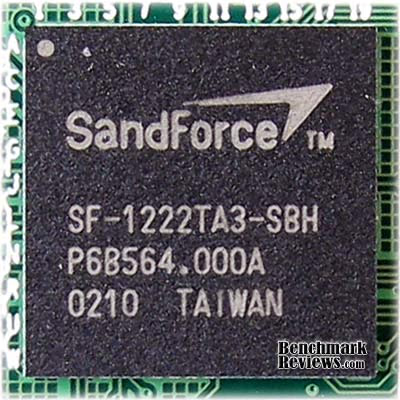
Another benefit of SandForce's SF-1200 architecture is that the SSD keeps all information on the NAND grid and removes the need for a separate cache buffer DRAM module. The result is a faster transaction, albeit at the expense of total storage capacity. SandForce SSDs utilize over-provisioning technology, which allocates a portion of NAND for data storage and the remainder reserved for transaction and cache buffer space. SandForce has also marketing custom firmware to the finished-goods companies that sell their SSDs, which remove performance restrictions.
The SF-1200 SSD processor provides ECC data protection and includes SandForce's unique RAISE (Redundant Array of Independent Silicon Elements) technology. RAISE provides the protection and reliability of RAID on a single SSD drive, thanks to flash architecture, without the significant write overhead of parity. The SandForce DuraClass technology automatically stores data in AES-128 encrypted format, preventing data extraction directly from the physical flash memory modules.
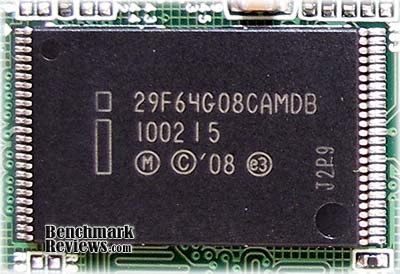
Sixteen multi-layer cell Intel 29F64G08CAMDB flash NAND modules are joined to the SandForce SF-1200 controller. On professional-level 28% over-provisioned SandForce SSDs, these NAND modules may combine for 128GB of physical storage space yet only 100GB of this capacity is designated for data. Consumer-level SandForce SSDs receive 7% over-provisioning and 128GB devices will yield 120GB of usable storage space.
Because the SandForce SF-1200 SSD processor inside the many SSDs is a non-exclusive component available market-wide, Benchmark Reviews expects to see many new solid state storage products using this controller in the near future. Please continue on for details and performance results for this Solid State Drive...
EDITOR'S NOTE: Benchmark Reviews has used this SSD to publish our SandForce SF1200 RAID-0 SSD Performance review.
SandForce SF-1200 Features
SandForce SF-1200 SSD Processors enable commodity flash memory to reliably operate in cost and power sensitive client computing environments. The SF-1200 is a true single-chip SSD Processor designed for volume manufacturing and outstanding performance. Innovative DuraClass technology delivers world class reliability, endurance, performance and power consumption.
Endurance and Longevity
As each generation of flash memory evolves and the silicon geometries shrink - performance, reliability, endurance, and data retention are negatively impacted. DuraWrite technology extends the life of the SSD over conventional controllers, by optimizing writes to the flash memory and delivering a write amplification below 1, without complex DRAM caching requirements.
Performance and Power Optimization
SSDs are capable of significantly outperforming traditional HDDs, but typical controllers haven't delivered the compelling value necessary for mainstream adoption. SandForce DuraClass technology enables the SSD to maximize both the endurance and performance for the life of the drive fulfilling the promise of high speed flash memory in client computing applications and improving system performance by up to 50% as measured by the SYSmark Benchmark.
Mobile Computing Security
The SF-1200 has built in AES-128 bit encryption controllable by a configurable user password. This feature prevents would-be thieves from extracting data directly from the flash memory should they ever have access to the drive.
Data Protection and Reliability
SF-1200 SSD Processors provide up to 100x greater data protection than today's SSDs, and leading enterprise HDDs. This is a result of superior ECC protection and unique RAISE (Redundant Array of Independent Silicon Elements) technology. RAISE provides the protection and reliability of RAID on a single drive without the significant write overhead.
SF-1222TA3-SBH Specifications
|
DuraClass Technology: |
|
|---|---|
|
Host Interface: |
|
|
Max Capacity Supported: |
512GB* (using 32Gb/die components) |
|
Performance (sustained): |
|
|
Flash Memory Support: |
MLC from numerous top flash memory manufacturers |
|
Power Consumption: |
|
|
Security: |
|
|
Protection: |
|
|
Reliability: |
|
|
Operating Temperature: |
0°C to 70°C ambient |
|
Package: |
361-Pin TFBGA - 13x13mm, 0.65mm pitch |
|
Compliance: |
RoHS, Halogen-Free, Green |
SSD Testing Methodology
Solid State Drives have traveled a long winding course to finally get where they are today. Up to this point in technology, there have been several key differences separating Solid State Drives from magnetic rotational Hard Disk Drives. While the DRAM-based buffer size on desktop HDDs has recently reached 32 MB and is ever-increasing, there is still a hefty delay in the initial response time. This is one key area in which flash-based Solid State Drives continually dominates because they lack moving parts to "get up to speed".
However the benefits inherent to SSDs have traditionally fallen off once the throughput begins, even though data reads or writes are executed at a high constant rate whereas the HDD tapers off in performance. This makes the average transaction speed of a SSD comparable to the data burst rate mentioned in HDD tests, albeit usually lower than the HDD's speed.
Comparing a Solid State Disk to a standard Hard Disk Drives is always relative; even if you're comparing the fastest rotational spindle speeds. One is going to be many times faster in response (SSDs), while the other is usually going to have higher throughput bandwidth (HDDs). Additionally, there are certain factors which can affect the results of a test which we do our best to avoid.
SSD Testing Disclaimer
Early on in our SSD coverage, Benchmark Reviews published an article which detailed Solid State Drive Benchmark Performance Testing. The research and discussion that went into producing that article changed the way we now test SSD products. Our previous perceptions of this technology were lost on one particular difference: the wear leveling algorithm that makes data a moving target. Without conclusive linear bandwidth testing or some other method of total-capacity testing, our previous performance results were rough estimates at best.
Our test results were obtained after each SSD had been prepared using DISKPART or Sanitary Erase tools. As a word of caution, applications such as these offer immediate but temporary restoration of original 'pristine' performance levels. In our tests, we discovered that the maximum performance results (charted) would decay as subsequent tests were performed. SSDs attached to TRIM enabled Operating Systems will benefit from continuously refreshed performance, whereas older O/S's will require a garbage collection (GC) tool to avoid 'dirty NAND' performance degradation.
It's critically important to understand that no software for the Microsoft Windows platform can accurately measure SSD performance in a comparable fashion. Synthetic benchmark tools such as HD Tach and PCMark are helpful indicators, but should not be considered the ultimate determining factor. That factor should be measured in actual user experience of real-world applications. Benchmark Reviews includes both bandwidth benchmarks and application speed tests to present a conclusive measurement of product performance.
Test System
- Motherboard: Gigabyte GA-X58A-UD7 (Intel X58-Express)
- Processor: Intel Core i7-920 BX80601920 @ 2.667 GHz
- System Memory: 6GB Triple-Channel DDR3 1600MHz CL6-6-6-18
- SATA 3Gb/s Storage HBA: Integrated Intel ICH10R Controller
- AHCI mode - Intel Rapid Storage Technology Driver 9.6.0.1014
- SATA 6Gb/s Storage HBA: Integrated Marvell SE9128 Controller
- AHCI mode - Marvell Magni Driver Marvell Magni Driver 1.0.0.1036
- Operating System: Microsoft Windows 7 Ultimate Edition 64-Bit
Drive Hardware Tested
The following storage hardware has been used in our benchmark performance testing, and may be included in portions of this article:
- ACARD ANS-9010 DDR2 SATA RAM-Drive
- ADATA S599 100GB SATA MLC SSD
- Corsair X256 CMFSSD-256D1 256GB SATA MLC SSD (Firmware version 1.1)
- Corsair Nova V128 CMSSSD-V128GB2 SATA MLC SSD
- Corsair Force F100 CSSD-F100GB2 SATA MLC SSD
- Crucial RealSSD-C300 CTFDDAC256MAG-1G1 256GB SATA 6Gb/s MLC SSD
- Intel X25-E Extreme SSDSA2SH032G1GN SATA SLC SSD
- Kingston SSDNowV+ SNVP325-S2 128GB SATA MLC SSD
- LiteOn LA-32M1S Strong-Page 32GB MLC SSD
- OCZ Agility OCZSSD2-1AGT120G 120GB SATA MLC SSD (Firmware version 1.5)
- OCZ Agility-EX OCZSSD2-1AGTEX60G 64GB SATA SLC (Firmware version 1.5)
- OCZ Vertex OCZSSD2-1VTX120G 120GB SATA SSD (Firmware v1.5)
- OCZ Vertex-EX OCZSSD2-1VTX120G 120GB SATA SLC SSD (Firmware version 1.5)
- OCZ Vertex Turbo OCZSSD2-1VTXT120G 120GB SATA SSD (Firmware version 1.5)
- OWC Mercury Extreme Pro-RE SSDMXRE100 100GB MLC SSD
- Patriot Inferno PI100GS25SSDR 100GB MLC SSD
- RunCore Pro-V RCP-V-S2520-MCN 200GB SATA SLC SSD
- Seagate Momentus-XT Solid State Hybrid Drive ST95005620AS
- Seagate Barracuda-XT ST32000641AS 2TB 7200RPM SATA 6Gb/s Hard Drive
- Western Digital VelociRaptor WD3000HLFS 300GB 10,000 RPM SATA Hard Disk Drive
- WD SiliconEdge-Blue SSC-D0256SC-2100 256GB SATA SSD
Test Tools
- AS SSD Benchmark 1.4.3704.27281: Multi-purpose speed and operational performance test
- ATTO Disk Benchmark 2.34: Spot-tests static file size chunks for basic I/O bandwidth
- Iometer 2008.06.28 by Intel Corporation: Tests IOPS performance and I/O response time
- Lavalys EVEREST Ultimate Edition 5.50: Disk Benchmark component tests linear read and write bandwidth speeds
- CrystalDiskMark 3.0.0b by Crystal Dew World: Sequential speed benchmark spot-tests various file size chunks
Test Results Disclaimer
This article utilizes benchmark software tools to produce operational IOPS performance and bandwidth speed results. Each test was conducted in a specific fashion, and repeated for all products. These test results are not comparable to any other benchmark application, neither on this website or another, regardless of similar IOPS or MB/s terminology in the scores. The test results in this project are only intended to be compared to the other test results conducted in identical fashion for this article.
SandForce Performance Differences
To best illustrate how SandForce SF-1200 series SSDs perform against each other, we used several different products that contain the SF-1222 storage controller to demonstrate relative performance levels. Each SSD was given the exact same preparation prior to testing, and all benchmarks were conducted on exact same system and drivers.
AS-SSD Benchmark
While the 4K 64-thread read-from results varied slightly, the write-to results were all nearly identical. Displayed in the chart below, the 64-thread 4KB IOPS performance results for several enthusiast-level storage products illustrates which products offer the best operation under load:

ATTO Disk Benchmark
Peak read and write performance was identical for all SandForce SSDs using ATTO Disk Benchmark with a default queue depth of four. The chart below does an excellent job of illustrating where the SandForce SSDs are positioned in terms of bandwidth speed.

CrystalDiskMark 3.0 Tests
Displayed in the chart below, the maximum 4KB queue depth 32 IOPS performance results for several enthusiast-level storage products illustrate which products offer the best operation under load:

Iometer IOPS Performance
To measure random I/O response time as well as total I/O's per second, Iometer is set to use 4KB file size chunks over a 100% random sequential distribution at a queue depth of 32 outstanding I/O's per target. The tests are given a 50% read and 50% write distribution. While this pattern may not match traditional 'server' or 'workstation' profiles, it illustrates a single point of reference relative to our product field. Our chart below illustrates random Read and Write IOPS performance over a 120-second Iometer test phase, with the average displayed in our benchmark results where high I/O is preferred:
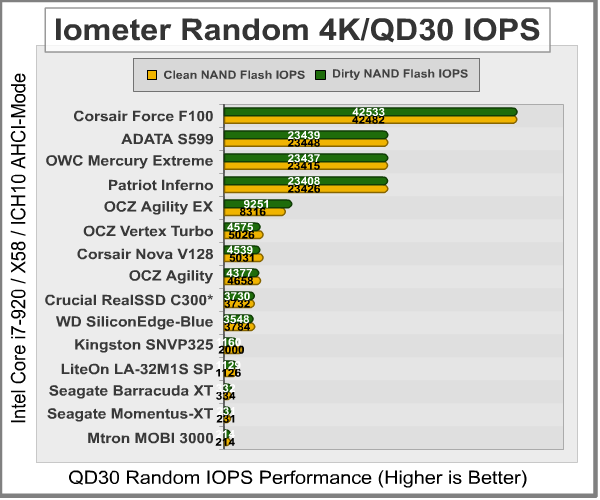
Up until this point, the SandForce SSDs have been either identical or roughly similar. Clearly, the Corsair Force F100 SSD has separated itself from the crowd by performing at nearly twice the level of the other SF-1222 SSDs. In our next section, we take a closer look at the firmware versions and explain why the focus on firmware could mean more than performance.
SF-1200 Firmware Revisions
Firmware is a subject few technical writers care to discuss, and for very good reason. What's here today, could be gone tomorrow. The fact of the matter is simple: device firmware can be updated at any time. Similar to writing articles on hardware device drivers, it's only informational and entertaining when there's something dramatically different between each version release.
SandForce SSDs depend on manufacturer support, but also allow OEM's to further customize the firmware to fit their needs. SandForce marketing director Jeremy Werner explained this to Benchmark Reviews: "We have a business model where we support customized firmware for customers under a compensation model. All of our OEM engagements require customized firmware to optimize for their platforms, and a number of the e-tailers have sought out customized fw to differentiate themselves in the market."
This makes sense, because not all OEM's have the same purpose in mind for their products. Some target prosumer enthusiasts, while others focus on the corporate enterprise segment. When we asked for more detail on the changes available, Mr. Werner responded: "The details of the firmware is often confidential and as such I'm not at liberty to comment on what each customer has in terms of custom firmware. You'll have to work with individual SSD manufacturers on the detailed capabilities of their products. This is one issue you should stay on top of, but directly with the vendors." Unfortunately, the vendors had very little to say on the subject.
Using the samples received here at Benchmark Reviews, we've put together some information on the various SandForce SF-1222 products and firmware available:
Sandforce 28% Over-Provisioning Firmware:
- 300A13F0 (3.0.0 Release Candidate): Mach Xtreme MX-DS
- 301A13F0 (3.0.1 Release Candidate): Corsair Force (Firmware Revision 0.2)
- 302A13F0 (3.0.2 Release Candidate): ADATA S599, RunCore Pro-V, PhotoFast G-Monster2
- 303A13F0 (3.0.3 Release Candidate): Undisclosed
- 304A13F0 (3.0.4 Release Candidate): Undisclosed
- 305A13F0 (3.0.5 Mass Production): OWC Mercury Extreme Pro-RE, Patriot Inferno
Sandforce 7% Over-Provisioning Firmware:
- 309A13F0 (3.0.9 Release Candidate): Mushkin Callisto
- 30CA13F0 (3.0.C Release Candidate): OCZ Vertex-2 "Extended"
- 310A13F0 (3.1.0 Release Candidate): G.Skill Phoenix Pro, OCZ Vertex-2 (Firmware Revision 1.10)
Why Be Different?
It seems like a silly question, but consider the implications involved when a finished-goods company alters the performance scope for firmware engineered by the manufacturer. SandForce has already explained why they offer custom firmware: not all OEMs have the same target market, and the added revenue stream is mutually beneficial. But at what cost?
The version 300A13F0 (3.0.0) firmware release had a few bugs, and was the initial release candidate used on early OEM products (such as the Mach Xtreme MX-DS series). As we discovered in our Iometer testing, the Corsair Force F100 offers nearly twice the IOPS performance using firmware 301A13F0 (3.0.1), but it does so at the expense of stability. Firmware 302A13F0 (3.0.2) used on the ADATA S599, RunCore Pro-V, and PhotoFast G-Monster2 seem no different than revision 305A13F0 (3.0.5) in terms of performance, as illustrated by the OWC Mercury Extreme Pro-RE and Patriot Inferno tests.
So by measuring these SSDs by their firmware, you might be led into believing the older revisions are the best of the bunch. The only problem with this logic is that the older firmware retains the problems and bugs later fixed in subsequent revisions. In versions 3.0.0 and 3.0.1 the SSD would not resume from low power states, and would essentially become non-operational. Corsair uses custom firmware (recorded at revision 0.2) that avoids these issue by disabling low-level power states, and as a result the Force F100 SSD demonstrates impressive 4k IOPS performance. Of course the drawback to this tactic is higher power consumption, which is one of the attributes SSDs are known for.
Consider these factors when you shop for and compare SandForce-based SSDs, just exactly as it required back when Indilinx firmware updates were changing the landscape.
28% OP Sandforce Products:
- A-DATA S599 Series
- Corsair Force Series
- G.Skill Phoenix Series
- 100GB model FM-25S2S-100GBP1 for $369
- 200GB model FM-25S2S-200GBP1
- Mushkin Callisto Series
- OCZ Agility-2 Series
- OCZ Vertex LE Series
- OCZ Vertex-2 Series
- OWC Mercury Series
- Patriot Inferno Series
- RunCore Pro-V Series
- Pro-V models at MyDigitalDiscount
- Mach Xtreme MX-DS Series
- PhotoFast G-Monster2 SFV1 Series
Comments? Questions? Benchmark Reviews appreciates constructive feedback, so leave your comment below are ask questions in our Discussion Forum.
Reader comments from the original article
2 comments were posted before commenting closed. They are preserved as written. Original avatars no longer resolve and are shown as a placeholder.
SF1500 ? and others tests ;) Federico La Morgia Permalink:
I saw on the website that there is a version of sandforce SF1500 enterprice class, you know if any SSD on the market uses to be able to test since SF1200/1220? A tip, there is some PCI-Express RAID controller that supports RAID SSD without disable the TRIM command and other commands that provides the sandforce and has at least 8 channels like normal RAID controllers from 300-1000 euros? Because it would be interesting to test 8-10 SSD with RAID controllers with Sandforce 0-1-5-10-50-60-51-61 doing many tests including those that completely filled and completely empty the resulting volume in order to understand how deteriorate the overall performance over time! I understand that now I hate the fact that I beg you to do many more tests, some seemingly strange, but I think it could bring to light strengths and weaknesses nasconti that would not normally go out :)
OK??? TRP member Permalink:
So the manufacturers are marketing SSD's with known bugs and flaws in the firmware (1222), and it's up to the buyer to upgrade the firmware to get the SSD to work properly, OR IT DIES??? This has a bad smell!