
Foxconn GeForce 9500 GT G96 Video Card
Foxconn GeForce 9500 GT
Not everyone can afford the bleeding edge of graphics hardware, and not everyone needs it. NVIDIA has already made headlines with their high-end GeForce GTX 280 video card, which offers high performance at a premium price. Most enthusiasts have seen so much coverage for the high-level graphic products that it might feel like nothing exists for the lower consumer segment. Benchmark Reviews hasn't forgotten about the entry-level enthusiast, which is why we test the Foxconn GeForce 9500 GT 256MB PCI Express video card against the bigger names in this review.
Just because the GeForce 9500 GT series isn't a top SKU, doesn't mean that it doesn't offer big performance. It may not come as a surprise that Foxconn's 9500 GT isn't going to compete with the 9800 GT, but it remains to be seen if this is a close match to the 9600 GT. NVIDIA's G96 GPU has already proven itself a worthy is many other SKU's across their product line. The GeForce 9500 GT we received from Foxconn was produced with a 65 nm fabrication process, but TSMC expects to begin producing 55 nm parts some time later this year. Unlike the GeForce 9600 series that receives the full 256-bit memory pipeline, the 9500 series will only offer a 128-bit variant. Our Foxconn Standard OC Edition video card came equipped with 256 MB of GDDR3 video DRAM, which can offer enough frame buffer for most low- and mid-level video games.
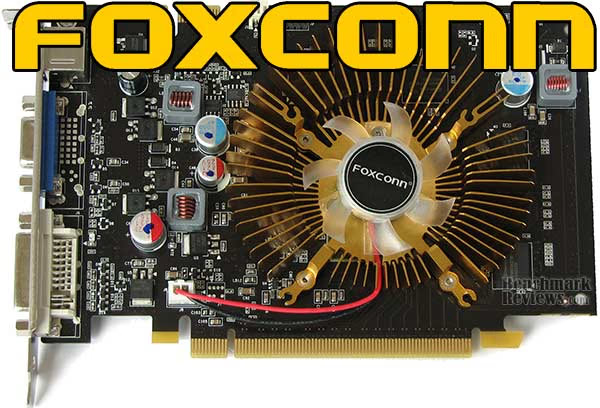
While it's fair to presume that this isn't going to turn many heads, the GeForce 9500 GT can offer a lot more feature functionality than just value-level graphics. To begin with, the 9500 GT is a very inexpensive SLI-capable graphics option. It also supports DirectX 10.0 (10.1 is unconfirmed), OpenGL 2.1, PCI Express 2.0, and Hybrid SLI. Although Foxconn integrates only the D-Sub, DVI, and component video connections, the GeForce 9500 GT series can also support DisplayPort which is the upcoming replacement for HDMI (and DVI). For many HTPC enthusiasts, the GeForce 9500 GT is a perfect fit for those systems not expecting to play the latest titles in video games.
In this article, Benchmark Reviews will test the new Foxconn GeForce 9500 GT Standard OC Edition 256MB video card 9500GT-256FR3 against a very large collection of the latest graphic card products.
About the Company: FOXCONN (Hon Hai Precision Industry Co., Ltd)
Foxconn is the registered trade name of Hon Hai Precision Industry Co., Ltd., a global leader in the design, manufacture, and distribution of advanced computer, communications, and consumer electronics components. Hon Hai Precision Industry may be the biggest electronics company you never heard of, more commonly known by its trade name: Foxconn, is one of the world's largest contract electronics manufacturers. It manufactures computer, consumer electronics, and communications products, including connectors, cable assemblies, enclosures, flat-panel displays, game consoles, motherboards, and servers. Hon Hai also provides design engineering and mechanical tooling services. The company's customers include Apple, Cisco, Dell, Nokia, and Sony. CEO Terry Gou founded Hon Hai in 1974 to make plastic switches for televisions. With over three decades of demonstrated manufacturing excellence, Hon Hai sets the standard in the industry for product quality and reliability, customer support, and value. In 2005 Hon Hai had sales of $25 billion (USD).
The Channel Service Division (CSD), part of the PCE Business Group of Hon Hai, is Hon Hai's worldwide organization for servicing channel customers. Guided by the mantra "The Art of More", CSD is dedicated to making it simpler and more affordable for its customers to offer superior information systems to their consumer and enterprise customers. CSD serves a network of distributors and OEM customers in Asia, EMEA, and the Americas.
Foxconn's Channel Innovation & Service Group (CISG) is committed to providing reliable, high-quality products to all its customers - large and small. We understand how the channel has evolved - its impact on consumers and the people who work in the computer industry. Consequently, we are aggressively innovating to deliver solid, honest products that promote simplicity and ease of use, while at the same time appreciating the natural and human environment through the entire product life cycle. Through this philosophy of connecting people and technologies, Foxconn CISG is enabling a vast range of PC assemblers, retailers and end-users the freedom to create their own computing solutions.
Guided by a belief that the electronics products would be an integral part of everyday life in every office and in every home, Terry Gou founded Hon Hai Precision Industry Company Ltd., the anchor company of Foxconn Technology Group in 1974 with US$7,500, a devotion in integrating expertise for mechanical and electrical parts and an uncommon concept to provide the lowest "total cost" solution to increase the affordability of electronics products for all mankind.
Today, Foxconn Technology Group is the foremost provider of joint-design, joint-development, manufacturing, assembly and after-sales services to global Computer, Communication and Consumer-electronics ("3C") leaders. Aided by its legendary execution, uncompromising customer devotion and its award-winning proprietary business model, eCMMS, Foxconn Group is not only the largest, but also the fastest growing multinationals manufacturing services provider (including CEM, EMS, ODM and CMMS) in the world.
Focusing on fields of nanotechnology, heat transfer, wireless connectivity, material sciences, and green manufacturing process, Foxconn's over 15,000 patents granted worldwide by 2005 made it a recognized leader of innovation and technical know-how in rankings such as MIT's patent scorecard.
Foxconn's commitment to continual education, investing in its people long term and localization globally not only leads to the deep collaborating relationships with leading institutions of higher learning, but also helps to make this Fortune Global 500 company's global operations including the largest exporter in Greater China and the second largest exporter in Czech Republic, and also allows it to be the only company consistently ranked among top ten in the Business Week IT100 since 2002.
GeForce 9500 GT Features
Backed by NVIDIA's Lumenex Engine, the GeForce 9500 GT delivers true 128-bit floating point high dynamic range (referred to as HDR), lighting capabilities with up to 16x full-screen anti-aliasing. Second-generation NVIDIA PureVideo HD technology with HDCP compliance delivers the ultimate high-definition video viewing experience to the Foxconn GeForce 9500 GT Standard OC Edition video card.
With hardware decoding for Blu-ray and HD DVD formats, PureVideo HD technology lowers CPU utilization when watching high-definition video formats by decoding the entire video stream in the graphics processor, freeing up the processor for other tasks. In addition to low CPU utilization, PureVideo HD enhances standard definition video content with de-interlacing and other post-processing algorithms to ensure standard DVD movies look their best on the PC screen and high-definition television sets. High definition content protection, or HDCP, technology ensures a secure connection between the GeForce 9500 GT graphics card and an HDCP capable monitor for viewing protected content such as high-definition Blu-ray or HD DVD movies.
Coupled with PureVideo HD technology, the 9500 GT deliver the ultimate multimedia experience. High definition component video technology allows users to connect a PC to a high-definition television sets with a single cable, delivering high-definition surround sound audio and video with resolutions up to 1080p. PureVideo HD technology scales video in the highest quality up to resolutions of 2560x1600 - from standard and high-definition file formats - while preserving the details of the original content. PureVideo HD technology also accelerates high-definition video decode, freeing up CPU cycles while watching high-definition Blu-ray and HD DVD movies or other VC-1 and H.264 encoded file formats.
NVIDIA Unified Architecture
-
Unified shader architecture
-
GigaThread technology
-
Full support for Microsoft DirectX 10
-
Geometry shaders
-
Geometry instancing
-
Streamed output
-
Shader Model 4.0
-
Full 128-bit floating point precision through the entire rendering pipeline
NVIDIA Lumenex Engine
-
16x full screen anti-aliasing
-
Transparent multisampling and transparent supersampling
-
16x angle independent anisotropic filtering
-
128-bit floating point high dynamic-range (HDR) lighting with anti-aliasing
-
32-bit per component floating point texture filtering and blending
-
Advanced lossless compression algorithms for color, texture, and z-data
-
Support for normal map compression
-
Z-cull
-
Early-Z
NVIDIA Quantum Effects Technology
-
Advanced shader processors architecture for physics computation
-
Simulate and render physics effects on the graphics processor

NVIDIA PureVideo HD Technology
Along with world-class video acceleration, PureVideo HD has been at the forefront of advanced video post-processing. With the R174 series driver, we are introducing new features for PureVideo HD for GeForce 9500 GT. These new features, Dynamic Contrast Enhancement and Dynamic Blue, Green, and Skin Tone Enhancements, are extremely computationally intensive and not found on even the most high-end Blu-ray or HD DVD players. But by tapping into the enormous pool of computational power offered by our processor cores, we can now enable post-processing techniques that have yet to be realized in fixed-function video processors.
-
Dedicated on-chip video processor
-
High-definition H.264, VC-1, MPEG2 and WMV9 decode acceleration
-
Advanced spatial-temporal de-interlacing
-
HDCP capable3
-
Spatial-Temporal De-Interlacing
-
Noise Reduction
-
Edge Enhancement
-
Bad Edit Correction
-
Inverse telecine (2:2 and 3:2 pull-down correction)
-
High-quality scaling
-
Video color correction
-
Microsoft Video Mixing Renderer (VMR) support
Advanced Display Functionality
-
One dual-link DVI outputs for digital flat panel display resolutions up to 2560x1600
-
Dual integrated 400MHz RAMDACs for analog display resolutions up to and including 2048x1536 at 85Hz
-
Integrated HDTV encoder provides analog TV-output (Component/Composite/S-Video) up to 1080i resolution
-
NVIDIA nView multi-display technology capability
-
10-bit display processing
Dynamic Color Enhancement
By analyzing the color components of each frame, we can also isolate and improve the appearance of blue, green, and skin tones, which the human eye is particularly sensitive to. Unlike televisions which have built-in image processors, PC monitors typically display the input picture without any processing, which can result in comparatively dull images. Dynamic blue, green, and skin tone enhancement alleviates this problem by applying correction curves on these sensitive colors. The result is improved total balance and clarity, without over saturation.
Built for Microsoft Windows Vista
-
Full DirectX 10 support
-
Dedicated graphics processor powers the new Windows Vista Aero 3D user interface
-
VMR-based video architecture
High Speed Interfaces
-
Designed for PCI Express x16
-
Designed for high-speed GDDR3 and DDR3 memory
Operating Systems
-
Built for Microsoft Windows Vista
-
Windows XP/Windows XP 64
-
Linux
API Support
-
Complete DirectX support, including Microsoft DirectX 10 Shader Model 4.0
-
Full OpenGL support, including OpenGL 2.0
9500GT-256FR3 Specifications
Coupled with PureVideo HD technology, the Foxconn GeForce 9500 GT Standard OC Edition video card delivers an astounding multimedia experience. The GeForce 9500 GT features an HDCP-enabled DVI-I output for connection to analog and digital PC monitors and HDTVs, a 7-pin analog video-out port that supports S-Video directly, plus composite and component (YPrPb) outputs via an optional (and included) dongle.
G96 Graphics Processing Unit
-
NVIDIA GeForce 9500 GT 560 MHz Graphics Engine
-
32 Stream Processors
-
1400 MHz Shader clock
-
400 MHz RAMDAC's
-
2560x1600 Maximum Digital Resolution
-
2048x1536 Maximum VGA Resolution
-
True 128-bit floating point high dynamic-range (HDR) lighting with 16x full- screen anti-aliasing
Memory
-
256 MB GDDR3 vRAM
-
810 MHz memory clock (1620 MHz realized)
-
128-bit memory bus
-
Memory pieces: 4
-
Memory package: uBGA
Bus Support
-
PCI Express 2.0
-
PCI Express x16 Backwards Compatible
3D Acceleration
-
Microsoft DirectX10 support
-
Unified Shader Model 4.0
-
OpenGL 2.1
Others
-
HDTV Ready
-
Vista Ready
-
SLI Ready
-
HDCP Ready
-
DVI Audio
-
Dual Link Dual DVI
-
RoHS Compliant
Dual-Stream Decode
Recently, studios have begun taking advantage of the additional space high-definition media such as Blu-Ray and HD DVD discs provide by adding dual-stream picture-in-picture functionality to movies. Often the PiP content is coupled with advanced BD-J (Java) or HDi (XML) features, so taking the processing burden off of the CPU is even more important for titles with these advanced features. The latest PureVideo HD engine now supports dual-stream hardware acceleration which takes the workload off of the CPU and gives it to the more powerful GPU.
HDCP over dual-link allows video enthusiasts to enjoy high-definition movies on extreme high-resolution panels such as the 30" Dell 3007WFP at 2560 x 1600 with no black borders.
Aero with HD DVD and Blu-ray Playback
Until now, users have been unable to take advantage of the Aero user interface in Windows Vista while playing HD video. When this was attempted, Vista would revert back to a basic theme and Aero would be disabled.
PureVideo HD now supports HD movie playback in Aero mode. This creates a more seamless user experience by eliminating the pop-up message notifying that Vista has switched to basic mode. As you can see in the screenshot below, Aero windows are enabled in conjunction with HD movie playback.
GeForce 9500 GT Closer Look
The Foxconn GeForce 9500 GT offers a single-slot design that is a small departure from the double-slot sized graphic cards we've seen a lot of lately. The first two things I noticed about the 9500 GT was the fan-sink cooler and SLI expansion port.
It's been quite a while since I had last seen a fan-sink cooler, and even longer since I've seen one on a NVIDIA product. Nevertheless, the 9500 GT promises to deliver many of the latest multimedia features available to the 9th generation of GeForce products, while at the same time offer decent gaming performance for entry-level enthusiasts.
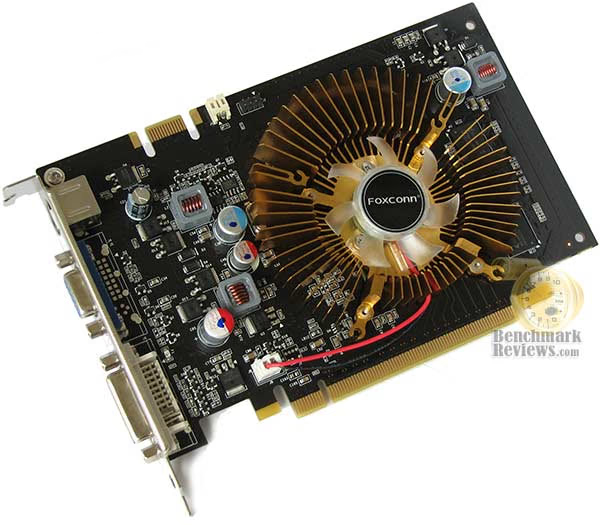
There really isn't too much to talk about when it comes to the overall looks of this card. There's one aluminum-alloy cooler with a small (yet considerably quiet) cooling fan embedded in the middle. None of the memory modules receive heatsinks, however the fins from the fan-sink extend overhead and prevent adding any after-market cooling components.
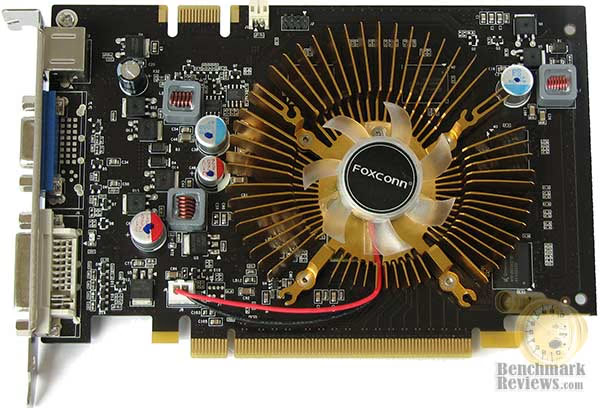
The backside of the GeForce 9500 GT doesn't offer a very exciting landscape, at least not in comparison to some of the more recent video card products we've tested here at Benchmark Reviews. The printed circuit board is colored a dark brown (intended to be black), with only a few small resistors and diodes covering the surface. The lack of video DRAM modules on the backside make this a cooler-running component.
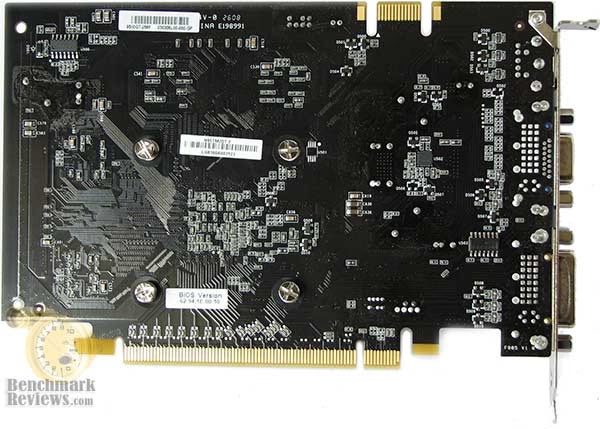
With limited after-market cooling options, the Foxconn 9500GT-256FR3 is meant to be a stand-alone entry-level product for multimedia enthusiasts and low-demand gamers. The GeForce 9500 GT G96 video card ranks ahead of the 8600 GTS, and directly competes with the 8600 GT it is meant to replace.
Please continue on to the next section where Benchmark Reviews takes a detailed look at the Foxconn GeForce 9600 GT Standard OC Edition video card.
9500GT-256FR3 Detailed Features
In the last section, we skimmed over the exterior appearance of the new GeForce 9500 GT video card. So far, there isn't too much excitement stirred up by this little product because of the minimalist design and single slot size. As we continue with the detailed features, the Foxconn 9500GT-256FR3 will be pulled apart for a closer look at the GPU and vRAM components.
Like other members of the GeForce 9 series family, the GeForce 9500 GT can offer native HDMI functionality if the manufacturer includes it in their design. Because HDMI audio functionality is controlled at the hardware level, there is no need for additional drivers or software. Much like the SPDIF connection on the back of a motherboard, the video cards audio out function is plug-n-play. Although Foxconn did not enable HDMI on their 9500GT-256FR3, the P/SPDIF connection is still evident at the side of the card near the SLI connection.

I am unaware if the other model SKU's Foxconn offers for the 9500 GT include HDMI, which is unfortunate because the G96 graphics processor is equipped with the PureVideo 2 engine for GPU-assisted decoding of the H.264 and VC-1 CODEC's.
Once I had carefully removed four spring-loaded screws, the GeForce 9500 GT fan-sink came apart with a light pull. Unlike other GeForce 9-series products, the Foxconn GeForce 9500 GT did not use a carbon or aluminum-based Thermal Paste. Instead, a gummy pink thermal interface material was used to mate the GPU to the fan-sink base.
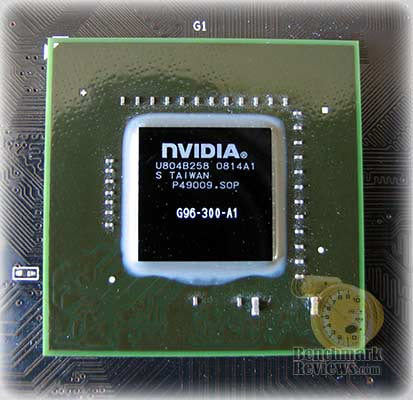
The G96 graphics processor looks identical to the G92 GPU found in the GeForce 9800 GTX, but the inner workings are night and day different. Rated to consume not more than 50W of power, the G96 has also found itself inside mobile applications.
Four Qimonda HYB18H51232BF-10 GDDR3 memory module IC's are used on the Foxconn 9500GT-256FR3, yielding a total of 256 MB of video frame buffer. These parts are rated for up to 2000 MHz, and have been seen on many other models from the GeForce family. Up to 512 MB can be integrated into the GeForce 9500 GT by add-in card partners.
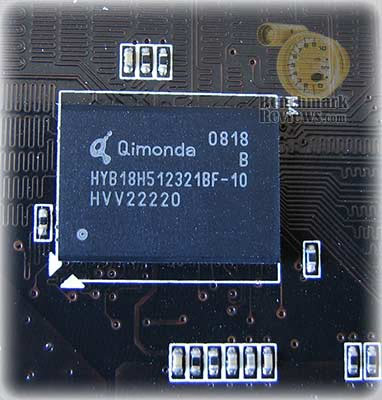
With the fan-sink removed, the PCB looks very bare on the GeForce 9500 GT. With exception to a few capacitors (both solid and standard), along with a couple of power management components, the surface is barren. All of these production optimizations add up to an efficient product that NVIDIA plans to market for less than $100.

This concludes our in-depth look into the Foxconn GeForce 9500 GT Standard OC Edition graphics card, which has revealed several interesting discoveries about the hardware and the assembly process for this economy product. The 9500 GT is as basic as they can get anymore, with an appearance reminiscent of the GeForce MX 400 days. In our next section, Benchmark Reviews begins testing on the Foxconn 9500GT-256FR3 against several other close competitors, but first we spend some time explain how it's all done here in our lab.
Video Card Testing Methodology
Benchmark Reviews has high hopes that one day we will be so giant and world famous that every combination of the graphic card available will be on-hand for our product testing... and we're getting closer! I envy the review sites that have twenty other video cards tested in stand-alone, SLI, and CrossFireX arrays for each and every review. Eventually we will be that big, and offer all of those configurations. Readers can help us grow to that size by spreading the word, but for now we'll have to make due with what our budget can afford. In this article, Benchmark Reviews is going to test and compare the NVIDIA GeForce 9500 GT graphics card against several other closely-ranked products from within the GeForce and Radeon family.
At the start of all tests, the previous display adapter driver is uninstalled and trace components are removed using Driver Cleaner Pro. We then restart the computer system to establish our display settings and define the monitor. Once the hardware is prepared, we begin our testing. The synthetic benchmark tests in 3DMark06 will utilize shader models 2.0 and 3.0. In our higher-end VGA products we conduct tests at the following resolutions: 768x1024 (17" Standard LCD) and 1280x1024 (19" Standard LCD). In some tests we utilized widescreen monitor resolutions, since more users are beginning to feature these products for their own computing.
Each benchmark test program begins after a system restart, and the very first result for every test will be ignored since it often only caches the test. This process proved extremely important in the World in Conflict and Supreme Commander benchmarks, as the first run served to cache maps allowing subsequent tests to perform much better than the first. Each test is completed five times, with the average results displayed in our article.
Our site polls and statistics indicate that the over 90% of our visitors use their PC for playing video games, and practically every one of you are using a screen resolutions mentioned above. Since all of the benchmarks we use for testing represent different game engine technology and graphic rendering processes, I feel that this battery of tests will provide a diverse range of results for you to gauge performance on your own computer system. Since most gamers and enthusiasts are still using Windows XP, it was decided that DirectX 9 would be used for all tests until demand and software support improve for Windows Vista.
Test System
-
Motherboard: Gigabyte GA-X48T-DQ6 (Intel X48 Chipset) with version F5 BIOS
-
Processor: Intel E8400 Core 2 Duo 3.0 GHz (Overclocked to 3.6 GHz)
-
System Memory: Corsair PC3-14400 DDR3 1800MHz
-
Disk Drive 1: OCZ SATA-II 32GB 2.5-Inch SSD OCZSSD2-1S32G
-
Disk Drive 2: (Paging File) MemoRight GT MR25.2-064S 2.5-Inch 64GB SATA SSD
-
Optical Drive: ASUS BC-1205PT SATA Blu-ray Disc Optical Drive
-
Operating System: Windows XP Professional SP-3 (optimized to 16 processes at idle)
Benchmark Applications
-
3DMark06 v1.1.0 (8x Anti Aliasing & 16x Anisotropic Filtering)
-
Crysis v1.21 Benchmark (High Settings, 0x and 4x Anti-Aliasing)
-
World in Conflict v1.0.0.8 Performance Test (Very High Setting: 4x AA/4x AF)
Video Card Test Products
-
Foxconn GeForce 9500 GT 9500GT-256FR3 (560 MHz GPU/1400 Shader/810 RAM - Forceware 177.79 WHQL Candidate)
-
XFX PV-T88S-FDD4 GeForce 8800 GS (680 MHz GPU/1700 Shader/800 RAM - Forceware v177.79)
-
Palit GeForce 9600 GT 1GB Sonic NE/960TSX0202 (700 MHz GPU/1750/1000 RAM - Forceware v177.79)
-
ZOTAC GeForce 8800 GT 512MB AMP! Edition ZT-88TES3P-FCP (700 MHz GPU/1700 Shader/1000 RAM - Forceware v177.79)
-
FOXCONN GeForce 9800 GTX Standard OC Edition 9800GTX-512N (685 MHz GPU/1713 Shader/1100 RAM - Forceware v175.79)
-
Sapphire Radeon HD 4850 102-B50102-00-AT (625 MHz GPU/993 MHz RAM - Catalyst 8.7)
Now we're ready to begin testing video game performance on the Sapphire Radeon HD 4870, so please continue to the next page as we start with the 3DMark06 results.
3DMark06 Benchmark Results
3DMark is a computer benchmark by Futuremark (formerly Mad Onion) to determine the DirectX performance of 3D game performance with graphics cards. 3DMark06 uses advanced real-time 3D game workloads to measure PC performance using a suite of DirectX9 3D graphics tests, CPU tests, and 3D feature tests.
3DMark06 tests include all new HDR/SM3.0 graphics tests, SM2.0 graphics tests, AI and physics driven single and multiple cores or processor CPU tests and a collection of comprehensive feature tests to reliably measure next generation gaming performance today.
Here at Benchmark Reviews, we believe that synthetic benchmark tools are just as valuable as video games, but only so long as you're comparing apples to apples. Since the same test is applied in the same controlled method with each test run, I believe 3DMark is a very reliable tool for comparing graphic cards against one-another.
Using a 1024x768 resolution as a starting point, the maximum settings were applied which for these tests includes 8x Anti-Aliasing and 16x Anisotropic Filtering. Low-resolution testing allows the graphics processor to plateau maximum output performance, which thereby shifts demand onto the system components. At the lower resolutions 3DMark will reflect the GPU's top-end speed in the composite score, indicating full-throttle performance with little load. This makes for a less GPU-dependant test environment, is helpful in measuring the maximum output performance in the test results.
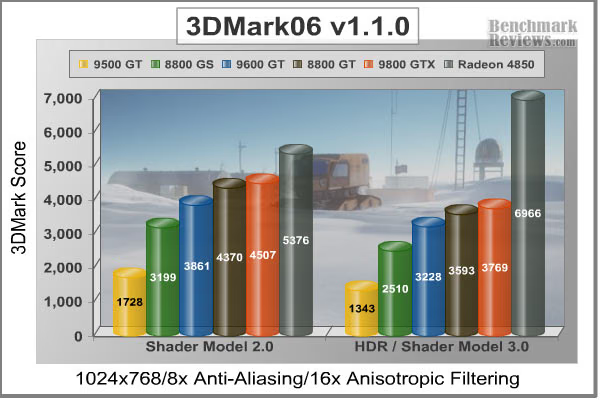
Right off the start, we can see that there's a very good reason why NVIDIA is marketing the GeForce 9500 GT below the $100 price level. With a Shader Model 2.0 score of 1728, the Foxconn 9500GT-256FR3 is well beneath the competition. Even when you look at the HDR/Shader Model 3.0 results, the GeForce 9500 GT scores 187% less than the GeForce 8800 GS and 240% less than the 9600 GT. Keeping in mind that this is Foxconn's Standard OC Edition video card, the 9500 GT doesn't look like the GeForce products we're used to seeing.
Bumping the GPU strain up a notch with 1280x1024 resolutions the scores remain relatively comparable in terms of performance ratio. Once again the Sapphire Radeon HD 4850 completely annihilates the competition with major-GPU muscle, but the rest of the pack still manages to keep up the pace with decent results... except the 9500 GT.

The GeForce 9500 GT SM 2.0 score of 1258 performed noticeably less than the 8800 GS and Palit GeForce 9600 GT. In the SM3 tests, the Foxconn 9500GT-256FR3 produced a score 186% less than that of the overclocked 8800 GS and a full 259% below the 9600 GT. As a comparison, the ZOTAC GeForce 8800 GT 512MB AMP! Edition produced a score 291% better with 2692.
After seeing the first three-digit score I've ever recorded in 3dMark06, I decided it was time to finishing up the series of synthetic benchmark tests and move on to the real-world gaming performance. If you were hoping to see the newer 9500 GT product line outperform the older 8800 GS series, I was hoping for it too. Heck, I even thought it might come close to the level of performance we see from the 9600 GT series just one notch above it.
Video Card Test Products
-
Foxconn GeForce 9500 GT 9500GT-256FR3 (560 MHz GPU/1400 Shader/810 RAM - Forceware 177.79 WHQL Candidate)
-
XFX PV-T88S-FDD4 GeForce 8800 GS (680 MHz GPU/1700 Shader/800 RAM - Forceware v177.79)
-
Palit GeForce 9600 GT 1GB Sonic NE/960TSX0202 (700 MHz GPU/1750/1000 RAM - Forceware v177.79)
-
ZOTAC GeForce 8800 GT 512MB AMP! Edition ZT-88TES3P-FCP (700 MHz GPU/1700 Shader/1000 RAM - Forceware v177.79)
-
FOXCONN GeForce 9800 GTX Standard OC Edition 9800GTX-512N (685 MHz GPU/1713 Shader/1100 RAM - Forceware v175.79)
-
Sapphire Radeon HD 4850 102-B50102-00-AT (625 MHz GPU/993 MHz RAM - Catalyst 8.7)
Take the 3DMark06 tests at face value, because in our next section we begin real-world testing on a cadre of popular video games known for taxing the graphics processor, and the order of this lineup might possibly change. Our first up is Crysis, so please continue on...
Crysis Benchmark Results
Crysis uses a new graphics engine: the CryENGINE2, which is the successor to Far Cry's CryENGINE. CryENGINE2 is among the first engines to use the Direct3D 10 (DirectX10) framework of Windows Vista, but can also run using DirectX9, both on Vista and Windows XP.
Roy Taylor, Vice President of Content Relations at NVIDIA, has spoken on the subject of the engine's complexity, stating that Crysis has over a million lines of code, 1GB of texture data, and 85,000 shaders. To get the most out of modern multicore processor architectures, CPU intensive subsystems of CryENGINE 2 such as physics, networking and sound, have been re-written to support multi-threading.
Crysis offers an in-game benchmark tool, which is similar to World in Conflict. This short test does place some high amounts of stress on a graphics card, since there are so many landscape features rendered. For benchmarking purposes, Crysis can mean trouble as it places a high demand on both GPU and CPU resources.
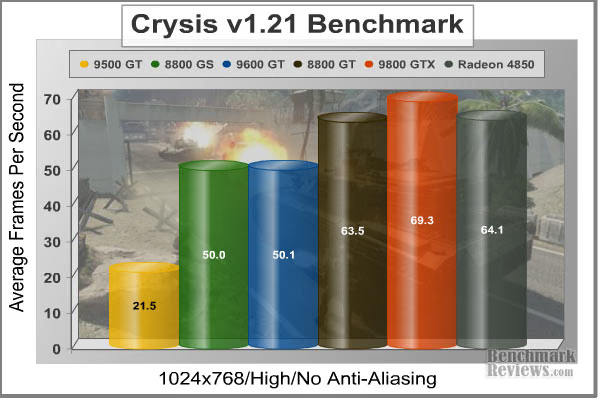
Low-resolution testing allows the graphics processor to plateau maximum output performance, which thereby shifts demand onto the system components. At the lower resolutions Crysis will reflect the GPU's top-end speed in the composite score, indicating full-throttle performance with little load. This makes for a less GPU-dependant test environment, is helpful in measuring the maximum output performance in the test results.
After I compiled the results of the Crysis benchmarks at 1024x768, it was extremely obvious that my collection of (what I consider) low-end video cards was just too much muscle to fairly compare against the new GeForce 9500 GT. Producing only 21.5 frames per second in our Crysis timedemo benchmark, the Foxconn 9500GT-256FR3 rendered less than half the performance of the next closes products: the GeForce 8800 GS (with 50.0 FPS) and 9600 GT (with 50.1 FPS).
At the 1280x1024 resolution our results mirror what gamers using a 19" LCD monitor would experience, and the 9500 GT's performance has slipped well below the acceptable 30 FPS threshold for graphics performance. In terms of relevant performance, all of these products maintain the same performance ratio as before.
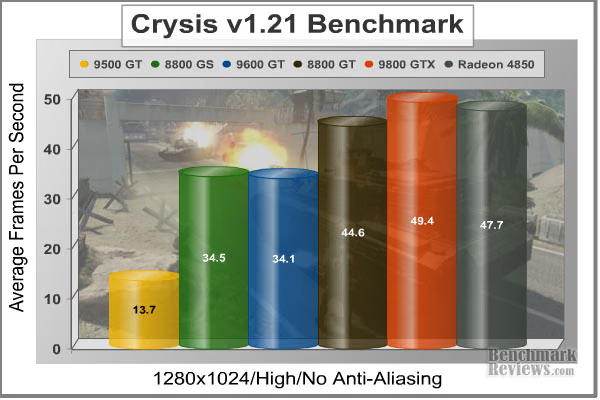
While I admit that Crysis is not a game anyone with a GeForce 9500 GT would ever risk (suffer) playing, it's a decent measure of how much performance a modern video component can exert from a modern video game. But just for the record, it shouldn't be this way: no new graphics product should ever redefine the lowest possible rung of performance. Without much question, the GeForce 9500 GT isn't going to find a home in too many systems meant for gaming.
Video Card Test Products
-
Foxconn GeForce 9500 GT 9500GT-256FR3 (560 MHz GPU/1400 Shader/810 RAM - Forceware 177.79 WHQL Candidate)
-
XFX PV-T88S-FDD4 GeForce 8800 GS (680 MHz GPU/1700 Shader/800 RAM - Forceware v177.79)
-
Palit GeForce 9600 GT 1GB Sonic NE/960TSX0202 (700 MHz GPU/1750/1000 RAM - Forceware v177.79)
-
ZOTAC GeForce 8800 GT 512MB AMP! Edition ZT-88TES3P-FCP (700 MHz GPU/1700 Shader/1000 RAM - Forceware v177.79)
-
FOXCONN GeForce 9800 GTX Standard OC Edition 9800GTX-512N (685 MHz GPU/1713 Shader/1100 RAM - Forceware v175.79)
-
Sapphire Radeon HD 4850 102-B50102-00-AT (625 MHz GPU/993 MHz RAM - Catalyst 8.7)
In our next section, Benchmark Reviews moves on to World in Conflict to demonstrate real-world performance for a medium-demand video game on the Foxconn GeForce 9500 GT G96 video card 9500GT-256FR3.
World in Conflict Benchmark Results
The latest version of Massive's proprietary Masstech engine utilizes DX10 technology and features advanced lighting and physics effects, and allows for a full 360 degree range of camera control. Massive's MassTech engine scales down to accommodate a wide range of PC specifications, if you've played a modern PC game within the last two years, you'll be able to play World in Conflict.
World in Conflict's FPS-like control scheme and 360-degree camera make its action-strategy game play accessible to strategy fans and fans of other genres... if you love strategy, you'll love World in Conflict. If you've never played strategy, World in Conflict is the strategy game to try.
World in Conflict offers an in-game benchmark; which records the minimum, average, and maximum frame rates during the test. Very recently another hardware review website made the assertion that these tests are worthless, but we couldn't disagree more. When used to compare video cards which are dependant on the same driver and use the same GPU architecture, the in-game benchmark works very well and comparisons are apples-to-apples.
First tested was the 1024x768 resolution in WiC, which relates to gamers using a 17" LCD monitor. Based on the test results charted below it's clear that WiC doesn't place a limit on the maximum frame rate (to conserve wasted power) which is good for full-spectrum benchmarks like ours, but bad for electricity bills.
Just as we have seen with 3dMark06 and Crysis, the GeForce 9500 GT just doesn't compete against others near it's series. In perspective to the frame rate scores in Crysis, all of the graphic cards tested share a similar FPS score in WiC. However, with WiC the majority of the pack hovers around 60 FPS whereas Foxconn's 9500GT-256FR3 posts 28 FPS.

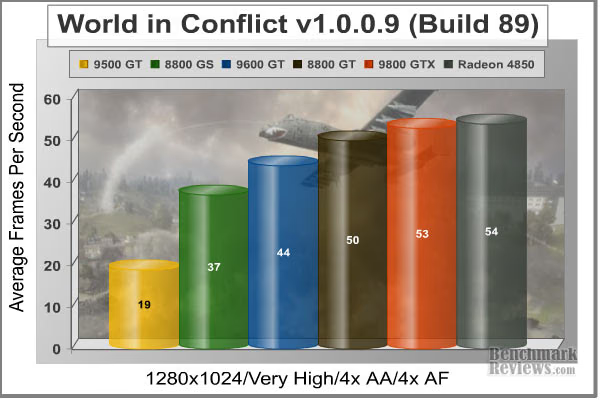
With a balanced demand for CPU and GPU power, the 1280x1024 resolution proved to be the turning point for performance. Set to the highest graphics quality settings the Masstech engine allows, World in Conflict begins to really strain all of the GeForce products.
While some of the video cards show almost no sign of stress, others fold to the pressure. The GeForce 9500 GT sinks to 19 FPS, and trails behind the 8800 GS score of 37 FPS. The Palit GeForce 9600 GT and ZOTAC GeForce 8800 GT both reduce frame rates at a similar ratio, but remain very strong. Finishing out the group is the FOXCONN GeForce 9800 GTX and Sapphire Radeon HD 4850, which showed only very small signs of fatigue.
Video Card Test Products
-
Foxconn GeForce 9500 GT 9500GT-256FR3 (560 MHz GPU/1400 Shader/810 RAM - Forceware 177.79 WHQL Candidate)
-
XFX PV-T88S-FDD4 GeForce 8800 GS (680 MHz GPU/1700 Shader/800 RAM - Forceware v177.79)
-
Palit GeForce 9600 GT 1GB Sonic NE/960TSX0202 (700 MHz GPU/1750/1000 RAM - Forceware v177.79)
-
ZOTAC GeForce 8800 GT 512MB AMP! Edition ZT-88TES3P-FCP (700 MHz GPU/1700 Shader/1000 RAM - Forceware v177.79)
-
FOXCONN GeForce 9800 GTX Standard OC Edition 9800GTX-512N (685 MHz GPU/1713 Shader/1100 RAM - Forceware v175.79)
-
Sapphire Radeon HD 4850 102-B50102-00-AT (625 MHz GPU/993 MHz RAM - Catalyst 8.7)
It's been a long run of tests for the Foxconn GeForce 9500 GT Standard OC Edition video card, and it appears obvious that the number and naming designation do not imply a relative performance to the counterparts. While the video games we've tested were playable with the Foxconn 9500GT-256FR3, the settings usually required some tuning and only 1024x768 or 1280x1024 resolutions would work.
In our next section, the heat output and operating temperatures are examined while the power consumption is analyzed.
GeForce 9800 GT Temperatures
Benchmark Reviews has a very popular guide written on How To Overclock the NVIDIA GeForce Series video card, but it was published shortly after the 8th generation of GeForce products was launched. Currently we are preparing for a more updated article, with additional information on shader overclocking and temperature control as the newest 9th generation GeForce products are made available. Once published you can expect more detailed information than what is shown below, as for now the temperatures depicted are GPU core temperatures at idle and under load.
To begin my testing, I used ATITool v0.26 to record GPU temperatures at idle and again at high-power 3D mode. The ambient room temperature was a comfortable 20.0°C and the inner-case temperature hovered around 33°C. The Foxconn GeForce 9500 GT G96 video card recorded a very cool 40°C in idle 2D mode, and increased to only 65°C in full 3D mode. Overall, it surprised me that the G96 GPU didn't get hotter since the fan-sink was so small in comparison to other G9x coolers..
As the temperature would slowly rise, I did not hear any audible difference in fan noise from the video card. Perhaps 65°C is not enough load to trigger an increase in fan power stepping, or perhaps the video BIOS doesn't offer it at all. Either way, the temperatures were low enough that the GeForce 9500 GT would do well in both desktop and HTPC chassis enclosures.
GeForce 9500 GT Power Consumption
It's becoming difficult to dodge the "doom and gloom" talks these days. Planet Earth is needs our help, badly. With forests becoming barren of vegetation and snow capped poles quickly turning brown, the technology industry has a new attitude towards suddenly becoming "green". I'll spare you the powerful marketing hype that I get from various manufacturers every day in press releases, and get right to the point: your CPU has been doing a lot more to save the planet than your GPU has... until now. Below is a chart with the isolated video card power consumption (isolated component - not total system) displayed in Watts for each specified test product:
VGA Product Description(sorted by combined total power) |
Idle Power |
Loaded Power |
|---|---|---|
NVIDIA GeForce GTX 480 SLI Set |
82 W |
655 W |
NVIDIA GeForce GTX 590 Reference Design |
53 W |
396 W |
ATI Radeon HD 4870 X2 Reference Design |
100 W |
320 W |
AMD Radeon HD 6990 Reference Design |
46 W |
350 W |
NVIDIA GeForce GTX 295 Reference Design |
74 W |
302 W |
ASUS GeForce GTX 480 Reference Design |
39 W |
315 W |
ATI Radeon HD 5970 Reference Design |
48 W |
299 W |
NVIDIA GeForce GTX 690 Reference Design |
25 W |
321 W |
ATI Radeon HD 4850 CrossFireX Set |
123 W |
210 W |
ATI Radeon HD 4890 Reference Design |
65 W |
268 W |
AMD Radeon HD 7970 Reference Design |
21 W |
311 W |
NVIDIA GeForce GTX 470 Reference Design |
42 W |
278 W |
NVIDIA GeForce GTX 580 Reference Design |
31 W |
246 W |
NVIDIA GeForce GTX 570 Reference Design |
31 W |
241 W |
ATI Radeon HD 5870 Reference Design |
25 W |
240 W |
ATI Radeon HD 6970 Reference Design |
24 W |
233 W |
NVIDIA GeForce GTX 465 Reference Design |
36 W |
219 W |
NVIDIA GeForce GTX 680 Reference Design |
14 W |
243 W |
Sapphire Radeon HD 4850 X2 11139-00-40R |
73 W |
180 W |
NVIDIA GeForce 9800 GX2 Reference Design |
85 W |
186 W |
NVIDIA GeForce GTX 780 Reference Design |
10 W |
275 W |
NVIDIA GeForce GTX 770 Reference Design |
9 W |
256 W |
NVIDIA GeForce GTX 280 Reference Design |
35 W |
225 W |
NVIDIA GeForce GTX 260 (216) Reference Design |
42 W |
203 W |
ATI Radeon HD 4870 Reference Design |
58 W |
166 W |
NVIDIA GeForce GTX 560 Ti Reference Design |
17 W |
199 W |
NVIDIA GeForce GTX 460 Reference Design |
18 W |
167 W |
AMD Radeon HD 6870 Reference Design |
20 W |
162 W |
NVIDIA GeForce GTX 670 Reference Design |
14 W |
167 W |
ATI Radeon HD 5850 Reference Design |
24 W |
157 W |
NVIDIA GeForce GTX 650 Ti BOOST Reference Design |
8 W |
164 W |
AMD Radeon HD 6850 Reference Design |
20 W |
139 W |
NVIDIA GeForce 8800 GT Reference Design |
31 W |
133 W |
ATI Radeon HD 4770 RV740 GDDR5 Reference Design |
37 W |
120 W |
ATI Radeon HD 5770 Reference Design |
16 W |
122 W |
NVIDIA GeForce GTS 450 Reference Design |
22 W |
115 W |
NVIDIA GeForce GTX 650 Ti Reference Design |
12 W |
112 W |
ATI Radeon HD 4670 Reference Design |
9 W |
70 W |
After glancing at our power consumption chart, one might determine that electrical demand rises with performance. However with video cards like the NVIDIA GeForce GTX 280 offering much better performance than the less efficient GeForce 8800 GTX, you can see that efficiency and consumption are not relative to frame rates.
But if you consider the performance we've seen thus far from the 9500 GT, then it's fitting that it ranks at the bottom (although that's a good thing in this particular case). Something that did surprise me was how close the GeForce 9500 GT came in power consumption to the drastically overclocked ZOTAC GeForce 8800 GT. At any rate, with only 30W consumed at idle and 104W under load, the Foxconn 9500 GT isn't going to have a heavy impact on power bills.
Please continue to the review conclusion in the next section, where I share my final thoughts on the G96 graphics processor and give my opinion of the new GeForce 9500 GT product offering.
NVIDIA G96 Final Thoughts
Perhaps I am a little jaded, having spent the past few months reviewing top-level powerhouse product from NVIDIA, but I find myself unimpressed by the G96 graphics processor. I understand that it's not intended to be compared with or compete against products like the GeForce 9800 GTX or Radeon HD 4850, since it's a sub-$100 product. No really, I get that. But what I don't fully understand is why it gets associated with the GeForce family at all, or receive a series designation like 9500 or GT. This is not what I consider progress, and 32 stream processors for a GPU launched in Q2 2008 is a far distance from the 240 cores of the GeForce GTX 280 launched months earlier.
Bare with me here, because I'm not driving off topic with any of this. Keeping in mind that this is an entry-level GPU, I have to imagine who will use it. Not to put all of the blame on NVIDIA, since they do intend the 9500 series to accommodate HDMI, but shouldn't they make it a necessity? Nobody that spends $100 for the GeForce 9500 GT is going to do it for the sake of video game frame rates; they'll be doing it to occupy the PCI-Express slot of their modern day motherboard with a multimedia capable graphics card. So since home theater and multimedia are what the 9500 series is all about, then someone should start including those add-in card partner extra's like DisplayPort and native HDMI interfaces. Palit has done it with their Palit GeForce 9600 GT 1GB Sonic NE/960TSX0202, so there's no reason not to make it standard.
So now we've established that this is a graphics card bound for HTPC's and multimedia PC's, let's talk about the other side of the coin: gaming. If you're the low-demand gamer who doesn't use high resolution displays or enable post process effects such as anti-aliasing or anisotropic filtering, then the 9500 series is probably going to suit you. But if you'll notice from the tests, the overclocked G96 didn't exactly push out frames even when the system demands were at their lowest. This leaves my feelings well reserved on the G96, since NVIDIA did give it the name GeForce 9500 GT.
Of course NVIDIA would like to argue that it's a DirectX 10 capable video card, but I challenge them to operate any DirectX 10 application with the G96 and deliver satisfactory frame rates. It's not going to happen. Games will work with the 9500 series, but only for the bottom rung of titles that have very light 3D demands. First Person Shooters are out of reach, but RTS and the like are fair game. I suppose it wouldn't be fair to ignore that NVIDIA offers SLI with the G96, which means that for the price of two GeForce 9500 GT graphic cards you can equal about half the performance of another video card like the GeForce 9800 GTX. That's not my idea of progress.
Please continue on to my conclusion of the Foxconn 9500GT-256FR3, where I bash the G96 a little more for being the little GPU that couldn't and give it a score that only ATI could love.
Foxconn 9500GT-256FR3 Conclusion
Benchmark Reviews begins the conclusion section by rating the product presentation. Normally, most manufacturers do a decent enough job at dressing up the retail package with nice images and helpful specification. However, when your retail package is just barely bigger than a 5.25" Optical Drive you aren't left with too many options. Foxconn has done what they could with the 9500GT-256FR3 packaging, but the lack of product specifications leave a lot to be desired. They do manage to tout the 60+ awards they've received in the past six months (Benchmark Reviews awarded the FOXCONN GeForce 9800 GTX Standard OC Edition 9800GTX-512N, but I guess we aren't important enough).
Next we rate the product appearance for Foxconn's GeForce 9500 GT Standard OC Edition video card. This is where things become a little rough, since we're judging a graphics card that looks very similar to the GeForce MX 440 from many years back. I'm not suggesting that every new product NVIDIA makes should have a full-cover plastic shroud, but I would really think that the fan-sink could have been a little more modern in design. Perhaps a simple cooling module reminiscent of the GeForce 6800 or 7900 series.
In terms of product construction, NVIDIA has made it very difficult to score the 9500 series with a low rating. The PCB is quite barren, with only a few capacitors and regulators matched beside four DRAM modules. In all seriousness, the 9500 series is as low-tech as I've seen a video card in many years. On the downside, Foxconn had a quality control issue with this particular card because two of the four securing screws for the fan-sink were not fully fastened and allowed the heatsink component to be uneven on the GPU. With all of the bad publicity this chip is getting for heat-related failures, it would be worth-while to ensure these are built correctly by add-in card partners.
In regards to product functionality, Foxconn's GeForce 9500 GT Standard OC Edition video card offers modest performance in multimedia application and low performance in 3D gaming. The retail package claims that "Gaming performance at its best for titles like Race Driver GRID, Age of Conan: Hyborian Adventures, and Spore without costing a bundle." Well I played Race Driver GRID along with Crysis and World in Conflict, and the experience was certainly not "at its best". However, performance on titles with low-demand graphics such as Age of Conan, Spore, Monopoly, and Solitaire were all acceptable. In all fairness, NVIDIA does enable SLI for the 9500 series.
For a company a giant as Foxconn, it surprises me that their products aren't more readily available to the North American market. You'll be hard-pressed to find the Foxconn GeForce 9500 GT Standard OC Edition video card 9500GT-256FR3 listed for sale at any of the major online retailers, however our PriceGrabber tool found a few other brands selling for around $70. NewEgg also lists several brands of the 9500 GT, which sell for between $55-$80. Considering the suggested retail price of $99 it should be hard to identify the value.
In conclusion, I feel that the Foxconn GeForce 9500 GT offers HTPC and multimedia builders a quality graphics card for home theater and video applications when gaming is not a priority. For most graphics cards functionality is measured with video games performance alone. However, with the GeForce 9500 GT you have to recognize that it's a product made for a particular purpose. The Foxconn GeForce 9500 GT includes D-Sub, DVI, and S-Video/Component Video connections, but I feel that native HDMI video output would have really added significant value to the product. The GeForce 9500 GT can be paired into an SLI set for added performance, but the pricetag for the added performance would put it on par with the much more powerful GeForce 9800 GTX. Ultimately the 9500 series is good for multimedia and low-demand video games, but if HDMI and faster frame rates are desired you'll want to move up the GeForce product line for another solution.
Pros:
+ Inexpensive High Definition Multimedia graphics
+ Supports DirectX 10 and Shader Model 4.0
+ Features NVIDIA PureVideo HD Technology
+ Extremely quiet fan under normal operation
+ Enables NVIDIA HybridPower technology
+ Supports SLI functionality
+ Power efficient 65nm G96 GPU
+ PCI Express 2.0 graphics interface
Cons:
- Very low performance in modern 3d video games
- Lacks HDMI and DisplayPort connections
Ratings:
-
Presentation: 7.75
-
Appearance: 8.00
-
Construction: 8.50
-
Functionality: 7.75
-
Value: 7.25
Final Score: 7.85 out of 10.
Questions? Comments? Benchmark Reviews really wants your feedback. We invite you to leave your remarks in our Discussion Forum.
Reader comments from the original article
2 comments were posted before commenting closed. They are preserved as written. Original avatars no longer resolve and are shown as a placeholder.
Asus 9500 video card phil ede Permalink:
Hi Can you advise me how many PCIe lanes is required by the Asus EN9500GT/DI/1GD2/V2 video card please. Thanks again Phil
RE: Asus 9500 video card Olin Coles Permalink:
This video card requires at least a PCI-E 8x slot.