
Seagate Cheetah 15K.7 SAS Hard Drive ST3600057SS
Seagate Cheetah 15K.7 SAS
Until SSDs can safely prove that they're a reliable long-term media for Enterprise storage, the Serial Attached SCSI (SAS) interface owns the market share for server storage. Until Seagate launches their Solid State Drive counterpart, the 600GB Seagate Cheetah 15K.7 SAS Hard Drive ST3600057SS delivers safe and affordable high-capacity storage to data servers and Enterprise environments. The 4Gb/s FC or 6-Gb/s SAS 2.0 interface allows the perpendicular storage technology to deliver 15,000 RPM data bandwidth for an industry-leading 1.6-million-hour MTBF. In this article, Benchmark Reviews tests the Seagate Cheetah 15K.7 SAS hard drive against a wide variety of storage solutions.
Most computer enthusiasts remember Seagate by their dominance over the performance storage market throughout the 1990's. Seagate Technology later acquired Maxtor Corporation in 2006, allowing them to compete with other brands for the desktop storage segment. Enjoying a near-monopoly over the corporate storage industry, Seagate offers the Constellation, Savvio, Cheetah, Barracuda, and SV35 storage solutions for the Enterprise server platform. The only real contender to their market share comes from IBM and Western Digital, from products like the 10,000 RPM WD VelociRaptor series SATA hard disk drive.
Very recently Seagate introduced the Barracuda XT hard drive, making Seagate is the first company to offer a product for the SATA 6Gb/s (SATA-III) interface. This is good news for hard drives, but it's even better news for SSDs, which have encroached upon the 300 MBps SATA-II throughput barrier for quite some time now. Until Seagate launches their own SSD product line for the Enterprise sector near the end of 2009, we can only speculate that it too will offer SATA 6G compatibility.

Seagate Cheetah 15K.7 drives reduce costs for 3.5-inch Tier 1 solutions, helping to sustain business. They have the highest performance, capacity and reliability of any 3.5-inch mission critical drive. The drive has up to 600 GB of capacity, which reduces storage costs per GB and increases capacity per watt. The Cheetah 15K.7 drive includes Seagate PowerTrim technology, which dynamically optimizes drive power consumption at all levels of activity.
The drive is leveraged from the highly successful Cheetah 15K.6 platform and has the industry's highest reliability rating, reducing drive replacement costs. The drive is available with a SAS or FC interface and is the highest-performing 3.5-inch drive in the world. The drive reduces RAID rebuild times while minimizing reliability risks. The SAS drives will support 6-Gb/s transfer rates as part of the new SAS 2.0 feature set.
SAS 2.0 was developed to provide additional signal and data integrity features to enable SAS to be ideally suited for use in high-end network storage applications. The Cheetah 15K.7 drive is the second generation of Cheetah drives available with a Self-Encrypting Drive (SED) option, (which requires TCG-compliant host or controller support) providing government-grade data security and instant secure erase for drives reused, recycled or returned for expired lease, repair or warranty.
About Seagate Technology LLC.
Seagate is the worldwide leader in the design, manufacture and marketing of hard disk drives and storage solutions, providing products for a wide-range of applications, including Enterprise, Desktop, Mobile Computing, Consumer Electronics and Branded Solutions. Seagate's business model leverages technology leadership and world-class manufacturing to deliver industry-leading innovation and quality to its global customers, with the goal of being the time-to-market leader in all markets in which it participates. The company is committed to providing award-winning products, customer support and reliability to meet the world's growing demand for information storage. Seagate can be found around the globe and at https://www.seagate.com/.
Cheetah 15K.7 SAS Features
The higher performance and capacity of Seagate Cheetah 15K.7 drives reduce storage costs per GB and increase capacity per watt. The drive has the industry's highest reliability rating, reducing drive replacement costs. The Cheetah 15K.7 drive includes Seagate PowerTrimTM technology, which dynamically optimizes drive power consumption at all levels of activity.
Key Features and Benefits
-
Highest-performance 3.5-inch Tier 1 drive
-
Highest-capacity Tier 1 drive (600 GB)
-
Highest reliability rating in the industry
-
Seagate PowerTrim technology dynamically reduces power usage.
-
Supports 6-Gb/s SAS 2.0 and 4-Gb/s FC
The Seagate Cheetah 15K.7 is the highest performing, highest capacity 3.5-inch mission critical hard drive with best-in-class reliability for Tier 1 storage environments. This industry-leading enterprise drive reduces storage costs per GB while increasing capacity per watt. Drive power consumption is dynamically optimized at all levels of activity with Seagate's exclusive PowerTrim technology.
Key Advantages
-
Third-generation perpendicular recording for maximum capacity.
-
Unprecedented performance with a 16 percent increase in sustained data rate over the last generation, up to 171 MB/sec.
-
Industry's highest 3.5-inch drive reliability at 1.6-million-hours MTBF.
-
Seagate proprietary PowerTrim technology provides up to 21 percent improvement over the last generation in watts/GB at idle.
-
Advanced read/write technology delivers unrecoverable error rate of 1x10E16 and AFR of 0.55 percent
-
Available in 4Gb/s FC or 6Gb/s SAS interfaces
Best-Fit Applications
All mainstream enterprise applications, such as:
-
Email
-
Business processing
-
Transaction processing
-
Decision support
-
Storage area networks
-
Networked attached storage
-
Internet and e-commerce
Seagate ST3600057SS Specifications
| Specifications | |
|---|---|
| Model Number | ST3600057SS |
| Interface | SAS 2.0 6.0Gb/s |
| Cache | 16MB |
| Capacity | 600 GB |
| Areal density (avg) | 225 Gbits/inch2 |
| Guaranteed Sectors | 1,172,123,568 |
| PHYSICAL | |
| Height (max) | 26.10 mm (1.028 inches) |
| Width (max) | 101.85 mm (4.010 inches) |
| Length (max) | 146.99 mm (5.787 inches) |
| Weight (typical) | 800 grams (1.76 pounds) |
| PERFORMANCE | |
| Spindle Speed | 15,000 rpm |
| Average latency | 2.0 msec |
| Random read seek time | 3.4 msec |
| Random write seek time | 3.9 msec |
| RELIABILITY | |
| MTBF | 1,600,000 hours |
| Annual Failure Rate | 0.55% |
| POWER | |
| Maximum start current, AC | 3.88 amps |
| Maximum start current, DC | 1.91 amps |
First Look: Seagate Cheetah 15K.7
The Seagate Cheetah 15K.7 SAS hard drive is offered with either a 6 GBps Serial Attached SCSI (SAS) interface, or a 4 GBps (20GFC) Fibre Channel (FC) interface. Benchmark Reviews has received the Cheetah 15K.7 SAS hard drive for testing, model ST3600057SS. The 15K.7 series is the successor to Seagate's 15K.6 SAS hard drive, and there's a lot more that separates these two products than a version number.
PowerTrim is a feature available on the Seagate Cheetah 15K.7 series. What it does is quite unique: depending on the particular demand, the disk can shut-down sections of the control board based on processing-power demands. So if a sequential file transfer only requires one or two logic components, the 15K.7 Cheetah can place all other logic components in a low-power standby state.

At first glance the Seagate Cheetah 15K.7 SAS hard drive looks a lot like most desktop SATA disks. While the outer chassis is very similar, the internal components operate at a much faster RPM, and the Cheetah 15K.7-series generates a tremendous amount of heat as a by-product. During our tests, the surface of the 15K.7 reached temperatures that were very hot to the touch.

Kept at a modest 20°C ambient room temperature, the 15K.7 SAS drive idled at 62°C and later reached 65°C under full load. The older 15K.6 model wasn't much better, however, and warmed up to 60°C at idle and 63°C under load. These were not the internal temperatures, mind you, but rather the external chassis temps when recorded by a non-contact IR thermometer. The point here is simple: these aren't suitable as desktop drives, and require the cool environment only a corporate Enterprise server facility can provide (although Seagate has intentionally designed the Cheetah series to work fine in much higher temperatures, all the way up to scorching 55°C ambient environment).
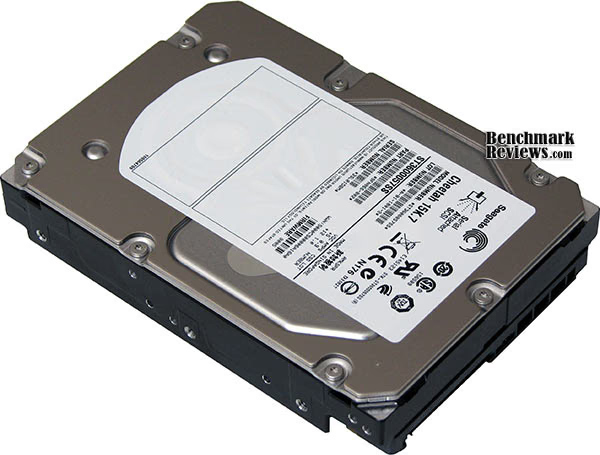
The primary purpose behind the Seagate Cheetah 15K.7 SAS hard drive is to deliver full-time service without failure. Designed to operate at full rotation for every second of every day, the Seagate Cheetah 15K.7 series offers a 5-year product warranty and promises a 1,600,000-hour Mean-Time Between Failure (MTBF). Considering that there are 8,760-hours in a year, the Seagate ST3600057SS could continuously operate full-time for nearly 183 year before expected failure. Considering that flash-based NAND found in Solid State Drive (SSD) products has roughly ten-years of organic shelf life, it would not be realistic to expect any SSD to outlast the Seagate Cheetah series.
Drive Testing Methodology
Comparing a Solid State Disk to a standard Hard Disk Drives is always relative; even when you're comparing the fastest rotational spindle speeds. One is going to be much faster in response time (SSD's), while the other is usually going to have higher throughput bandwidth (HDD's). Additionally, there are certain factors which can affect the results of a test which we do our best to avoid.
Solid State Drives have traveled a long winding course to finally get where they are today. Up to this point in technology, there have been several key differences separating Solid State Drives from magnetic rotational Hard Disk Drives. While the DRAM-based buffer size on desktop HDD's has recently reached 32 MB and is ever-increasing, there is still a hefty delay in the initial response time. This is one key area in which flash-based Solid State Drives continually dominates because they lack moving parts to "get up to speed".
However the benefits inherent to SSD's have traditionally fallen off once the throughput begins, even though data reads or writes are executed at a high constant rate whereas the HDD tapers off in performance. This makes the average transaction speed of a SSD comparable to the data burst rate mentioned in HDD tests, albeit usually lower than the HDD's speed.
EDITORS NOTE: After November 2009 Benchmark Reviews will begin testing storage devices using the Microsoft Windows 7 Operating System. Although the Marvell SATA 6Gb/s (SATA-III) controller is available on select motherboards, our testing indicates that SSD devices perform better on the Intel ICH-10 Southbridge.

SSD Testing Disclaimer
Early on in our SSD coverage, Benchmark Reviews published an article which detailed Solid State Drive Benchmark Performance Testing. The research and discussion that went into producing that article changed the way we now test SSD products. Our previous perceptions of this technology were lost on one particular difference: the wear leveling algorithm that makes data a moving target. Without conclusive linear bandwidth testing or some other method of total-capacity testing, our previous performance results were rough estimates at best.
Our test results were obtained after each SSD had been prepared using DISKPART or Sanitary Erase tools. As a word of caution, applications such as these offer immediate but temporary restoration of original 'pristine' performance levels. In our tests, we discovered that the maximum performance results (charted) would decay as subsequent tests were performed. SSDs attached to TRIM enabled Operating Systems will benefit from continuously refreshed performance, whereas older O/S's will require a garbage collection (GC) tool to avoid 'dirty NAND' performance degradation.
It's critically important to understand that no software for the Microsoft Windows platform can accurately measure SSD performance in a comparable fashion. Synthetic benchmark tools such as HD Tach and PCMark are helpful indicators, but should not be considered the ultimate determining factor. That factor should be measured in actual user experience of real-world applications. Benchmark Reviews includes both bandwidth benchmarks and application speed tests to present a conclusive measurement of product performance.
Test System
-
Motherboard: Gigabyte GA-EX58-UD4P (Intel X58/ICH10R Chipset) with version F9d BIOS
-
Processor: Intel Core i7-920 BX80601920 @ 2.667 GHz
-
System Memory: 6GB Tri-Channel DDR3 1600MHz CL6-6-6-18
-
SAS Adapter: LSI SAS3081E-R Serial Attached SCSI 3.0 GBps PCI-Express
-
Operating System: Windows XP Professional SP-3 (optimized to 16 processes at idle)
Drive Hardware Tested
The following storage hardware has been used in our benchmark performance testing, and may be included in portions of this article:
-
Intel X25-E Extreme SATA-II SLC SSD SSDSA2SH032G1GN
-
OCZ Agility-EX 64GB SATA SLC OCZSSD2-1AGTEX60G (Firmware version 1.31)
-
OCZ Vertex EX 120GB SATA SLC SSD OCZSSD2-1VTX120G (Firmware version 1.20)
-
Seagate Cheetah 15K.6 SAS 450GB 15,000 RPM Hard Drive ST3450856SS (16MB Cache Buffer)
Test Tools
-
ATTO Disk Benchmark v2.34: Spot-tests static file size chunks for basic I/O bandwidth
-
HD Tune Pro v3.5 by EFD Software: Measured random access IOPS and speed
-
Iometer 2006.07.27 by Intel Corporation: Tests IOPS performance and I/O response time
-
EVEREST Ultimate Edition v5.30.1900 by Lavalys: Disk Benchmark component tests linear read and write bandwidth speeds
-
CrystalDiskMark v2.2 by Crystal Dew World: Sequential speed benchmark spot-tests various file size chunks
-
HD Tach RW v3.0.4.0 by Simpli Software: Measures approximate buffered read and write bandwidth speeds
ATTO Disk Benchmark
The ATTO Disk Benchmark program is free, and offers a comprehensive set of test variables to work with. In terms of disk performance, it measures interface transfer rates at various intervals for a user-specified length and then reports read and write speeds for these spot-tests. There are some minor improvements made to the 2.34 version of the program, but the benchmark is still limited to non-linear samples up to 256MB. ATTO Disk Benchmark requires that an active partition be set on the drive being tested.
While the bandwidth results are not realistic for determining the maximum drive speeds, ATTO Disk Benchmark is still a good tool for illustrating bandwidth using various file size chunks. Please consider the results displayed by this benchmark to be basic bandwidth performance indicators.

Our basic I/O bandwidth tests begin with the Seagate Cheetah 15K.7 hard drive connected to the LSI SAS3081E-R Serial Attached SCSI 3.0 GBps PCI-Express SAS adapter, as the ATTO Disk Benchmark tools performs file transfers ranging from 0.5 KB to 8192 KB. The 600GB ST3600057SS model reveals a 204 MBps read plateau from 8-8192 KB file chunks (which is nearly the entire range), while the 203 MBps write performance plateaus from 128-8192 KB.

Drive Hardware
- Intel X25-E Extreme SATA-II SLC SSD SSDSA2SH032G1GN
- Mtron MOBI 3500 64GB 3.5" SATA SSD MSD-SATA3535-064
- OCZ Agility-EX 64GB SATA SLC OCZSSD2-1AGTEX60G (Firmware version 1.31)
- OCZ Vertex EX 120GB SATA SLC SSD OCZSSD2-1VTX120G (Firmware version 1.20)
- Seagate Cheetah 15K.6 SAS 450GB 15,000 RPM Hard Drive ST3450856SS (16MB Cache Buffer)
- Seagate Cheetah 15K.7 SAS 600GB 15,000 RPM Hard Drive ST3600057SS (16MB Cache Buffer)
- Western Digital VelociRaptor 300GB WD3000HLFS 10,000 RPM SATA Hard Disk Drive (16MB Cache Buffer)
In our next section, Benchmark Reviews compares random access IOPS performance among high-end storage devices using HD Tune Pro...
HD Tune Pro Benchmarks
In the past, Benchmark Reviews has avoided HD Tune benchmarks because the software was so similar to others already being used in our articles. However, EFD Software has released several versions of this program, which now adds functionality and features not available in previous revisions. The latest edition of HD Tune Pro allows random access read and write testing, a feature not available to other similar software benchmark tools. HD Tune is a low-level test that will not operate on a drive which contains a partition, so Benchmark Reviews uses DISKPART to prepare hardware and remove any partitions before conducting these tests.
Random Access tests are divided into 512b, 4KB, 64KB, 1MB and random size test files sizes. The Random Access test measures the performance of random read or write operations. The amount of data which will be read varies from 512 bytes to 1 MB. Performance is reported in operations per second (IOPS), average access time, and average speed. Because it is our intent to compare one product against another, Benchmark Reviews has focused on random transfer size IOPS performance.

Benchmark Reviews has tested the 600GB Seagate Cheetah 15K.7 ST3600057SS SAS hard drive against a collection of top-performing Enterprise storage drives for our random IOPS benchmarks. The 4 KB random IOPS performance in HD Tune measured 181 for read IO, and 391 for write. In comparison, the 4KB read IOPS was only slightly better than the WD VelociRaptor SATA hard drive.
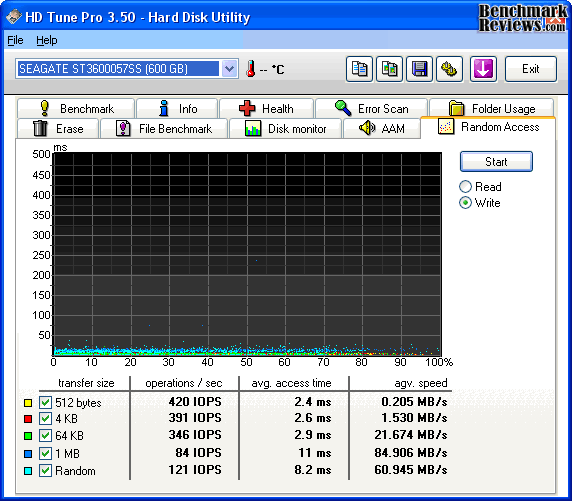
The tight range of IO is an indicator of operational bottlenecks. For example, the WD VelociRaptor WD3000HLFS SATA Hard Disk Drive indicates a read-IOPS range of 10-150 whereas the average SSD might offer 200-1,000. As a direct result, in most cases SSDs will offer a much higher IO over their hard disk counterparts. The random read/write operations per second is charted below:

The OCZ Vertex EX (firmware 1.20) enjoys the benefit of SLC construction that delivers traditionally better IOPS performance than MLC counterparts, and also offers the best measured random IOPS performance of the group with 384 read and 477 write IOPS. The SLC Agility EX produced 346 read and 408 write IOPS while the Intel X25-E Extreme SSD performed well and produced 337 random read IOPS, and 394 write.
Our test results were obtained after each SSD had been prepared using the DISKPART program, and in the case of products using the Indilinx Barefoot controller they were further prepared with the Sanitary Erase application. In our tests, we discovered that the maximum performance results (charted) would decay as subsequent tests were performed. As a word of caution, applications such as Sanitary Erase (SE) and Wiper offer immediate but temporary restoration of original 'pristine' performance levels.
Hard drive performance fared differently, however. The Seagate Cheetah 15K.7 offered the best HDD IOPS performance, producing 118 IO reads, and 121 IO writes. This comes well ahead of the WD VelociRaptor's 82/111, which is Western Digital's 'Enterprise Solution'.
Drive Hardware
- Intel X25-E Extreme SATA-II SLC SSD SSDSA2SH032G1GN
- Mtron MOBI 3500 64GB 3.5" SATA SSD MSD-SATA3535-064
- OCZ Agility-EX 64GB SATA SLC OCZSSD2-1AGTEX60G (Firmware version 1.31)
- OCZ Vertex EX 120GB SATA SLC SSD OCZSSD2-1VTX120G (Firmware version 1.20)
- Seagate Cheetah 15K.6 SAS 450GB 15,000 RPM Hard Drive ST3450856SS (16MB Cache Buffer)
- Seagate Cheetah 15K.7 SAS 600GB 15,000 RPM Hard Drive ST3600057SS (16MB Cache Buffer)
- Western Digital VelociRaptor 300GB WD3000HLFS 10,000 RPM SATA Hard Disk Drive (16MB Cache Buffer)
Benchmark Reviews measures I/O Response Time and IOPS performance using the Iometer tool in our next section...
Iometer IOPS Performance
Iometer is an I/O subsystem measurement and characterization tool for single and clustered systems. Iometer does for a computer's I/O subsystem what a dynamometer does for an engine: it measures performance under a controlled load. Iometer was originally developed by the Intel Corporation and formerly known as "Galileo". Intel has discontinued work on Iometer, and has gifted it to the Open Source Development Lab (OSDL).
Iometer is both a workload generator (that is, it performs I/O operations in order to stress the system) and a measurement tool (that is, it examines and records the performance of its I/O operations and their impact on the system). It can be configured to emulate the disk or network I/O load of any program or benchmark, or can be used to generate entirely synthetic I/O loads. It can generate and measure loads on single or multiple (networked) systems.
Benchmark Reviews has resisted publishing Iometer results because there are hundreds of different configuration variables available, making it impossible to reproduce our tests without having our Iometer configuration file. To measure random I/O response time as well as total I/O's per second, Iometer is set to use 4KB file size chunks over a 100% random sequential distribution. The tests are given a 50% read and 50% write distribution. Our charts show the Read and Write IOPS performance as well as I/O response time (measured in ms). Iometer was configured to test for 120 seconds, and after five tests the average is displayed in our benchmark results. The first tests included random read and write IOPS performance, where a higher I/O is preferred.

In the Random IOPS performance tests the single layer cell (SLC) OCZ Agility EX (3982/3988), Intel X25-E Extreme (3543/3548), and OCZ Vertex EX (3106/3091) outperformed all other products by a wide margin. Current-generation Solid State Drive products offer phenomenal IO performance, which is why every other product thereafter performs far beneath the above-listed products, and are not suggested for highly-intensive input/output applications.
The Western Digital VelociRaptor still fell short on IOPS performance compared with several current-generation SSDs and produced only 134/138 IO's. The Mtron MOBI 3000 performed 107 read and write IOPS, while the Seagate Cheetah 15K.6 and 15K.7 both performed around 120 IOPS each direction. The newer Mtron MOBI 3500 rendered 58 IOPS, which was worse than the older 3000 model. Next comes the average I/O response time tests...

The Iometer random IOPS average response time test results were nearly an inverse order of the IOPS performance results. It's no surprise that SLC drives perform I/O processes far better than their MLC versions, but that gap is slowly closing as controller technology improves the differences and enhances cache buffer space. The Read/Write IOPS performance for the 64GB OCZ Agility-EX SLC SSD was 0.19/0.06 ms, with the Intel X25-E Extreme SSD measuring 0.22/0.06 ms, while the OCZ Vertex EX (firmware 1.20) achieved 0.26/0.06 ms. Both of these premium MLC products share a dramatic lead ahead of the other SSDs tested. These times were collectively the best available, as each product measured hereafter performed much slower.
The Western Digital VelociRaptor did very well compared against SSD products, producing 6.59/0.82ms. The Mtron MOBI 3000 offered a fast 0.42ms read response time, but suffered a slower 8.97ms write response. The opposite was true for the Seagate 15K Cheetah's. The 15K.7 rendered reads at 8.11ms and 0.30ms writes, while the oder 15K.6 scored a 7.90ms read and 0.37 write. Mtron's newer MOBI 3500 offered great read response times at 0.19ms, but suffered poor write responses at 17.19ms.
Drive Hardware
- Intel X25-E Extreme SATA-II SLC SSD SSDSA2SH032G1GN
- Mtron MOBI 3500 64GB 3.5" SATA SSD MSD-SATA3535-064
- OCZ Agility-EX 64GB SATA SLC OCZSSD2-1AGTEX60G (Firmware version 1.31)
- OCZ Vertex EX 120GB SATA SLC SSD OCZSSD2-1VTX120G (Firmware version 1.20)
- Seagate Cheetah 15K.6 SAS 450GB 15,000 RPM Hard Drive ST3450856SS (16MB Cache Buffer)
- Seagate Cheetah 15K.7 SAS 600GB 15,000 RPM Hard Drive ST3600057SS (16MB Cache Buffer)
- Western Digital VelociRaptor 300GB WD3000HLFS 10,000 RPM SATA Hard Disk Drive (16MB Cache Buffer)
In our next section, we test linear read and write bandwidth performance and compare its speed against several other top storage products using EVEREST Disk Benchmark. Benchmark Reviews feels that linear tests are excellent for rating SSDs, however HDDs are put at a disadvantage with these tests whenever capacity is high.
EVEREST Disk Benchmark
Many enthusiasts are familiar with the EVEREST benchmark suite by Lavalys, but very few are aware of the Disk Benchmark tool available inside the program. The EVEREST Disk Benchmark performs linear read and write bandwidth tests on each drive, and can be configured to use file chunk sizes up to 1MB (which speeds up testing and minimizes jitter in the waveform). Because of the full sector-by-sector nature of linear testing, Benchmark Reviews endorses this method for testing SSD products, as detailed in our Solid State Drive Benchmark Performance Testing article. However, Hard Disk Drive products suffer a lower average bandwidth as the capacity draws linear read/write speed down into the inner-portion of the disk platter. EVEREST Disk Benchmark does not require a partition to be present for testing, so all of our benchmarks are completed prior to drive formatting.
Although the Seagate Cheetah 15K.7 hard drive is connected to the LSI SAS3081E-R Serial Attached SCSI 3.0 GBps PCI-Express SAS adapter, all other high-performance storage products tested with EVEREST Disk Benchmark are connected to the Intel ICH10R SATA controller resident on the Gigabyte GA-EX58-UD4P motherboard. Using the 1MB block size, linear read performance of the 600GB Seagate ST3600057SS measured an average 172.1 MBps with a maximum peak of 201.1 MBps. Linear write-to tests were next...

Linear disk benchmarks are superior tools in my opinion, because they scan from the first physical sector to the last. A side affect of many linear write-performance test tools is that the data is erased as it writes to every sector on the drive. Normally this isn't an issue, but it has been shown that partition tables will occasionally play a role in overall SSD performance (HDDs are more mature products and don't suffer this problem). The Seagate Cheetah 15K.7 SAS Hard Drive did well-enough for itself, as shown in the waveform chart below. The Seagate Cheetah 15K.7 SAS hard drive recorded an average linear write-to speed of 138.8 MBps, with a maximum performance of 168.3 MBps.

The chart below shows the average linear read and write bandwidth for a cross-section of other SATA drives attached to the Intel ICH10 Southbridge:

Linear bandwidth certainly benefits the Solid State Drive, since there's very little fluctuation in transfer speed. Hard Disk Drive products decline in performance as the spindle reaches the inner-most sectors on the magnetic platter. I personally consider linear tests to be the single most important comparison of storage drive products, although hard disk drive products decrease performance as they reach the edge of the spindle, SSD products operate at a relatively smooth speed from start to finish.
Drive Hardware
- Intel X25-E Extreme SATA-II SLC SSD SSDSA2SH032G1GN
- Mtron MOBI 3500 64GB 3.5" SATA SSD MSD-SATA3535-064
- OCZ Agility-EX 64GB SATA SLC OCZSSD2-1AGTEX60G (Firmware version 1.31)
- OCZ Vertex EX 120GB SATA SLC SSD OCZSSD2-1VTX120G (Firmware version 1.20)
- Seagate Cheetah 15K.6 SAS 450GB 15,000 RPM Hard Drive ST3450856SS (16MB Cache Buffer)
- Seagate Cheetah 15K.7 SAS 600GB 15,000 RPM Hard Drive ST3600057SS (16MB Cache Buffer)
- Western Digital VelociRaptor 300GB WD3000HLFS 10,000 RPM SATA Hard Disk Drive (16MB Cache Buffer)
In the next section, Benchmark Reviews tests sequential performance using the CrystalDiskMark software tool...
CrystalDiskMark Tests
CrystalDiskMark is a very basic read and write benchmark tool by Crystal Dew World that offers performance speed results using sequential, 512KB random, and 4KB random samples. For our tests, sequential read and write performance was measured using a 1000MB file size, with 50, 100, and 500MB being the other available options. CrystalDiskMark requires that an active partition be set on the drive being tested, and all drives are formatted with NTFS.
Benchmark Reviews uses CrystalDiskMark to confirm manufacturer suggested bandwidth speeds. In addition to our other tests, the sequential read and write benchmarks allow us to determine if the maximum stated speed of any storage product is within reasonable specification. In the chart below illustrated below, our sequential read and write performance speeds are organized from highest to lowest based on total bandwidth.
Enjoying a noticeable lead atop of our sequential performance chart, both the Intel X25-E Extreme (261/206 MBps) and the OCZ Vertex EX Single-Layer Cell SSD (256/182 MBps) followed by the OCZ Agility EX (258/172 MBps) offer the highest read and write bandwidth performance. Keeping pace was the Seagate Cheetah 15K.7 SAS drive, offering 208 MBps read and 207 MBps write. Even though the high-performance VelociRaptor hard drive is made to look low-end by the results charted below, it's actually very encouraging to see that a hard disk can still keep pace with a few SSDs. The WD VelociRaptor offers sequential read and write performance comparable to the Mtron MOBI 3500 and the first-generation OCZ SLC SSD.

Drive Hardware
- Intel X25-E Extreme SATA-II SLC SSD SSDSA2SH032G1GN
- Mtron MOBI 3500 64GB 3.5" SATA SSD MSD-SATA3535-064
- OCZ Agility-EX 64GB SATA SLC OCZSSD2-1AGTEX60G (Firmware version 1.31)
- OCZ Vertex EX 120GB SATA SLC SSD OCZSSD2-1VTX120G (Firmware version 1.20)
- Seagate Cheetah 15K.6 SAS 450GB 15,000 RPM Hard Drive ST3450856SS (16MB Cache Buffer)
- Seagate Cheetah 15K.7 SAS 600GB 15,000 RPM Hard Drive ST3600057SS (16MB Cache Buffer)
- Western Digital VelociRaptor 300GB WD3000HLFS 10,000 RPM SATA Hard Disk Drive (16MB Cache Buffer)
Benchmark Reviews tests and compares buffered transaction speed using HD Tach in the following section...
HD Tach RW Results
Although HD Tach (and also HD Tune or Crystal Disk Benchmark) are all excellent tools for measuring Hard Disk Drive products, they fail to offer the same precision with Solid State Drive products. These programs offer only an approximate estimate of bandwidth speed through their quick-result sample-testing mechanisms, as I have proven in the Solid State Drive (SSD) Benchmark Performance Testing article published not long ago. Nevertheless, HD Tach is still useful for offering an alternative perspective at performance, even if it isn't precisely correct when used with SSD architecture.
HD Tach is a software program for Microsoft Windows that tests the sequential read, random access and interface burst speeds of the attached storage device. For the record. every single product tested was brand new and never used. HD Tach allows write-bandwidth tests only if no partition is present. Additionally, each and every product was tested five times with the highest and lowest results removed before having the average result displayed here. The graphical user interface (GUI) of the Windows-based benchmark tool HD Tach is very convenient. and allows the test product to be compared against others collected on your system or those registered into the Simpli Software database. HD Tach will not test write performance if a partition is present, so all of our benchmarks are completed prior to drive formatting.
In the tests below, Benchmark Reviews utilizes the HD TachRW tool to compare the fastest collection of desktop hard drives and competing SSD's we can get our hands on. Using the Intel ICH10R SATA controller on the Gigabyte GA-EX58-UD4P, HD Tach was used to benchmark the test SSD five times with the best results displayed below. It's important to note that HD Tach's Burst Speed result should be ignored for Solid State Drives due to the cache methods inherent to each memory controller architecture. There are times where this number will be extremely high, which is a result of the optimized cache used for SSD's.
The important numbers used for comparison are the sustained read and write bandwidth speeds, which indicate an approximate performance level of the product. Our featured test item, the 600GB Seagate Cheetah 15K.7 SAS hard drive, performed at an average 178.4 MBps best sustained average read speed and a best average sustained write bandwidth of 159.9 MBps.

The chart below illustrates the collected averages for benchmark results using HD Tach RW on the Intel ICH10 SATA controller, with the read and write bandwidth results added together to determine rank placement. The first group is a collection of high-performance SLC-SSD storage products. With an improved write performance, the SLC Vertex EX finds itself positioned in first place with the Corsair X256, Intel X25-E Extreme, and OCZ Agility EX SSDs both tied for second. Hard disk drive products suffer from linear performance loss, and result in lower scores.

The Seagate Cheetah 15K.7 offers 178/160 MBps, which pulls way ahead of the Western Digital VelociRaptor's 108/99 MBps. Yesterday's high-performance SSD is today's low-performance drive, as the Mtron MOBI 3500 SSD offers less combined performance than Hard Disk Drive alternatives (except in regard to response time).
Drive Hardware
- Intel X25-E Extreme SATA-II SLC SSD SSDSA2SH032G1GN
- Mtron MOBI 3500 64GB 3.5" SATA SSD MSD-SATA3535-064
- OCZ Agility-EX 64GB SATA SLC OCZSSD2-1AGTEX60G (Firmware version 1.31)
- OCZ Vertex EX 120GB SATA SLC SSD OCZSSD2-1VTX120G (Firmware version 1.20)
- Seagate Cheetah 15K.6 SAS 450GB 15,000 RPM Hard Drive ST3450856SS (16MB Cache Buffer)
- Seagate Cheetah 15K.7 SAS 600GB 15,000 RPM Hard Drive ST3600057SS (16MB Cache Buffer)
- Western Digital VelociRaptor 300GB WD3000HLFS 10,000 RPM SATA Hard Disk Drive (16MB Cache Buffer)
Please continue on to the Final Thoughts sections, where the state of SSD testing and Data Storage market sector are put under analysis...
Storage Media Final Thoughts
At some point, the Enterprise sector will eventually succumb to the allure of Solid State Drive technology. IOPS performance and bandwidth speed already favor the SSD. The price barrier is already nearing a break point, and technological advancements will yield long-term longevity as reliable as we've seen it with the Seagate Cheetah 15K.7-series. Nevertheless, we're still a few years from the age of widespread SSDs; even if the popularity of retail desktop SSDs makes it seem otherwise. The Enterprise storage sector will, at some point, belong to Solid State.
New technology always has one major hurdle to face: the consumer. I have long maintained my opinion that DDR3 system memory is every bit an excellent replacement to the aging DDR2 standard, but the argument of high price and limited adoption by manufacturers has hushed my position. Of course, everything changes in time, and an economic recession actually helped DDR3 make its way mainstream. Faced with a similar situation, Solid State Drive technology has suffered the same difficult transition towards widespread use and it's a matter of time before the SSD replaces Hard Disk Drive technology completely. Like most electronics, it wasn't a question of how much of a technology improvement was evident, it was price.
There's no argument that HDDs still capture the capacity-hungry market segment; especially since SSDs cannot compete there. But the premium high-performance desktop storage market is losing patience with Hard Disk Drive technology, and as a result consumers are turning to Solid State Drive technology in large numbers. It's no surprise then that the industries premier names in high-performance HDD technology have also invested in SSD solutions. As of August 2009, the Western Digital SiliconDrive III SSD has been launched, but retail enthusiasm has been very mild. While Western Digital Solid State Storage (official name of SSD division) may have a leg up on Seagate in regard to SSD options for the moment (Seagate has promised to launch their own SSD series in the next month or two), the SiliconDrive series is hardly a threat to more familiar SSD market share leaders like Samsung, Mtron, Intel, and OCZ.
I'll discuss price in a moment, but considering how each new series of SSD product employs greater performance than the one before it, the gray area surrounding SSD performance benchmarks have got me concerned. You might not know this, but SSDs can be very temperamental. In my experience some designs are better for performance benchmarking than others, such as controllers from Mtron, MemoRight, Samsung and Intel; all of which require no special care or attention. JMicron controllers are difficult to test because of an inconsistent range of results, while the Indilinx Barefoot controller seems to really favor 'clean' NAND or they perform well below peak. The reason all of this matter is simple: the performance results reported to consumers in product reviews are often the very best performance numbers possible, and even then, the process to obtain those results isn't the same as real-world usage.
Getting back to price, back in May of 2008 when I reviewed the OCZ SATA-II 32GB SSD it seemed like $17 per gigabyte was a relatively good price for SSD products at the time. Consider for a moment that before then, SSD's such the elite-level 32 GB MemoRight GT cost on the level of $33 per gigabyte. Even products like the entry-level 32 GB Mtron MOBI 3000 were still selling for $14 per gigabyte, making the price of admission seem quite high for even the lower-level SKU's. So when OCZ announced the CORE series SSD tin July of 2008, the new $4/GB price range made SSDs an affordable reality. This event in itself should have probably started the long-awaited dawn of widespread consumer acceptance for SSD products... but there was a problem.
As it turned out, the first generation (v1) OCZ Core Series SSDs I touted in my review was prone to long-term data corruption and occasional delay stuttering. Although OCZ would later issue a second version (v2) of the CORE series, and resolve most problems though firmware updates, a lingering fear of product reliability associated with Solid State Drives remained. Thankfully, now several product generations later, data corruption and read/write delays are virtually non-existent. Now the only problems are price and maintaining peak performance through NAND garbage collection (TRIM).
Once again, everything tends to change over time, and Solid State Drive sale prices are much more affordable compared to their early years. When it comes to computer hardware, generally speaking the newer, faster, and better performing products traditionally cost more than their older predecessors... but oddly enough this is not the case with SSD's. I recognize that the current selection of SSD products on the market right now share a range of bandwidth speeds from abysmal to phenomenal and everywhere in-between, but the prices don't seem to correspond to performance. SSD's are filling store shelves, and several Solid State Drive models now sell for as low as $2.07 per gigabyte, which is getting dangerously close to Western Digital's VelociRaptor at $0.76 per gigabyte of storage. The future is SSD, and the day when HDDs are obsolete is nearing, but there are still a few bumps in the road to navigate.
ST3600057SS Conclusion
Benchmark Reviews begins our conclusion with a short summary for each of the areas that we rate. The first section is performance, which considers how effective the Seagate Cheetah 15K.7 SAS hard drive performs in operations against direct competitor products. For reference, not many other SAS drives exist, and some of the closest competition (the WD VelociRaptor for example) is nowhere near the same level. Because spinning disk media loses performance as in nears the inner-most sectors, it's difficult to compare HDDs to SSDs unless you disregard the linear loss of speed. The 600GB ST3600057SS model offered 201/168 MBps maximum read/write in Everest, followed by 208/207 MBps in Crystal DiskMark, then 199/182 MBps peak speed in HD-Tach, and finally ATTO Benchmark scored 204/203 MBps. Taken in as a whole, the Seagate Cheetah 15K.7 SAS hard drive ST3600057SS appears to perform at an approximate speed of 200 MBps read and 180 MBps write.
There really isn't a lot to be said for the appearance of a hard drive. The Seagate Cheetah 15K.7 is virtually identical to every other 3.5" storage product Seagate offers, and there aren't any stand-out physical features (such as heatsink cradle or transparent window) to make this SAS drive into anything other than it's intended purpose: corporate server storage.
Seagate has had eight years to refine and perfect the Cheetah 15K product line, and as a result the 15K.7 series is probably the best-constructed hard drive in the world. The incredibly-low 0.55% Annualized Failure Rate (AFR) and industry's highest 3.5" drive reliability (1.6-million-hours MTBF) are proof evident that the construction is a direct reflection of Seagate's research. If this isn't enough, there's a full 5-year warranty on all Seagate Cheetah 15K.7 hard drives.
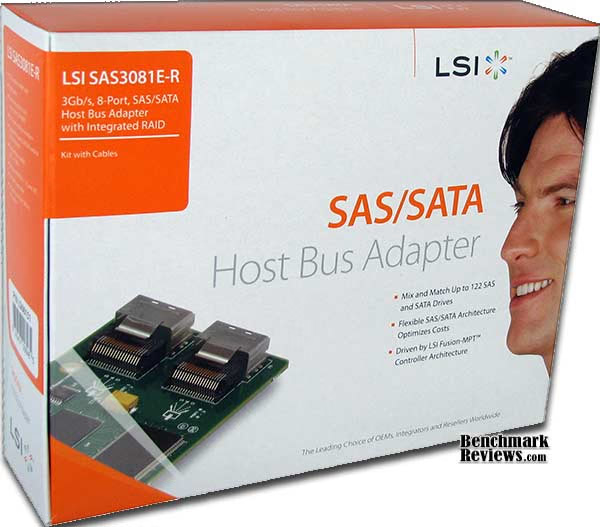
Benchmark Reviews has admittedly focused on desktop-centric tests for this article, and I realize that Enterprise drives strive for reliability above all else. Unfortunately, there's no good way to test for long term failures in a timely manner. The functionality of the Seagate Cheetah 15K.7-series is going to require either a Fibre Channel (FC) or Serial Attached SCSI (SAS) adapter depending on your model, and the LSI SAS3081E-R 3.0 GBps PCI-Express SAS controller card easily updates any desktop motherboard into a converted server. Seagate's PowerTrim feature will certainly get a nod from 'Green'-focused Enterprise environments, while programmable sector ranges can enhance bandwidth speed using a 'short-stroke' method.
As of late October 2009, the Seagate Cheetah 15K.7 SAS hard drive, model ST3600057SS, was found for sale at several online retailers for $649.99 using the Benchmark Reviews price comparison tool. This equates to roughly $1.08/GB of storage space, which is quite affordable considering the uptime reliability and five-year warranty.
In conclusion, the Seagate Cheetah 15K.7 SAS drive has demonstrated a dominance over existing Enterprise storage solutions and improved file transfer speeds at the same time as it saves electrical energy costs. While Seagate's Cheetah is an endangered product line because of fast-encroaching SSD technology, it's not quite extinct. Corporate servers are a long ways from full migration to a yet-unproven long-term Solid State technology, and in the mean time there are few options as good as the 15K.7 series. Fortunately for Seagate, even fewer can compete with the bandwidth performance and lifetime reliability. If your server is mission critical and absolutely must maintain 100% storage uptime, then the Seagate Cheetah 15K.7-series is a the ideal solution.
Pros:
+ Impressive 204 MBps read and 203 write bandwidth with ATTO
+ 5-Year product warranty with advance exchange available
+ 15,000 RPM Spindle speed offers quick transfer response time
+ 600GB Perpendicular Recording Enterprise storage capacity
+ PowerTrim feature conserves energy without compromising performance
+ 5-Year product warranty with advance exchange available
+ 0.55% Annualized Failure Rate / 1.6-million-hours MTBF
+ SAS Interface enable bottleneck-free bandwidth
+ Highest performance and capacity of any Enterprise storage solution
Cons:
- Fast mechanical rotation generates tremendous heat
- May be replaced with SSD technology in the near future
- Considerably low IOPS transaction performance
- Not available with SATA-III 6GBps interface for SOHO servers
Ratings:
-
Performance: 9.25
-
Appearance: 7.75
-
Construction: 9.50
-
Functionality: 9.00
-
Value: 8.25
Final Score: 8.75 out of 10.
Quality Recognition: Benchmark Reviews Silver Tachometer Award.
Questions? Comments? Benchmark Reviews really wants your feedback. We invite you to leave your remarks in our Discussion Forum.
Reader comments from the original article
1 comment were posted before commenting closed. They are preserved as written. Original avatars no longer resolve and are shown as a placeholder.
Oh yeah !!! Manoj Permalink:
ROCK MY WORLD