
Seagate Momentus XT Hybrid ST750LX003
Seagate Momentus XT 750GB Hybrid Drive Review
Manufacturer: Seagate Technology LLC
Product Name: Momentus XT Solid State Hybrid Drive
Model Number: ST750LX003
Price As Tested: $245 MSRP
Full Disclosure: The product sample used in this article has been provided by Seagate
Mechanical hard disk technology has been the traditional standard for decades, refined to the point where it can deliver massive storage capacity beyond 3TB. Recently introduced solid-state drive storage solutions have begun pecking away at the market share thanks to their tremendous speeds and operational performance. Each offers an advantage over the other, leading manufacturers to seek out a hybrid solution that delivers quick access and large data capacity. The original 500GB Seagate's Momentus XT hybrid had the right ingredients, just not enough polish. More than a year later, the Seagate Momentus XT 750GB solid state hybrid drive (SSHD) returns with a double-size 8GB SLC NAND flash SSD buffer fused onto a larger 7200-RPM hard drive. Seagate FAST Factor firmware and Adaptive Memory Technology negate the need for third-party software, and makes this an all-in-one hybrid SSD solution. In this article Benchmark Reviews tests the Seagate Momentus XT (750GB model ST750LX003) in single and RAID-0 configurations against its predecessor, and several of the fastest notebook storage devices available.
The Hard Disk Drive (HDD) technology has enjoyed a long service life in the computer industry, and only recently have Solid State Drive (SSD) storage solutions threatened to replace it. While the HDD offers higher capacity at a better price per Gigabyte, SSDs offer tremendous speeds and operational performance. Seagate believes they've achieved the optimal blend of each, presenting their second-generation solid state hybrid drive. Seagate's Momentus XT 750GB Hybrid relies on an Adaptive Memory technology that works by identifying patterns in how often certain digital data is used, which caches qualified user data access transactions onto the 8GB SSD. We experiment with two Seagate Momentus XT Hybrid drives in a striped RAID-0 array to see just how well Adaptive Memory Technology keeps up. Yet, while the name is Solid State Hybrid Drive (SSHD), the product is really a 'smart' HDD with an extremely large memory buffer.
When SSD storage devices first arrived to market, hardware review websites had to gradually understand the new technology and how to benchmark its performance. Testing SSDs required more preparation than HDD benchmarks, and operational performance was vastly more relevant then traditional transfer speeds. For this purpose, our usual collection of benchmark test-metrics won't paint an accurate picture. ATTO and Iometer will offer traditional measurements, but these performance readings will ignore Seagate's Adaptive Memory algorithm that improves the operation of accessing these programs and not the benchmark results. Repetitive processes will benefit from SSD-like performance, but one-time file transfers and initial application access will be handled by the enhanced hard drive. In addition to traditional HDD/SSD benchmark tests, the Seagate Momentus XT Solid State Hybrid will be used for real-world tasks and compared against the competition.

Bandwidth Speed vs Operational Performance
As we've explained in our SSD Benchmark Tests: SATA IDE vs AHCI Mode guide, Solid State Drive performance revolves around two dynamics: bandwidth speed (MB/s) and operational performance (IOPS). These two metrics work together, but one is more important than the other. Consider this analogy: operational IOPS performance determines how much cargo a ship can transport in one voyage, and the bandwidth speed is how fast the ship moves. By understanding this and applying it to SSD storage, there is a clear importance set on each variable depending on the task at hand.
For casual users, especially those with laptop or desktop computers that have been upgraded to use an SSD, the naturally quick response time is enough to automatically improve the user experience. Bandwidth speed is important, but only to the extent that operational performance meets the minimum needs of the system. If an SSD has a very high bandwidth speed but a low operational performance, it will take longer to load applications and boot the computer into Windows than if the SSD offered a higher IOPS performance.
Closer Look: Seagate Momentus XT
The Seagate Momentus XT Solid State Hybrid Drive looks identical to other 2.5" notebook hard drive storage products, so there's not much to report on the appearance. However, it's the inside of this drive that makes it unique. An 8GB Single-Layer Cell (SLC) NAND flash memory resides near two disk platters, and makes up the drives SSD cache. These platters have an operating rotational speed of 7200 RPM on the 750GB Seagate Momentus XT, and paired to 32MB of DRAM buffer memory. Going forward, Seagate has retired the 250GB and 320 capacities for Momentus XT, but continues to offer the 500GB first-generation version along with the new 750GB second-generation product:
- 500GB Momentus XT - ST95005620AS (first generation)
- 750GB Momentus XT - ST750LX003 (second generation)

Seagate's Momentus XT is best suited for notebook computer installations that fit a 2.5" drive, but this Solid State Hybrid Drive can easily be installed into most desktop systems without the need for any adapter. Seagate Momentus-XT hybrid drives have been designed with a focus on enhancing real-world user experience while maintaining a large storage capacity. Using their refined Seagate Adaptive Memory Technology, the Seagate Momentus XT learns which programs need to be cached onto the SSD all based on actual usage patterns.
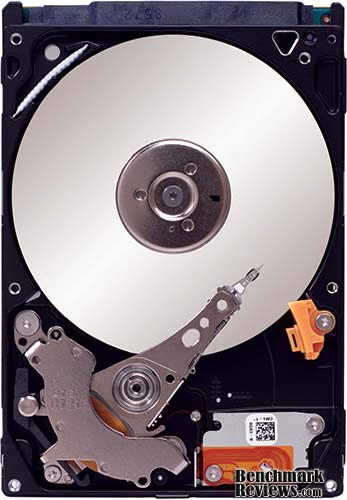
While marketed as a Solid State Hybrid Drive, the Seagate Momentus XT is actually a hard drive first and foremost. This means that if the 8GB SSD cache ever fails, which is unlikely given that its uses single-layer cell (SLC) NAND flash components, the Momentus XT continues to operate as a hard disk drive without any lost data. This could prove critical for those users in need of a less volatile storage solution.

While Momentus XT is more like a hard drive than a SSD, it's still very different than your average hard drive. For example, the WD VelociRaptor features and operating shock (read) value of 65G measured at 2-ms, and non-operating shock of 300G. Conversely, all Momentus XT SSHDs are safe up to 350G's operating shock and 1000G's non-operating.

In the next few sections we test how well the new 2nd-generation 750GB Seagate Momentus XT compares to the 1st-generation 500GB model, as well as other hybrid and solid-state storage solutions. Join us...
SSD Hybrid Features
At the core, Momentus XT is a high-performance 7200RPM drive with 32MB of drive level caching and a SATA 6Gb/s interface. Integrated into the electronics of the drive is 8GB of Single Level Cell (SLC) high- speed NAND flash. Momentus XT features a new technology - Seagate FAST Factor - to synergize the communication and data intelligence between the NAND and rotating media. FAST Factor and Adaptive Memory Technology combine to create a user experience of instant response, instant boot and instant gratification.
FAST Factor Technology
According to Seagate, FAST Factor boot gives laptop users the instant response they need to get moving fast. Booting nearly as fast as an SSD, the Momentus XT drive with FAST Factor boots up to 3 times faster than a traditional 5400RPM drive in a laptop PC. Your boot-up time will never slow you down again. Bottom line: You get up and running faster.
FAST Factor flash management provides seamless integration of hardware, firmware and high-speed NAND flash while maintaining data under all configurations-in any system, using any operating system and with any driver. For fast application loads and overall SSD-like speed of response
from your system, FAST Factor flash management keeps you moving. Bottom line: You get up and running faster with the applications you use most.
Seagate Adaptive Memory
Technology Adaptive Memory technology is a self-learning algorithm designed to deliver SSD-like response from your favorite applications and files. Adaptive Memory selectively copies data that is the most frequently read and time-consuming to retrieve into the flash, giving you an instant-response experience.
Momentus XT Specifications
Specifications
750GB
500GB
Model Number
ST750LX003
ST95005620AS
NAND Type/Size
SLC/8GB
SLC/4GB
Interface
SATA 6Gb/s NCQ
SATA 3Gb/s NCQ
Special Performance Features
FAST Factor Flash Management
Yes
-
FAST Factor Boot
Yes
-
Adaptive Memory Technology
Yes
Yes
Performance
Spindle Speed (RPM)
7200
7200
Cache, Multisegmented (MB)
32
32
SATA Transfer Rates Supported (Gb/s)
6.0/3.0/1.5
3.0/1.5
Seek Average, Read (ms)
11.0
11.0
Seek Average, Write (ms)
13.0
13.0
Configuration/Organization
Heads/Disks
4/2
4/2
Bytes per Sector
4096
512
Reliability/Data Integrity
Head-Rest Method
QuietStep Ramp Load
QuietStep Ramp Load
Load/Unload Cycles
600,000
600,000
Nonrecoverable Read Errors per Bits Read, Max
1 per 10E14
1 per 10E14
Power Management
Power (W)
Seek, Typical
3.3
2.2
Idle, Typical
1.1
0.8
Environmental
Temperature (°C)
Operating
0 to 60
0 to 60
Nonoperating
-40 to 70
-40 to 70
Shock (Gs)
Operating: 2ms
350
350
Nonoperating: 1ms
1000
1000
Acoustics (bels-sound power)
Idle, Typical
2.3
2.3
Seek, Typical
2.6
2.6
Physical
Height (in/mm)
0.370/9.5
0.370/9.5
Width (in/mm)
2.75/69.85
2.75/69.85
Depth (in/mm)
3.951/100.35
3.951/100.35
Weight (lb/g)
0.253/115
0.238/110
Drive Testing Methodology
Solid State Drives have traveled a long winding course to finally get where they are today. Up to this point in technology, there have been several key differences separating Solid State Drives from magnetic rotational Hard Disk Drives. While the DRAM-based buffer size on desktop HDDs has recently reached 64 MB and is ever-increasing, there is still a hefty delay in the initial response time. This is one key area in which flash-based Solid State Drives continually dominates because they lack moving parts to "get up to speed".
However the benefits inherent to SSDs have traditionally fallen off once the throughput begins, even though data reads or writes are executed at a high constant rate whereas the HDD tapers off in performance. This makes the average transaction speed of a SSD comparable to the data burst rate mentioned in HDD tests, albeit usually lower than the HDD's speed.
Comparing a Solid State Disk to a standard Hard Disk Drive is always relative; even if you're comparing the fastest rotational spindle speeds. One is going to be many times faster in response (SSDs), while the other is usually going to have higher throughput bandwidth (HDDs). Additionally, there are certain factors which can affect the results of a test which we do our best to avoid.
Test System
- Motherboard: ASUS P8P67 EVO (Intel P67 Sandy Bridge Platform, B3 Stepping)
- Processor: Intel Core i7-2600K 3.4 GHz Quad-Core CPU
- System Memory: 16GB Kingston DDR3 1600MHz CL6-6-6-18
- 4GB RAM-Disk partition from system memory
- SATA 6Gb/s Storage HBA: Integrated Intel P67 Controller
- AHCI mode - Intel Rapid Storage Technology Driver 10.1.0.1008
- SATA 3Gb/s Storage HBA: Integrated Intel P67 Controller
- AHCI mode - Intel Rapid Storage Technology Driver 10.1.0.1008
- Operating System: Microsoft Windows 7 Ultimate Edition 64-Bit with Service Pack 1
- No page file allocated to virtual memory
Storage Hardware Tested
The following storage hardware has been used in our benchmark performance testing, and may be included in portions of this article:
- OCZ RevoDrive Hybrid RVDHY-FH-1T MLC PCI SSD (Firmware 1.15)
- OCZ Vertex 3 VTX3-25SAT3-240G 240GB MLC SATA SSD (Firmware 1.15)
- Seagate Momentus XT 500GB SATA SSHD ST95005620AS
- Seagate Momentus XT 750GB SATA SSHD ST750LX003
- Western Digital Caviar Black 750GB 7200RPM SATA HDD
Benchmark Software
- AS SSD Benchmark 1.6.4067.34354: Multi-purpose speed and operational performance test
- ATTO Disk Benchmark 2.46: Spot-tests static file size chunks for basic I/O bandwidth
- Futuremark PCMark 7: Primary Storage Suite tests real-world drive performance
Test Results Disclaimer
This article utilizes benchmark software tools to produce operational IOPS performance and bandwidth speed results. Each test was conducted in a specific fashion, and repeated for all products. These test results are not comparable to any other benchmark application, neither on this website or another, regardless of similar IOPS or MB/s terminology in the scores. The test results in this project are only intended to be compared to the other test results conducted in identical fashion for this article.
AS-SSD Benchmark
Alex Schepeljanski of Alex Intelligent Software develops the free AS SSD Benchmark utility for testing storage devices. The AS SSD Benchmark tests sequential read and write speeds, input/output operational performance, and response times. Because this software receives frequent updates, Benchmark Reviews recommends that you compare results only within the same version family.
For the purpose of testing Solid State Hybrid Drive (SSHD) products, we've concentrated more on transfer speeds and less on 4K IOPS. After running several sequential read and write benchmarks to cache the test, the Seagate Momentus XT 750GB reported consistent results that appeared to rely on hard disk performance. After ten cache tests, the Seagate Momentus XT hybrid drive continued producing a 102.26 MB/s read and 97.71 MB/s write speed.

Seagate Momentus XT 750GB Solid State Hybrid Drive
Combining two Seagate Momentus XT 750GB Solid State Hybrid Drives into a striped RAID-0 array yields much faster sequential speeds: 213.65 MB/s read and 216.77 MB/s write. These results are slight more than double the performance of a single Momentus XT SSHD, which will make our other tests much more interesting to compare.

RAID-0 Seagate Momentus XT 750GB Solid State Hybrid Drives
The chart below is sorted by total combined sequential performance, which illustrates the differences in basic read/write speeds:

In the next section, Benchmark Reviews tests transfer rates using ATTO Disk Benchmark.
ATTO Disk Benchmark
The ATTO Disk Benchmark program is free and offers a comprehensive set of test variables to work with. In terms of disk performance, it measures interface transfer rates at various intervals for a user-specified length and then reports read and write speeds for these spot-tests. There are some minor improvements made to the 2.46 version of the program that allow for test lengths up to 2GB, but all of our benchmarks are conducted with 256MB total length. ATTO Disk Benchmark requires that an active partition be set on the drive being tested. Please consider the results displayed by this benchmark to be basic bandwidth speed performance indicators.

Seagate Momentus XT 750GB Solid State Hybrid Drive

RAID-0 Seagate Momentus XT 750GB Solid State Hybrid Drives
Bandwidth speed tests begin with the Seagate Momentus XT attached to the motherboard's native Intel P67-Express SATA 6Gb/s port. Using the ATTO Disk Benchmark tool, the test drive performs file transfers ranging from 0.5 KB to 8192 KB. After several caching runs followed by restarts, the single 750GB Seagate Momentus XT revealed 115 MBps maximum read speed that plateaus from approximately 8-8192 KB file chunks, and 116 MBps peak write bandwidth plateaus from 32-8192 KB. The chart below illustrates how the Seagate Momentus XT compares:

In the next section we utilize PCMark 7 to test real-world storage performance...
PCMark 7 System Storage Test
PCMark is an objective hardware performance benchmark tool for PCs running 32- and 64-bit versions of Microsoft Windows Vista or Windows 7. PCMark 7 is well suited for benchmarking any type of Microsoft Windows Vista/7 PC: from multimedia home entertainment systems and laptops, to dedicated workstations and high-end gaming rigs. Benchmark Reviews has utilized the System Storage test suite to demonstrate simulated real-world drive performance in this article.
PCMark runs several drive tests, each with a specific purpose. Once the benchmarking tests have completed, all of the results are combined into a PCMark score, while optional detailed results illustrate actual transaction speeds. After several cache runs and system restarts, the Seagate Momentus XT hybrid drive produced its best System Storage test score of 3216 with PCMark 7:

Seagate Momentus XT 750GB Solid State Hybrid Drive

RAID-0 Seagate Momentus XT 750GB Solid State Hybrid Drives
Our tests were conducted on an Intel P67-Express Sandy Bridge motherboard using the onboard SATA 6Gb/s controller and 8x PCI-Express bus with 64-bit Windows 7. Overall results are displayed in the chart below:

Switching from synthetic to real-world benchmark tests, the next section times Windows 7 boot-up to determine how well these hybrid storage solutions cache data.
Windows 7 Boot-Up Times
One of the primary claims that Seagate makes for its Momentus XT series is improved Windows start times, which we put to the test in this section. According to Seagate, the 2nd-generation 750GB Momentus XT "can cut your system start-up time by up to 65% over a traditional HDD". Our tests allowed the system to reboot ten times to ensure O/S files were cached to the drive before testing began. To normalize our results, the timer started at the POST screen and ended when the Windows 7 desktop appeared. This removed the additional time specialized controllers added (for RAID devices), which initialized prior to displaying the POST screen.
Analyzing the results helps to show how well Seagate Adaptive Memory Technology functions, which appears to significantly improve start-up times with the new 750GB Momentus XT model over a standard hard disk drive. Two 750GB Momentus XT solid state hybrid drives assembled into a RAID-0 array matched boot times with the premium OCZ Vertex 3 SSD, but were only one second faster than a single standalone hybrid drive. One SATA-based 750GB Momentus XT SSHD processed the Windows 7 start-up routine a second faster than the OCZ RevoDrive Hybrid PCI-Express storage solution, which is impressive considering the price difference.

In the final test section, we compare real-world file transfer performance with the Seagate Momentus XT 750GB Solid State Hybrid Drive...
Compressed File Transfers
Synthetic benchmark tools are very useful, but sometimes it helps to reproduce real-world tasks; our file transfer test does exactly that. The goal of this test was to measure write time to the test drive, using three 1GB compressed files. Since we wanted to ensure our source drive was faster than all the destination drives tested, we utilized a RAM-Disk partition based on the a 4GB portion of the 16GB Kingston DDR3 installed in the system.
Each file weighed exactly 1GB (1073741824 bytes) after maximum GZip ultra compression, and three of these files were transferred from the source to destination all at once. This process was completed ten times on each hybrid drive to ensure caching algorithms were given every opportunity; however this was an unnecessary step as write-to file transfer functions are not cached. The results were consistent with every test, with the transfer time illustrated in the chart below:

Based on our results, file transfer speeds will depend on the media written to. In the case of hybrid drives that media is the hard disk, which benefits more from the integrated DRAM buffer than any logic-controlled SSD cache. The SSD performed file transfers fastest, followed by the RAID-0 combination of Momentus XT SSHDs. Beyond these two stand-out storage solutions, results were very similar.
In the next section I share my conclusion and share the final product rating.
Seagate Momentus XT Conclusion
IMPORTANT: Although the rating and final score mentioned in this conclusion are made to be as objective as possible, please be advised that every author perceives these factors differently at various points in time. While we each do our best to ensure that all aspects of the product are considered, there are often times unforeseen market conditions and manufacturer changes which occur after publication that could render our rating obsolete. Please do not base any purchase solely on our conclusion, as it represents our product rating specifically for the product tested which may differ from future versions. Benchmark Reviews begins our conclusion with a short summary for each of the areas that we rate.
Our performance rating considers how effective the Seagate Momentus XT 750GB Solid State Hybrid Drive (model ST750LX003) performs against directly competing storage solutions. In our benchmark tests, the 750GB Seagate Momentus XT SSHD delivered 115/116 MBps peak read/write speeds using ATTO Disk Benchmark, while the RAID-0 set increased bandwidth to 231/215 MBps. These results confirm that random (synthetic) benchmark tests utilize the SSHDs hard disk drive, and that tests are not buffered to the SSD cache.
When we switched to real-world tests, such as the Windows boot time, file transfer, and PCMark 7 tests, Seagate FAST Factor firmware and Adaptive Memory Technology really helped Momentus XT shine. In these tests, especially Windows boot time and file transfer, the second-generation Momentus XT SSHD outperformed the PCI-Express hybrid solution and surpassed hard disk performance. While a single Momentus XT will be sufficient for more super-users, enthusiasts can overcome limited hard disk speeds by joining two of these drives together into a RAID-0 array.
Seagate has come a long way with the Momentus series, and the benchmarks show a maturity in hybrid technology. Judging by the pace of development, it won't be long before the Momentus XT matches SSD performance in every task - not just what's cached. I'll agree that 8GB is a solid start, but eventually this SSD cache will need to grow beyond 32GB to really achieve what solid state drives can already do.

2.5" Notebook drives are low-visibility products: you see them just long enough to install and then they're forgotten. Like their Hard Disk Drive counterparts, Solid State Hybrid Drives (SSHD) are meant to place function before fashion. Anything above and beyond a simple metal shell is already more than what's expected in terms of the appearance, but unfortunately the Seagate Momentus-XT looks the part of 'strictly business'. Unlike many of the colorful brushed-aluminum enclosures we've seen for SSDs, the Momentus XT looks like most other notebook HDDs.
Construction is generally a strong point for solid state drive products, and the Seagate Momentus XT SSHD is no exception. While not quite up to the 1500-G shock resistance that most SSDs enjoy, the Seagate Momentus XT does boast a 539% higher operating shock tolerance than the WD VelociRaptor. Touting a five-year warranty helps to position the Seagate Momentus XT ahead of most other storage products, especially SSDs that often offer a basic 1-year warranty. Seagate delivers industry-leading quality and construction in all of their products, and the hybrid-performance/high-capacity Momentus XT series is the end-result of years of proven industry experience.
My value rating is going to work a bit differently than previous articles, and there's good reason for this. When this drive was originally delivered, the MSRP was set at $189. After suffering warehouse floods in Thailand a few weeks ago, that launch price then soared to $245. I've got reservations with how well the 750GB Momentus XT carries value at this new price, compared with an actual SSD. Ultimately the consumer (you) will have to make this decision for yourself.
I really like where the Seagate Momentus XT series is heading, because I firmly believe all-in-one hybrid storage solutions are the future... at least until NAND flash components can cost as much as mechanical counterparts. Multi-part hybrid solutions with 3rd party software, such as those currently promoted by the competition, are hardly a match for integrated hybrid products like Momentus XT. Now grown to offer 750 Gigabytes of storage capacity, the new second-generation Seagate Momentus XT is offering the best of both worlds better than anyone else.
Pros:
+ All-in-one Hybrid storage solution does not require software
+ Outperforms PCI-Express hybrid solutions in boot and file transfers
+ Seagate Adaptive Memory tech buffers data for SSD responsiveness
+ 5-Year full Seagate product warranty
+ Large 750GB hybrid storage capacity
+ Extremely high HDD operational shock durability
+ Supports Native Command Queuing and SMART
+ SSD Failure does not effect preserved HDD data
+ 3rd-Generation SATA 6Gb/s compliant
Cons:
- Lacks comparable IOPS operational performance to SSDs
- Expensive hybrid storage solution (post-facility flooding)
- Hard disk would benefit from 64MB DRAM buffer
Ratings:
- Performance: 9.25
- Appearance: 7.50
- Construction: 9.50
- Functionality: 9.25
- Value: 8.25
Final Score: 8.5 out of 10.
Quality Recognition: Benchmark Reviews Silver Tachometer Award.
Benchmark Reviews invites you to leave constructive feedback below, or ask questions in our Discussion Forum.
Reader comments from the original article
21 comments were posted before commenting closed. They are preserved as written. Original avatars no longer resolve and are shown as a placeholder.
dependable realneil Permalink:
I have one of these in the 500GB size. I've had it for a long time and it has proven to be reliable and it's fast. This new one with double the Cache size of mine is probably a nice performer, and if the price had not blown so far out of proportion because of the flooding, would be a must have. Your observation that at least a 32GB size Cache or larger 64GB would improve it is spot on. I'd love to own a few of them with a large Cache.
Hmmm...I'm not convinced. Mergatroid Permalink:
I would say this was better than a hard drive by itself. I've been using an SSD as my boot drive for about a year now and I love it. I am using a regular hard drive for my applications. I could see a hybrid being pretty good for a replacement application drive if the capacity was larger, even though reading files that are not used so much would be no faster than my current hard drive. As for a storage drive, I don't think these would be suitable at all since storage is just for storing and not for reading the same files over and over reducing the number of times you would read something that was actually in the cache. I'll stick with my SSD for a system drive which is always fast, not just under some conditions. Adding more RAM would increase the price of a drive like this to the point where one might as well purchase an SSD. The only real advantage I see to a hybrid drive is that, as it gets closer to being filled up, you should still get the same transfer rates unlike some SSDs. Also, you don't have to purposefully leave some empty space for trash collection and wear leveling. I try and keep my SSD under 60% capacity to try and increase its longevity, something you shouldn't have to worry about with a hybrid. So I could completely understand anyone installing one of these in a laptop computer. It would give you the fast system you would get with an SSD (most likely) while having a larger less expensive overall capacity as compared to an SSD. Definitely an interesting idea. However, now you're convinced me to go out and purchase a second SSD for my desktop system drive and set it up in a RAID 0.
RE: Hmmm...I'm not convinced. Olin Coles Permalink:
I honestly don't think SSD owners will ever feel the difference with two of them in RAID-0, but it can't hurt. I wrote a RAID-0 SSD article not that long ago: /index.php?option=com_content&task=view&id=513
Almost double transfer rate Mergatroid Permalink:
Using an artificial benchmark on the RAID 0 I just set up with two 60GB SATA II SSDs (Corsair and Patriot). I was getting 246 MB/s on a fresh install of the Patriot Inferno SSD, and now with a fresh install on the RAID 0 I'm getting 461MB/s using HD tune. My boot time has gone from just over 20 seconds to just over 10 seconds after post. I'll learn more as I use it more but so far I am experiencing a significant performance increase. You can go onto other forums around the 'net and talk to people using SSD RAIDs. So far so good for me.
falls short ddll Permalink:
For a 3rd generation effort, this is pretty disappointing. I expected it to be closer to SSD performance levels, like other SSD hybrid/cache solutions on the market. Once again, this just looks like a souped up HDD at a $200 premium! Not holding my breath, but let's hope Gen4 can hit the mark.
RE: falls short Olin Coles Permalink:
I'm not sure which 'other' hybrid solutions you're referring to, since only one can reach SSD levels and it's an expensive PCI-E device.
RE: falls short ddll Permalink:
I think the best thing going for Momentus XT is that its simplicity. It's really just a Hard Drive with built-in DRAM and NAND caches. I don't see how they can charge so much for so little added performance, no matter how much the memory components cost. If they doubled the cache again, would it would perform better? (I suspect it's really a matter of software and architecture)
RE: Seagate Momentus XT Hybrid ST750LX003 dlb Permalink:
Honestly, I haven't read the entire review yet, but I had the 500gb hybrid installed in a laptop a few months back, and I can truly say that the laptop booted slower, and overall performance was slower than laptops with std non-SSD's. I was stunned at how slow the hybrid drive was! This was with 4gb DDR2, Vista 64bit, and a dual core Turion (which isn't a great CPU, I know), but it was a slower laptop than a single core Celeron with 2gb DDR and 32bit Vista with an 80gb SATA drive.... since then, I've stayed away from the hybrids. However, maybe reading this review in its entirety will change my thoughts on hybrid drives.
RE: RE: Seagate Momentus XT Hybrid ST750LX003 Olin Coles Permalink:
That's odd. Even without the cached data, the drive still operates like a regular 7200RPM hard drive. It should always be faster than any other hard drive, but not as fast as SSDs. Also, keep in mind the algorithm takes 4-5 times before it caches the data to SSD.
Senior Software Engineer JMSigler2 Permalink:
I think your investigation and generalization is off the mark. I own the Gateway P-173 XL FX and the Gateway P-7805u FX laptops. Both computers have dual-bay SATA II ports, and each computer has BIOS and hardware supporting RAID. These FX laptops were high-end machines, a line I believe is no longer offered since the buy out of Gateway by Acer. I have purchased and installed the Seagate Momentus XT 500GB drives with 4GB of SSD on each. I set my systems to RAID-0. The benchmark test I used for comparison: Gateway P-7805u with Seagate Momentus XT 500GB drives in RAID-0 versus stardard 7200rpm drives with no SSD also in RAID-0. The application tested was the loading of Visual Studio Professional 2005 or 2008. My results, having a 2.2Ghz processor found that first launch of Visual Studio after a cold boot took 52 seconds. With the Seagate Momentus XT 500GB drives my first launch time after a cold boot took 11 to 12 seconds. I then shut down these applications and restarted the applications. My Gateway P-7805u with 8GB of DRAM had restart times with Visual Studio of about 10 to 12 seconds with the conventional drives and 2 to 3 seconds with the Seagate Momentus XT 500GB drives. I use this application all the time, so this program became well cached by the SSD or my DRAM. I have also tried some additional tests in using a Secure Digital Card (Type=SDHC) with ReadyBoost; the big argument there is that with RAM prices as they are, the benefits of Class 10 SD Cards ( or USB Thumb Drives ) cards diminish with greater RAM capacities, especially after a program has been loaded once into RAM. The biggest benefit, of course, is load times from the initial launch of an OS or application. And, one could see benefits where games exceed the size of RAM space available on the computer. Paging code to memory from SSD, flash or solid state memory should outweigh that of a conventional hard disk. With prices dropping to where SSD 500GB drives are about 400 dollars and the Seagate Momentus XT 750GB 7200rpm Hybrid Hard Drives (HHD) are now about 140 dollars ( and one could consider conventional 10000rpm drives ), the analysis and comparison of these options is getting to be more about storage space on one side versus reliability and overall performance on the side than it is squarely about price.
Software RAID-0, 2 x Hybrids? Greg Zeng Permalink:
"# Almost double transfer rate ? Mergatroid 2011-12-01 18:54 Using an artificial benchmark on the RAID 0 I just set up with two 60GB SATA II SSDs (Corsair and Patriot). I was getting 246 MB/s on a fresh install of the Patriot Inferno SSD, and now with a fresh install on the RAID 0 I'm getting 461MB/s using HD tune. My boot time has gone from just over 20 seconds to just over 10 seconds after post. I'll learn more as I use it more but so far I am experiencing a significant performance increase." Back on topic - RAID-0 for two of these 750 GB hybrid drives? On my top-of-the-line Hp Pailion notebook, it has 2 conventional drives, but no hardware RAID controller. As well as W&-64bit, I run several Ubuntu booting choices. So in Linux or Apple IOS, i could run software RAID-0. Curious if it has ever been attempted before ...
RE: Software RAID-0, 2 x Hybrids? Olin Coles Permalink:
I would not recommend software RAID of any sort, but most especially RAID-0. The overhead is tremendous, and the cost on performance often outweighs any benefits.
Haven't tried software raid Mergatroid Permalink:
The new ASUS board I'm using has hardware raid built in. It was a real pleasure to set up and has given me a fair performance boost. However, I haven't tried a software raid myself and cannot comment on how the overhead may effect performance. Both RAID 0 I have had experience with myself have been hardware. One final note. If you have SATA III SSD I think the speed of the SSD would be so high that it may not be worth the bother of using a RAID 0. In fact, with two SATA III SSDs I would be tempted to set up a (hardware) RAID 1 considering they should be fast enough for any performance hits to have minimum effect. It's hard to say how a RAID 0 would affect these hybrid drives. You would think it would give you a performance improvement for data not contained in the cache.
RE: Seagate Momentus XT Hybrid ST750LX003 Ryan Permalink:
Would I see much improvement with one of these in my 2011 mac mini if I already have 8gb of ram installed?
RE: RE: Seagate Momentus XT Hybrid ST750LX003 Olin Coles Permalink:
You would see faster start-up, and your programs would open faster.
Seagate Momentus XT Hybrid ST750LX003 Emran Permalink:
Got it on my MBP 13 and compared with my son's MBP 15 on SSD, boot up just a tad slower compared to the SSD, but everything feels snappy on the Macbook. I going to get MBP 17 and will put in the 750GB on day 1. This solution works great on notebooks since you have only 1 drive option (unless you forgo the optical). So you have very fast drive and spacious too.
500 GB SSD versus Seagate Momentus XT 7200rpm HHD (750GB HD with 8GB SSD) JMSigler2 Permalink:
This is where I find myself comparing the market. The price differential is close enough now that I question myself as to whether I should commit to a lower price and higher storage capacity, or commit to higher price with better reliability and overall performance. Personally, I am also thinking about cheap 2.5? 1TB 5400rpm drives as a backup solution for the 500GB(x2) SSD solution or going to the Seagate Momentus XT 750GB drives (x2) with higher capacity space and higher SSD cache of 8GB per drive, than the 500GB first generation drives had with 4GB SSD per drive, also then switching my drive solution to RAID-1 (Mirroring) instead of RAID-0 (stripping) where I can forget about the need for backup drives. One other think I am thinking about is the new mSATA mini SATA SSD drives that now match full size SSD drives of 6Gbps. Check out these two links. ##mydigitaldiscount.com/solid-state-drives-msata-ssd/?&sort=alphaaz&sort_direction=0&xsearch_e12=256GB ##mydigitaldiscount.com/msata-ssd-compatability-list.html If every penny count and you are on a tight budget, then this Seagate Momentus XT Hybrid ST750LX003 drive is a great solution for the price. I do think the full and mini SATA SSD drives will force conventional and hybrid drives down even further to where they will amost become obsolete. However, I have found research that SSD drives on average have about 2 million read write operations before they fail. To my knowledge, data cannot be recovered from an SSD. On the other hand, with a little bit of money, you can have data recovered from conventional hard drives. In this way, some might say that a hybrid hard drive offers a combination of performace enhancement and residual data recovery opportunity, should you fail to backup your data regularly. So this drive is good food for thought.
RE: 500 GB SSD versus Seagate Momentus XT 7200rpm HHD (750GB HD with 8GB SSD) David Ramsey Permalink:
Your research on SSDs is incomplete/incorrect. Current multi-level cell devices support an effectively infinite number of read cycles and 2,000-5,000 write cycles. The ARM-based controllers use sophisticated wear-levelling software to spread the load around the individual flash memory chips; and most SSDs are "over provisioned" (i.e. they have more actual memory than their capacity states) so that data in write-failing blocks can be moved. When enough flash memory chips on the SSD fail to write, it becomes a "read only" device. At least that's the theory. Although consumer SSDs have been on the market for several years now, I haven't heard of this happening yet. Data recovery from a failed drive should never be a consideration-- that's what backups are for. Companies like DriveSavers do offer SSD data recovery, though, should you need it.
SSD and MTBF JMSigler2 Permalink:
I stand corrected on the read operations. I over generalized. I should have referred only to write operations. Also, yes, any drive usually put to market has extra space so failing blocks can be moved or marked for non-use. One thing I found on conventional drives with RAID is that if a block or cluster fails, then all drives in the RAID are marked as a bad cylinder. You have also taught me something new about a failing SSD device becoming a read-only device. I have never experienced a failing SSD, so I will have to take your word on this. I concur with you on Data Recovery and backups, but Murphy's law still lives; any extra safety net never hurts. Thanks for the added input.
so what to buy? Paul Permalink:
an intel 835 SSD at 256GB or a seagate momentus XT? with 7500 RPM an
RE: so what to buy? Olin Coles Permalink:
It depends. If you want the drive for storing files, the hybrid wins. If you're running the OS and programs from it, then the SSD is best.