
Mushkin Redline Enhanced 2133MHz DDR3 Memory
Mushkin Enhanced Redline 2133Mhz DDR3 Memory
Manufacturer: Mushkin Enhanced
Product Name: Redline
Model Number: 966996
Price As Tested: $145.99 at Amazon
Full Disclosure: The product sample used in this article has been provided by Mushkin Enhanced.
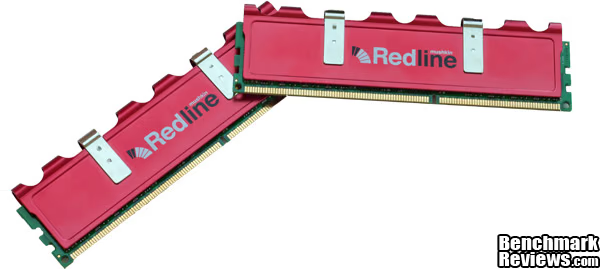
Started in 1994 Mushkin Enhanced has been well received for years by enthusiasts for their RAM's overclocking ability and sharp aesthetics. Mushkin has many different lines ranging from their Essentials for budget conscious consumers all the way to their Redline series which utilizes the cream of the crop integrated circuits to get the fastest speed possible with tight timings. The Redline series has been well received by overclockers and building on this is Mushkin Enhanced's high performance memory for the Intel's P67 chipset. Rated at 2133Mhz with 9-11-10-28 timings this Redline kit also utilizes Mushkin's proprietary Frostbyte heat spreader. Benchmark Reviews will see if this kit is worth the extra money for its high speed or if users are better off going with a lower speed but less expensive kit.
Years ago using the fastest possible memory was the only way to get the full potential out of a processor. This is because in the days before Sandy Bridge getting the highest clock possible was achieved using a combination of changing the clock multiplier, and increasing the FSB or base clock. Because changing these also increased the base speed of the memory using the fastest memory possible was only the only way to push a processor to its upper limits. But things have changed since the Sandy Bridge platform debuted, the only effective way to overclock is to increase the clock multiplier of the K SKU's meaning that memory speed is less important for overclocking and therefore companies are concentrating on dropping prices, and timing to compete with each other. As prices have dropped, users have started demanding more RAM for their systems. Mushkin's Redline has been a well-received product for many years and now they have updated their Redline series to be compatible with Intel's newest P67 chipset. This means that each kit of memory has a speed that is divisible by 266.6Mhz so as to provide optimum speed in a user's system.
Benchmark Reviews wants to be able to provide the most accurate information on the performance of components to its readers and therefore has a very specific way in which tests are run on components. For RAM, each set is run first run through Memtest86+ at its advertised speed to insure that that there are no errors. Once passed a combination of pure benchmark based, and application based tests will be run a total of three times each. Once the results have been acquired the worst score of each test will be thrown out and the final two will be averaged resulting in the final score that will be presented to our readers.
Mushkin Enhanced Redline 2133Mhz Specifications
| Type | DDR3 |
|---|---|
| Voltage | 1.65V |
| Speed Spec | PC3-17000 |
| Frequency | 2133Mhz |
| Kit Type | Dual Kit |
| Module Size | 4GB |
| tCL | 9 |
| tRCD | 11 |
| tRP | 10 |
| tRAS | 28 |
| Heatsink | FrostByte |
Closer Look: Mushkin Enhanced Redline 2133Mhz
Unlike cases, the aesthetics of RAM will not be something that a user will need to deal with on a daily basis. This means a user can pick the ugliest piece set of ram they can find and as long as it has the same timing, and speed will perform just as well as a tricked out set of RAM. None-the-less enthusiast with Plexiglas windows on their case may want RAM that goes along with the color scheme being used in their system.
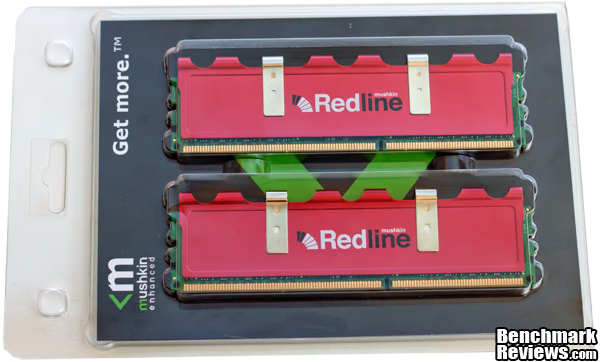
Mushkin Enhanced uses a fairly typical blister pack for their storage and transport of the Redline 2133Mhz kit . On the back Mushkin Enhanced has provided information on installing these in your system. Also included is Mushkin Enhanced's marketing information and how to contact them.
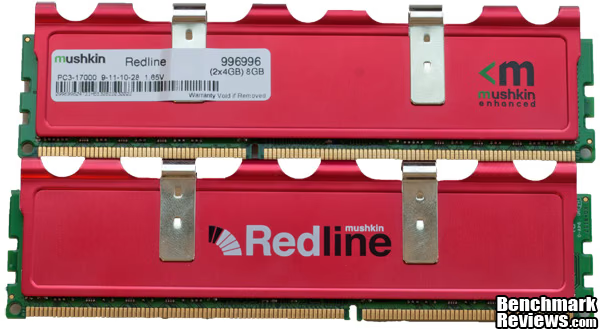
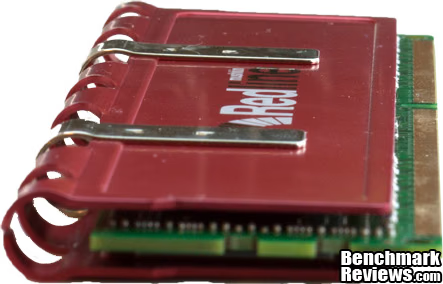
Mushkin Enhanced has created a very beautiful kit of memory that utilizes their proprietary Frostbyte heat spreader. To help with cooling on each of the Redline's heat spreaders clips are used, these are designed to provide as much pressure as possible against the IC's and therefore will help increase their cooling performance. At the same time the design of the heat spreader is designed to create air disturbances to help increase the heat transfer. Even better at 1.45" these are short enough to easily fit under any of the aftermarket CPU heatsinks that are on the market at the moment.
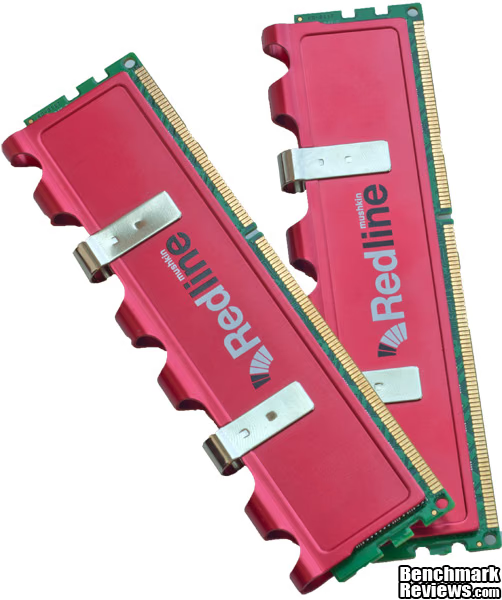
With a nicely finished exterior this Redline kit has a metallic red exterior with no blemishes and a minimalistic logo that does not look overly flash or gaudy.

Unlike other companies Mushkin does not use a decipherable model number and therefore the only use for this is as a reference number when looking for an identical set of memory for a later upgrade.
RAM Testing & Results
Testing Methodology
When testing RAM the preferred method is to remove as many bottlenecks as possible. This ensures that any changes in the benchmarks are dependent on the RAM that is being tested as much as possible. For this reason no games have been included because at the moment games are far more dependent on computers GPU's and CPU's, rather than their memory subsystems. Instead the tests used will be focused on being more memory intensive tasks such as fluid dynamics simulations, compression, and real-time rendering. These benchmarks will be run alongside traditional benchmarking tests that will scale more effectively with speed but will be an unrealistic indication of real world performance.
In order to test each RAM kit in the most effective fashion a multistep process was required. First in order to verify the advertised speed each set of RAM they will be initially run the Memtest86+ for one run. Once no errors are found, Windows 7 Professional 64-bit with all of the need tools will be loaded. In order to make sure that fluctuations in other subsystem do not influence the scores, each test will be run a total of three times. At the end of the benchmark the lowest score will be dropped and the final two tests scores will be averaged. The test being used for benchmarking will be as follows. 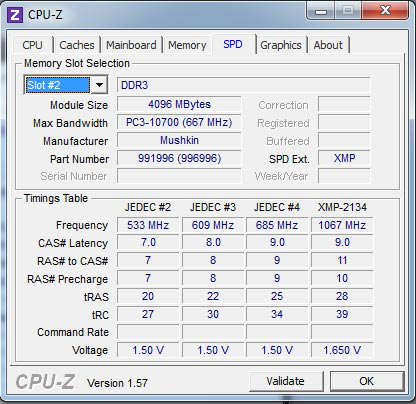
- MaxxMEM2
- SiSoft Sandra Light 64-bit
- AIDA64
- PCMARK Vantage
- WinRAR
- CINEBENCH R11.5
- Euler 3D
Test System
-
Motherboard: MSI P67-GD65
-
System Memory: 2 x 4GB G.Skill Ripjaw 1600Mhz
-
Processor: Core i5 2500k 3.3Ghz @ 4.7Ghz
-
Video: ASUS GTX 580
-
Disk Drive 1: Patriot Inferno 60GB
- Disk Drive 2: 2 x 1TB Seagate 7200RPM RAID 0 Array
- Disk Drive 3: 1 x 500GB Seagate 7200RPM
-
Optical Drive: DVD Burner
-
Enclosure: Silverstone Raven RV02-EW
-
PSU: OCZ GamerXStream 700w
-
Monitor: ASUS 27.5" 1920x1200
-
Operating System: Windows 7 64-bit Professional
Memory Test
- G.Skill Ripjaw 1600Mhz 9-9-9-24 F3-12800CL9D-4GBRL (2 x 4GB Kit)
- G.Skill Sniper 1866Mhz 9-10-9-28 F3-14900CL9D-8GBSR (2 x 4GB Kit)
- Corsair Vengence 1866Mhz 9-10-9-28 CMZ8GX3M2A1866C9 (2 x 4GB Kit)
- Mushkin Enhanced Redline 2133Mhz 9-11-10-28 Model 996999 (2 x 4GB Kit)
- Mushkin Enhanced Redline 1600Mhz 7-9-8-24 Model 996982 (2 x 4GB Kit)
Also because each IC produced is slightly different and will have different overclocking characteristics any overclocking results obtained may vary from user's actual experience. In the end this means that spending the time to overclock our system memory will be unbeneficial to our readers and therefore will be omitted from the results except for in special cases, such as when a product is advertised as having a great amount of headroom.
We have recently introduced the Euler3D Computational Fluid Dynamics benchmark into our memory test suite and so I would like to give a small explanation as to what is being used. Our newest test simulates the fluid dynamics of a wing and therefore is very memory and CPU intensive. Each test is run and the final result is given in Hertz(Hz). For our purposes the final Hertz score is what will be used for comparing each set of memory to its competitors. It has been found that this benchmark is particularly sensitive to both memory speed and timing and therefore makes a perfect benchmark to add to Benchmark Reviews memory suite.
Synthetic Benchmarks
Benchmark Reviews users synthetic benchmarks to more effectively show difference between the hardware being tested. These tests are very sensitive to the most minor changes and therefore can highlight the performance difference that exist between different sets of RAM.

AIDA64 provides a memory benchmarking tool that scales well with speed but unfortunately does not respond nearly as well to tightening timings. Because of this the Redline 2133Mhz kit skyrockets ahead of the competition with a read speed of 23963.5MB/s. This is 18% higher than our 1600Mhz 9-9-9-24 kit which benchmarked at 19668MB/s, and 10% faster than our 1866Mhz 9-10-9-28 which came in at 21746.5MB/s.

One of our newest benchmarking applications MaxxMEM2 provides results that are more responsive to speed changes rather than tightening of timings. At 24601MB/s Mushkin Enhanced's Redline 2133Mhz kit performance 18.3% better than our 1600Mhz 9-9-9-24 kit which could only muster 20116MB/s of bandwidth at the read benchmark.

Using STREAM SiSoft's Sandra provides a near linear performance increase as the speed of RAM increases. At 27.465GB/s the Redline 2133Mhz kit blows away the competition with a 24.5% increase in bandwidth compared to our 1600Mhz 9-9-9-24 kit and 13% more bandwidth compared to our 1866Mhz 9-10-9-28 kit.
Application Benchmark
Application benchmarks are a look at real world performance of the memory being tested. During this review we will be employing a combination of rendering, compression, and simulation to see how timing and speed of memory affects their performance.

Much like games that use DirectX or OpenGL to render their scenes CINIBENCH sees very little in gain by using higher performance RAM. The difference in performance between the Redline 2133Mhz 9-11-10-28 and our 1600Mhz 9-9-9-24 kit is within our 1% margin of error. This is because the CINEBENCH OpenGL test is reliant on the video subsystem which bottlenecks well before our memory subsystem has a chance to affect our test.

Using the benchmarking tool that was built into WinRAR 4.00 we were able to effectively gauge how many kilobytes per second our test bed was able to compress. WinRAR is responsive to speed and timings and as such the Redline 2133Mhz 9-11-10-28 kit outperformance the second best Redline 1600Mhz 7-7-7-24 kit by 5% with a compression speed of 4506kB/s compared to 4315kB/s.

The speed of Euler 3D simulation is obviously sensitive to both speed and timings. As such the Redline 2133Mhz surges ahead of the competition and leads with a 4.7% performance increase over our Redline 1600Mhz 7-7-7-24 kit at 6.02Hz compared to 5.742Hz. Even more impressive compared to our high latency 1600Mhz 9-9-9-24 kit we see a 14% boost in performance increasing from 5.1825Hz.
Mushkin Enhanced Redline 2133Mhz Final Thoughts
For enthusiasts RAM is an important component in getting every sliver of performance out of their system. Fortunately for those users Mushkin Enhanced has just what they need with their Redline 2133Mhz 9-11-10-28 kit. It provides 24.5% more bandwidth in our SiSoft's Sandra memory benchmark compared to the 1600Mhz 9-9-9-24 kit. Real world this translates to an 11% boost in compression performance when compared to the same kit. At the same time utilizing the Frostbyte heat spreader this kit looks great in users system and will easily fit under even the largest of coolers with its 1.45" size. This all comes wrapped up in a beautiful red finish that looks great in a multitude of systems. Just adding to this is the fact that Mushkin Enhanced stands behind this kit enough to provide a lifetime warranty if things were to ever go belly up.
Unfortunately the Mushkin Enhanced Redline 2133Mhz kit is not perfect. While running our Memtest86+ against the memory at the speeds specified by the XMP profiles we ran into problems in the form of massive amounts of error. This was easily rectified by keeping the same timings but loosening the command rate from 1T to 2T. I understand that this kit is running right at the edge of what Intel's P67 chipset can handle so your mileage may vary, still it was disconcerting to see this.
Mushkin Enhaned Redline 2133Mhz Conclusion
Needless to say the Redline 2133Mhz 9-11-10-28 kit performs great. It easily stayed ahead of its competition in each of the benchmarks it was given both synthetic and real world. Although this will not be perceivable in gaming other applications such as photo editing, compression, and simulation will show benefit in using this very quick kit of memory.
The Redline 2133Mhz 9-11-10-28 kit with Mushkin Enhanced's proprietary Frostbyte heat spreader looks great. This heat spreader is then covered in great looking, well done, and perfectly finished coat of metallic red paint. It all comes together to make a very slick looking package that looks great in a enthusiests system.
The Redline 2133Mhz kit is well built with each stick of memory having a decent amount of heft to it. This ends up giving off the impression that this kit is designed to last, and apparently Mushkin Enhanced feels the same way providing a lifetime warranty to owners of this kit.
Functionality is all about being able to perform at the specified speed and timing set by the manufacture. Unfortunately the Redline 2133Mhz 9-11-10-28 kits falls slightly short of this because it is unable to perform at the specified XMP profile using a 1T command rate without being very unstable and throwing out all kind of errors within Memtest86+. This can be rectified by increasing the command rate to 2T. Still it should be on the mind of those buying this RAM that running at the edge of what the P67 chipset is designed to handle may require some manual settings in order to get system stability.
When compared to the sub $60 8GB kits on the market the Redline 2133Mhz 9-11-10-28 kit is expensive at $145.99 at Amazon. Still compared to days of old when prices of RAM where down right outrageous the fact that we are paying less than $200 for 8GB kit of memory that is rated at over 2133Mhz is acceptable. To top it off you get a lifetime warranty with it something that many people would be willing to pay for.
For users wanting to get every last bit of performance out of their P67 system I would easily recommend the Mushkin Enhanced Redline 2133Mhz 9-11-10-28 kit. It provides solid performance, while looking great, and users will be able to rest assured that they will be taken care of with the lifetime warranty that Mushkin Enhanced provides with this kit. In the end we award Mushkin Enhanced's Redline 2133Mhz 9-11-10-28 kit the Benchmark Reviews Golden Tachometer for outstanding performance.
Pros:
+ Top our charts for performance on the P67 chipset
+ Great looking appearance
+ Short enough to fit under most heatsinks
+ Lifetime Warrrenty
+ Well priced for a 2133Mhz kit
Cons:
- Had to loosen command rate from 1T to 2T to pass Memtest 86+
- Gaming will not see a benefit from the extra bandwidth
Ratings:
-
Performance: 9.75
-
Appearance: 9.25
-
Construction: 9.50
-
Functionality: 8.00
-
Value: 9.00
Final Score: 9.1 out of 10.
Questions? Comments? Benchmark Reviews really wants your feedback. We invite you to leave your remarks in our Discussion Forum.
Reader comments from the original article
15 comments were posted before commenting closed. They are preserved as written. Original avatars no longer resolve and are shown as a placeholder.
WHY NOT USE NEW AMD SETUP? James Smith Permalink:
Why didn't You use the new AMD A8-3850 APU set up? It probably could have used the extra bandwidth in Gaming ,etc?
Why realneil Permalink:
^~Why didn't you test it at 47MPH in a Bentley with Grey Poupon spread all over it?~^ I have 16GB of this RAM in my newest i7-2600K build. I'm not over clocking it all, (yet) but I find it to be quite stable for me using the XMP Profile. But,.....my GSKill branded DDR3-1600 gives me the same experience (or 'feel') when gaming with my i7-870 system. I bought this Mushkin because many people were crowing about it in reviews here and there, but I don't think it's necessary unless you're trying to break records.
RE: Why Austin Downing Permalink:
Thank you Neil, I didn't test it in a new AMD system because I do not have a new AMD system. More importantly just as many people will be buying a new Intel system and perhaps they would have liked to see their performance differences. The world does not revolve around you. All of my other kits have been very stable. I am even running a 16GB of 1866Mhz in my 4.7Ghz 2500k system. (my daily computer I might add) But once you start getting to the highest speed that SB is designed to take it is understandable to have some problems.
Déjà Vu realneil Permalink:
I'm a mod on another hardware site and I see "Why didn't you" posts all of the time. People sometimes don't realize that it's hard to get a hold of samples for testing purposes. If you say something negative about a product, the manufacturer will sometimes lock you out, and stop sending you any samples to test, just to 'punish' you. Unless you have very deep pockets, it's hard to test it all, every time.
RE: Why Olin Coles Permalink:
@James: If we provide you with the shipping address for our staff, would you kindly donate the new AMD A8-3850 APU to them? I promise they'll use it in all of their testing.
RE: Mushkin Redline Enhanced 2133MHz DDR3 Memory James Smith Permalink:
Hey Austin , If You are going to be a Reviewer on a REVIEW site ,Maybe You should get both an AMD and Intel system , Thanks for trying to make it a personal attack on me , I'll be unsubscribing to reward You for that! #GFY
RE: RE: Mushkin Redline Enhanced 2133MHz DDR3 Memory Olin Coles Permalink:
@James: since you've unsubscribed, I doubt you'll be reading this. However, in the event you're still curious, consider that perhaps your thankless comment was an attack on his work, and a rather selfish request on top of that. Hardly anyone has the latest platforms, so we test for the largest segment of the enthusiast population.
RE: Mushkin Redline Enhanced 2133MHz DDR3 Memory James Smith Permalink:
Say Olin , Big Time REVIEW Sites (Apparently this isn't one of them) have Intel and AMD "lend" them a system to test components on OR they Buy One.For example, have You seen "Tom's Hardware" review website?, they are very professional ,they don't personally attack readers for offering constructive advice and they don't beg readers for computers to test on.
RE: RE: Mushkin Redline Enhanced 2133MHz DDR3 Memory Austin Downing Permalink:
So you want to compare us to Tom's Hardware do you? Good thing I read most of the major tech sites out there so I can compare our articles. First article from Tom's Hardware using only P67 ##tomshardware.com/reviews/corsair-vengeance-crucial-ballistix-kingston-hyperX,2907.html Second Article only using a P55 system. ##tomshardware.com/reviews/dual-channel-ram-ddr3-4gb,2618-6.html Third Article only using a P55 System ##tomshardware.com/reviews/8gb-ddr3-ram,2542-7.html What was that about using both systems on Tom's Hardware you where talking about?
RE: Mushkin Redline Enhanced 2133MHz DDR3 Memory James Smith Permalink:
I'll bet Tom's Hardware will do a follow up with AMD hardware ,they are very good at that AND Again they don't personally attack readers for constructive advice. GOOD-BYE!
don johnson don jonson Permalink:
nerd rage........oh the lolz
RE: don johnson Olin Coles Permalink:
Yep. I especially loved how James compared Benchmark Reviews with Tom's Hardware. Little does he know that BmR is about a dozen enthusiasts who work without manufacturer bias, and Tom's is an international corporation with a dozen offices across the globe and huge advertising contracts.
details? Billy Beaker Permalink:
where are the SPD ratings? where are the XMP ratings? what about testing with 1.5v at lower speeds? seems like this is seriously lacking
Wrong data salmanshah Permalink:
The image provided are of gskill Rams. /index.php?option=com_content&task=view&id=771&Itemid=23&limit=1&limitstart=4
RE: Wrong data Olin Coles Permalink:
Huh? The link is ALSO from a G.Skill review. I'm not sure why you're posting on a different review.