
OCZ Octane SATA 6 Gb/s Indilinx Everest SSD
OCZ Octane Indilinx Everest SSD Review
Manufacturer: OCZ Technology Group, Inc.
Product Name: Octane Solid State Drive
Model Number: OCT1-25SAT3-512G (512GB)
Prices: 128GB $199 (Newegg / Amazon), 256GB $370 (Newegg / Amazon), 512GB $900 (Newegg / Amazon)
Full Disclosure: The product sample used in this article has been provided by OCZ.
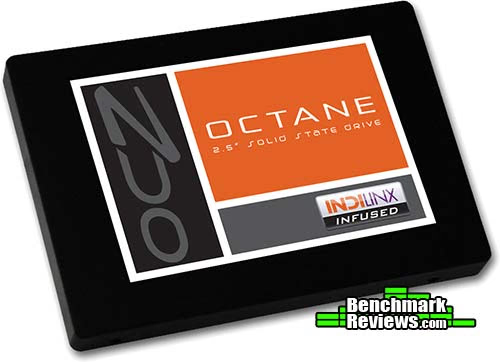
Nearly one year since acquiring well-known flash controller manufacturer Indilinx, OCZ has debuted their first storage product based on the Indilinx infused Everest platform with NDurance technology: welcome OCZ's Octane SSD. Offered in 1-terabyte capacities, the OCT1-25SAT3 series is designed to deliver optimized performance for mainstream users wanting to capitalize on near-instant solid state response times. OCZ Octane SSDs are good for up to 480MB/s read speeds over the latest SATA 6 Gb/s interface, and yield up to 35,000 Random Read IOPS. In this article Benchmark Reviews tests these specifications, and compares the OCZ Octane solid state drive to the leading competition.
For those keeping up with the Indilinx Everest platform SSD controller, OCZ's announcement back in July (2011) listed one particular stand-out feature: a 275 MHz dual-core CPU with 128KB on-chip SRAM for programs and another 64KB for data. Up to that point (and since), there hadn't been another dual-core SSD on the market. Even the 512MB DDR2/DDR3 cache buffer operating at 400 MHz raised expectations. It was anybody's guess as to how much a dual-core SSD controller would impact performance, but the potential was at least there on paper. Since the OCZ Octane series features this very same Everest technology, we'll soon see what these features amount to for end-users.
Solid State vs Hard Disk
Despite decades of design improvements, the hard disk drive (HDD) is still the slowest component of any personal computer system. Consider that modern desktop processors have a 1 ns response time (nanosecond = one billionth of one second), while system memory responds between 30-90 ns. Traditional hard drive technology utilizes magnetic spinning media, and even the fastest spinning mechanical storage products still exhibit a 9,000,000 ns / 9 ms initial response time (millisecond = one thousandth of one second). In more relevant terms, the processor receives the command and must then wait for system memory to fetch related data from the storage drive. This is why any computer system is only as fast as the slowest component in the data chain; usually the hard drive.
In a perfect world all of the components operate at the same speed. Until that day comes, the real-world goal for achieving optimal performance is for system memory to operate as quickly as the central processor and then for the storage drive to operate as fast as memory. With present-day technology this is an impossible task, so enthusiasts try to close the speed gaps between components as much as possible. Although system memory is up to 90x (9000%) slower than most processors, consider then that the hard drive is an added 1000x (100,000%) slower than that same memory. Essentially, these three components are as different in speed as walking is to driving and flying.
Solid State Drive technology bridges the largest gap in these response times. The difference a SSD makes to operational response times and program speeds is dramatic, and takes the storage drive from a slow 'walking' speed to a much faster 'driving' speed. Solid State Drive technology improves initial response times by more than 450x (45,000%) for applications and Operating System software, when compared to their mechanical HDD counterparts. The biggest mistake PC hardware enthusiasts make with regard to SSD technology is grading them based on bandwidth speed. File transfer speeds are important, but only so long as the operational IOPS performance can sustain that bandwidth under load.
Bandwidth Speed vs Operational Performance
As we've explained in our SSD Benchmark Tests: SATA IDE vs AHCI Mode guide, Solid State Drive performance revolves around two dynamics: bandwidth speed (MB/s) and operational performance (IOPS). These two metrics work together, but one is more important than the other. Consider this analogy: bandwidth determines how much cargo a ship can transport in one voyage, and operational IOPS performance is how fast the ship moves. By understanding this and applying it to SSD storage, there is a clear importance set on each variable depending on the task at hand.
For casual users, especially those with laptop or desktop computers that have been upgraded to use an SSD, the naturally quick response time is enough to automatically improve the user experience. Bandwidth speed is important, but only to the extent that operational performance meets the minimum needs of the system. If an SSD has a very high bandwidth speed but a low operational performance, it will take longer to load applications and boot the computer into Windows than if the SSD offered a higher IOPS performance.
Closer Look: OCZ Octane SSD Series
Solid state drives have gained quick popularity with performance-minded consumers because they work equally well in PC, Linux, or Apple computer systems. Likewise, they install quite easily into both desktop and notebook platforms without modification. The OCZ Octane SSD Series is best suited for performance-orientated users, giving personal computers a much faster response time and boosting productivity. OCZ Octane SSDs are designed with a focus on consumer-level performance features, such as high operational transactions and fast data transfer speeds. Additionally, OCZ's Indilinx-Infused architecture includes automatic AES encryption for secure data protection, and improved NAND wear-leveling through their proprietary Indilinx Ndurance NAND flash compression technology.
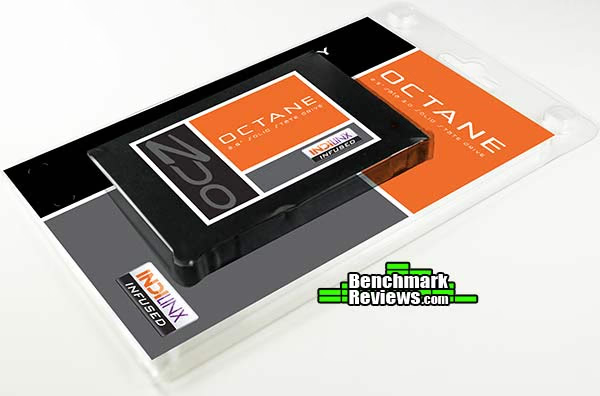
For this article Benchmark Reviews is testing the 512GB OCZ Octane SSD, which is specified to reach sustained speeds of 480 MB/s for sequential reads and 330 MB/s sequential writes. OCZ specifies 4K random writes up to 26,000 IOPS and random reads up to 35,000 IOPS, for 61,000 combined IOPS performance. All OCZ Octane SSDs feature a 512MB DDR3 DRAM cache buffer, which assists in the speedy transfer of data to NAND flash components and yields a near-instant 0.06ms response time. The 512GB model we received for testing is built using 25nm synchronous Intel-Micron MLC NAND flash components. OCZ Technology offers several capacities for the OCZ Octane series of solid state drives: 128GB, 256GB, 512GB, and 1TB (yet to be released). All models share the same part numbers with a capacity designator: OCT1-25SAT3-512G stands for 512GB.
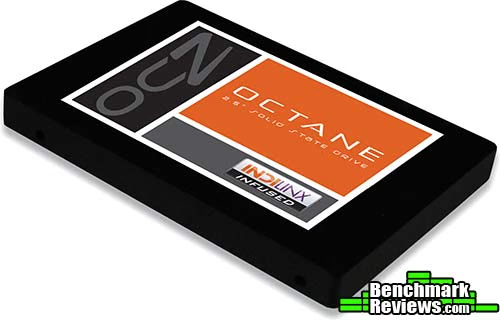
The OCZ Octane SSD chassis is finished in black, with a brushed aluminum underside. Once installed the SSD is usually hidden away from view, which explains why OCZ has maintained a conservative appearance on the Octane solid state drive. Both halves of the enclosure are made of metal, with a textured semi-gloss finish on the top panel and metal finish on the bottom. Standard 2.5" drive bay mounting points are pre-drilled into the SSD chassis with fine screw threading, allowing this drive to fit directly into notebook computers that use SATA connections. The SSD mounting positions matched up to the drive bracket on my notebook computer, and after only a few minutes of upgrading I was booting from a restored Windows 7 System Backup Image with ease. Optionally, by using a 3.5" to 2.5" tray adapter (not included) this SSD will also install directly into ATX desktop computers.
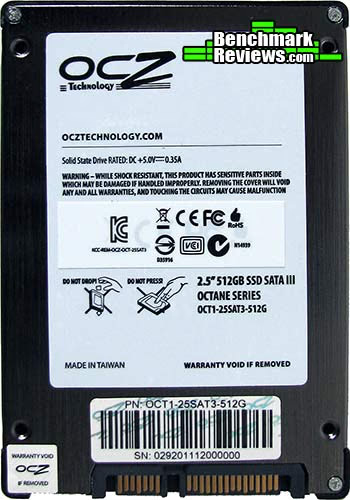
Unlike fragile Hard Disk Drive (HDD) storage products, SSDs are not nearly as sensitive to impact damage and do not require (or benefit from) any kind of special vibration dampening or shock-proof enclosures. OCZ utilizes a standard two-piece metal enclosure for their Octane-series SSDs, which reveals the internal components after removing four small counter-sunk screws located along the sides of this solid state drive. OCZ Technology offers a three-year warranty on all Octane SSD storage products.

At the heart of OCZ's Octane SSD is the Marvell-based 275 MHz dual-core Indilinx Everest controller, which is branded with part number IDX300M00-BC, and comes with 128KB on-chip SRAM for programs and another 64KB for data. Backwards compatible with SATA 1.5 GB/s and 3.0 GB/s interfaces, this SATA 6.0 GB/s controller includes standard features such as Native Command Queuing (NCQ), S.M.A.R.T. health monitoring, and TRIM-based garbage collection. Marvell-based Everest SSD controllers all offer BCH error correcting capable of 70 bits correction per 1KB of data.
In the next few sections we'll test the OCZ Octane solid state drive, comparing this solid state drive to other retail products intended for notebook and desktop installations.
OCZ Octane SSD Series Features
Combining high-speed data transfer rates with record-breaking access times, OCZ Octane SSDs are designed to provide a superior user experience and improved application performance. Octane leverages the cutting-edge Indilinx Everest platform and is optimized for the complete spectrum of file types and sizes, with proprietary page mapping algorithms mirroring real world conditions across a wide range of applications.
The Octane series also includes advanced features unique to Indilinx, including latency reduction technology to enhance system responsiveness and enable instant-on boot-ups, and proprietary NDurance technology to increase the lifespan of the NAND flash memory and minimize performance degradation. In addition, Octane drives support AES and automatic encryption to secure critical data, bringing unique enterprise features within the reach of enthusiasts. Octane SSDs also deliver the energy efficiency, durability, and reliability that traditional hard drives cannot provide.
Octane Series are available in 128GB to 1TB capacities and come backed by a 3-Year warranty.

OCT1-25SAT3 Specifications
- Available in 128GB, 256GB, 512GB, and 1TB capacities
- Interface: SATA 6Gbps / Backwards Compatible 3Gbps
- 512MB Onboard Cache
- Indilinx Infused
- TRIM Support
- Background Garbage Collection Support
- Boot Time Reduction Optimization
- AES and Automatic Encryption
- SMART Support
- Proprietary Indilinx Ndurance Technology
- Low-Latency Seek Time: 0.06ms Read; 0.09ms Write
- Slim 2.5" Design
- 99.8 (L) x 69.63 (W) x 9.3 mm (H)
- Lightweight: 83g
- Operating Temp: 0°C ~ 70°C
- Ambient Temp: 0°C ~ 55°C
- Storage Temp: -45°C ~ +85°C
- Low Power Consumption: 1.98W active,1.15W standby
- Shock Resistant up to 1500G
- RAID Support
- MTBF: 1,250,000 hours
- 3-Year Warranty
- Compatible with Windows XP, Vista, 7 (32/64 bit), Linux, Mac OSX
128GB Max Performance*
- Max Read: up to 470MB/s
- Max Write: up to 210MB/s
- Random Write 4KB: 18,000 IOPS
- Random Read 4KB: 35,000 IOPS
256GB Max Performance*
- Max Read: up to 480MB/s
- Max Write: up to 310MB/s
- Random Write 4KB: 25,000 IOPS
- Random Read 4KB: 35,000 IOPS
512GB Max Performance*
- Max Read: up to 480MB/s
- Max Write: up to 330MB/s
- Random Write 4KB: 26,000 IOPS
- Random Read 4KB: 35,000 IOPS
1TB Max Performance*
- Max Read: up to 470MB/s
- Max Write: up to 330MB/s
- Random Write 4KB: 25,000 IOPS
- Random Read 4KB: 35,000 IOPS
*Performance specifications reflect update to current firmware version
SSD Testing Methodology
Solid State Drives have traveled a long winding course to finally get where they are today. Up to this point in technology, there have been several key differences separating Solid State Drives from magnetic rotational Hard Disk Drives. While the DRAM-based buffer size on desktop HDDs has recently reached 64 MB and is ever-increasing, there is still a hefty delay in the initial response time. This is one key area in which flash-based Solid State Drives continually dominates because they lack moving parts to "get up to speed".
However the benefits inherent to SSDs have traditionally fallen off once the throughput begins, even though data reads or writes are executed at a high constant rate whereas the HDD tapers off in performance. This makes the average transaction speed of a SSD comparable to the data burst rate mentioned in HDD tests, albeit usually lower than the HDD's speed.
Comparing a Solid State Disk to a standard Hard Disk Drives is always relative; even if you're comparing the fastest rotational spindle speeds. One is going to be many times faster in response (SSDs), while the other is usually going to have higher throughput bandwidth (HDDs). Additionally, there are certain factors which can affect the results of a test which we do our best to avoid.
SSD Testing Disclaimer
Early on in our SSD coverage, Benchmark Reviews published an article which detailed Solid State Drive Benchmark Performance Testing. The research and discussion that went into producing that article changed the way we now test SSD products. Our previous perceptions of this technology were lost on one particular difference: the wear leveling algorithm that makes data a moving target. Without conclusive linear bandwidth testing or some other method of total-capacity testing, our previous performance results were rough estimates at best.
Our test results were obtained after each SSD had been prepared using DISKPART or Sanitary Erase tools. As a word of caution, applications such as these offer immediate but temporary restoration of original 'pristine' performance levels. In our tests, we discovered that the maximum performance results (charted) would decay as subsequent tests were performed. SSDs attached to TRIM enabled Operating Systems will benefit from continuously refreshed performance, whereas older O/S's will require a garbage collection (GC) tool to avoid 'dirty NAND' performance degradation.
It's critically important to understand that no software for the Microsoft Windows platform can accurately measure SSD performance in a comparable fashion. Synthetic benchmark tools such as HD Tach and PCMark are helpful indicators, but should not be considered the ultimate determining factor. That factor should be measured in actual user experience of real-world applications. Benchmark Reviews includes both bandwidth benchmarks and application speed tests to present a conclusive measurement of product performance.
Test System
- Motherboard: ASUS P8P67 EVO (Intel P67 Sandy Bridge Platform, B3 Stepping)
- Processor: Intel Core i7-2600K 3.4 GHz Quad-Core CPU
- System Memory: 4GB Dual-Channel DDR3 1600MHz CL6-6-6-18
- SATA 6Gb/s Storage HBA: Integrated Intel P67 Controller
- AHCI mode - Intel Rapid Storage Technology Driver 11.7.0.1013
- SATA 3Gb/s Storage HBA: Integrated Intel P67 Controller
- AHCI mode - Intel Rapid Storage Technology Driver 11.7.0.1013
- Operating System: Microsoft Windows 7 Ultimate Edition 64-Bit with Service Pack 1
Storage Hardware Tested
The following storage hardware has been used in our benchmark performance testing, and may be included in portions of this article:
- Crucial RealSSD-C300 CTFDDAC256MAG-1G1 256GB SATA 6Gb/s MLC SSD
- Intel X25-E Extreme SSDSA2SH032G1GN SATA SLC SSD
- Intel SSD 311 Series Larson Creek SSDSA2VP020G2E
- Intel SSD 320 Series MLC Solid State Drive SSDSA2CW160G3
- Intel SSD 520 Series MLC Solid State Drive SSDSC2CW240A3
- OCZ Agility OCZSSD2-1AGT120G 120GB SATA MLC SSD
- OCZ Agility 2 'Extended' OCZSSD2-2AGTE120G 120GB MLC SSD
- OCZ Agility 3 AGT3-25SAT3-240G 240GB MLC SSD
- OCZ Octane OCT1-25SAT3-512G 512GB MLC SSD
- OCZ RevoDrive OCZSSDPX-1RVD0120 120GB MLC PCI-Express SSD
- OCZ RevoDrive X2 OCZSSDPX-1RVDX0240 240GB MLC PCI-E SSD
- OCZ RevoDrive3 X2 RVD3X2-FHPX4-480G 480GB MLC PCI-E SSD
- OCZ Vertex OCZSSD2-1VTX120G 120GB SATA SSD
- OCZ Vertex Turbo OCZSSD2-1VTXT120G 120GB SATA SSD
- OCZ Vertex 2 'Extended' OCZSSD2-2VTXE120G 120GB MLC SSD
- OCZ Vertex 3 VTX3-25SAT3-240G 240GB MLC SSD
- OCZ Vertex 3 Max IOPS VTX3MI-25SAT3-240G MLC SSD
- Patriot Torqx 2 PT2128GS25SSDR 128GB MLC SSD
- Seagate Momentus XT Hybrid ST750LX003 750GB SSHD
- Seagate Barracuda-XT ST32000641AS 2TB 7200RPM SATA 6Gb/s Hard Drive
- Western Digital VelociRaptor WD3000HLFS 300GB 10,000 RPM SATA Hard Disk Drive
- WD SiliconEdge-Blue SSC-D0256SC-2100 256GB SATA SSD
Test Tools
- AS SSD Benchmark 1.6.4067.34354: Multi-purpose speed and operational performance test
- ATTO Disk Benchmark 2.46: Spot-tests static file size chunks for basic I/O bandwidth
- CrystalDiskMark 3.0.1a by Crystal Dew World: Sequential speed benchmark spot-tests various file size chunks
- Iometer 1.1.0 (built 08-Nov-2010) by Intel Corporation: Tests IOPS performance and I/O response time
- Lavalys EVEREST Ultimate Edition 5.50: Disk Benchmark component tests linear read and write bandwidth speeds
- Futuremark PCMark Vantage 1.02: HDD Benchmark Suite tests real-world drive performance
Test Results Disclaimer
This article utilizes benchmark software tools to produce operational IOPS performance and bandwidth speed results. Each test was conducted in a specific fashion, and repeated for all products. These test results are not comparable to any other benchmark application, neither on this website or another, regardless of similar IOPS or MB/s terminology in the scores. The test results in this project are only intended to be compared to the other test results conducted in identical fashion for this article.
AS-SSD Benchmark
Alex Schepeljanski of Alex Intelligent Software develops the free AS SSD Benchmark utility for testing storage devices. The AS SSD Benchmark tests sequential read and write speeds, input/output operational performance, and response times. Because this software receives frequent updates, Benchmark Reviews recommends that you compare results only within the same version family.
Beginning with sequential transfer performance, the OCZ Octane solid state drive produced speeds up to 492.68 MB/s for reads and 348.87 MB/s writes. Because this benchmark uses compressed data, sequential file transfer speeds are reported lower than with other tools using uncompressed data. For this reason, we will concentrate on the operational IOPS performance for this section.
Single-threaded 4K IOPS performance tests deliver 23.31 MB/s read and 37.65 MB/s write, while the 64-thread 4K reads recorded 130.57 MB/s and write performance was 50.87 MB/s.

AS-SSD 64-thread 4KB IOPS performance results are displayed in the chart below, which compares several enthusiast-level storage products currently on the market. In these 64-thread 4KB IOPS performance tests the OCZ Octane series did not outperformed many other SSDs, but did surpass the older Indilinx Barefoot series. The chart below is sorted by total combined performance, which helps illustrate which products offer the best operational input/output under load:

In the next section, Benchmark Reviews tests transfer rates using ATTO Disk Benchmark.
ATTO Disk Benchmark
The ATTO Disk Benchmark program is free, and offers a comprehensive set of test variables to work with. In terms of disk performance, it measures interface transfer rates at various intervals for a user-specified length and then reports read and write speeds for these spot-tests. There are some minor improvements made to the 2.46 version of the program that allow for test lengths up to 2GB, but all of our benchmarks are conducted with 256MB total length. ATTO Disk Benchmark requires that an active partition be set on the drive being tested. Please consider the results displayed by this benchmark to be basic bandwidth speed performance indicators.

ATTO Disk Benchmark: Queue Depth 4 (Default)
Our bandwidth speed tests begin with the OCZ Octane solid state drive attached to the Intel P67-Express SATA 6Gb/s controller operating in AHCI mode. Using the ATTO Disk Benchmark tool, the test drive performs basic file transfers ranging from 0.5 KB to 8192 KB. This 512GB model reports 542 MBps maximum read speeds that plateau from about 256-8192 KB file chunks, and 356 MBps peak write bandwidth plateaus from 32-8192 KB. These results both exceed OCZ's performance specifications of 480/330 MBps for the Octane SSD series.

In the next section, Benchmark Reviews tests sequential performance using the CrystalDiskMark 3.0 software tool...
CrystalDiskMark 3.0 Tests
CrystalDiskMark 3.0 is a file transfer and operational bandwidth benchmark tool from Crystal Dew World that offers performance transfer speed results using sequential, 512KB random, and 4KB random samples. For our test results chart below, the 4KB 32-Queue Depth read and write performance was measured using a 1000MB space. CrystalDiskMark requires that an active partition be set on the drive being tested, and all drives are formatted with NTFS on the Intel P67 chipset configured to use AHCI-mode. Benchmark Reviews uses CrystalDiskMark to illustrate operational IOPS performance with multiple threads. In addition to our other tests, this benchmark allows us to determine operational bandwidth under heavy load.
CrystalDiskMark uses compressed data in its benchmark tests, so sequential file transfer speeds appear lower compared to those tested with other tools using uncompressed data. This section concentrates on operational IOPS performance using compressed data. CrystalDiskMark 3.0 reports sequential speeds reaching 501.6 MB/s reads and 354.9 MB/s writes. 512K test results reached 311.6 MB/s read and 334.8 MB/s write performance. 4K tests produced 25.78 read and 45.95 write performance.

Maximum 4KB IOPS performance results at queue depth 32 are reported in the chart below. These values represent the performance levels for several enthusiast-level storage solutions, and illustrates which products offer the best operational performance under load:

In the next section, we continue our testing using Iometer to measure input/output performance...
Iometer IOPS Performance
Iometer is an I/O subsystem measurement and characterization tool for single and clustered systems. Iometer does for a computer's I/O subsystem what a dynamometer does for an engine: it measures performance under a controlled load. Iometer was originally developed by the Intel Corporation and formerly known as "Galileo". Intel has discontinued work on Iometer, and has gifted it to the Open Source Development Lab (OSDL). There is currently a new version of Iometer in beta form, which adds several new test dimensions for SSDs.
Iometer is both a workload generator (that is, it performs I/O operations in order to stress the system) and a measurement tool (that is, it examines and records the performance of its I/O operations and their impact on the system). It can be configured to emulate the disk or network I/O load of any program or benchmark, or can be used to generate entirely synthetic I/O loads. It can generate and measure loads on single or multiple (networked) systems.
To measure random I/O response time as well as total I/O's per second, Iometer is set to use 4KB file size chunks over a 100% random sequential distribution at a queue depth of 32 outstanding I/O's per target. The tests are given a 50% read and 50% write distribution. While this pattern may not match traditional 'server' or 'workstation' profiles, it illustrates a single point of reference relative to our product field.
All of our SSD tests used Iometer 1.1.0 (build 08-Nov-2010) by Intel Corporation to measure IOPS performance, using a SandForce-created QD30 configuration: 4KB 100 Random 50-50 Read and Write.icf. The chart below illustrates combined random read and write IOPS over a 120-second Iometer test phase, where highest I/O total is preferred:
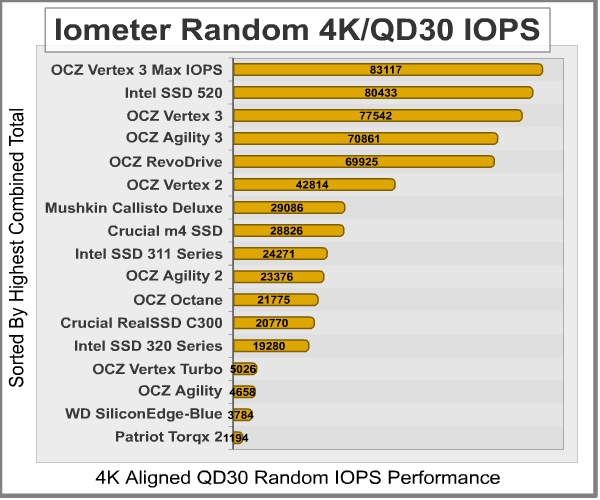
In our Iometer tests, which is configured to use 32 outstanding I/O's per target and random 50/50 read/write distribution, SandForce SSDs generally outperform the competition when tested with this large queue depth. The latest SATA 6Gb/s storage solutions lead the pack, and while the 240GB OCZ Vertex 3 Max IOPS Edition is on top with 83,117 IOPS this 512GB OCZ Octane solid state drive produced a modest 21,775 peak combined IOPS. This isn't the highest I/O device we've ever tested by any means, but it's still far beyond the needs of multi-tasking power users and hardcore gamers.
In our next section, we test linear read and write bandwidth performance and compare its speed against several other top storage products using EVEREST Disk Benchmark. Benchmark Reviews feels that linear tests are excellent for rating SSDs, however HDDs are put at a disadvantage with these tests whenever capacity is high.
EVEREST Disk Benchmark
Many enthusiasts are familiar with the Lavalys EVEREST benchmark suite, but very few are aware of the Disk Benchmark tool available inside the program. The EVEREST Disk Benchmark performs linear read and write bandwidth tests on each drive, and can be configured to use file chunk sizes up to 1MB (which speeds up testing and minimizes jitter in the waveform). Because of the full sector-by-sector nature of linear testing, Benchmark Reviews endorses this method for testing SSD products, as detailed in our Solid State Drive Benchmark Performance Testing article. However, Hard Disk Drive products suffer a lower average bandwidth as the capacity draws linear read/write speed down into the inner-portion of the disk platter. EVEREST Disk Benchmark does not require a partition to be present for testing, so all of our benchmarks are completed prior to drive formatting.
Linear disk benchmarks are superior bandwidth speed tools in my opinion, because they scan from the first physical sector to the last. A side affect of many linear write-performance test tools is that the data is erased as it writes to every sector on the drive. Normally this isn't an issue, but it has been shown that partition table alignment will occasionally play a role in overall SSD performance (HDDs don't suffer this problem).

The high-performance storage products we've tested with EVEREST Disk Benchmark are connected to the Intel P67-Express SATA 6Gb/s controller and use a 1MB block size option. Read performance on the OCZ Octane solid state drive measured average speeds of 489.1 MB/s, with a relatively close maximum peak speed of 496.6 MB/s. These results are virtually identical to the OCZ Vertex 3 Max IOPS Edition and Intel SSD 520 Series drives we recently tested. Everest linear write-to tests were next...

The waveform chart below illustrates how well the OCZ Octane manages file transfers, and makes linear write performance appears relatively uneven. The results seen here are consistent with most other SSD products we've tested in the past that use a DRAM cache buffer. The OCZ Octane solid state drive recorded an average linear write-to speed of 288.8 MB/s, with maximum performance reaching 371.2 MB/s.
The chart below shows the average linear read and write bandwidth speeds for a cross-section of storage devices tested with EVEREST:

Linear tests are an important tool for comparing bandwidth speed between storage products - although HDD products suffer performance degradation over the span of their areal storage capacity. Linear bandwidth certainly benefits the Solid State Drive, since there's very little fluctuation in transfer speed. This is because Hard Disk Drive products decline in performance as the spindle reaches the inner-most sectors on the magnetic platter, away from the fast outer edge.
In the next section we use PCMark Vantage to test real-world performance...
PCMark Vantage HDD Tests
PCMark Vantage is an objective hardware performance benchmark tool for PCs running 32- and 64-bit versions of Microsoft Windows Vista or Windows 7. PCMark Vantage is well suited for benchmarking any type of Microsoft Windows Vista/7 PC: from multimedia home entertainment systems and laptops, to dedicated workstations and high-end gaming rigs. Benchmark Reviews has decided to use the HDD Test Suite to demonstrate simulated real-world storage drive performance in this article.
PCMark Vantage runs eight different storage benchmarks, each with a specific purpose. Once testing is complete, results are given a PCMark score while and detailed results indicate actual transaction speeds. The 512GB OCZ Octane SSD produced a total PCMark Vantage (secondary) HDD Test Suite score of 41137, with specific speeds reported below:

Our tests were conducted on an Intel P67-Express Sandy Bridge motherboard using the onboard native SATA 6Gb/s controller with 64-bit Windows 7. Performance results are displayed in the chart below:

In the next section, I share my review conclusion and final product rating.
OCZ Octane SSD Conclusion
IMPORTANT: Although the rating and final score mentioned in this conclusion are made to be as objective as possible, please be advised that every author perceives these factors differently at various points in time. While we each do our best to ensure that all aspects of the product are considered, there are often times unforeseen market conditions and manufacturer changes which occur after publication that could render our rating obsolete. Please do not base any purchase solely on our conclusion, as it represents our product rating specifically for the product tested which may differ from future versions. Benchmark Reviews begins our conclusion with a short summary for each of the areas that we rate.
Compared to toggle and asynchronous components used in older SSD products, synchronous NAND flash used in new products like the OCZ Octane series represent the future of consumer-level solid state drives. Not only are these components fast, but they maintain better performance throughout the product's lifetime. Compared to toggle and asynchronous NAND flash, synchronous components resist performance degradation as storage capacity is filled. Our performance rating considers how effective the OCZ Octane solid state drive performs in file transfer operations against competing storage solutions. For reference, the 512GB model is specified to produce 480 MB/s read speeds and 330 MB/s writes, yet in our storage benchmark tests the OCZ Octane solid state drive (model OCT1-25SAT3-512G) performed at or above these speeds. Our test results demonstrated the OCZ Octane SSD was good for delivering 542/356 MB/s peak read and writes speeds using ATTO Disk Benchmark SSD speed tests... performing significantly higher than OCZ's specification. Linear file transfers with Everest Disk Benchmark produced 489/289 MB/s, which exceeds performance of both SATA 6 Gb/s Crucial RealSSD products. In general, transfer speeds were especially fast.
The 512GB OCZ Octane SSD sent to us for testing is advertised to deliver up to 26,000 random 4KB write IOPS and 35,000 random 4KB read IOPS, although it's unclear which tools and configuration settings were used to produce these particular specifications. Using Iometer operational performance tests configured to a queue depth of 32 outstanding I/O's per target, our benchmarks produced 21,775 combined IOPS performance. In comparison, this doesn't improve much over the previous Indilinx Barefoot controller's IOPS performance. In the 4K 32QD tests with AS-SSD and CrystalDiskMark, the OCZ Octane SSD fares well enough, but clearly strives to excel in workstation-level file transfer performance over operational transactions which a server might depend on.
Solid State Drives are low-visibility products: you see them just long enough to install and then they're forgotten. Like their Hard Disk Drive counterparts, Solid State Drives are meant to place function before fashion. Anything above and beyond a simple metal shell is already more than what's expected in terms of the appearance. OCZ has created a back-to-basics look with the black textured paint finish with orange branding on their Octane series SSDs. As solid state storage controllers become faster and more advanced, heat dissipation through the enclosure walls may demand that chassis designs become more beneficial than they previously needed to be. This isn't the case yet, and a metal chassis suits Indilinx Infused Everest SSDs nicely.
Construction is probably the strongest feature credited to the entire SSD product segment, and OCZ products seldom offer exception to this rule. Solid-state storage is by nature immune to most abuses, but add a hard metal shell and the chance of failure is reduced to internal component defects. If any Octane series SSD product happens to fail during the 3-year warranty period, end-users may contact OCZ via the company website or extensive support forums. Fortunately, there's also a toll-free telephone number (800-459-1816) for free technical support and customer service questions. OCZ has been proven to be one of the best companies in the business when it comes to customer service, and replacement parts are often sent with priority delivery.
As of late February 2012, the OCZ Octane SSD is available online in the following models and prices:
- OCT1-25SAT3-128G (128GB): $199 (Newegg / Amazon)
- OCT1-25SAT3-256G (256GB): $370 (Newegg / Amazon)
- OCT1-25SAT3-512G (512GB): $900 (Newegg / Amazon)
Overall, I really like the OCZ Octane SSD. It's aimed at the performance consumer segment, and I feel that it addresses their needs. It's fast, and the dual-core Indilinx Everest processor reads data at nearly the limit of SATA 6 Gb/s. Although the IOPS performance doesn't allow massive concurrent transactions like a database server would require, OCZ's not suggesting this drive for the Enterprise segment. Additionally, the use of 25nm synchronous NAND flash components and large 512MB cache buffer ensure that power-users never have to wait for their programs to open or data to be fetched. This is OCZ's first in-house SSD, and as a result support for it will be above and beyond what we've seen in their other product lines. For many consumers, it's all about performance specifications regardless of their needs. For those enthusiasts willing to recognize that OCZ's Octane SSD offers everything they could need, it will burn through everything they throw at it.
Pros:
+ Impressive 542/356 MBps read/write transfer speeds
+ Automatic AES data encryption
+ Indilinx Everest SSD processor supports TRIM garbage collection
+ 3-Year OCZ product warranty support
+ Indilinx Ndurance technology extends NAND lifetime
+ 128/256/512GB high-speed SSD storage capacities
+ Lightweight compact storage solution
+ Resistant to extreme shock impact
+ Low power consumption may extend battery life
Cons:
- Some manufacturers offer five-year warranty
- Expensive enthusiast-level product
- Lacks 3.5" drive tray adapter kit
Ratings:
- Performance: 8.75
- Appearance: 9.00
- Construction: 9.50
- Functionality: 9.00
- Value: 7.75
Final Score: 8.8 out of 10.
Quality Recognition: Benchmark Reviews Silver Tachometer Award.
Benchmark Reviews invites you to leave constructive feedback below, or ask questions in our Discussion Forum.
Reader comments from the original article
7 comments were posted before commenting closed. They are preserved as written. Original avatars no longer resolve and are shown as a placeholder.
PRICE realneil Permalink:
SSD's still cost too much. I have a few small ones, but cannot afford the larger, better performing drives yet. Once they get their prices down, (by more than a little) they will have an explosion in sales.
Smaller SSDs are affordable Mergatroid Permalink:
I agree that the larger SSDs are still too expansive. However, the smaller sized units (120 Gb and smaller) work great as boot drives. They really speed up your o/s. They're also big enough to put your favorite apps on and really give them a speed boost. I can't speak for anyone but myself, but I really don't need to have all my storage sped up (in fact, most of my movies, music and archives are on a NAS anyway). However, I had a 60Gb Patriot Inferno SSD that was a pretty good boot drive, and all I could afford (~250 MB/s). A year later I added another in a RAID 0 and got quite the speed boost (not only in benchmarks, but boot times and load times for games and apps). If anyone had an older SATA II SSD but can't afford to purchase a larger drive, look around for another SATA II SSD for a RAID (make sure your board supports hardware RAID, not software). I wouldn't recommend this for people who already own an SATA III SSD since they're already fast, however you could add another in RAID 0 if you wanted to increase the size of your boot drive using a RAID volume without paying the higher cost for a larger drive.
RE: OCZ Octane SATA 6 Gb/s Indilinx Everest SSD steve white Permalink:
Colin....maybe I'm not reading your review right but the IOPS of 35,000 is less than half that of half a dozen other SATA 111 SSD's on the market that are 40% cheaper. I've just ordered a Corsair 120Gb Force GT series 3 and admittedly is a very small temporary storage drive it's IOPS is 85,000 and 4K sequential read is 550Mb/s and writes at 515Mb/s. Price $234 Aussie dollars. Currently my 300Gb velociraptor (10,000rpm) is really showing it's age and is holding the system back. Any info I want to keep long term I burn onto 25Gb Blu-ray media and catalogue. I would be in heaven if I owned OCZ's Vertex 3 X2 hybrid drive but the price right now is just too high, even if it is the quickest out there.
RE: RE: OCZ Octane SATA 6 Gb/s Indilinx Everest SSD Olin Coles Permalink:
I'm guessing that you read it wrong, since you didn't get my name right. At any rate, Octane is a plenty-fast SSD that's ideal for users like yourself. If you're running a database server on your system, then IOPS will matter. If you're just running standard applications, you won't notice a difference.
Network-capable Johnny-Cakes Permalink:
Colin - I appreciate your feedback on the OCZ Octane SSD card mentioned. Steve White said he bought a Corsair SSD that has and IOPS of 85k, but your comment says that the Octane SSD (at 35k IOPS) is ideal for him. Not sure I understand your feedback that indicates that IOPS matters, and if so, why would the Octane card at 35k IOPS be ideal for him when he has an SSD that does 85k IOPS? Sorry, I am kind of a newbie looking to upgrade to a new SATA III board and SDD that is at least 300Gig, and don't understand your recommendation? I don't run a database server on my system (and don't anticipate doing so on the new system), so I'm trying to get my hands around what is a worthwhile investment if i use standard applications plus a couple games like COD MW3, that may benefit from SSD performance? I am currently under the impression that moving from my Raptor 10k rpm HDD to ANY ssd drive is a move in the right direction, but am thinking a really don't need to be paying the premium to get the highest performing SSD, since per your comment, I'm mostly using standard apps that won't realize much benefit. If COD MW3 is the most demanding app I use, should I even be looking at SSD at this point?
Any SSD is sweet Mergatroid Permalink:
Even an SATA II SSD would get you 250 MB/s or more. A good SATA III SSD should net you around 500 MB/s. Any SSD will blow the doors off any mechanical hard drive. Personally, I don't think how demanding the app is should be your deciding factor. I think you should look more at boot times and sheer performance in load times. I could only afford 120G worth of SSD (2 x 60GB in a RAID 0), but my system flies now, and I have installed the games I play the most on this volume and the performance difference is unreal. My system boots in about 15 seconds now. If you're looking at a 300G SSD, you'll get a pretty highly performing unit. It will cost a fair amount, but the performance increase will justify it easily.
Fast, while they last... WangoTango Permalink:
I bought 4 of the 512GB OCTANE drives and have had 2 fail, in different laptops. One just flat out died and the other acts as if it is being hot swapped, comes and goes, usually goes. One is off on an RMA now, getting ready to start a trouble ticket on the other. Got me so spooked that I replaced one critical drive with a Crucial 512GB. Got my fingers crossed on the other two units.