
SilverStone SST-EC03 USB 3.0 PCI-E Card
SilverStone EC03 USB-3.0 Expansion Card Review
Manufacturer: SilverStone Technology
Product Name: SuperSpeed USB 3.0 PCI-Express Expansion Card
Model Number: SST-EC03 / RL-EC03B
Price As Tested:$32.50 (Amazon)
Full Disclosure: The product sample used in this article has been provided by SilverStone Technology.
Getting access to the gigabytes of data on your external storage devices is excruciatingly slow as it trickles thru the USB 2.0 port, or at least, that's how it feels these days as storage devices store more data and USB 2.0 just can't get the job done fast enough. USB 3.0 at least for now is the answer for external access. The EC03 card from SilverStone installs into a single lane PCI-E gen 2.0 slot and gives you two internal USB 3.0 ports. SilverStone also provides a 3.5” I/O bay and the necessary cabling to bring the ports to the front of your case. Most motherboards do not have USB 3.0 ports and even when they do most motherboards rarely provide more than two USB 3.0 ports usually hardwired to the back panel I/O. The benefits of USB 3.0 over 2.0 are substantial, with an approximate 10 fold increase in speed. If you have been wanting USB 3.0 capability but don't want to swap motherboards then the EC03 can upgrade your system at a reasonable cost.
SilverStone was founded in 2003, and has a very long list of products that it has manufactured, from mice and fans to computer cases and power supplies. SilverStone's philosophy is to ensure that their “expertise is delivered to all products with consistency, in response to user's needs and with maximum user satisfaction.” SilverStone has its headquarters in Taiwan, and branch offices in the USA, and Germany.
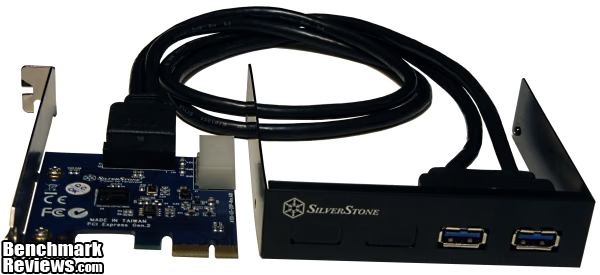
The concept is simple, open the case, install the EC03, and drivers then via 5Gbit/s USB 3.0 super speed interface you get access to your data. So how fast is it? Benchmark Reviews takes the EC03 thru the paces, let's take a look.
SilverStone SST-EC03 Features
-
Unique USB 3.0 dual port internal connector
-
PCI Express gen2.0 with single lane(x1) throughput 5Gbit/s
-
Support simultaneous operation of multiple USB 3.0/2.0/1.1 devices
-
Expands 2 external USB 3.0 super speed ports on the system
-
Support 5Vdc/3600mA (supply upto 4x standard power current)
-
Build in power connector to receiving extra power from system (sic)
SilverStone EC03 Specifications
|
Model No. |
SST-EC03 |
|---|---|
|
Form Factor |
Single Lane (x1) PCIe gen 2.0 |
|
USB 3.0 Controller |
NEC uPD720200 |
|
Power Requirement |
5Vdc via peripheral 4pin power connector |
|
USB Ports |
Dual port USB 3.0 support (one internal connector) |
|
Transfer Speed |
USB 3.0 (5Gbit/s), USB2.0 (480Mbit/s), USB 1.1 12Mbit/s |
|
Enclosure Interface |
USB 3.0 (Max. 5Gbps) compatible with USB 2.0 |
|
USB bus power output |
5Vdc/900mA |
|
Drive Support |
Windows XP, Vista, 7 (32bit/64bit) |
*Features and specifications per SilverStone product manual on website, and box literature.
Closer Look: EC03 Exterior
The EC03 arrived well protected and unharmed. The packaging itself is quite nice with full color on all sides.

You will also notice clearly the advertised 5Gbit/s USB 3.0 Super Speed transfer rate right on the box.

The mini CD includes a multi-language product manual. The manual is overly simple and could benefit from real pictures instead of simplified schematics. However, most people won't have any trouble with the installation. The mini-CD also includes a set of drivers. Newer drivers are already available and they can be downloaded from SilverStone.
A 24” (609.6mm) internal connector cable with dual USB 3.0 ports is included in the packaging.
The EC03 features an anodized black aluminum exterior. The surface is slightly resistant to the typical fingerprint. The aluminum is a bit thin and could bend very easily if mishandled.
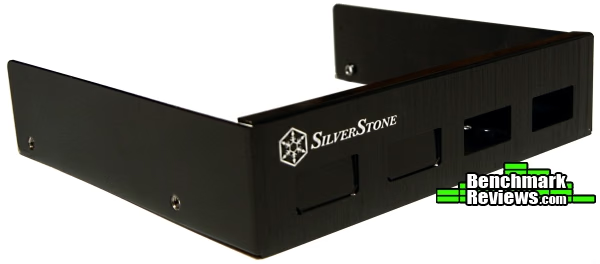
The I/O bay has an additional 2 ports should you ever locate another EC03.

The EC03 ports are mounted in the bay with 1 screw and a single plastic pin. This gives the ports a little too much wiggle room.
Closer Look: Interior
The inside of the SilverStone EC03 bay is also black anodized. All of the edges were finished.
Here we can see the 1 lane PCI-E card connects to the 2 port bay using the included cable. You can also see the molex receptacle on the right side of the card in this image. The molex connector gives the EC03 the ability to provide up to 3.6 amps of power, which is handy when using it for charging devices.
Here we see the electronic components of the EC03 card.
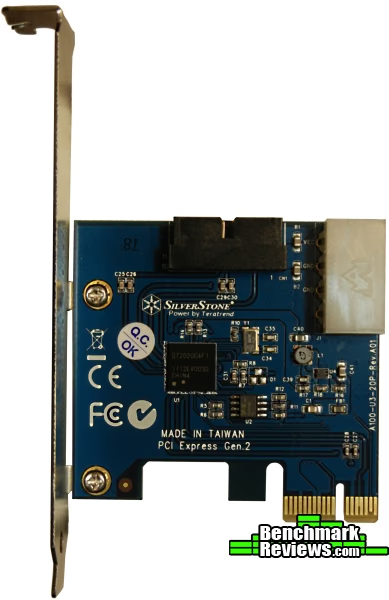
Silverstone uses the NEC, now Renesas uPD720200 USB3.0 Host Controller.

Here's a better view of the uPD720200.
Testing Methodology
Prior to each benchmark the ADATA S511 is zero filled, and the benchmark is run. If the software requires an active partition then this will be performed. A minimal Windows 7 environment is run to ensure repeatability. At least 3 runs are performed for each test.
The ADATA N004 Nobility is a working drive with 60% data on it. This SSD is interesting because it ships with both SATA II and USB 3.0 on it.
-
Case: Thermaltake Armor MX VH8000
-
Motherboard: EVGA SR-2 Dual Xeon
-
System Memory: 16 GB ECC RAM
-
Processor: Dual Intel E5620 CPU @ 2.4 Ghz
-
Video: ATI Radeon 4850
-
Highpoint RocketRAID 2720SGL
-
Primary Drive: ADATA S511 120GB SSD x 4 in RAID 10
-
Test Drive: ADATA S511 120 GB SSD (single drive)
-
Test Drive: ADATA N004 60GB, approximately 60% used.
-
Monitor (Primary): Hanns·G HZ281HPB WideScreen LCD 27.5"
-
Connection: supplied DVI to HDMI
-
-
Monitor (Secondary) Acer AL2216W 22"
-
Connection: DVI
-
-
Operating System: Win 7, 64-bit
-
SilverStone SST-EC03 USB 3.0 dual port PCI Express Card
-
SilverStone TS07 USB 3.0 Enclosure
*Special note: The onboard SATA III of the EVGA SR-2 is powered by the Marvel 9128 Chipset. Please see this article which provides significant detail as to the nature of the problem.
For this reason, a Highpoint RocketRAID 2720SGL was used to test baseline speeds of the ADATA S511.
Testing and Results
The card, bay, and drivers were installed into PCI-E slot #6 on the SR-2 motherboard. A SilverStone TS07 enclosure was used with an ADATA S511 120 GB SSD. An ATTO benchmark was used just to get a baseline idea of transfer speeds. And this is where there were some issues. This card behaved rather oddly depending on the slot that was used. ATTO was showing much lower than expected bandwidth for my first choice slot #6. Everest failed to run at all. PCI Express should not have a problem with data sharing, and the EVGA SR2 has a minimum of x8 lanes for each of the 7 PCI-E slots. Nevertheless, moving from slot #6 to slot #3 or slot #4 made a significant difference in bandwidth speeds, and there was no further problems when using these slots. I suspect this issue was due to an IRQ sharing conflict.
For this review we will be using the ADATA S511 120GB SSD and N004 Nobility 64GB SSD / flash drive. The ADATA S511 is reviewed here by Benchmark Reviews. We see that claimed speeds are 550MB/s read and 510MB/s write.
The ADATA N004 Nobility is somewhat unique in that it is a flash drive that has both SATA II, and USB 3.0 interfaces built in. According to the manufactures specification it is capable of 230MB/s Seq. Read, and 130MB/s Seq Write on the SATA II interface. For USB 3.0, it claims 180MB/s Seq Read and 150 MB/s Seq Write.
Additionally, we will be using the SilverStone TS07 USB enclosure as reviewed here.
ATTO Disk Benchmark
The ATTO Disk Benchmark program is free, and offers a comprehensive set of test variables to work with. In terms of disk performance, it measures interface transfer rates at various intervals for a user-specified length and then reports read and write speeds for these spot-tests. There are some minor improvements made to the 2.46 version of the program that allow for test lengths up to 2GB, but all of our benchmarks are conducted with 256MB total length. ATTO Disk Benchmark requires that an active partition be set on the drive being tested. Please consider the results displayed by this benchmark to be basic bandwidth speed performance indicators.
The RocketRaid 2720 using SATA 3.0 (SATA 6 Gbit/s interface) will allow us to test a single disk when configured as JBOD, and establish the upper baseline of transfer speed for the ADATA S511. This is our original baseline test using the data from the Silverstone TS07 review.

Here we see the baseline for ADATA S511 using the Highpoint RocketRaid 2720SGL. If you had a chance to read the ADATA S511 review, please note that the RocketRaid 2720 does not perform quite as well in single disk JBOD as compared to an integrated Intel P67 SATA 6.0 Gb/s controller in AHCI. But it is far better than the Marvel controller on the EVGA SR-2. The purpose here is to show that the ADATA S511 is capable of very high read / write speeds and to set the bar for the USB 3.0 tests.

This benchmark shows the ADATA S511 in a SilverStone USB 3.0 Enclosure attached directly to the onboard SR-2 motherboard USB 3.0 port. We see a respectable 234MB/s read, and 187MB/s write. This test is showing data from the SilverStone TS07 USB enclosure review. The next step will be to determine if the Silverstone EC03 can match the onboard USB 3.0. You will notice the change to the Aero interface.

This benchmark shows the ADATA S511 in a SilverStone USB 3.0 Enclosure attached to the SilverStone EC03 USB 3.0 port. A 221MB/s read and 164MB/s write comes pretty close to the SR-2's onboard 234MB/s read, and 187MB/s write, but it is pretty clear that the onboard USB 3.0 is faster.
Now lets look at the N004 using the on-board USB 3.0 and compare it directly to the SilverStone. First we show our original ADATA N004 tests using the onboard USB 3.0 of the SR-2.

We see sequential read of 196MB/sec and writes of 137MB/sec as our baseline for the EVGA SR-2 USB 3.0.
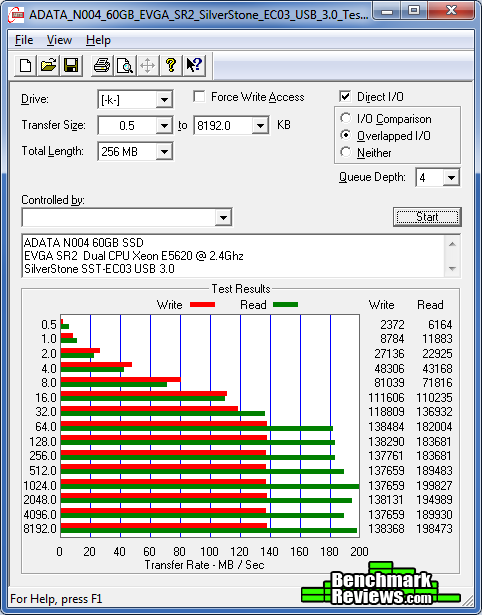
Here we see that the SilverStone EC03 does reach a sequential read speed of 199MB/s and a write speed of 138MB/s. The EC03 performance is very close to the onboard USB, although read speeds seem to vary more with the transfer size. The onboard solution gets a consistently higher read speed than the EC03 but not higher than the EC03's best score for the 1024 KB transfer size.
Let's look at the CrystalDiskMark Scores:
CrystalDiskMark 3.0 Tests
CrystalDiskMark 3.0 is a file transfer and operational bandwidth benchmark tool from Crystal Dew World that offers performance transfer speed results using sequential, 512KB random, and 4KB random samples. For our test results chart below, the 4KB 32-Queue Depth read and write performance was measured using a 1000MB space. CrystalDiskMark requires that an active partition be set on the drive being tested, and the S511 drive is formatted with NTFS. Benchmark Reviews uses CrystalDiskMark to illustrate operational IOPS performance with multiple threads. In addition to our other tests, this benchmark allows us to determine operational bandwidth under heavy load.

This is the Highpoint RocketRAID 2720 with the ADATA S511 using SATA III (SATA 6 Gbit/s interface). This sets the bar for the next set of tests.

This is the ADATA S511 in the TS07 Enclosure using the onboard USB 3.0 from the SR-2 motherboard. We can see that USB 3.0 does not fare as well as SATA 3.0.
.png)
This is the ADATA S511 in the TS07 Enclosure using the SilverStone EC03 USB 3.0 PCI-E card. Read speeds are very slightly lower, and write speeds slightly higher for the SilverStone EC03.

This shows the original benchmark from the TS07 review: ADATA N004 Nobility using the onboard USB 3.0 of the EVGA SR-2. Read performance is close to the ADATA S511.

This is the ADATA N004 Nobility using the SilverStone USB 3.0 Enclosure and then attaching directly to the SilverStone EC03. The scores are very close.
Everest Disk Benchmark
The EVEREST Disk Benchmark performs linear read and write bandwidth tests on each drive, and can be configured to use file chunk sizes up to 1MB (which speeds up testing and minimizes jitter in the waveform). Because of the full sector-by-sector nature of linear testing, Benchmark Reviews endorses this method for testing SSD products, as detailed in our Solid State Drive Benchmark Performance Testing article. However, Hard Disk Drive products suffer a lower average bandwidth as the capacity draws linear read/write speed down into the inner-portion of the disk platter. EVEREST Disk Benchmark does not require a partition to be present for testing, so all of our benchmarks are completed prior to drive formatting.
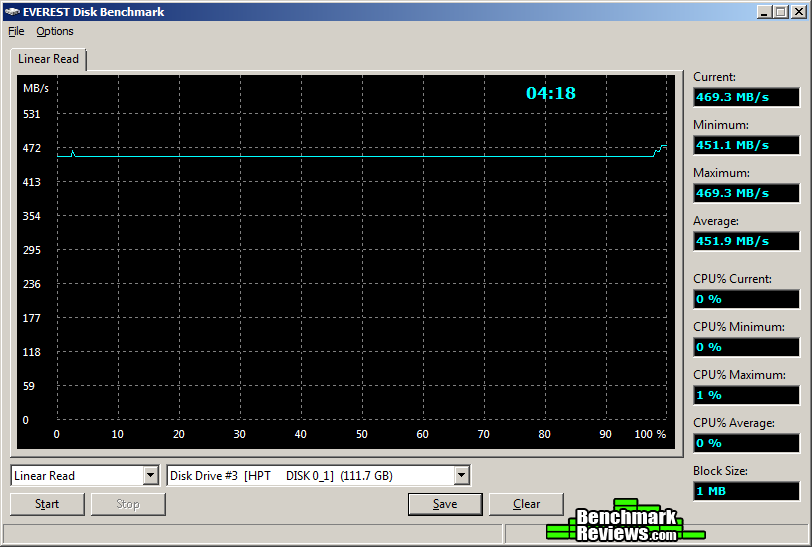
This is the original benchmark showing the ADATA S511 using The Highpoint RocketRaid 2720GSL. This gives us our baseline maximum expected linear read performance.
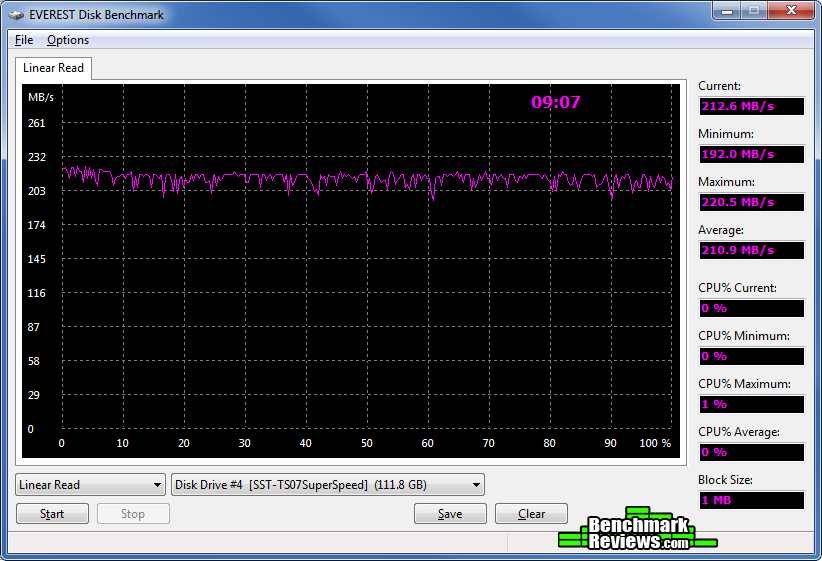
The linear read performance for the ADATA S511 connecting from the SilverStone TS07 USB 3.0 enclosure to the EC03 USB 3.0 port.

This is the original linear write benchmark showing the ADATA S511 using The Highpoint RocketRaid 2720GSL.
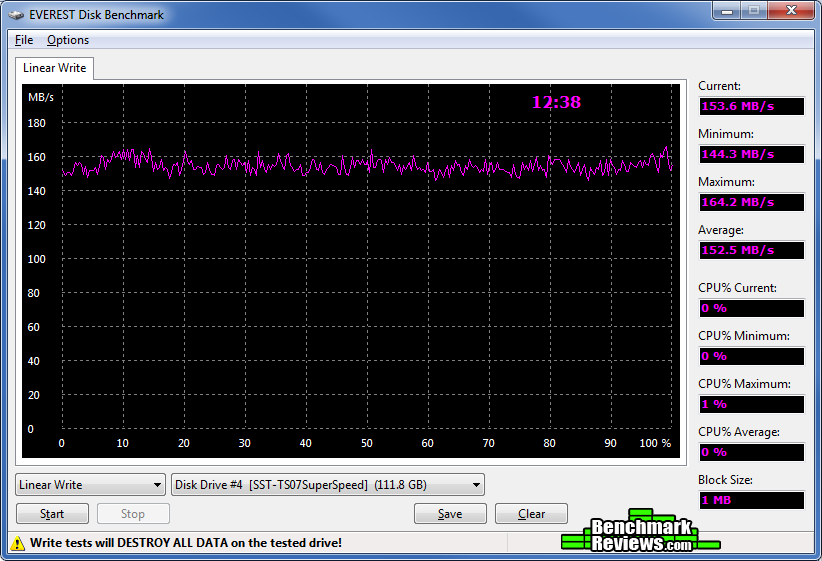
And finally the linear write performance.
Final Thoughts and Conclusions
IMPORTANT: Although the rating and final score mentioned in this conclusion are made to be as objective as possible, please be advised that every author perceives these factors differently at various points in time. The author's experience with the product may differ significantly from your own. While we each do our best to ensure that all aspects of the product are considered, there are often times unforeseen market conditions and manufacturer changes which occur after publication that could render our rating obsolete. Please do not base any purchase solely on our conclusion, as it represents our product rating specifically for the product tested which may differ from future versions. All testing used the Windows 7 64-bit OS. Testing was not performed for any other operating systems.
The EC03 dual port USB 3.0 PCI express card (internal) is designed to give users access to two USB ports using the supplied 3.5” bay. And that is exactly what it does.
USB 3.0 is a vast improvement over USB 2.0. Theoretically USB 3.0 is capable of 4.8 Gbits/s (600Megabytes/s) versus high-speed USB 2.0 which is limited to 480Mbits/s (60 Megabytes/s). Protocol overhead will limit the actual bandwidth significantly. A PCI Express 2.0 “lane” can provide 500MB/s in one direction (1000MB/s in both directions).
Now that we have the EC03 to compare against the onboard USB 3.0 of the EVGA SR-2, we can see that USB 3.0 performance of the onboard SR-2 is only slightly better than the USB 3.0 speeds of the EC03 card. For anyone who lacks USB 3.0, the EC03 is a really good solution. In fact, there are many users out there right now who would like to get access to USB 3.0 and were dreading the added cost of a new computer build, who can now get access to USB 3.0 for around $32 (see below).
Even though SATA 3.0 (SATA 6 Gbits/s) only has a theoretical advantage of 20% over USB 3.0 (5Gbit/s), we are seeing that SATA 3.0 performance far exceeds the expected USB 3.0 performance (onboard or add-on). So, clearly if you are thinking about buying external drives vs internal, and you want maximum speed you have the information you need to make a good decision.
The EC03 itself is a PCI express card with no obvious issues with the exception that rarely a device would not register unless it was first inserted into a USB 2.0 port. The included external 3.5” bay is somewhat thin and easily bends. The ports mount on with a decent size plastic pin, and 1 screw but they do not prevent motion of the USB ports and overall the EC03 feels flimsy.
While I do value the 3.5” form factor, many cases do not use this and if they do, these cases are likely to have only a single bay that is populated with a floppy disk drive. That means in order to install the EC03, many people will have to buy an additional adapter to fit a 5.25” bay. And this will result in those same individuals looking for USB 3.0 cards with 5.25” bays rather than 3.5” bays. In the long run, a free 3.5” bay will not do SilverStone's market as much justice as a bump in price for a 5.25” bay. At that point, using a complete 5.25” bay might not be a good use of space, so perhaps they can come up with a USB 3.0 card that provides 4 slots and can optionally use up to 4x PCI-E lanes. There are already 4 port USB 3.0 devices in the market, and SilverStone should look in that direction. This seems like a leap of the product niche, but looking at it from a market point of view, most people will want more than 2 USB 3.0 ports on a large 5.25 bay. In fact, there are already people asking for USB 3.0 ports on card readers, so this might also be a great area to move to. In general, the mere fact that this product is using a 3.5” bay is not counted as a deduction. However, if SilverStone had included a 5.25” adapter with the 3.5” bay, this would have been mirrored with a significant increase on the value side of the score.
The Supplied USB connector cable (24”) was not quite long enough for my EVGA SR-2. As a result I was not able to mount the bay in the standard location. It would be better if the cable was longer. However, if you are not running a huge case or HPTX motherboard then, it should be adequate as long as you don't mind the cable going across your motherboard.
The EC03 can supply up to 3600 milliamps of current when using the supplied molex connector. This is more than adequate for most uses.
Overall, performance was good. It came very close to the onboard USB 3.0 of the EVGA SR-2 board, and even exceeded its performance for some benchmark tests.
The unit tested with only an occasional issue. As mentioned, rarely, a USB device would not register in the 3.0 port initially. If I removed the device and placed it in a 2.0 port, then re-inserted back into the EC03, it would show up.
This review was also brought about because in the review of the SilverStone TS07 External USB 3.0 Enclosure, there was some thoughts that perhaps the limit on transfer speed was related to the onboard USB 3.0. SilverStone graciously volunteered the EC03 to test this theory. But clearly, the TS07's limit of around 234MB/s based on the benchmarks still stands. This does not rule out the possibility that the TS07's asmedia chip is the culprit. Therefore, additional testing is still warranted. The good news is that the SilverStone EC03 dual port USB 3.0 PCI Express Card was able to come very close to onboard USB 3.0 speeds.
It is important to note that the negatives and the positives listed here may not be the same as your own. There are some minor deductions for the flimsy feeling of the external bay. While the bay is marketed as “free”, the reality is that without the external bay and supplied connector, the internal USB 3.0 is not very useful. In that respect, I consider that it should be part of the package (as evidenced by the manual), and not some “free” add on to give additional value. Providing just a 3.5” bay is not a deduction, but the value of the product could have been higher if a 5.25” adapter was included. On the plus side, performance almost matches the motherboard USB 3.0 speeds. Also, a plus goes to improving access to power thru the molex connector. Each plus or minus listed should be measured by your own personal meter, and then you can decide if this case is worth your money.
Overall, for a USB 3.0 card providing 2 ports specifically to 3.5” drive bay $32.50 (Amazon) is a fair deal, and the performance of the EC03 is good.
Pros:
+ Good Value (if just using 3.5” bay.)
+ Good Performance.
+ Easy driver installation.
Cons:
- USB cord not long enough for larger desktop installs.
- 3.5” bay is flimsy.
- No Warranty visible in packaging.
- Rarely, a device would not be recognized unless it was inserted into a 2.0 port, and reinserted into the 3.0 port.
Ratings:
Final Score: 8.45 out of 10.
Benchmark Reviews invites you to leave constructive feedback below, or ask questions in our Discussion Forum.
Reader comments from the original article
9 comments were posted before commenting closed. They are preserved as written. Original avatars no longer resolve and are shown as a placeholder.
I'm glad I didn't wait WhyNotV2 Permalink:
While the SilverStone USB 3.0 doesn't seem terrible, I'm glad I became a semi-early adopter and bought the SIIG 4-port USB 3.0 kit. It's worked very well for me this past year that I've had it and definitely isn't flimsy. The only issues I had with it was my original installation in that I forgot to plug the power in and it took me a few minutes to figure it out. The price I the SIIG was high (I got mine "on sale" for $54.95), but again, 4 ports (not that I've used more than 1 at a time), sturdier and 2 size bay compatibility. I may pick up the Silverstone 3.0 for my wife's computer for the price...or wait :)
PCIe x1 slot katnrica Permalink:
This article says: "The EC03 card from SilverStone installs into a single lane PCI-E gen 2.0 slot..." How many motherboards built before 2010 even have a "Gen2, 5.0Gbps" x1 PCIe slot? All (or nearly all) only have a Gen1 (2.5Gbps) x1 PCIe slot. Yes, the graphics x16 slot is Gen2 on a vast majority of motherboards, but not the x1 slots.
RE: PCIe x1 slot Olin Coles Permalink:
Before 2010? How about before 2007, which is when PCI-E 2.0 slots were all over the market and a standard for motherboards? I think you might be remembering the dates incorrectly. I remember Intel X38 motherboards having PCI-E 2.0 lanes back in early 2007.
RE: RE: PCIe x1 slot katnrica Permalink:
Olin -- you are correct! I looked at the product briefs of the X38 and the P45 chipsets; yes both of those support multiple x1 lanes (6) at 500MB/s, which clearly means they are Gen2 capable. Sorry about that - I should have looked at these datasheets before I posted my question ;-)
RE: SilverStone SST-EC03 USB 3.0 PCI-E Card Mugsy Permalink:
I'm wondering if there isn't a "technical" reason why most boards and adapters are limited to just TWO usb 3.0 ports and not more? ("WhyNot" above is the first report I've heard of a 4-port adapter, and it's pricey.) Even this particular adapter, while providing room for two more ports, requires a SECOND card to add them. That suggests one needs beefier hardware to support more than two usb 3.0 ports at once. This also raises serious questions about an inability to use "hubs", "daisy-chaining" or other ways of expanding the number of ports when you run out. Or... to paraphrase what Bill Gates once said about the PC: "640K should be enough for anybody"... or in this case, "two usb 3.0 ports should be enough for anybody"?
RE: RE: SilverStone SST-EC03 USB 3.0 PCI-E Card Mack Permalink:
Intel has been lacking native support for USB 3.0. on their motherboards. That seems to be a lot of the reason why these boards seem to only carry 2 onboard USB ports, as they are 3rd party solutions. Intel's new 7X series chipsets do support USB 3.0. A single PCI Express 2.0 ?lane? can provide 500MB/s in one direction (1000MB/s in both directions). So, having a 4 port USB 3.0 solution that is plugged in to a single PCI-E slot, is not going to give you full bandwidth for each port. There's just not enough available bandwidth. That is why it might be better for engineers to spec a x4 PCI slot for 4 port USB 3.0
RE: RE: RE: SilverStone SST-EC03 USB 3.0 PCI-E Card Mack Permalink:
Sorry typo, x4 PCI-E slot... would cover the necessary bandwidth.
RE: RE: RE: SilverStone SST-EC03 USB 3.0 PCI-E Card David Ramsey Permalink:
Everybody lacks native USB 3.0; not a single Intel or AMD chipset supports it. Anything that has USB 3.0 now relies on NEC or Renesas controller chips. Dunno what AMD's excuse is. Intel said Light Peak, aka Thunderbolt, would obviate the need for it, but their latest X79 chipset doesn't have that, either.
Nice clean look Max Power - usb3pcicard.com Permalink:
I like these kits because the usb 3 ports are located at the front of the pc. The cables aren't too obstructive inside the case either.