
Super Talent RAIDDrive USB-3.0 Flash Drive
SuperTalent USB 3.0 RAIDDrive Flash Drive Review
SuperSpeed USB-3.0 delivers a very dramatic improvement over the older USB-2 protocol. Bandwidth speed has increased from 480 Mb/s to 5000 Mb/s, and file transfer rates as fast as 400 MB/s are now possible; making SuperSpeed USB-3.0 very competitive with the Serial-ATA interface. In this article Benchmark Reviews tests the Super Talent RAIDDrive ST3U64SRK SuperSpeed USB-3.0 flash drive, a product with up to 128GB of capacity which utilizes two SSD controllers in a RAID-0 array. The Super Talent USB-3.0 RAIDDrive is capable of 320 MB/s according to specifications, making it the fastest USB flash drive on the market.
The introduction of the USB 3.0 standard opens up some very exciting possibilities for the external storage market. Boasting 10x performance increase, it's really fast, but performance alone can not topple a standard as pervasive as its predecessor, USB 3.0 also needed to be completely backward compatible; and it is.
The rapid acceptance of the USB 3.0 standard is assured due to its complete backward compatibility with the USB 2.0 standard, ports and receptacles. A well written specification, USB 3.0 was designed to co-exist with USB 2.0 instead of replace it. USB 3.0 devices can work with USB 2.0 ports and USB 3.0 ports support USB 2.0 devices, but both at USB 2.0 speeds. Buried deep within new USB 3.0 (plugs and receptacles) are an additional five pins which provide two more data line pairs. When a USB 3.0 device is plugged into a USB 3.0 host, not only will it be possible to send and receive data up to 10 times faster, but the possibility to send and receive data concurrently using UASP drivers also avails itself.

With the creation of USB 3.0, we can now create storage products to take advantage of these new capabilities. So, how do you go about creating a drive to go 10 times faster? You think outside the box. At SuperTalent, our engineers have created a drive that distributes data across two solid-state drives and combine their performance together. The technology is called RAID, and by combining the throughput of two fast SSDs we were able to create a drive that delivers USB 3.0 (10x) performance like no other. SuperTalent is proud to herald the introduction of USB 3.0 with our latest achievement, the USB 3.0 RAIDDrive. It's a RAID array of SSDs that delivers over 300MB/s - oh, and fits in your pocket.
About Super Talent Technology Corporation
Super Talent Technology, headquartered in San Jose, California, designs and manufactures a full range of DDR, DDR2, and DDR3 memory modules and Flash based storage devices for computers and consumer electronics. An ISO 9001 certified company, Super Talent utilzes its state-of-the art factory and leading-edge components to produce award winning products with outstanding reliability. Super Talent is an active member of JEDEC, ONFI and USB-IF standards bodies, and holds over 200 patents in Flash and DRAM technology.

Super Talent's Silicon Valley based electrical, mechanical, and software Engineering teams develop leading-edge DRAM and Flash memory solutions for a multitude of applications. Our US-based engineering enables Super Talent to bring advanced new products and technologies to market well ahead of the competition. A leading innovator, Super Talent holds over 200 patents on DRAM and Flash module design and manufacturing processes, making Super Talent one of the world's chief patent holders in memory device categories. Super Talent is an active member of JEDEC, the association that defines future memory standards. The company is a technical leader in producing industry standard memory modules as well as in developing custom memory solutions.
USB 3.0 RAIDDrive Features
Our USB 3.0 RAIDDrive is unquestionably one of the fastest drives on the market today; even faster than the fastest internal SSD. Available in 32, 64 and 128GB capacities, our USB 3.0 RAIDDrive is actually two SSDs combined together in RAID 0 array. This means that we are able to pull data from two drives simultaneously. Supported by a caching system, each SSD controller is able to support true performance across the entire performance curve.
Far more than a flash drive, the USB 3.0 RAIDDrive is two multi-channel SSD drives cleverly combined into a RAID array. Packaged in an ultra-small form factor, this SSD RAID array is slightly larger than a standard flash drive yet able to achieve data transfers of over 300MBps; that's incredible performance for a drive of any size. The USB 3.0 RAIDDrive is not only fast, it is also the only RAID array that you can fit in your pocket.
- USB 3.0 Interface for unprecedented speed
- Compatible with USB 3.0 & USB 2.0 standards*
- Highly Reliable MLC NAND Flash

64GB RAIDDrive ST3U64SRK Actual Size
Models
-
32GB RAIDDrive: ST3U32SRK (MSRP $240)
-
64GB RAIDDrive: ST3U64SRK (MSRP $330)
-
128GB RAIDDrive: ST3U28SRK (MSRP $560)
ST3U64SRK Specifications
|
Capacity |
32GB, 64GB, 128GB |
|
|---|---|---|
|
Interface |
USB 3.0 (USB-2.0/1.1 Compatible) |
|
|
OS Support |
Windows XP, Vista, Windows 7 |
|
|
NAND Flash |
MLC | |
|
Dimensions |
95 x 34 x 15.4 mm |
|
|
MTBF |
+1,000,000 hours |
|
|
Data Integrity |
10-Years | |
| Sequential Read |
up to 320 MB/sec |
|
| Sequential Write |
up to 180 MB/sec |
|
|
Shock (operating) |
1500G, 3 axis |
|
|
Vibration (operating) |
16G, each axis |
|
|
Operating Temperature |
0°C to +70°C |
|
|
Chart by BmR |
Closer Look: USB 3.0 RAIDDrive
Super Talent has earned the right to proclaim they've produced the World's first SuperSpeed USB 3.0 flash drive. While this is no ordinary USB flash drive, the SuperTalent RAIDDrive does offer some of the same features and portability as other 'thumb drives' on the market.

In order to house two independent SSD controllers inside of one flash drive, Super Talent's USB-3.0 RAIDDrive has adopted a larger 3.74x1.34x0.61-Inches (95x34x15.4mm) profile. The RAIDDrive will still fit inside the average pocket, but a keychain flash drive it is not.
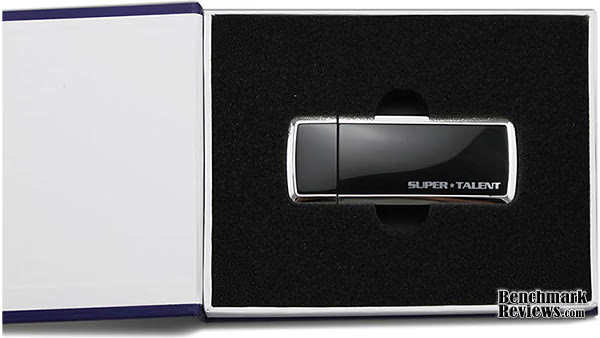
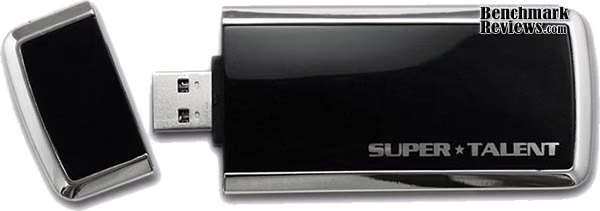
Super Talent offers their USB-3.0 RAIDDrive in a polished metal finish, with piano-black plastic components embedded into the chassis. The large cap comes away with a snap, but doesn't remain attached to the drive or offer any type of lanyard loop.
In the following sections, Benchmark Reviews will test the Super Talent RAIDDrive ST3U64SRK flash drive on a SuperSpeed USB-3.0 to verify manufacturer speciation's using AS-SSD Benchmark and ATTO Disk Benchmark.
SSD Testing Methodology
Solid State Drives have traveled a long winding course to finally get where they are today. Up to this point in technology, there have been several key differences separating Solid State Drives from magnetic rotational Hard Disk Drives. While the DRAM-based buffer size on desktop HDDs has recently reached 32 MB and is ever-increasing, there is still a hefty delay in the initial response time. This is one key area in which flash-based Solid State Drives continually dominates because they lack moving parts to "get up to speed".
However the benefits inherent to SSDs have traditionally fallen off once the throughput begins, even though data reads or writes are executed at a high constant rate whereas the HDD tapers off in performance. This makes the average transaction speed of a SSD comparable to the data burst rate mentioned in HDD tests, albeit usually lower than the HDD's speed.
Comparing a Solid State Disk to a standard Hard Disk Drives is always relative; even if you're comparing the fastest rotational spindle speeds. One is going to be many times faster in response (SSDs), while the other is usually going to have higher throughput bandwidth (HDDs). Additionally, there are certain factors which can affect the results of a test which we do our best to avoid.
SSD Testing Disclaimer
Early on in our SSD coverage, Benchmark Reviews published an article which detailed Solid State Drive Benchmark Performance Testing. The research and discussion that went into producing that article changed the way we now test SSD products. Our previous perceptions of this technology were lost on one particular difference: the wear leveling algorithm that makes data a moving target. Without conclusive linear bandwidth testing or some other method of total-capacity testing, our previous performance results were rough estimates at best.
Our test results were obtained after each SSD had been prepared using DISKPART or Sanitary Erase tools. As a word of caution, applications such as these offer immediate but temporary restoration of original 'pristine' performance levels. In our tests, we discovered that the maximum performance results (charted) would decay as subsequent tests were performed. SSDs attached to TRIM enabled Operating Systems will benefit from continuously refreshed performance, whereas older O/S's will require a garbage collection (GC) tool to avoid 'dirty NAND' performance degradation.
It's critically important to understand that no software for the Microsoft Windows platform can accurately measure SSD performance in a comparable fashion. Synthetic benchmark tools such as HD Tach and PCMark are helpful indicators, but should not be considered the ultimate determining factor. That factor should be measured in actual user experience of real-world applications. Benchmark Reviews includes both bandwidth benchmarks and application speed tests to present a conclusive measurement of product performance.
Test System
- Motherboard: Gigabyte GA-X58A-UD7 (Intel X58-Express)
- Processor: Intel Core i7-920 BX80601920 @ 2.667 GHz
- System Memory: 6GB Triple-Channel DDR3 1600MHz CL6-6-6-18
- SATA 3Gb/s Storage HBA: Integrated Intel ICH10R Controller
- AHCI mode - Intel Rapid Storage Technology Driver 9.6.0.1014
- SATA 6Gb/s Storage HBA: Integrated Marvell SE9128 Controller
- AHCI mode - Marvell Magni Driver Marvell Magni Driver 1.0.0.1036
- USB 2.0 Adapter: Intel ICH10 Controller
- USB 3.0 Adapter: NEC-D720200F1 Controller
- Operating System: Microsoft Windows 7 Ultimate Edition 64-Bit
Test Tools
- AS SSD Benchmark 1.4.3704.27281: Multi-purpose speed and operational performance test
- ATTO Disk Benchmark 2.34: Spot-tests static file size chunks for basic I/O bandwidth
Test Results Disclaimer
This article utilizes benchmark software tools to produce operational IOPS performance and bandwidth speed results. Each test was conducted in a specific fashion, and repeated for all products. These test results are not comparable to any other benchmark application, neither on this website or another, regardless of similar IOPS or MB/s terminology in the scores. The test results in this project are only intended to be compared to the other test results conducted in identical fashion for this article.
AS-SSD Benchmark Test Results
Alex Schepeljanski of Alex Intelligent Software develops the free AS SSD Benchmark utility for testing storage devices. The AS SSD Benchmark tests sequential read and write speeds, input/output operational performance, and response times. Because this software receives frequent updates, Benchmark Reviews recommends that you compare results only within the same version family.
This purpose of this section is to illustrate sequential file transfer speeds and demonstrate operational IOPS performance using AS-SSD Benchmark. For reference, we first tested the OCZ Rally-2 Turbo USB-2.0 flash drive which produced 27.9 MB/s read and 24.8 MB/s write speeds. With the Super Talent RAIDDrive ST3U64SRK attached to the Intel ICH10 USB-2.0 controller, this flash drive produced 33.2 MB/s read and 26.8 MB/s write speeds.

Stepping up to SuperSpeed USB-3.0 using the NEC-D720200F1 controller, the Super Talent RAIDDrive produced an impressive 156.3 MB/s read and 72.7 MB/s write speeds. These results are getting closer to the manufacturers suggested maximum speeds of 320/180 MB/s, but we haven't applied Super Talent's RAIDDrive RAID-0 software yet.

Once the 'STT USB Composite Device' and 'STT USB 3.0 Miniport' software has been installed, the Super Talent USB-3.0 RAIDDrive operates in a RAID-0 twin SSD array. AS-SSD produced 225.6 MB/s read and 103 MB/s write, both of which are impressive, but not quite reaching the advertised 320/180 MB/s read and write speeds.

AS-SSD Benchmark is great for comparing 4K IOPS results tested with 64 concurrent threads, but it's good to have a second opinion for basic speed measurements. To approach this from a different angle, we've included ATTO Disk Benchmark results in the next section.
ATTO Disk Benchmark Results
The ATTO Disk Benchmark program is free, and offers a comprehensive set of test variables to work with. In terms of disk performance, it measures interface transfer rates at various intervals for a user-specified length and then reports read and write speeds for these spot-tests. There are some minor improvements made to the 2.34 version of the program, but the benchmark is still limited to non-linear samples up to 256MB. ATTO Disk Benchmark requires that an active partition be set on the drive being tested. Please consider the results displayed by this benchmark to be basic bandwidth speed performance indicators.
While AS-SSD Benchmark is great for obtaining operational IOPS performance at the 4KB level using 64-threads, ATTO Disk Benchmark works equally well at illustrating bandwidth speeds at various file chunk sizes (including 4KB). Benchmark Reviews has tested the Super Talent USB-3.0 RAIDDrive ST3U64SRK using a queue depth set to 4 for all benchmark runs, each using either the Intel ICH10 USB-2.0, NEC 3.0, or Super Talent enhanced SCSI USB-3.0 driver.
The first test utilized the Intel ICH10 HiSpeed USB-2.0 controller, and produced a 35 MB/s maximum read speed and 28 MB/s write speed; both which plateau at 64-8192 KB.

Next, the Super Talent RAIDDrive was connected to the NEC-D720200F1 SuperSpeed USB-3.0 controller using the NEC driver. The 'standard' USB-3.0 connection delivered 168 MB/s peak read speeds, and a 69 MB/s maximum write speed. These speeds are nowhere near the manufacturers suggested maximum speeds of 320/180 MB/s, so we applied Super Talent's RAIDDrive RAID-0 software and re-tested.

Once the 'STT USB Composite Device' and 'STT USB 3.0 Miniport' software has been installed, the Super Talent USB-3.0 RAIDDrive operates in a RAID-0 twin SSD array. This raised our bandwidth speed results to 239 MB/s maximum read and 106 MB/s peak write performance.

ATTO Disk Benchmark confirms our results with AS-SSD Benchmark, and demonstrates how well the Super Talent RAIDDrive operates on the SuperSpeed USB-3.0 interface compared to the previous generation. Unfortunately, Super Talent appears optimistic in their assertion of a 320/180 MB/s maximum speed. The best results we could produce were 239/106.
USB-3.0 Final Thoughts
SuperSpeed USB 3.0 has some room to grow and mature. It's an excellent standard that improves over the out-going HiSpeed USB-2.0 protocol by more than 250%, but it lacks universal support. On Intel motherboards, the USB controller is supported by the ICH 'Southbridge', and driver support is native from Microsoft Windows XP forward. USB 3.0 is not. As of April 2010, all motherboards including the new SuperSpeed support utilize NEC's D720200F1 controller which relies on NEC driver software. Unfortunately, SuperSpeed USB-3.0 is not natively supported by Microsoft Windows 7, so it will have to wait for the next version of the O/S which is still a few years away.
Once SuperSpeed USB-3.0 is functional and put into service, the theoretical advantages are impressive. SuperSpeed USB-3.0 offers theoretical bandwidth of 5Gbps, which could potentially rival the SATA 6Gb/s storage interface. While the idea of USB-3.0 based primary drives is not supported by Windows 7, Benchmark Reviews hopes to one day demonstrate the differences between running the Operating System on a SATA SSD and on a SuperSpeed USB 3.0 flash drive.
RAIDDrive Conclusion
The Super Talent USB-3.0 RAIDDrive performed at up to 239 MB/s read and 106 MB/s write speeds in our RAID-0 benchmark tests, which is far beyond the sub-30 MB/s speeds offered by the fastest USB-2.0 flash drives. Still, 239/106 is a stretch from Super Talents advertised maximum speeds of 320/180 MB/s. In standard USB-3.0 tests the RAIDDrive produced 168/69 MB/s, which is not nearly as impressive.
In terms of appearance the RAIDDrive is elegant, but still big and elegant. Measuring 3.74" long by 1.34" wide and 0.61" thick, the RAIDDrive will fit a pocket or briefcase, but don't expect it to become your next keychain flash drive. Sadly, I've seen mobile phones that were about the same size.
The Super Talent RAIDDrive is well constructed, and is still a SSD at its core. Solid State Drives are by nature immune to most abuses, but If any RAIDDrive product does happen to fail during the 2-year warranty period, end-users can contact the support department by e-mailing or by filling out an RMA form from their website. Unfortunately, there isn't a toll-free 800 number available for customer support.
Offering fast portable flash-based storage in 32/64/128GB capacities is a great start, and performing at up to 239/106 MB/s certainly helps, but ultimately the functionality for Super Talent's RAIDDrive rests in the hands of the user. Depending on the Operating System, features such as TurboBoost and SuperFetch may further increase performance. Additionally, some file types and sizes transfer faster than others.
As of late April 2010, none of the three Super Talent RAIDDrive sizes are available at NewEgg. Listed below are the suggested retail prices, which may guide consumers in locating the best online deal.
- 32GB RAIDDrive: ST3U32SRK (MSRP $240)
- 64GB RAIDDrive: ST3U64SRK (MSRP $330)
- 128GB RAIDDrive: ST3U28SRK (MSRP $560)
Pros:
+ Industry's First SuperSpeed USB-3.0 Flash Drive
+ Produced 239/106 MB/s Speeds with ST Optimized Drivers
+ Up to 128GB of Portable Flash Storage Capacity
+ Fully Backwards Compatible with USB-2.0
+ Hot Plug-n-Play Functionality
Cons:
- Large Profile Size
- Expensive Enthusiast Product
- Does Not Include TRIM Support
- Limited Warranty Period
Questions? Comments? Benchmark Reviews really wants your feedback. We invite you to leave your remarks in our Discussion Forum.
Reader comments from the original article
9 comments were posted before commenting closed. They are preserved as written. Original avatars no longer resolve and are shown as a placeholder.
Wrong testing bench Stas Permalink:
You took the wrong motherboard for testing - it would not support more than 240MB/s, as NEC chip is using only 250GB/s PCIe x1 link. Try it with ASUS add-on combo on the board that has southbridge PCIe x4 slot - only then you can compare real and declared productivity.
@ Stas Olin Coles Permalink:
I'm not entirely certain this is the case. The NEC controller ties into the PCIe 2.0 lanes from my research, which means that there is at least 5Gb/s bandwidth. Regardless, the 320/180 MB/s that Super Talent suggests was nowhere close to the 239/106 MB/s we received. AS-SSD and ATTO both had low write-to performance, which was a far cry from the bandwidth restriction you suggest.
not exactly nnobody Permalink:
NEC USB3.0 chip on this mobo connected directly to X58 chip, so it gets one PCI-E 2.0 lane. You may check it by yourself, just view user's guide to this mobo.
:) Stas Permalink:
A bit earlier version of the article stated that the testbench was GA-P55A-UD7. And that make a big difference.
Time for glasses. :p Olin Coles Permalink:
You need to get more sleep. :p This article hasn't been modified or edited. The original test motherboard was the GA-X58A-UD7. As far as I know, Benchmark Reviews has never received/tested the GA-P55A-UD7. At any rate, I'm glad we got that sorted out.
RE: Time for glasses. :p Stas Permalink:
Sorry,then there is still much to improove to get full USB 3.0 speed.
Agreed Olin Coles Permalink:
I think this is a good start, but it seems that the new SuperSpeed USB-3.0 standard is too new for the industry. We probably have a few more years before USB 3 flash drives become widely available and used.
Master Rob Permalink:
Just wondering if you used the ST USB 3 RAIDDrive drivers ??? ---> ##supertalent.com/support/driver_download.php?open=usb
Ooops ... Rob Permalink:
I found it :)