
Patriot Gamer-Series DDR3-1600 Memory Kit
Patriot Gamer Series DDR3 Memory Kit
Overclocking is getting easier than ever, and more and more users are finding that they want to try their hand at what used to be an art reserved for hardcore computer enthusiasts. In this article Benchmark Reviews tests the Patriot Gamer Series 4GB PC3-12800 DDR3-1600 dual-channel system memory kit, SKU PGS34G1600ELKA. Patriot designed this DDR3 kit to work with BEMPs (Black Edition Memory Profiles) that have been uploaded for use with the AMD Overdrive program in order to make overclocking even easier for the average enthusiast. This Patriot Gamer Series RAM is designed to work in tandem with AMD Black Edition processors, but can be overclocked quite effectively in nearly any DDR3 compatible system. Priced at $130, the Patriot Gamer Series PC3-12800 DDR3-1600 kit represents a great opportunity for PC hardware enthusiasts to upgrade to low latency, high-performance memory at a very affordable price.
Now that DDR3 memory is getting so affordable and available, it can be difficult to determine which kit is the best for your system. Most memory manufacturers at this point are building their new memory kits to be optimized for certain systems. Core i5 and i7 memory kits abound, and now many manufacturers are making kits specifically optimized for AMDs Black Edition processors. Generally speaking, these kits are made with overclocking in mind. Through their Overdrive program, AMD provides memory manufacturers with the ability to set the optimum settings for their memory kits in an online database that individual users can download for use with Black Edition Processors to get the best performance out of their systems.

Patriot has been a big name in computer memory for a long time. Their recently released memory kits optimized for use with Black Edition Processors come in 1066Mhz and 1600Mhz kits. Available at PC3-12800 1600Mhz are two latency configurations, one low at 7-7-7-20, and one enhanced for gaming performance with timings at 9-9-9-24. Benchmark Reviews has tested the Patriot Extreme Performance Gaming Series DDR3 4GB (2 x 2GB) PC3-12800 Enhanced Latency DIMM Kit (PGS34G1600ELKA) at a variety of speeds and timings to show you the benefits it brings to your computing environment, especially when upgrading from DDR2 memory kits.
Patriot Gamer Series Features
Patriot Gamer Series (PGS), part of the Extreme Performance (EP) Enhanced Latency line is engineered to expand your gaming options. Our latest addition to this family is the AMD Black Edition Ready G-Series of memory modules targeted for enthusiasts and overclockers. These modules provide well balanced performance and stability. When used with AMD OverDriveTM software on AMD-based platforms featuring AM3 processors and AMD 7-series chipsets users can easily adjust and fine tune their memory bandwidth, timing and voltages. These modules are designed to operate at 1600MHz at 9-9-9-24 timings and are available in 4GB kit capacity.
PGS34G1600ELKA Specifications
- Extreme Performance PC3-12800 (1600MHz)
- Enhanced Latency for Gaming (9-9-9-24)
- AMD Overdrive Ready
- Equipped with advance aluminum heat-dispersing shields
- 100% Tested and Verified
- Lifetime Warranty
- RoHS Compliant
- Tested on Intel P55 chipset
- 1.8V
About Patriot Memory
Established in 1985, Patriot Memory builds a full range of memory module and flash memory products, offering a perfect blend of quality and value. Patriot products include Extreme Performance (EP), Signature Lines (SL) and Flash Memory solutions (FM).
 Patriot has sales offices located throughout the U.S. and Asia. Patriot sells through the distribution channels throughout North America, Europe, Asia Pacific, Middle East, Africa, and Latin America.
Patriot's development and manufacturing facility are located in Fremont, California USA. Our manufacturing segment is composed of a highly skilled production staff and multiple production lines optimized for modules, giving Patriot the ability and resources necessary to provide a full line of memory module solutions. Patriot Memory is a trademark of PDP Systems, Inc.
Closer Look: Patriot Gamer DDR3
The Patriot Extreme Performance Gaming Series DDR3 4GB (2 x 2GB) PC3-12800 Enhanced Latency DIMM Kit comes packaged in the pretty standard plastic clamshell packaging that is nearly impossible to open. I reached for my trusty kitchen shears to do the job and was relieved to find that the package opened very easily. It wasn't sealed like I had expected and must admit I smiled a little at the convenience.

The heat spreaders on the Patriot Gamer Series are light-weight aluminum and help to evenly distribute the heat. The spreaders are plenty big and should provide adequate cooling, even with the slightly higher than normal voltage of 1.8v on the PGS34G1600ELKA Enhanced Latency DIMM Kit. The only issue that I did run into with the Patriot Gamer Series Kit head spreaders is that they slightly obstruct the CPU cooler fan on the motherboard we used for testing. The ASUS M4A785TD-M EVO is a mATX motherboard with four DIMM slots. The saving grace for the Patriot Gamer Series Kit was that ASUS recommends using the two DIMM slots closest to the power connector for the best overclocking gains. Even so, my CPU cooler fan rests on top of the Patriot Gamer Series DIMMs. They push the cooler fan up and I lose some surface area at the bottom of the CPU cooler heatsink.

In the pictures above and below, you can see just how much the heat spreaders extend above the Patriot Gamer Seried DDR3 Module itself. The body of the heat spreaders is two completely solid pieces, with the only perforations occurring above the PCB. This is in line with most of Patriot's memory kits. We certainly didn't run into any trouble with the Patriot Gamer Series DDR3 Memory Kit overheating, so it seems that the style works well enough.

The front of each of the Patriot Gamer Series DIMMs shows the G Series logo and gives the RAM Kit information. As you can see, this is clearly the PGS34G1600ELKA model. This model number specifies that, of the two styles of Patriot Gamer Series Black Edition Ready Memory Kits, this is the Extreme Gaming Series Enhanced Latency version. The PGS34G1600ELLA is the other Black Edition Kit and is sold as the Low Latency Kit. As you can read on the front of the Patriot Gamer Series DIMM, the Enhanced Latency Kit comes with the Latency at 9-9-9-24. The Low Latency kit is just that, and uses timings at 7-7-7-20.

The Patriot Gamer Series Dual-Channel Kit is designed for use with the AM3 platform and specifically for use with a Black Edition Processor. That being said, this Patriot DDR3 Dual-Channel Kit could be used in any motherboard that utilizes DDR3 dual-channel memory. It could be at home in an Intel 1156 motherboard as well as an AM3 board. Since the PGS34G1600ELKA has no XMP support, any overclocking would have to be done in the BIOS. Also, if you are considering the Patriot Gamer Series DDR3 Memory Kit for an Intel platform, be advised that the voltage rating of 1.8v is way to high for an Intel board. Even the 1.65v that we used for the high end of our overclocks is pushing the limit. The default memory configuration for this Patriot Gamer Series Kit is 1.5v and it is at this voltage setting that we ran the PGS34G1600ELKA at both 1333Mhz and 1600Mhz speeds. These settings would be fine for either an Intel or an AMD platform.

If you are looking to get a little higher speeds and a corresponding boost in performance out of the Patriot Gamer Series Enhanced Latency Kit, you should use it in an AM3 motherboard so you can push those higher voltages. Also, to take advantage of the Black Edition Memory Profiles provided by Patriot for use with the PGS34G1600ELKA kit, you will need a Black Edition Processor. Be aware that, for now at least, the Patriot Gamer Series 1600Mhz Dual-Channel Kit is only compatible for use with AMD Overdrive with the 965BE (C2&C3) and 955BE processors. If you have a 720BE processor, you will have to manually overclock. Follow us into the next section for a more detailed look at the Black Edition Memory Profiles and the AMD Overdrive program.
Black Edition Memory Profiles
Now, both Intel and AMD support a way to overclock your RAM and your CPU together to a specified setting made by the manufacturer for the performance you desire. Basically, they are making overclocking easier than ever and more accessible to a wider range of people. Previously, overclocking has been limited to enthusiasts who like to tweak the settings in their motherboard's BIOS, taking a lot of time to study and read about what each specific setting means and what it does for (and to) your system. AMD's BEMP and Intel's XMP help to automate the whole process for you, making all that research unnecessary for the average user to be able to overclock. Don't worry, enthusiasts, AMD's overdrive utility, which runs the BEMP, still allows you the option to manual tweak any of the 38 different settings for a unique overclock.
The main difference between AMD Overdrive and BEMP and Intel's XMP is that all the data for the BEMP is stored in an online server run by AMD. The Intel XMP is stored on the chip itself. This makes the BEMP much easier to change if the manufacturer comes up with a better configuration that suits their RAM kit. As for now, the profiles are built and changed only by the manufacturer and stored on the AMD server. The BEMP, however, is stored in an XML format. This seems to foretell of user configured profiles sometime in the future.
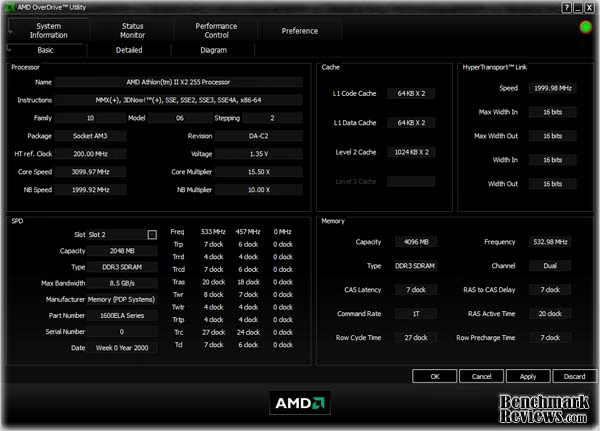
Using the AMD Overdrive Utility is easy. Just download the program, install it, and it runs right from windows. From within the program you select the desired profile and click Apply. The changes are then made to your system right before your eyes. No restart required. If the overclock fails for some reason (it shouldn't if you are using the profile provided by the RAM manufacturer), the program will either tell you that the overclock failed or a number of other problems could occur. Your computer may freeze up, the screen may go black, you might get a blue screen. Regardless, when you restart your computer, the previous stable settings will be returned.
Benchmark Reviews will be testing the Patriot Gamer Series 4GB DDR3-1600Mhz PC3 12800 Dual-Channel Enhanced Latency Memory Kit using the AMD Athlon-II X2-255 processor. As you can see, this is not a Black Edition processor. All that means, however, is that we get to keep it old school and do all of our overclocking within the BIOS. Below you can see the standard profile for the Patriot Gamer Series Memory kit, which is set at 1066Mhz. During testing, we are going to skip this JEDEC all together. The AMD Athlon-II X2-255 wants the RAM at 1333Mhz, so that is where we will start with the PGS34G1600ELKA kit. We will also use 1600Mhz speeds, which is what the Patriot Gamer Series Kit is rated for. We will then overclock the Patriot Gamer Series DDR3 Memory to 1760Mhz and 1800Mhz to complete our testing.

Patriot calls this Dual-Channel Memory kit the Extreme Performance Gaming Series DDR3 4GB (2 x 2GB) PC3 12800 Ehanced Latency DIMM Kit. A Low latency Gamer Series Kit is also available, but since we are testing the Enhanced Latency Kit, we have tried to keep the latency to the numbers specified by Patriot. For that reason, we have kept the relatively high latency of 9-9-9-24 when running the RAM at 1333Mhz. You can see from the picture above that the automatic latency when running at 1066Mhz are 7-7-7-20, which matches the low latency kit. We bumped them up for the Patriot Gamer Series Enhanced Latency Kit. We were able to keep the latency the same when running the PGS34G1600ELKA kit at 1600Mhz and also at 1760Mhz but we had to increase the latency to 11-11-11-30 to be able to use the Patriot Gamer Series RAM at 1800Mhz stably at 1.65v.
In order to avoid getting different results due to CPU speed increases, the CPU speed for all tests was kept as close to a constant 3.1Ghz as possible; the stock speed for the AMD Athlon-II X2-255. For the 1333Mhz and 1600Mhz speeds, we simply increased the RAM multiplier and kept all other settings the same. To get the higher performance of the 1760Mhz RAM speed we increased the RAM core voltage to 1.65v and the bus speed to 220Mhz (from 200Mhz). We then tuned the processor multiplier down to x15 to keep it at 3.1Ghz. Moving up to the 1800Mhz RAM speed we kept the core voltage at 1.65v and moved the bus speed up to 225Mhz. The processor was tuned to a x14.5 multiplier.
Even though the Patriot Gamer Series Enhanced Latency Kit is rated up to 1.8v, I only needed to push 1.65v in order to make it up to 1800Mhz. I spent very little time trying to see if I could push the Patriot Gamer Series DDR3 RAM even higher, seeing that I had an extra .15v to work with, but I couldn't get anything stable. Even at the 1800Mhz speeds that we reached, the performance increase was somewhat offset by the fact that we had to use higher latency to get it there. It seems like the lower latency kit (PGS34G1600ELLA) might have a better chance of getting up higher while maintaining a lower latency.
Now that we have gone over the specific settings that we used to test the Patriot Gamer Series PGS34G1600ELKA Kit, lets move in the testing section and see how it fared. To better exemplify the increased speed and performance of the Patriot Gamer Series DDR3 Memory, we have also thrown in a Corsair Dual-Channel DDR2 800Mhz kit for fun.
Testing & Benchmark Results
Testing Methodology
All benchmarks are conducted using the same system components and the same memory modules in the same DIMM slots. The memory slots sit directly between the main power connector and the CPU socket on the motherboard. Some systems work better when the memory modules are closer to the power source, and some perform better when the RAM is closer to the CPU. The manufacture of the motherboard used for testing in this review states their preference in the manual: "Install the RAM in the sockets closest to the power connector for better over-clocking capability."
Each benchmark begins after a complete system restart and is repeated five times; the high and low results are discarded, and the average of the three remaining results is calculated and reported in the text. To ensure system stability and the reliability of our results, each new memory configuration was fully tested with Memtest86 v4.00. Although the CPU used in the test system is not a Black Edition Processor, and therefore the Core Multiplier is not unlocked, the multiplier on the Athlon-II X2-255 can be set to a lower setting than the x15.5 standard. This makes it possible for us to keep the CPU speed at a steady 3.1Ghz speed throughout all of the tests.
Below is a table summarizing the hardware settings used on the Patriot Gamer Series DDR3 Kit in this review. I tried to keep the same timings throughout all the speeds, but in order to keep stability, I had to increase them for the 1800Mhz overclock. At the two standard frequencies of 1333Mhz and 1600Mhz I left the FSB base clock the same, at 200 MHz. When I started to overclock the RAM, I had to raise the FSB, but I reduced the CPU multiplier to keep the CPU frequency steady at 3.1 GHz. I also increased voltage for the two overclocked settings. A single DDR2-800Mhz setting has been added to show the benefits of the faster, newer RAM.
| Memory Speed |
Memory Timings |
Voltage |
System Bus |
CPU Multiplier |
|---|---|---|---|---|
| 1333 MHz | 9-9-9-24 | 1.5v | 200 MHz | 15.5 |
| 1600 MHz | 9-9-9-24 | 1.5v | 200 MHz | 15.5 |
| 1760 MHz | 9-9-9-24 | 1.65v | 220 MHz | 15 |
| 1800 MHz | 11-11-11-30 | 1.65v | 225 MHz | 14.5 |
|
DDR2 800Mhz |
5-5-5-18 |
1.5v |
200 Mhz |
15.5 |
Test System
-
Motherboard: ASUS M4A785TD-M EVO AM3
-
System Memory: Patriot Gamer Series 4GB DDR3-1600Mhz PC3 12800 Dual-Channel Kit / Corsair 4GB DDR2-800Mhz PC2-6400 Dual-Channel Kit
-
Processor: AMD Athlon-II X2-255 3.1Ghz
-
Audio: VIA VT1708S On-Board 8-Channel
-
Video: MSI NVIDIA GeForce 9800GTX+
-
Disk Drive 1: OCZ Agility Series 30GB SSD
-
Disk Drive 2: Western Digital 400GB SATA
-
Optical Drive: ASUS DRW-24B1ST 24X DVD-RW
-
Enclosure: NZXT Gamma Mid-Tower
-
PSU: APEVIA ATX-JV650W
-
Monitor: ACER X233Hbid 23"
-
Operating System: Windows 7 Professional x64
Benchmark Applications
- Passmark Performance Test v6.1 Build 1018
- EVEREST Ultimate Edition v5.00.1650
- SiSoftware SANDRA v2010.1.16.26
- PCMark Vantage - Memory Benchmark Tool
- Memtest86 v4.00
Results
You'll notice right up front that we haven't included any game benchmarks to test the PGS34G1600ELKA memory kit. This may seem unjust, as the kit is called the Patriot Gamer Series DDR3 Memory Kit. This is due to the fact that it has been extensively proven that modern games, when paired with a decent CPU and GPU, realize hardly any performance increase at all due to an increase in RAM clock speeds. I can't imagine that a gamer looking for a performance increase in Crysis or Resident Evil 5 would spend $130 dollars on his RAM kit while failing to upgrade his video card to one that will nullify any gains in FPS possibly made by the RAM. While I did run some game benchmarks just out of curiosity, no amount of overclocking on the PGS34G1600ELKA registered more than a 1 or 2 FPS increase in any of the gaming benchmarks, even using an older 9800GTX+ GPU. The performance increase over the older DDR2 RAM kit was much more noticeable, but that is not the focus of our testing. The other tests used here better exemplify the performance increases associated with increased speeds of the Patriot Gamer Series DDR3 Memory Kit. If only gaming benchmarks were used it would appear that the Patriot Gamer Series DDR3 Memory was just as good at 1333Mhz as it was at 1800Mhz. Looking at the Passmark Performance Test, you will see results similar to those found in gaming FPS.
Passmark Performance Memory Test, EVEREST Memory Test, and SiSoftware Sandra Memory Test have been the standard here at Benchmark Reviews in terms of testing memory performance for a long time. They will probably remain our go-to tests for a while to come, as no real competitors seem to be emerging that can add new or better information to the results we get from these benchmarks. The three programs are synthetic benchmark suites that specifically target many different aspects of the memory being tested. Combining the different results from diverse approaches of testing memory, we can come to a pretty complete overall conclusion of the performance trends of the memory.
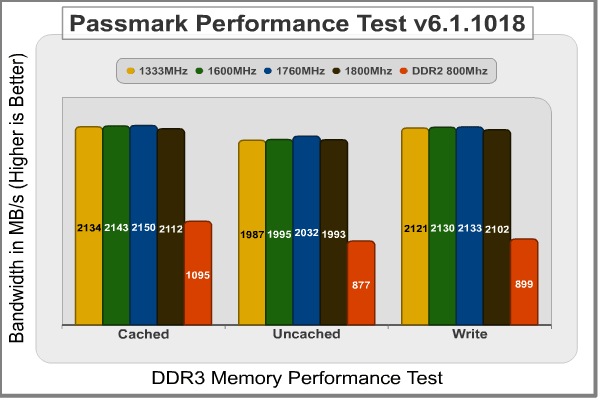
As you can see on the chart above, the Passmark memory tests show very little difference in bandwith when changing the clock speed of the Patriot Gamer Series DDR3 RAM. Across the board there were only very slight changes, similar to FPS results in gaming benchmakrs. In the cached test, the Patriot Gamer Series DDR3 Memory didn't even improve by 1% when moved up from the AMD standard 1333Mhz to an overclocked 1760Mhz. There was actually a performance decrease when moving to the 1800Mhz speed, probably due to the increased timings. The uncached and write tests show the same trend, with the highest performance gain coming in the form a 2.25% gain from the uncached memory test when overclocking the PGS34G1600ELKA to 1760Mhz. Again in both the latter tests, a performance decrease was realized when overclocking to 1800Mhz.
The real story here, however, is the superb performance increase the Patriot Gamer Series DDR3 Enhanced Latency Kit provided over the DDR2-800Mhz memory kit. The performance increase from the cached memory test was almost 95%. The uncached test showed an increase in performance of over 126% and the write test had the most impressive gains at nearly 136%. These excellent increases are from comparison with the lowest (1333Mhz) speed tested for the Patriot Gamer Series Memory Kit. When compared to the highests scores at 1760Mhz, the difference is even clearer. If there was ever a question of whether or not it is worth the extra price to upgrade from a DD2 Kit to the Patriot Gamer Series DDR3 Memory Kit, let that be put to rest now.
EVEREST Ultimate Edition offers three simple memory bandwidth tests that focus on the basics; Read, Write, and Copy. In order to avoid concurrent threads competing over system memory bandwidth, the Memory benchmarks utilize only one processor core and one thread.

The Everest Read benchmark measures the maximum achievable memory read bandwidth. The code behind this benchmark method is written in Assembly and it is extremely optimized for every popular AMD and Intel processor core variants by utilizing the appropriate x86, MMX, 3DNow!, SSE, SSE2 or SSE4.1 instruction set extension. The benchmark reads a 16 MB sized, 1 MB aligned data buffer from system memory into the CPU. Memory is read in forward direction, continuously without breaks.
As is expected, the Lavalys Everest test shows us a wider range of performance boosts when overclocking the Patriot Gamer Series Memory Kit. From low to high on the read test, the difference in performance raises by nearly 33%. It would appear that increase in timings doesn't have as much affect on the Lavalys test suite as it seems to in the Passmark tests. As we can see again with the Everest read tests, the performance gain realized from upgrading from the DDR2 memory to the faster Patriot Gaming Series DDR3 memory gives us a 31% increase at worst, and a 74% increase at best.
The Everest Write benchmark measures the maximum achievable memory write bandwidth. The code behind this benchmark method is written in Assembly and it is extremely optimized for every popular AMD and Intel processor core variants by utilizing the appropriate x86, MMX, 3DNow!, SSE or SSE2 instruction set extension. The benchmark writes a 16 MB sized, 1 MB aligned data buffer from the CPU into the system memory. Memory is written in forward direction, continuously without breaks.
The write test, while flattening out the performance increases of the Patriot Gamer Series Kit at higher speeds just a little more than the read test, still shows that the bar is raised from slowest to fastest speeds by nearly 30%. Increases over the older DDR2 memory range from 56% to a 103% performance gain when compared to the Patriot Gamer Series overclocked at 1800Mhz.
The Everest Copy benchmark measures the maximum achievable memory copy speed. The code behind this benchmark method is written in Assembly and it is extremely optimized for every popular AMD and Intel processor core variants by utilizing the appropriate x86, MMX, 3DNow!, SSE, SSE2 or SSE4.1 instruction set extension. The benchmark copies an 8 MB sized, 1 MB aligned data buffer into another 8 MB sized, 1 MB aligned data buffer through the CPU. Memory is copied in forward direction, continuously without breaks.
The copy speeds test continues the trend in the Everest suite of showing us significant performance increases through raising the clock speed of the Patriot Gamer Series Memory Kit. From 1333Mhz to 1800Mhz, there is a 20% gain in bandwidth speeds. While this is the lowest increase we have seen in the Everest suite, it still represents a very valid rise in performance for the easy work of slightly overclocking the PGS34G1600ELKA memory. Again, the gains when compared to the DDR2 memory are significant at 34% compared to the 1333Mhz DDR3 memory and 61% against the overclocked 1800Mhz speeds.

Sandra is based on STREAM, a popular memory bandwidth benchmark that has been used on personal computers to super computers. It measures sustained memory bandwidth not burst or peak. Therefore, the results may be lower than those of other benchmarks. STREAM 2.0 uses static data (about 12M) - Sandra uses dynamic data (around 40-60% of physical system RAM). This means that on computers with fast memory Sandra may yield lower results than STREAM. It's not feasible to make Sandra use static RAM - since Sandra is much more than a benchmark, thus it would needlessly use memory.
A major difference is that Sandra's algorithm is multi-threaded on SMP/SMT systems. This works by splitting the arrays and letting each thread work on its own bit. Sandra creates a thread for each CPU in the system and assigns each thread to an individual CPU. Another difference is the aggressive use of scheduling/overlapping of instructions in order to maximize memory throughput even on "slower" processors. The loops should always be memory bound rather than CPU bound on all modern processors.
The float and integer performance tests from the SiSoftware Sandra suite give us the same impression that the Everest suite gave. We notice a improvement in performance based on the clock speeds of the Patriot Gamer Series Memory Kit. The two SiSoftware tests are very close to one another and show the same trend in the performance of the memory. For the integer test we notice nearly a 30% increase from lowest to highest clock speeds and the float test gives us a little over 30%. The show stealer, once again, is the DDR2 to DDR3 performance gain, at between 71% and 121% on the integer test and between 74% and 126% on the float test.

PCMark Vantage Advanced and Professional Editions include additional test suites covering consumer scenarios such as digital photography and video, HDTV and movies, gaming, music, communications and productivity performance as well as specific storage system tests. Memories Suite measures the system's performance when handling digital photos and video.
While the PCMark Vantage Memory Test gives us a performance increase based on the higher clock speeds up to the overclocked 1760Mhz setting, it appears once again that the slower timings have affected the score at the higher 1800Mhz, causing a slight decrease in performance. Even so, the increase from 1333Mhz to 1760Mhz is very respectable at 24%. The Patriot Gamer Series Memory Kit also registers a low gain of 46% and a high gain of 81% over the slower and older DDR2 memory kit.
Patriot DDR3 Final Thoughts
With the rapid spread of DDR3 memory and its lowering prices, it is important to find a perfect fit for your system. Many users upgrading their older systems may be tempted to stick with their old DDR2 memory due to the fact that it is one piece that is still compatible, even a few years later. While this is an option for keeping prices down, one must weigh the performance benefits against the increased costs. In this review of the Patriot Gamer Series DDR3 1600Mhz Dual Channel Memory Kit, we were able to see that the performance increase over DDR2 memory is significant.
Another benefit of more recent memory kits is that they are being specifically manufactured to work with your system. As we saw with this Patriot Gamer Series Kit, it was engineered to work best with AM3 motherboards, and more specifically with Black Edition AMD Processors. A computer enthusiast using an AMD system and desiring to get the most from it will find that the Black Edition Gamer Series Memory Kit provided by Patriot is a great choice to complement their system.
We were able to get the PGS34G1600ELKA to overclock very easily 1800Mhz, albeit at the expense of higher timings. Even so, with a little more work and dedication, I'm quite confident that 1800Mhz can be reached with lower timings due to the fact that we never pushed the memory voltage core higher than 1.65v. The Patriot Gamer Series Memory performed extremely well, with very impressive bandwith gains over the older DDR2 memory. While we have mentioned the irony between the naming of the Patriot Gamer Series and its corresponding gaming performance increases, it is important to note that with more tweaking and experimentation with the timings and speeds, it is likely that some measurable performance increase could be made to modern games. Also, using the current and future BEMP data uploaded by Patriot for use with this memory kit may offer more significant gaming performance. Regardless, I can't think of a single gamer I know that only uses their computer for gaming. Performance increases for every other aspect of computer usage that depends on memory bandwidth will see improvement with the Patriot Gamer Series Memory Kit.
While many hardcore computer gamers are overclocking enthusiasts, and vice versa, plenty of us play few games while still enjoying the challenge of pushing our system to the limit. The Patriot Gamer Series Black Edition Ready Memory Kit has certainly proven its value and the performance increase when upgrading to and overclocking the PS34G1600ELKA will be noticeable. If you are using a 965 or 955 Black Edition processor paired with the kit, the overclocking work is easier than ever. The higher voltage threshholds on the Patriot Gamer Series DDR3 Memory Kit are obviously meant for AM3 motherboards, and offer an even wider range of overclocking capabilities.
Patriot Gamer Series Conclusion
Though the name of the Patriot Gamer Series DDR3 Memory Kit may be misleading because it doesn't directly affect the FPS we see in games, the PGS34G1600ELKA kit is, nevertheless, an excellent performer. Any gamer or enthusiast will undoubtedly notice a performance increase in there system by upgrading to and/or overclocking the Patriot Gamer Series Memory Kit. Additionally, any computer user looking to upgrade their system and push its limits would be well advised to look at the Patriot Gamer Series as a viable option.
The performance of the Patriot Gamer Series was undeniable. Moving from older DDR2-800Mhz memory to DDR3-1600Mhz and higher speeds provided by the PGS34G1600ELKA improved system performance by a very noticeable amount at the very least, to more than double at the most. The Patriot Gamer Series did everything it was supposed to, and even operated above its rated 1600Mhz speeds while still running under the 1.8v maximum rated voltage.
The Patriot Gamer Series DDR3 Memory Kit offers a visually appealing experience for any RAM shopper. The green splash on the front of the box and the DIMM itself scream AMD compatibility, even if you were to miss the Black Edition logo. The black PCB pairs well with the same colored heat spreaders that are shaped in true Patriot fashion, rising up above the RAM itself. While this may cause issues for the functionality of the Patriot Gamer Series RAM, there is no questioning the fact that it certainly looks cool.
Though those looks may be important, the construction of the DIMM is even more vital. The heatspreaders on the Patriot Gamer Series Memory Kit are actually two pieces, one fitted to each side of the PCB. There are no protruding clips or nubs on the outside of the chip, but the top of the one of the PGS34G1600ELKA DIMMs I tested was slightly offset. It gave the appearance of a pair of DIMMs with a gap between it's front teeth. While that may work for some superstars, it makes for the possibility that the RAM might catch on some of the stray wires stretched across the motherboard. This happened to me on one occasion only, and shouldn't happen often at all unless your constantly changing out your RAM.
The only real issue that I had with the functionality of the Patriot Gamer Series Memory Kit was that it impeded slightly the placement of the CPU cooler fan. I use a Scythe Mugen-II CPU cooler and generally place the fan to where it situates over the top of the two RAM slots closest to the CPU slot. Luckily for me, ASUS recommends using the two RAM slots closest to the motherboard power connector when overclocking. This at least allowed the fan to fit on that side of the CPU cooler, but the second DIMM of the Patriot Gamer Series pair still pushes up the CPU fan slightly. Another disappointing issue is that the Patriot Gamer Series BEMP only works with 965BE and 955BE processors.
DDR3 memory is getting much more affordable these days. While the $129.99 pricetag for the Patriot Gamer Series Memory Kit at NewEgg is a little higher that some other 4GB (2x2GB) DDR3 memory kits, the Patriot Gamer Series makes up for the difference in a couple of ways. First, the Gamer Series Memory Kit is rated for 1600Mhz, higher than many lower priced kits. Also, the PGS34G1600ELKA is specifically engineered for enhanced performance with AM3 and Black Edition Processors. This gives it a distinct advantage for AMD Overdrive users. Additionally, the voltage rating on the Patriot Gamer Series Enhanced Latency Kit is 1.8v, quite a bit higher than you see on a lot of kits. This screams overclockability, making the Gamer Series Memory Kit a great choice for overclockers.
If you are upgrading your computer and considering sticking with your DDR2 memory, I urge you to change your mind. If you are a gamer or enthusiast who looks to pull every available ounce of performance out of your system, the Patriot Gamer Series Memory Kit is a great choice for you. Overclocking with the BEMP is easier than ever and even if you are overclocking manually, the Patriot Gamer Series Memory kit makes that quick, painless, and a lot of fun.
Pros:
+ BEMP Support
+ 1600Mhz and higher speeds
+ 1.8v Voltage Rating
+ Relatively low (CL9) latency when Overclocked
+ Lifetime Warranty
+ Great heat dispersion, no problems with overheating
Cons:
- Very tall heatspreaders
- BEMP only works with 965BE and 955BE
Ratings:
-
Performance: 9.50
-
Appearance: 9.00
-
Construction: 8.50
-
Functionality: 7.00
-
Value: 9.00
Final Score: 8.6 out of 10.
Recommended: Benchmark Reviews Seal of Approval.
Questions? Comments? Benchmark Reviews really wants your feedback. We invite you to leave your remarks in our Discussion Forum.