
NZXT Sentry Mix Fan Controller
NZXT Sentry Mix Fan Controller Review
Manufacturer: NZXT
Product Name: Sentry Mix
Model Number: SEN-MIX
Price As Tested: $36.99 (Newegg)
Full Disclosure: The product sample used in this article has been provided by NZXT.
Have you ever turned your computer off, and noticed suddenly, just how quiet the room became? It is pretty amazing how loud those fans are when you compare their humming to pure silence. Many cases these days are built with silence in mind, but some are not designed to attenuate the noise. And, in some cases, the enthusiast, has purposely placed additional fans inside the case in order to wring out every last ounce of air overclocking they can get. But eventually, the incessant whine of the fans begins to bother, yes, even annoy. It is at that point, when having a fan controller becomes particularly useful. NZXT has released the Sentry Mix Fan Controller.
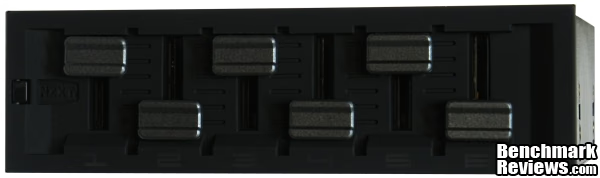
The Sentry Mix has 6 channels. Each channel is up to 50 watts. Those are some pretty big numbers considering many fan controllers can only handle 10 to 30 watts per channel. It also has some cool LEDs that illuminate the channel number in any of 5 different colors. When this particular fan controller arrived, there were several criteria that were needed to effectively review it. Does it have a quality build? Does it include any extras like temperature and RPM monitoring? Does it prevent fan stalling or have alarms for fan stalling? Are the voltages solid? Now that we have a decent list of criteria let us investigate the Sentry Mix.
NZXT is "a company built upon gamers dreams, hopes to create products that put consumers first. With the objective of designing unique products catered for hardware enthusiasts and gamers, NZXT has grown into a globally renowned brand recognized for dedication towards creating the next great gaming product."
NZXT Mix Features*
-
6 channels
-
50 Watts per channel
-
5 different colors (Red, Green, Blue, Orange, White) for channel illumination.
-
Uses only one 5.25” external drive bay
-
Slide Controls
-
3 pin connectors for each channel
-
40% minimal voltage
-
Voltage Control
NZXT Mix Specifications*
|
Material Type |
Plastic and Rubber |
|---|---|
|
Color |
Black |
|
Dimensions |
Fits 5.25” ODD |
|
Panel |
Slides |
|
Fan Channels |
6 |
|
Connections |
3 pin |
|
Watts |
50W/Channel |
|
Manual |
Min 40% |
|
Control |
Voltage |
* Features and specifications per box literature.
Closer Look: Exterior
The Sentry Mix is somewhat surprising in that if you look at many of NZXT's fan controller offerings, such as the NZXT Sentry LXE Digital Fan Controller, many of them are digital designs with many features. There is also the Sentry Mesh fan controller which is limited to 5 channels and 30 watts per channel. So, in some ways, the Sentry Mix is an evolution of the Mesh. The new design can handle up to 50 watts per channel, covers 6 channels and even has some lighting effects.

Here we see the front view of NZXT's Sentry Mix. The sliders control the voltage. They have a very good feel. There is no grinding or difficulty in moving them. However, unlike some fan controllers, there are no detents for maximum voltage and there is no way to shut off a fan completely. The detents are not necessary but they do give someone tactile feedback that they are (supposed) to be using 100% of available power.

The Sentry Mix comes with a 1 page manual (front and back) that explains how to install the fan controller and how to use it. There are four screws included for mounting to the external drive bay. It also comes in a nice box, and there was no damage to the contents.
Detailed Exterior Features
Ergonomically, the most difficult issue faced with the Sentry Mix, is the push button control to change the LED color. You will notice it is flush with the rubberized enclosure. This switch is on par with recessed reset switches for most computer cases, difficult to push accidentally, and in this case, to push on purpose.
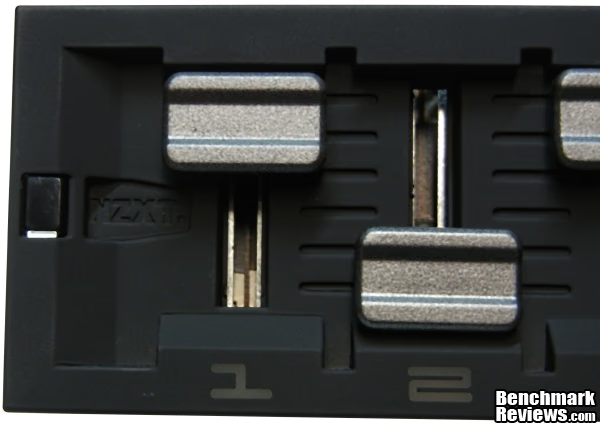
There are 5 colors. Each activated in turn by pressing the recessed switch, shown above on the left. If you hold down the button for 5 seconds you can also turn off / on the LEDs completely.
And now, a word about the digital camera used for these pictures. I am not entirely satisfied that I cannot reproduce the depth, brilliance and hue with the clarity that you, the readers, deserve. I have carefully compared these images with the actual light and tried with great difficulty to get it as close as possible to the actual color.
This is actually how the white LEDs look to the eye. You will notice there is a blue tinge to it. It appears this way because the LED used is combining multiple colors to achieve “whiteness”, and apparently this LED is strong in the blue side, giving the white color that bluish tinge.
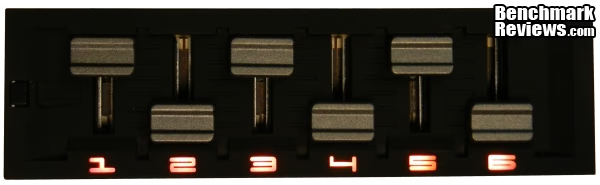
The orange LEDs appear washed out in real life. And this is reasonably close to how it looks. Alternatively, if you look at “red” below, it is certainly no more orange than that.
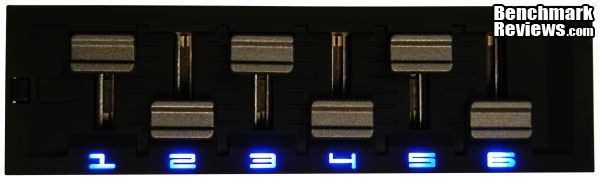
The blue LEDs are very impressive. The light is even deeper when viewed live.
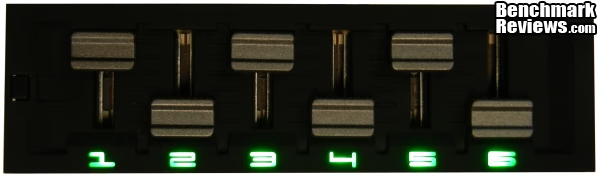
The green LEDs are also a little bit deeper and very impressive.
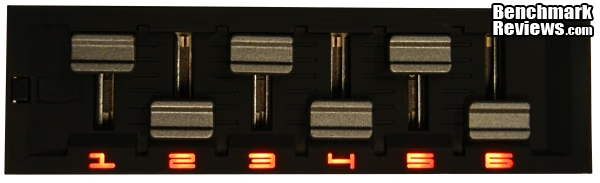
Here is where I must apologize, as my digital camera absolutely refused to take a quality red LED image. So, what you see above as orange... is actually supposed to look like the image below.
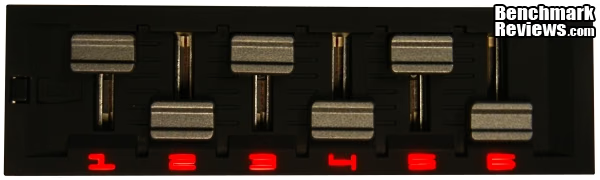
This image is color enhanced to show you just how nice the red LEDs look.
Closer Look: Interior Features
Here we come to the internals of the NZXT Sentry Mix. It comes with six 3 pin fan connectors. And 2 Molex connectors that are spliced into a 3 pin power connector that will be used to connect to the main PCB. On the first pass the overall build quality is good, but please see my many comments below for more detail. All the connectors fit snugly and without difficulty, with the exception that channel 1 is positioned such that removing the connector once it is on, is not so easy. This could be alleviated if the connector on the PCB had been rotated 180 degrees. The included cables are nicely tucked away, but can extend to approximately 28.5 inches.
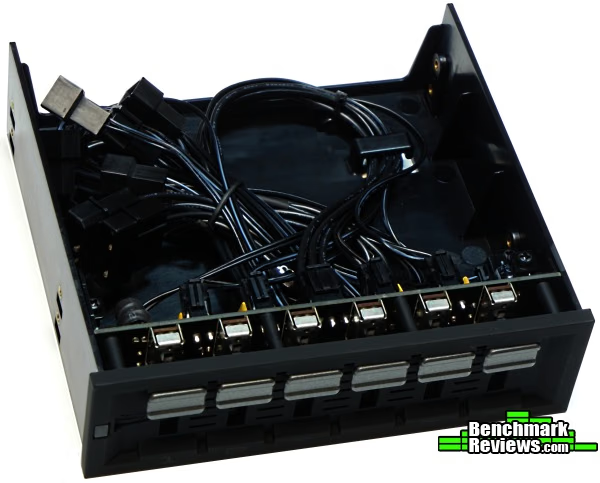
Here we have a perspective view of NZXT's Sentry Mix Fan Controller. It has standard external drive mounting positions. There is not much to see on the outside looking in, so we move to the detailed interior features.
Here we have the PCB, currently in revision 4.0, though it might be difficult to see from this image. Many of the components are unmarked as this is a pre-release sample. Some of the capacitors are labeled “Qunlo”, some are labeled “china” and for some I could not find any identifiable markings.
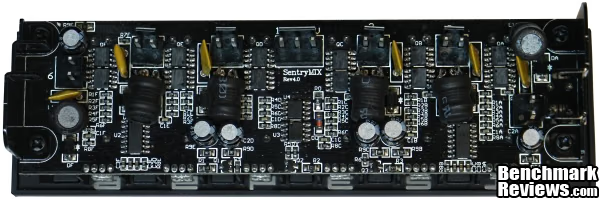
Overall, the layout is pretty good. As mentioned, the one area that was problematic was connector for channel 1, because it is rotated such that the latch is right against the mounting screw for the board, making it difficult to remove if you wanted to remove the wiring.
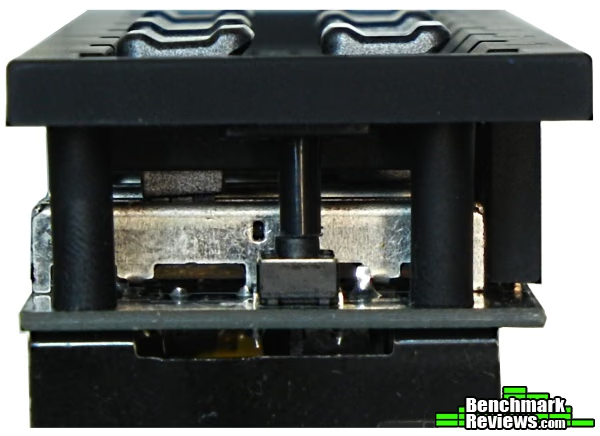
Here is the switch for the LED colors. If the switch was just a little less recessed it would be do just fine.
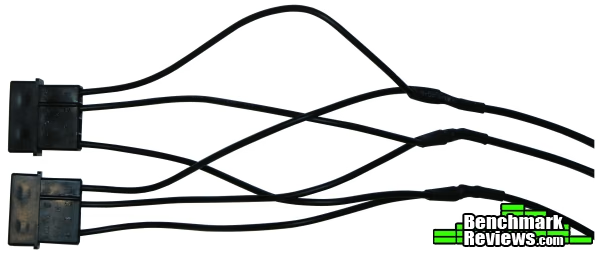
The Sentry Mix is designed for 50 watts per channel. If an end-user were to ever actually use the full rating of the fan controller, that would be 300 watts. However, if you visit the site for Molex, and check out the spec for the maximum Ampacity of a Molex connector, you will find that it is rated for only 10 amps or if you visit your wiki, you can see Molex 8981 Series is rated at 11 amps per pin. It's somewhat confusing that such a ubiquitous connector has so many disparate values for ampacity. Nevertheless, the interesting thing is that basically, a Molex connector is limited to somewhere around 10 to 11 amps.
The formula for Power (watts) = I * V where power is watts, and I = amps, and V = voltage. So, a little math shows us that 300 Watts = I amps * 12 volts (the operating voltage of the controller).
We solve for I, and get 25 amps. Perhaps, there is something missing here, (and I will be more than glad to change these calculations if someone can provide reasonable proof of error), but it appears that the 2 Molex connectors are under sized for the maximum rating of the controller by about 3 to 5 amps (depending on who you believe, Molex or the Wiki).
Finally, the wire used to splice the Molex connector into the 3 pin connector was 16 AWG. According to the Handbook of Electronic Tables and Formulas for American Wire Gauge, the maximum is 22 amps for 16 gauge hookup wire. So, again, it appears the wiring is just slightly under sized for the maximum continuous rating of 50 watts per channel. We have forwarded this concern to NZXT and we are waiting on the final response.
Test Results
I simply don't have six 50 watt 3 pin fans floating around, and I doubt any typical user or even enthusiast has them. Instead, testing revolved around some basic tenets. If I had a fan controller I would want the controller to detect stall, or at a minimum provide enough voltage at the lowest setting to prevent fan stall. Fans that are stalled our (not rotating) can be a problem because they are still receiving current and they are not moving air. Eventually your components can over heat, which results in an early demise. Does the controller have an alarm for stall conditions? Does the controller provide a good minimum voltage and a solid maximum voltage during operation? Fans are not as susceptible to minor voltage fluctuations as other components, so only a multimeter was employed for checking voltages.
|
Min Voltage VDC |
Max Voltage |
Min Voltage VDC |
Max Voltage |
Fan rotation |
|
|---|---|---|---|---|---|
|
Channel 1 |
5.01 |
9.6 to 12.0* |
4.59 |
9.7 to 12.0* |
Stalled |
|
Channel 2 |
5.02 |
9.6 to 12.0* |
4.59 |
9.8 to 12.0* |
Stalled |
|
Channel 3 |
5.02 |
9.6 to 12.0* |
4.57 |
9.77 to 11.97* |
Stalled |
|
Channel 4 |
5.01 |
9.6 to 12.0* |
4.59 |
9.59 to 11.77* |
Stalled |
|
Channel 5 |
5.01 |
9.6 to 12.0* |
4.59 |
9.79 to 12.00* |
Stalled |
|
Channel 6 |
4.98 |
12.03 Steady |
? to 12.01** |
12.01 steady |
Stalled |
DC supply measured consistently at 12.3V.
Fan tested 12 VDC, .16 Amp, 1.9W DC Brushless
Channels 1 thru 5 consistently varied from around 9.7 to 12 volts (+/- a few tenths), while under load. The pattern was always the same, slowly rising voltage followed by slowly decreasing voltage. Honestly, I had hoped for a much more steady regulation. To rule out supply side issue I ran a check on the input side, and it was a rock steady 12.3 VDC. This cycle of up and down occurred from 3 to 5 seconds.
The first test was simply the stall test, and no voltages were measured. Each and every channel stalled out the fan at the lowest setting. During that time, I noticed that channel 6 was a bit off, in that as I was adjusting the slide, it would run the fan faster than at maximum slider position. After that, I ran the Max Load voltage and Min Load voltage tests, only to discover that channel 6 did not want to change despite the slider position. I suspect there is an issue with the potentiometer, and hopefully this won't be a recurring issue for release versions of the controller.
Final Thoughts
The NZXT Sentry Mix is a step up from the Sentry Mesh fan controller. It has 6 channels rated for 50 Watts per channel. It also includes multicolor LED channel illumination. Installation was easy.
I am concerned about a couple of issues that came up during my review. The first is that use of the 2 Molex connectors spliced together in attempt to meet the power requirements of the controller. This controller should be capable of handling 50 Watts x 6 channels, totaling 300 Watts. But, 2 Molex connectors and 16 AWG wiring on the input side, don't seem to be able to handle that much continuous power. This issue has been sent to NZXT and we await their final response.
Another issue that occurred during testing: I had expected the voltages to be relatively stable during testing. But in fact they varied significantly.
The potentiometer on channel 6 seems to have become defective during testing, resulting in a continuous maximum voltage output.
NZXT Sentry Mix Conclusion
IMPORTANT: Although the rating and final score mentioned in this conclusion are made to be as objective as possible, please be advised that every author perceives these factors differently at various points in time. The author's experience with the product may differ significantly from your own. While we each do our best to ensure that all aspects of the product are considered, there are often times unforeseen market conditions and manufacturer changes which occur after publication that could render our rating obsolete. Please do not base any purchase solely on our conclusion, as it represents our product rating specifically for the product tested which may differ from future versions.
The NZXT Sentry Mix has a simple black rubberized exterior. The LED colors look very good, except perhaps that the orange is a bit washed out.
50 Watts per channel is way more than enough for any enthusiast using air cooling. However, I must also say that most cases don't even come close to having fans that can pull 4 amps @ 12VDC, let alone 6 of those. Then comes the thought that, if you actually had a setup that used 4 amps per channel, could you ever consider lowering your fan speed assuming you need that much power to begin with, thus obviating the need for a controller altogether. The whole point of a fan controller is to lower the speed of the fan at the most basic level. As features get added, things like auto regulation of RPM to adjust for specific minimum and maximum temperatures can be achieved.
Unfortunately, the Sentry Mix has none of these advanced features. It also lacks a PWM channel, and also there's no RPM monitoring.
When considering the construction score, there is a deduction for the spliced Molex connectors and for the faulty Slider.
It is important to note that the negatives and the positives listed here may not be the same as your own. For example, I found the lack of RPM and Temperature Monitoring to be important in my rating. If you happen to be looking for a high watt fan controller without those bells and whistles, you can raise the score somewhat. Some people may be content with no alarms for stalled fans. My preference is to have an alarm, so I know when a fan is failing, so I don't toast my components. Each plus or minus listed should be measured by your own personal meter, and then you can decide if this controller is worth your money.
Also, many cases are using the larger 4 pin Molex connectors for their fans. It would make sense to at least include some adapters.
Realistically, if you are buying a fan controller, you probably want to see things like internal temperatures, and fan RPM, in addition to lowering your decibels.
Overall, for a basic fan controller, with decent but simple looks, 6 channels of control at 50 Watts each, at a cost of $36.99 (Newegg), this is moderately overpriced for the functionality. I much prefer fan controllers that include at least 1 channel of PWM, RPM and Temp monitoring, even if it means only 30 watts per channel. I would strongly consider moving up to NZXT Sentry LXE Digital Fan Controller or a similar controller, gaining more features at somewhat higher cost.
Pros:
+ 50 Watts per channel
+ 6 channels
+ Easy Installation
Cons:
- Watt rating exceeds Molex Rating.
- No PWM channel(s)
- No Temp or RPM monitoring.
- No Stall detection or Alarms
- Faulty Slider on Channel 6
- No 4 Pin Molex Adapters to fit majority of case fans.
- Widely varying output voltages.
Ratings:
-
Performance: 6.5
-
Appearance: 8.0
-
Construction: 6.5
-
Functionality: 6.5
-
Value: 6.5
Final Score: 6.80 out of 10.
Questions? Comments? Benchmark Reviews really wants your feedback. We invite you to leave your remarks in our Discussion Forum .
