

| Corsair Vengeance LP 16GB DDR3-1600 |
| Reviews - Featured Reviews: Memory | |
| Written by David Ramsey | |
| Monday, 12 December 2011 | |
Corsair Vengeance Low-Profile 16GB Quad-Channel Memory Kit Review
Manufacturer: Corsair Full Disclosure: The product sample used in this article has been provided by Corsair. The introduction of Intel's X79 chipset with its quad-channel memory controller coincides nicely with historic lows in memory prices. Corsair's recently introduced "Vengeance" line of peripherals includes products as diverse as headphones, mice, and even memory. Representing a lower-cost alternative to their "Dominator" memory line, Vengeance memory is offered with both high and low profile heat spreaders and several different speeds and timings. Benchmark Reviews tests the 1600MHz C8 16GB quad-channel low profile Vengeance kit against an assortment of other memory in this test. High performance memory is one facet of a high performance system; a balanced approach to system performance considers processor speed, the amount of memory (as well as the speed), the GPU (for gamers), and the storage device (hard disk or SSD). Enthusiasts commonly concentrate on one or two of these items to the exclusion of others, which leads to systems that produce great benchmarks scores in some instances but drag in others.
Vengeance LP DDR3-1600 Specifications
The main differences between Corsair's "Dominator" and "Vengeance" memory products are that the Dominator memory gets fancier, machined aluminum heat spreaders and some guaranteed degree of overclockability, while the Vengeance line makes do with sheet aluminum heat spreaders and no guaranteed overclockability. All Corsair memory comes with a lifetime warranty. So how does this kit perform? Let's find out... Closer Look: Vengeance LP DDR3-1600Corsair Vengeance LP CML16GX3M4X1600C8 memory is delivered in a nice box with each DIMM module in an individual closed plastic tray. You can choose red, blue, or black heat spreaders (there's also a special white, low-voltage version). And according to the photo on the box, it can even be used in systems without a CPU!
Corsair does not provide a height specification for the Vengeance LP modules, but if they did, it would probably be about 31mm.
The label shows the XMP profile specifications (1600MHz at 8-8-8-24) rather than the SPD specifications of 1333MHz, 9-9-9-24. But that's OK: you're going to run this memory at its XMP specs, right?
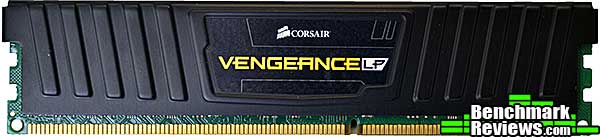
With black heat spreaders and a black label, the Corsair Vengeance LP memory is low-profile in more ways than one. Still, low-profile memory's a good idea for X79 systems, since almost any air cooler is going to overhang one or both of the banks of memory on either side of the CPU socket.
Join me as I explain my test methodology in the next section. Testing & ResultsTesting MethodologyI rounded up several new quad-channel memory kits to provide a basis for comparison. All kits comprised four 4GB DIMMs for a total of 16GB of memory. There was one DDR3-1333 kit, the Corsair Vengeance LP at DDR3-1600, and a Kingston HyperX kit at both 1866MHz and 2133MHz. I ran all the memory kits at their XMP profile speeds (the Kingston memory had two XMP profiles, one for 1866MHz and one for 2133MHz, so I tested with both) on an Intel X79 Express system using an ASUS X79 Sabertooth motherboard and an Intel Core i7 3960X processor running at its stock clock speeds. For this test I used three synthetic benchmarks to measure memory performance, and three application-based benchmarks to assess real-world performance. 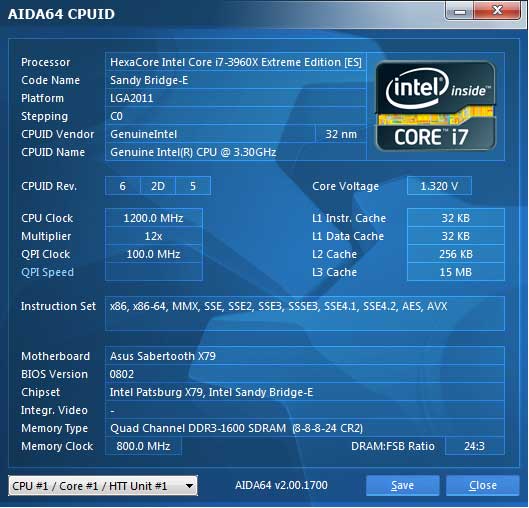
Test System
Test Software
Let's start with the synthetic testing... AIDA64 Memory TestBenchmark Reviews has used AIDA64 and its predecessor Lavalys Everest for years, mainly for its processor benchmarks and CPU stress-testing features. But it also includes a "Cache and Memory Benchmark" that performs read, write, and copy bandwidth tests on a system's installed memory. 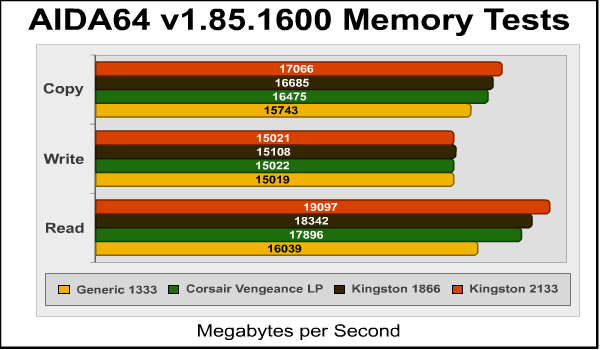
Corsair's Vengeance LP memory turns in noticeably better scores than the generic DDR3-1333 memory, especially in the read test where it's about 12% faster. It's narrowly edged out by the Kingston memory at 1866MHz, but more decisively beaten by the Kingston memory at DDR3-2133 speeds. Remember, though, that the Kingston HyperX DDR3-2133 16GB memory kit costs more than twice as much as the Corsair memory kit. NOTE: In my original tests C states were enabled because the test machine operated with the default BIOS settings. I re-ran the AIDA64 tests on the same motherboard and CPU used in this review, and used Kingston HyperX Genesis DDR3-2133 memory at enthusiast-level speeds.
C states enabled: read 18924, write 14995, copy 16914, latency 48.8ns The difference in write performance is a fraction over 1%, well within the margin of error of these tests. I conclude that at least with this motherboard and CPU, whether or not C states are enabled makes no difference in memory performance as measured by AIDA64's tests. SiSoft Sandra Memory TestSiSoft's Sandra Lite is a free version of SiSoftware's "Sandra" benchmarking utility. Its comprehensive memory benchmark tests report a number of items, but we're interested memory throughput tests. Unlike some other benchmarks that merely perform straight sequential reads and writes, Sandra reads and writes different areas of memory, using integer as well as floating point data, all in SMP mode. 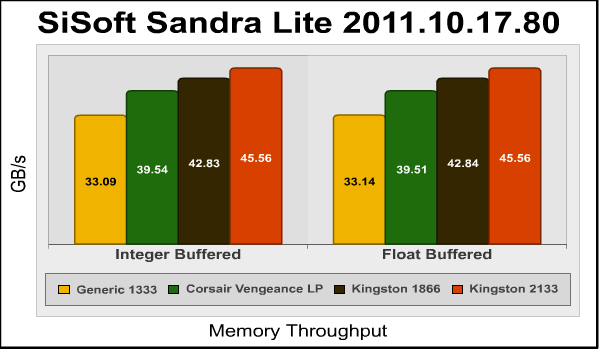
The Sandra memory test ranks the memory nicely by its speed. Latency doesn't matter much in this test, and the scaling evident in the results corresponds well with memory speed in MHz. Euler 3DEuler 3D is a Computational Fluid Dynamics (CFD) program that is multi-threaded and computationally very intensive. The benchmark version by Case Labs is built with the Intel FORTRAN compiler and uses 8-byte double precision floating-point math. The test case simulates Mach 0.5 airflow over a NACA 65A004 airfoil section. The benchmark score is the CFD cycle frequency, with higher scores being better. 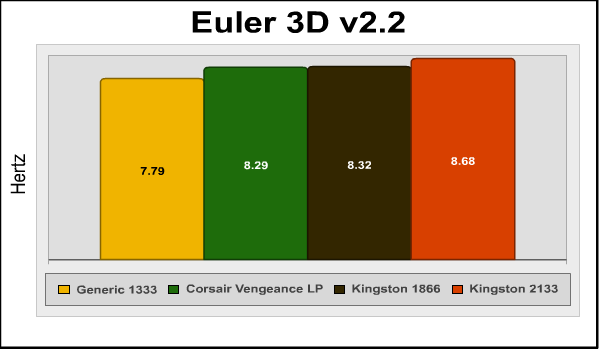
This benchmark kind of straddles with "synthetic" and "application" benchmark worlds. While the Kingston DDR3-2133 memory still wins, it's by a much narrower margin than on the pure synthetic tests. Note that negligible difference (about 1/3 of 1%) between the Corsair 1600MHz memory and the Kingston 1866MHz memory. Join me in the next section as I run the application benchmarks. CINEBENCH 11.5 Multi-Core Rendering TestMaxon CINEBENCH is a real-world test suite that assesses the computer's performance capabilities. CINEBENCH is based on Maxon's award-winning animation software, Cinema 4D, which is used extensively by studios and production houses worldwide for 3D content creation. Maxon software has been used in blockbuster movies such as Spider-Man, Star Wars, The Chronicles of Narnia, and many more. CINEBENCH Release 11.5 includes the ability to more accurately test the industry's latest hardware, including systems with up to 64 processor threads, and the testing environment better reflects the expectations of today's production demands. For this test I ran the multi-core rendering test, which resulted in 12 threads rendering the test scene. The CINEBENCH score is a dimensionless number that's only useful for comparison to other CINEBENCH results. 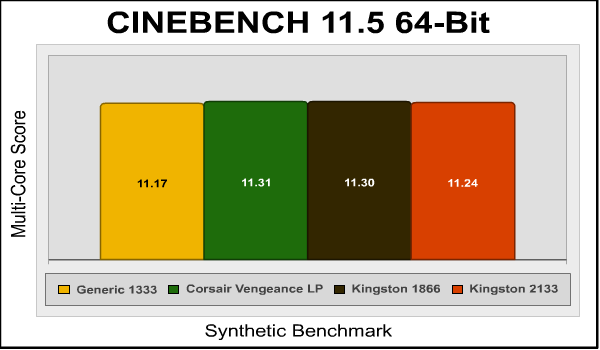
Here we see results that will be mirrored in the remaining two application benchmarks...virtually no difference in performance between the various quad-channel memory kits. Blender/IcetestBlender is an open-source, free content creation suite of 3D modeling, rendering, and animation capabilities. Originally released in 2002, it's available in versions for Mac OS X, Windows, Linux, and several Unix distributions. It supports rigid and soft-body objects and can handle the draping and animation of cloth, as well as the rendering and animation of smoke, water, and general particle handling. Our Blender test renders multiple frames of an animation of a rotating chunk of ice, with translucency and reflections. Rendering of this model uses ray-tracing algorithms and the program reports the rendering time for each of the animation's 25 frames. The results are a summation of the rendering times for all frames and the lower the score, the better. 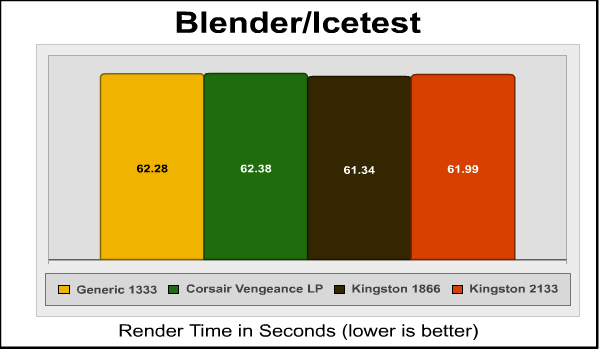
Memory speed makes little difference in this test. Oddly, though, the generic DDR3-1333 memory posts a better score than the Corsair 1600MHz memory, and the Kingston HyperX memory posts a better score at the lower 1866MHz speed. Still, the differences between the various memory kits are minimal. Handbrake 0.95The immense power (and cost!) of Intel's Sandy Bridge Extreme Core i7-3960X CPU virtually ensure that it will see a lot of video rendering and transcoding work, since this is one of the few applications that can really use the resources this processor has. My standard Handbrake test transcodes a standard-definition video of a Family Guy episode to the "iPhone and iPod Touch" presets. I report the time it took to perform the transcode in seconds; lower scores are better. 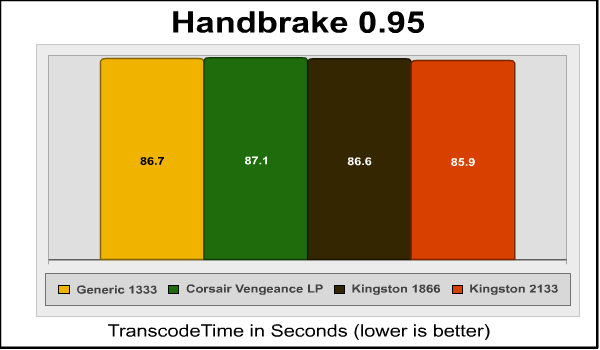
Here again we see razor-thin differences: Frankly, with only 1.2 seconds separating the best and worst scores, all scores can be considered equal within a reasonable margin of error. Corsair Vengeance LP Final ThoughtsA common mistake for enthusiasts to make is to concentrate on only a single aspect of system performance: a fast CPU can be hobbled by a low-end video card, or too little memory or hard drive space. Hard drive prices have skyrocketed in recent months due to the flooding in Thailand, which makes SSDs more attractive (although there's still a huge price differential). But while hard disk prices are up, memory has become absurdly cheap in the last couple of years, with prices as much as 80% lower than prices just two years ago. This is good news for computer users: it's now possible to buy 16GB of good memory for well under a hundred dollars from top-tier vendors like Corsair and Kingston. This CAS-8 memory kit represents a compromise between sub-$100 16GB kits, which typically have either slower speeds like 1333Mhz or looser timings like CAS-9, and more expensive high-performance kits that run at higher frequencies. 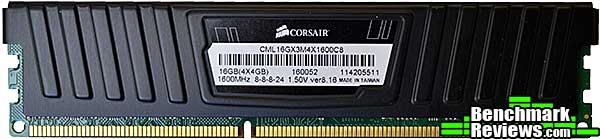
Still, as our tests have shown, there's little real world difference between various memory kits, even when the speeds and timings are dramatically different. This is because modern processors contain megabytes of cache memory (15MB in the case of the Core i7-3960X I used), and thus most memory requests will be satisfied from the cache, without accessing main memory at all, and even low-end CPUs these days typically have 2-4M or more of cache. Continuous accessing of system memory is simply quite rare in "real world" applications, while synthetic benchmarks are designed to do just that...which is why you see memory performance differences in these benchmarks, and not in applications. Enthusiasts should remember that having enough memory is much more important than having fast memory, and take advantage of current low prices. CML16GX3M4X1600C8 ConclusionThe whole point behind paying more for high-performance components, be they fast CPUs, killer graphics cards, SSDs, or performance memory, is to see this better performance in your system. The Corsair Vengeance LP 1600Mhz memory represents a middle ground in 16GB memory kits, with both its price and its performance falling neatly between the lower-end, sub-$100 kits and the high-speed kits like the Kingston HyperX Genesis 2133, which costs over twice as much. Corsair's own CAS-9 Vengeance 16GB quad channel kit CMZ16GX3M4A1600C9B has an MSRP that's $40 less than this kit, and I've seen it on sale for as little as $79.00. Enthusiasts will want to consider if the miniscule performance advantages of faster memory are worth the significant extra price. Construction quality was good, although the sheet aluminum heat spreaders aren't as substantial and visually impressive as those on Corsair's Dominator memory. Since performance is so similar for most DDR3 memory kits, vendors try to distinguish themselves on appearance and price. The Corsair Vengeance LP kit is comprised of about the plainest-looking modules you'll see short of kits with no heat spreaders at all. Anyone running this memory (on an Intel system) should select its XMP profile in their computer's BIOS for the best performance. Corsair doesn't currently offer Vengeance memory with AMD performance profiles but AMD users can manually set the same settings specified in the Intel XMP profile). The memory was stable during testing and even under benchmarking loads the heat spreaders were only warm to the touch. Functionality is excellent: the user can elect to run this memory at its default SPD-determined 1333MHz speed, but the guaranteed, albeit minor, performance improvement of 1600MHz is just a mouse click away. The low profile heat spreaders sacrifice visual bling for a noble cause: being able to fit any air cooler you want without worrying about clearance problems. This is a good tradeoff to make, especially on the X79 platform. Priced for $149.99 at Newegg, this memory is priced competitively with other kits of similar specifications from other vendors. Corsair offers a lifetime warranty on all their memory and has a well-deserved reputation for quality and support. The Vengeance LP 1600MHz C8 memory kit represents a good value for the performance-minded system builder who wants more than "base level" memory. Pros:
+ Low-profile heat spreaders won't present cooler clearance problems Cons:
- Your pay a lot more for that CAS-8 timing Ratings:
Final Score: 8.45 out of 10.Benchmark Reviews invites you to leave constructive feedback below, or ask questions in our Discussion Forum.
Related Articles:
|
|



Comments
Importantly, as the reviewer notes, you do not really see a perceptible difference between high speeds and lower latencies. It is good RAM, and the low profile heatsinks (which is all you need if you are going to run at 1600Mhz, these do not get hot at all, they are warm to the touch) enable them to fit even under large heatsink overhangs. Perfect.
enable C state tech and rebench please, the memory performance suffers greatly on Core i processors when C state tech is disabled.
In benchmarking tests the most important thing is consistency, so that users can judge the relative performance of the products being tested. All the memory in these benchmarks was tested on the same system with the same settings, so even if the C state thing is legitimate (and I will do more research on this), the results are comparable.
these write results are also a good deal less than what i've seen from other benchmarks using the C9 vengeance kit on lesser hardware (the C8 sticks should obviously be a little faster)
see
##pureoverclock.com/review.php?id=1216&page=5
Can you provide an example of a reproducible benchmark I can use to test this? If so I can incorporate it into future memory reviews.
C states enabled: read 18924,, write 14995, copy 16914, latency 48.8ns
C states disabled: read 18897, write 15082, copy 17101, latency 48.9ns
The difference in write performance is a fraction over 1%, well within the margin of error of these tests. I conclude that at least with this motherboard and CPU, whether or not C states are enabled makes no difference in memory performance as measured by AIDA64's tests.
"You can choose red, blue, or black heat spreaders (there's also a special white, low-voltage version)."
In any case I can only review what a vendors sends me. Corsair sent me a black memory kit, so that's what the appearance score was judged on.
Sigh.
#forums.aida64.com/index.php?/topic/292-c-state-tech-disabled-negatively-affects-memory-bandwidth-tests/page__p__1712#entry1712