
33-Way Thermal Interface Material Comparison
33-Way TIM Comparison Test
EDITOR'S NOTE: Since this article was first published March 2008, Benchmark Reviews has conducted a new set of tests in search of the best thermal pastes. Our results have been published in the 80-way Thermal Interface Material Performance Test review article.
Benchmark Reviews has seen a lot of products made for the purpose of delivering better performance. Some of these products exist for overclockers and enthusiasts, and often times help deliver performance out of otherwise tame hardware. Other products sometimes only deliver the empty marketing claim of improvements. Of all the products we have seen and tested, one particular category always stands out as the culprit for over-hyped promises: Thermal Interface Material (TIM). Of all the heatsink compounds and thermal pastes made and marketed, they must all only concentrate themselves to deliver the simple function of mating the CPU to the cooler with the highest thermal conductivity possible. Of course, some work better than others, and this is exactly what Benchmark Reviews intends to discover. Please join us for a comprehensive testing of 33 different TIM products.
In this 33-way Thermal Interface Material (TIM) performance test, we give equal attention to what could be the largest collection of heatsink grease, thermal paste, interface material, and thermal compound any test has ever seen in one comparison review article. The market is rife with fakes and wanna-be's, which is why it's our duty to ensure that only a very select few products receive the Benchmark Reviews seal of approval.
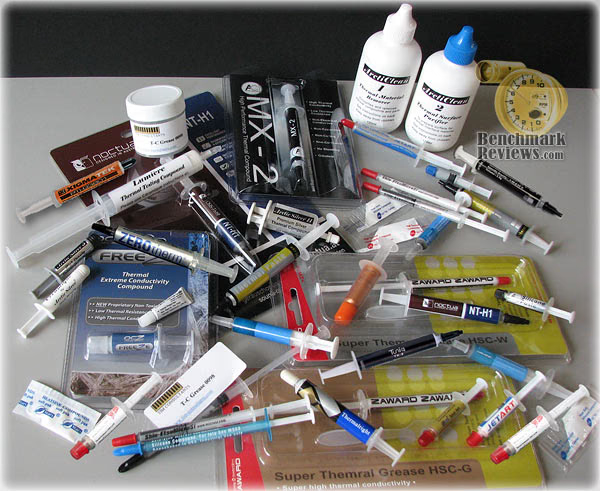
This project has been one year in the making, and the delays have been numerous. While some of our materials were supplied directly from the manufacturer (from lack of retail availability), most were purchased right off of store shelves (more specifically via web shopping). Although our collection is by no means a complete list of every thermal interface material produced, it is without question the largest assortment of real-world TIM products available. Many of the products listed below are new to the market, and only a scant few are out of production and included because of past popularity. Benchmark Reviews presents the first round of testing, comprised of the following products:
Thermal Interface Materials Tested
-
Antec Formula 5 Silver Thermal Compound (1)
-
Arctic Cooling MX-1 Thermal Compound (0)
-
Arctic Cooling MX-2 Thermal Compound (0)
-
Arctic Silver II Silver Thermal Compound (2)
-
Arctic Silver 3 Silver Thermal Compound (3)
-
Arctic Silver 5 Polysynthetic Thermal Compound (4)
-
Arctic Silver Ceramique (5)
-
Arctic Silver Lumiere (0)
-
Cooler Master HTK-002 Thermal Grease (0)
-
FrozenCPU Copper Thermal Compound (0)
-
Innovative Cooling Seven Carat Diamond (6)
-
Jetart CK4000 (0)
-
Jetart Thermal Compound (0)
-
Masscool Fanner-420 (0)
-
Masscool AK-100 Stars Heatsink Compound (0)
-
Noctua NT-H1 (0)
-
OCZ Freeze (0)
-
Rosewill RCX-TC050 (0)
-
Shin Etsu G751 (0)
-
Shin-Etsu Microsi Silicon Compound (0)
-
Shin-Etsu X-23-7762 (0)
-
SIL Heatsink Compound (0)
-
Stars 612 Copper Grease (0)
-
Startech Silver Grease (0)
-
Thermalright Chill Factor (0)
-
TIM Consultants T-C Grease 0098 (0)
-
Tuniq TX-2 (0)
-
Ultra Thermal Compound (0)
-
Xigmatek PTI-G3801 (0)
-
Zalman ZM-TG2 Thermal Grease (0)
-
Zaward HSC-W (0)
-
Zaward HSC-G (0)
-
ZEROtherm ZT-100 (0)
-
(0) No Curing Time or Special Application Suggested
-
(1) Antec Formula 5 Application Instructions (no curing time suggested)
-
(2) Arctic Silver II Application Instructions(48-hours minimum curing time recommended)
-
(3) Arctic Silver 3 Application Instructions (up to 200-hours recommended curing time)
-
(4) Arctic Silver 5 Application Instructions (up to 200-hours recommended curing time)
-
(5) Arctic Silver Ceramique Application Instructions (25-hours minimum recommended curing time)
-
(6) IC Seven Carat Diamond Application Instructions (10-minute evaporation time, 2-hour curing recommended)
Thermal Conductance is simply the transfer of energy from any particular source to a receptor. In the computer hardware circles this energy is heat, and the thermal transfer happens in key locations such as the processor and motherboard chipset controllers. In an ideal environment, this heat transfer would happen without a reduction in efficiency and without resistance. However it is because our performance products are often made from dissimilar metals that we must rely on a medium to connect the source and receptor with as little resistance as possible. A key factor in selecting a thermal interface material is the relationship between bond line thickness (BLT) and thermal resistance.
The importance of using a quality Thermal Interface Material is critical to improving thermal conductance between components. Even now as processors are built to stricter tolerances and consume less power, overclocking still demands the highest order of performance from the cooling equipment. As a byproduct of overclocking the processor, certain motherboard components such as the northbridge chipset must also mate together perfectly with the heatsink cooler to keep system bus speeds operating at a stable level. While CPU heat output is in decline, GPU heat output is steadily rising. Video cards are now the hottest item on the market, literally, and must be cooled with high-performance solutions to ensure the best video game graphics experience possible. Everything that creates heat relies on the cooler, but the cooler itself relies on the interface material to make a connection with very little thermal resistance.
This comparison review is very direct and to the point; and to this end, we have intentionally kept our article short and focused so that you can retain as much as possible. We hope you enjoy our efforts, and the research and testing conducted by Benchmark Reviews will allow you to achieve the overclock results you have always wanted from your performance computer system.
Thermally Conductive Element Reference
Manufacturers have made a small fortune off of misinformation and confusion tactics. Marketing departments often times neglect to refer back to solid science when making claims, which is why we have assembled a complete list of thermally conductive elements in the reference chart below.
It's very well known that Silver, Copper, Gold, and Aluminum together comprise top four most thermally conductive elements. However, without knowing the thermal conductance of these elements you might think the performance was close. As it turns out, Silver and Copper both offer nearly twice the performance of Aluminum when transferring thermal energy such as heat. Aluminum is the least expensive top-tier metal, which explains the popularity. Most Thermal Interface Material and CPU coolers use several different elemental ingredients to work together, but after a careful inspection of the performance levels it comes as a surprise to me that some of the most popular products make use of such poor conductors.
| Thermal Conductance | Element Name | Symbol |
|---|---|---|
| 4.29 W/cmK | Silver | Ag |
| 4.01 W/cmK | Copper | Cu |
| 3.17 W/cmK | Gold | Au |
| 2.37 W/cmK | Aluminum | Al |
| 2.01 W/cmK | Calcium | Ca |
| 2.01 W/cmK | Beryllium | Be |
| 1.74 W/cmK | Tungsten | W |
| 1.56 W/cmK | Magnesium | Mg |
| 1.5 W/cmK | Rhodium | Rh |
| 1.48 W/cmK | Silicon | Si |
| 1.47 W/cmK | Iridium | Ir |
| 1.41 W/cmK | Sodium | Na |
| 1.38 W/cmK | Molybdenum | Mo |
| 1.29 W/cmK | Carbon | C |
| 1.17 W/cmK | Ruthenium | Ru |
| 1.16 W/cmK | Zinc | Zn |
| 1.024 W/cmK | Potassium | K |
| 1 W/cmK | Cobalt | Co |
| 0.968 W/cmK | Cadmium | Cd |
| 0.937 W/cmK | Chromium | Cr |
| 0.907 W/cmK | Nickel | Ni |
| 0.876 W/cmK | Osmium | Os |
| 0.847 W/cmK | Lithium | Li |
| 0.816 W/cmK | Indium | In |
| 0.802 W/cmK | Iron | Fe |
| 0.718 W/cmK | Palladium | Pd |
| 0.716 W/cmK | Platinum | Pt |
| 0.666 W/cmK | Tin | Sn |
| 0.599 W/cmK | Germanium | Ge |
| 0.582 W/cmK | Rubidium | Rb |
| 0.58 W/cmK | Dubnium | Db |
| 0.575 W/cmK | Tantalum | Ta |
| 0.54 W/cmK | Thorium | Th |
| 0.537 W/cmK | Niobium | Nb |
| 0.506 W/cmK | Technetium | Tc |
| 0.502 W/cmK | Arsenic | As |
| 0.479 W/cmK | Rhenium | Re |
| 0.47 W/cmK | Protactinium | Pa |
| 0.461 W/cmK | Thallium | Tl |
| 0.406 W/cmK | Gallium | Ga |
| 0.359 W/cmK | Cesium | Cs |
| 0.353 W/cmK | Lead | Pb |
| 0.353 W/cmK | Strontium | Sr |
| 0.349 W/cmK | Ytterbium | Yb |
| 0.307 W/cmK | Vanadium | V |
| 0.276 W/cmK | Uranium | U |
| 0.274 W/cmK | Boron | B |
| 0.243 W/cmK | Antimony | Sb |
| 0.23 W/cmK | Hafnium | Hf |
| 0.23 W/cmK | Rutherfordium | Rf |
| 0.227 W/cmK | Zirconium | Zr |
| 0.219 W/cmK | Titanium | Ti |
| 0.2 W/cmK | Polonium | Po |
| 0.186 W/cmK | Radium | Ra |
| 0.184 W/cmK | Barium | Ba |
| 0.179 W/cmK | Promethium | Pm |
| 0.172 W/cmK | Yttrium | Y |
| 0.168 W/cmK | Thulium | Tm |
| 0.165 W/cmK | Neodymium | Nd |
| 0.164 W/cmK | Lutetium | Lu |
| 0.162 W/cmK | Holmium | Ho |
| 0.158 W/cmK | Scandium | Sc |
| 0.15 W/cmK | Francium | Fr |
| 0.143 W/cmK | Erbium | Er |
| 0.139 W/cmK | Europium | Eu |
| 0.135 W/cmK | Lanthanum | La |
| 0.133 W/cmK | Samarium | Sm |
| 0.125 W/cmK | Praseodymium | Pr |
| 0.12 W/cmK | Actinium | Ac |
| 0.114 W/cmK | Cerium | Ce |
| 0.111 W/cmK | Terbium | Tb |
| 0.107 W/cmK | Dysprosium | Dy |
| 0.106 W/cmK | Gadolinium | Gd |
| 0.1 W/cmK | Lawrencium | Lr |
| 0.1 W/cmK | Einsteinium | Es |
| 0.1 W/cmK | Berkelium | Bk |
| 0.1 W/cmK | Californium | Cf |
| 0.1 W/cmK | Fermium | Fm |
| 0.1 W/cmK | Curium | Cm |
| 0.1 W/cmK | Nobelium | No |
| 0.1 W/cmK | Americium | Am |
| 0.1 W/cmK | Mendelevium | Md |
| 0.0834 W/cmK | Mercury | Hg |
| 0.0787 W/cmK | Bismuth | Bi |
| 0.0782 W/cmK | Manganese | Mn |
| 0.0674 W/cmK | Plutonium | Pu |
| 0.063 W/cmK | Neptunium | Np |
| 0.0235 W/cmK | Tellurium | Te |
| 0.0204 W/cmK | Selenium | Se |
| 0.017 W/cmK | Astatine | At |
| 0.00449 W/cmK | Iodine | I |
| 0.00269 W/cmK | Sulfur | S |
| 0.00235 W/cmK | Phosphorus | P |
| 0.001815 W/cmK | Hydrogen | H |
| 0.00152 W/cmK | Helium | He |
| 0.00122 W/cmK | Bromine | Br |
| 0.000493 W/cmK | Neon | Ne |
| 0.000279 W/cmK | Fluorine | F |
| 0.0002674 W/cmK | Oxygen | O |
| 0.0002598 W/cmK | Nitrogen | N |
| 0.0001772 W/cmK | Argon | Ar |
| 0.0000949 W/cmK | Krypton | Kr |
| 0.000089 W/cmK | Chlorine | Cl |
| 0.0000569 W/cmK | Xenon | Xe |
| 0.0000364 W/cmK | Radon | Rn |
Recipes usually call for only the finest ingredients, and the very same pricipal is true for overclocker and hardware enthusiast products. Thermal pastes are often times mixed from at least a dozen different components, while heatsink coolers may use only one or two different metals. Armed with the knowledge above, you might expect any silver-based product to be a clear-cut winner... but building a superior product by design is different than what you receive in execution.
TIM Testing Methodology
In this comparison review article, it is the sole mission of Benchmark Reviews to test each product in a controlled environment in order to determine the maximum thermal conductivity which therefore translates into the best cooling performance. Almost all of these products have been collected over the past several months, so there will be no specific interest in one particular manufacturer. In our first series of tests, all thirty-three thermal interface materials were compared. Of those TIM's tested, only the top fourteen will move on to the second round of testing. In the third round of testing the top five will be compared.
One of the toughest parts of our benchmarking process was maintaining a temperature-controlled test environment. To establish a stable and consistent ambient room temperature, all of the testing hardware was partitioned off and the room was sealed. While we did our best to operate at exactly the same testing temperature for each product, there were very small fluctuations which resulted in fractional differences inside of one degree. As we progressed into the later stages of testing, the ambient temperatures were much tighter and more controlled.

Probably the most critical step in the testing process was the preparation. Thanks to the team at Arctic Silver, we were able to clean and prepare the surface of six brand-new stock Intel OEM heatsinks and Intel Core 2 Duo E6550 IHS (Integrated Heat Spreader) to a pristine state with their ArctiClean products. While these products are praised by product analysts like myself, they can be equally as useful for anyone who frequently separates the cooler from the CPU or frequently applies TIM material such as extreme overclockers and hardware enthusiasts.
Thixotropy
Thixotropy is a term which is sometimes used to describe the property of pseudoplastic fluids to show a time-dependent change in viscosity; the longer the fluid undergoes shear stress the lower its viscosity. A thixotropic fluid is a fluid which takes a finite amount of time to attain equilibrium viscosity when introduced to a step change in shear rate.
As we see progression in the area of Thermal Interface Materials, there has become a substantial increase in the number of manufacturers who embrace thixotropic TIM's. Many of these products make up the newest names on the market, and can be compared to the revelation that the Heatpipe Direct Touch technology has seen in the CPU cooler industry.
Even though nearly all of our TIM products were new, some had been sitting on the test shelf for a many months. Before each test the TIM material was mixed and agitated to ensure proper consistency. Silicon-based TIM's are more susceptible to the breakdown because of dissimilar compound bonds, and should always be mixed prior to use regardless of product age. Newer carbon-enriched silicon compounds seldom exhibit breakdown because of their thixotropic consistency (see definition above). Regardless, all test samples were aggressively mixed prior to application onto the CPU cooler. Once the product was prepared, it was applied onto the surface in a very thin coating and spread evenly.
Test System
-
Motherboard: Gigabyte GA-X48T-DQ6 (Intel X48 Chipset) with E BIOS
-
System Memory: Corsair PC3-14400 DDR3 1800MHz (Overclocked to 1844MHz)
-
Processor: Intel E6550 Core 2 Duo 2.33GHz (Overclocked to 3.23GHz)
-
Cooling: Intel OEM Aluminum Cooler with Copper Base
-
Disk Drive 1: Western Digital 74GB WD740ADFD 10,000 RPM SATA
-
Disk Drive 2: (Paging File): MemoRight GT MR25.2-064S 2.5-Inch 64GB SATA SSD
-
Optical Drive: Samsung SH-S203 SATA 20x DVD R/W
-
Operating System: Windows XP Professional SP-2 (optimized to 16 processes at idle)
Procedure Notes
Benchmark Reviews used the following hardware parameters for all of our test equipment:
-
Intel Speed Step Technology was disabled. The allows the processor to operate with normal power at all time, and does not reduce power or heat output.
-
All fan control mechanisms were disabled. The CPU cooler fan operated under 100% power, and did not adjust speed to match the temperatures.
-
The Gigabyte GA-X48T-DQ6 was enclosed in the Lian Li PC-B25B Black Aluminum Mid-Tower ATX Case and set on its side. This eliminates heat-rise as an influencing factor.
Cure Time
Do to the nature of our tests, no single Thermal Interface Material was allowed additional time to cure. Each test session would begin with a motherboard and idle temperature reading, followed by a system restart. Between the idle and load readings, only one thermal cycle was exposed, which would have no realized benefit to those materials requiring prolonged cure times.
Although only a couple of the items tested suggest it (on their website), we understand that certain interface products will exhibit improved thermal conductivity if they are allowed several temperate cycles to expand and contract the material. However, the best method to scientifically test each product was to either allow no cure time, or equal cure time to all test products. Because of the extremely long cure time one particular product recommends, this article would not have been possible if we allowed all test subjects the same benefit.
-
Arctic Silver II Application Instructions(48-hours minimum curing time recommended)
-
Arctic Silver 3 Application Instructions (up to 200-hours recommended curing time)
-
Arctic Silver 5 Application Instructions (up to 200-hours recommended curing time)
-
Arctic Silver Ceramique Application Instructions (25-hours minimum recommended curing time)
-
IC Seven Carat Diamond Application Instructions (10-minute evaporation time, 2-hour curing recommended)
In the final step of our testing, the test system utilized Lavalys EVEREST v4.20.1170 to stress all processor cores of the CPU to a point of maximum thermal output. After about four minutes, the processor would usually reach it's maximum heat output; however all of our test timelines last ten minutes in duration. The final maximum temperature is then recorded, and compared against the ambient room temperature for the differential temperature score.
EDITORS NOTE: Benchmark Reviews has published a new article since this one was released, titled Best Thermal Paste Application Methods. This article dicusses the various methods and patterns used on standard and Heat-pipe Direct Touch coolers.
TIM Testing: Round 1
At the beginning of this 33-Way Thermal Interface Material review, the list of products is overwhelming. Since each test consumes an average of twenty minutes of time from setup to tear-down, our test day was very long. Throughout the test period, critical environmental temperatures were carefully measured and adjusted using constant air circulation inside the room.
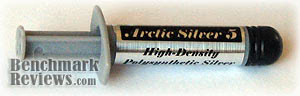
The TIM product testing was a daunting task, and one that I have been putting off for months now, but my light at the end of the tunnel was coming with the reduction of test products for round two. Some of my old favorites line the list, including several names from the Arctic Silver laboratory.
Product Name Description Amb/MB Amb/Idle Amb/Load Difference OCZ Freeze Aluminum Oxide 20.8/27 20.8/40 20.7/53 32 IC Seven Carat Diamond Aluminum Oxide 20.2/25 20.2/39 20.2/53 32 TIM Consultants T-C Grease 0098 Aluminum Oxide 20.4/26 20.4/39 20.4/53 32 Shin-Etsu X-23-7762 Aluminum Oxide 26.7/26 20.7/39 20.6/53 32 Shin-Etsu Microsi Silicon Compound Aluminum Oxide 20.6/26 20.6/39 20.4/53 32 Shin Etsu G751 Aluminum Oxide 20.6/26 20.7/39 20.6/53 32 Thermalright Chill Factor Silicon Oxide Grease 20.4/25 20.4/38 20.5/53 32 Noctua NT-H1 Silicon Oxide Grease 20.7/27 20.7/40 20.8/54 33 Zaward HSC-G Aluminum Oxide 20.7/24 20.6/40 20.6/54 33 Arctic Cooling MX-2 Aluminum Oxide 20.8/28 20.8/39 20.7/54 33 Arctic Silver 5 Polysynthetic Silver 20.5/26 20.5/39 20.4/54 33 Tuniq TX-2 Silicon Oxide Grease 20.5/27 20.5/40 20.5/55 34 Arctic Silver 3 Polysynthetic Silver 20.3/26 20.4/39 20.5/55 34 Arctic Silver 2 Polysynthetic Silver 20.0/25 20.0/39 20.1/55 34 Zalman ZM-TG2 Thermal Grease Silicon Oxide Grease 20.4/25 20.4/39 20.4/55 34 Jetart Thermal Compound Silicon Oxide Grease 20.6/26 20.6/39 20.6/55 34 Masscool AK-100 Stars Silicon Oxide Grease 20.8/27 20.7/39 20.6/55 34 Arctic Cooling MX-1 Silicon Oxide Grease 20.4/26 20.4/39 20.2/55 34 Arctic Silver Lumiere Silicon Oxide Grease 20.3/26 20.3/39 20.2/55 34 ZEROtherm ZT-100 Aluminum Oxide 20.6/25 20.7/39 20.6/55 34 Zaward HSC-W Silicon Oxide Grease 20.9/28 20.9/39 20.8/55 34 Arctic Silver Ceramique Zinc Oxide Grease 20.6/25 20.6/42 20.7/55 34 Antec Formula 5 Polysynthetic Silver 20.3/26 20.3/39 20.3/56 35 Startech Silver Grease Polysynthetic Silver 20.4/25 20.5/41 20.5/56 35 Ultra Thermal Compound Silicon/Carbon Synthetic 20.7/26 20.6/40 20.5/56 35 SIL Heatsink Compound Silicon Oxide Grease 20.3/25 20.3/39 20.3/56 35 Jetart CK4000 Silicon/Carbon Synthetic 20.7/27 20.8/39 20.8/56 35 Xigmatek PTI-G3801 Silicon Oxide Grease 20.3/26 20.3/39 20.3/56 35 Rosewill RCX-TC050 Silicon Oxide Grease 20.4/27 20.4/40 20.4/56 35 Masscool Fanner-420 Silicon Oxide Grease 20.6/26 20.6/39 20.7/56 35 STARS 612 Copper/Silicon Grease 20.9/27 20.9/41 20.9/56 35 Cooler Master HTK-002 Silicon Oxide Grease 20.7/27 20.8/39 20.8/57 36 FrozenCPU Copper Compound Copper/Silicon Grease 20.1/25 20.1/40 20.1/61 40 (Tested by Benchmark Reviews: 01 March 2008)
Apparent from the abbreviated description I have included, the white silicon-based thermal grease products appear to be taking a back-seat to the darker carbon-synthetic compounds spreading onto the current market. Two of our TIM products were particularly interesting, because they consisted of a copper-based grease and looked exciting. In practical application however these interface materials performed the worst, and seemed more of a novelty than solution.
In the table above, Benchmark Reviews has arranged the results in order of lowest thermal difference between maximum heat output attained and the ambient room temperature. While there were small room-temperature fluctuations which may have skewed our results, we felt that selecting the top fourteen products would ensure that no worthy TIM would be neglected in our next round of tests.
TIM Testing: Round 2
The second day of our Thermal Interface Material performance comparison tests began with a sense of renewed faith in technology. For the most part, the carbon treated silicon compounds made up the largest segment of test products in our second round. Some were mere knock-offs of others, while others took to using very unique compositions to "improve" thermal conductivity. One particularly interesting product which proved itself worthy in round 2 was the IC Diamond thermal compound, which boasts a content of 92% pure diamonds by weight.
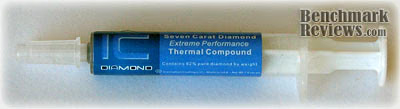
While the first day of testing proved to be the most tiresome, the second day brought us good fortune as the ambient room temperatures remained nearly identical the entire time. Nearly five hours of testing later, we had some very good results to work from. The difference in maximum loaded temperature output against the ambient temperature was beginning to narrow down and results were becoming very similar. Round two starts with fourteen, but it's going to end with five. Although the table below may not offer the "very best of the best" results just yet, I think it's still fair to admit that these products are among the finest quality available.
| Product Name | Amb/MB | Amb/Idle | Amb/Load | Difference |
|---|---|---|---|---|
| OCZ Freeze | 20.3/27 | 20.3/41 | 20.2/53 | 32.8 |
| Zaward HSC-G | 20.2/24 | 20.2/39 | 20.1/53 | 32.9 |
| Arctic Silver 5 | 20.3/26 | 20.3/38 | 20.1/53 | 32.9 |
| TIM Consultants T-C Grease 0098 | 20.0/26 | 20.1/39 | 20.1/53 | 32.9 |
| IC Diamond Seven Carat | 20.0/26 | 20.0/38 | 20.0/53 | 33.0 |
| Shin Etsu G751 | 20.0/26 | 20.0/39 | 20.0/53 | 33.0 |
| Thermalright Chill Factor | 20.0/25 | 20.0/38 | 20.0/53 | 33.0 |
| Noctua NT-H1 | 20.0/26 | 20.0/39 | 19.9/53 | 33.1 |
| Shin-Etsu X-23-7762 | 20.0/26 | 20.0/38 | 20.0/54 | 34.0 |
| Arctic Cooling MX-2 | 20.0/26 | 20.0/39 | 20.0/54 | 34.0 |
| Tuniq TX-2 | 20.0/26 | 20.0/38 | 20.0/54 | 34.0 |
| Arctic Silver 3 | 20.0/26 | 20.0/39 | 20.0/54 | 34.0 |
| Arctic Silver 2 | 20.0/26 | 20.0/38 | 20.0/54 | 34.0 |
| Zalman ZM-TG2 Thermal Grease | 20.0/26 | 20.0/39 | 19.9/54 | 34.1 |
| (Tested by Benchmark Reviews: | 03/02/08) |
While the first round helped to eliminate the good from the bad, there were still a few stragglers left in the mix. The Zinc-oxide based Zalman thermal grease would closest resemble the generic STAR or SIL packets from round one, and might possibly explain why it rounds out this list. Ironically, Thermalright's silicon-based thermal grease managed to run with the best of them and offer equally good performance. Although both of these white TIM's are included with CPU cooler products, you really never know if the manufacturer is packing a worthy interface material or just another grease.

Most of the results we received in the second round of testing matched the results from the first round. But we're after the very best, and nobody likes to read about the top-14 TIM's! So on we pushed, and cut out everything but the very best in preparation for the third and final round of testing.
With a full weekend spend testing several very messy thermal interface materials and running up a power bill, I was pleased to complete testing and announce the final five products. Now obviously, you could skip everything I am about to tell you, and just simply read the results and be on your way; but then you would miss my insider notes. This project started as a 33-Way Thermal Interface Material (TIM) Compound Performance Comparison Review, and it ends with only five, but there were several products that really deserve some credit for making it this far.
Although this each round of testing was very controlled, there will always be small differences discovered with each new test. Obviously one TIM might perform slightly different from test to test, but this final round is a collection of those products which proved themselves consistent performers.

In what I would consider the biggest surprise of the entire test series, the white silicon-based TIM provided with every Thermalright CPU cooler product really earned a name for itself. Most manufacturers enclose a small packet of white thermal grease with their coolers, while selling a premium product separately. Thermalright actually offers their very noteworthy "Chill Factor" thermal grease "for free", and I can appreciate that after spending so much on their product. It's a real shame that other manufacturers do not follow this lead, and match their premium cooling product with their premium thermal compound.
| Product Name | Amb/MB | Amb/Idle | Amb/Load | Difference |
|---|---|---|---|---|
| TIM Consultants T-C Grease 0098 | 21.2/27 | 21.2/39 | 21.2/53 | 31.8 |
| OCZ Freeze | 21.1/27 | 21.2/40 | 21.1/53 | 31.9 |
| Arctic Silver 5 | 21.1/27 | 21.1/40 | 21.2/54 | 32.8 |
| IC Seven Carat Diamond | 21.2/27 | 21.1/40 | 21.2/54 | 32.8 |
| Zaward HSC-G | 21.1/27 | 21.1/40 | 21.1/54 | 32.9 |
| (Tested by Benchmark Reviews: | 03/03/08) |
Other products did very well, but have very little chance of ever finding store shelves. Our finest example is the TIM Consultants T-C Grease 0098, which performed very well in each round of testing, but is available from an obscure website that seems as low-tech as you can find.
Our final five show a very diverse collection of compound materials: from diamonds to silver, carbon to aluminum, and zinc to silicon, there's a little of everything represented here. Obviously these manufacturers keep their recipe closely guarded and secret, as to avoid duplication by the competition. The final result is a wide array of interface materials which arrive at the same result using different techniques. The only key ingredient which appears shared in all of these top-tier products is the use of aluminum-oxide, which gives the darkened grey appearance and conducts energy very well between compound components.
Alternative Opinions
After this article was first published, there was an immediate backlash from some of the manufacturers listed in this review. The primary argument was the lack of cure time. Here is the Arctic Silver 5 recommended cure time instruction from the manufacturers web site:
Due to the unique shape and sizes of the particles in Arctic Silver 5's conductive matrix, it will take a up to 200 hours and several thermal cycles to achieve maximum particle to particle thermal conduction and for the heatsink to CPU interface to reach maximum conductivity. (This period will be longer in a system without a fan on the heatsink or with a low speed fan on the heatsink.) On systems measuring actual internal core temperatures via the CPU's internal diode, the measured temperature will often drop 2C to 5C over this "break-in" period. This break-in will occur during the normal use of the computer as long as the computer is turned off from time to time and the interface is allowed to cool to room temperature. Once the break-in is complete, the computer can be left on if desired.
So by my estimation of this statement it would take almost a year of normal use to properly cure the AC5 compound, or almost nine days of continuous power cycles to meet their recommendation. Benchmark Reviews feels that this is a characteristically unreasonable requirement for any TIM product, and we do not support it. We want products that perform without the burden of sacrifice on our time, especially with some many competing products offering performance without this extra requirement.
Some enthusiasts might seem left out, since this review concentrated its efforts on air-cooled solutions. By nature, air-cooled products do not create condensation between materials because they are always operating above ambient temperatures. There is good reason for the exclusion of liquid-cooled reference in this article, and that is because processors have reduced their thermal output to such a point to where air cooling today is more effective than liquid-cooling years ago.
Final Thoughts on Cooling
What began as a huge collection of products has worked its way to a narrow selection of premium Thermal Interface Materials. It may seem like a lot of testing for such a small difference in performance, but when everything you do relies on performance the research is always of great value. Even though the slight difference in thermal conductance among products is considered very important for hardware enthusiast and overclockers, your average user has very little to gain from aftermarket thermal interface materials.
Years back, the average computer system processor would consume almost twice the power it presently does... even without the additional cores. Nowadays (and I hate using that term) the vanilla computer system that receives no overclocking or additional voltage can operate considerably cool with the stock manufacturer-supplied cooler. This is evidence enough that CPU cooling has reached a delta, and the need for aftermarket cooling is, well, cooling.
But all of this has a lot to do with CPU coolers, and nothing to do with TIM's. Good thermal interface material is still the link between good performance from the cooling solution, or bad. Video cards are the next platform for aftermarket cooling, as the recently launched GeForce 8800 GT video card have helped to spawn dozens of aftermarket cooling solutions. Heatpipe Direct Touch may have revolutionized CPU cooling the way liquid cooling did over a decade ago, but now our attention must turn to graphics processors and their growing hunger for power.

TIM Mega-Roundup Conclusion
My biggest regret is not having a more powerful test system, and by system I don't mean computer hardware. You see, even with a heavy overclock on the most modern processor there just isn't enough heat produced to create a clearly evident divide between products. Telling the difference between products producing less than one degree of temperature variance isn't a perfectly accurate method, which is why a heat source that approaches boiling point would be best. Until that day arrives, you will have the better part of three days worth of testing to prove the point.
EDIT: Although cure time is only suggested for two of the thirty-three products listed in this review, it is understood that extended performance may be gained if the material is allowed proper thermal cycles to level the TIM. In a scientific comparison such as this one, all products must be compared "apples-to-apples" to ensure fair and comparative results. The average user can use this at face value, and the hard core overclocker or hardware enthusiast can use this as a basis for selecting potential materials for their own project.
Excellence Achievement Recipients: Benchmark Reviews Golden Tachometer Award
-
TIM Consultants T-C Grease 0098

-
OCZ Technology Freeze
TIM Consultants offers their T-C Grease 0098 product to OEM's and end-users alike, with packages available in syringe and large container sizes. Ultimately, they proved that producing a quality product will beat a quality marketing pitch, and narrowly claimed the top position in our final test. In a market that is overrun with advertising and hype, it's nice to see the little guy come out on top for a change. (Anyone care to guess how long it takes before they get bought out now?)
T-C Grease 0098 sure doesn't roll off the tongue, but thanks to its thixotropic properties the more I spread it the more viscous it became. I can see this being a favorite among overclockers and enthusiasts, as it was very easy to work with in comparison to other TIM's.
OCZ Technology is best know for their amazingly diverse system memory product line. Very recently though, they have expanded into high-performance system building with the acquisition of Hypersonic. This puts them in a perfect position to offer full-spectrum performance on every level.
The OCZ Freeze compound appeared to be identical to all other grey silicon-based carbon-enriched TIM's, yet somehow the lab coats managed to dope this product with all the right ingredients. I presume that this will be the most popular product of the bunch, since it can be purchased from a myriad of online stores such as NewEgg for only $6.49.
Quality Recognition Recipients: Benchmark Reviews Silver Tachometer Award
-
Innovation Cooling Seven Carat Diamond

-
Arctic Silver 5
-
Zaward HSC-G
I think that aside from TIM Consultants, Innovation Cooling might be the next least-known name in the thermal interface market. It has already been mentioned how the marketing dollar can often times outweigh the actual performance of a product, so I always cheer for the team the produces a product capable of impressive results.
IC's Seven Carat Diamond interface compound seemed to be identical to the others in appearance, in that it was a grey silicon-carbon mix, but is spread very thick and required effort to smooth. Nevertheless, it performed like a diamond in the rough rather than a rough diamond. Puns aside, whatever the clever folks at Innovation Cooling are using in their recipe, it works.
What would a Thermal Interface Material review be without Arctic Silver products being mentioned? In a land once dominated by their polysynthetic silver paste, it's good to see a little diversity in the final lineup. Arctic Silver has been a integral part of the hardware enthusiast family for over a decade, and their AC 5 product still stands the test of time (and temperature). Available almost everywhere that sales cooling products, NewEgg offers two sizes to answer personal and system builder needs.
Zaward has seen very little exposure in the United States, since they are based out of the UK. That hasn't stopped Benchmark Reviews from testing the very first Heatpipe Direct Touch products that were ever offered to the market when Zaward made their evolutionary step. Taking their HDT technology one step further (which is difficult since it is now used by nearly everyone), Zaward offers the HSC-G compound to help bridge the contact gap between bare copper heatpipe and CPU.
If you have any questions or comments regarding this article, Benchmark Reviews really wants your feedback. We invite you to leave your remarks in our Discussion Forum. It's the only way we can meet your expectations.
TIM Project Epilogue
Because of the overwhelming response to this article and with the assistance of manufacturer feedback, Benchmark Reviews has planned to revisit many of the top products which made it into round two of this project with similar test results. In this future "part II" article, each test will include a period of constant thermal cycling to allow for a basic cure time. Although this procedure would have been impractical with the large test group used in this article, it would be worth the effort to conduct on a more refined test group.
EDITORS NOTE: Benchmark Reviews has published a new article since this one was released, titled Best Thermal Paste Application Methods. This article dicusses the various methods and patterns used on standard and Heat-pipe Direct Touch coolers.
UPDATE 14 March 2008: Benchmark Reviews has read through a long list of suggestions from the community. In preparation for a second Thermal Interface Article using cure times, many of the original manufacturers were contacted for their suggestions. Surprisingly, only a select few products are said to 'require' curing; and nearly all manufacturers agreed that their product would need little more than a series of thermal cycles to level out the material. We have also added a few new names based on valuable community suggestions, and will be testing these products in our next article:
-
AI Technology Cool-Gel CGR7019 Non-Silicone Thermal Gel (0)
-
AI Technology Cool-Grease CGL8050 Non-Silicone Thermal Grease (0)
-
AI Technology Cool-Silver Non-Silicone Thermal Grease (0)
-
Antec Formula 5 Silver Thermal Compound (1)
-
Arctic Cooling MX-1 Thermal Compound (0)
-
Arctic Cooling MX-2 Thermal Compound (0)
-
Arctic Silver II Silver Thermal Compound (2)
-
Arctic Silver 3 Silver Thermal Compound (3)
-
Arctic Silver 5 Polysynthetic Thermal Compound (4)
-
Arctic Silver Ceramique (5)
-
Arctic Silver Lumiere (0)
-
Cooler Master HTK-002 Thermal Grease (0)
-
Cooler Master PTK-002 Thermal Grease (0)
-
Cooler Master R9-GE7-PTK3 NanoFusion (0)
-
CooLaboratory Liquid MetalPad (0)
-
CooLaboratory Liquid Pro (7)
-
Evercool STC-01 (0)
-
FrozenCPU Copper Thermal Compound (0)
-
GC Electronics Silcone Z9 (0)
-
GC Electronics Type 44 Non-Silicone (0)
-
GC Electronics HTC (0)
-
Innovative Cooling Seven Carat Diamond (6)
-
Jetart CK4000 (0)
-
Jetart Thermal Compound (0)
-
Kingwin White Freeze WF-2 (0)
-
Masscool Fanner-420 (0)
-
Masscool AK-100 Stars Heatsink Compound (0)
-
MG Chemicals 8463 Silver Conductive Grease (0)
-
MG Chemicals 860 Silicone Heat Transfer Compound (0)
-
MG Chemicals 8610 Non-Silicone Heat Transfer Compound (0)
-
Noctua NT-H1 (0)
-
OCZ Freeze (0)
-
Rosewill RCX-TC050 (0)
-
Shin Etsu G751 (0)
-
Shin-Etsu Microsi Silicon Compound (0)
-
Shin-Etsu X-23-7762 (0)
-
SIL Heatsink Compound (0)
-
Stars 612 Copper Grease (0)
-
Stars 700 Silver Grease (0)
-
Startech Silver Grease (0)
-
Thermalright Chill Factor (0)
-
Thermaltake Grease A2014 (0)
-
Thermaltake Grease A2150 (4)
-
TIM Consultants T-C Grease 0098 (0)
-
Tuniq TX-2 (0)
-
Ultra Thermal Compound (0)
-
Ultra Thermal Gel ULT40124 (0)
-
Xigmatek PTI-G3801 (0)
-
Zalman ZM-TG2 Thermal Grease (0)
-
Zalman ZM-STG1 Super Thermal Grease (0)
-
Zaward HSC-W (0)
-
Zaward HSC-G (0)
-
ZEROtherm ZT-100 (0)
-
(0) No Curing Time or Special Application Suggested
-
(1) Antec Formula 5 Application Instructions (no curing time recommended)
-
(2) Arctic Silver II Application Instructions(48-hours minimum curing time recommended)
-
(3) Arctic Silver 3 Application Instructions (up to 200-hours recommended curing time)
-
(4) Arctic Silver 5 Application Instructions (up to 200-hours recommended curing time)
-
(5) Arctic Silver Ceramique Application Instructions (25-hours minimum recommended curing time)
-
(6) IC Seven Carat Diamond Application Instructions (10-minute evaporation time, 2-hour curing recommended)
-
(7) CooLaboratory Liquid Pro Application Instructions (no curing time recommended)
UPDATE 16 April 2008: Benchmark Reviews has begun to test our new collection of TIM products using a Intel P4 Northwood 3.0 GHz CPU overclocked to 3.61 GHz (1.648V). To ensure uniform distribution of thermal interface material we are using Intel socket 478 stock reference coolers which utilize lever arms to compress the unit onto the processor. So far, this is proving to be a very successful configuration. Additionally, we are going to make our entire test results available (hundreds of entries) and screenshots in a package download.
UPDATE 14 June 2009: Since this article was first published March 2008, Benchmark Reviews has conducted a new set of tests in search of the best thermal pastes. Our results have been published in the 80-way Thermal Interface Material Performance Test review article.
Reader comments from the original article
2 comments were posted before commenting closed. They are preserved as written. Original avatars no longer resolve and are shown as a placeholder.
Correction on OCZ and Newegg Noworldorder Permalink:
Please note that Newegg no longer carries. the OCZ Freeze Compound.
haha boby Permalink:
the picture of all the thermal paste looks like a pile of drugs!