
Video Games as a Legitimate Art Form
The Question
A few months ago my baby sister and I were talking about video games in general. She and our other sister (I am the eldest of three siblings) had just finished L.A. Noire on the PS3, and I had just started the same game on the PC. For a few weeks before I purchased the game on Steam, I watched my sisters play through the game at my parents' house once my young nephews had gone to bed.
Gradually, the conversation between my sister and me gravitated towards L.A. Noire's virtues. Obviously, we liked the game; it wouldn't even be a stretch to say that we both loved it. For one thing, we were both enthralled in how the game looked. It didn't matter which version of the game - PS3 or PC - we were talking about. We both thought it looked great. Then there's all the period-specific music and sound effects. The game had superb voice acting, and it told a great story. Between my sister and me, there was simply no denying it: L.A. Noire is one beautiful game.
So I asked my sister this question: Can video games be considered a legitimate art form?
Beauty in the Details
If you've ever seen or played L.A. Noire, no doubt you'd know precisely why my sister and I were pondering that question. Borrowing very heavily from the “film noir” cinematic genre in visual style and presentation as well as story elements, L.A. Noire captures the player's attention and transports him to a stylized portrayal of post-World War II Los Angeles.
The game's graphics are a visual treat. For one thing, the characters are rendered with an uncanny realism. The characters' facial expressions are lifelike, nuanced; the characters' movements, including the subtleties of body language, have the same quality of verisimilitude. This is no surprise given the fact that they were not animated from scratch as is typical with video games; rather, they were created using a proprietary motion capture technique involving thirty two high definition cameras capturing each actor as he or she performs. Given the game's central gameplay mechanic - the player must be able to interpret non-player characters' facial expressions and body language correctly - it is critical for the rendering of all the characters' faces to be as realistic as possible. If the game fails at rendering facial expressions and body language, the whole thing collapses in a heap and becomes unplayable.
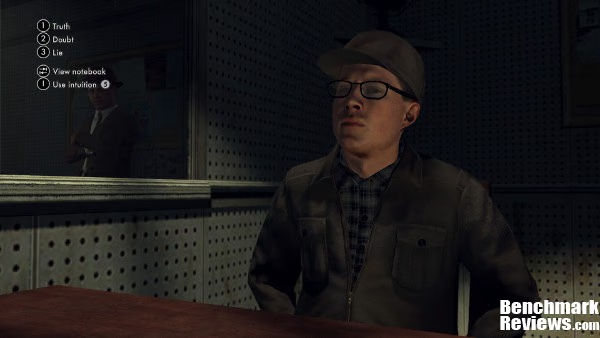
But the rendering of characters isn't the only reason whymy sister and I say L.A. Noire is visually beautiful. The game takes place in the city of Los Angeles in 1947, and its re-creation of the city is stunning. I live in a Los Angeles suburb, and twice a week I travel to downtown L.A. as part of my job duties. While I cannot vouch for the absolute accuracy of L.A. Noire's depiction of the City of Angels from the immediate post-World War II period (I was born nearly three decades later, after all), I am fairly familiar with the real-life city and some of its more famous landmarks referred to in the game. Famous streets such as Temple, Hill, Vermont, Wilshire, Spring, and Main are where they should be; well-known landmarks such as City Hall, the Public Library (my dad used to work there before he retired, in fact), Pershing Square, the La Brea Tar Pits and the L.A. River - spots familiar to anyone who has spent a significant amount of time in Los Angeles - all look familiar and faithful to their real-world counterparts. It is a testament to the artistic skills and sensibilities of Team Biondi's animators that they can make a player feel that he or she is indeed walking and driving around the streets of Los Angeles as it was in 1947.
Beauty in the Details
L.A. Noire stays consistent with the cinematic genre that inspired it. Each scene is lit starkly: It seems as if everything takes place in either full-on noon-time sunlight or in the shadows of a sparsely-lit interior space. This is no accident; indeed, this is a deliberate artistic touch. Just as in film noir, the lighting in L.A. Noire is meant to convey the bald contrast, and the eternal struggle, between good and evil. You might think that you'd only see visual metaphors of this kind in the movies, or perhaps on stage; you certainly can see them in paintings and artistic photography. L.A. Noire proves that you can use the same techniques to produce the same effects in video games as well.
But L.A. Noire is hardly the only video game that has been praised for its visual flair. Back when it was introduced, Crytek's Crysis won well-deserved acclaim for the stunning beauty of its depiction of a fictional tropical island in Southeast Asia. A few years before that, the same developer's Far Cry was singled out as a watershed moment in video game visual quality as well. Crysis, indeed, was just the logical advancement of the ingredients first seen in Far Cry: The tropical setting, some science fiction elements (alien invaders), spectacular environmental effects such as water and lighting simulation, and others.
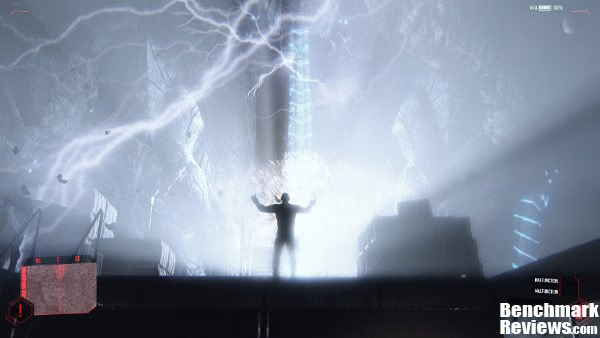
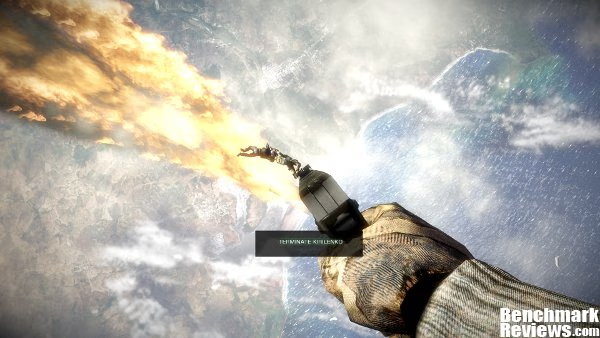
These days, Electronic Arts Digital Illusions CE's Battlefield 3 is praised as the standard bearer in visual beauty. As L.A. Noire truly does make you feel as if you've been transported to a post-WW II Los Angeles, so does BF3 do the same with its re-creation of war-torn sites in Iraq and Iran. Harsh daytime lighting makes you feel as if you're in the middle of the desert, while dust particle and smoke effects almost bring tears to your eyes as you and your squad rush from building to building dodging heavy fire from the enemy.
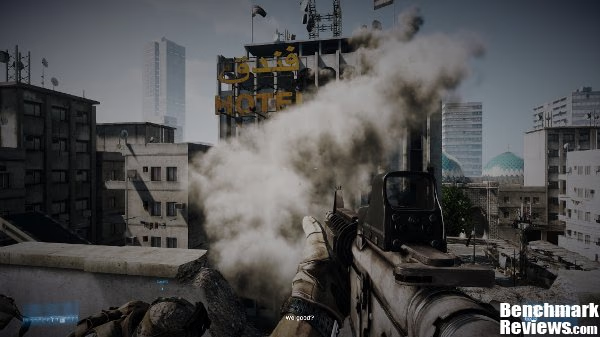
The current state of the visual art in video game production truly endow today's games with a beauty that had never been achieved before. The smallest visual details, like the aforementioned dust particle and smoke effects, speak to the great lengths that game graphics artists reach for to provide a feast for the eyes, all in the name of making the video game player feel as if he or she is looking at something that's real.
Pleasing the Ears
But it's not just the sense of sight that gets satisfied in an aesthetic sense. In addition to visual beauty, there is aural beauty; the sound in video games is also an element that contributes to the idea that games are legitimate forms of art.As any cinema buff knows, the soundtrack is a critical element that augments the experience of watching the movie. The same is just as true in video games.
Let's consider Star Wars games as a convenient example. There have been a lot of Star Wars games over the years. Some have been bad; some have been very good, even excellent. However, regardless of any particular game's specific merits or lack thereof, a huge part of what makes a Star Wars video game a Star Wars video game is its music soundtrack. Every single one includes the iconic John Williams themes from the movies. We always hear the Main Star Wars Theme when the game starts; the Imperial March often plays when we see the bad guys; the Theme of the Force (also known as Obi-Wan's Theme) is part of the musical background when our Force-wielding character learns something about that mystical “energy field that surrounds us, penetrates us, and binds the galaxy together.” In cinema as well as in video games, the use of musical leitmotifs helps tell the story: They convey action, set the emotional tone of a scene, or accentuate the individual importance of specific characters. I confess that I loved the music from some games so much that I bought the soundtrack albums from more than a few games, including all three Call of Duty: Modern Warfare games, both Crysis games, and L.A. Noire.
Then there's the sound effects in the games. Everybody knows what a lightsaber is supposed to sound like; you've heard it in the Star Wars movies and TV shows, and you can hear the same in the video games. In racing games you can hear tires squealing and chirping as an auditory clue when your tires are starting to break traction; engine notes from real engines are often sampled and used, and you can easily tell the difference between the bombastic, throaty rumble of a big Chevrolet Corvette V8 and the shrill yet spine-tingling wail of a modern-era 2.4L Formula 1 V8 screaming its way up to 18000RPM. And just how enjoyable would a first-person shooter be if all the guns and weaponry sounded the same? I don't know about you, but it matters a huge deal that my character's SCAR assault rifle has a different report compared to an AK-47's. And the explosion you get from a hand-tossed frag grenade better sound different from the KABOOM you get from the remotely-detonated C4 you planted as a trap for your unsuspecting enemies.
Aside from the music and the sound effects, there's also the voice acting in games. Great voice acting immerses the player into the game. The voice acting in the Grand Theft Auto games is an example of this point. These games employ very talented performers - artists - to lend their voices and help breathe life into the characters. Samuel L. Jackson's performance as Sgt. Tenpenny is just as compelling as his turn as Jules Winnfield in Quentin Tarrantino's Pulp Fiction. A game with great voice acting conveys emotion; it helps sell the story all the more. Great voice acting makes you believe that what's happening in the game can indeed happen.
Certainly, the games' soundtracks are an important ingredient. To paraphrase Obi-Wan Kenobi, a game's soundtrack is that ever-present element that surrounds, penetrates, and binds the whole game together.
That's My Story, and I'm Sticking to It
Great graphics and a well-designed soundtrack are all well and good, but in my opinion what truly makes a game particularly artful is its story. Now it has to be said that not everybody looks for a story in the games they play. Team Fortress 2 isn't about the story; there isn't one. Nor is there one in Counter-Strike: Source. People play multiplayer first-person shooters and racing simulations strictly for the thrill of competition, and that's perfectly fine. But for people like me, video games are a lot like those old-school “Choose Your Own Adventure” books: I'm in it for a good story, and a huge part of what makes the story great is the game's ability to give you interesting choices in how the story should unfold.
Some of my favorite games become favorites just because I fell in love with the story. That's why I so dearly love L.A. Noire, Grand Theft Auto: San Andreas, Grand Theft Auto: Vice City, and KotOR. Every single one of these games is like a book I just cannot put down. I simply cannot wait to see what happens next to the characters I'm controlling.
There are many elements that make for a good story. The plot has to be engaging, for one thing. In KotOR, the protagonist follows a storytelling template familiar to most Star Wars fans. Known formally in literary criticism circles as the Hero's Quest, the hero, Revan, goes through a journey of self-transformation: He wakes up in the middle of a space battle, then goes on various adventures, learning more and more about himself, the other characters, and the mysteries of the Force. By the end, Revan is a fully-formed Jedi Knight, powerful enough to do battle with the Dark Lord of the Sith, his former apprentice, Darth Malak. Yes, I said former apprentice. Revan's quest reveals that he once was the supreme Dark Lord of the Sith, and the game therefore is the story of his redemption and return to the light. I've lost count of how many times I've played and re-played KotOR just to relive the story again.
Beyond the richness of the plot and the characters, KotOR really excels in one specific aspect: Almost every decision the player makes in the course of playing the game and advancing the story influences subsequent events. For example, acting with compassion on a consistent basis opens up the canonical "light side" (of the Force, of course!) storyline; on the other hand, acts of cruelty and violence will lead you towards the dark side in the game. Treading the middle ground - being neither all light or all dark - opens up even more storytelling possibilities. This is but one reason why KotOR has so much replay value. You really can choose your own adventure with this game.
Games like L.A. Noire and the GTA series have a different style of storytelling, but they are no less compelling. In these games, the storytelling is a lot like how it's done on a typical TV show. Each level of the game can function independently of the larger story, but each episode builds upon the next, functioning as mini-quests that ultimately drive towards a grand conclusion. In L.A. Noire, you see the seedy side of Los Angeles as you live and breathe as Detective Cole Phelps and, later, insurance investigator Jack Kelso. Each "case" is like a single TV episode, or a chapter of a book. But every small bit is a part of a larger jigsaw puzzle. As you go from case to case you see that heroes can be flawed, and that enemies and adversaries can be sympathetic characters too. But despite your characters' flaws, you still root for him and feel sorry when really bad things happen to him. By the end of the story, you can't help but feel tension and angst, as well as frustrated that many threads remain unresolved. I am sure that this is by design; after all, many film noir movies end the same way. Not only that, but that's also a good excuse to produce a sequel which promises to close up those dangling threads.
Surprisingly enough, some first-person shooters do have an engaging story. I love the original Far Cry for its mix of a generic action movie plot and science fiction elements; its progeny, Crysis and Crysis 2, are composed of a lot more science fiction and a far more satisfying storyline that is, at this point, still unfinished. Then there's the Modern Warfare miniseries of Call of Duty games. The single-player campaigns in both games have so much replay value, even though I know what's going to happen next and where all the NPC spawn points are. I may have seen all the twists and the turns before, the surprise betrayals of trusted allies and the just-as-surprising honor of sworn enemies, but the story is no less compelling the ninth time I experience it as it was the first time. As I do with my favorite books and movies, I keep on coming back to these well-loved games - stories - just to relive them one more time.
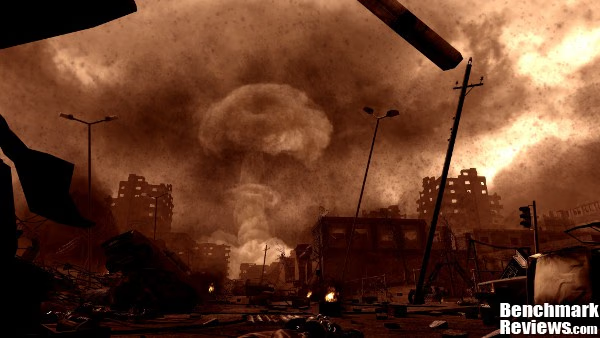
For me, the story and how it is told make all the difference why one game is so much fun to play, and why another is not. EA DICE made both Battlefield 3 and the older Battlefield: Bad Company 2. While BF3 is a good bit prettier and has superior sound effects, its single-player campaign pales in comparison to BF: BC2's. I can't make myself care about what happens to Blackburn; BF3's plot seems contrived, and the characters are boring. I will concede, however, that the storytelling method - switching between real-time events and flashbacks, a la LOST - is an interesting touch. In contrast, BF: BC2 has much more replay value for me since it's easy to care about Sarge and Sweetwater, Haggard and the character you play as, Marlowe. The members of Bad Company all have their interesting personality quirks. Not only that, but their interactions are actually quite funny at times. Their adventures take you from the snowy steppes of Russia to various points in South America, until, in the game's final scene, Bad Company finds itself parachuting down to Texas of all places. I've played through BF3 exactly once; I don't know how many times I've re-played BF: BC2.
The Answer to the Question
In my opinion, great games share so many things with legitimate forms of art like cinema or live theater, music or literature. A great game will engage your mind and your senses and will stimulate your appreciation for all things beautiful and well-designed.
My conversation with my baby sister about L.A. Noire took us through many of the same points that I've already made here. But here's the upshot, the consensus conclusion that we both came up with: A great video game is indeed a legitimate form of art. In so many ways, it's just like a great movie.
The only real difference is that a video game is inter-active.
So, are video games legitimate forms of art? Why or why not? Weigh in with your thoughts and opinions below!
Reader comments from the original article
3 comments were posted before commenting closed. They are preserved as written. Original avatars no longer resolve and are shown as a placeholder.
RE: Video Games as a Legitimate Art Form Ben Permalink:
L.A Noire is far from amazing, its overrated, and all the praise its been getting is a shame. L.A Noire gets very, very repetitive fast, every single investigation follows the same format but the theme of the crime is different. Also the story was very underwhelming, the plot jumped from one case to the other with nothing in between, *SPOILERS AHEAD* Later on in the story, Cole cheats on his wife that you only get a glimpse of, and your supposed to give a #? The story also seems to feel very coincidental to the end, its just a coincidence that Elsa had the hole insurance issue, and that Cole's old army buddy's happened to be screwing around with the drugs on the boat, and Elsa just happened to be seeing the same doctor that Cole's old army friend(forget his name) had been seeing. The game play was BORING, My God, it was so repetitive, the same God damn thing every single time! your hand was also being held throughout the investigation, apparently Cole has some sort of spidey sense that tingles when he walks close to a clue, and didn't you find it weird that every match box, and lighter had the address of a bar in L.A? The interrogation system was broken as well, when you tell actors to lie on purpose, and make it obvious, ITS OBVIOUS! Instead of some stupid truth, lie system, a conversation tree would have been more engaging, while throwing in evidence that they're lying. Are video games art, well that's highly subjective, some people think modern art isn't art, and dub step isn't real music. But, what we have to consider is the music and well made artistic features of a game like L.A Noire, that's all L.A Noire had, it was pretty, and it sounded great, that's all it had. In my ASSERTION, an amazing game can both keep you interacted with engaging game play, and well built levels, and a well thought out story that doesn't seem so coincidental, stretched out, convoluted, boring, and senseless. L.A Noire did look pretty tho.
RE: RE: Video Games as a Legitimate Art Form Joseph Dionisio Permalink:
I guess L.A. Noire ISN'T your favorite game... if that's all you took away from the op-ed piece. :) That's OK. What's not good for some is really good for others. While the piece really wasn't a review of L.A. Noire per se, it clearly was the launch point for the whole discussion. Many other games - games that I liked, for the reasons I cited - were discussed. L.A. Noire is hardly the only game that would fit anyone's standards of a good game, just as it is not the only game that would fit anyone's standards of a bad game. As you alluded to yourself, the same is true for art as well. Some people adore Picasso and Dali; sometimes, a friend's doodles are just as aesthetically pleasing. The point is, art can inspire strong reactions, both positive and negative. Whether the art is visual or aural or literary in form, or maybe if it has all these elements and more, hardly matters; if it stimulates that part of you that appreciates beauty, well, that's art enough for me. Thanks for the comment. :)
Art, Products and (ugh) services MORINGA Permalink:
There are 3 things I'd pay for, in our economic system: 1) Art: it feels like when I'm in Heaven: the results of what I - gladly - paid for, at least, match my expectations; 2) Products: without them, one can't live (unless, like, a hermit? No, thanks); at least, I can normally choose between high-quality ones, and cheaper ones; 3) Services: and only if I can't stand living without them; i.e: electricity (and I have to be prepared for massive headaches. Feels like I'm in Hell on this one). That said so, which games can be considered a form of art? Those I gladly paid for, and enjoyed as much as expected, IMO. Quality games, then, can be considered, at the very least, products (makes sense ^^). But, unfortunately (for me), most games nowadays are just...services. Unnecessary ones.