
NVIDIA GeForce GTX 690 Video Card Features
Benchmark Reviews previews the world's most powerful graphics solution
Manufacturer: NVIDIA
Product Name: GeForce GTX 690
Suggested Retail Price: $999.99 MSRP
Full Disclosure: The product sample used in this article has been provided by NVIDIA.
NOTE:NVIDIA GeForce GTX 690 Benchmark Performance Test Results will be available on 03 May 2012.
Admit it: you knew the GeForce GTX 690 was coming ever since the NVIDIA GeForce GTX 680 video card launched back on 22 March (2012). It didn't take long for the engineers at NVIDIA to find the right combination of speed and power before they could successfully fit two 28nm GK104 Kepler GPUs onto the same printed circuit board. A mere six weeks later, and now you find yourself reading all about it. So here's a spoiler alert: it's awesome and you'll want it... and this article gives you something to dream about at night.
Of the many platforms available for gamers to enjoy video games, there's no question that the highest quality graphics come from PC. While game developers might not consider PC gaming as lucrative as entertainment consoles, companies like NVIDIA use desktop graphics to set the benchmark for smaller more compact designs that make it into notebooks, tablets, and smartphone devices. NVIDIA's Kepler GPU architecture is an example of this, delivering unprecedented performance while operating cooler and consuming less power in relation to performance than all previous flagship graphics processors.
In this article Benchmark Reviews inspects the features available on the new NVIDIA GeForce GTX 690, a double-slot graphics card equipped with a pair of Kepler GPUs. Featuring NVIDIA's cutting-edge GPU Boost technology, the GeForce GTX 690 video card can dynamically adjust power and clock speeds based on real-time application demands. Using EVGA Precision-X, the GeForce GTX 690 has both GPUs overclocked beyond 1200GHz to produce ultimate graphical performance in PC video games.
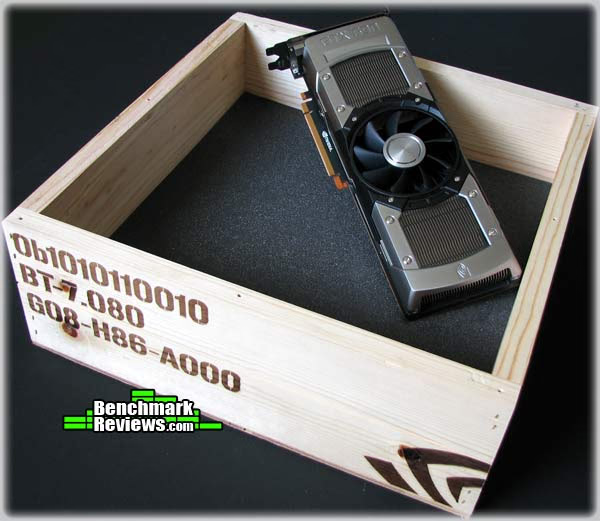
NVIDIA's GeForce GTX 690 is the first dual-GPU graphics card designed around their next-generation Kepler architecture, which adopts key aspects from the previous Fermi architecture. Building from the 32-core Streaming Multiprocessor (SM) from Fermi on the GeForce GTX 580, NVIDIA optimized Kepler GPUs with twice the performance per watt using an innovative 192-core streaming multiprocessor (referred to as SMX) that exchanges a double speed processor clock for more processor cores. Utilizing eight SMXs per Kepler GPU, the , the GeForce GTX 690 boasts 3072 total CUDA cores which manage shader, texture, geometry, and compute tasks. A reengineered memory subsystem reduces pipeline penalty for these many cores, and enables the 4GB GDDR5 resident on the GTX 690 to reach memory speeds up to 6.0 Gb/s.
In addition to dual GPUs using the freshly released Kepler architecture and NVIDIA's new GPU Boost technology, the GeForce GTX 690 video card includes several refinements to the user experience. Smoother FXAA and adaptive vSync technology results in less chop, stutter, and tearing in on-screen motion. Overclockers might see their enthusiast experiments threatened by the presence of NVIDIA GPU Boost technology, but dynamically adjusting power and clock speed profiles can be supplemented with additional overclocking or shut off completely. Adaptive vSync on the other hand, is a welcome addition by all users - from the gamer to the casual computer user. This new technology adjusts the monitor's refresh rate whenever the FPS rate becomes too low to properly sustain vertical sync (when enabled), thereby reducing stutter and tearing artifacts. Finally, NVIDIA is introducing TXAA, a film-style anti-aliasing technique with a mix of hardware post-processing, custom CG file style AA resolve, and an optional temporal component for better image quality.
GeForce GTX-Series Product Family
|
Graphics Card |
GeForce GTX 550 Ti |
GeForce GTX 460 |
GeForce GTX 560 Ti |
GeForce GTX 570 | GeForce GTX 580 | GeForce GTX 590 | GeForce GTX 680 | GeForce GTX 690 |
|---|---|---|---|---|---|---|---|---|
| GPU Transistors | 1.17 Billion | 1.95 Billion | 1.95 Billion | 3.0 Billion | 3.0 Billion | 6.0 Billion Total | 3.54 Billion | 7.08 Billion Total |
|
Graphics Processing Clusters |
1 | 2 |
2 |
4 |
4 |
8 Total | 4 | 8 Total |
|
Streaming Multiprocessors |
4 | 7 |
8 |
15 | 16 | 32 Total | 8 | 16 Total |
|
CUDA Cores |
192 | 336 |
384 |
480 | 512 | 1024 Total | 1536 | 3072 Total |
|
Texture Units |
32 | 56 |
64 |
60 | 64 | 128 Total | 128 | 256 Total |
|
ROP Units |
24 | 768MB=24 / 1GB=32 |
32 |
40 | 48 | 96 Total | 32 | 64 Total |
|
Graphics Clock |
900 MHz |
675 MHz |
822 MHz |
732 MHz | 772 MHz | 607 MHz | 1006-1058 MHz | 1006-1058 MHz |
|
Processor Clock |
1800 MHz |
1350 MHz |
1644 MHz |
1464 MHz | 1544 MHz | 1215 MHz | 1006-1058 MHz | 1006-1058 MHz |
|
Memory Clock |
1025/4200 MHz |
900/3600 MHz |
1001/4008 MHz |
950/3800 MHz | 1002/4016 MHz | 854/3414 MHz | 1502/6008 MHz | 1502/6008 MHz |
|
Total Video Memory |
1024MB GDDR5 |
768MB / 1024MB GDDR5 |
1024MB GDDR5 |
1280MB GDDR5 |
1536MB GDDR5 |
3072MB GDDR5 |
2048MB GDDR5 | 2x 2048MB GDDR5 |
|
Memory Interface |
192-Bit |
768MB=192 / 1GB=256-Bit |
256-Bit |
320-Bit |
384-Bit |
384-Bit |
256-Bit |
2x 256-Bit |
|
Total Memory Bandwidth |
98.4 GB/s |
86.4 / 115.2 GB/s |
128.3 GB/s |
152.0 GB/s | 192.4 GB/s | 327.7 GB/s | 192.26 GB/s | 384.4 GB/s Total |
|
Texture Filtering Rate |
28.8 GigaTexels/s |
37.8 GigaTexels/s |
52.6 GigaTexels/s |
43.9 GigaTexels/s |
49.4 GigaTexels/s |
77.7 GigaTexels/s |
128.8 GigaTexels/s |
234.2 GigaTexels/s |
|
GPU Fabrication Process |
40 nm |
40 nm |
40 nm |
40 nm |
40 nm |
40 nm |
28 nm | 28 nm |
|
Output Connections |
2x Dual-Link DVI-I |
2x Dual-Link DVI-I |
2x Dual-Link DVI-I |
2x Dual-Link DVI-I |
2x Dual-Link DVI-I |
3x Dual-Link DVI-I |
2x Dual-Link DVI-I |
3x Dual-Link DVI-I |
|
Form Factor |
Dual-Slot |
Dual-Slot |
Dual-Slot |
Dual-Slot |
Dual-Slot |
Dual-Slot |
Dual-Slot |
Dual-Slot |
|
Power Input |
6-Pin |
2x 6-Pin |
2x 6-Pin |
2x 6-Pin |
6-Pin + 8-Pin |
2x 8-Pin |
2x 6-Pin |
2x 8-Pin |
|
Thermal Design Power (TDP) |
116 Watts |
768MB=150W / 1GB=160W |
170 Watts |
219 Watts | 244 Watts | 365 Watts | 195 Watts | 300 Watts |
|
Recommended PSU |
400 Watts |
450 Watts |
500 Watts |
550 Watts |
600 Watts |
700 Watts | 550 Watts | 650 Watts |
|
GPU Thermal Threshold |
100°C |
104°C |
100°C |
97°C |
97°C |
97°C |
98°C |
98°C |
|
Chart Courtesy of Benchmark Reviews |
First Look: GeForce GTX 690
NVIDIA has built the GeForce GTX 690 for the ultra-performance hardware enthusiast and hard-core gamer wanting to play PC video games at their maximum graphics quality settings with the highest screen resolution possible. It's a small niche market that few can claim, but also one that every PC gamer dreams of enjoying.
The outer dimensions for the NVIDIA GeForce GTX 690 give this 1.5" tall double-bay, 3.9" wide, 11.0" long graphics card a similar profile to their last generation GeForce GTX 590 dual-GPU graphics solution, yet offers a more compatible length compared to the AMD Radeon HD 6990 that reaches 12.0" long.

NVIDIA engineers went overboard tweaking the design on GeForce GTX 690, such as the cast aluminum shroud frame that is protected with (Chem-101 alert!) trivalent chromium plating. This special highly-bonded trivalent chromium plating gives the GeForce GTX 690 a sleek look while also being highly durable. The fan housing on GeForce GTX 690 is made from injection molded magnesium alloy, which takes advantage of magnesium's light weight, superior heat dissipation, and improved acoustic dampening properties. By positioning a clear polycarbonate window above each cooling unit, NVIDIA gives this video card an added design dimension.
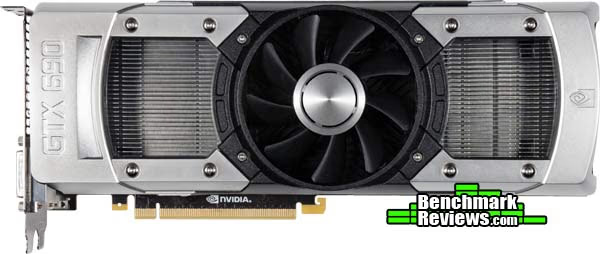
Specified for 300W Thermal Design Power output, the GeForce GTX 690 dramatically outperforms NVIDIA's previous generation dual-GPU solution. Because TDP demands have been reduced from 365W TDP for the GeForce GTX 590 to 300W TDP, NVIDIA's GeForce GTX 690 runs cooler and has move power available for overclocking. NVIDIA has added a "GeForce GTX" logo along the exposed side video card, and the LED backlit letters glow green when the system is powered on. GeForce GTX 690 requires two eight-pin PCI-E connections, and NVIDIA recommends a 650W power supply for computer systems equipped with one of these video cards.

The standard GTX 690 reference design offers four simultaneously-functional connections: three dual-link DVI (DL-DVI) ports and a mini-DisplayPort 1.2 connection. Add-in partners may elect to remove or possibly further extend any of these video interfaces, but most will likely retain the original engineering. Only one of these video cards is necessary to drive triple-display NVIDIA 3D-Vision Surround functionality. Each of these video interfaces consume exhaust-vent real estate, but this has only a minor impact on cooling performance because each 28nm Kepler GPU generates less heat than past GeForce processors, and also because NVIDIA intentionally positions the heatsink far enough from these vents to equalize exhaust pressure.

A slightly reward 80mm (3.15") cooling fan mounted with a small above-surface offset takes advantage of the chamfered depression to draw cool air into the angled fan shroud, allowing more air to reach the intake whenever two or more video cards are combined in close-proximity SLI configurations. To create the intricate geometries required for the fan housing, NVIDIA used a form of injection molding called thixomolding, in which liquid magnesium alloy is injected into a mold. It's unlikely that add-in card partners will offer cooling solutions that surpass the benchmark of this reference design.
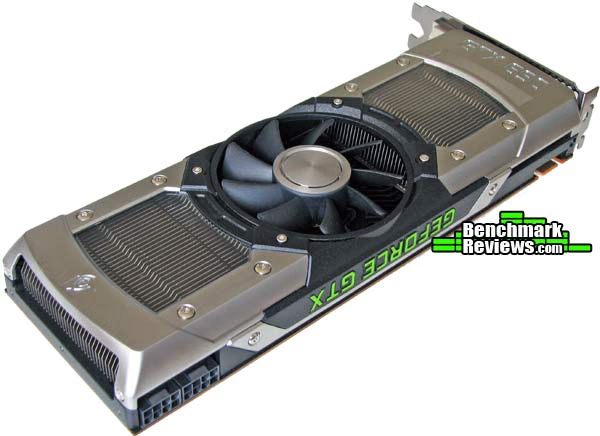
As with past-generation dual-GPU GeForce GTX series graphics cards, the GTX 690 is capable of a two-card "Quad-SLI" configuration. Because GeForce GTX 690 is PCI-Express 3.0 compliant device, the added bandwidth could potentially come into demand as future games and applications make use of these resources. Most games will be capable of using the highest graphics quality settings available using only a single GeForce GTX 690 graphics card, but multi-card Quad-SLI configurations are perfect for gamers wanting to experience high-performance video games played at their highest quality settings with all the bells and whistles enabled across multiple monitors.

In our next section, we disassemble the GeForce GTX 690 for a more detailed look and inspect the internal component technology that NVIDIA used to build this dual-GPU video card...
NVIDIA Kepler Dual-GPU Details
On prior dual-GPU video cards, compromises had to be made in order to produce a final product that performed well while still delivering excellent acoustics. In the past, GPU power has been the largest gating factor. For instance, clock speeds had to be lowered dramatically for GeForce GTX 295 and GTX 590. However, thanks to the GTX 690's robust board design and Kepler's tremendous power efficiency, the GeForce GTX 690 largely overcomes this issue.
To best deliver optimal cooling performance in the smallest footprint possible, each GPU has its own dedicated cooling unit consisting of a self-contained copper vapor chamber and a dual-slot heatsink. These two heatsink rest atop an aluminum baseplate, which provides additional cooling for the PCB and board components. Channeling cool air through the GPU coolers is a center-mounted 80mm axial fan, which NVIDIA optimized to use the most ideal fin pitch and fan angle at which air from the fan hits the fin stack to maximize air movement while minimizing noise output.

Low-profile airflow channels are molded into the aluminum baseplate section directly below the 80mm cooling fan, which encourage smooth airflow all the way to outer edges. All of the components located under the cooling fan are made low-profile, so that they won't cause turbulence or obstruct airflow. NVIDIA acoustic engineers fine-tuned the GeForce GTX 690 fan control software so that changes in fan speed would occur gradually, rather than in noticeable and annoying audible steps.

With both heatsinks removed, two NVIDIA graphics processors are exposed as illustrated below. Armed with 3072 CUDA Cores and 4GB of GDDR5 memory, the GeForce GTX 690 offers performance similar to that of two GeForce GTX 680 cards running in SLI. However, the GeForce GTX 690 boasts a number of key advantages over GeForce GTX 680 SLI: the GTX 690 only needs one PCI Express graphics slot, and the GeForce GTX 690 board runs cooler and quieter than GeForce GTX 680 SLI while also consuming less power. Finally, two GeForce GTX 690 cards can be combined together to support Quad SLI.
An onboard PLX bridge chip provides independent PCI Express 3.0 x16 access to both processors for maximum multi-GPU throughput. Two independent 28nm NVIDIA Kepler GPUs combine to offer 16 SMX units, equal to twice the amount available with GeForce GTX 680. The memory subsystem on GeForce GTX 690 remains similar to the GTX 680, consisting of four 64-bit memory controllers (256-bit) with 2GB of GDDR5 memory per GPU operating at 6008 MHz data rate. The base clock speed of the GeForce GTX 690 is 915 MHz with a typical Boost Clock speed of 1019MHz, which is only 3.9% below the GeForce GTX 680's 1058 MHz Boost Clock.
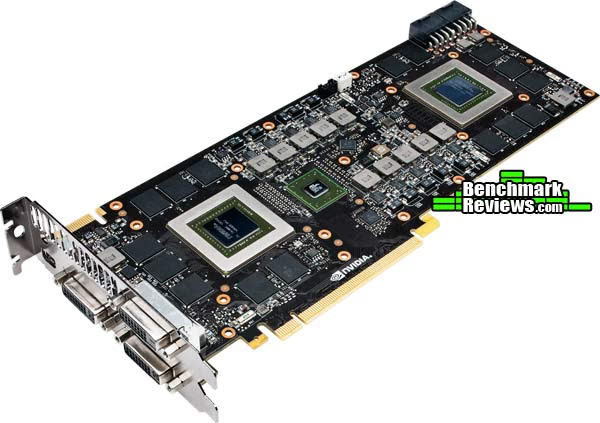
NVIDIA engineers have used the top-quality electronic components across the entire board, which has been designed for maximum efficiency in order to properly power and cool the twin GPUs at the heart of GeForce GTX 690. Featuring a 10-phase power supply with a ten-layer 2-ounce copper PCB provides the GeForce GTX 690 video card with high-efficiency power delivery with less internal resistance, lower power consumption, and less heat generation.

Lower power and less heat also enhances the board's longevity, while the added PCB layers provide maximum signal integrity. The result of these efforts is not only lower noise output, but also a less-perceptible noise. By eliminating board clutter, high-frequency sounds are removed. When you listen to the fan alone, it's clean and smooth.
Examining the outer-exposed printed circuit board (PCB) on the underside of the video card reveals a few small differences compared to GeForce GTX 590, namely the absence of aluminum heatsink plates covering the backside of each GPU, and the inclusion of a Richtek Technology Corporation RT8802A multi-phase synchronous PWM advanced digital power controller with over-volting capability.

Now that you've seen what this video card offers for hardware features, make sure to read our NVIDIA GeForce GTX 690 Benchmark Performance Test Results (available 03 May 2012).
So what do you think of the NVIDIA GeForce GTX 690 Kepler graphics card, and are you planning to buy one?
Reader comments from the original article
9 comments were posted before commenting closed. They are preserved as written. Original avatars no longer resolve and are shown as a placeholder.
builder DB62 Permalink:
Just another awesome nVidia card! I'd love to buy one, but just can't justify it when I already have a GTX580 lightning, and it does everything I need, and does it well!
GTX690 Hu1tik Permalink:
its a nice card with excellent design but the cost of getting one. no way am I paying from one of them. I'm happy with my 590 :P
Nice alfresc0 Permalink:
Nice write up. King of cards. Can't wait for this tech to trickle down to the gtx660. Does it take two six-pin PCI-E connections because they look like 8 pin to me (page 2 para 3).
RE: Nice Olin Coles Permalink:
Thanks- I've fixed the typo.
RE: NVIDIA GeForce GTX 690 Video Card Features x3ckid Permalink:
In 3 or 4 years they will realease the 900 series then the 600 series will be very cheap . So lets say if we wait 30 years we will have such a powerful video card that all the cards in the present will be considered toys .
RE: NVIDIA GeForce GTX 690 Video Card Features claydough Permalink:
Between the fast release of the x90 version and the initial suspicions of a gtx 780 in the works... I am more hesitant knowing that even if another incremental kepler release exposing true Kepler power initially touted ( 700 series ) That maxwell is at worst a year and a half away. Everything depends on the power given to the new consoles. And since that is supposedly southern Islands. I would be mistaken to wait for cards that would be ablt to handle development in a new console generation. Sadly at best, I do not see anything that woul lead me to believe that consoles have anything to look forward to ( our best PC experience today is not all that revolutionary compared to a console experience ) Unles Metro 2033 is better than my first impressions. It's just to confusing... And not knowing how things are going to develop when as much is critical at the pricepoint of 2 x90 card SLI. But knowing that the 2013 date of Maxwell was supposed to mean production and not release... That news now does not mean as much with 2013 a half a year away. And if console games for the next 8 years will be as boring as southern Islands. I would rather not develop for consoles at all! ( at least last cycle consoles had some punch where the 7800 gtx tech in ps3 had longer legs than my actual gtx 7800! Hopefully, the southern island tech hold big surprises that make me eat my words ) And even if I wait another 6months and there is not a gtx 580 styled gtx 780 release... Then by that time a maxwell release would only a single year away... And for the performance and easy wait. Considering every benchmark I see. Everything sandy ivy and kepler seem very depressing for the price... That Haswell and Maxwell will be about the same time I am hoping for a nice surprise then. ( and if consoles are underpowered compared to haswell and maxwell which will be released at the same time... I imagine a glorious future for PC gameing making a comeback )
RE: RE: NVIDIA GeForce GTX 690 Video Card Features claydough Permalink:
If Nvidia's own charts are correct And two 680 chips scale that nicely! ( big congratulations ovr the improvement compared to the 590s ) And even if they did release 780's in the near future... I imagine these cards could still be attractive considering that there was no rumors of a 790 card? In which case the 690 could still be attractive even if there was a gtx780 release depending on the price drops after a new version release. I would not be so supicious if Kepler released with anything close to the kind of power originally being touted. ( 2x the power of fermi? maybe 400 series in SLI to come anywhere close to those claims ) In which case a rurmor of a series that explains the discrepency is more gentle for an nvidia zealot than markey lies.
IS this not beast? ssuamw Permalink:
HOLY #!!!!!!!! this card is going to kick all ATI's and all Nvidia's for sure . man this card ,OH no im over surprised , damn great card. can't wait until I see the bench's . I bet this card will score more than 90 fps in metro 2033 on ultra. this is what a real beast is and should be. ATI fan boys, this is a total loss. im also an ati fan boy to be honest. I can't imagine. from the moment I saw this , I fell in love with nvidia .
Nice Persojet Permalink:
the GeForce GTX 690 has both GPUs overclocked beyond 1200GHz(