
Hiper Osiris HTC-1K514 Mid-Tower Computer Case
Hiper Osiris HTC-1K514-A1
High Performance Group (Hiper) is best known for their self-designed power supply units, yet they have recently begun to compete in the computer chassis market. Their first foray into the arena was with the rock-solid Hiper Anubis Mid Tower ATX Case HTC-1K614, which could withstand brutal punishment while looking very stylish. Mere months later, Hiper has returned with the Osiris Mid-Tower 6063-T5 Alloy Computer Case HTC-1K514-A1. Named after the ancient Egyptian god of the overworld, this case comes equipped with many of the award-winning features found in the Anubis and adds a total of 20 new refinements.
Osiris defines a design level all of its own, beyond just the unique look and feel. The entire case is constructed for tool-less disassembly, and utilizes an innovative airflow concept which offers a superior cooling solution: The PSU is located at the bottom with a direct fresh air intake, so the heat of the PSU is isolated from the case completely. On the top and at the back there are 120mm fans with 3pin plugs for connecting with the motherboard. And, just like Anubis, the modular HDD rack has the third 120mm fan on the front. Moreover three PCI air ventilation plates are also included in the package; this provides better exhaust capability for systems equipped with SLI or Crossfire. Of course Osiris supports XL ATX PSU's and all graphic cards currently available.
On the outside Osiris has a stylish round shaped front. The I/O function panel offers plenty of USB ports and adds eSata capability while being conveniently located on the top front side of the mid-tower chassis. The edges of the buttons, plugs and the front side are diamond laser cut, giving off very nice accents in the right light. Hiper offers the Osiris in both brushed black and brushed silver alloy finishes.
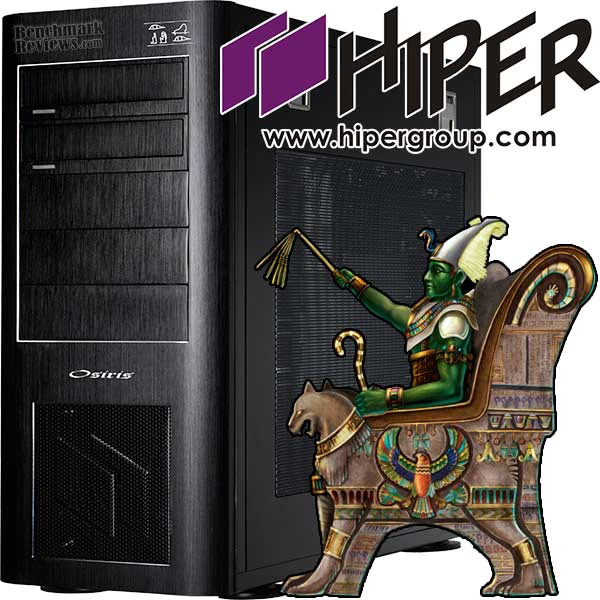
Osiris is made entirely of 6063-T5 military spec alloy, which offers outstanding heat dissipation. A patented welding technology joins the parts to form an extremely solid case capable of withstanding tremendous abuse. The side panels are easily detachable and made 3mm-thick, and one EMI-proof window panel helps protect the components while giving a clear view to the hardware inside.
The HTC-1K514-A1 has been designed with thermal issues in mind and the specific placement of cooling fans the Osiris can effectively dissipate the conducted heat from inside the case. The side panel assembly is completely tool-less/screw-less and the drive-bay mounting is also tool-free.
An additional functional detail among others is the removable modular HDD rack with dedicated fan mount for optimized cooling. As a bonus there is a limited edition Osiris key ring supplied inside with the accessories. Osiris should be a very attractive mid-tower case for hardware enthusiasts and gamers with the cutting edge design and top-quality computer chassis construction.
About the company: Hiper - High Performance Group
High Performance Group was founded in Milton Keynes/UK in 2001. Based on high-end marketing and technology expertise the company is now among the leading manufacturers of PC power supply units & connection cables, HTPC (Home Theatre Personal Computer), low profile thermal solutions, and Digital Connectivity cables for Consumer Electronics, now with 6 offices and 3 warehouses.
Most of HIPER's products are patented before their releases. Our concepts and designs are protected & backed by solid patents covering most major countries. We have no doubt that our Innovation & Invention will continue to be a significant force, providing dynamic growth for HIPER worldwide.
The brand name HIPER represents the cutting edge technology, quality, passion and entrepreneurial spirit of more than 250 employees throughout Europe, Asia and North America put in every single product that is shipped from own factories. Due to the close partnership with major IT-companies HIPER products represent the latest state of technology. And even the very top of the line HIPER product can be afforded with a student's week salary.
Features and Specifications
Hiper Osiris Features
-
Constructed with 100% 6063 TS Alloy
-
Patented welding technology
-
Ultra heavy duty construction is capable to withstand weights up to 100kg
-
Support XL ATX power supply
-
Top 12cm fan for optimized heat dissipation
-
Screwless latched side panels HIPER-styled mesh see-through side panel
-
Tool-Free Driver Bay installation
-
Rear retaining holes for liquid cooling kits
-
4 adjustable feet
-
Stealth style front door
-
Removable Modular HDD rack with dedicated fan mount
HTC-1K514-A1 Specifications
| OSIRIS HTC-1K514-A1 | Specification | ATX Mid Tower Case |
|---|---|---|
| I/O panel | USB 2.0 | 2 |
| Audio in | 1 | |
| Audio out | 1 | |
| line in | 1 | |
| ESATA | 1 | |
| Driver Bay | 3.5 " Floppy | 1 |
| 5.25" (Exposed) | 5 | |
| 3.25" (Modular Rack) | 4 | |
| Motherboard | Form Factor | ATX / MicroATX / FlexATX / ITX |
| Power Supply | Form Factor | Standard ATX / EPS 12V |
| Cooling System | 120mm fans with 1500 rpm | Top (exhaust) x 1 |
| Rear (exhaust) x 1 | ||
| HDD Modular Rack (exhaust) x 1 | ||
| Material | 6063 T5 Alloy | |
| Thickness | 2.0mm (0.08") | |
| Dimension | 526(L) x 202(W) x 452(H) mm | |
| 20.7" x 8.0" x 17.8" | ||
| Net Weight | 8.4 Kg (18.52 lbs) |
Closer Look: Osiris Exterior
Hiper (High Performance Group) is already very well known to computer enthusiasts and gamers alike because of their power supply product line. Hiper has built a name based on performance and quality above everything else, offering solid power and reliable components. Every single product released by Hiper has had meticulous attention paid to details which the competition usually ignores, and this tradition is evident in their latest venture into the computer chassis industry. Hiper really impressed us with the Anubis HTC-1K614, and they may be extending their winning streak once again with the Osiris Mid-Tower 6063-T5 Alloy Computer Case HTC-1K514-A1.

Because of the emphasis on durable construction, it would be safe to compare the Hiper Osiris with the NZXT Adamas. Both are built to survive the harshest environments while still looking pretty. Because Aluminum is no longer the inexpensive metal it once was not long ago, there aren't too many manufacturers making 3mm thick cases with it. The Osiris utilizes an alloy mix which features 87% aluminum content. This reason alone will give the Osiris an edge in regards to overall appeal.
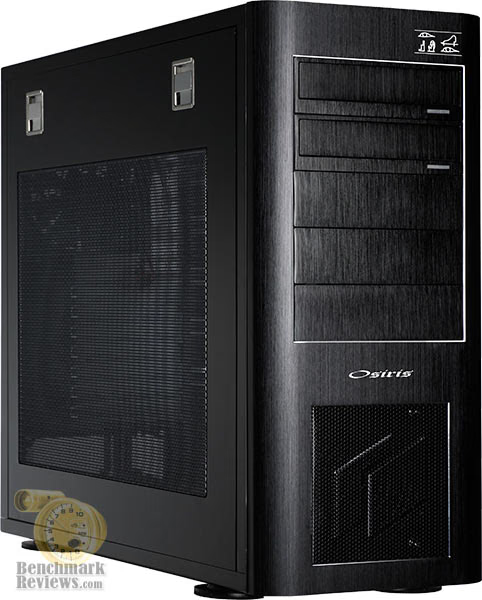
Designed with a clear path for airflow, the Osiris HTC-1K514-A1 will be great for the overclocker wanting to keep the contents inside cool. Each of the panels on the Osiris is finished in the same anodized black that the rest of the case, and the edges are all polished round so there are no sharp corners.
Unlike the Hiper Anubis, the Osiris offers a perfectly flat top surface and does away with the heatsink fins. Since I am such a busy person, I find it convenient to set items of interest on top of the tower unit. It's probably a bad habit, but when desk space is limited you use what you can get. Also available from the top is the I/O panel interface, which offers unrestricted access to power and reset buttons. Near the rear of the Osiris is a single exhaust grill for the included 120mm cooling fan.

Benchmark Reviews has tested its fair share of computer cases, with over 24 products tested in our Computer Case section in the past year. We already have articles on products ranging from HTPC enclosures to extremely simple cases, but very few fit into the same category as the Hiper Osiris. After working with so many different varieties and designs I have started to quickly categorize these products into different classes the moment I see them, which allows me to easily determine which demographic might appeal to a certain computer case. The Osiris HTC-1K514-A1 is very much intended for upper-crust enthusiasts with a taste for ultra-high quality constructions.

At the rear of the Osiris mid-tower ATX case you can see that Hiper has consciously designed the HTC-1K514-A1 with liquid-cooling enthusiasts in mind. It's my opinion that each and every case designed from 2007 forward should have these soft rubber grommets in place, and thankfully Hiper agrees. A single exhaust fan can be mounted to the multi-size 80/92/120mm fan grill based on your particular needs, but Hiper has taken the liberty of including a 120mm cooling fan at this location already.

One particularly unique design feature that sets the Osiris apart from many other cases we've seen is the PSU placement location. Heat rises; everyone including Hiper knows this. So to keep the system components safe from power concerns, Hiper has positioned the power supply unit at the lowest point on the chassis to take advantage of the cooler temperatures.
Since there's a 120mm fan filter at the bottom of the case beneath where the power supply is installed, the PSU can be mounted in a standard arrangement or upside-down without fear of reduced air intake.
Please continue on as we cover the detailed exterior features offered by the Hiper Osiris.
Detailed Exterior Features
Most readers who are familiar with my case reviews are already aware of my personal dislike for front bezel doors. Unless it's a server, or a workstation in a secure environment, the front bezel door is almost a complete waste of material. In nearly all chassis designs the power and reset buttons are hidden behind the bezel door, adding an extra step of inconvenience when trying to use your personal computer. However, since Hiper has placed these buttons at the top of the case beside the I/O ports, the front bezel plays a much smaller roll similar to the trend other manufacturers have taken in cases like the Cooler Master Cosmos RC-1000 we reviewed.
Since HIPER has gone along with a theme on ancient-Egypt, the front bezel of the Osiris is adorned with hieroglyphic text from the same period. Accented with reflective beveled edges which are polished to a mirror-finish, the Osiris combines old with new. Hiper really deserves credit for making something so simple still pull off the look of elegance and add prestige to the HTC-1K514-A1.

To make it easier for users to access and clean the fan filter or install components, the entire front bezel is detachable from the Osiris. Clips secure the front bezel onto the chassis, but with a strong pull you can separate the two pieces.
Hiper has designed a very convenient I/O panel atop the Osiris mid-tower ATX case. Included in the array of ports are two USB 2.0 ports, a microphone input jack, headphone output, and the often desired but seldom found audio input jack (which makes the HTC-1K514-A1 one of very few cases I have seen with this feature). eSATA is now supported on nearly all modern motherboards and seems to be catching wind, so it was a wise decision to include at least one eSATA port.

Additionally, the polished aluminum power and reset buttons are available without removing a door taking the Osiris to a higher level of convenience than the competition.
The side panel doors are both designed to give convenient tool-free and screw-less access into HTC-1K514-A1. The service side panel has a window set into place, with a fine mesh grill positioned over the top which Hiper suggests helps to reduce static discharge.
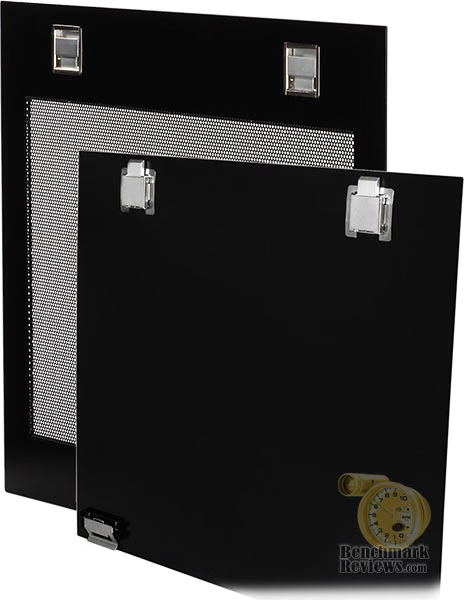
Hiper has used clips on the Osiris side panels, borrowing from the successful design utilized in the NZXT Adamas. The deeper I get into this review, the more it appears that the Osiris has in common with the NZXT design. The exception here is that the Osiris does not support side panel fans, whereas the Adamas does (two 120mm fans to be exact).
Opening the HTC-1K514-A1 is as easy as pushing down the two levers on each latch at the corners of the panel door. The image below shows how the door easily pulls up and away from the chassis, allowing you to work on your system without tools or keeping track of screws.
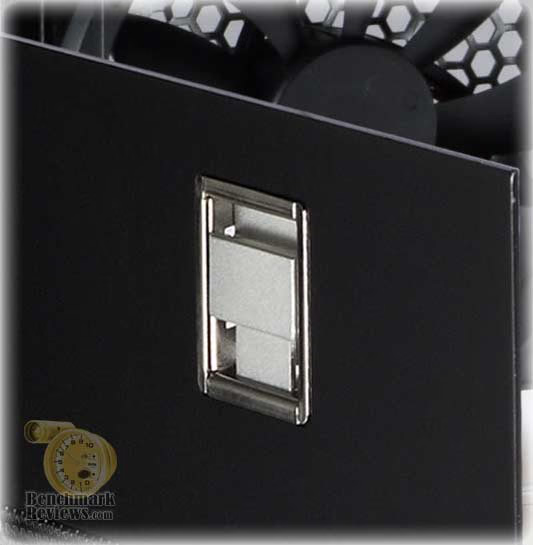
While the side panel doors may be screw-less, the rest of the Osiris is not. Hiper has included every screw and bolt you will need to secure fans, motherboard, and add-on devices to your system.
Hiper has gone to great lengths to ensure their products are among the most durable available. We've seen this for quite some time now in their Power Supply Unit products, so it's good of them to retain the tradition and not try to "cheapen" their product line.

With an emphasis on durability, Hiper has decided to use solid round feet identical to those used in the Zalman Z-Machine GT1000, NZXT Adamas, and Lian Li PC-B20A. to secure the Osiris on floor and desk surfaces. These feet have a rubberized-silicone non-slip pad on the underside, and can be unscrewed from the chasses (the screw is part of the chassis, not part of the feet). These feet are very effective on top of tables and desks, or practically anything the soft rubber rings around the feet can adhere to. With the weigh of the HTC-1K514-A1 approaching 19 pounds, this style of chassis feet works extremely well.
So now that you are more familiar with the outside of the Osiris, it's time to move onto the interior where we will finalize our impression of the HTC-1K514-A1 design.
Closer Look: Osiris Interior
Now we can open the Hiper Osiris up, and see what lies inside this mid-tower ATX case. We begin with an exploded view of the Hiper HTC-1K514-A1 case, which looks to be comprised of fully-detachable panels. At the core of the Osiris is a very solid chassis made of 6063-T5 Aluminum alloy. The image below offers a good representation of how versatile this rugged case can actually be.

While I personally feel that 3.5" drives are long since obsolete from the computing scene (even though I still use my USB-based external floppy drive to flash an occasional BIOS), Hiper has included a special-purpose tray. Most users who might need this tray will use it for multi-card readers that fit the 3.5" opening. Otherwise, you can simply pull it out and lighten the load, like I ultimately did.
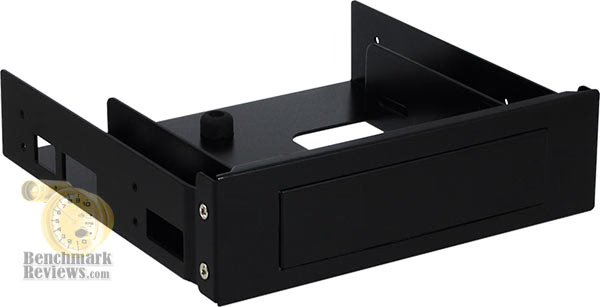
Since CPU's are now becoming less prone towards generating extremely high temperatures (as evidenced by the petite 1" tall Intel cooler that now accompany the latest Core 2 Duo processors), manufacturers have had to shift their attention away from core cooling and focus more on component hardware such as the hard drive and video card.
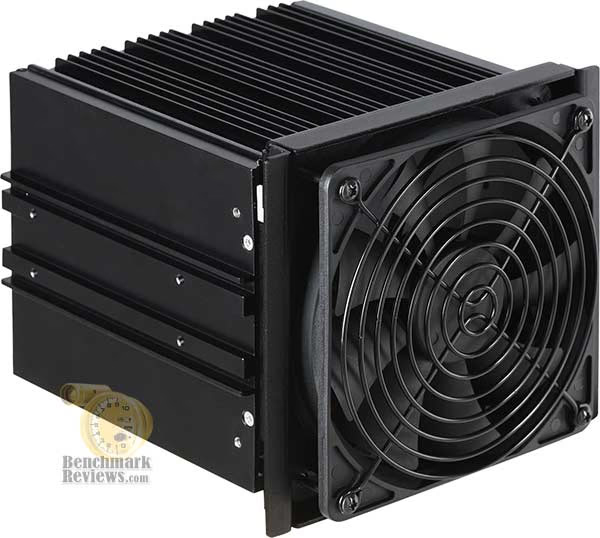
Hiper dresses their removable hard drive cage with an array of heatsink fins atop the enclosure, and an attached 120mm cooling fan mounted directly to the front of the cage. The hard drive cage slides in and out from the Osiris chassis and can be removed from the front (once the front bezel is removed).
This modular 5.25" drive bay can fit four hard drives, which are positioned on their sides along thin strips of silicon-rubber (to reduce vibration). Enthusiasts may not realize it, but by placing the drive on its side the entire unit can cool itself more effectively.

The solid welds securing each panel are buffed and level so that they are not easily detected, keeping fashion in step with function. Beyond the welds, there are intricate panel joints which improve strength and offer a cleaner finish to the edgework.
In our next section, the final details are discussed before we give our final thoughts and conclusion for the Hiper Osiris.
Osiris Interior Details
Once you glimpse the naked interior, the simple design of the Hiper Osiris really becomes evident. I have mixed feelings about a black mid-tower ATX case which maintains a solid attachment to the same base color all around... so thankfully Hiper has mixed the interior landscape with a bright little motherboard sections standing in the darkness.
Since the motherboard mounting panel is not removable, nor does the Osiris offer a slide out tray similar to the Lian Li PC-B20A or Apevia X-Qpack 2 CM500, there really isn't any logical reason to make it stand out with the silver metal finish. But I like it anyway.
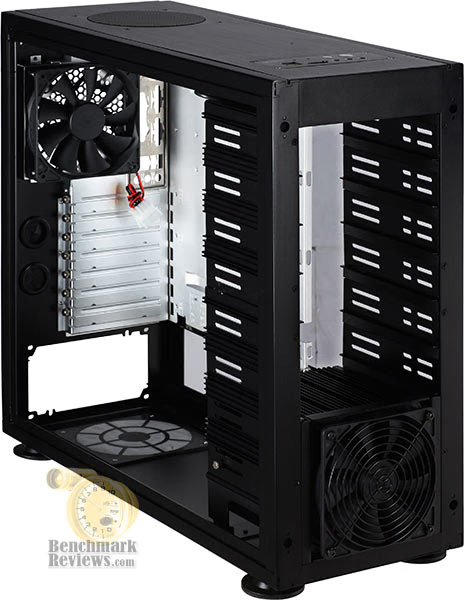
There are plenty of silver and black thumbscrews supplied with the HTC-1K514-A1, which means that installing 5.25" and 3.5" devices is a twist away from completion. However, with ten expansion bays available, all of those thumbscrews will become a tiresome chore. Since the Hiper Osiris mid-tower ATX case is something of a high-dollar high-performance specimen, I would liked to see high-convenience features on the inside as well as the exterior, similar to the push-button mounting system in the Cooler Master Cosmos RC-1000.
One particular feature of interest is the relocated PSU placement, which places the power supply in direct path with intake airflow from the hard drive cage. Power supply units with topside intake fans can be turned upside-down to take advantage of the filtered intake grill along the bottom of the case.

The filtered grill for the power supply unit is the only one of its kind on the Osiris, which is too bad because the intake fan on the hard drive cage could use on as well.
The cooling fans located at the top and top-rear panels of the Osiris help to exhaust heated air that has completed its path from the intake fan positioned on the hard drive cage. All three 120mm cooling fans that come with Osiris use a three-pin motherboard power connection, or can use the included adapters for use with four-pin Molex power connections.
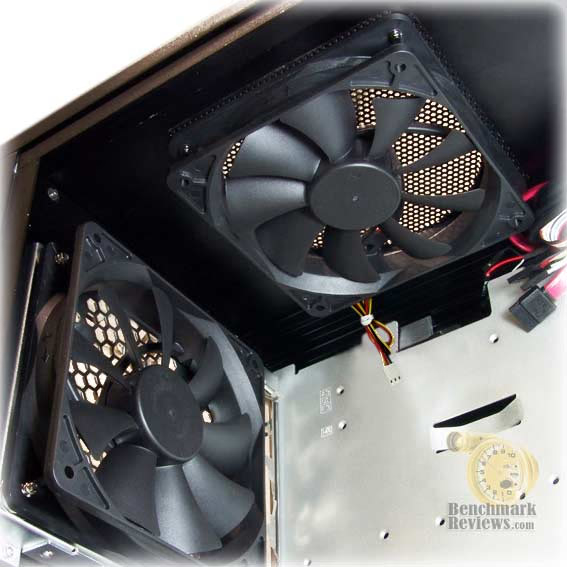
Since the back panel of the HTC-1K514-A1 is finished with the same silver color, it blends in well, but most motherboards will cover the tray completely. In the long run, the contrasting color may help you work to spot wires and cables in low light situations.
On the reverse "non-service entry" side of the Hiper Osiris, the backside of motherboard mounting panel gives evidence to a few passive cable management features. Using bands or zip-ties you can secure large cable groups to this panel and keep them from obstructing the panel door.
In the next section, I give some final thoughts on the state of computer cases. It's a twisted point that I make, but I think you'll find it worth reading; especially if you're not a fan of giant-size full-tower cases.
Computer Chassis Final Thoughts
Initially I had no plan of creating a stand-alone page for my final thoughts, but then I began to dwell on a few trends that seem to be circling the computer chassis industry without relent. For each and every year that I have been professionally involved with computers (which officially began around 1998), the same collective trends have repeated themselves over and over. Originally, beige computer cases were the de facto standard for enthusiasts wanting to construct their own IBM clone personal computer. The focus seemingly revolved around strength and capacity (usually for fans) while fashion and creature comforts were usually neglected.
I thought this trend was going to phase itself out around the turn of the century, but there was still a dominant demand for large full-tower cases. Beige was still the only color you'd expect and nearly everything was built of steel. The most you could really expect out of higher-end computer cases around the Y2K era was a vast collection of colorful (usually purple) cages for smaller 60mm cooling fans (92mm in rare occasions). Case strength was still a marketing buzz word used in ads to show how much lumpy geek-weight could be supported by their case. Even though most of these products were anchored down to the floor due to their excessive weight, the marketing hype seemed to hypnotize the masses. This is all slowly bringing me to my point: which is that the more things change the more they seem to remain the same.
Personal computers evolved out of the beige-syndrome condition sometime around 2002, when Thermaltake began shipping aluminum versions of their full-tower cases and Dell began shipping systems with a black contoured plastic shell. It would take a little while to catch on, but not much later we began to see colored plastic bezels and see-through side panel windows available on just about everything that could hold a motherboard. With the exception of a few minor tweaks here and there, computer cases remained the same item at its core.
So here I am in the middle of 2008, almost exactly ten years since I began breathing in bytes. The computer industry has changed to the point that I believe it could soon look entirely different from the landscape I joined into only a decade ago. But something tells me that with all the change, we'll inadvertently keep a few things the same out of habit. One of which, the one trend I've been harping on about, is the rugged durability of computer cases that seem to have evolved above and beyond what any normal consumer would actually require.
In the past sixteen months that Benchmark Reviews has been on the web, I have personally reviewed dozens of computer cases. I sometimes think that I've seen it all, but then I browse the Lian Li website and see a computer case shaped like a snail. It's a bizarre world for sure, but what can we leave behind as we evolve away from our ancient computing roots? Not all that long ago everyone seemed to want a full-tower computer with ten drive bays, and just a few years later they reduced their demands to almost half that amount. Heading into 2009, I have to wonder what it is we will really need from our computer cases.
The future of computer cases
Back in the day, having two (or more) optical drives was almost a requirement for anyone who wanted to work with the CD and DVD formats. Now, you can have one drive that reads and writes to CD, DVD, and Blu-ray Disc of HD-DVD. This makes anything more than two 5.25" external drive bays unnecessary. Next is the 2.5" external drive bay, which was used exclusively for floppy disk drives (once upon a time). Since your average CD-R or USB flash drive has replaced removable magnetic media for pennies on the dollar, I don't expect the 2.5" drive bay to get much attention anymore. Although a few people might still be using multimedia expansion bays (outfitted for a 5.25" expansion bay), I think that manufacturers have done an excellent job making I/O ports readily available on the front, top, and side of most cases we see produced. So far, there hasn't been real reason to have more than two or three external drive bays, but there's more fat to be trimmed.
The last hold-out is the hard drive cage, which has historically (if not traditionally) held four hard disk drives. This made sense back at the turn of the century when capacities were on the level of 8 GB, but we live in a world of affordable Terabyte-size hard drives openly available to the retail market. So do we need all of this space? I don't think so, and it seems that enthusiasts are trying to make a slow shift towards compact computing. Small Form Factor (SFF) cases have been getting more popular over the past two years, and now make up a noticeable segment of the consumer market. Let's recount our basic needs: two external 5.25 drive bays and possibly two more internal 5.25" drive bays. With an open mind, you could even begin to see how a MicroATX motherboard might also make good sense for most of us since PCI slots are really a necessity of the past (for modems, sound cards, and network interface cards).
Which brings me into my final thoughts: are we really clinging to the past when we accept a new design? I don't know what each of you need out of a computer case, but I can begin to imagine that none of you will be using your PC chassis to support your body weight while you change a light bulb. Full tower cases, while still in demand for a tiny slice of enthusiasts, are about as necessary for home users as Cadillac Escalades. Mid-tower computer cases are a different story, and without some major change to power supply unit dimensions in a future ATX standard we will be seeing them for a long time to come. I think it's great that we can have all of this extra space, but personally I think we need manufacturers to begin to think outside the box and come up with product designs more in-line with our evolved hardware needs.
Hiper Osiris HTC-1K514-A1 Conclusion
It shouldn't be a surprise to anyone that the Osiris looks good. Hiper has a long-standing history or delivering solid performance with world-class design, and the HTC-1K514-A1 is no different from the entire line of Hiper products in this regard. Although this case could easily fit into the tastes of practically everyone shopping for a new mid-tower computer chassis, it would be a disservice to say that this is going to fit everyone's needs.
The Osiris offers quality far beyond the expectations of consumers; and this is still stating it lightly. Aluminum 6063 TS Alloy joined by solid welds and not rivets ensures that nothing is going to break this chassis down, short of a tank. Unfortunately, all that solid construction makes it nearly as heavy as one, too. 
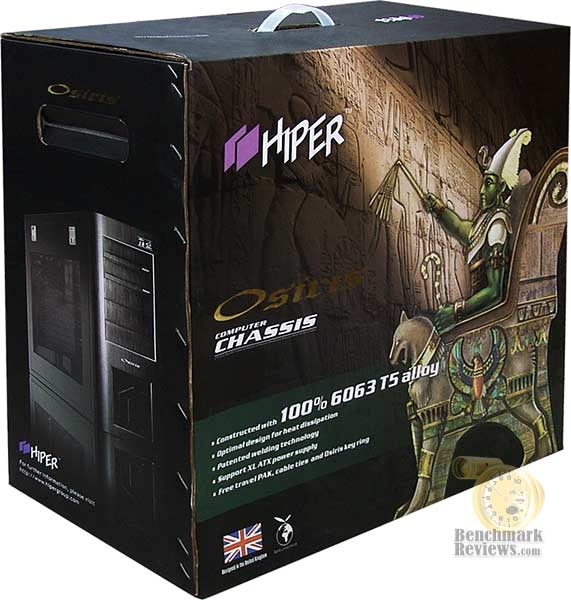
Hiper has done a great job packaging, protecting, and marketing the Osiris. Exciting graphics and informative retail packaging help the consumers confidence in selecting this mid-tower ATX case from the bunch. The retail package does a great job of showcasing the Osiris with a glossy finish over the graphics to draw them out and seem realistic. This is a premium product, and there isn't any mistaking it.
Black anodized alloy and mirror-finished accents make the HTC-1K514-A1 stand out. The all-black finish may not appeal to everyone, which is why Hiper makes a silver version available, but for those who approve the Osiris is going to keep its fashion friendly looks forever. The contrasting interior lacks some consistency, but does not directly detract from the appearance. If anything, it adds a nice accent to the dark interior quarters.
Solid construction is part of Hiper's master plan for the Osiris. Structural welds increase chassis integrity far beyond rivets, making the HTC-1K514-A1 among the strongest mid-tower ATX cases available. Integrated panel intersections add an even higher level of structural rigidity. High marks were given for the impeccable construction built exactly as well as it was designed, from top to bottom.
In terms of functionality, the Osiris offers above average performance with the intelligent placement of a bottom-mounted PSU with its own intake filter to draw cool air from beneath the case. A perfect channel of circulated cooling air is created from the 120mm intake fan attached to the hard drive cage all the way to the top-rear set of fans exhausting heated air outside the Osiris. Liquid cooling enthusiasts can take advantage of the open interior which should be large enough to accommodate most pumps, while the radiator can be fed through the two panel openings at the rear of the HTC-1K514-A1.
Hiper unveiled the Osiris at CeBIT 2008 back in March, and so far the reception has been a warm one. like NewEgg. This reviews was of the black version of the Osiris, but as this article is published Hiper will be launching a silver version as well. NewEgg currently lists the HTC-1K514 for $169.99, which makes it a palatable price for a premium product. I expect that the Osiris mid-tower computer case will demand appropriate prestige considering it offers refined architecture at an affordable cost.
In summary, the Osiris HTC-1K514 improves upon the mid-tower design originally introduced by Hiper in the Anubis HTC-1K614; and now it's offered at a reduced price. The Osiris comes recommended to those who appreciate fine quality and refined looks, and desire more functionality out of a case than just a glossy place to mount a motherboard. I consider the Hiper Osiris to be an elite-level product offered to enthusiasts without the outrageous top-shelf price tag found on other cases. Consider the Osiris for enthusiast computer systems that won't require constant travel, since it weighs the same as a thin steel case, but can handle more abuse than you'll be willing to give it. With no painted finish to scratch off and a frame that is indestructable, the Osiris will easily outlast anything you put inside of it.
Pros:
+ Constructed with 100% 6063 TS Alloy
+ Jointed seams are welded and not riveted
+ Available in elegant black and refined silver finishes
+ Convenient I/O panel with audio input and eSATA
+ Low-mount PSU location with fan filter
+ Anti-vibration silicon-rubber pads for all drives
+ Matching optical drive front bezel plates
+ Excellent cooling fan placement for optimal airflow channel
+ Liquid-cooling compatible rear ports
+ Direct cooling drive cage design
+ Tool-less side panels, bezel, and drive bays
+ Incredible attention to detail
Cons:
- Drive cage intake fan lacks matching filter
- Heavy product weight despite alloy construction
Ratings:
-
Presentation: 9.25
-
Appearance: 9.25
-
Construction: 9.75
-
Functionality: 9.00
-
Value: 8.25
Final Score: 9.1 out of 10.
Excellence Achievement: Benchmark Reviews Golden Tachometer Award.
Questions? Comments? Benchmark Reviews really wants your feedback. We invite you to leave your remarks in our Discussion Forum.