
nMedia System HTPC 180 & 280 Enclosures
nMedia HTPC Case Introduction
The term HTPC may not be familiar to most readers or even be common place in computer and technology discussions, yet it is something which most everyone wants without even knowing it. HTPC, or Home Theater Personal Computer, is the professional name for personal computers which have but one very specific duty: enrich the home theater environment. Gamers, movie buffs, music lovers, and couch potatoes all stand to enjoy themselves a little more through the refined enclosures designed to help your PC blend in and be part of the team resting near the entertainment center.
If you already play video games, watch movies, listen to music, or record television on your personal computer, then your computer is just one step away from looking the way it acts. This is where the HTPC enclosure market has taken keen note and met the needs of the home theater and computer enthusiast with a variety of stylish computer cases. Now, with many of the most current enclosures being build with IR remote compatibility and Media Center components in mind, it makes perfect sense to build it yourself.
There is a company out there that is thinking of you, and they have built a line of enclosures that will have you replacing your DVD player, DVR, and stereo, all for a stylish HTPC. This company is nMedia System. Like most emerging companies that have made a success in the enthusiast market, nMedia System originate from overseas. With offices in Hong Kong and GunagZhou, China, as well as a stateside presence in Fremont, California, nMedia System offers a wealth of research and development for their enthusiast line of products.
In this review, I will reveal the new nMedia System HTPC 180SA and the slightly larger HTPC 280BA enclosures for Home Theater Personal Computers. You can expect that the quality and craftsmanship of these cases will receive thorough testing, and the optional features such as the IR remote integration and cooling fan noise control will demand close inspection. In addition, I have paired these two cases with similar HTPC components, and put them all into action using the new Windows Vista (RC1) Ultimate Edition's Media Center functionality.
Features and Specifications:

HTPC 180 Specifications:
Models: HTPC 180BA (Black) and HTPC 180SA (Silver)
Dimensions: 15.5"(W) x 5.4"(H) x 15"(D)
Material: Aluminum & Steel Construction
Form Factor Support: Micro-ATX (9.6" x 9.6")
Power Supply Support: Includes NMEDIAPC 300W Super Silent Micro-ATX (20+4 pins/90mm fan)
Drive Bays: (1) 5.25" for Optical Drive, (3) 3.5" for Hard Disks
Expansion Bays: 4 Slots - Full Size
Cooling: 60mm Silent Case Fan at rear, CPU Air Duct on top panel
Front I/O Ports: All-in-1 Card Reader (Internal USB), IEEE 1394, (2) USB 2.0, Audio Mini-Jacks,
Non-programmable backlit LCD display with fan speed controller (CPU Temp & Fan RPM)
HTPC 180 Special Features:
• MCE Receiver rack with internal USB adapter (receiver not included)
• S/PDIF Output Jack
• CPU Overheat and fan out-of-order alarm functions
• Fan speed control
HTPC 280 Specifications:
Models: HTPC 280BA (Black) and HTPC 280SA (Silver)
Dimensions: 17"(W) x 5.25"(H) x 16"(D)
Material: Aluminum & Steel Construction
Form Factor Support: Micro-ATX (9.6" x 9.6")
Power Supply Support: ATX 2.0 Standard
Drive Bays: (1) 5.25" for Optical Drive, (3) 3.5" for Hard Disks
Expansion Bays: 4 Slots - Full Size
Cooling: (2) 60mm Silent Case Fans at rear, 80mm HDD fan, CPU Air Duct on top panel
Front I/O Ports: All-in-1 Card Reader (Internal USB), IEEE 1394, (2) USB 2.0, Audio Mini-Jacks,
Non-programmable backlit LCD display with fan speed controller (CPU Temp & Fan RPM), AV Capture Component & S-Video (RCA), Audio (RCA) Inputs
20 x 2 VL System Media Center Edition (MCE) Programmable VFD with Internal USB Connector (Optional)
HTPC 180 Special Features:
• MCE Receiver rack with internal USB adapter (receiver not included)
• S/PDIF Output Jack
• CPU Overheat and fan out-of-order alarm functions
• Fan speed control
From these specifications you can see that both enclosures are suited for Micro-ATX form factor motherboards, and both have MCE-ready IR receiver racks. In addition, both have an eye-catching backlit LCD display, which reads the CPU temp via a wired temperature probe and monitors the CPU cooling fan speed along with a fan speed control dial. Only the HTPC 280 offers hard drive cooling and an optional VFD (Vacuum Formed Display), and allows room for a full-size ATX power supply unit.
Component Compatibility
Motherboard Selection
Form Factor:
• HTPC 100, 180, 200 & 280 -- Micro ATX
• HTPC 300 & 400 -- Full ATX
Onboard (Internal) USB Connector:
• Suggest minimum 2 10xpins Headers that support 4 USB Ports
• The 4 USB ports can serve the two front USB ports, 9-in-1 Card Reader, IR Receiver and VFD/LCD module
Onboard (Internal) IEEE 1394 Firewire Connector:
• Suggest minimum 1 for the front IEEE 1394 Firewire port
Motherboard list that supports HTPC 100, 180 200 & 280
Intel Socket LGA775
• Intel D945GTP Executive Series
• Intel D945GTPLR Media Series
• Intel D945GTPLKR Media Series
• Intel D925XBCLK Media Series
• Intel BLKDG965SSCK
• Intel BOXDG965SSCK
• Intel BOXDQ965GFEKR
• ASUS P5L-VM 1394
• ASUS P5B-VM
• GIGABYTE GA-8I945GMF
• Gigabyte GA-8I945GMH-RH
• ABIT LG-80
• Foxconn 945G7MA-8EKRS2
• Foxconn 945G7MA-8EKRS2H
• Foxconn 915M03-G-8EKRS2
• ECS 945G-M3 (1.0b)
Intel Socket 479 (Mobile CPU)
• Aopen i915GMm-HFS
• AOpen i945GTm-VHL
• ASUS N4L-VM DH
AMD64 Socket 754
• ASUS K8V-MX
• DFI K8M800-MLVF
• ECS C51G-M754
• MSI RS480M-IL
• GIGABYTE GA-K8N51GMF
AMD64 Socket 939
• DFI RS482 INFINITY
• Foxconn NF4K8MC-EKRS
• Foxconn 6150K8MA-8EKRS
• ECS RS480M V1.0
• ECS RS482-M (1.0A)
• GIGABYTE GA--K8N51GMF-9
• MSI RS482M4-ILD
• MSI K8NGM2-FID
• ECS RS480-M V1.0
• ASUS A8N-VM CSM
• eVGA 131-K8-NF44-AX
AMD64 Socket AM2
• ASUS M2NPV-VM
• Gigabyte GA-M51GM-S2G
• MSI K9NGM2-FID
The thing that makes a difference in selecting the motherboard for HTPC 100, 180, 200 & 280 is the IEEE 1394 Firewire port. It is very fast external bus standard that supports data transfer rates of up to 400Mbps (in 1394a). One of the most use application in a HTPC system is to connect the digital camcorder so that you can capture video file directly to hard disk in real time without using the A/V cables.
For example, let say you are planning to use LGA Socket 775 Intel CPU processor, there are only 4 boards on the Intel official website that support an onboard IEEE 1394a port. (allow you to connect the front 1394 port internally to the motherboard) If you don't plan to use the IEEE 1394 port, you will have more than 50 choices of Micro-ATX motherboard.
Closer Look: HTPC 180SA Exterior
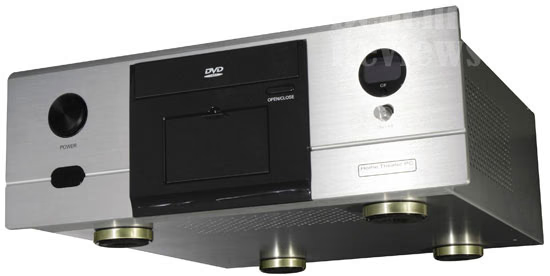
The great thing about building an HTPC is that you can make a small project that goes barely noticed next to the receiver, or you can turn the table and make it a large attention getter. The HTPC 180SA is the perfect foundation for a micro-ATX based project, which also means that it will take very little space in your entertainment center. The small footprint of the HTPC 180 is most beneficial to those who do not have the comfort of large entertainment platforms, or would like to build a simple PC interface to their home theater system. The compact design of the HTPC emphasizes efficiency and simplicity.
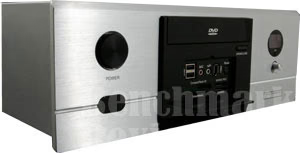
Having such a compact design, as the HTPC 180 series does, can allow for installation into areas that were previously out of reach to tower computers. Most people would balk at the idea of placing a tower computer near their entertainment center, but when the unit looks and acts exactly like the surrounding equipment, and HTPC case becomes an easy sell. Adding to this are the two finishes available for the HTPC 180 series of enclosures: silver with brushed aluminum bezel, and black with gloss black bezel.
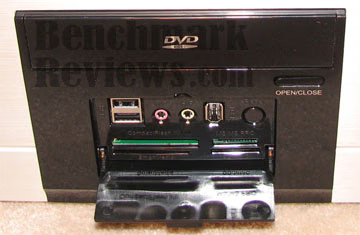
With a large backlit power button and opposing blue LED temperature and fan speed display, the layout is quite clean on the HTPC 180 series. Additionally, a window for an optional (not included) IR remote control is directly below the power button, and a fan speed controller is on the opposite side. Located in the center of the HTPC 180 is a drop-down door with access to a multi-card reader, IEEE-1394 and USB 2.0 ports, and a headphone and microphone mini-jack.

The overall design of the case is very compact, but it keeps a presence of mind towards system cooling. The HTPC 180 series of enclosures has multiple vent locations in strategic positions on the every side of the case. Although most Micro-ATX systems may not generate excessive heat because of fewer features, the ventilation and cooling channels have been carefully designed to aid in prolonging the component life. nMedia System appears to be aware that HTPC systems are expected to live among the home theater components, and will require a longer life span then the average computer.
Closer Look: HTPC 180SA Interior
There are some sacrifices made when building an HTPC with Micro-ATX form factor components. The most obvious it the lack of expansion slots, which can limit the functionality of an HTPC design. Usually this isn't a problem for most builders, but there are some small details that are also compromised elsewhere.

Additional features will usually be trimmed out of the motherboard: such as audio header pins for front panel input, or additional USB and IEEE-1394 ports. Furthermore, some high-end chipsets are not available in Micro-ATX form factor, which limits your field of motherboards.
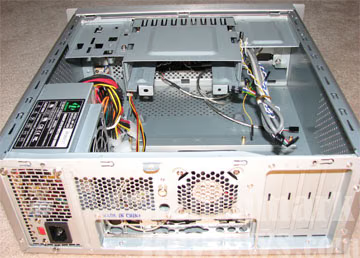
In most cases, when building a Micro-ATX based HTPC, you will need to use small form factor components. nMedia System takes the trouble out of locating the conforming components and includes MP-300 micro 300W power supply. The MP-300 is featured from the nMedia System Mute Power series of silent power supplies, which are included with the HTPC 180 series kit.
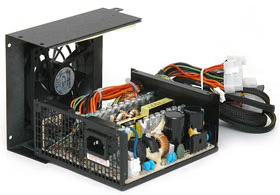

Cooling is at the forefront of concerns for a system builder, and the HTPC 180 series go to great lengths to ensure that system stability is never compromised. The 90mm fan in the super silent power supply works together with a single 60mm cooling fan, which comes attached to the rear of the case to assist in venting out heated air. Even with the two fans drawing out air, nMedia System has designed a vent directly above the CPU location and has attached an air duct to concentrate cool air onto the CPU.

Closer Look: HTPC 280BA Exterior
Similar to the HTPC 180 series only slightly larger, the HTPC 280 series offers a few distinct advantages. As you can see in the images, the HTPC 280BA offers a full placement of cooling vents. The front of the enclosure is identical to the HTPC 180 series regarding the backlit power button and LCD temperature display; however the I/O ports are located at the bottom of the window for the optional VFD (not included).

While the smaller HTPC 180 series offers an extremely compact footprint, it would not sit well with standard size rack components. For this reason, the larger HTPC 280 series utilizes the standardized rack system sizes and makes great use of the additional enclosure space.
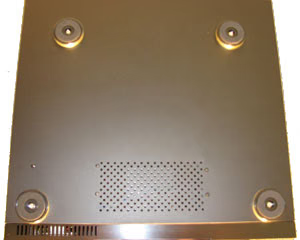
Turning the unit over will reveal that there is indeed an emphasis on function as well as fashion. In the same regard to similarities, both of the HTPC cases feature padded cushion feet to absorb vibration and securely maintain the unit positioning. Nearby there is another vent on the underside of the VFD location and an intake vent for the hard disk drive fan. This thoughtful engineering proves that nMedia System has done their research to produce a very efficient and reliable HTPC series of cases.
Closer Look: HTPC 280BA Interior
As mentioned previously, the HTPC-280 series borrows much from the design of it's smaller cousin. Some of the immediate differences: improved hard drive rack with rubber vibration-cancelling pads and 80mm nMedia-branded cooling fan, full-size ATX power supply opening with support platform, and twin 60mm cooling fans to exhaust system heat. There is additional room beneath the optical drive carriage for a VFD/LCD module (not included), which truly completes any HTPC system. From the rear-view you will notice that there is additional space beneath the IR Receiver perch in the upper-right corner.

Not exactly known for their ability to cool while remaining quite, this set of twin 60mm cooling fans know their role. Additionally, the S/PDIF output jack is efficiently placed above the power supply unit. This is a great design feature which serves to maximize the use of back panel space and minimize the impact on available component slots.

One of the best improvements to the larger HTPC 280 design is the hard drive facility. With a silent running 80mm cooling fan and rubberized-silicone vibration pads, the hard drive rack in the HTPC 280 is well ahead of most cases on the market; HTPC or otherwise.

To ensure that the silent properties of the HTPC 280 series of enclosures are not abandoned by a purchase of a noisy power supply from another manufacturer, nMedia System has designed the aptly named Mute Power supplemental series of power supply units. In the construction and review of the HTPC 280 series, nMedia supplied the silent-running MP-400 power supply unit. With a two-rail 12V (14A + 15A) system, and extremely large 140mm cooling fan, this would be a formidable power supply unit for any system. In regards to the nMedia HTPC series of products which support full size ATX power supplies, it proves obvious in design that the MP-400 mates perfectly. Equipped with SATA and PCI-E 12V power connectors, and the more compatible 20+4 main connector pin design your media center PC will be able to feature all of the best hardware available to the market. The Mute Power series of power supplies come in 300, 400, and 500W variations, enforcing noise dicipline in your system.

Once all of the internal components are installed, you will begin to appreciate the time and effort which nMedia System has placed in designing a very efficient and functionally sound HTPC case. With ventilation everywhere, and aided by silent cooling fans both supplied and incorporated into their supporting peripherals, it is easy to see that the do-it-yourself builder will not get burned. In some systems build on components with less power demand (such as Core Duo and Core 2 Duo CPU's), a nearly all-passive design could be used to ensure a completely silent system allowing you to enjoy everything your entertainment center unleashes.

Final Thoughts
From the moment I unpacked both the HTPC-180SA and the HTPC-280BA cases, I couldn't help but imagine myself building the best Home Theater PC money could buy. With competition for this slice of the market finally thinning out less attractive solutions, the HTPC series of enclosures will undoubtedly please the consumer while engraining the nMedia brand name. Since more manufacturers are now building better quality system components in smaller packages, it appears likely that more consumers will soon find interest in the HTPC market.
I was pleased with the quality and construction of both HTPC cases, and even more impressed by the well refined design. With overall space and cooling efficiently managed, there were very few times I wondered how nMedia could have done better. This is clearly not the first design release, as it reflects some solid research and development on their part. Equally impressive are the supporting peripherals available from nMedia System.
Conclusion
At the time of this review, the nMedia HTPC-180SA was being sold for $99.99 at NewEgg.com, while the HTPC-280SA sells for a mere $114.99; clearly making it the obvious winner for value. With a bit of deep searching you may find some less expensive merchants available which carry these products, but none will carry the customer service which NewEgg is know for.
The Mute Power MP-300 Micro-ATX power supply unit (included in the HTPC-180 series kit) was very functional and silent, but somehow missed the fashionable part of its job description with the raw steel finish. In past reviews of power supply units, this would be a negative factor, but it's hard to find serious fault in a component which is absolutely not going to be seen from inside the case. Conversely, the MP-400 redeems this quality with a very attractive polished smoke-mirror finish. At the time of this writing, the MP-400 was $39.99 and the MP-500 sold for $49.99 at NewEgg.com, which is actually a very good price for these dual-rail PSU's with 140mm fan.
As far as improvements go, the front I/O bay on the HTPC-180 series did not seem to fit in with the rest of the design and landscape. It could have been better implemented; possible a retracting/fold-in door would make for a better fit and finish. One of my few complaints with the HTPC-280 series is the optional VFD/LCD module. I did not receive this optional item, which was the determining factor for excluding the Windows Vista RC2 Media Center portion of this review, and I personally think it should not be left to option since it is built specifically for this case.
In conclusion, I rate both the nMedia HTPC-180 and HTPC-280 series of cases with a 8.5 based on my aforementioned findings.
Pros:
+ Stylish layout and attractive design
+ Fan speed controller with backlit LCD display
+ Front I/O panel supports nearly every connection and media card
+ Exceptional use of space and efficient cooling design
+ Silent cooling features and ventilation are built in everywhere
+ Hard drive mounts and cooling are superior to most (HTPC-280 only)
+ Available is the most popular home theater component finishes
Cons:
- Front I/O panel door on HTPC-180 seems to detract from design
- DVD cage is a tight fit with most systems
- VFD/LCD Module should be included (optional on HTPC-280)
Ratings:
-
Presentation: 6.25
-
Appearance: 9.0
-
Construction: 9.5
-
Functionality: 8.5
-
Value: 8.75
Final Score: 8.4 out of 10.
Questions? Comments? Benchmark Reviews really wants your feedback. We invite you to leave your remarks in our Discussion Forum.