
G.SKILL 2133MHz DDR3 Pi-Series Memory Kit
G.SKILL DDR3-2133 4GB Memory Kit Review
Enthusiasts and overclockers are always looking for the components that can provide the most bang for the buck. An inexpensive processor can often be carefully tweaked to yield performance that's superior to a more expensive version. Likewise, many video cards can realize substantial performance improvements with manual adjustment of the voltage and clocks on the card. With memory, however, there's typically much less headroom: your DDR3-1333 memory may not run reliably at 1600MHz, even with looser timings. If you want really fast memory, you're going to have to pay for it. Benchmark Reviews has run tests on a number of high-speed memory kits from the likes of Corsair, Crucial, Kingston, Patriot, OCZ, and others, and these reviews offer a wealth of information you can use to educate yourself on the subject.
G.SKILL is a relatively recent entry into the high-end memory market, and they're going up against established brands like Corsair, Mushkin, and Crucial in a very competitive marketplace. They're arguably more focused, though, since their only products are memory (desktop and laptop memory, as well as SSDs).
Computer memory is somewhat of a commodity these days: memory modules with a given specification will perform pretty much identically with other modules with similar specifications. How will G.SKILL distinguish their product from others in the market? We'll see in the following pages.
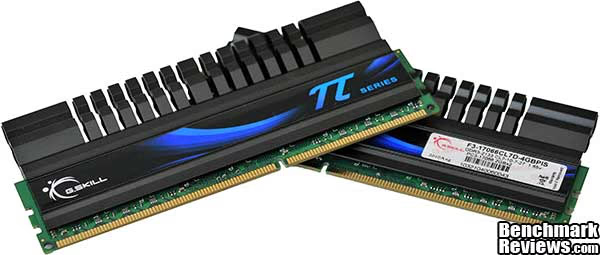
Although the memory controller built into Intel's Socket 1156 processors only supports DDR3-1333 speeds officially, any enthusiast knows that there's more than a bit of overclocking headroom there. DDR3-1600 memory is increasingly common, and recently a number of memory vendors have upped the ante even more, with DDR3-2000 and higher speeds becoming available. G.SKILL has entered the enthusiast memory market with a broad selection of high-speed and low-latency memory kits, and Benchmark Reviews tests their new DDR3-2133 memory kit (F3-17066CL7D-4GBPIS) to see what kind of performance benefits it will yield when overclocked.
Manufacturer: G.SKILL
Product Name: DDR3-2133 (PC3 17066) 4G memory kit
Model Number: F3-17066CL7D-4GBPIS
Price As Tested: $174.99
Full Disclosure: The product sample used in this article has been provided by G.SKILL.
Closer Look: G.SKILL DDR3-2133
While this memory will of course work in any DDR3-supporting motherboard, G.SKILL makes a point of saying that it's for systems based on Intel's P55 chipset, and "specifically" for the Core i7-860/870 CPUs, and the qualified motherboard list on G.SKILL's web site comprises only P55-based boards. The reason G.SKILL specifies the Core i7-860 processor is that it supports a 12x memory multiplier, whereas Core i5 chips like the 750 only support up to an x10 multiplier. Here's why this is something you need to understand...
The frequency your memory runs at is determined by multiplying the system's base clock (133MHz standard for P55 systems) by the processor's memory multiplier (6, 8, or 10 for the Core i5-750, and 6, 8, 10, or 12 for the Core i7-860/870, a higher memory multiplier being one of the non-obvious perqs of a Core i7-series CPU). Thus, the XMP profile on the memory's included SPD (serial presence detect) chip will try to set your system to achieve the memory's 2133MHz rating by juggling the base clock and memory multiplier. On the 860, this results in a 178MHz base clock and an x12 memory multiplier, yielding a nominal memory frequency of 2136MHz. However, if you activate the XMP profile on a Core i5-750 system, you'll get a 214MHz base clock paired with the maximum x10 multiplier...which is fine except most P55 boards won't overclock to 214MHz; I had to drop the bus speed to 200MHz to get my board to POST with an I5-750CPU, resulting in a memory speed of DDR3-2000. This is still a pretty decent speed, but be aware that you might not be able to run this memory at its full rated speed with some systems.
The official specifications for this memory kit are listed below:
| Main Board | Intel |
|---|---|
| System | Desktop |
| System Type | DDR3 |
| M/B Chipset | Intel P55* |
| CAS Latency | 7-10-7-27-2N |
| Capacity |
4GB (2GB x2) / 8GB (2GB x4) |
| Speed | DDR3-2133 (PC3 17066) |
| Test Voltage | 1.65 Volts |
| Registered/Unbuffered | Unbuffered |
| Error Checking | Non-ECC |
| Type | 240-pin DIMM |
| Warranty | Lifetime |
*Engineered Specifically For Intel Core i7 860/870 CPUs
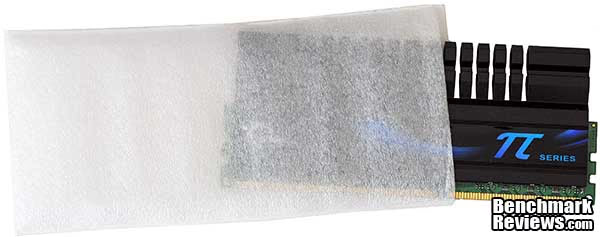
The memory kit is delivered in a plain brown box; opening the box reveals the clip-on "Turbulence Fan" memory cooler and the two 2GB DIMMs, each in its own foam sleeve.

The DIMMs have large black aluminum heat spreaders. One side of the heat spreader has the company logo:

...while the other side has a label with the detailed memory specifications:
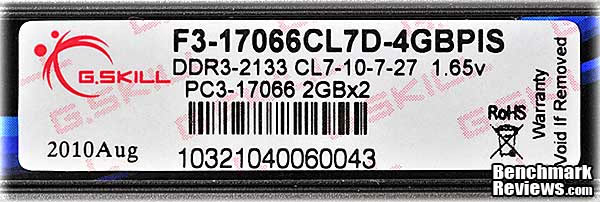
The heat spreaders almost double the height of the DIMM module. If you have a large CPU cooler that overhangs your first memory slot, this memory probably won't fit. Speaking of things that don't fit, the included "Turbulence fan" cooler's single-piece plastic construction is designed to clip around the release latches on a DIMM socket, but the ASUS Sabertooth 55i motherboardI tested with (one of the board on G.SKILL's approved list for this memory) only has latches on one side of its sockets, which meant the fan couldn't be securely attached, since the left side had nothing to clip to, as shown below.

While this is not G.SKILL's fault - one-clip sockets are increasingly popular, even when, as is the case here, there is no issue with clearance - it's something to be aware of. Fortunately in most cases DDR3 memory will not get hot enough to benefit from active cooling.
So, how does it perform? Join me in the next section to find out.
Testing & Results
Testing Methodology
Testing memory is tricky: you need a processor to do so, but the processor contains its own internal cache memory. In fact, modern processors are specifically designed to minimize accesses to external memory, since the internal cache memory is so much faster. The Intel Core i7-860 processor I used for this test has 8 megabytes of "Smart Cache" internal memory, and depending on the code being executed by the processor, the cache "hit rate" can approach 90%. So in many cases, even infinitely fast memory would only improve throughput by 10% or so. The G.SKILL DDR3-2133 memory certainly has the right specs, but how much difference will it really make?
Synthetic benchmarks try to minimize the influence of a processor's on-chip cache memory by reading very large data sets sequentially. But this is rarely the case with "real world" programs, which is why you'll almost always see a much larger performance difference with synthetic benchmarks than real-world application tests. In other words, synthetic benchmarks will reveal the theoretical performance, whereas the application tests will show the performance you're actually likely to see.
If you install the G.SKILL DDR3-2133 memory kit in your system and reboot, it will run at 1333MHz at CL9 latency (specifically, CL9-9-9-24). By activating the XMP profile in your system's BIOS, you'll specify that the memory run at 2133MHz with CL7 latency (7-10-7-24). As I described in the previous section, the XMP profile attempts to set the memory to its rated speed by adjusting the base clock and memory multiplier, so be aware that depending on your motherboard and processor, you may not be able to run this memory at its full rated speed.
To see how the memory performance varied with different speeds, I ran all tests with the memory at the Intel stock 1333MHz, the common enthusiast rate of 1600MHz, the XMP profile speed of 2133MHz, and the highest stable overclock I was able to reach, 2214MHz. The first two settings used timings of 9-9-9-24, while the higher two settings used timings of 7-10-7-27. I ran the synthetic benchmark tests four times, and averaged the results for the final score. In all cases there was less than a 3% variance between successive runs of each test.
Test System
-
Motherboard: ASUS Sabertooth 55i, BIOS 1702
-
System Memory: G.SKILL DDR3-2133 F3-17066CL7D-4GBPIS
-
Processor: Intel Core i7-860
- Operating System: Windows 7 Home Premium x64
Test Software
-
Everest Ultimate version 5.5
-
PassMark Performance Test 7 (64-bit)
-
SiSoftware Sandra Lite 2010.SP2
-
CineBench 11.5
-
Crysis Warhead 1.1
-
WinRAR version x64 v3.93
Synthetic Benchmark Results
Lavalys Everest Ultimate is a system information and benchmark tool that every enthusiast should have. I used the Memory Read, Memory Write, and Memory Copy benchmark tests to compare the performance of the G.SKILL memory at the four different settings described above.
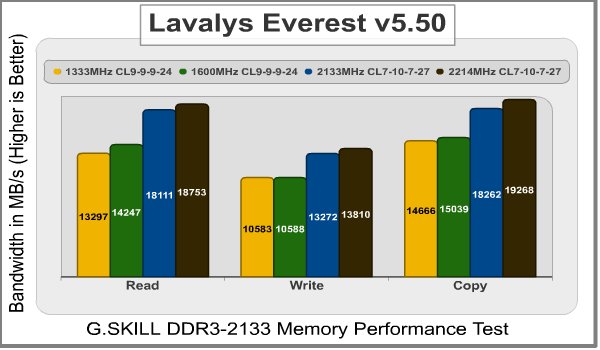
As you can see, the XMP profile (blue bar) make a substantial difference in performance...at least in this test. Memory read throughput increases by about 36% over the Intel base 1333MHz, and write and copy throughput increased by 25%. Overclocking the memory to 2214MHz adds little, though, with about a 3-4% improvement over the XMP results.
The PassMark Performance Test is a large set of benchmarks covering all aspects of a computer system; I used the Uncached Read, Write Speed, and Memory Mark tests to gather the data for this chart. (The Memory Mark score is a composite rating based on the results of several other memory tests as well as the ones I used.)

The differences between the various memory speeds are minimal here; oddly, the XMP profile speed of 2133MHz turns in the lowest scores in all cases.
SiSoftware's "Sandra" is their System ANalyser, Diagnostic and Reporting Assistant. It has a comprehensive memory test suite; their memory test is heavily multi-threaded, and the test code is "aggressively overlapped" to keep the memory bus saturated so that the limiting factor should always be memory throughput rather than CPU power.

The Sandra test results are more dramatic than the Everest results, with the DDR3-2133 setting beating the 1333MHz setting by 51% in both tests. As with Everest, the 2214MHz overclock adds very little, about 3.5%.
In two of three synthetic tests, the higher speeds of the G.SKILL kit make a real difference. In the next section, we'll see how it performs in application tests.
Application Test Results
For application testing, I chose CineBench 11.5, the Crysis Warhead benchmark, and WinRAR's built-in benchmark test to see how the G.SKILL DDR3-2133 memory would perform. First up: CineBench. This free benchmark tool by Maxon makes use of the same rendering code used in their professional "Cinema" line of products, and it performs several rendering tests to assess system performance. The OpenGL subtest uses a animated car chase scene rendered in real time, and reports the results in frames per second.
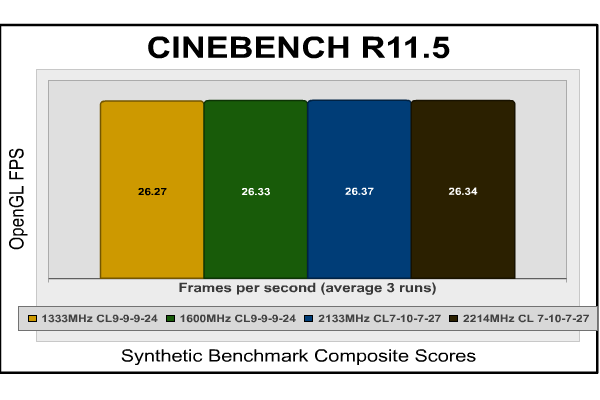
With differences measured in a fraction of a frame per second, it seems that the results of this test are insensitive to memory performance. Next, I tested game performance with Crysis Warhead, using the "Airfield" demo.

Crysis Warhead is the successor to Crysis, at the time of its release one of the most graphically demanding games on the market. I chose the popular 1680x1050 resolution for this test, and used the high quality settings to ensure that the graphical textures loaded into memory were large. Still, the results mirror those of CineBench, with very little difference between the various memory settings. Oddly, the overclocked DDR3-2214 setting shows a slight (about 5%) performance disadvantage in the maximum frame rate as compared to the XMP setting of DDR3-2133.
The final test uses WinRAR, the popular archiving utility. It includes an internal benchmark that will compress megabytes of data and report the results.

Here, we finally see some real differences, with a smoothly increasing progression as memory speeds increase. The DDR3-2133 setting improves the DDR3-1333 setting by 18%, with the overclocked 2214MHz setting adding another 6% on top of that. Still, even this difference is fairly minimal; unless you're compressing some very large files, you're not likely to notice the difference: a job that took 60 seconds at 1333MHz would take just over 49 seconds at DDR3-2133.
So how can we interpret the results of the synthetic and application benchmarks? I'll explain in the next section.
DDR3-2133 Final Thoughts
One thing to keep in mind is that how much memory you have is much more important than how fast the memory is. When I initially ran the Crysis Warhead tests, I was getting terrible frame rates, with minimums of 0FPS and maximums of only 20FPS or so. I eventually noticed that the system was only showing 2G of memory (due to a DIMM that was not fully in its socket, which is another reason I don't like "latch on only one side" DIMM sockets), and that's just not enough for Windows 7 and Warhead and a benchmarking tool: excessive disk thrashing (from Windows' virtual memory) was what finally clued me in. Shutting down the system and re-seating the errant DIMM cured that problem.
As the synthetic benchmarks show, G.SKILL's F3-17066CL7D-4GBPIS kit is indeed significantly faster than the standard 1333MHz memory, although not by the ratio one would think from the difference in clock speeds. The difference in performance in the application tests, however, ranged from small to nonexistent.
Enthusiasts looking to improve the performance of their systems can overclock the CPUs and video cards, but memory typically doesn't overclock well, especially if you're looking for frequencies beyond 1600MHz. Companies like Corsair, Mushkin, Crucial, and now G.SKILL have stepped in to address this perceived need with high-speed memory kits, often available in a dizzying number of variations. G.SKILL offers no fewer than 33 different combinations of speed, latency, and DIMM size in its DDR3 portfolio, so you're sure to find whatever fine-grained combination of these characteristics you want; of course, the converse is that you might be confused by the number of options. But given that the demonstrated "real world" improvements of high-speed memory are minimal, why would you want to spend the money on a kit like this?
The main reason is that lower memory speeds can act, indirectly, as a brake on your CPU performance. Unless you have an AMD Black Edition or Intel Extreme or K-series CPU, the only way you can overclock your system is by raising the base clock, which will also raise the memory speed. You can juggle the CPU and memory multipliers, but your options there are limited; so in many cases your overclock will be constrained by your memory, even though your CPU has more to give. In other words, high-speed memory, while offering little performance improvement on its own, can indirectly enable significant performance improvements by allowing higher CPU overclocks.
In the introduction to this review, I referred to memory as a "commodity", which is true: there's little to distinguish one set of memory modules of a given specification from another...except for price. And this is where G.SKILL holds a significant advantage over most of its competitors: the $174.99 price of this kit is far below the price most other vendors charge for their equivalents: for example, one vendor's DDR3-2133 4G memory kit costs twice as much, and runs at CL9 instead of CL7. I was not able to find another kit of similar specifications selling for anywhere near G.SKILL's price.
G.SKILL 4GB DDR3 Conclusion
Although the rating and final score mentioned in this conclusion are made to be as objective as possible, please be advised that every author perceives these factors differently at various points in time. While we each do our best to ensure that all aspects of the product are considered, there are often times unforeseen market conditions and manufacturer changes which occur after publication that could render our rating obsolete. Please do not base any purchase solely on our conclusion, as it represents our product rating for the sample received which may differ from retail versions. Benchmark Reviews begins our conclusion with a short summary for each of the areas that we rate.
The performance of this memory is excellent, in that it easily runs at its rated speed and low latencies, and supports a small (about 4%) overclock. The increase in performance is notable in synthetic benchmarks, illustrating that significant throughput improvements over standard speed memory are possible. While real-world performance improvements are minimal, high-speed memory can give you more versatility in overclocking the rest of your system.
The low voltages that DDR3 memory runs at mean that heat, even in stress-test situations, is rarely a concern, but enthusiasts expect a little bling from their expensive memory. The black aluminum heat spreaders with blue accents stand out, and the blue-lit LED cooling fan, while unnecessary in most situations, can be added for a little extra visual flair.
The heat spreaders also serve to protect the delicate memory chips and surface-mount components on the DIMM. But even if something bad happens, G.SKILL offers a lifetime warranty on the memory, which adds a nice "peace of mind" aspect to this product. The memory cooling fan's one-piece plastic construction seems a little cheap, but is just as effective as more expensive multi-piece aluminum mounting systems.
This memory's XMP profile renders it best suited for Core i7-860 processors; while it will work in any DDR3 system, you might not be able to run it at its full rated speed. Still, those who aren't afraid to dive in and start tweaking voltages, clocks, and memory timings (the ASUS Sabertooth 55i motherboard I used for this review offers 25 different memory timing settings you can adjust) will manage to extract excellent performance from this memory in most systems.
Compared to other high-speed memory kits, this kit represents an excellent value due to its low price; but compared to memory in general, it's still much more expensive at about twice the price of a typical DDR3-1333 4G kit. Your performance dollars are better spend on almost any other aspect of your system hardware: the CPU, graphics card, or even an SSD. But if you're looking to extract the last bit of performance from your rig, this product is an excellent way to do so. It's also a potentially good long-term investment for your system; the DDR3 standard isn't in danger of being superseded any time soon, since it will continue to be used even by Intel's upcoming desktop chipsets in 2011. At $174.99 at Newegg, a price that significantly undercuts its competitors, this memory represents an excellent value in its field.
Pros:
+ 2133MHz 7-10-7-24 performance
+ Included LED-lit cooling fan
+ 4G kit is perfect for Core i5/Core i7 systems
+ Lifetime warranty
+ Low price for this class of memory
+ Allows extra versatility in CPU overclocking
Cons:
- Tall heat spreaders may interfere with large CPU coolers
- Almost no overclocking headroom
- Little real-world performance improvement
- Twice the cost of standard DDR3-1333 4G kits
Ratings:
- Performance: 9.0
- Appearance: 9.5
- Construction: 9.5
- Functionality: 8.0
- Value: 9.0
Final Score: 9.0 out of 10.
Excellence Achievement: Benchmark Reviews Golden Tachometer Award.
Questions? Comments? Benchmark Reviews really wants your feedback. We invite you to leave your remarks in our Discussion Forum.
Reader comments from the original article
2 comments were posted before commenting closed. They are preserved as written. Original avatars no longer resolve and are shown as a placeholder.
RE: G.SKILL 2133MHz DDR3 Pi-Series Memory Kit Doug Permalink:
"...excessive disk thrashing (from Windows' virtual memory) was what finally clued me in." Since I have all program related applications on SSD, oh oh what will we do!!! LOL One less tool we have to trouble shoot problems. The clickitty-click of the "hard drive." I In Jan of 2009 I bought 12 GB of OCZ Gold 160 RAM for 175 USD.
RE: G.SKILL 2133MHz DDR3 Pi-Series Memory Kit David Ramsey Permalink:
Yeah, my main PC has an SSD, but fortunately the test bed machine I was using for this review does not!