
EVGA GeForce GTX 580 Classified: Overclocked
Manufacturer: EVGA
Product Name: GTX 580 Classified
Model Number: 03G-P3-1588
Price As Tested:$599.99 at Newegg
Full Disclosure: The product sample used in this article has been provided by EVGA.
The EVGA GTX 580 Classified is one of the most powerful single card solutions on the market. With a 14+3 VRM design, a new cooler and the Classified logo many users want to know "How far can the EVGA GTX 580 Classified go?" Benchmark Reviews is here to answer this question armed with the Beta EVTUNE software to allow us to really push the voltage and is yearning to see how far this card can go. So please join us as Benchmark Reviews overclocks and benchmarks the EVGA GTX 580 Classified.
When NVIDIA introduced the Fermi architecture in April 2010 with the GF104 and the GTX 480 it ran hot, and was very power hungry. Fast forward to November 2010 and NVIDIA is releasing the GTX 580 using the GF110 which uses the same Fermi architecture but now has access to all 16 streaming multiprocessors while at the same time bringing down power consumption and more importantly giving off less heat. Since then many radical designs have been released to help further control heat output but few have been designed from the ground up to set overclocking records.
This is where EVGA comes in with its Classified line for its GTX 580 which was built from the ground up for extreme overclocking using LN2 and Liquid Helium Cooling. EVGA included a 14+3 VRM design, 2 x 8 + 1 x 6 power inputs, a second BIOS developed to deal with the Fermi cold bug, an 8 cm blower fan, and a somewhat redesigned heatsink. To top it off EVGA has also added a generous 73MHz overclock to the core clock bringing the core clock on the Classified to 855Mhz.

Since this is a top of the top of the line card we will only be using the most powerful of benchmarks. With a majority of upcoming titles being designed to take advantage of the DX11 APIs, Benchmark Reviews will focus on only the most powerful of DX11 benchmarks both synthetic and real world.
EVGA GTX 580 Classified Features
- Microsoft DirectX 11 Support
- NVIDIA CUDA Technology with CUDA C/C+, DirectComputer 5.0 and OpenCL Support
- NVIDIA PhysX Technology
- NVIDIA PureVideo HD Technology
- NVIDIA 2-way, 3-way, and 4-way SLI Ready
- NVIDIA 3D Vision Surround Ready
- PCI Express 2.0 Support
- Two Dual-Link DVI-I HDCP Capable Connectors
- One EVBot Connector
- OpenGL 4.1 Support.
GTX 580 Classified Specifications
- Core Clock: 855Mhz
- Memory Clock 4212 Mhz Effective
- Sharder Clock: 1710 Mhz
- CUDA Cores: 512
- Bus Type: PCI-E 2.0
- Memory Detail: 3072MB GDDR5
- Memory Bit Width: 384 Bit
- Memory Speed: 0.4 ns
- Memory Bandwidth: 202.1GB/sec
- Texture Fill Rate: 54.7GT
Overclocking Methodology
The Microsoft DirectX-11 graphics API is native to the Microsoft Windows 7 Operating System, and will be the primary O/S for our test platform. DX11 is also available as a Microsoft Update for the Windows Vista O/S, so our test results apply to both versions of the Operating System. The majority of benchmark tests used in this article are comparative to DX11 performance, however some high-demand DX10 tests have also been included.
According to the Steam Hardware Survey published for the month ending May 2010, the most popular gaming resolution is 1280x1024 (17-19" standard LCD monitors). However, because this 1.31MP resolution is considered 'low' by most standards, our benchmark performance tests concentrate on higher-demand resolutions: 1.76MP 1680x1050 (22-24" widescreen LCD) and 2.30MP 1920x1200 (24-28" widescreen LCD monitors). These resolutions are more likely to be used by high-end graphics solutions, such as those tested in this article.
In each benchmark test there is one 'cache run' that is conducted, followed by five recorded test runs. Results are collected at each setting with the highest and lowest results discarded. The remaining three results are averaged, and displayed in the performance charts on the following pages.
In order to get the highest stable overclock, my preferred method is to slowly increase the core clock speed by 10MHz and make five runs through our Crysis 2 benchmark. This creates enough stress to quickly discern if the overclock is stable, and if so I continue increasing the overclock by another 10MHz until NVIDIA's Forceware driver's crash. From that point I fine tune my overclock to get the most stability out of the system.
After much deliberation I finally settled on 940MHz at 1.3v as the highest fully stable overclock that I could attain. Although this voltage is high for the speeds reached the Classified was designed to handle the higher voltages that are needed for record breaking speeds attained using extreme cooling solutions such as LN2 and Liquid Helium .
It should be noted that since no software will correctly advertise the voltage being used by the Classified I used a multimeter to attain the actual voltage of the Classified while overclocking.
Intel P67 Test System
-
Motherboard: MSI P67-GD65
-
System Memory: 4 x 4GB 1866Mhz 9-10-9-28 1.65v
-
Processor: Core i5 2500k 3.3Ghz @ 4.7Ghz
-
Video: ASUS GTX 580
-
Disk Drive 1: Patriot Inferno 60GB
- Disk Drive 2: 2 x 1TB Seagate 7200RPM RAID 0 Array
- Disk Drive 3: 1 x 500GB Seagate 7200RPM
-
Optical Drive: DVD Burner
-
Enclosure: Silverstone Raven RV02-EW
-
PSU: Cooler Master SilentPro 1000w
-
Monitor: ASUS 27.5" 1920x1200
-
Operating System: Windows 7 64-bit Professional
DirectX-11 Benchmark Applications
- 3dMark 2011
- Crysis 2
- Ultra Settings (Ultra Quality, 4x AA, DX11, Edge Blur, Hi Resolution Textures)
- Aliens vs Predator
- Extreme Settings: (Very High Quality, 4x AA, 16x AF, SSAO, Tessellation, Advanced Shadows)
- BattleForge v1.2
- Extreme Settings: (Very High Quality, 8x Anti-Aliasing, Auto Multi-Thread)
- Lost Planet 2
- Extreme Settings: (16x AA, Very High Shadow Detail, High Texture, High Render, High DirectX 11 Features)
- Unigine Heaven Benchmark 2.5
- Extreme Settings: (High Quality, Exteme Tessellation, 16x AF, 8x AA)
Video Card Test Products
| Card | ASUS GTX 580 | EVGA GTX 470 SC | EVGA GTX 460 SC | XFX 5970 | EVGA GTX 580 Classified | EVGA GTX 580 Classified Overclocked |
|---|---|---|---|---|---|---|
| GPU Cores | 512 | 448 | 336 | 3200 | 512 | 512 |
| Core Clock (MHz) | 772 | 625 | 763 | 735 | 855 | 940 |
| Shader Clock (MHz) | 1544 | 1250 | 1526 | N/A | 1710 | 1880 |
| Memory Clock (MHz) | 4008 | 3402 | 3800 | 4000 | 4212 | 4212 |
| Memory Amount | 1536 MB GDDR3 | 1280 MB GDDR5 | 1024MB GDDR5 | 2048MB GDDR5 | 3072MB GDDR5 | 3072MB GDDR5 |
| Memory Interface | 384-bit | 320-bit | 256-bit | 512-bit | 384-bit | 384-bit |
Disclaimer: Although we have pushed our card as far as we are able, your milage may vary based as each chip has its own characteristics.
DX11: Aliens vs Predator
Aliens vs. Predator is a science fiction first-person shooter video game, developed by Rebellion, and published by Sega for Microsoft Windows, Sony PlayStation 3, and Microsoft Xbox 360. Aliens vs. Predator utilizes Rebellion's proprietary Asura game engine, which had previously found its way into Call of Duty: World at War and Rogue Warrior. The self-contained benchmark tool is used for our DirectX-11 tests, which push the Asura game engine to its limit.
In our benchmark tests, Aliens vs. Predator was configured to use the highest quality settings with 4x AA and 16x AF. DirectX-11 features such as Screen Space Ambient Occlusion (SSAO) and tessellation have also been included, along with advanced shadows.
- Aliens vs Predator
- Extreme Settings: (Very High Quality, 4x AA, 16x AF, SSAO, Tessellation, Advanced Shadows)

| Card | ASUS GTX 580 | EVGA GTX 470 SC | EVGA GTX 460 SC | XFX 5970 | EVGA GTX 580 Classified | EVGA GTX 580 Classified Overclocked |
|---|---|---|---|---|---|---|
| GPU Cores | 512 | 448 | 336 | 3200 | 512 | 512 |
| Core Clock (MHz) | 772 | 625 | 763 | 735 | 855 | 940 |
| Shader Clock (MHz) | 1544 | 1250 | 1526 | N/A | 1710 | 1880 |
| Memory Clock (MHz) | 4008 | 3402 | 3800 | 4000 | 4212 | 4212 |
| Memory Amount | 1536 MB GDDR3 | 1280 MB GDDR5 | 1024MB GDDR5 | 2048MB GDDR5 | 3072MB GDDR5 | 3072MB GDDR5 |
| Memory Interface | 384-bit | 320-bit | 256-bit | 512-bit | 384-bit | 384-bit |
DX11: Crysis 2
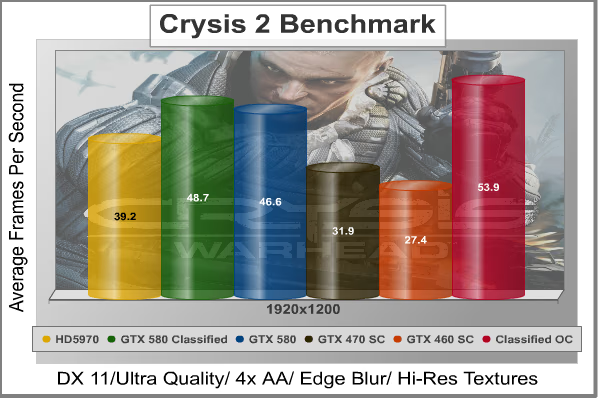
Crysis 2 launched in the US on March 22, 2011 and runs off the Crytek 3 engine. Although it had a rough start because of the lack of DX11 support and somewhat muddy textures it was later vindicated with the updated DX11 and Hi-Resolution texture package which enabled the "Ultra" Settings. With these additions Crysis 2 was turned into the DX11 beast that it was supposed to be.
Using the Adrenaline Crysis 2 Benchmark Tool v1.0.1.12 we will be going through the Central Park benchmark. The Adrenaline Crysis 2 Benchmark Tool will generate the same run through of the end game Central Park level which provides many different visual effects to help push our test system to its very limits while keeping track of our FPS for each run. We will be using the highest available setting for our Crysis 2 Benchmark.
- Crysis 2
- Extreme Settings: (Ultra Quality, 4x AA, DX11, Edge Blur, Hi Resolution Textures)
| Card | ASUS GTX 580 | EVGA GTX 470 SC | EVGA GTX 460 SC | XFX 5970 | EVGA GTX 580 Classified | EVGA GTX 580 Classified Overclocked |
|---|---|---|---|---|---|---|
| GPU Cores | 512 | 448 | 336 | 3200 | 512 | 512 |
| Core Clock (MHz) | 772 | 625 | 763 | 735 | 855 | 940 |
| Shader Clock (MHz) | 1544 | 1250 | 1526 | N/A | 1710 | 1880 |
| Memory Clock (MHz) | 4008 | 3402 | 3800 | 4000 | 4212 | 4212 |
| Memory Amount | 1536 MB GDDR3 | 1280 MB GDDR5 | 1024MB GDDR5 | 2048MB GDDR5 | 3072MB GDDR5 | 3072MB GDDR5 |
| Memory Interface | 384-bit | 320-bit | 256-bit | 512-bit | 384-bit | 384-bit |
DX11: BattleForge
BattleForge is a free Massive Multiplayer Online Role Playing Game (MMORPG) developed by EA Phenomic with DirectX-11 graphics capability. Combining strategic cooperative battles, the community of MMO games, and trading card gameplay, BattleForge players are free to put their creatures, spells and buildings into combinations they see fit. These units are represented in the form of digital cards from which you build your own unique army. With minimal resources and a custom tech tree to manage, the gameplay is unbelievably accessible and action-packed.
Benchmark Reviews uses the built-in graphics benchmark to measure performance in BattleForge, using Very High quality settings (detail) and 8x anti-aliasing with auto multi-threading enabled. BattleForge is one of the first titles to take advantage of DirectX-11 in Windows 7, and offers a very robust color range throughout the busy battleground landscape. The charted results illustrate how performance measures-up between video cards when Screen Space Ambient Occlusion (SSAO) is enabled.
- BattleForge v1.2
- Extreme Settings: (Very High Quality, 8x Anti-Aliasing, Auto Multi-Thread)

| Card | ASUS GTX 580 | EVGA GTX 470 SC | EVGA GTX 460 SC | XFX 5970 | EVGA GTX 580 Classified | EVGA GTX 580 Classified Overclocked |
|---|---|---|---|---|---|---|
| GPU Cores | 512 | 448 | 336 | 3200 | 512 | 512 |
| Core Clock (MHz) | 772 | 625 | 763 | 735 | 855 | 940 |
| Shader Clock (MHz) | 1544 | 1250 | 1526 | N/A | 1710 | 1880 |
| Memory Clock (MHz) | 4008 | 3402 | 3800 | 4000 | 4212 | 4212 |
| Memory Amount | 1536 MB GDDR3 | 1280 MB GDDR5 | 1024MB GDDR5 | 2048MB GDDR5 | 3072MB GDDR5 | 3072MB GDDR5 |
| Memory Interface | 384-bit | 320-bit | 256-bit | 512-bit | 384-bit | 384-bit |
DX11: Lost Planet 2
Lost Planet 2 is the second installment in the saga of the planet E.D.N. III, ten years after the story of Lost Planet: Extreme Condition. The snow has melted and the lush jungle life of the planet has emerged with angry and luscious flora and fauna. With the new environment comes the addition of DirectX-11 technology to the game.
Lost Planet 2 takes advantage of DX11 features including tessellation and displacement mapping on water, level bosses, and player characters. In addition, soft body compute shaders are used on 'Boss' characters, and wave simulation is performed using DirectCompute. These cutting edge features make for an excellent benchmark for top-of-the-line consumer GPUs.
The Lost Planet 2 benchmark offers two different tests, which serve different purposes. This article uses tests conducted on benchmark B, which is designed to be a deterministic and effective benchmark tool featuring DirectX-11 elements.
- Lost Planet 2
- Extreme Settings: (Antialiasing, 16x AF, High Shadow Quality, High Detail, High Geometry, Ambient Occlusion)

Test Summary: Lost Planet 2 is definitely a TWIWMTBP game and as such even our GTX 470 SC almost beats out the 5970. This means that again the Classified is competing against a stock GTX 580 for best performance. At 1680 x 1050 the Classified sees a 5.8% gain in performance compared to the stock GTX 580, as we increase the resolution to 1920 x 1200 we see that lead shrink to only 4.9% with 55.7FPS total.
| Card | ASUS GTX 580 | EVGA GTX 470 SC | EVGA GTX 460 SC | XFX 5970 | EVGA GTX 580 Classified | EVGA GTX 580 Classified Overclocked |
|---|---|---|---|---|---|---|
| GPU Cores | 512 | 448 | 336 | 3200 | 512 | 512 |
| Core Clock (MHz) | 772 | 625 | 763 | 735 | 855 | 940 |
| Shader Clock (MHz) | 1544 | 1250 | 1526 | N/A | 1710 | 1880 |
| Memory Clock (MHz) | 4008 | 3402 | 3800 | 4000 | 4212 | 4212 |
| Memory Amount | 1536 MB GDDR3 | 1280 MB GDDR5 | 1024MB GDDR5 | 2048MB GDDR5 | 3072MB GDDR5 | 3072MB GDDR5 |
| Memory Interface | 384-bit | 320-bit | 256-bit | 512-bit | 384-bit | 384-bit |
DX11: 3DMark 2011
FutureMark 3DMark11 is the latest addition of the 3DMark benchmark series built by FutureMark corporation. 3DMark11 is a PC benchmark suite designed to test the DirectX-11 graphics cardperformance without vendor preference. Although 3DMark11 includes the unbiased Bullet Open Source Physics Library instead of NVIDIA's PhysX for the CPU/Physics tests, Benchmark Reviews concentrates on the four graphics-only tests in 3DMark11 and uses them with medium-level 'Performance' presets.
The 'Performance' level setting applies 1x multi-sample anti-aliasing and trilinear texture filtering to a 1280x720p resolution. The tessellation detail, when called upon by a test, is preset to level 5, with a maximum tessellation factor of 10. The shadow map size is limited to 5 and the shadow cascade count is set to 4, while the surface shadow sample count is at the maximum value of 16. Ambient occlusion is enabled and preset to a quality level of 5.


| Card | ASUS GTX 580 | EVGA GTX 470 SC | EVGA GTX 460 SC | XFX 5970 | EVGA GTX 580 Classified | EVGA GTX 580 Classified Overclocked |
|---|---|---|---|---|---|---|
| GPU Cores | 512 | 448 | 336 | 3200 | 512 | 512 |
| Core Clock (MHz) | 772 | 625 | 763 | 735 | 855 | 940 |
| Shader Clock (MHz) | 1544 | 1250 | 1526 | N/A | 1710 | 1880 |
| Memory Clock (MHz) | 4008 | 3402 | 3800 | 4000 | 4212 | 4212 |
| Memory Amount | 1536 MB GDDR3 | 1280 MB GDDR5 | 1024MB GDDR5 | 2048MB GDDR5 | 3072MB GDDR5 | 3072MB GDDR5 |
| Memory Interface | 384-bit | 320-bit | 256-bit | 512-bit | 384-bit | 384-bit |
DX11: Unigine Heaven 2.5
The Unigine "Heaven 2.5" benchmark is a free publicly available tool that grants the power to unleash the graphics capabilities in DirectX-11 for Windows 7 or updated Vista Operating Systems. It reveals the enchanting magic of floating islands with a tiny village hidden in the cloudy skies. With the interactive mode, the emerging experience of exploring the intricate world is within reach. Through its advanced renderer, Unigine is one of the first to set precedence in showcasing the art assets with tessellation, bringing compelling visual finesse, utilizing the technology to the fullest extent, and exhibiting the possibilities of enriching 3D gaming.
The distinguishing feature in the Unigine Heaven benchmark is a hardware tessellation that is a scalable technology aimed for automatic subdivision of polygons into smaller and finer pieces, so that developers can gain a more detailed look to their games almost free of charge in terms of performance. Thanks to this procedure, the elaboration of the rendered image finally approaches the boundary of veritical visual perception: the virtual reality transcends conjured by your hand. The "Heaven" benchmark excels at providing the following key features:
- Native support of OpenGL, DirectX-9, DirectX-10, and DirectX-11
- Comprehensive use of tessellation technology
- Advanced SSAO (screen-space ambient occlusion)
- Volumetric cumulonimbus clouds generated by a physically accurate algorithm
- Dynamic simulation of changing environment with high physical fidelity
- Interactive experience with fly/walk-through modes
- ATI Eyefinity support

Although Heaven-2.5 was recently released and used for our DirectX-11 tests, the benchmark results were extremely close to those obtained with Heaven-1.0 testing. Since only DX11-compliant video cards will properly test on the Heaven benchmark, only those products that meet the requirements have been included.
| Card | ASUS GTX 580 | EVGA GTX 470 SC | EVGA GTX 460 SC | XFX 5970 | EVGA GTX 580 Classified | EVGA GTX 580 Classified Overclocked |
|---|---|---|---|---|---|---|
| GPU Cores | 512 | 448 | 336 | 3200 | 512 | 512 |
| Core Clock (MHz) | 772 | 625 | 763 | 735 | 855 | 940 |
| Shader Clock (MHz) | 1544 | 1250 | 1526 | N/A | 1710 | 1880 |
| Memory Clock (MHz) | 4008 | 3402 | 3800 | 4000 | 4212 | 4212 |
| Memory Amount | 1536 MB GDDR3 | 1280 MB GDDR5 | 1024MB GDDR5 | 2048MB GDDR5 | 3072MB GDDR5 | 3072MB GDDR5 |
| Memory Interface | 384-bit | 320-bit | 256-bit | 512-bit | 384-bit | 384-bit |
Overclocking Final Thoughts
Overclocking the Classified is much like the overclocking of ole' proving to be as much of an art as a science. Although I hoped that the Classified I was given would be able clock higher than the 940MHz I was "only" able reach, this represents a 17.88% overclock from a stock GTX 580 or a 9% vs. the stock 855MHz core clock on the Classified. When asked, our representative at EVGA did confirm that the GF110 chips that go into each GTX 580 Classified are not handpicked and therefore our reader's luck overclocking their individual EVGA GTX 580 Classifieds may be better or worse than ours.
| Game | Stock GTX 580 | EVGA GTX 580 Classified | EVGA GTX 580 Classified OC | Percent Difference (Stock/Classified/Combined) |
|---|---|---|---|---|
| GT1 |
26.43 |
28.1 | 31.7 | 6.6% / 11% / 17.6% |
| GT2 | 27.7 | 30.27 | 32.8 | 8.4% / 7.7% / 16.1% |
| GT3 | 39.14 | 42.18 | 46.79 | 7.2% / 9.8% / 17% |
| GT4 | 19.55 | 20.51 | 23.08 | 4.7% / 11% / 15.7% |
| Crysis 2 | 46.6 | 48.7 | 53.9 | 4.3% / 9.6% / 13.9% |
| Unigine |
27.7 |
28.8 | 30.7 | 3.8% / 6.1% / 9.9% |
| AvP | 63.9 | 68 | 72.6 | 6% / 6.3% / 12.3% |
| Lost Planet 2 | 53 | 55.7 | 58.8 | 4.9% / 5.3% / 10.2% |
| Battleforge | 78.8 | 85.3 | 89.3 | 7.6% / 4.5% / 12.1% |
Overall, the EVGA GTX 580 Classified performed admirably when overclocked. Compared to the stock 855MHz core clock our overclocked Classified performed 9.875% better in our 3DMark 2011 benchmark adding, on average, 3.3 frames per second to each test compared to stock settings. In a more real world test Crysis 2 performed admirably also, giving 9.6% more FPS at 940MHz compared to the Classifieds stock 855MHz clock speeds.
Even better, when we look at the overclocked Classified compared to a stock GTX 580 with a core clock of 772MHz our increases in performance are even more apparent with an average gain of 14.2% or on average around 6.3 more frames per second. This is a very nice bump in performance and easily could keep our readers lowest FPS from dipping below 30FPS when the stock 772MHz may not be up to par.

EVGA GTX 580 Classified Conclusion
Rather than Benchmark Reviews typical conclusion, I would like to end this article on a slightly different note. This will be a overview of the overclocking potential of the Classified, the performance that was actually gained, and a quick note on temperature and power at these high speeds.
The potential for extreme overclocking on the Classified gives into the feeling that its talents are wasted on mere air-cooling. The Classified was designed from the ground up to have LN2 and liquid helium used as a cooling method. This becomes obvious when you open the Classified up and find its 14 VRM's along with all of the power control circuitry needed to contain the 1000 watts of power the Classified can use. Still with a 17.88% from a stock GTX 580's 772MHz and 9% higher than the stock Classified, our air-cooled Classified is no slouch in the benchmarks.
When we look at the overclocked Classified and how it affects performance when gaming it paints a very nice picture with a performance increase compared to our Classified's stock 855MHz core clock of anywhere from 4.4%-11%. This translates to on average 3.3 frames per second on our tests when compared to stock settings. More performance, which although not a huge boost in performance, could help push a user's frame rate above 30FPS in very stressful games.
Unfortunately, this extra performance comes at the price of heat and power. The EVGA GTX 580 Classified can easily deal with the extra heat generated with a core clock of 940MHz @ 1.3v. On average with stock fan, settings I would only see our core temperature increasing to 81c during our tests, but this number could be drastically lowered if you manually set the fan to 100%. Power on the other hand is a completely different story with the Overclocked EVGA GTX 580 Classified drawing a staggering 486w of power during a Furmark stress test, which is 110w over stock power consumption. If users plan to overclock with two or more Classified in their system they should at least invest in a well-made 1200w, if not at least a 1500w PSU.
Overall, though our overclocked EVGA GTX 580 Classified performed superbly it does have some flaws. Users should be aware of the heat and power requirements of this monster card so that their system is adequately prepared for the Classified. As long as these requirements are met, an overclocked EVGA GTX 580 Classified will provide the power needed to play the most strenuous of games for years to come. Even better should users opt to use extreme cooling along with an EVBot unit they should be prepared for a pleasant experience as the EVGA GTX 580 Classified has been clocked up 1600MHz on LN2.
Reader comments from the original article
11 comments were posted before commenting closed. They are preserved as written. Original avatars no longer resolve and are shown as a placeholder.
beast godrilla Permalink:
I just bought mine from newegg. Sold out everywhere. Based on newegg reviews owners got 900-920 mhz at default volt. I'm hoping to get the same. Extra 20 to 40mhz for a 0.2 volts extra is too much. Did toy try to oc without volt tweaking? Can't wait to bench mine.
beast godrilla Permalink:
* did you try to oc without voltaze tweak?
1000 watts!? Farnsworth Worthington Permalink:
For the good of humanity, you must test this card and see if it can actually draw 1000 watts of power. More seriously, I doubt you could get to 1000 watts without those liquid-He/Ni cooling ideas. Still, if you could get it to 600 or 700 watts using air or water, that would be amazing. It's already drawing more power than most people's entire systems - it'd be both humorous and educational to see if it could outdraw most enthusiast systems. Anyway, another enjoyable article. You guys run an excellent operation here at BMR.
RE: Beast, 1000 Watts Austin Downing Permalink:
I did not test it at stock voltage as my goal was to see how far this card would go at full tilt. I can not test for anything over the power draw I had on during this test due to thermal constraints. Even so during our test I was drawing almost 500w just for this card. Thank you for the compliment it means a lot to know that our readers appreciate our work.
RE: EVGA GeForce GTX 580 Classified: Overclocked claydough Permalink:
I was hoping to see more reviews of this card! Thanks! Nice to see an unashamedly "enthusiast" review. Seems a little late to the party ( evga ). I can't see getting the classified when Kepler is around the corner now ( the first round of consumer cards and then the enthusiast cards soon after )
kepler probably in April godrilla Permalink:
I believe southern islands b4 kepler by a few months. Rumors have it because intel delayd ivybridge to april and kepler has many design wins with ivy that the launch will also be in april. Expect an appearnace @ CES 2012. FYI Even if you wants to buy this gpu you can't it has bin sold out since launch and available in limited quantaties. Meaning when kepler hit I should have no problem selling the thing due to the limited quantities and demand @ a good price. Besides how would I play skyrim with all the hd mods out there already as well as bf3 @ max!
gtx 680 what not in 2013 godrilla Permalink:
Based on todays kepler roadmap leak the high end kepler gpu out late 2012 or early 2013 #m.tweaktown.com/news/21713/rumortt_nvidia_s_28n m_desktop_gpu_roadma p_revealed_no_high_e nd_geforce_card_unti l_2h_2012/index.html I hope not another fermi
Hmm.. Greg Permalink:
I get 930x2300 from stock GTX 580 with 0.1vcore increase and 870x2300 at stock volts. I see no real reason for the Classified tbh...
RE: EVGA GeForce GTX 580 Classified: Overclocked JackNaylorPE Permalink:
Isn't 940 / 772 a 21.76% % OC ? not 17.88% ....that would be 797.5 stock speed
RE: RE: EVGA GeForce GTX 580 Classified: Overclocked Austin Downing Permalink:
Actually you do 772/940 to find the amount of performance difference. Which equals .1787 or 17.88%
RE: RE: RE: EVGA GeForce GTX 580 Classified: Overclocked John Naylor Permalink:
Nope.....by definition the denominator is the reference. Ya math doesn't work .... 772/970 = 0.7958, meaning the stock card is 79.58% of the OC'd card. OC is like over speed limit.....if ya going 10% over the 60 mph peed limit, that's 1.10 x 60 or 66 mph ....66/60 = 1.10 or 10% over speed limit % Overclock = 100 x (OC Speed / Stock Speed - 1) 100 x (940/772 - 1) = 21.76% Or another way .... % OC = (OC speed - Ref Speed) / Ref Speed (940 - 772) / 772 = 21/76 $ same answer