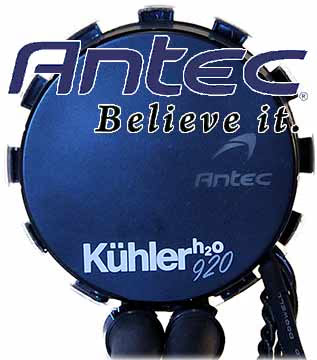
Since Corsair popularized their version of Asetec's "LCLC" (low cost liquid cooling) system back in 2009, it seems that every time you look, another variation on the theme appears. Other manufacturers have leapt into the fray, and Antec's initial entry into the market, the Kühler 620, impressed us with its amazing performance. Now Antec's introduced a new product, the Kühler 920. At first glance it seems very similar to Corsair's Hydro H70 product, but Antec distinguishes their offering with exceptional performance and features.

|
|
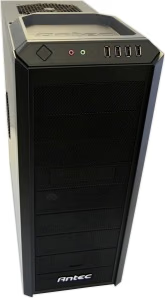
The Antec One Hundred computer case is touted as "the gaming case that delivers high-end features at a price that won't break the bank." Many gamers (and non-gamers) will purchase cases with sexy exteriors, only to find that the functionality and performance of the case are significantly hindered. For experienced users, a gaming case brings certain expectations, such as the need for good cooling, ease of use for install and re-installation of components, proper placement of USB ports and audio jacks, as well as several other factors. Benchmark Reviews will take the Antec One Hundred for a spin and you can decide if it meets your criteria for a good economy gaming case.

|
|
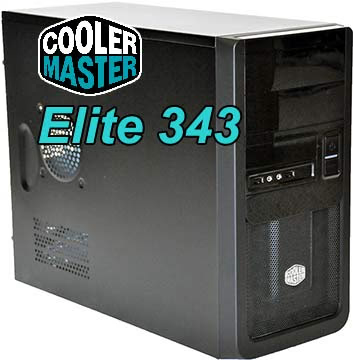
The enthusiast case market is replete with fancy cases brimming with exotic materials and features. It's not unusual for builders to buy "more case than they need", investing extra money in a case their system can grow into. But sometimes all you need is a basic case: a good-quality enclosure that will serve as a home for your components in a business, "grandma computer", or other non-enthusiast setting. Although Benchmark Reviews does not often look at cases like this, they make up the bulk of the case market. While Cooler Master's best known for its enthusiast cases (such as the HAF series), they serve this market as well with cases like the Elite 343 mATX computer case.

|
|
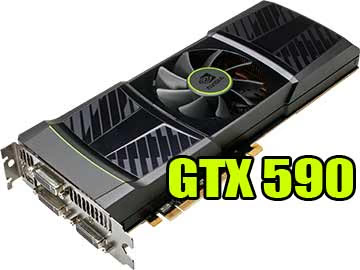
Designed around their flagship GeForce GTX 580 video card, they've combined two titanic graphics processors into a package roughly the same size, and still manage to produce the quietest dual-GPU video card ever made. With 512 CUDA cores each, two independent NVIDIA GF110 GPUs join to deliver 1024 total cores of graphical processing power. There are six 64-bit memory controllers that offer 384-bit combined bandwidth per GPU, and feed 3GB of combined GDDR5 video frame buffer. All of this is said to deliver comparable performance to the Radeon HD 6990, which is good for gamers, but it does so while using less power and emitting less noise. In this article, Benchmark Reviews tests the GeForce GTX 590 against the AMD Radeon HD 6990 and an entire market of top-end desktop graphics solutions.

|
|
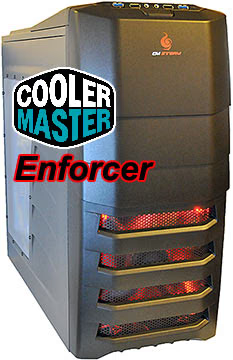
Cooler Master cases have garnered a well-earned reputation for quality and design innovation. Their Cosmos and H.A.F. series have won praise from enthusiasts around the world, and their "Storm" series of cases has shown that "budget" doesn't have to mean "cheap". The Cooler Master Storm Enforcer is the newest member of the Storm line, bringing internal USB 3.0 support and a configurable interior to the game. Benchmark Reviews checks out this new chassis in this review.

|
|
Everyone knows that SSDs cannot offer the capacity of a hard drive, and HDDs will never deliver solid state response time. Somewhere between the speed of Solid State Drive technology and the reliability of value-priced Hard Disk storage is the Seagate Barracuda XT. The Seagate Barracuda XT series is designed for performance computer enthusiasts, as well as large-capacity storage systems. Enthusiast tools such as the free Seagate SeaTools software allow users to custom-define firmware parameters to enable performance features such as 'Short Stroke' and noise reduction. Featuring the industry's largest 3TB capacity and third-generation SATA 6Gb/s controller interface, the Seagate Barracuda XT is also the first product to create a Windows XP-safe software solution for overcoming the 2TB barrier. In this article, Benchmark Reviews tests the 3TB Seagate Barracuda XT hard drive, model ST33000651AS, against a cross-section of competing storage products using the native SATA-III controller present on the Intel P67 platform.

|
|
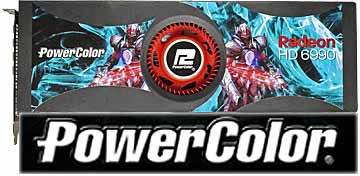
AMD's new Radeon HD 6990 video card reclaims the top spot in their overall GPU product hierarchy. There is no single-GPU card that can compete with two Cayman-class Radeon HD 6870 processors running in tandem. This was also true for the prior generation's king, the HD 5970, and at first glance the 6990 looks like a one-for-one replacement, but is it? Not really; it's better, or I should say it's more better. The PowerColor Radeon HD 6990 takes a slightly different tack, as the full complement of shaders (1536) is always available from each GPU. There is a BIOS switch that unlocks the core clock and the GPU voltage for the more adventurous among us. Normally that kind of enhancement-on-a-switch might seem a bit ho-hum, but with the power of 5.3 billion transistors on board, there are physical limits that must be respected. Heat and power go hand in hand, and some say it's folly to try and pack this much power into a single package. It's better to have two cooling systems, and two slots, and two sets of PCI-E power connectors to spread the load, they claim. They may be right; we'll just have to test it and see... Follow along with Benchmark Reviews as we put the new PowerColor AX6990 4GBD5-M4D to the test.

|
|
Cloud computing has been the big word for the last two years, and has quickly become a part of everyone's daily lives. Photos going up on the web to be edited, music and video being streamed, and documents stored online are becoming the norm. Google's CR-48 Chrome Notebook running the Chrome OS is a culmination of all of these. It provides no local services and allows users to only use internet accessible services. Benchmark Reviews will investigate to see if the CR-48 is really the future of computing or if it just is an interesting idea that will fade away like many other products that have been touted as "the future of computing."

|
|
Recently, I wrote an op-ed piece here titled "The Fast Enough Computer". I argued that for gamers, low- to mid-range components provided the most bang for the buck and could readily play most modern games. The metric I used was "30 frames per second at 1680x1050". In this follow-up, I build a system based on the components I thought would be adequate and test the result with several modern games.

|
|
|
<< Start < Previous 31 32 33 34 35 36 37 38 39 40 Next > End >>
|
| Results 352 - 360 of 1033 |