
Patriot Viper-II DDR3 Lynnfield Memory Kit
Patriot Viper II Sector 5 2000MHz DDR3 Kit
In testing the Lynnfield platform, we've have had to stick to fairly moderate memory speeds to ensure uniformity with the other Benchmark Reviews test platforms. Even at these speeds, though, Lynnfield has already proven an excellent performer in terms of memory bandwidth. In this review, we'll push our system even further with the help of a 2000MHz DDR3 kit from Patriot. As part the of the Viper II Sector 5 Series, the PVV34G2000LLKB kit we're testing was designed specifically for the P55 platform and should provide some insight into how Lynnfield handles high performance memory.
Achieving 2000MHz is no easy feat, particularly in light of the 1.65v limit established by Intel. As with Bloomfield, memory manufacturers and vendors must keep their modules at or below this limit to maintain compatibility with Lynnfield systems. Often this results in higher timings, but by using higher binned ICs, Patriot was able to keep the timings at a respectable 8-8-8-24. The Viper II Sector 5 kit also utilizes an XMP profile, which can set these timings and the necessary BIOS settings automatically.
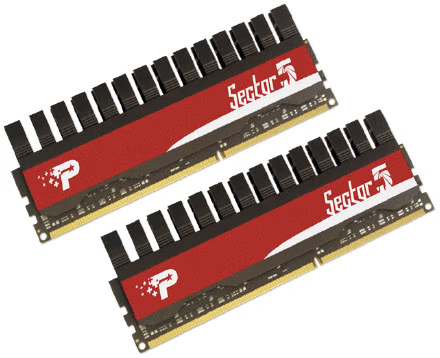
As impressive as these memory modules are, they do come at a price. The 4GB kit that we're testing today retails for $179.99 at Newegg. At that price, it's nearly twice as much as some of the budget DDR3 kits on the market. That may leave many asking if the added speed is worth it. To answer this question, we'll fire up our Lynnfield test bed and analyze the Sector 5 kit at several different speeds. We'll also do some overclocking to find out how much headroom to expect from these modules.
Viper II Sector 5 Features
The Patriot Viper II ‘Sector 5' Series, part of the Extreme Performance (EP) line, is the ultimate performance memory solution for the Intel P55 system platform. The Viper II ‘Sector 5' series are built using only the highest quality pre-sorted IC's available and are subjected to rigorous testing and validation on the P55 platform to achieve optimized performance and maximum quality. These modules are engineered to reach 2000MHz at 8-8-8-24 timings and are available in 4GB kit capacity. This kit includes Futuremark's 3DMark Vantage benchmarking software for enthusiasts to fine tune their system for optimal performance.
PVV34G2000LLKB Specifications
-
Extreme Performance PC3-16000 (2000MHz)
-
Low Latency (8-8-8-24)
-
XMP Ready
-
Equipped with advance aluminum heat-dispersing shields
-
100% Tested and Verified
-
Lifetime Warranty
-
RoHS Compliant
-
Tested on Intel P55 chipset
-
1.65V
About Patriot Memory
Established in 1985, Patriot Memory builds a full range of memory module and flash memory products, offering a perfect blend of quality and value. Patriot products include Extreme Performance (EP), Signature Lines (SL) and Flash Memory solutions (FM).
 Patriot has sales offices located throughout the U.S. and Asia. Patriot sells through the distribution channels throughout North America, Europe, Asia Pacific, Middle East, Africa, and Latin America.
Patriot's development and manufacturing facility are located in Fremont, California USA. Our manufacturing segment is composed of a highly skilled production staff and multiple production lines optimized for modules, giving Patriot the ability and resources necessary to provide a full line of memory module solutions. Patriot Memory is a trademark of PDP Systems, Inc.
Closer Look: Patriot Sector 5
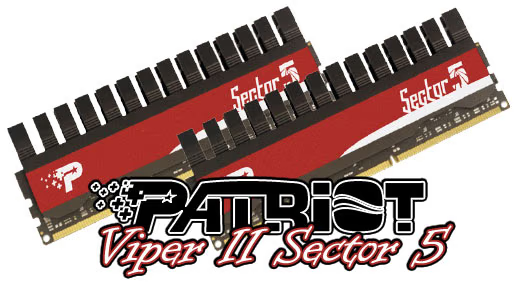
Most high performance memory modules include some type of heatsink and the Patriot Sector 5 kit is no exception. It features the same aluminum heatspreaders as the rest of the Viper II line, albeit with a different logo. At 1.65v, these heatspreaders are plenty adequate to deal with any heat the modules produce and look pretty good too. My only concern is that the fins may interfere with some CPU coolers and motherboard layouts. I suppose it's a trade off for increased surface area and dissipation capacity.
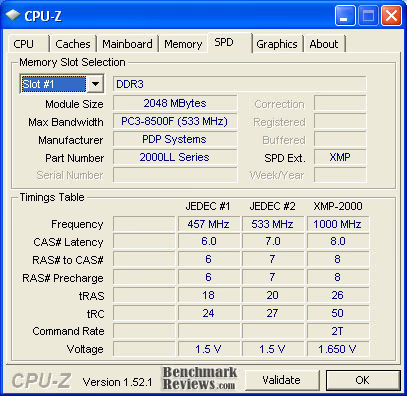
Also worth noting is that kit we received from Patriot is an engineering sample. Compared to the final retail version, there is a slight variation in the programming of the SPD. As you can see in the CPU-Z screenshot above, the XMP profile for this kit is set to 8-8-8-26 timings instead of 8-8-8-24. Despite the variation we decided to use the SPD settings as is. We were more interested in how the XMP profile would adjust the settings needed to reach 2000MHz. Because the multiplier of the Core i7-870 in our test bed cannot exceed 12, the system bus had to be increased from 133MHz to 166MHz. Selecting the XMP profile on our ASUS P7P55D EVO did this automatically, while also reducing the CPU multiplier to 18 to ensure it would not be unintentionally overclocked.
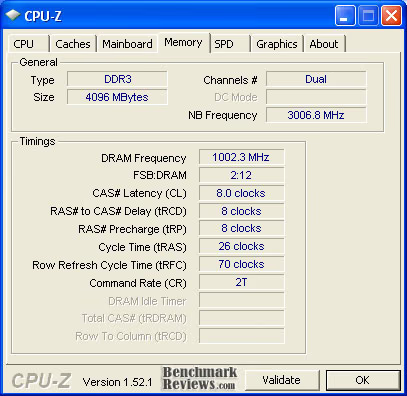
As you can see in the screenshot above, the Northbridge frequency, also connected to the system bus, was overclocked as well. The XMP profile took care of just about everything, but I would suggest one more thing: turn off Turbo Boost. Even though the base multiplier of the CPU was reduced, I found that the CPU would try to throttle up to 27, resulting in a CPU frequency of roughly 4500MHz. While this is a great overclock, if you aren't prepared for it with adequate voltage and cooling, it can result in stability issues.
RAM Testing Methodology
As with any hardware test, we begin by eliminating as many variables as possible. All benchmarks are conducted using the same system and the same memory modules. Each benchmark begins after a complete system restart and is repeated five times with the averages presented in the results section. To ensure system stability and the reliability of our results, each change to memory speed is fully tested with Memtest86+ and Prime95.
For this review, we are using an Intel Core i7-870 processor. This processor is limited to a memory multiplier of 12. Therefore, to achieve the manufacturer-specified settings, the system bus must be overclocked. Unfortunately, this also affects the CPU frequency. To compensate for this, the CPU multiplier is reduced to bring the CPU frequency as close to the stock frequency as possible.
Below is a table summarizing the hardware settings used in this review. Our benchmarks begin with JEDEC standard frequencies and timings to establish a baseline. Next, we move on to the manufacturer-specified settings, utilizing XMP profiles when possible. Once these benchmarks are completed, we raise the system bus again while keeping the memory timings and voltages at manufacturer-recommended values. After the maximum stable frequency is found, the benchmarks are run one last time.
| Memory Speed |
Memory Timings |
Voltage |
System Bus |
CPU Multiplier |
CPU Speed |
|---|---|---|---|---|---|
| 1066MHz | 7-7-7-20 | 1.5v | 133MHz | 22 | 2930 |
| 1333MHz | 9-9-9-24 | 1.5v | 133MHz | 22 | 2930 |
| 2000MHz | 8-8-8-26 | 1.65v | 166MHz | 18 | 2996 |
| 2160MHz | 8-8-8-26 | 1.65v | 180MHz | 17 | 3060 |
Test System
-
Processors: Intel Core i7-870 (Turbo Boost Disabled)
-
Motherboard: ASUS P7P55D EVO
-
Video: ASUS EAH4870 TOP
-
Disk Drive: Western Digital 6400AAKS 640GB
-
Operating System: Windows 7 Ultimate x64
Benchmark Applications
-
Passmark PerformanceTest v7.0
-
EVEREST Ultimate Edition v5.30
-
Sisoftware Sandra 2009.SP4
-
Crysis Benchmark Tool
Performance Test Results
Today's review features four different benchmark applications: Passmark Performance Test, Lavalys EVEREST, Sisoftware Sandra, and Crysis. The first three are synthetic benchmark suites designed to assess memory performance. Each one has a unique approach to memory testing, which should provide a good assortment from which to determine performance trends. The last application, Crysis, offers some insight into how memory performance affects gaming on our Lynnfield system. It's important to keep in mind, though, that CPU speed may also be a factor in our test results. While we did our best to eliminate it as a variable, it was impossible to keep the CPU frequency the same while still testing the memory kit at the necessary settings.

In Passmark PerformanceTest, the first two memory speeds we tested, 1066MHz and 1333MHz, don't show much variation. It's likely that the difference in timings offset any gain in frequency. Moving on to the Viper II Sector 5's default frequency of 2000MHz, we see a slight increase in performance in all three benchmarks. As expected, overclocking the memory results in a further increase.

Lavalys EVEREST paints a slightly different picture than Passmark. While the higher frequencies take the lead in the Read and Copy benchmarks, they drop slightly behind in the Write benchmark. This kind of result can usually be attributed to a blottle-necked memory controller. In this case, though, there may have also been a compatibility issue between Windows 7, EVEREST, and our hardware.
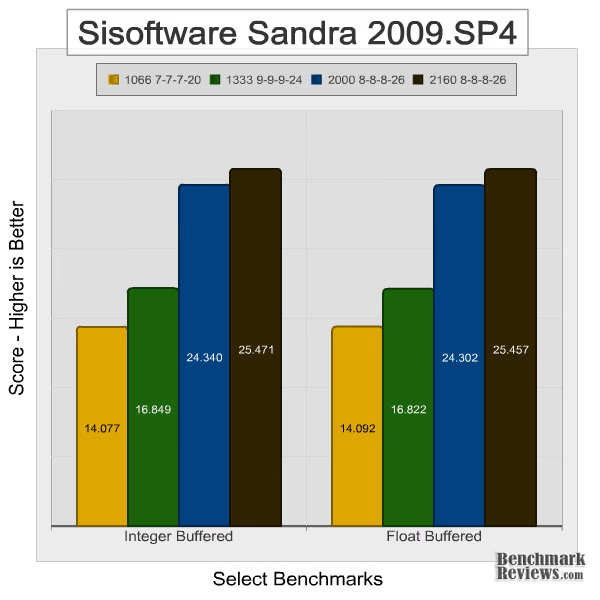
The results of Sisoftware Sandra are much more consistent than EVEREST. They appear to scale directly with the memory frequency of our Sector 5 DDR3 kit. That's not surprising as these two benchmarks are intended to measure memory bandwidth. As with all synthetic benchmarks, though, it's important to keep in mind that performance will vary in real world applications.

Our real world gaming benchmark for this review is Crysis. Three resolutions and quality settings were chosen to demonstrate the effect of memory speed as the demand on the video card increases. The results are fairly clear. At the lowest resolution, the higher memory speeds can increase framerates by nearly 15%. At higher resolutions, though, the difference is negligible. It's likely that we've reached the limit of our HD 4870 and no increase in memory bandwidth can help.
Patriot Sector 5 Final Thoughts
Memory manufacturers have been hard at work trying to free up every last bit of performance from Intel's Lynnfield Desktop Platform. The challenge has been to push frequencies higher, without compromising latencies or the 1.65v limit established by Intel. At 2000MHz, the Patriot Sector 5 DDR3 kit we looked at today definitely accomplishes that. The question posed at the beginning of the article, however, was whether this increased speed would translate to better performance.
To answer that question, we ran several benchmarks. The results of our synthetic tests indicate that in most cases, the higher frequency does improve memory bandwidth and performance. We also ran a real-world gaming test using Crysis Benchmark Tool. At 1024x768 and low quality, the faster memory did have a significant impact on framerates. However, after increasing the resolution and quality settings, the performance advantage dropped down to a negligible amount. The bottom line here is that high performance memory of any kind should be paired with a system that can support and fully utilize the added bandwidth.
PVV34G2000LLKB Conclusion
The Viper II Sector 5 DDR3 kit from Patriot was designed to meet the unique requirements of Intel's Lynnfield Desktop Platform. The 1.65v limit established by Intel often poses a challenge to memory manufacturers and vendors, but by selecting only the highest-binned chips, Patriot was able to deliver a kit rated at 2000MHz and 8-8-8-24 timings. In our benchmarks, that extra bandwidth translated to improved performance in just about every test. In the real world, performance gains aren't likely to be dramatic, but a high performance memory kit like this can help get the most out of Lynnfield.
The Sector 5 kit also fares well when it comes appearance. Combined with a black PCB and red Sector 5 logo, the Viper II heatsinks add a definite visual appeal. More importantly, though, they help to dissipate heat. While the moderate voltage of these modules does not necessitate the use of heatsinks, they do offer some peace of mind and should contribute to the longevity of these modules. Just be sure to check your system for clearance issues as the fins along the top may interfere with some CPU coolers.
Another key factor when it comes to reliability and component longevity is quality control. Detecting problems early on will ensure they aren't passed along to the consumer. According Patriot, each kit is hand-tested before it's sent out the door. While it's difficult to validate this claim, it is reassuring to know they back it up with a lifetime warranty on all DRAM modules. As for the kit we received, it achieved the rated specifications without issue and performed flawlessly throughout benchmarking.
Getting the Sector 5 kit up to 2000MHz was a fairly painless process thanks to the built in XMP profile. On Lynnfield systems this is critical as the restricted memory multipliers require the system bus to be overclocked to reach higher memory speeds. A good XMP profile can handle this automatically by selecting the necessary frequencies, multipliers, and voltages. The only issue we encountered is that Turbo Boost needs to be disabled or manually adjusted to compensate for the higher bus speed.
With a retail price of $179.99 at Newegg, the 4GB PVV34G2000LLKB kit certainly isn't for budget builds. Compared to other high performance DDR3 kits on the market, though, it's a fairly reasonable price. Given the results of the performance testing we conducted today, it's easy to recommend the Patriot Viper II Sector 5 series for any high-end P55 system. Those on a budget, though, may want to consider upgrading other components first. As we discovered in our benchmarking, the video card is likely to become a bottleneck before the system memory.
Pros:
+ 2000MHz rating
+ Low latency
+ Convenient XMP profile
+ Lifetime Warranty
+ 3DMark Vantage included
Cons:
- Heatsink fins may interfere with some CPU coolers
Ratings:
-
Performance: 9.5
-
Appearance: 9.0
-
Construction: 9.5
-
Functionality: 9.0
-
Value: 8.0
Final Score: 9.0 out of 10.
Questions? Comments? Benchmark Reviews really wants your feedback. We invite you to leave your remarks in our Discussion Forum.