
NZXT HAVIK 140 CPU Cooler
Manufacturer: NZXT
Product Name: HAVIK 140
Price As Tested: $69.99 at Newegg
Full Disclosure: The product sample used in this article has been provided by NZXT.
Ah, another day, another CPU cooler. This time it's from NZXT, a company that started out making low-priced computer cases with features and quality normally seen only on more expensive products. Then they added a line of premium sleeved cables, case fans, mice, higher-end cases like the critically acclaimed Phantom, and even power supplies. The NZXT HAVIK 140 is their first CPU cooler, and they're aiming directly at the high-end air cooling market with an MSRP of $74.99. Benchmark Reviews tests their latest offering to see if it can play with the big boys.
As CPU design migrates to a 32nm process (such as Intel's new Sandy Bridge processors and AMD's forthcoming Bulldozer CPUs), power consumption and heat production go down, and the need for monster cooling systems decreases. But there are still a lot of very hot CPUs out there, such as the overclocked and overvolted Core i7-950 I use in my heat sink test machine.

Any CPU cooler's primary task is to cool the CPU. Since retail CPUs come with perfectly adequate coolers, the main reason to buy an aftermarket cooler is for conditions that the stock cooler can't handle...namely, overclocking. The Hyper 612 PWM is Cooler Master's latest entry in the field.
NZXT HAVIK 140 CPU Cooler Specifications
- Cooler Dimensions: 140(W) x 166(H) x 120(D) mm (with fans); 135(W) x 160(H) x 60(D) mm (heatsink only)
- Cooler weight: 1035g (with fans); 760g (heatsink only)
- Heatsink material: Aluminum and nickel-plated copper
- Fan: 140x140x25mm, 1200RPM
- Fan airflow: 90.3 CFM
- Fan noise level: 25dBa
- Fan life: 30,000 hours
Closer Look: NZXT HAVIK 140
NZXT presents the HAVIK 140 in a plain white box that showcases the cooler's unusual fan blade design.

The box contains the bare heat sink, two 140mm fans, a Y-cable so that both fans can be powered from a single 3-pin header, and the mounting hardware for AMD and Intel sockets in resealable plastic bags. The fans are not PWM-controlled, which is disappointing, especially at this price level, but at least their power cables are sleeved.
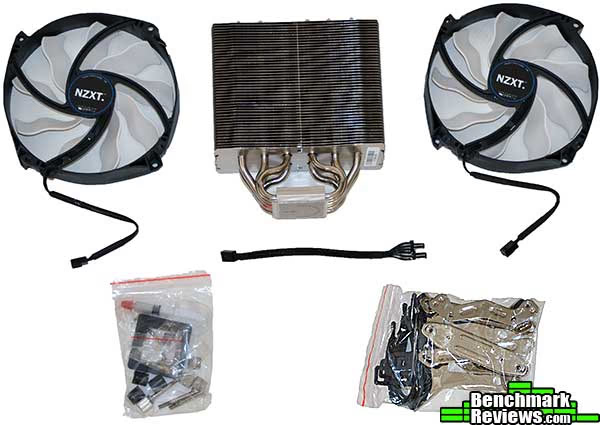
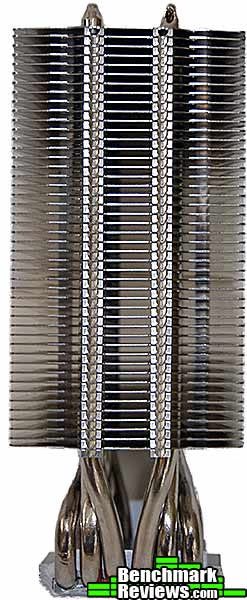
The heat sink is comprised of 46 fins pierced by 6 nickel plated copper heat pipes. Two 140mm fans, each rated at just over 90CFM, provide a "push-pull" airflow through the heat sink.
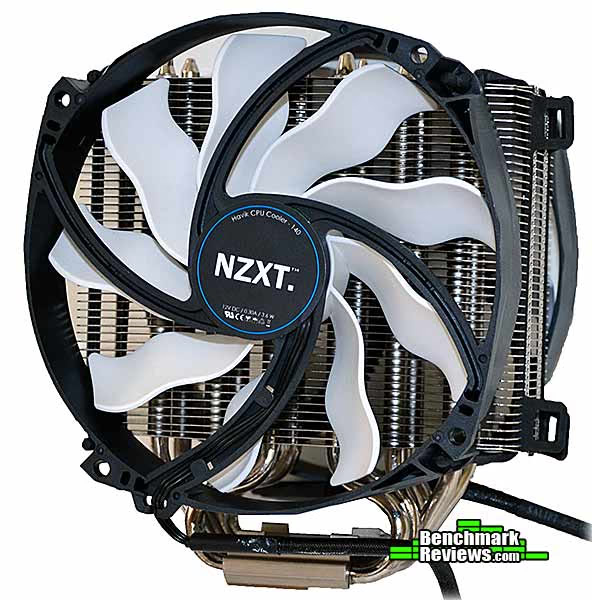
With the oversized 140mm fans attached, the HAVIK 140 is ready for action. NZXT claims the unusual design of the fan blades helps reduce noise and improve airflow.
The top of the cooler is plain aluminum, without any embossed logos or plastic shrouds. For the price, it seems odd that NZXT didn't take the opportunity to brand the cooler in a way that would be visible in a windowed case.

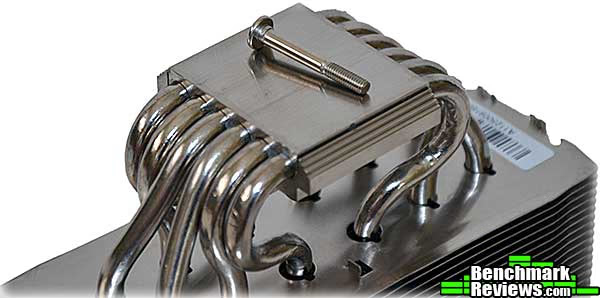
The base of the HAVIK 140 isn't a mirror finish, but the surface graining is too fine to be felt with a fingernail.
Let's take a closer look and then mount this cooler.
HAVIK 140 Detailed Features
The NZXT HAVIK 140's fans are attached with unique rubber bands. The bands are designed so the part that inserts into the fan also serves as padding between the fan and the heat sink fins for noise reduction. The push-through connectors at the ends of the rubber bands are too thick to push through standard fan mounting holes, so if you want to use other fans, you'll have to come up with your own mounting solution. The tension of the rubber fan mounts bends the bottom fins of the heat sink in slightly.

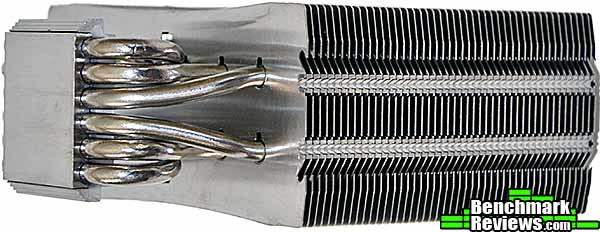
This view shows the HAVIK's unusual staggered heat pipe arrangement.
The HAVIK's backplate fits all Intel and AMD sockets the heat sink supports. You push mounting screws through the plastic friction plates which hold them in place. The black plastic friction plates are removed for AMD installations.

Friction-fit black plastic spacers push over the backplate screws as they protrude through the motherboard. Most other coolers would use screws here, but it's not necessary and the push-on spacers make it quick and easy to secure the backplate for the next step. The protruding screws locate two mounting brackets (helpfully stamped with arrows that point towards the processor), which are in turn secured with knurled nuts. Note the screw post in the center of the bracket: this is that the heat sink's mounting crossbar will be secured to.

A separate crossbar fits over the base of the heat sink and screws down to the posts on the mounting brackets. A rather strong spring under the crossbar's mounting screw (not visible in this image) provides the clamping pressure, and although NZXT doesn't specify this pressure, it seems like quite a lot. This mounting mechanism is mechanically very similar to the ones used by other high-end heat sinks such as the Prolimatech Megahalems.

Installed and ready for testing, the HAVIK in this orientation does cover the first RAM slot in my ASUS Sabertooth X58 motherboard. It covers the first RAM slot when mounted with the fans blowing front-to-back, too.

OK, let's see how NZXT's first CPU cooler performs.
Heat Sink Test Methodology
Benchmark Reviews is obsessed with testing CPU coolers, as our Cooling Section has demonstrated over the past few years. We've solicited suggestions from the enthusiast community, and received guidance from some of the most technical overclockers on the planet. As a result, our testing methodology has changed with every new edition of our Best CPU Cooler Performance series. Because of this, each article is really its own stand-alone product, and cannot be fairly compared to the others. Benchmark Reviews continues to test CPU coolers using the stock included fan (whenever applicable), and then replace it with a high-output fan for re-testing.
Manufacturers are not expected to enjoy this sort of comparison, since we level the playing field for all heat sinks by replacing their included fan with a common unit which is then used for every CPU cooler tested. Many manufacturers include fans with their heat sink products, but many 'stock' fans are high-RPM units that offer great airflow at the expense of obnoxiously loud noise levels, or, conversely, quiet fans that sacrifice performance for low noise. By using the same model of cooling fan throughout our heat sink tests, we can assure our results are comparable across the board. This is one of the more significant changes we have made to our test methodology, since many of the benchmark tests we have conducted in the past have compared the total package. Ultimately we're more interested in the discovering the best possible heat sink, and we believe that you'll feel the same way.
For each test, ambient room temperature levels were maintained within one degree of fluctuation, and measured at static points beside the test equipment with a digital thermometer. The NZXT HAVIK 140 and the comparison coolers used a common Thermal Interface Material of our choosing (listed in the support equipment section below) for consistency. The processor received the same amount of thermal paste in every test, which covered the heat spreader with a thin nearly-transparent layer. The heat sink being tested was then laid down flat onto the CPU, and compressed to the motherboard using the supplied retaining mechanism. If the mounting mechanism used only two points of force, they were tightened in alternation; standard clip-style mounting with four securing points were compressed using the cross-over method. Once installed, the system was tested for a baseline reading prior to testing.
At the start of each test, the ambient room temperature was measured to track any fluctuation throughout the testing period. AIDA64 Extreme Edition is utilized to create 100% CPU-core loads and measure each individual processor core temperature. It's important to note that software-based temperature reading reflects the thermal output as reported from the CPU to the BIOS. For this reason, it is critically important (for us) to use the exact same software and BIOS versions throughout the entire test cycle, or the results will be incomparable. All of the units compared in our results were tested on the same motherboard using the same BIOS and software, with only the CPU-cooler product changing in each test. These readings are neither absolute nor calibrated, since every BIOS is programmed differently. Nevertheless, all results are still comparable and relative to each product in our test bed (see The Accuracy Myth section below).
Since our test processor reports core temperatures as a whole number and not in fractions, all test results utilize ADIA64 to report averages (within the statistics panel), which gives us more precise readings. The ambient room temperature levels were all recorded and accurate to one-tenth of a degree Celsius at the time of data collection.
When each cooler is tested, Benchmark Reviews makes certain to keep the hardware settings identical across the test platform. This enables us to clearly compare the performance of each product under identical conditions. Benchmark Reviews reports the thermal difference; for the purposes of this article, thermal difference (not the same as thermal delta) is calculated by subtracting the ambient room temperature from the recorded CPU temperature.
Please keep in mind that that these test results are only valid within the context of this particular test: and, as the saying goes, your mileage may vary.
Intel Test System
- Processor: Intel Core i7-950 Bloomfield 3.06GHz LGA1366 130W Quad-Core Processor Model BX80601950, core voltage set to 1.35V
- Motherboard: ASUS Sabertooth X58 Intel X58-Express chipset) with BIOS 0603, BCLK set to 175MHz for a processor speed of 4025MHz
Support Equipment
- AIDA64 Extreme Edition version 1.50.1200
- MG Chemicals Heat Transfer Compound 8610-60G
- Stock fan (for heat sinks without fans): Thermalright TR-FDB-12-1600 (63.7CFM advertised)
- High-speed fan: Delta AFC1212D (113CFM advertised)
All of the tests in this article have been conducted using vertical motherboard orientation, positioned upright in a traditional tower computer case. Air-cooled heat sinks are positioned so that heat pipe rods span horizontally, which in most cases means the fan is blowing air out the top of the chassis. The radiators of water coolers are mounted as per manufacturer instructions. In both cases, fans are connected directly to the power supply (rather than motherboard headers) and run at full speed during the test. At the start of our test period, the test system is powered on and AIDA64 system stability tests are started with Stress CPU and Stress FPU options selected. AIDA64 loads each CPU core to 100% usage, which drives the temperature to its highest point. Finally, once temperatures have sustained a plateau (no observed change in average temperatures for 5 minutes), the ending ambient room temperature and individual CPU core levels are recorded thus completing the first benchmark segment. The time to reach stable temperatures varied between 10 and 20 minutes for the heat sinks in this test; larger heat sinks typically take longer to stabilize.
The second test segment involves removing the stock cooling fan and replacing it with a high-output 120 mm Delta AFC1212D cooling fan, then running the same tests again.
Note: Both the Antec Kühler H2O 620 and the Coolit Vantage A.L.C. are designed to drive their own RPM-controlled fans directly; in the case of the Vantage, an alarm will sound continuously if there is no fan connected. For these coolers, the fans were left connected as designed during stock fan testing. For high-speed fan testing, the Delta fan was connected directly to the power supply (and the alarm on the Vantage ignored).
The Accuracy Myth
All modern processors incorporate an internal thermal diode that can be read by the motherboards' BIOS. While this diode and the motherboard are not calibrated and therefore may not display the actual true temperature, the degree of accuracy is constant. This means that if the diode reports 40°C when it's actually 43°C, then it will also report 60°C when it's truly 63°C. Since the design goal of any thermal solution is to keep the CPU core within allowable temperatures, a processor's internal diode is the most valid means of comparison between different heat sinks, or thermal compounds. The diode and motherboard may be incorrect by a small margin in relation to an actual calibrated temperature sensor, but they will be consistent in their margin of error every time.
Testing and Results
For this test, I used the following heat sinks in addition to the NZXT HAVIK 140:
- Thermalright Venomous X
- Thermalright Silver Arrow
- Thermalright Macho HR-02
- Thermaltake Frio OCK
- Cooler Master V6 GT
- Cooler Master Hyper 612 PWM
- Prolimatech Super Mega
- Corsair Hydro Series H50
- Corsair Hydro Series H70
- Coolit ECO A.L.C.
- Coolit Vantage A.L.C.
- Antec Kühler H2O 620
For heat sinks without a stock fan, I used a Thermalright TR-FDB-12-1600 fan, which puts out 63.7CFM at 28dBa according to Thermalright. This mid-range fan provides good airflow and reasonable noise levels. For "apples to apples" testing, where each heat sink is tested with the same fan, I used a Delta AFC1212D. This high-performance PWM fan is rated at 113CFM at a claimed 46.5dBa at full speed...which means that while it moves quite a bit of air, it's very loud.
The Intel Core i7-950 I used in this test runs much hotter than the Core i7-920 I've used previously. At 1.35 volts, with a BCLK of 175Mhz, the 4,025Mhz CPU pumps out enough heat to stress the very best heat sinks. AIDA64 would report throttling once any single core reached 100 degrees Celsius; any throttling resulted in canceling the test and recording a "FAIL". This overclocked and overvolted Core i7-950 represents an extreme that many heat sinks cannot handle.
The chart below summarizes the results with the stock fans (hotter temperatures towards the top of the chart, and cooler temperatures towards the bottom). The twin-fan coolers have a real advantage here, since their dual fans generally move more air than the stock single fan of any of the other units. Remember that the lower the thermal difference is, the better the heat sink is performing.
Stock Fan Tests
|
Heat Sink (*=two fans) |
Thermal Difference (degrees Celsius) |
Difference from HAVIK 140 |
|---|---|---|
| Coolit ECO A.L.C. | 75.2 | +4.6 |
| Corsair H50 | 73.1 | +2.5 |
| Coolit Vantage A.L.C. (extreme) | 73.0 | +2.4 |
| Thermalright Macho HR-02 | 71.0 | +0.4 |
| NZXT HAVIK 140* | 70.6 | +0.0 |
| Prolimatech Super Mega | 67.2 | -3.4 |
| Antec Kühler H2O 620 | 65.9 | -4.7 |
| Corsair H70 (high)* | 65.3 | -5.3 |
| Thermaltake Frio OCK* | 65.2 | -5.4 |
| Thermalright Venomous X | 63.0 | -7.6 |
| Cooler Master Hyper 612 PWM | 62.3 | -8.3 |
| Thermalright Silver Arrow* | 61.8 | -8.8 |
| Cooler Master V6 GT* | 61.2 | -9.4 |
As you might expect, the heat sinks that come with two fans tend to do better than those with only one fan...which makes the HAVIK 140's performance all the more surprising. It's the worst-performing dual fan cooler in this roundup, coming in more than 5 degrees behind the Corsair H70 and Thermaltake Frio OCK. The HAVIK 140's dual fans always run at full speed, since they're not PWM, and are audible but not obtrusively so. The sound is a low-pitched hum.
Delta High Speed Fan Tests
|
Heat Sink |
Thermal Difference (degrees Celsius) |
Difference from HAVIK 140 |
|---|---|---|
| Corsair H50 | 68.1 | +4.7 |
| Coolit Vantage A.L.C. | 67.8 | +4.4 |
| Corsair H70 | 64.7 | +1.3 |
| Thermalright Macho HR-02 | 64.5 | +1.1 |
| Thermaltake Frio OCK | 64.3 | +0.9 |
| Coolit ECO A.L.C. | 64.3 | +0.1 |
| NZXT HAVIK 140 | 63.4 | +0.0 |
| Cooler Master V6 GT | 59.5 | -3.9 |
| Prolimatech Super Mega | 59.4 | -4.0 |
| Cooler Master Hyper 612 PWM | 59.0 | -4.4 |
| Antec Kühler H2O 620 | 58.7 | -4.7 |
| Thermalright Venomous X | 58.0 | -5.4 |
| Thermalright Silver Arrow | 55.8 | -7.6 |
With the Delta high-speed fan taped to the heat sink (the rubber band mounts won't fit through the smaller, standard-size mounting holes in the Delta fan), the HAVIK 140's cooling improves by just over 7 degrees, but its scores still place it in the bottom half of the group. And in the real world, the heat sink's unique fan mounts mean that you won't be able to easily replace the stock fans...and at this price level, you shouldn't have to. I was surprised at how much better the heat sink did with the Delta fan as the other dual-fan heat sinks don't improve nearly as much. The Delta fan is rated at 113CFM, while NZXT's rating for the HAVIK's stock fans is 90.3CFM. I had thought that was "per fan" but given these results it must be the aggregate airflow of both fans. The airflow from the Delta fan was significantly better: I could feel a lot more air coming out of the cooler with the Delta fan than with the stock fans.
I'll summarize my opinions on this cooler in the next section.
CPU Cooler Final Thoughts
High end cooler performance has been approaching an asymptote over the last year or so, with the best-performing coolers within a few degrees of each other in my tests. The latest trend is better performance from mid-priced coolers, some of which (like the Cooler Master Hyper 612 PWM) are turning in performances equal to the very best air coolers at a price that's 30% or more cheaper. This is good news: enthusiasts no longer have to pay upwards of $70 to get a really good air cooler.

Since my test bed represents an extreme case, and most of the coolers I've tested recently have been high-end coolers, those coolers that don't perform at the top level tend to look worse than they would in the real world. The performance of the HAVIK 140 is actually quite good (actually, any cooler than can keep my overclocked and overvolted Core i7 950 from throttling under load is quite good). The HAVIK 140 outperforms all the entry level water coolers at a price that's less than all of them, and it's quieter than they are, too.
But it doesn't compare so well to the other high-end air coolers. With a price of $69.99 at Newegg, NZXT is pitting it squarely against the likes of the Prolimatech Magahalems, Thermaltake Frio OCK, and Thermalright Venomous X, all of which provide better cooling at a lower price. Its performance is very close to that of the Thermalright Macho HR-02, which costs almost $30 less. Also, coolers at this price level typically "show" better: the Megahalems is beautifully finished and polished; other coolers use decorative shrouds and/or LED lighting to dress things up. The HAVIK 140 has a very plain appearance, and while the way the rubber fan mounts bend in the top and bottom fins of the heat sink doesn't affect the cooling, it looks rather cheap.
What NZXT has done is produce a very nice mid-high end cooler with good performance and acoustics. It's easy to mount and comes with niceties like a sleeved Y-adapter cable for the fans. It's simply priced too high for the performance it returns.
NZXT HAVIK 140 Conclusion
Please remember that these test results reflect our experience with each cooler on a specific motherboard, with a specific processor, BIOS revision, BCLK and voltage settings, and test programs. The results of this test cannot be directly compared to other tests since many factors will have changed.
The NZXT HAVIK 140 uses the now-standard design of a relatively small heat sink core sandwiched by two fans in a push-pull arrangement. The top of the cooler is bare aluminum without any cover plates or logos. The cooler's appearance is very plain and frankly a little down from what I'd expect at this price level. The staggered heat pipes are visually interesting but can't be seen when the cooler is installed.
Overall, the construction quality is good. The fans are quiet and reasonably effective. Since the fans run at full speed all the time, you'll hear a low hum. PWM fans would make the cooler quieter under idle and moderate loads scenarios, and are again something I expect at this price level.
The accessories package was standard, and the cooler was very easy to mount: the friction-fit plastic spacers make it easy to keep the backplate from falling off the back of the computer while you're trying to secure it from the inside. Re-sealable plastic accessory bags cost virtually nothing, but make keeping track of all the bits a lot easier and I'm still amazed at how many competing products don't use them; thankfully, NZXT does.
The performance of this cooler was good: as I noted, any cooler that can keep my test CPU from throttling under load is by definition good. But it just wasn't up to the performance expected at its price, and the value part of the equation is where this cooler falls down. I think the fix is simple: NZXT simply needs to replace the included fans with fans that provide more airflow. The physically similar Thermaltake Frio OCK's fans are rated at 121CFM, and that extra 30+ CFM would make a world of difference. Make the fans PWM so you wouldn't have to listen to them at full speed, and you'd have a pretty nice cooler...although you'd still want to drop the price a little for its plain aesthetics.
NZXT's products typically excel at providing above average bang for the buck. Priced for $69.99 at Newegg, the HAVIK 140 disappoints in this regard, but given NZXT's track record, I'm sure we'll see this addressed soon.
Pros:
+ Quiet fans
+ Sleeved fan cables
+ Included Y-adapter allows both fans to share a motherboard header
Cons:
- Visually very plain
- Performance lower than expected in this price range
Ratings:
-
Performance: 8.5
-
Appearance: 7.5
-
Construction: 8.5
-
Functionality: 8.5
-
Value: 7.25
Final Score: 8.05 out of 10.
Questions? Comments? Benchmark Reviews really wants your feedback. We invite you to leave your remarks in our Discussion Forum.
Reader comments from the original article
9 comments were posted before commenting closed. They are preserved as written. Original avatars no longer resolve and are shown as a placeholder.
RE: NZXT HAVIK 140 CPU Cooler Robert17 Permalink:
Nice review David. It parallels other reviews I've read; I'm shopping. Since you follow the cooling market well, is there anything on the horizon from the cooler manufacturers you're aware of that I may want to hold out for? I've got some fairly ambitious plans for the next 6-9 months involving a new build/upgrade, however it best works out. The future of coolers isn't as well reported as the future of CPUs and MBs.
RE: RE: NZXT HAVIK 140 CPU Cooler Olin Coles Permalink:
Since David gets his projects from me, I'll chime in: nothing new to has been offered to us. So that you know, most projects get a 2-3 week lead before they're published. About the only time we here of new projects that we're not reviewing is through press release or trade show.
Heat Sinked! Derek Permalink:
Hi Guys, What setting did you use to overclock and overvolted your Core i7-950 I used in your heat sink test machine? As I have the same!! Derek
RE: Heat Sinked! David Ramsey Permalink:
Derek, the settings I used for the overclocks in my tests are in each heat sink review, on the page titled "Heat Sink Test Methodology". In this case I set the BCLK to 175mHz and the voltage to 1.35V. YMMV.
RE: NZXT HAVIK 140 CPU Cooler Doug Dallam Permalink:
David, nice clear review. Thanks for your efforts. I almost didn't read this, one, becasue I'm not on the market for a cooler, and two, I know about how these fans in this area will fall out. I wasn't surprised here, except that how poorly the NZXT fan really performed compared to its cost and its fugliness. As far as temperature goes, it performed great, since all of the temps you recorded were very low, and so all of the coolers you tested are doing a good job of heat dissipation. So where does this leave a buyer? Looking at cost and design. This thing looks like something out of a Steam Punk photo contest at Deviant Art. On the subject a little, I'm wondering why my 3.8Ghz clocked 920 only uses 1.264 volts under load? My last mother board was the Gigabyte UD5 Extreme rev 1 and I had to run the core voltage w here you have yours, maybe even 1.38 if, I remember correctly. With the new Extreme UD 5 rev2, I'm only using 1.264v and just as stable. That equates to about a 10C drop in heat for me too. Why do you think that is?
RE: RE: NZXT HAVIK 140 CPU Cooler David Ramsey Permalink:
Good question re your different voltage settings. The Gigabyte board might have better voltage regulation, so that there's less VDROOP under load. But bear in mind that my heat sink test machine settings are designed to produce about as much heat as possible; I might be able to run the 950 at that speed at a lower voltage than I'm using.
RE: RE: RE: NZXT HAVIK 140 CPU Cooler Doug Dallam Permalink:
That would be interesting to see what voltage you could run stable at. Instead of messing with the voltage manually, when I switched boards, I just left it on auto (I think). And, it worked. I was pretty amazed.
mrs SNOWHITE Permalink:
I returned this unit after less than a wek as it had a concave base. Checked this using a steel straight edge and seen light through it in both directions. Need i say that my temperatures increased using this. The rubber band fan mounts were terrible to fit in my very large case. Glad to get rid of if and would Not recommend
RE: NZXT HAVIK 140 CPU Cooler Steve Permalink:
The thing I find most troubling about reading reviews is that several seemingly unbiased sites get such radically different results from their testing. Several other testers got much better results out of this cooler than you did.