
Mushkin Ridgeback Redline Enhanced DDR3
Manufacturer: Mushkin Enhanced
Product Name: Redline
Model Number: 997000
Price As Tested: $133.99
Full Disclosure: The product sample used in this article has been provided by Mushkin Enhanced.
Started in 1994 Mushkin Enhanced has been well received for years by enthusiasts for their RAM's overclocking ability and sharp aesthetics. Mushkin has many different lines ranging from their Essentials for budget conscious consumers all the way to their Redline series which utilizes the cream of the crop integrated circuits to get the fastest speed possible with tight timings. The Redline series has been well received by overclockers and so pushing on that success Mushkin has released the Redline Enhanced 1600Mhz 7-8-7-24 kit utilizing their proprietary Ridgeback heat spreader. Benchmark Reviews will be running this kit through its paces to see if it stacks up the competition or if falls short when it really matters.
Years ago using the fastest possible memory was the only way to get the full potential out of a processor. This is because in the days before Sandy Bridge getting the highest clock possible was achieved using a combination of changing the clock multiplier, and increasing the FSB or base clock. Because changing these also increased the base speed of the memory using the fastest memory possible was only the only way to push a processor to its upper limits. But things have changed since the Sandy Bridge platform debuted, the only effective way to overclock is to increase the clock multiplier of the K SKU's meaning that memory speed is less important for overclocking and therefore companies are concentrating on dropping prices, and timing to compete with each other. As prices have dropped, users have started demanding more RAM for their systems. Mushkin's Redline has been a well-received product for many years and now they have updated their Redline series to be compatible with Intel's newest P67 chipset. This means that each kit of memory has a speed that is divisible by 266.6Mhz so as to provide optimum speed in a user's system.
Benchmark Reviews wants to be able to provide the most accurate information on the performance of components to its readers and therefore has a very specific way in which tests are run on components. For RAM, each set is run first run through Memtest86+ at its advertised speed to insure that that there are no errors. Once passed a combination of pure benchmark based, and application based tests will be run a total of three times each. Once the results have been acquired the worst score of each test will be thrown out and the final two will be averaged resulting in the final score that will be presented to our readers.
Specifications
Type
DDR3
Voltage
1.65v
Speed Spec
PC3-12800
Frequency
1600Mhz
Kit Type
Dual Channel
Module Size
4GB
tCL
7
tRCD
8
tRP
7
tRAS
24
Heatsink
Ridgeback Redline
Closer Look: Mushkin Enhanced Redline 1600Mhz
Unlike cases, the aesthetics of RAM will not be something that a user will need to deal with on a daily basis. This means a user can pick the ugliest piece set of ram they can find and as long as it has the same timing, and speed will perform just as well as a tricked out set of RAM. None-the-less enthusiast with Plexiglas windows on their case may want RAM that goes along with the color scheme being used in their system.

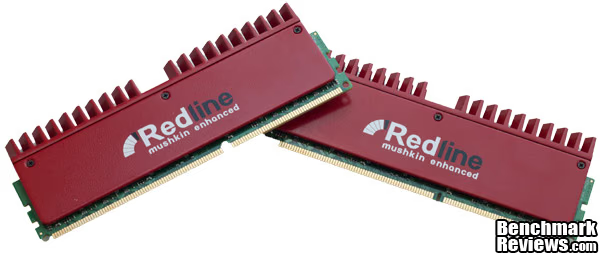
Utilizing a typical blister pack for shipping Mushkin has made it so that users can easily see the gorgeous heat spreaders that have been included on this set of RAM. On the back are instructions on how to properly install this kit into users system along with Mushin's marketing information and their address.
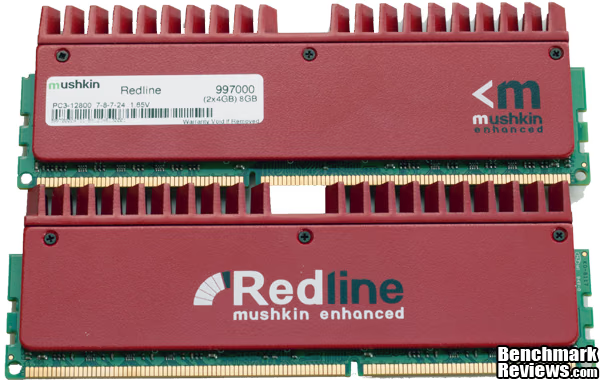
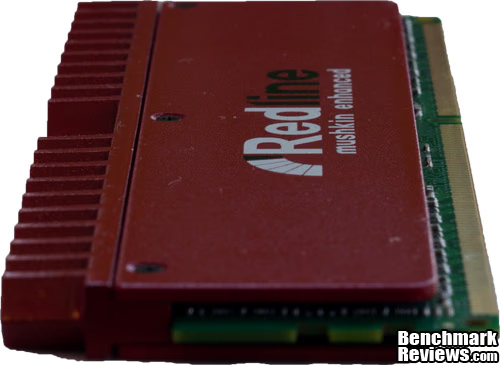
Utilizing the Ridgeback heat spreader Mushkin's kit of memory is very sharp looking with a quite a bit of heft to them. The unique tines on the top of the Ridgeback are designed to create disturbances in the air as it runs across them which will increase their cooling capacity. Still since DDR3 uses much lower voltages then older technology the need to cool the IC's is virtually non-existent and therefore the cooler being used become a matter of personal preference. Thankfully at 1.75" the Mushkin Ridgeline cooler is just short enough to fit under many CPU heatsinks on the markets allowing for this set of RAM to be used on a multitude of systems.
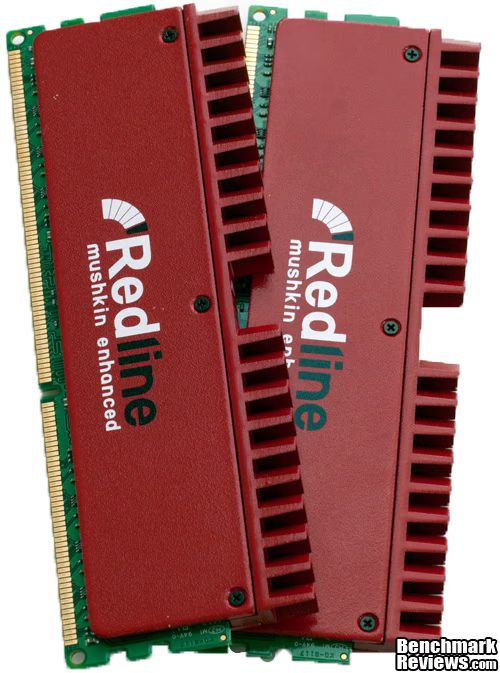
The matte red finish that is used on Ridgeback heat spreader looks absolutely stunning. The finish is superbly done with no blemishes and Redline logo that was applied looks great providing a nice look without being overly flashy.
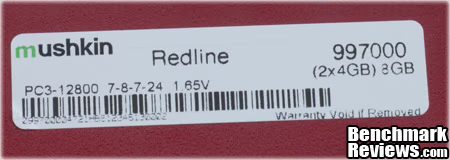
Unlike other companies Mushkin does not use a decipherable model number and therefore the only use for this is as a reference number when looking for an identical set of memory for a later upgrade.
RAM Testing & Results
Testing Methodology
When testing RAM the preferred method is to remove as many bottlenecks as possible. This ensures that any changes in the benchmarks are dependent on the RAM that is being tested as much as possible. For this reason no games have been included because at the moment games are far more dependent on computers GPU's and CPU's, rather than their memory subsystems. Instead the tests used will be focused on being more memory intensive tasks such as fluid dynamics simulations, compression, and real-time rendering. These benchmarks will be run alongside traditional benchmarking tests that will scale more effectively with speed but will be an unrealistic indication of real world performance.
In order to test each RAM kit in the most effective fashion a multistep process was required. First in order to verify the advertised speed each set of RAM they will be initially run the Memtest86+ for one run. Once no errors are found, Windows 7 Professional 64-bit with all of the need tools will be loaded. In order to make sure that fluctuations in other subsystem do not influence the scores, each test will be run a total of three times. At the end of the benchmark the lowest score will be dropped and the final two tests scores will be averaged. The test being used for benchmarking will be as follows.
- MaxxMEM2
- SiSoft Sandra Light 64-bit
- AIDA64
- PCMARK Vantage
- WinRAR
- CINEBENCH R11.5
- Euler 3D

Test System
-
Motherboard: MSI P67-GD65
-
System Memory: 2 x 4GB G.Skill Ripjaw 1600Mhz
-
Processor: Core i5 2500k 3.3Ghz @ 4.7Ghz
-
Video: ASUS GTX 580
-
Disk Drive 1: Patriot Inferno 60GB
- Disk Drive 2: 2 x 1TB Seagate 7200RPM RAID 0 Array
- Disk Drive 3: 1 x 500GB Seagate 7200RPM
-
Optical Drive: DVD Burner
-
Enclosure: Silverstone Raven RV02-EW
-
PSU: OCZ GamerXStream 700w
-
Monitor: ASUS 27.5" 1920x1200
-
Operating System: Windows 7 64-bit Professional
Memory Tested
- G.Skill Ripjaw 1600Mhz 9-9-9-24 F3-12800CL9D-4GBRL (2 x 4GB Kit)
- G.Skill Sniper 1866Mhz 9-10-9-28 F3-14900CL9D-8GBSR (2 x 4GB Kit)
- Corsair Vengeance 1866Mhz 9-10-9-28 CMZ8GX3M2A1866C9 (2 x 4GB Kit)
- Mushkin Enhanced Redline 2133Mhz 9-11-10-28 Model 996999 (2 x 4GB Kit)
- Mushkin Enhanced Redline 1600Mhz 7-9-8-24 Model 997000 (2 x 4GB Kit)
Also because each IC produced is slightly different and will have different overclocking characteristics any overclocking results obtained may vary from user's actual experience. In the end this means that spending the time to overclock our system memory will be unbeneficial to our readers and therefore will be omitted from the results except for in special cases, such as when a product is advertised as having a great amount of headroom.
We have recently introduced the Euler3D Computational Fluid Dynamics benchmark into our memory test suite and so I would like to give a small explanation as to what is being used. Our newest test simulates the fluid dynamics of a wing and therefore is very memory and CPU intensive. Each test is run and the final result is given in Hertz(Hz). For our purposes the final Hertz score is what will be used for comparing each set of memory to its competitors. It has been found that this benchmark is particularly sensitive to both memory speed and timing and therefore makes a perfect benchmark to add to Benchmark Reviews memory suite.
Synthetic Benchmarks
Benchmark Reviews users synthetic benchmarks to more effectively show difference between the hardware being tested. These tests are very sensitive to the most minor changes and therefore can highlight the performance difference that exist between different sets of RAM.

AIDA64 provides a memory benchmarking tool that scales well with speed but unfortunately does not respond nearly as well to tightening timings. Because of this compared to the higher latency 1600Mhz 9-9-9-24 kit we only receive a 3% boost in performance with an increase in write speed from 19968MB/s to 20264MB/s. Although this early test may not bode well for the Mushkin Enhanced Redline 1600Mhz 7-8-7-24 kit as we will see later it is vindicated in real world test later.

One of our newest benchmarking applications MaxxMEM2 provides results that are more responsive to speed changes rather than tightening of timings. With less than a 1-2% difference in these tests the differentiation between our higher latency 1600Mhz kit is negligible. The only test that shows some difference is the write test with a 3.4% difference in bandwidth with this Mushkin kit leading at 20820MB/s compared to the RipJaws 20116MB/s.

Using STREAM SiSoft's Sandra provides a near linear performance increase as the speed of RAM increases and has some sensativities to changes in timing. Our Integer Buffered performance sees a 2.3% boost in performance compared to our 1600Mhz 9-9-9-24 kit at 21.275GB/s compared to 21GB/s. At the same time our Floating Buffered performance gets a 2.2% boost compared to the 1600Mhz 9-9-9-24 kit at 21.26GB/s compared to 21GB/s. As we will see in real world application benchmarks the lower latency of this kit can easily make up for its lower speed.
Application Benchmarks
Application benchmarks are a look at real world performance of the memory being tested. During this review we will be employing a combination of rendering, compression, and simulation to see how timing and speed of memory affects their performance.

Much like games that use DirectX or OpenGL to render their scenes CINIBENCH sees very little in gain by using higher performance RAM. Between the Mushkin Enhanced 1600Mhz 7-8-7-24 and the Mushkin Enhanced 2133Mhz 9-11-10-28 is around .8% performance difference within our 1% margin of error.

Using the benchmarking tool that was built into WinRAR 4.00 we were able to effectively gauge how many kilobytes per second our test bed was able to compress. WinRAR is responsive to speed and timings and as such our Mushkin 1600Mhz 7-8-7-24 was able to surpass both of our looser 1866Mhz kits. This is made more obvious when you compare Mushkin 1600Mhz 7-8-7-24 kit to the G.Skill Sniper 1866Mhz 9-10-9-28 where Mushkin's kit gains a respectable 2.1% boost in performance.

The speed of Euler 3D simulation is obviously sensitive to both speed and timings. Interestingly enough this 1600Mhz 7-8-7-24 kit keeps up with our 1866Mhz 9-10-9-27 kits sitting within our 1% margin of error for both kits. Still compared to our other 1600Mhz 9-9-9-24 kit we see a near 10% boost in performance. Although this may not seem like a useful increase in performance, since the calculation being done by this program can be run for days or weeks a 10% increase can be a huge difference in time for long term simulations.
Mushkin Redline Final Thoughts
RAM is one of the basic components of any computer and Mushkin Enhanced's Redline 1600Mhz 7-8-7-24 kit will gladly fill that role in any enthusiast computer. This kit provides a boost in performance in compression and simulation where the tighter 7-8-7-24 timings shine. This allows this 1600Mhz kit to keep up and even surpass its faster 1866Mhz brothers. All of this is wrapped up in a beautiful, well-constructed, matte red heat spreader that will look great in the Plexiglas side of a enthusiast system. All of these benefits are backed by Mushkin Enhanced's lifetime warranty.
Unfortunately this kit is not perfect. The price of this kit is around 22% more expensive than the similarly performing 1866Mhz kits while the performance gap between the two is at most 2.2%. Secondly although nice looking and only 1.75" tall the heat spreader used may still get in the way of larger tower heatsinks on the market something that potential buyers should be aware of.
Redline 1600Mhz DDR3 Conclusion
Mushkin Enhanced Redline 1600Mhz 7-8-7-24 kit performs admirably in real world test keeping up with and even surpassing the faster 1866Mhz kits in certain circumstances, and when it comes to our Euler3D benchmark it adds 10% performance increase compared to our 1600Mhz 9-9-9-24 kit.
The Ridgeback heat spreader used looks stunning and along with the matte red paint that Mushkin elected to use makes for a beautiful kit of RAM. Of the RAM I have benchmarked I would have to put the Redline Ridgeback at one of my top five designs.
The Redline 1600Mhz kit is very well constructed weighing more than any RAM kit I have tested before. It feels extremely sturdy and well made. Even more importantly Mushkin Enhanced stands behind their memory and provides a lifetime warranty to all users.
Functionality is all about a memory kit's ability to perform as advertised. I was able to easily run Mushkin Enhanced's 1600Mhz 7-8-7-24 kit at the rated XMP profile with no errors within Memtest86+.
Priced at $133.99 on Newegg this kit is around $30 more expensive than a similarly performing 1866Mhz kit from many other manufactures. While this is definitely a tough pill to swallow it is made easier as this a low latency kit, with a very nice heat spreader on it, and a lifetime warranty to boot.
The Mushkin Enhanced 1600Mhz 7-8-7-24 performs superbly keeping up with and surpassing its fasters 1866Mhz brothers. At the same time it looks great, and has a lifetime warranty. Therefore Benchmark Reviews awards this kit our Golden Tachometer award.
Pros:
+ Looks Great
+ Performs well even surpassing 1866Mhz kits in some real world tests
+ Short enough to fit under many different heatsinks
+ Well made with very sturdy feeling construction
+ Lifetime warrenty
Cons:
- More expensive then similarly performancing 1866Mhz kits
- Although nice looking large heat spreaders are unnecessary
Ratings:
-
Performance: 9.00
-
Appearance: 10.00
-
Construction: 9.50
-
Functionality: 9.00
-
Value: 8.50
Final Score: 9.2 out of 10.
Questions? Comments? Benchmark Reviews really wants your feedback. We invite you to leave your remarks in our Discussion Forum.
Reader comments from the original article
4 comments were posted before commenting closed. They are preserved as written. Original avatars no longer resolve and are shown as a placeholder.
Low CAS Impacts JackNaylorPE Permalink:
There's an ole Anandtech article which shows some significant performance increases with low CAS RAM, even in games.....but it's minimum frame rates that shows the biggest impact, not average frame rates. My interest in RAM is for AutoDesk and other demanding apps but do manage to get some game time in.....minimum frame rates however is rarely a part of RAM tests .... ##anandtech.com/show/2792/12 22.3 % (SLI) increase in minimum frame rates w/ C6 instead of C8 in Far Cry 2 18% (single card) / 5% (SLI) increase in minimum frame rates w/ C6 instead of C8 in Dawn of War 15% (single card) / 5% (SLI) increase in minimum frame rates w/ C6 instead of C8 in World in Conflict Also see ##bit-tech.net/hardware/memory/2011/01/11/the-best-memory-for-sandy-bridge/1 I would love to see how / if this carries over to today's systems .... Minimum frame rate impacts also seems to be ignored in testing x8 x8 versus x16 x16
@ JackNaylorPE GanjaSMK Permalink:
Real world performance differs greatly from generic and game benchmarking.
RE: @ JackNaylorPE Austin Downing Permalink:
That is very true, and something I try to show off in each of my reviews.
Love myn Glamdring Permalink:
I love my Mushkin Redline series, except I got the set with the frostbyte cooler to save room for CPU cooler. I would recommend their products over and over again based on past experience.