
G.Skill Ares 16GB 1866Mhz DDR3 Memory Kit
G.Skill Ares 1866MHz 16GB DDR3 Memory Review
Manufacturer: G.Skill
Product Name: Ares
Model Number: F3-1866C10D-16GAB
Price As Tested: $149.99 (Newegg)
Full Disclosure: The product sample used in this article has been provided by G.Skill.
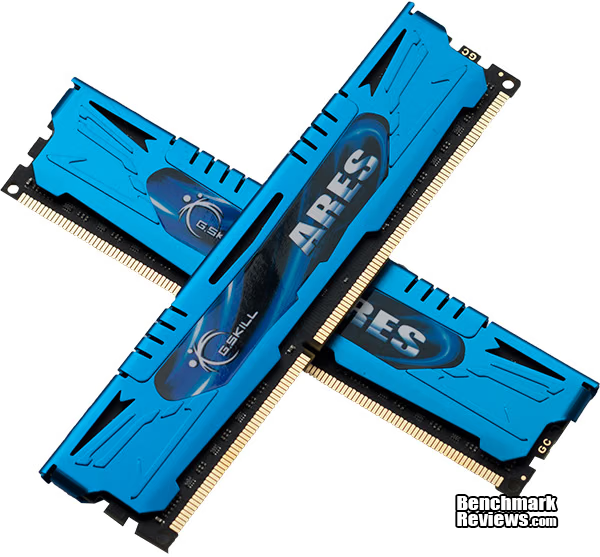
Some people want or even need the most memory that they possibly can get into a system, for those users a simple 16GB of RAM may not be enough. Thankfully, due to rapidly dropping prices having as much RAM as servers of yesteryear is neither overly expensive, nor that unreasonable to have. Benchmark Reviews will be looking at the G.Skill Ares 1866MHz 2 x 8GB kit designed specifically with those people in mind. Named after the Greek god of war the G.Skill Ares kit looks like it is ready for war with its heat sinks glistening in the sun but is it really the warrior it claims to be or a just imposter with nice armor. Benchmark Reviews will evaluate the merit of the Ares name and determine if this kit is truly worth of the name it has been given.
Years ago using the fastest possible memory was the only way to get the full potential out of a processor. This is because in the days before Sandy Bridge getting the highest clock possible was achieved using a combination of changing the clock multiplier, and increasing the FSB or base clock. Because changing these also increased the base speed of the memory using the fastest memory possible was only the only way to push a processor to its upper limits. But things have changed since the Sandy Bridge platform debuted, the only effective way to overclock is to increase the clock multiplier of the K SKU's meaning that memory speed is less important for overclocking and therefore companies are concentrating on dropping prices, and timing to compete with each other. As prices have dropped, users have started demanding more RAM for their systems. Mushkin's Redline has been a well-received product for many years and now they have updated their Redline series to be compatible with Intel's newest P67 chipset. This means that each kit of memory has a speed that is divisible by 266.6MHz so as to provide optimum speed in a user's system.
Benchmark Reviews wants to be able to provide the most accurate information on the performance of components to its readers and therefore has a very specific way in which tests are run on components. For RAM, each set is run first run through Memtest86+ at its advertised speed to insure that that there are no errors. Once passed a combination of pure benchmark based, and application based tests will be run a total of three times each. Once the results have been acquired the worst score of each test will be thrown out and the final two will be averaged resulting in the final score that will be presented to our readers.
Specifications
Type
DDR3
Voltage
1.5
Speed Spec
PC3-14900
Frequency
1866MHz
Kit Type
Dual Channel
Module Size
8GB
tCL
10
tRCD
11
tRP
10
tRAS
30
Closer Look: G.Skill Ares DDR3 Memory
Companies for years have been attempting to woo potential customers with big heat sinks, flashy colors, and fancy names. In the era of sub 1.5v memory modules there is no need for the large heat sinks that have been used in the past when memory voltages were past 2.0v. As such the designs used have become much more of an aesthetic decision than a performance decision and while that may not matter to some users others may have Plexiglas windows and so the aesthetic designs of their RAM may be of some concern to them.
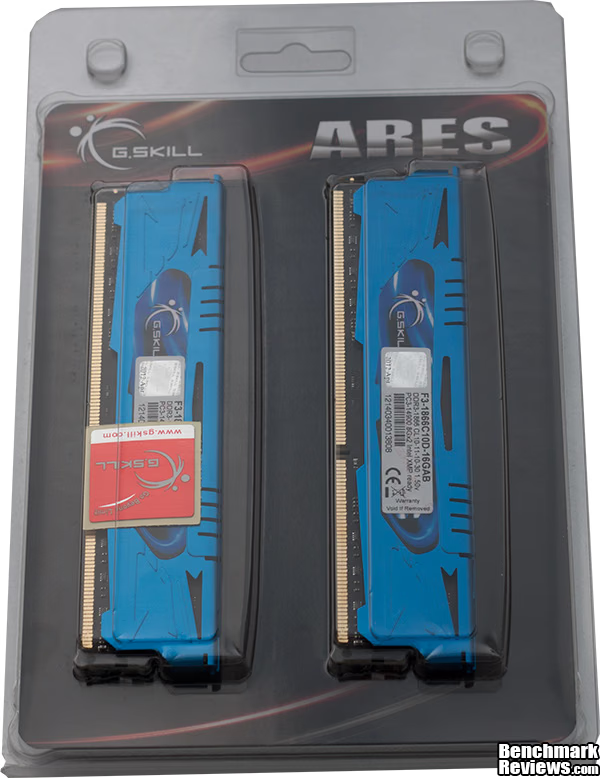
G.Skill uses the typical blister packaging providing users with everything that they could want to know about the Ares kit of memory. Also included is a G.Skill sticker that users can adorn their systems with allowing them to show off what they have on the inside.
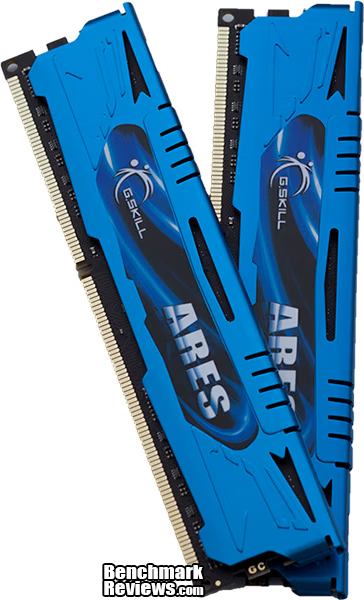
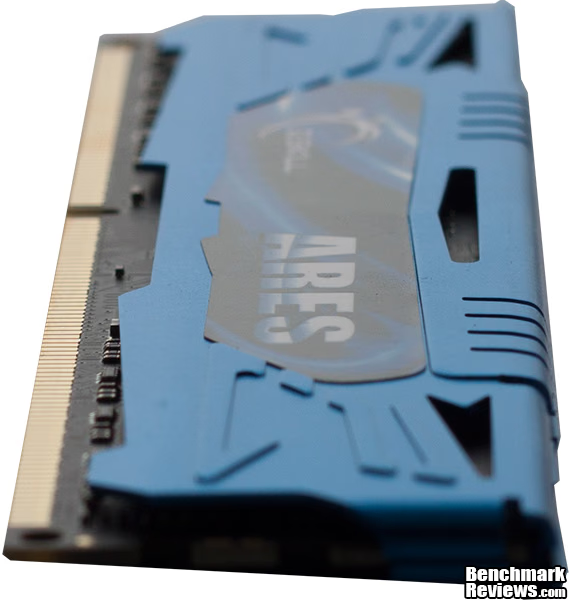
G.Skill utilizes a rather flashy design for its Ares line of memory with a bright metallic blue shell covering each of the IC's on the PCB board.
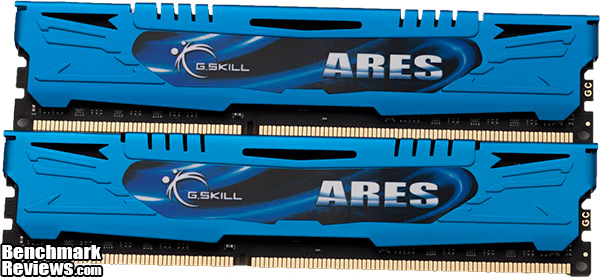
The Ares utilizes a black PCB board with a particularly short 3.2cm heat sink. This design makes it perfect for users in need of memory that can be fit under a large heat sink or in a SFF system that can be put anywhere.
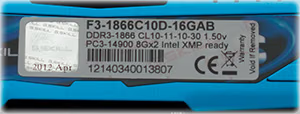
G.Skill used their standard numbering scheme for their models and as such, it is an easily decodable string of letters and numbers. F3 describes the technology that the Ares kit uses, which in this case it translates to DDR3. Following this is the PC3 rating, which is 14900 that when divided by eight will give you the proper DDR3 speed. Next is the CL rating, which for this particular kit is CL 10 and the series ends with a D, which stands for dual since this a dual channel kit. Next to last is the 16G, which describes the entire size of the kits. Lastly, we have the AB which is the model ID.
RAM Testing & Results
Testing Methodology
When testing RAM the preferred method is to remove as many bottlenecks as possible. This ensures that any changes in the benchmarks are dependent on the RAM that is being tested as much as possible. For this reason no games have been included because at the moment games are far more dependent on computers GPU's and CPU's, rather than their memory subsystems. Instead the tests used will be focused on being more memory intensive tasks such as fluid dynamics simulations, compression, and real-time rendering. These benchmarks will be run alongside traditional benchmarking tests that will scale more effectively with speed but will be an unrealistic indication of real world performance.
In order to test each RAM kit in the most effective fashion a multistep process was required. First in order to verify the advertised speed each set of RAM they will be initially run the Memtest86+ for one run. Once no errors are found, Windows 7 Professional 64-bit with all of the need tools will be loaded. In order to make sure that fluctuations in other subsystem do not influence the scores, each test will be run a total of three times. At the end of the benchmark the lowest score will be dropped and the final two tests scores will be averaged. The test being used for benchmarking will be as follows.
- MaxxMEM2
- SiSoft Sandra Light 64-bit
- AIDA64
- PCMARK Vantage
- WinRAR
- CINEBENCH R11.5
- Euler 3D

Test System
-
Motherboard: MSI P67-GD65
-
System Memory: 2 x 4GB G.Skill Ripjaw 1600MHz
-
Processor: Core i5 2500k 3.3Ghz @ 4.7Ghz
-
Video: ASUS GTX 580
-
Disk Drive 1: Patriot Inferno 60GB
- Disk Drive 2: 2 x 1TB Seagate 7200RPM RAID 0 Array
- Disk Drive 3: 1 x 500GB Seagate 7200RPM
-
Optical Drive: DVD Burner
-
Enclosure: Silverstone Raven RV02-EW
-
PSU: Cooler Master SilentPro 1000w
-
Monitor: ASUS 27.5" 1920x1200
-
Operating System: Windows 7 64-bit Professional
Memory Test
- G.Skill Ripjaw 1600MHz 9-9-9-24 F3-12800CL9D-4GBRL (2 x 4GB Kit)
- G.Skill Sniper 1866MHz 9-10-9-28 F3-14900CL9D-8GBSR (2 x 4GB Kit)
- Corsair Vengeance 1866MHz 9-10-9-28 CMZ8GX3M2A1866C9 (2 x 4GB Kit)
- Mushkin Enhanced Redline 2133MHz 9-11-10-28 Model 996999 (2 x 4GB Kit)
- Mushkin Enhanced Redline 1600MHz 7-9-8-24 Model 997000 (2 x 4GB Kit)
- VisionTek Ultimate Performance 1866MHz 10-10-10-24 Model 400426 (2 x 4GB Kit)
- G.Skill Ares 1866MHz 10-11-10-30 F3-1866C10D-16GAB (2 x 8GB Kit)
Also because each IC produced is slightly different and will have different overclocking characteristics any overclocking results obtained may vary from user's actual experience. In the end this means that spending the time to overclock our system memory will be unbeneficial to our readers and therefore will be omitted from the results except for in special cases, such as when a product is advertised as having a great amount of headroom.
We have recently introduced the Euler3D Computational Fluid Dynamics benchmark into our memory test suite and so I would like to give a small explanation as to what is being used. Our newest test simulates the fluid dynamics of a wing and therefore is very memory and CPU intensive. Each test is run and the final result is given in Hertz(Hz). For our purposes the final Hertz score is what will be used for comparing each set of memory to its competitors. It has been found that this benchmark is particularly sensitive to both memory speed and timing and therefore makes a perfect benchmark to add to Benchmark Reviews memory suite.
Synthetic Benchmarks
The synthetic testing that Benchmark Reviews uses are designed specifically to highlight differences in each kit of memory. As such, each test can over emphasize the differences of each kit that may not be observable in day-to-day operations.

The AIDA64 benchmark is extremely sensitive to changes in the frequency of the RAM being tested without being affected by the timings of the particular kit. As such our G.Skill Ares 16GB kit even with its 10-11-10-30 timing performs within 0.62% of our 1866MHz 9-10-9-27 kit during the write test even though it has 20% increase in timing. When it comes to its read speeds the G.Skill Ares performs within 2.5% our Corsair 9-10-9-27 kit and nearly identical to our VisionTek 1866MHz 10-10-10-24 kit.

One of the more recent additions to our benchmarking suite is MaxxMEM2 which uses STREAM to generate data designed to test memories continuous speed rather than burst speed. When the G.Skill Ares 1866MHz kit is compared to our Corsair 1866MHz kit it performs with 2.2% of our strongest 1866MHz kit. When write speeds are compared the Ares kit performs on par with the Corsair Vengeance kit and in the read speed test the Ares is outperformed by 3% by the Corsair Vengeance 1866MHz 9-10-9-27 kit.

The final piece of software in Benchmark Reviews synthetic suite is SiSoft's Sandra, which provides a near linear performance increase as the speed of RAM increases. Timings also make very little difference in the score of a kit meaning that our Ares 1866MHz 10-11-10-30 kit performs within 4% of our Corsair Vengeance 1866MHz 9-10-9-27 kit and easily outperforms our 1600MHz kits by around 11%. It will become apparent in our application-based benchmarks though this gap may not always exist between our 1600MHz and 1866MHz kits especially when compared to the Mushkin 1600MHz 7-8-7-24 kit.
Application Benchmark
Application benchmarks are a look at real world performance of the memory being tested. During this review we will be employing a combination of rendering, compression, and simulation to see how timing and speed affects their performance.

The CINEBENCH R11.5 benchmark uses OpenGL to render pre-created scenes in a way that is repeatable making it a perfect test for benchmarking a system. The CINEBENCH test aptly shows that in our era of GPU and CPU limited games and rendering software memory is not normally the limiting factor for these pieces of software. Because of this between our 1600MHz 9-9-9-24 kit and our G.Skill Ares 1866MHz 10-11-10-30 kit we see less than 1% of a difference well within our margin of error.

Using the benchmarking tool built into WinRAR 4.00, we were able to effectively gauge how many kilobytes per second our test bed was able to compress. Rather than our normal three test runs I actually run this test 9 times because of the weird results it was giving me. Although it has nearly the same specs as our VisionTek 1866MHz 10-10-10-24 kit it performs 3.7% worse consistently. I can only attribute this to our timings which our Mushkin 1600MHz 7-8-7-24 kit has shown WinRAR has a very high sensitivity to.

Our final and newest test Euler 3D is a fluid dynamics simulation that is extremely sensitive to both speed and timings. With its looser timings the G.Skill Ares 10-11-10-30 kit performs around 4.5% worse than the VisionTek 1866MHz 10-10-10-24 kit. This test is one of the most sensitive test we have for memory benchmarking and it responds quite effectively to both timing and speed changes in the memory of a system. As such our slower Mushkin 1600MHz 7-8-7-24 kit of memory handily beats our Ares 1866MHz 10-11-10-30 kit.
DDR3 Memory Final Thoughts
As RAM prices have steadily fallen over the years RAM sizes consequently have increased. The G.Skill Ares 1866MHz 16GB kit is a testament to this by providing users with massive amounts of memory for a very reasonable price. Unfortunately everything is not perfect, although the memory does run at its specified 1866MHz 10-11-10-30 @1.5v this G.Skill Ares kit has a XMP profile of 1778MHz with 10-12-10-31 timing. This means that if users aren't paying attention or if they do not know what to look for then they may end up having a kit of memory that performs 5-7% worse than the kit of memory that they thought they were paying for.
Thankfully, although it does have some shortcomings, when you look at the high density of the kit, low profile design, and lifetime warranty the G.Skill Ares kit still comes out on top. Because it will run at its specified speed as long as users are willing to manually enter the speed and timings I do not see this as a earthshattering error but rather a minor annoyance.
G.Skill Ares 1866MHz DDR3 Conclusion
Performance in RAM is about being able to complete real world benchmarks faster the competition. Unfortunately, in measures of pure speed the Ares kit consistently performs worse than the other 1866MHz kits with tighter timings. For users in need high density memory this may be an acceptable tradeoff as the performance added by having extra memory may overshadow the slight loss from the looser timings used by the Ares kit.
Appearance is one area that I am extremely picky about, and I find the G.Skill Ares kit to be a bit to flashy for my taste, as I prefer mute blacks and matte colors to the flashy, bright colors used on the Ares kit. Thankfully, although brightly colored the Ares is not gaudy looking allowing me to overlook my tastes as I find that the Ares still stays within good fashion.
The construction quality of the G.Skill Ares kit is superb, the PCB doesn't flex, the heat sinks just fit together, and overall the quality of Ares is as one would expect from a major producer like G.Skill.
Functionality is all about being able perform at the specified speed without errors. The G.Skill Ares does this quite easily, passing our Memtest86+ with flying colors but not without a hiccup along the way. I found that during my testing the Ares kits XMP profiles was specified for 1778MHz with 10-12-10-31 timing. This is easily remedied by manually setting the speed and timings but still a situation that I would like to see corrected in the future.
Priced at $149.99 (Newegg) the G.Skill Ares kit is on average $50 cheaper than its competition making it quite a interesting proposition for those wanting high density memory. For users simply want 16GB of memory though it would simply be more cost effective to buy two separate 8GB kits and fill all four of their memory banks.
Designed for enthusiast requiring high density 8GB modules due to limited memory banks or due to the large amounts of memory need for their work the G.Skill Ares will easily make its users happy. It provides good performance, a decent looking kit, with lifetime warranty, for a reasonable price. I hope to see the XMP profiles fixed in the future but even with such a problem I would easily award the G.Skill Ares 1866MHz 16GB kit the Benchmark Reviews Recommend Product award.
Pros:
+ High density modules
+ Lifetime warranty
+ Low profiles heatsinks allow for use in SFF systems and under large heatsinks
+ Cheaper than many of the other 1866MHz 16GB kits
Cons:
- Not as cost effective as buying two 8GB kits
- Looser timings comprimise performance
- XMP profile does not correctly set the specified speed and timings.
Ratings:
-
Performance: 8.00
-
Appearance: 9.00
-
Construction: 9.00
-
Functionality: 9.00
-
Value: 9.0
Final Score: 8.8 out of 10.
Benchmark Reviews invites you to leave constructive feedback below, or ask questions in our Discussion Forum.
Reader comments from the original article
3 comments were posted before commenting closed. They are preserved as written. Original avatars no longer resolve and are shown as a placeholder.
lowest cas t iming Roland Permalink:
Any plans to test the memory to see just how low cas timing can be had? I always look for stuff like that in memory reviews but rarely see them.. My thoughts are.. well it's PC 1866 memory.. what are cas timings like at PC1600, can it do 8-8-8 or omg cas 7? Stuff like that you know?
RE: lowest cas t iming Austin Downing Permalink:
For many sets of memory it can be less than useful to test their overclocking or underclocking abilities because my results most likely will not reflect what our readers experience because of the minute differences in each IC that is made.
RE: G.Skill Ares 16GB 1866Mhz DDR3 Memory Kit Jim R Permalink:
Don't know, but I wouldn't have tested on MSI, there BIOS is somewhat shoddy when it come to 8GB DIMMS, which may well have accounted for XMP loading wrong, should have tried a couple other good mobos before making a rash decision that the DIMMS set up wrong since it's how the BIOS sets things based on what it reads, which is often to 'as close as possible' as it can. In your cons you state not as effective as buying to 8 GB kits, which in of itself is a con, especially with higher frequency memory A) there's no guarantee two sets of DIMMS, even of the same model will work together, B) XMP won't work with multiple sets and C) you'd be filling 4 slots instead of two which is more stress on the MC (Memory Controller). The looser timings are keeping in consistency to the price which is low for 2x8GB 1866, the same 2x8GB at CL9 is likely to cost $50 more (and I believe Corsair has a Vengence model out w/ the same exact timings at $50 more). Most if they wanted higher performance (and still didn't want to pay the Corsair price of $200 for a like set, for less could easily order GSkill 2133/CL9 2x8GB set for about $30 more at around $180. Need to compare other options that are available rather than make rash statements, in this case to come up with cons...this is a good set for the price/freq/CL baselines.