
Antec Eleven Hundred Computer Case
Antec Eleven Hundred Computer Case Review
Manufacturer: Antec, Inc.
Product Name: Eleven Hundred
Model Number: 0-761345-15950-0
Price As Tested: $129.99 (Newegg)
Full Disclosure: The product sample used in this article has been provided by Antec
Due to the popularity of Antec's Nine Hundred and Twelve Hundred gaming cases, Antec has released the anticipated Eleven Hundred. As an extended mid-tower case it fills a small void between mid and full sized gaming cases and has room to grow with the individual as well as the industry. It complements the expanding variety of gaming configurations by providing greater range of options for things like motherboard size and fan placement. In this article, Benchmark Reviews will give an intimate look at the features and performance of the Eleven Hundred and score it against the competition.
Mid-sized cases provide smaller hardware frames that help keep costs down while still providing useful features and accommodating a wide range of user needs. For many people the small box just doesn't provide enough space or features. It could be that the novice builder gains more experience and parts and just needs more room. It could be the experienced user who follows the technology trend and ends up with larger and larger video cards. Whatever the circumstance there often comes a time when you just need more than a small case can offer.
Until recently this often meant stepping up to the next class and getting a full-sized ATX case. This comes with the addition to both the price tag and the footprint. I remember when I made that transition that the full-sized case dwarfed what I really needed. It was total overkill and difficult to justify the cost. Some builders just don't need or want some mammoth beast. Don't get me wrong, giant cases definitely have their purpose, especially for intense builds. But you don't need buy a jackhammer when a sledge will get the job done.

That's what Antec's Eleven Hundred is poised to offer; an upgrade from a framing hammer to the sledgehammer! In a broader sense they are allowing a more modest transition into a larger computing platform. This move opens up more options and a wider range of possible configurations. Just check out the features listed below to get an idea of the versatility offered. Read on to see how these features actually perform and for our rating of Antec's Eleven Hundred.
Features and Specifications
Antec Eleven Hundred Features
|
FEATURES & TECHNOLOGY |
USER BENEFIT |
|---|---|
| Supports up to XL-ATX motherboards (10.3" x 13.6" / 262 mm x 345 mm) | Flexibility in motherboard selection Extra space for component installation |
| 9 thumbscrew expansion slots | Easily install up to 4 discrete graphics cards up to 13" long |
| Easy-to-remove air filters | Convenient maintenance Keep internal components consistently cool |
| 6 total cable routing holes (4 that are grommet-lined) with up to 36 mm of space behind the motherboard tray | Cleaner builds for better airflow and component lifetime Easier to build systems worth showing off |
| Fan power hub | Allows four 3-pin fans to easily connect to a single Molex for improved cable management (2 included fans are connected to the hub by default) |
| Maximum-sized CPU cutout | Accommodates vast majority of CPU socket placements |
| Tool-less 3.5" and 5.25" drive bays | Hassle-free secure drive installation |
| 2 included fans with 7 optional fans | Powerful stock cooling system with 1 x 200 mm top blue LED exhaust fan and 1 x 120 mm rear exhaust fan Unique 120 mm intake fan mount behind motherboard tray for CPU cooling 6 x 120 mm fan mounts (2 in front, 2 internal, 2 in side panel) for graphics card and hard drive cooling |
| 2 front panel USB 3.0 ports with internal connector Optional USB 3.0-to-2.0 available for minimal cost | Ready for high-speed devices and the latest motherboards |
| 3 year warranty | Peace of mind |
Computer Case Specifications
|
Case Type |
Super Mid Tower |
|---|---|
|
Motherboard |
XL-ATX (10.3" x 13.6" / 262 mm x 345 mm), Standard ATX, microATX, Mini-ITX |
|
Drive Bays |
External: - 3 x 5.25" (tool-less) |
|
Internal: - 6 x 3.5" (tool-less) - 2 x 2.5" (dedicated) |
|
|
Cooling |
1 x rear 120 mm exhaust fan (standard) 1 x top 200 mm blue LED exhaust fan with LED switch (standard) 2 x front 120 mm intake fans (optional) 2 x internal 120 mm intake fans (optional) 2 x side panel 120 mm intake fans (optional) 1 x behind motherboard 120 mm intake fan (optional) |
|
Maximum Graphics Card Size |
13" / 330 mm |
|
Expansion Slots |
9 |
|
Front Panel |
2 x USB 3.0 2 x USB 2.0 Audio In/Out Power / Reset buttons |
|
Product Weight |
20.0 lbs / 9.0 kg |
|
Product Dimensions |
20.7" (H) x 9.3" (W) x 21.5" (D) 527 mm (H) x 237 mm (W) x 546 mm (D) |
Closer Look: Exterior
One thing that I really like about Antec is their ability to project a clean, crisp appearance. Their marketing, their products, everything just looks sharp. I'm not one to be swayed much by outward appearances, but I have to admit that a having something that looks nice can feel that much better when you know the inside is just as good or better.

The Eleven Hundred certainly fits the crisp, clean appearance. It loosely maintains the form seen on both the Nine hundred and Twelve Hundred which is a smart move to capitalize on the success of these products. IO ports are high in the front, full mesh face, large top-fan and perforated panels for side induction.

But there are some differences in style and functionality. The Eleven hundred has dedicated vents on the front panel for air flow, a more squared profile, and the funky mesh / plexi window gets replaced by a cleaner all-plexi window. The top-fan is flusher with the case, and the case sizes closer to the Nine Hundred only much wider.

A profile view of the Antec Eleven Hundred shows a more squared, basic shape compared to the previous versions. This square profile is evidence of the extended depth of the Eleven Hundred. At 21.5" it's deeper than both the Nine Hundred and Twelve Hundred. I think it looks better even though I'm not a fan of perfectly square cases. The full-plastic window is much easier to see through and provides mounting locations for two 120 mm fans.

Despite being shorter than the Twelve hundred, the Eleven Hundred squeezes in two more expansion slots for a total of nine. The rest is basically standard with a bottom-mounted PSU, two water-cooling ports and a single fan towards the top.
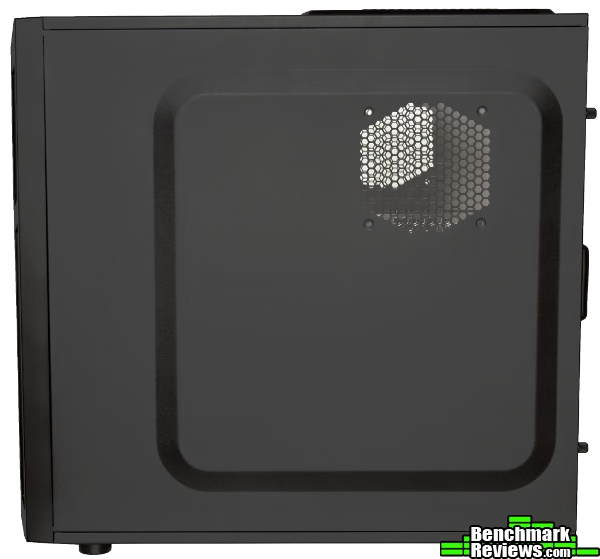
While the right side of most cases has nothing to provide, Antec bumped out the panel and added perforations and mounting points for a 120mm fan behind the motherboard. This is an unusual move that can actually be functional if done correctly. Both the left and right panels are mounted with thumb-screws for easy access. This comes in quite handy during the initial build.
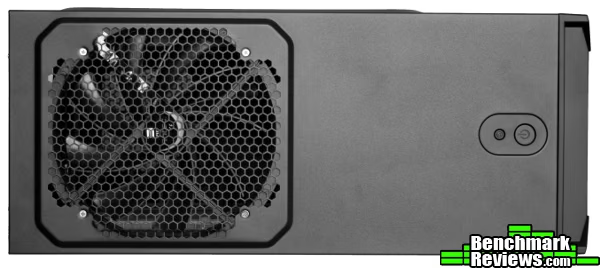
Like its predecessors, the Antec Eleven Hundred has a top-mounted 200 mm exhaust fan. It is recessed further into the case than the previous versions, but enough is left sticking out to add a touch of style. The top of the case is also home for the power and reset switches. This seems like an unusual spot, but I REALLY like it. Perhaps you are not as clumsy as me, but I have this horrible habit of bumping the power or reset buttons while trying to plug in or remove devices. I also accidentally push buttons on the front when removing and replacing my case in my computer desk. Having these buttons isolated from the rest of the IO keeps me much safer.

The bottom of the case has no functional parts or much to mention. There is a recess in the front panel which allows for easier removal. It's also worth mentioning that the feet are made of a hard plastic. I've griped about this before, but hard feet transfer case noise to the desk. While cosmetic, it can magnify something previously unnoticed into a real nuisance.
Now for a closer look at some exterior features.
Detailed Exterior Features
The IO panel on Antec's Eleven Hundred gaming case is split into two parts. The power and reset switches reside on the top while the ports face forward on the bezel. I like the switches separated from the ports because it prevents accidental presses when plugging or unplugging devices.

The Nine Hundred and Twelve Hundred both had the IO panel at an angle that made it awkward to plug and remove devices. Sure, it didn't take long to get adjusted, but it's a non-standard interface. Antec repented and gave us a standard interface that's tried and proven. To sweeten the deal they threw in another USB 3.0 port to give a total of two USB 2.0 ports and two USB 3.0 ports. This provides compatibility with any motherboard and prepares the Eleven Hundred for compatibility with future hardware.

In addition to nine expansion slots, the back panel of the Eleven Hundred has a fan controller with room for three separate controls. One control is dedicated to the top-fan. It has one spot for an LED on\off switch and one spot for a speed control switch which was merely cosmetic (no switch). The other two controls were empty, to be filled at your pleasure (or displeasure). Even though the controls say "REAR", the rear fan supplied with the case has a three wire power jack and no controls. It seems like they did this much work already, what kept them from following through and providing all the features that were apparently intended?

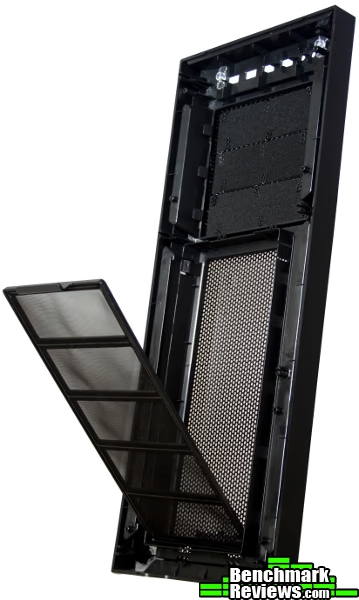
Lots of fans are usually attended by some number of filters. The Eleven Hundred has filters in the front and filters on the bottom. The bottom filters slides in at the bottom and is removable from the left side. I prefer this arrangement over a filter that removes from the back, but I'm waiting for the filter that can be removed from the front. The side and back are often obstructed, but the front of a case is almost always the most accessible. My filter got jammed inside the case after sliding against the desk wall. I had to open the side panel to pry it loose.
Closer Look: Interior
The inside of the Antec Eleven Hundred feels huge. It's got a very durable coating and solid construction. The framework is all metal with double-rivets at almost every joint.

The drive cage is bounded by a metal beam that runs from top to bottom, the left side of the cage is plastic and the right side is metal. The drive cages houses 5.25" bays, two 2.5" rails, and six 3.5" rails. The space at the top of the case looks under-utilized containing only the top-fan, the fan power hub (mounted on the inside rear), and the IO cabling. While probably not necessary, Antec probably could have squeezed another 3.5" drive bay, or at least another 2.5 rail! I'd rather that they shortened the case by a tad.

With the front panel removed we see space for two 120 mm fans, which are not included. We also see here, as in the previous photo, that the 3.5" drives are mounted sideways. It seems like this configuration should have allowed the case to be less deep. Rather than shorten, skinny or shallow out the case Antec opted to keep the case compatible with XL-ATX motherboards and allow plenty of room for cabling.

And there is PLENTY of room for cabling. The extra space allows four large, grommeted cable holes, and two smaller auxiliary holes. The space between the motherboard tray and the right panel is 36 mm where the panel is bulged, and 30 mm otherwise. Along the main cabling routes there are five tie-down anchors that are truly useful. There's also a huge cutout in the motherboard tray. Combined with a fan on the right panel there is potential for better cooling. But just to see what benefit might be obtained I measured the temps on the motherboard. It was 37°C on most of the motherboard, but 40°C directly under the processor. Since the overall motherboard temp was fairly consistent this tells me that the temp is governed by the case temp. You'll get more bang for your buck by getting higher flow through the main cavity than by trying to spot cool the back. I would rather see another bottom fan mount in front of the PSU.

One of the most exciting features of the Eleven Hundred are the potential for an XL-ATX case along with nine expansion slots. The PCI slots all have thumb-screws compatible with normal screws should you desire. The extra width on the case provides plenty of room above the PCI cards for water cooling hardware as well as extra large CPU or other coolers. Also on the backside interior of the case is a "centralized" power hub for all the fans.

As metnioned before, the hard drive cage faces sideways. Unlike the Nine Hundred and Twelve Hundred cases, the smaller drives in the Eleven hundred face sideways. The top of the bay mounts two 2.5" drives without the need for any hardware but a screw. The rest of the drives all slide on rails, and by default are cabled from behind.
Next we'll get slightly more intimate with the inside of the Eleven Hundred including a simple build.
Detailed Interior Features
It's great tha most new cases include tool-less installation hardware. Simple spring loaded mechanisms are all but standard for 5.25" bays for holding one or more optical drives.
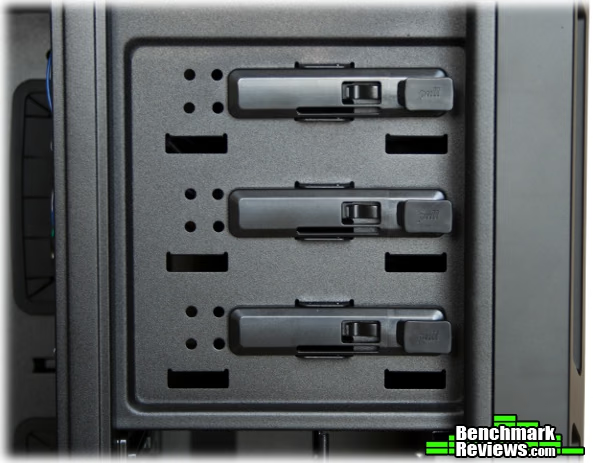

The smaller 3.5" drives were much easier to install. Simply pop on a couple rails and slide them right in. To remove the drive just squeeze the curved tabs at the end of the rails and pull. There are several different styles of rails out there, and for the most part the style doesn't make a huge difference. Some cases are wide enough that a hard drive can be installed with the port facing rearward or forward. In the Eleven Hundred the case is wide enough for either configuration, but the rails will only mount the drive in one direction, and the cage is mounted too close to the front panel. A small nuance, but perhaps useful to someone.

The Eleven Hundred is an unusually deep mid-tower case. The extra depth allows for large motherboards and space, but it also allows room for more fans. In addition to the front fans (not included) Antec left space to mount two interior fans on the drive cage (also not included). I've never actually benchmarked or used two front fans and two frontal interior fans. Intuitively I have a hard time believing that they will make much difference unless the hard drive cage is full.

While we're on the subject of fans we can look more closely at the "central" power hub. It's a small PCB with a male molex plug for power input and four 3-pin fan outputs. The top and rear fans are both plugged leaving only two more jacks for additional fans. Since there is potential to install seven more fans in the Eleven Hundred you'll need to use some type of daisy chain or splice. The hub best serves the side fans, but you'll need to run either a solitary power cable or an extension.
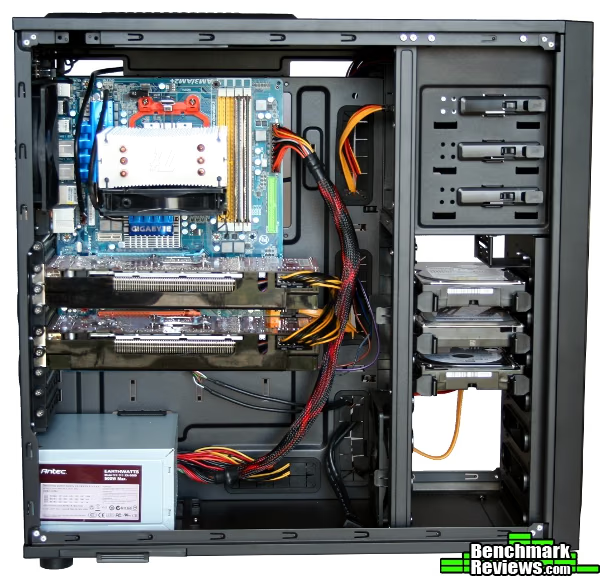
The build in this case could have been my fastest build ever. There is tons of space for running and organizing cables. Tons of space for my hands and long cards. Tons and tons of space!!! Everything dropped in and secured quickly. With the motherboard in place you can see the spacious interior. The CPU cutout extends past the end of the motherboard (which is slightly shorter than average). In fact the case is so spacious that some of my cables were too short to run behind the motherboard.

There was one thing that kept this from being my fastest build. Well, four things really. The grommets in the mobo tray kept popping out. You can see in the picture above at the bottom where I left one grommet hanging loose. The rubber was too soft, or the holes to big, or the seatings were too shallow, or some combination of all three left me constantly fighting to keep them in place. It was almost faster to pull the grommet out, run the cables through, then try to fit it back in place. An unexpected frustration that Antec can hopefully mend (will hopefully mend).
One last thing worth mentioning is that the USB 3.0 cable terminates in a motherboard header without any adapters for a 2.0 port. This should be less and less of a problem going forward, but many people are still in a transition stage, especially if you're considering this case. Overall I have to remark on how clean the installation was. Excepting the one hiccup it was a very positive experience.
Computer Case Final Thoughts
I'm finding that I really like the extended mid-tower cases, especially the ones being released lately. They come packed full of features, though perhaps not EVERY feature, and they can handle most hardware configurations you can throw at it. They're big enough to provide space for an easy build without being so big that they cost extra cash or no longer fit in your computer spot. They allow you to put in a modest motherboard, PSU, graphics cards and adequate cooling, and leave space for adding more, bigger, faster, better. These cases will easily support and cool three and four GPUs. They've got USB 3.0 and dedicated spots for SSDs.
They're ready to move forward with you, grow with you, accept whatever decide. These larger mid-tower cases remind me of when SUV's started appearing in the car market. Consumer options went from car/van/truck to minivans, SUVs, cross-overs and everything in-between. I don't know if computer cases will soon see a similar divergence of classes away from standard, mid and full sized ATX, but I fully expect to see a wider range of customized offerings that blur the lines between classes. I'd love to see a point where we can choose our features the same way you can choose a custom package for your car. But until then we'll keep reviewing cases and find our favorites.
Antec Eleven Hundred Conclusion
When it came time to build the Eleven Hundred the performance was almost spectacular. The extra depth and width provided tons of space to quickly add and remove parts as well as run cables without restriction. But the grommets in the motherboard tray kept dislodging and impeded the build. Once the cables were through and the grommets all replaced it was an easy matter to organize the cables into clean bundles and secure them to the tray. When it came to cooling, the case was setup for success. There are spots for 9 fans, but only two were included. The top 200 mm fan was a quiet workhorse, and the rear 120 mm fan pulled its own weight. In the default configuration the negative pressure setup couldn't keep up with cases that just have more fans. Finally, when it comes to configurability the Eleven Hundred excels with motherboard options (up to XL-ATX), and USB 3.0, but otherwise doesn't offer anything special.
The Eleven Hundred keeps with the main visual theme of Antec's gaming series with slight modifications that give a cleaner look. Though slightly more boxy I think it eliminated many odd lines, angles and visual obstructions. There's enough style and pattern to avoid the boring box look but the layout is functional and familiar.
Characteristic of Antec's quality, the Eleven Hundred uses solid steel construction with rigid plastic in mostly non-critical areas. The one exception is the left side of the hard drive cage and interior fan mounts. The joins and seams are well crafted and the coating is durable. The front panel can be pulled off, but it won't come off accidentally. The feet are made from hard plastic which can magnify noise, would be nice to see something soft. The bottom and front filters are well constructed and functional.
USB 3.0, removable filters, side left, side right rear and top fans (or at least potential for such), deep motherboard tray, large CPU cutout, tool-less install...the Eleven Hundred has lots of good stuff going on inside. Panels are easy to remove, thumb-screws on the PCI slots, nine expansion slots, what's not to like? There's even a fan power hub and mounts for fan controls on the back panel. But to get the full functionality out of the case you're going to have to put in some effort. You'll need to provide the additional fans, and find ones with control switches if you want to use the back panel.
As of late November 2011, the Antec Eleven Hundred is available for $129.99 at Newegg. This is really a difficult case to compare monetarily against the competition. If you look at cases offering 9 or more expansion cards, there's almost nothing even close to the price class. The closest competitor as far as i can tell is Rosewill's Thor V2 which had a very mixed reception, but it was a full tower case. So how do you value a one-of-a-kind? If you don't care about expansion ports then you can get better features for the same price point. If you don't care about case size then you can get large cases that offer more for a little more.
This case was very difficult to rate. You may agree or disagree, and I'd love to hear your thoughts (kindly). I can't help but feel like Antec cut some corners to hit the price point. Any sane person who wants to run multiple GPUs in this case is going to pony up extra for adequate cooling, and it's hard to say exactly what will be required. For me it would be a minimum of two more decent 120 mm fans. I'm also miffed at their choice to short-change the fan controller. Not that I'd use it much since it's inconveniently located at the back, but just because it's not as good as they did in previous case models. To Antec: this could be a GREAT case. Add two decent fans, firm up the grommets by adding a hardening agent to the rubber, and fix the fan controller. If history tells us anything, we expect to see Eleven Hundred V2 with improvements.
Pros:
+ XL-ATX Form-factor compatible
+ Nine expansion bay slots
+ Lots of space for fast build
+ SuperSpeed USB 3.0 Ports
+ 200 mm top-fan
+ Tool-less installation
+ Up to nine fans possible
+ Excellent quality / construction
+ Inexpensive for motherboard size
Cons:
- Only comes with 2 fans
- Cabling grommets come loose
- Fan controller not functional
- Hard plastic feet on case
Ratings:
- Performance: 8.50
- Appearance: 8.25
- Construction: 9.50
- Functionality: 8.75
- Value: 9.25
Final Score: 8.85 out of 10.
Benchmark Reviews invites you to leave constructive feedback below, or ask questions in our Discussion Forum.
Reader comments from the original article
5 comments were posted before commenting closed. They are preserved as written. Original avatars no longer resolve and are shown as a placeholder.
RE: Antec Eleven Hundred Computer Case Chris Permalink:
Awesome review! Finally, an acceptable successor to the original Antec 800.
More work needed Robert Johnson Permalink:
It has 9 slots but some things are not designed well. The position of the fan controller is not correct. Fan controllers should always be in the front. The top is poorly designed because lots of people like to mount a large rad on top. There should have been two 120mm fans or two 140mm fans and holes for both. The HD drive bays should be removable. The price could be a bit lower.
RE: More work needed Dan Ferguson Permalink:
Thanks Robert, the point about mounting a top-radiator is something I didn't mention. This entire series makes it difficult to use a radiator due to the top panel configuration. The Twelve Hundred had lots of room up top, but the Eleven Hundred uses all the extra room for the motherboard. It's hard to get PSU + XL-ATX + top radiator in 20".
RE: Antec Eleven Hundred Computer Case JackNaylorPE Permalink:
I'm gonna guess no by the pictures, but I assume this won't take the CP-850 PSU.
RE: RE: Antec Eleven Hundred Computer Case Dan Ferguson Permalink:
It won't fit the larger PSU. Even if you bend in the tab that supports the top of the PSU, you'll run into the PCI slots.