
Marvell 88SS9174-BLD2 SSD Processor
For those who can still remember the occasion, back on February 2010 Micron Technology introduced the Crucial RealSSD C300 solid state drive. This was the first consumer-level SSD to support the cutting-edge SATA 6Gb/s interface, known by some as SATA-III. Back then, Crucial's RealSSD C300 was able to reach 383/227 MBps read/write speeds on a Marvell controller in our lab tests. Just over one year later, they've returned to deliver its sequel rated for speeds up to 415 MB/s: the Crucial m4 Solid State Drive. The Crucial RealSSD-C300 was the industry's first SATA 6Gb/s consumer solid state drive, and also the first SSD to use ONFI 2.1 synchronous NAND flash. But with a 355/215 MB/s read and write speed rating from its Marvell 88SS9174-BJP2 SSD processor, the C300 was ready to be replaced.
Micron equips the RealSSD C400 with the revised Marvell 88SS9174-BLD2 SSD processor. Marvell's 88SS9174 (aka "9174") controller is used in the following solid state drives: Micron RealSSD C400/Crucial m4, Strontium SSD Matrix, Intel SSD 510 (BKK2 revision), Corsair Performance 3 (BKK2 revision), and many more. This controller is based on the same processor that powered the C300, but its been tweaked to output 90,000 combined IOPS based on Micron's own Iometer tests. In this article, we examine just how much has changed 'under the hood' with the new Crucial m4/Micron RealSSD C400 series.
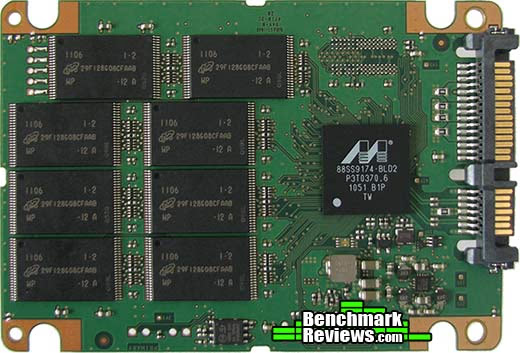
Marvell's BLD2 revision of their popular 88SS9174 controller offers a few primary differences from the older BJP2 varient, and a few good reasons to consider their storage product over the competition. The 88SS9174-BLD2 offers faster transfer speeds, improved write IOPS, and support for Micron 25nm MLC NAND flash modules. The Marvell SSD printed circuit board (PCB) follows the same general design as several past products, with a familiar component layout complete with NAND flash modules, DRAM buffer, and Marvell 88SS9174 controller.
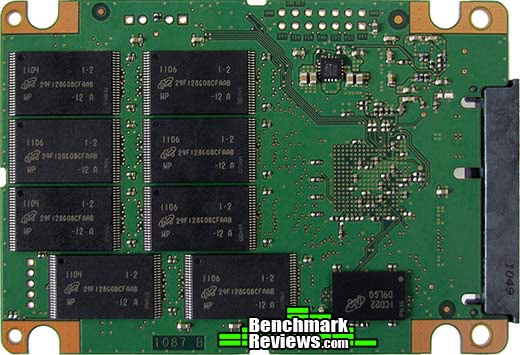
Marvell's solid state drive processor is joined by up to sixteen 25nm flash NAND flash memory arranged in an 8-channel design, and a single DRAM chip for buffered transactions. The Marvell 88SS9174 supports Native Command Queuing (NCQ) with 32 command slots. Similar to other modern SSD controllers, the Marvell 88SS9174-BLD2 processor was built to support native TRIM and Secure Erase commands. Additionally, the Self-Monitoring, Analysis, and Reporting Technology (SMART) command set is also supported. Bandwidth estimates for the Marvell 88SS9174-BLD2 SSD controller claim speeds up to 415 MB/s read-from and 260 MB/s write-to, however these are dependant on the flash-NAND and DRAM buffer used.

Our Marvell test sample was pulled from a Crucial m4/Micron RealSSD C400 SSD. Since Crucial is a Micron brand, it's not surprising to see Micron NAND used in their solid state drive. The flash NAND used on the 256GB CT256M4SSD2/MTFDDAC256MAM-1K1 model are built with 25-nanometer technology and utilizes Micron's high-speed ONFI 2.1 NAND interface for 166 MT/s with 512-byte industry standard sector size. Each 32GB Micron 29F128G08CFAAB MLC NAND module requires 3.3V, and yields a total NTFS formatted capacity of 223 GB in Windows 7.
In addition to Marvell 88SS9174-BKK2/BLD2 SSDs, this same 25nm Micron MLC NAND flash component is used on SandForce SF-2200 series SSDs such as the OCZ Vertex 3.
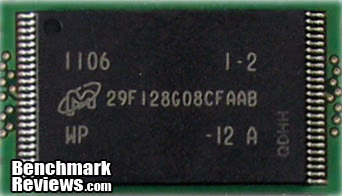
The ONFI 2.1 specification pushes NAND performance levels into a new performance range: 166 MB/s to 200 MB/s. This new specification is the first NAND specification to specifically address the performance needs of solid-state drives to offer faster data transfer rates in combination with other technologies such as SATA 6Gb/s, USB 3.0 and PCI Express Gen2.
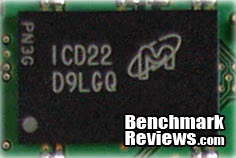
After the SSD processor and NAND flash, all that remains is the DRAM buffer. While other 256GB Marvell-based storage devices such as the Intel SSD 510 and Corsair Performance 3 receive only a 128MB cache transaction buffer, the Crucial m4/Micron RealSSD C400 and Strontium SSD Matrix each get the benefit of a 256MB DRAM module. Micron's 256MB DDR DRAM module (ICD22-D9LGQ) offers decent cache performance for fast transaction buffering, which will become more important as SATA 6Gb/s transfers are observed.
Crucial m4 Solid State Drive
The solid state drive (SSD) industry is quickly gaining popularity because the technology works equally well in PC, Linux, and Apple Macintosh computers. Likewise, these storage devices are installed into desktop and notebook platforms without modification. For this article Benchmark Reviews is testing the 256GB Crucial m5 SSD, which is advertised to reach speeds of 415 MB/s for sequential reads and 260 MB/s sequential writes. Crucial's performance specification suggest Iometer random 4K reads at up to 40,000 IOPS and 50,000 write IOPS, for a total combined performance of 90,000 IOPS. The CT256M4SSD2 model we've received for testing is built using the Marvell 88SS9174-BLD2 SSD controller, very similar to the previous generation.
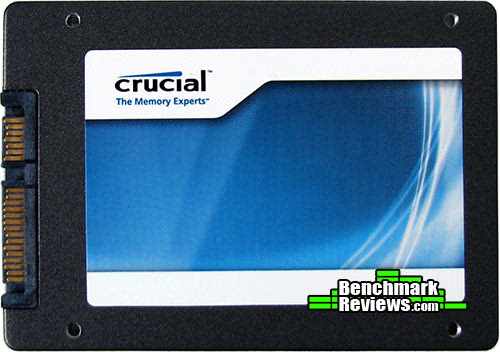
The Crucial m4 SSD is best suited for performance-orientated personal computers, but also works extremely well for SOHO computer systems. If required, the Crucial m4 SSD could also be utilized for mission-critical backup systems. Marvell SATA 6Gb/s SSDs have generally been designed with a focus on high-performance operational and data transfer speeds, so they also make the ideal storage solution for performance-orientated computers. Although Crucial m4 SSDs do not offer an integrated USB Mini-B port, which appeared on some early-generation SSDs, the retail market offers several different 2.5" SATA enclosures that utilize the SuperSpeed USB-3.0 standard for high-performance portable file transfers.
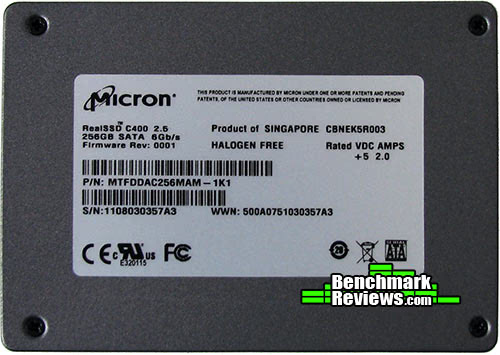
Crucial understands that once installed, the SSD will be hidden away from view inside your notebook computer or desktop workstation, so they've remained conservative towards the appearance of their solid state drive. Both halves of the enclosure are given a gun-metal textured finish, which does not show fingerprints or smudges like a gloss surface would. A glossy label is attached to the top of the enclosure, denoting model and capacity.
Standard 2.5" drive bay mounting points are pre-drilled and threaded into the Crucial m4 chassis, which allows for quick upgrade or addition into any existing notebook and other compact computer system. Fortunately, Crucial also includes a 3.5" to 2.5" tray adapter with their retail m4 SSD kit, so the drive will easily install into desktop computers. The mounting positions matched up to the drive bracket on my notebook computer, and after only a few minutes I was booting from a restored Windows 7 System Image without a hitch.

If you're already familiar with previous generation Crucial RealSSD C300 storage product, you'll notice that the new m4/C400 hasn't changed its look beyond the product decal. While its outward appearance is similar to many other solid state drives, the functionality and value packaged inside are considerably unique. Now that you're acquainted with the basic exterior features of this SSD, it's time to see how well it performs...
AS-SSD Benchmark
Beginning with sequential read and write performance, the 256GB Crucial m4 SSD CT256M4SSD2 produced 402.21 MB/s read speed, and 263.46 MB/s write performance. This compares well against the new SandForce SF-2281 controller on the OCZ Vertex 3, which produced 505.67 MB/s read speed, and 282.84 MB/s write performance
Single-threaded 4K IOPS performance delivers 19.73 MB/s read and 57.70 MB/s write, nearly matching the OCZ Vertex 3 with 21.69 MB/s read and 61.58 MB/s write. The 64-thread 4K reads recorded 158.24 MB/s and 211.48 MB/s writes, compared to 164.88 MB/s and 221.39 MB/s for the OCZ Vertex 3.

ATTO Disk Benchmark
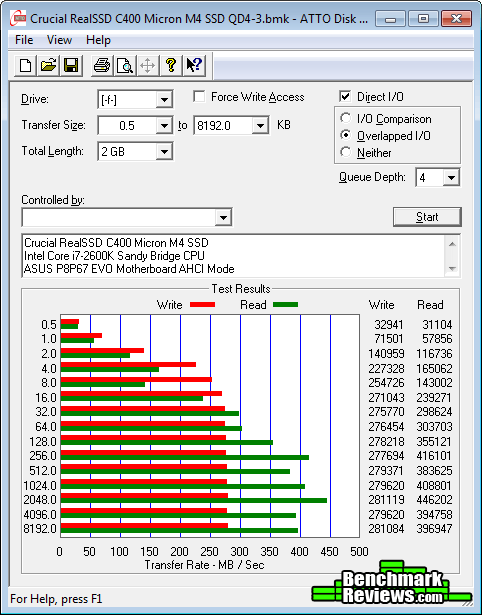
Our basic bandwidth speed tests begin with the Crucial m4 SSD attached to the Intel SATA 6Gb/s controller operating in AHCI mode. Using the ATTO Disk Benchmark tool, the test drive performs file transfers ranging from 0.5 KB to 8192 KB. The CT256M4SSD2 model we received reveals 446 MB/s maximum read speed that plateaus from 128-8192 KB file chunks, and 281 MB/s peak write bandwidth plateaus from 8-8192 KB. These both exceed Marvell specification, and meet manufacturer specification.
CrystalDiskMark 3.0 Tests
Each of our tests with the Crucial m4 SSD were consistent, and the best results obtained were used in the chart below. Sequential tests on this Marvell solid state drive produced a maximum read speed of 410.0 MB/s while the write speed was 277.0 MB/s, compared to 500.6 and 300.5 MB/s for the OCZ Vertex 3.
CrystalDiskMark 3.0 reported 512K results of 329.9 MB/s read and 276.9 MB/s write performance, which compares to 440.0 MB/s read and 295.6 MB/s write for the SandForce SF-2281 SSD. 4K tests produced 21.68 MB/s read and 68.94 write performance, while the OCZ Vertex 3 produced 33.33 MB/s reads and 80.11 writes.

Based on our tests, it seems that performance emphasis has switched read and write priority when compared to the previous RealSSD C300 series. The new Crucial m4 SSD stands strong all on its own, but it's too soon to tell how well these minor tweaks appeal to consumers. Compared head-to-head, SandForce 2200 SSDs appear to offer better performance than Marvell 88SS9174 revisions, which could make it difficult for the Crucial m4/Micron RealSSD C400, as well as Strontium SSD Matrix, Intel SSD 510, Corsair Performance 3, and others to thrive.
For the Crucial m4 SSD to succeed it must be aggressively priced against the competition, but the five-year warranty certainly sweetens the deal. The complete Crucial m4 Solid State Drive review is goes into more detail on these points. Micron officially launched the Crucial m4 SSD on 26 April 2011, offering the following capacities: 64GB Model $150, 128GB Model $260, 256GB Model $520, 512GB Model $1000.
Benchmark Reviews invites you to leave constructive feedback below, or ask questions in our Discussion Forum.