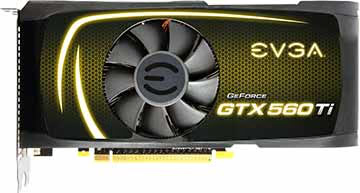
It's been nearly a decade since NVIDIA last used the Titanium moniker on one of their product, and for those who can still recall how the GeForce 4 series was revision of the previous series the new GeForce GTX 560 Ti will make perfect sense. Replacing the GeForce GTX 470 video card in the current product stack, NVIDIA's GeForce GTX 560 Ti uses a tuned GF114 GPU that finally delivers a full GF104 Fermi architecture. The original GF104 GPU offered seven of eight possible Streaming Multiprocessors (SM) with the GeForce GTX 460 video card, and now NVIDIA returns to enable that last SM to make even more cores available to GF114, now 384 compared to 336. Keeping with tradition, the GeForce GTX 560 Ti uses an identical SM configuration as the GeForce GTX 460. Each SM still offers 48 CUDA cores, four dispatch units, and eight texture/special function units. Besides including the eighth and final SM on the GPU, what's different is the myriad of transistor-level changes to improve power efficiency and in turn allowed for significantly faster clock speeds. In this article, Benchmark Reviews tests the EVGA GeForce GTX 560 Ti (model 01G-P3-1561-AR) against an entire market of graphics card options.

|
|
The ASUS P8P67 EVO is an EVOlutionary leap over previous motherboards, and introduces several new features such as the long-awaited UEFI to replace the traditional BIOS, Digi+VRM digital power management, Bluetooth remote overclocking control, and ASUS HyperDuo technology that combines a HDD with SSD to create a hybrid storage drive. Despite its many new features, the ASUS P8P67 EVO motherboard is only one half of the equation. Designed as the performance platform for mainstream enthusiasts, the P67 series unlocks and multiplies performance with Intel Core-i3/i5/i7 'Sandy Bridge' processors. In this article, Benchmark Reviews will explore the ASUS P8P67 EVO motherboard and test its overclocking limits with the unlocked Sandy Bridge Intel Core i7-2600K CPU.

|
|
In the wake of the HD 6900 series debut last month, the Barts GPU and its place in the product line finally makes perfect sense. The Cypress chip, as used on the Radeon HD 5830 with 334 square millimeters of silicon, is way too big for just 1120 shaders and 16 ROPS. The new Barts GPU uses just 255 mm2 to do the same job only better, thanks to twice the number of ROPs as the 5830. Although TSMC denied AMD the opportunity to roll out 32nm-based chips for this product cycle, they went back to the drawing board and optimized this new generation of GPUs for the current 40nm manufacturing process. AMD did a better job of reading the rule book last time, and their first full line of 40nm GPUs dominated the graphics market for a full 6 months. AMD has now successfully inserted an additional class of GPU (as defined by die size), to fill the performance gap that existed in the Radeon HD 5000 series. You may have seen some benchmarks already for some reference HD 6870 cards, but please follow along with Benchmark Reviews as we take a complete look, inside and out, at the PowerColor PCS+ HD6870 1GB GDDR5 graphics card.

|
|
It's been nearly a decade since NVIDIA last used the Titanium moniker on one of their product, and for those who can still recall how the GeForce 4 series was revision of the previous series the new GeForce GTX 560 Ti will make perfect sense. Replacing the GeForce GTX 470 video card in the current product stack, NVIDIA's GeForce GTX 560 Ti uses a tuned GF114 GPU that finally delivers a full GF104 Fermi architecture. The original GF104 GPU offered seven of eight possible Streaming Multiprocessors (SM) with the GeForce GTX 460 video card, and now NVIDIA returns to enable that last SM to make even more cores available to GF114, now 384 compared to 336. Keeping with tradition, the GeForce GTX 560 Ti uses an identical SM configuration as the GeForce GTX 460. Each SM still offers 48 CUDA cores, four dispatch units, and eight texture/special function units. Besides including the eighth and final SM on the GPU, what's different is the myriad of transistor-level changes to improve power efficiency and in turn allowed for significantly faster clock speeds. In this article, Benchmark Reviews tests the GeForce GTX 560 Ti against an entire market of graphics card options...

|
|
World Ranked overclockers from North America and Latin America have assembled to compete using Intel's high-end X58 platform and NVIDIA GeForce GTX 580 GPU for a seat at the global final in Taipei, Taiwan. This MOA event was timed to coincide with the 2011 Consumer Electronics Show in Las Vegas, Nevada, the MSI Master Overclocking Arena was set to determine the finalists for the Americas region. Staged at the popular Pole Position Raceway near the Palms hotel, contestants were challenged to produce the best CPU and GPU performance results using identical hardware. The CPU portion of the event used Super-Pi performance results to determine the winner, while the graphics segment consisted of GPU benchmarks using 3dMark 2011.

|
|
Here at Benchmark Reviews we know that with the turbulent financial markets the way they are these days having a high quality product that can draw customers in and keep them coming back for more is essential. Mionix is a relatively new company that is hoping to make their mark on the computer gaming world. This Swedish company knows how to make a good mouse. The Naos 3200 is affordable, durable, and so comfortable you'll have to use it to believe. Keep reading to see what this gaming mouse can bring to your table.
|
|
The New Year is starting off well for the computer hardware industry. Intel is releasing the long-awaited Sandy Bridge platform and AMD is filling in more of the Phenom-II and Athlon-II series. The two AMD CPUs set for release in early January 2011 are the Phenom-II X4-840 and the Phenom-II X4-975BE. The Phenom-II X4-840 HDX840WFGMBOX is the latest budget quad-core processor released by AMD. Set for release at an MSRP of only $102, the Phenom-II X4-840 could be a very affordable quad-core processor that brings a high level of performance to your computer without breaking the bank. In this article, Benchmark Reviews will help you decide if you want to spend some of your holiday cash on the new Phenom-II X4-840 CPU.

|
|
One of the processors in Intel's Sandy Bridge line-up that is being released in early January 2011 is the Intel Core i5-2500K. Intel is calling Sandy Bridge the 2nd Generation of Intel Core Processors. That also happens to be the significance of the 2 in the name of the Core i5-2500K. Sandy Bridge has promised to bring a lot of new ideas and technologies to the computer hardware industry, including improved media and gaming performance. The Intel Core i5-2500K is a quad-core, non-hyper-threaded, 3.3GHz processor equipped with the latest version of Intel's Turbo Boost. Set to be priced at $205 dollars, the Intel Core i5-2500K competes directly with the top end AMD Phenom-II X4 processors in price. In this article, Benchmark Reviews is bringing you the scoop on the Intel Core i5-2500K, including its performance against AMD's newest flagship quad-core, the Phenom-II X4-975BE.

|
|
The International Consumer Electronics Show is a virtual utopia for the gadget geek. At the 2011 CES unveiling event where industry leaders offer an early look at their product showcase, Benchmark Reviews was live on the scene snooping out details and revealing the upcoming product line. Our first stop is MSI, otherwise known as MicroStar International. For those that don't already know, MSI specializes in making military-grade desktop motherboard hardware for dead-serious hardcore enthusiasts... as in record-setting Liquid Nitrogen sub-zero cooling serious. MSI commits to this charge with events like the upcoming MSI Master Overclocking Arena 2011 competition, but now that we've entered the age of Intel's Sandy Bridge platform everyone is wondering what they'll offer next...

|
|
|
<< Start < Previous 41 42 43 44 45 46 47 48 49 50 Next > End >>
|
| Results 397 - 405 of 1033 |