
GlacialPower GP-PS550BP Real Power 550W ATX PSU
Introduction
Some of the players in the power supply industry have made a big name for themselves with a product line full of sparkle, or ultra glamorous design. Others take a different approach and offer the best product they can design at the best price possible. GlacialPower is such a company, and Benchmark Reviews was fortunate enough to shine the light on their GP-PS550BP Real Power 550W Power Supply Unit with series of ripple and regulation tests.
Benchmark Reviews has seen some major changes within the power supply industry over the past year. Even in such a limited purpose industry, somehow fads manage to come into existence. At one point, the number of rails a PSU offered was key to media hype. At another point, you could see everyone pushing for the highest watts in their new product. I can't forget how modular power supplies, with the assortment of cables and interfaces, also shared some time in the limelight.

The latest trend seemed to be 80-Plus efficiency, but since most PSU's are at least this efficient the label has lost meaning. And then without any warning, it was as if every company manufacturing power supply units suddenly decided that they could win the battle for industry dominance by combining all of the above features, and add a nice paint job or mirror finish for good measure. Not this time. GlacialPower keeps it real with some basic features and a modest price.
By now you should know that the power supply unit is the single most important part of any computer. Regardless of the system or purpose there is a given rule: whether it is a simple workstation with integrated components or an advanced gaming system with newest technology available, everything requires power to operate. As anyone who has suffered the failure of a low-end power supply will tell you: not all power supply units (PSU's) are created equal, and looks don't mean a thing. But being able to afford a flashy PSU is not something everyone can do, which is why GlacialPower offers an excellent value in the GP-PS550BP Real Power 550W PSU.
About the company: GlacialPower, Inc.
GlacialPower Inc. was established in April 2006 by a talent engineering team from the Switch Mode Power Supply (SMPS) Industry. The team members of GlacialPower has averagely 12 years rich experience in designing, quality controlling and manufacturing SMPS products. During past years the team designed for A brand companies of Acer, Asus, Cisco, Dell, Fujitsu-Siemens, Gateway, HPQ, IBM, LG Electronics, Microsoft, Samsung, Sony, Toshiba and Wistron. The team also invented the solid quality control manufacturing process approved by companies of Dell, HPQ, IBM, etc.
The company goal is to be one of the leading SMPS solution provider in the world and will use solid design to deliver quality products that possess the features of innovation and usability for customers. We will work closely together with our customer and our slogan is Power Your Idea.
Safety Features
-
UL 60950 Edition - CAN / CSA - C22.2 - 60950 - 00
-
EN60 950 Edition
-
IEC60 950 Edition (CB Report to include all national deviations)
-
EU Low Voltage Directive (73 / 23 / EEC) (CE Compliance)
-
GB4943-90 CCIB (China)
Specifications
| DC OutPut |
+5V
|
+3.3V
|
+12V1
|
+12V2
|
-12V
|
+5Vsb
|
|---|---|---|---|---|---|---|
| Nominal Output Voltage (V) |
5
|
3.3
|
12
|
12
|
-12
|
5
|
| Min. Current (A) |
0.3
|
0.3
|
0.5
|
0.5
|
0
|
0
|
| Max. Current (A) |
25
|
25
|
18
|
18
|
0.6
|
3
|
| Peak Current (A) |
19
|
19
|
3.5
|
|||
| Max. Power (W) |
125
|
82.5
|
216
|
216
|
7.2
|
15
|
| Combined Max. Power (W) |
130
|
400
|
7.2
|
15
|
||
| Total Max. Output Power (W) |
550
|
|||||
Closer Look: GlacialPower GP-PS550BP
Since the mission of GlacialPower is to supply top-quality switching mode power supply products for OEM's such as Acer, Gateway, IBM, Sony, and Toshiba, it didn't surprise me at all when I first saw how bare and basic the GP-PS550BP Real Power 550W ATX PSU appeared once it was out of the box.
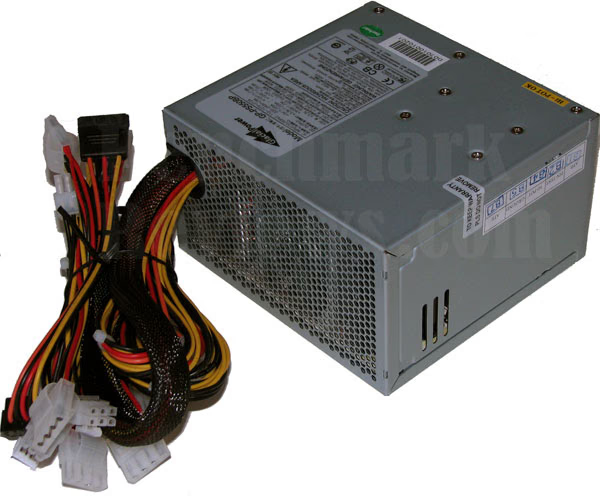
Since most OEM manufacturers are critical of production costs, especially Dell, HP, Sony, and Gateway, GlacialPower utilizes an unpainted and unfinished steel chassis on GP-PS550BP 550W ATX PSU. The honeycomb intake grill is among the most modern design features on the GP-PS550BP.
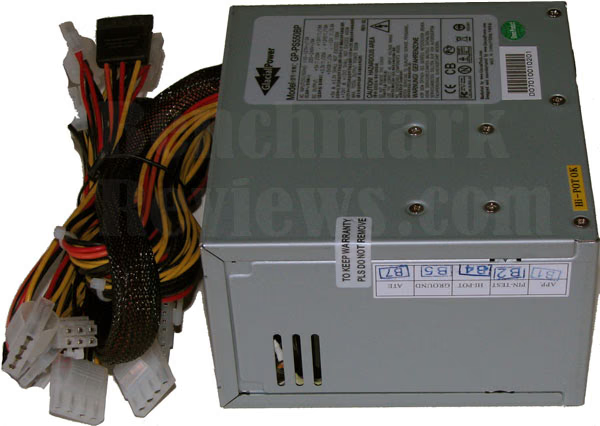
At the sides of the chassis are three very small vent openings, which assist the cooling fan in supplying air over the internal electronics. Certainly not most efficient design, but most likely the easiest to produce.
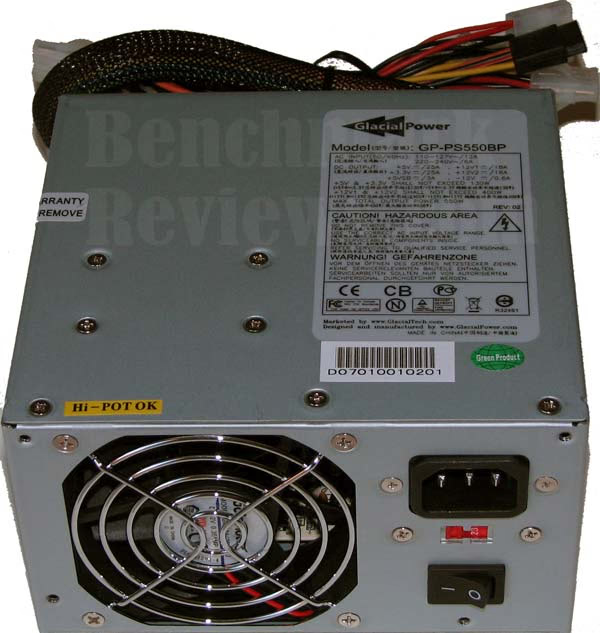
A single 80mm cooling fan forces heated air out through the rear of the chassis and past a chrome safety grill. The power connector and switch are industry standard parts, made of black plastic.
Since most PSU's now offer active power factor correction as a basic feature, it is rare to find a product that still uses the input voltage switch. There was a brief delay with this review when I first received the GlacialPower GP-PS550BP 550W ATX PSU because of the input voltage switch. As you can see from the image above, this unit shipped with the input voltage moved to the 230V selection. In eight years of system building, this was the first time I had ever received a PSU with the input set to anything other than 115V, so you might understand my confusion when the test system would start but not enter POST.

Unlike most other power supply manufacturers, GlacialPower has not designed the Real Power 550W ATX PSU with oversized cooling fans or an extremely ventilated chassis. Additionally, a chromed chassis or fancy paint job was not an option, since cost is key for OEM's. This could translate into a 550W PSU sold at a tremendously low price point for consumers; so long as performance is adequate.
Details: GlacialPower GP-PS550BP
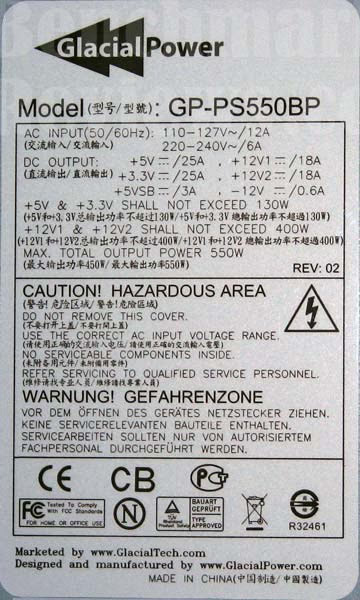
From the top view, the GlacialPower GP-PS550BP 550W ATX PSU offers very little information. Normally a decal illustrating the power rail output and maximum amperage per rail would be attached to the side of the chassis, but in the case of the humble GP-PS550BP it is replaced with modest text with warnings and certification stamps.
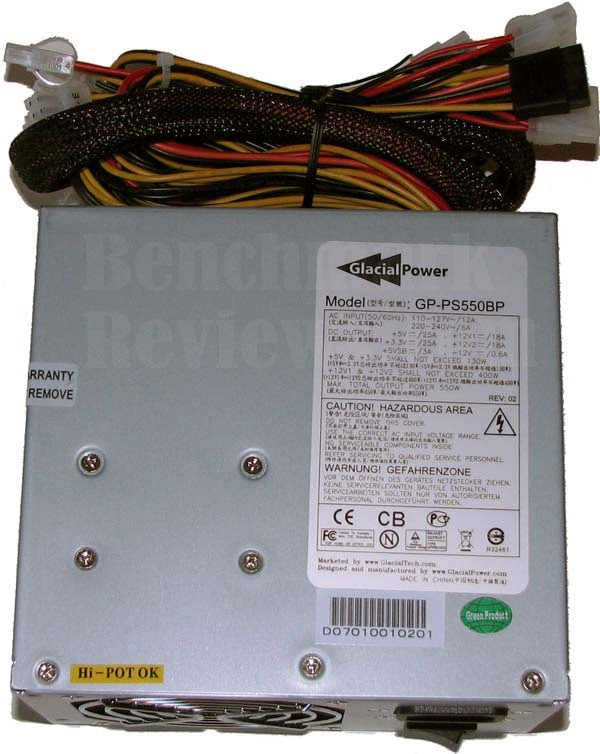
Take note, however, that GlacialPower proudly displays the "Green Product" label, which is the only real deviation from gunship gray out side of a quality control sticker. So far, the exterior design has been strictly the essentials, with little or no improvements in the appearance.
Closer Look: Adapters and Connectors
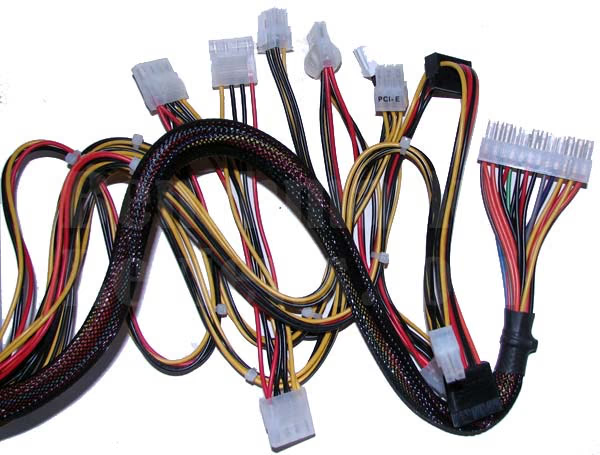
The GP-PS550BP uses a nylon sleeve over the primary ATX main power group, but otherwise the power connector wires are simply zip-tied over six inches. The Real Power 550W PSU uses a combination of connector colors: black plastic for SATA connectors, and clear (opaque) plastic connectors everywhere else.
A very simple black and white user manual accompany the power cord and mounting screws for the GlacialPower GP-PS550BP 550W ATX PSU.

Most of the consumers likely to purchase this product will probably require little more than stable power, since it appears that the focus is firmly set on function before fashion. In our testing section, we will see just how well that function performs, since the GlacialPower GP-PS550BP is absent of any detectable fashion.
Load Testing
Power supplies are not like most other computer components, where it is a simple matter of comparing the item to others in the same category. Power supply's are comprised of several different variables, such as maximum output, voltage regulation, and current ripple. Each of these variables must be analyzed with unique tools, which makes it a difficult product to properly review.
I am well aware of what the more knowledgeable readers think about these power supply reviews: impractical and often useless. That's about to change. In the past, Benchmark Reviews has been guilty of the same thing nearly all of the other sites are guilty of: testing with a digital multimeter alone. So beginning now with this review, we are taking a corrected approach to testing PSU's and hope to offer the best analysis possible.
Benchmark Reviews has researched the equipment necessary to complete the most thorough power supply unit review possible. We spent the time learning what it takes because the best possible PSU tests are what we want to give to our readers. But after discovering the prices on a programmable output DC power supply system, variable range load testing units, and a DC power analyzer (Oscilloscope), we felt that more than ten-thousand dollars worth of equipment would be far too cost prohibitive for testing a hundred-dollar power supply. So without compromising too much, we made a slightly less-expensive investment into a good quality Oscilloscope in order to test DC voltage regulation and AC power ripple. Together, the Oscilloscope and digital multimeter will offer readers the best measurement of power stability any review site could reasonably offer.
Test System
-
Motherboard: ABIT AB9 Pro v1.6 BIOS (Intel 965 chipset)
-
Processor: Intel E6600 Core 2 Duo 2.2GHz operating at 3.2 GHz (356 MHz FSB)
-
Memory: 2 GB (1,024 MB x2 modules) Crucial PC2-8500 CL5 Ballistix DDR2 RAM
-
Audio Device: HT Omega 7.1 C-Media 8788 Oxygen Chipset
-
Hard Disks: (2) Western Digital WD360GD 10,000 RPM SATA in RAID-0 array
-
Optical Drive: Lite-On SH-16A7S-05 SATA DVD R/W
-
Operating System: Windows XP Professional SP-2 with IE7
Test Equipment
-
Velleman PCSU-1000 Oscilloscope
-
DC Voltage Regulation Settings: 2V DC Volt/Division, 60MHz 1x, 1ms
-
AC Power Ripple Settings: 50mV Volt/Division, 60MHz 1x, 1ms
-
-
PC-Lab2000SE v3.03 Interface Software
-
Extech 450 Auto ranging Digital Multimeter
Test Methodology
Our testing process is comprised of measuring the AC current ripple, and the DC voltage regulation. There are several key steps, all of which allow us to measure and record our readings using the identical methods for every test we perform. Consistent testing methods are key to obtaining comparable results.
At the start of every test, the Velleman PCSU-1000 Oscilloscope is calibrated to the PC-Lab2000SE software. After calibration is complete, the voltage on the 12V rails are measured and recorded with the Extech 450 digital multimeter to ensure comparable margin across all rails. Once the Velleman 60MHz probe has been grounded and attached to the 12V lead, our test system is powered on and left at the Windows logon screen for ten minutes.
Once this lightly-loaded idle warm up period is complete, the Velleman PCSU-1000 Oscilloscope was allowed to run for one minute measuring the AC power ripple. Then once ripple is recorded, the 12V DC voltage regulation is recorded after another minute.
After the results have been recorded from the light idle load, our test system then receives heavy load by utilizing the following tools: two console versions of the Folding @ Home client operate and task each CPU core to 100%, hard disks are stressed by benchmarking each with HD Tach RW, system memory (RAM) is given a stress test with Lavalys EVEREST, and ATITool scans for artifacts which forced the video card into high-power 3D mode. After ten minutes of heavy load the power supply is again measured, and the AC power ripple and 12V DC voltage regulation results are recorded.
Voltage Regulation & Ripple Test Results
In the test results below, it will be necessary to explain what you are viewing. In each image the AC power ripple is represented by the yellow trace line making up the waveform. While every personal computer power supply unit available to the retail market has some degree of measurable AC power ripple, it is most important that measurable AC ripple is very minor and does not create a large peak to peak voltage (Vpp) distortion. Stable, well-regulated power is critical to system stability and hardware longevity.
AC Ripple at Light Idle Load

The waveform image above shows the AC power ripple under light idle load, which is measured inside of a 1ms recording frame. Waveform data recorded during the light idle load measurement is represented in the chart below:
AC Ripple Waveform Data at Light Idle Load

The waveform data above describes the actual measurements at light idle load. The maximum peak-to-peak AC voltage distortion was 287.5 mV, and the AC RMS ripple was 34.56 mV under light idle load. Note that these results are much worse than the average results we have collected under light idle load.
Here are the average AC RMS ripple measurements under light idle load for power supplies we have recently tested:
- 11.3 mV - Thermaltake W0133RU 1200W PSU
- 12.1 mV - Antec EA500 500W PSU
- 12.7 mV - Hiper HPU-4M730-SS 730W PSU
- 14.2 mV - Antec TPQ-850 850W PSU
- 16.1 mV - Ultra ULT33185 800W PSU
- 17.9 mV - ePower EP-1200P10 1200W PSU
- 19.4 mV - Hiper HPU-4K530-MS 530W PSU
- 20.0 mV - Apevia WIN-500PS 500W PSU
- 22.4 mV - OCZ OCZ780MXS 780W PSU
- 24.2 mV - Hiper HPU-4M880 880W PSU (Tested at 198W)
- 24.5 mV - Kingwin ABT-800MA1S 800W PSU (Tested at 198W)
- 24.5 mV - Hiper HPU-5B680 680W PSU (Tested at 207W)
- 24.9 mV - Mushkin HP-580AP 580W PSU
- 32.3 mV - Hiper HPU-5K880 880W PSU (Tested at 198W)
- 34.6 mV - GlacialTech GS-PS550BP 550W PSU
- 39.0 mV - Hiper HPU-4M630 630W PSU (Tested at 198W)
The waveform image below shows the AC power ripple under heavy load. The maximum peak-to-peak AC voltage distortion was 376.6 mV, and the AC RMS ripple was 48.87 mV under heavy load. Note that these results are slightly worse than the average results we have collected under heavy load.
AC Ripple at Heavy Load

Under heavy load, the GlacialPower GP-PS550BP 550W ATX PSU measured an average AC RMS ripple only slightly higher than the ripple at light idle load, yet both recorded less than desired measurements. The waveform data recorded during the heavy load measurement is represented in the chart below:
AC Ripple Waveform Data at Heavy Load

Because the GlacialPower GP-PS550BP 550W ATX PSU offered poor results in the idle readings, I was not surprised by the heavy load test results which were just as dissatisfying. Here are the average AC RMS ripple measurements under heavy load for other power supplies we have recently tested:
- 16.3 mV - Hiper HPU-4M730-SS 730W PSU
- 22.2 mV - Ultra ULT33185 800W PSU
- 23.9 mV - ePower EP-1200P10 1200W PSU
- 25.8 mV - Antec EA500 500W PSU
- 28.8 mV - Thermaltake W0133RU 1200W PSU
- 29.3 mV - OCZ OCZ780MXS 780W PSU
- 32.2 mV - Hiper HPU-5B680 680W PSU (Tested at 315W)
- 32.7 mV - Antec TPQ-850 850W PSU
- 36.2 mV - Hiper HPU-4M630 630W PSU (Tested at 306W)
- 36.9 mV - Hiper HPU-4M880 880W PSU (Tested at 306W)
- 37.7 mV - Hiper HPU-5K880 880W PSU (Tested at 306W)
- 48.9 mV - GlacialTech GS-PS550BP 550W PSU
- 61.0 mV - Mushkin HP-580AP 580W PSU
- 62.2 mV - Apevia WIN-500PS 500W PSU
- 64.4 mV - Kingwin ABT-800MA1S 800W PSU (Tested at 306W)
- 65.0 mV - Hiper HPU-4K530-MS 530W PSU
DC Voltage Regulation Waveform Data at Light Idle and Heavy Load


Many of the power supplies we test here at Benchmark Reviews have DC voltage regulation measuring above the 12V baseline more often than below. For obvious reasons, the diversion from the 12V baseline with increased voltage is more preferred than below it since dropping too far under 12V will cause a system to power off or recycle. Plainly put, no power supply is ever perfectly centered at 12V DC; instead they most often maintain a DC mean voltage higher than they are regulated at.
Final Thoughts
The best feature of the GlacialPower GP-PS550BP is certainly the value it offers price-critical consumers. The cosmetic appearance is completely absent of any attractive details, which shifts the balance towards function. However, even the performance testing revealed that the GlacialPower GP-PS550BP Real Power 550W PSU is not as stable as we would like under even the lightest load.
Because the power performance is really best suited for mid-range systems which would not particularly tax a 530W dual rail unit. But despite a very long list of glitz and glamour items, the HPU-4K530-MS Type R still does a very capable job of keeping stable power supplied to equipment; just don't go overboard.
Power regulation could have been better, but it is consistent with others we have tested in the same power range. With DC voltage regulation measuring 0.38 Vpp and AC ripple at 0.65 mV under load, the HPU-4K530-MS Type R is generated average results, especially within its rated output.
Conclusion
GlacialPower's product presentation was above the average, but once you get your hands on the GP-PS550BP the pretty pictures on the box escape your memory. It surprises me that a product destined for OEM use would even bother with a glossy retail package; especially if the contents were far from exciting.
The only positive attribute towards the GP-PS550BP appearance is the single ATX main cable sleeve. Other than this, the product is dull and colorless. To date, the only power supply we have seen that looked less attractive was Antec's EarthWatts EA500, which was nearly identical but lacked any cable sleeves.
GlacialPower is somewhat well known for their solid and reliable power supply units. Perhaps this is an old reputation which is outdated by the fact that their most powerful model is a 550W unit with less than stellar performance and poor efficiency. The construction found in the GlacialPower GP-PS550BP keeps a portion of this tradition intact, but it falls short of worthy since it's a well-built low-end PSU.
Rating the functionality would have been easier if the GlacialPower GP-PS550BP didn't score so poorly in every other category. The DC voltage regulation measured higher Vpp than desired during light idle and heavy load, and the AC ripple was considerably high under light load but became very high under heavy load.
The GP-PS550BP is not presently sold at any of the popular US-based online merchants, however a GlacialPower Tech marketing representative quoted me the MSRP of $34.99 USD. At this price, the value rating in off the scale; but you have to consider that you are truly getting exactly what you pay for.
If you have read this far into the article, you are not browsing Benchmark Reviews for your next OEM-level product; you are most likely after an improved after-market product which offers serious performance. The GlacialPower GP-PS550BP is not that product. It works well as a spare power supply for hardware enthusiasts, and could even offer a value-priced solution for IT technicians who carry stock on hand. However, the GlacialPower GP-PS550BP Real Power 550W ATX PSU is not recommended for anyone who requires more than a simple replacement for a medium-performance office workstation. Overclockers and Gamers should only pursue the GP-PS550BP when price is the most important factor.
Pros:
+ Very inexpensive
+ Superior product support
+ Fully-sleeved primary cable group
+ 400 Watts of 12V power
Cons:
- Much higher AC ripple than average
- DC Power regulation is much worse than average
- No cable group sleeves
- No protective end caps included
- Unattractive unfisihed steel case
- No active power factor correction
- Not 80 Plus efficient
- Cooling design could be improved
- No warranty available
- Lack of EPS 12V connector limits motherboard usage
Ratings:
-
Presentation: 8.25
-
Appearance: 7.0
-
Construction: 8.25
-
Functionality: 7.25
-
Value: 9.75
Final Score: 8.1 out of 10.
Questions? Comments? Benchmark Reviews really wants your feedback. We invite you to leave your remarks in our Discussion Forum.