
ASUS My Cinema EHD3-100 HDTV/FM Tuner
ASUS My Cinema-EHD3-100
The switch to digital television has finally come into action. Those who want to watch over the air TV at all must either purchase a TV with an ATSC tuner installed or purchase one of the signal conversion boxes for sale. For the HTPC crowd, it means that their tuner card must support ATSC just the same. Otherwise, their computer-based DVR systems will receive very little video anymore.
Though, because the ATSC specification is completely digital most cards out there are going to produce video results that are exactly the same, especially considering the signal and quality are more a factor of antenna reception than card quality. So, what's to make someone decide on one TV tuner over another?

The ASUS My Cinema-EHD3-100 answers this question by going one step further than most cards out there to be your all-in-one media center card. It fully supports the ATSC and QAM digital TV specifications allowing you to access digital TV in high definition resolution. It also fully supports analog NTSC TV, analog video and radio. Plus, its on-board mpeg-2 encoder chip helps on-the-fly video recording. Is the My Cinema-EHD3-100 your HTPC answer? Benchmark Reviews will fill you in!
About ASUSTek Computer, Inc.
ASUS is one of the most respected manufacturers of computer hardware of the industry, including video cards. Here is what they have to say about their commitment to quality:

"ASUS, a technology-oriented company blessed with one of the world's top R&D teams, is well known for high-quality and innovative technology. As a leading company in the new digital era, ASUS offers a complete product portfolio to compete in the new millennium.
In 2007, one in three desktop PCs sold was powered by an ASUS motherboard; and the company's 2007 revenues reached US$6.9 billion.
ASUS products' top quality stems from product development. It's like learning Chinese Kung-Fu; one must begin with cultivating the "Chi" and inner strength. Besides innovating cutting-edge features, ASUS engineers also pay special attention to EMI (electromagnetic interference), thermal, acoustics and details that usually go unnoticed to achieve complete customer satisfaction. ASUS notebooks are the first TCO'99-certified notebooks worldwide.
The requirements for this honor include radiation emission control, energy (battery consumption), ecology (environment friendly) and ergonomics. To succeed in this ultra-competitive industry, great products need to be complimented by speed-to-market, cost and service. That's why all 8,000 over employees of ASUS strive for the "ASUS Way of Total Quality Management" to offer the best quality without compromising cost and time-to-market while providing maximum value to all customers through world-class services.
With unyielding commitment to innovation and quality, ASUS won 2,568 awards in 2007, meaning on average, the company received over 7 awards every day last year. BusinessWeek has ranked ASUS amongst its InfoTech 100 for the 10th straight year; and the company is ranked as No.1 in quality products and services by the Wall Street Journal. ASUS has also achieved the number one title on the annual league table of Taiwan Top 10 Global Brands with a brand value of 11.96 billion US dollars."
ASUS My Cinema-EHD3-100 Features
The My Cinema-EHD3-100 supports the standard complement of digital TV standards, including 480i/p, 576 i/p, 720p60 and 1080i/p30. It also supports analog television input in both NTSC and PAL/SECAM standards. The card utilizes an NXP SAA7164E video codec chip, which supports dual channel processing and mpeg-2 encoding. ASUS advertises a 50% decrease in processing power between the My Cinema-EHD3-100 and video card with no hardware decoding.
The system requirements on the box include:
-
Pentium 4/AMD K7 processor
-
Minimum of 256mb of memory, 512mb recommended
-
A graphics card with 32mb or more of video memory is recommended
-
1 GB of free disk space
-
DirectX-compatible sound device
-
Microsoft Windows XP
-
DirectX 9 or above
-
Windows Media Player 9 or above
The ASUS My Cinema-EHD3-100 retails at Newegg for $119.99, which is significantly more expensive than a run-of-the-mill TV Tuner device, such as the ASUS MyCinema U3100 Mini, which was reviewed by Benchmark Reviews earlier this year. However, the increase in price includes a greater amount of kit as well as more features.
Testing Methodology
The My Cinema-EHD3-100 was tested with a regular bunny-ear styled antenna, a twin wire FM antenna and a video game console with an s-video connection. The tests were conducted on a desktop with the following specifications:
-
Intel Core 2 Quad Q8300
-
8GB (2GB x 4) DDR2 800 memory
-
EVGA GeForce 9600GT
-
Seagate 500 GB, 7200.11 RPM
-
Windows Vista Ultimate 64-bit w/ SP2
As I stated before in the review of the ASUS My Cinema U3100 Mini, the antenna is the most important aspect of television quality. Antenna quality is even more important with digital reception. In the days of yore, a weak signal would just be really snowy. There would be varying degrees of watchability and each person had their own threshold of acceptability with snowy pictures, but you'd at least receive a picture of some sort. With digital TV, you either have the signal or you don't. If you have the signal, the picture looks great and you're golden. If you don't have the signal, the picture will either show up as a blocky mess or just stutter and freeze.
You won't need to worry about an antenna if you plan on using your cable TV connection to receive QAM video. However, with the importance of antennas for over the air TV in mind, you should choose your antenna and place it wisely. The card has a standard RG6 RF connector on the back for your TV antenna or cable TV connection, so there's no adapters needed like many of the USB stick tuners require. By the same token, the My Cinema-EHD3-100 doesn't come with an antenna. An antenna is also required for listening to FM, but it's typically a lot easier to acquire good radio signals than TV signals.
Closer Look: My Cinema-EHD3-100
The My Cinema-EHD3-100 comes with a large kit of items. The box itself is bright orange with a nice glossy finish. There are ample descriptions of what is included in the box, what connections there are, included software and included accessories. There's a lot of information on the box, so no one will be left at a loss of what's included.

In the box, you'll find the card itself, with a standard ATX back plate attached. A separate slim back plate is also included. The back plates are attached with a pair of screws and are interchangable. A separate bracket is included that has expanded ports for analog video and audio input. A passive s-video to composite video adapter is included, in case the user cannot use the included bracket. A USB infrared receiver and remote is also included. A small set of instructions and an installer CD rounds out the package.
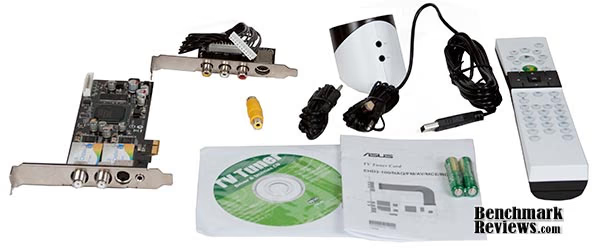
The My Cinema-EHD3-100 utilizes a newer PCI-Express (PCI-E) 1x form factor. Most new desktops come with at least one PCI-E slot and many come with multiple slots. Because this card is a 1x form factor, it's also able to fit in x4, x8 and x16 slots. The card's slim design and detachable back plate allow you to fit the card in a standard ATX case as well as a slim ATX case.

The back of the card has two antenna ports, one for television and one for FM radio, an s-video port and an analog stereo mini plug port. The expansion bracket includes another s-video port as well as a composite video port and a pair of stereo analog audio ports. It has a cable that connects into a plug in the rear corner of the main tuner card. The expansion bracket does not come with a slim backplate, so a user would only be able to fit the main card into their case.
The USB IR receiver has two ports on the back of the device that connect to long cables that have IR photodiodes. These photodiodes have double sided tape that allows you to place them on walls or other flat objects. The remote itself is non-branded. It has a fairly decent build quality and comes with a large collection of Media Center functions.

The instructions are, unfortunately, rather sparse with very little substantive information. It gives you a very brief rundown of the card's hardware and installing the software. Fortunately, the included CD comes with a PDF instruction manual that is a bit more expansive. The CD also contains Cyberlink TV Enhance, which is a Windows Media Center-styled software suite as well as ASUS VideoSecurity and ASUS GadgeTV.
Software
Installing the software from the CD is a snap. The ASUS My Cinema-EHD3-100 is compatible with Windows Media Center and the provided drivers make the card compatible with any other piece of software that is capable of utilizing video capture or TV. A GUI with menu options for installing the drivers for your OS, Cyberlink PowerCinema TV Enhance, ASUS VideoSecurity and ASUS GadgeTV are all represented with buttons that pop up the respective installers. TV Enhance is a Windows Media Center styled media suite with the ability to watch and record both TV and radio. ASUS GadgeTV is a plugin for the Windows Vista Sidebar and ASUS VideoSecurity is a suite for connecting CCTV cameras.

ASUS GadgeTV, right off the bat, didn't function well. It didn't interface with the Tuner card well and it would freeze from time to time. I wasn't able to get the program to actually function with a TV signal or play anything. Eventually, I had to give up on it.
ASUS VideoSecurity has an interesting and novel design where the software analyzes the video feed and records images when it sees movement of some sort. When it detects movement you also have the option of sending an e-mail or communicating via Skype. This feature works well if you're recording an area that expects no movement, such as an empty room during the day. However, the program is inadequate for security in any area that expects movement.

Cyberlink PowerCinema TV Enhance is the main draw of the software suite that comes with the ASUS My Cinema-EHD3-100. It takes full advantage of all the features of the tuner card. Its design is very similar to Windows Media Center and you'll get real time TV, radio and video capture abilities. OTA digital TV is recorded in a transport stream (ts) container with mpeg-2 video and AC3 audio. Radio audio can be recorded in Windows Media Audio format (wma) in 128kbps, 64kbps or 32kbps. Analog video is recorded in mpeg-2 with mpeg audio.
The recordings made from TV Enhance are pretty good and feature a decently high bitrate of around 2000-3000kbps, but video recordings from TV Enhance look blockier than video recorded from other TV programs, such as Windows Media Center. As a DVR, this poses no problem, but I wouldn't use TV Enhance to archive video. When recording video, Windows showed very low CPU usage, making it possible for much lower end computer systems to record video in real time.

The focus of TV Enhance is solely on the tuner card. For this reason, there's no organization software for music, movies or pictures. It works very well for watching TV and listening to the radio with a fairly simple interface that's easy to use. Unfortunately, analog video capture doesn't work as well. There's a significant delay between when the video is output from the device and when it appears on the screen. When you're watching a show from an analog source, it's not too large a problem as both the video and audio are in sync. However, the delay renders video games unplayable, requiring a suitable alternative.
Hardware
As noted many times, digital television is mostly dependent on signal quality. When I received a good signal, video quality was very good. There was no noticeable lag or dropped frames and only when the signal was dropped would problems occur. By virtue of being digital television, the video and audio both looked great at full resolution.
Analog capture quality, for the most part, was very good. There was no video interference or audio line noise. Composite video still suffered from dot crawl and rainbowing, but that's more a factor of the video transmission format than of the card itself. S-video separates the chrominance and luminance signals and maintains a greater amount of video fidelity. Sharpness and contrast were reasonably high, though video was still somewhat soft.

The ASUS My Cinema-EHD3-100 comes with an analog over the air TV tuner as well. Though, because of the transition to digital television, there weren't any analog TV stations that the reviewer could receive. It's important to note that the inclusion of an analog TV tuner isn't superfluous. Even after the conversion to digital TV, there are still many areas and TV stations that aren't required to change over to digital TV. For this reason, many people will still receive analog television.

The remote is designed with Windows Media Center and WMC styled suites in mind. As such, it contains a standard collection of buttons with standard functionality. The remote has a lot of functionality when using your media center suite of choice. The IR receiver does a particularly apt job of receiving the signal. In fact, I found that I needn't unravel the infrared receivers as the line of sight between the remote and receivers is pretty broad. The combo is much more reliable than the wireless radio remotes I've tried before. Unfortunately, the remote has little use outside of a media center environment as most of the buttons have little use in a regular Windows environment.
My Cinema Final Thoughts
The ASUS My Cinema-EHD3-100 is another entry into a sea of digital TV tuners that have been released in the past years. It separates itself from the general devices out there by packing as many features as possible into the kit. The PCI-E interface, high quality codec chip and multiple inputs makes this tuner to pull out ahead.
The inclusion of analog video support is a welcome addition, considering that most TV tuner devices are, by most standards, quite plain and featureless. An analog TV tuner is also good for those who still watch TV from analog sources. The remote and IR receiver round out the kit. They make it possible to transform your HTPC from merely a computer in a living room to a full featured media center.
However, the EHD3-100 kit is not cheap. At $119.99 at Newegg.com, it's more than 2 times more expensive than a plain digital TV tuner. The cost of an antenna, if needed, must be factored into the price as well. However, for the people who desire an all-in-one HTPC, this kit definitely comes through in spades.
ASUS EHD3-100 Conclusion
The ASUS My Cinema-EHD3-100 comes in very nice, attractive packaging that describes the product well. Unfortunately, the printed instructions are rather lackluster. The insutrctions included on the CD in pdf format are much nicer, though.
The card, itself, looks like any other card out there. The inclusion of a slim bracket allows it to fit in with the more attractive, small HTPC cases. The included remote and receiver have a very nice style that would fit in well with contemporary TV remotes.
The construction of the card feels where it ought to be, with hard PCB that shouldn't break or bend easily. The extension bracket is similarly strong. The remote is light and somewhat sturdy, but feels that it shouldn't be abused.
The card functions very well with both digital TV and analog video, showing no digital problems and low distortion in analog video. The included TV Enhance software works great with digital TV, but renders video games through analog video input unplayable.
The ASUS My Cinema-EHD3-100 is definitely the easiest way to transform your HTPC from just a computer into a full featured Media Center. The kit is full featured, providing much more than the typical digital TV tuner and comes with its own remote. At $119.99, it's not cheap, but it has a great value, considering it'd be expensive to purchase all of the same components separately.
Pros:
+ Comes with an FM Radio tuner
Cons:
- Analog video delay in included software makes video games unplayable
- GadgeTV software is non-operational and VideoSecurity software isn't particularly useful
- Media center remote doesn't have much use outside of media center software
- Media center software doesn't organize music and movies
Ratings:
-
Presentation: 8.50
-
Appearance: 8.75
-
Construction: 9.25
-
Functionality: 9.00
-
Value: 9.50
Final Score: 9.0 out of 10.
Questions? Comments? Benchmark Reviews really wants your feedback. We invite you to leave your remarks in our Discussion Forum.
Reader comments from the original article
1 comment were posted before commenting closed. They are preserved as written. Original avatars no longer resolve and are shown as a placeholder.
error de eliminacion conchita Permalink:
_Buenas tengo su hardware introducido en mi ordenador ya de inicio de compra y por error he borrado del sofware el archivo My cinema ¿ como lo puedo recuperar ? GRACIAS