
NVIDIA Tegra 650 Mobile Processor
NVIDIA Tegra Processor
NVIDIA has done very well for itself over the past decade. While most of the world can recognize the chip-maker for its popular GeForce product line, very few might realize that this green-machine also has focus outside of the graphics card industry. Like any company that has mastered its craft, NVIDIA set out to develop a competitive processor design that would change the face of mobile computing. Earlier this year NVIDIA announced that they were ready to product the APX 2500 application processor for a new line of handheld mobile Internet devices, but then very little actually materialized. Back with what might be considered a re-launch, NVIDIA launches the Tegra 650 and 600 mobile processors.

A few weeks ago at the NVIDIA Editors Day 2008, Benchmark Reviews was fortunate enough to meet with NVIDIA's mobile products staff and witness the Tegra processor in action. Using the APX 2500 processor in a mobile Internet device, we were able to see how a Smart Phone or portable media player could not only display full 720p content on its screen (or external display via HDMI interface), but is could also encode the very same media.
"Creating Tegra was a massive challenge. Our vision was to create a platform that will enable the 2nd personal computer revolution - which will be mobile centric, with devices that last days on a single charge, and yet has the web, high definition media, and computing experiences we've come to expect from our PC," said Jen-Hsun Huang, president and CEO at NVIDIA. "Shrinking down a 50 watt PC architecture will not create the discontinuity this industry needs. The culmination of nearly 1,000 man years of engineering, Tegra is a completely ground-up computer-on-a-chip architecture that consumes 100 times less power. Mobile internet and computing devices built with Tegra are going to be magical."
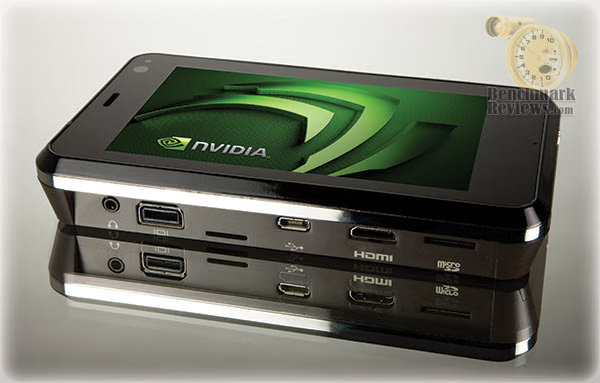
NVIDIA is building their mobile product offerings around the Windows Mobile 7 Operating System, which can offer a host of mobile compute applications to take full advantage of the Tegra 650 Mobile Processor. While the Tegra Processor is capable, you won't find any 3D video games running on a Tegra handheld device, which might disturb the ultra-conservative 2 Watts of power consumption.
About the Company: NVIDIA
NVIDIA (Nasdaq: NVDA) is the world leader in visual computing technologies and the inventor of the GPU, a high-performance processor which generates breathtaking, interactive graphics on workstations, personal computers, game consoles, and mobile devices. NVIDIA serves the entertainment and consumer market with its GeForce products, the professional design and visualization market with its Quadro products, and the high-performance computing market with its TeslaTM products. NVIDIA is headquartered in Santa Clara, Calif. and has offices throughout Asia, Europe, and the Americas.
NVIDIA Tegra Architecture
The NVIDIA Tegra 650 processor is the second product in the Tegra line, the first being the NVIDIA Tegra APX 2500 processor, which is enabling the next generation of Windows Mobile smartphones. With the launch of this new processor, the NVIDIA Tegra products will reach consumers towards the end of the year.
At first, the APX and CSX product lines were the plan, but NVIDIA later dropped the APX name to create the CSX, Tegra 600, and Tegra 650 descriptions. This might have a lot to do with how the Tegra operates, which more closely resembles a full system architecture on one single silicon chip. This might also have a lot to do with a new target: Intel's Atom processor.
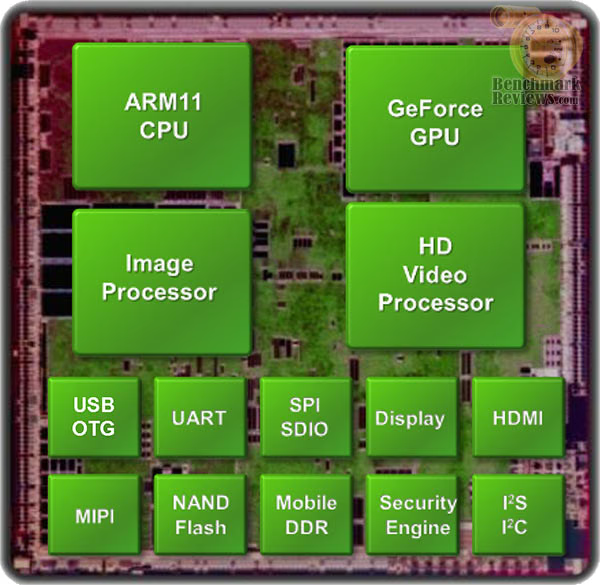
Depicted in the image above is the full reference design of the Tegra 650 processor. The four primary processors are joined by a host of support co-processors, which together form one of the most complete all-in-one processor packages designed. At the top of the architecture you'll find the ARM11 and GeForce processors, which work both compute and graphics requests fo the image and video processors.
The ARM11 MPCore multicore processor can be configured for implementations using between one and four processors. The unique scalability of the ARM11 MPCore processor provides device OEMs with the optimum level of performance for their application, while at the same time allowing each processor to go into standby, dormant or power-off energy management states to help control the level of dynamic and static energy consumed by the processor.
"With the growing market demand for mobile Internet access, NVIDIA launched the APX 2500 computer-on-a-chip targeted at smartphones and handsets earlier this year. Recognizing that mobile Internet access usages will occur not just on smartphones and handsets but on compute devices as well, NVIDIA announced today Tegra. Representing the first products to be targeted at the MID and portable device space, it is anticipated to bring integrated capabilities similar to the APX 2500 with NVIDIA's graphics expertise, an ARM core, HD video, and advanced power management," said Ian Lao, senior analyst at In-Stat.
|
APX 2500 |
TEGRA 600 |
TEGRA 650 |
|||
|---|---|---|---|---|---|
|
CPU Speed (MHz) |
600 |
700 |
800 |
||
|
Primary LCD max resolution |
FWVGA (854x480) |
SXGA (1280x1024) |
WSXGA+ (1680x1050) |
||
|
Video Decode (H.264, WMV9/VC-1) |
720p @ 30fps |
720p @ 30fps |
1080p@ 24fps |
||
|
Video Encode |
720p |
720p |
720p |
||
|
IDE Support |
No |
Yes |
Yes |
||
|
USB OTG |
Yes |
Yes |
Yes |
||
|
Memory Speed (MHz, LP-DDR) |
166 |
166 |
200 |
||
NVIDIA Tegra is a heterogeneous processor architecture with multiple processors, each architected for a specific class of tasks - an 800 MHz ARM CPU, a HD video processor, an imaging processor, an audio processor, and an ultra-low power GeForce GPU These processors are used together or independently to deliver a wonderful experience while utilizing a minute amount of power. With this heterogeneous ultra-low-power processor architecture, NVIDIA Tegra processors achieve up to 10 times the power efficiency of existing products in battery-operated computer systems running compelling visual computing applications.
NVIDIA Tegra 650 Features:
-
All-day media processing, for 130 hours audio, 30 hours HD video playback
-
HD image processing for advanced digital still camera and HD camcorder functions
-
Optimized hardware support for Web 2.0 applications for a true desktop-class internet experience
-
Display support for 1080p HDMI, WSXGA+ LCD and CRT, and NTSC/PAL TV-Out
-
Direct support for Wi-Fi, disk drives, keyboard, mouse, and other peripherals
-
A complete Board Support Package (BSP) to enable fast times to market for Windows Mobile-based designs
NVIDIA describes the on-chip GeForce GPU to offer fully programmable pixel shaders and OpenGL ES 2.0 support added to Microsoft's Direct3D Mobile. The Tegra processor receives its energy efficient characteristics from a smart architecture that joins the already-efficient processor to the lowest power-drain DDR SDRAM memory available which boast power consumption in low-mV figures.
Tegra 600/650 Applications
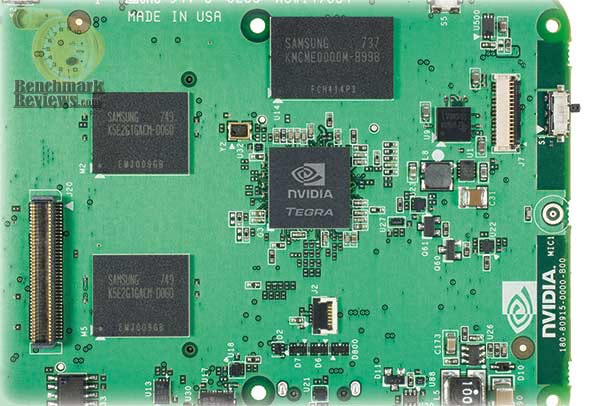
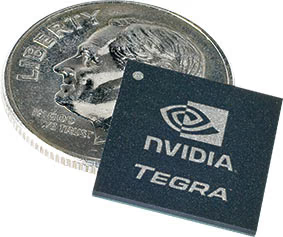
Compared to the collective 1250~1850 mm2 of surface space required for an Intel Atom platform, NVIDIA has reduced the footprint of their Tegra 600 and 650 processors to a minute 144mm2. Shown in the printed circuit board below, you can see how diminutive the Tegra processor is compared against the other IC components. Even the Samsung SDRAM modules appear larger! Ultimately, the combination-purpose chip architecture and meager power requirements will make for ultra-compact applications in a space 1/10 the size of Intel Atom platforms.
"As more consumers begin to access the mobile Internet with devices like smartphones and MIDs, device manufacturers will be challenged to create the same high-quality user experience on mobile devices that consumers currently enjoy on their desktop PCs," said Warren East, CEO, ARM. "Using advanced ARM technology and providing a ground-breaking mix of performance, power consumption and form factor, the NVIDIA Tegra mobile computer-on-a-chip addresses this challenge more effectively than any other solution yet on the market, thereby taking a major step toward the oncoming mobile Internet revolution."
Technology doesn't evolve, unlike I may have erroneously commented in previous articles. No, there isn't an unseen force that gradually develops the technology we see occupy shelf space at Best Buy or NewEgg. It takes creative thinking and a vision beyond single-purpose chips. NVIDIA has been pushing this concept in every level of their product development, and the Tegra 650 mobile processor is simply their latest example. Look for future NVIDIA processors to share the same energy efficient heritage, while multi-tasking in compute and graphics requests with equal effort.
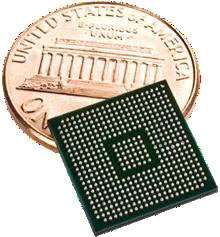
This all bodes well for the consumer. After all, it's in our human nature to want more product and performance for less cost. Presently most of the computer industry relies on portable computers to maintain productivity. Notebook and UMPC products are growing popular, but the Tegra makes the leap into handheld devices fully-capable of web browsing as much as they are for high-definition video playback. Added to this is the fact that one Tegra-equipped device can last an entire day on one small battery, and you can image how this technology will see itself spread to adjacent industries in very little time.
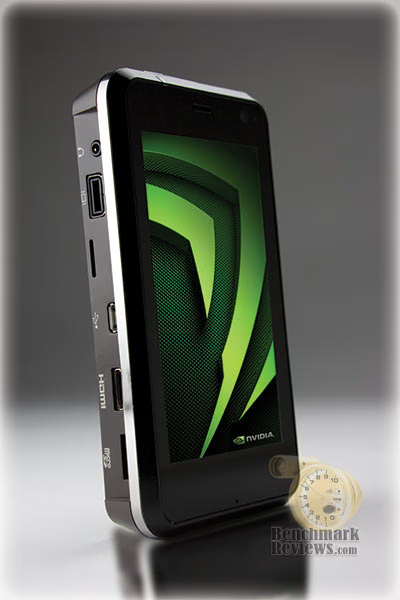
Like I said at the beginning, NVIDIA has done very well for itself. Because the Tegra is now the most advanced ultra-low power computer processor ever built, optimized smart phones and mobile Internet devices (MIDs) are just the beginning.
Questions? Comments? Benchmark Reviews really wants your feedback. We invite you to leave your remarks in our Discussion Forum.