
ASUS My Cinema-U3100Mini HDTV Tuner
ASUS My Cinema-U3100Mini
Come February 17, 2009, most major broadcast stations in the US will make the final switch from analog to digital broadcasts. This transition has been coming for a long time, ever since VCDs were introduced into the market over a decade ago. Digital video through ATSC provides the necessary efficiency to allow the same broadcasts while using less bandwidth than is already used in traditional analog broadcasts (Standard Definition, 480i) and also allows enhanced definition (ED, 480p) and high definition (HD, 720p and 1080i) content to be broadcast over the air.
This switch will affect the computer user two-fold. First of all, the analog video tuners that people bought long ago will not pick up broadcasts any longer. But, at the same time, it's a great opportunity for HTPC and media center builders to develop a digital TV recorder and viewer for their computers. The ASUS My Cinema U3100Mini steps into place as a portable digital TV viewer and recorder.
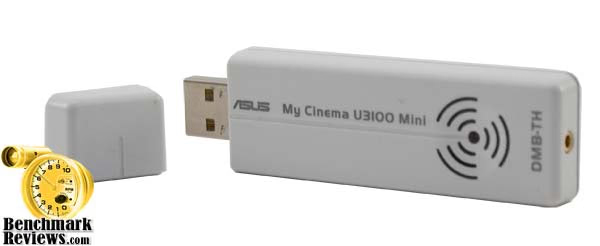
The U3100Mini is a USB 2.0 device that has the ability to accept both ATSC signals over the air as well as QAM signals through coaxial cable connections. It can display and record at all ATSC resolutions and frame rates. Does the ASUS My Cinema U3100 Mini deliver? Read on and find out.
About the company: ASUS
Asus is one of the most respected manufacturers of computer hardware of the industry, including video cards. Here is what they have to say about their commitment to quality:
"ASUS, a technology-oriented company blessed with one of the world's top R&D teams, is well known for high-quality and innovative technology. As a leading company in the new digital era, ASUS offers a complete product portfolio to compete in the new millennium.
In 2007, one in three desktop PCs sold was powered by an ASUS motherboard; and the company's 2007 revenues reached US$6.9 billion.

ASUS products' top quality stems from product development. It's like learning Chinese Kung-Fu; one must begin with cultivating the "Chi" and inner strength. asus_logo_blue_300px.pngBesides innovating cutting-edge features, ASUS engineers also pay special attention to EMI (electromagnetic interference), thermal, acoustics and details that usually go unnoticed to achieve complete customer satisfaction. ASUS notebooks are the first TCO'99-certified notebooks worldwide.
The requirements for this honor include radiation emission control, energy (battery consumption), ecology (environment friendly) and ergonomics. To succeed in this ultra-competitive industry, great products need to be complimented by speed-to-market, cost and service. That's why all 8,000 over employees of ASUS strive for the "ASUS Way of Total Quality Management" to offer the best quality without compromising cost and time-to-market while providing maximum value to all customers through world-class services.
With unyielding commitment to innovation and quality, ASUS won 2,568 awards in 2007, meaning on average, the company received over 7 awards every day last year. BusinessWeek has ranked ASUS amongst its InfoTech 100 for the 10th straight year; and the company is ranked as No.1 in quality products and services by the Wall Street Journal. ASUS has also achieved the number one title on the annual league table of Taiwan Top 10 Global Brands with a brand value of 11.96 billion US dollars."
Closer Look: ASUS My Cinema
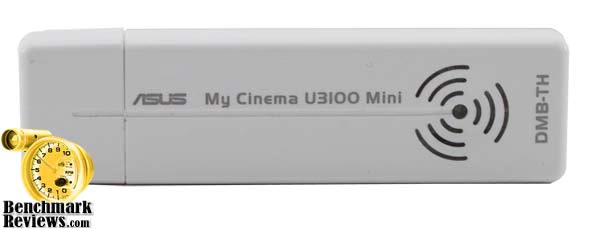
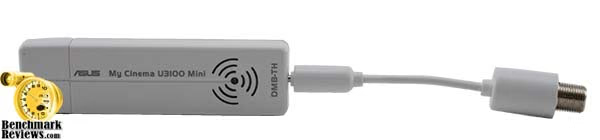
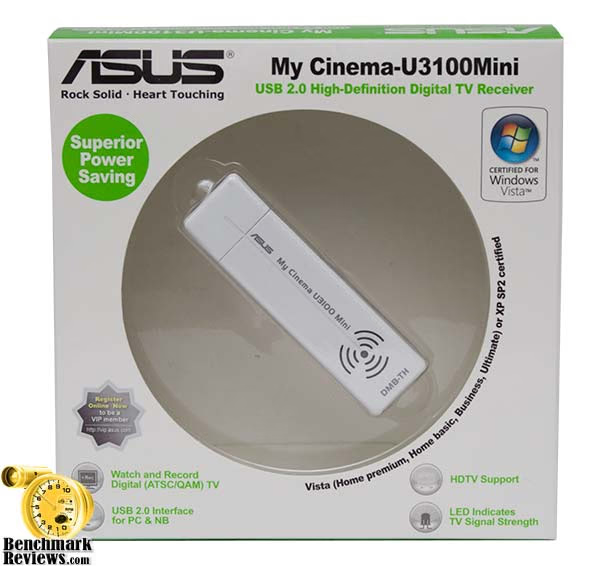
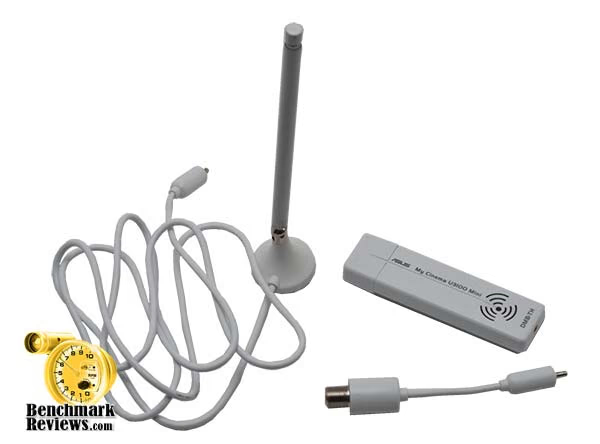
The ASUS My Cinema U3100Mini, at its core, is just a USB stick. The USB connector is covered by a magnetically attached piece. On the opposite side, a small port allows the connection for the TV input. The box set contains two connectors for the port: A small antenna and an adapter to a traditional coaxial port. The entire device is slightly heavier than a typical USB flash drive.
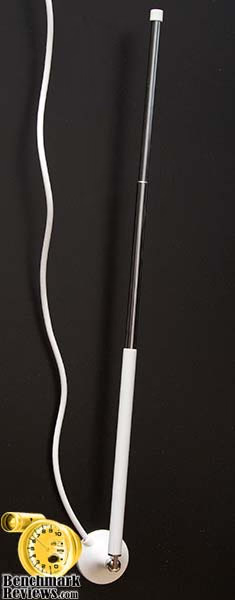
The antenna, itself, is telescopic and extends from 6" to a little over 12". The cable length is a little less than 5 feet long. The antenna has a magnetic base that for attaching either to computer cases or other metallic surfaces. The antenna can unscrew off of the magnetic base and can screw on to an included suction cup base.
When in use, a green LED light shines showing a consistent connection. When the antenna is not picking up a strong or consistent signal, the green light will flash. When not in use, the light turns off.
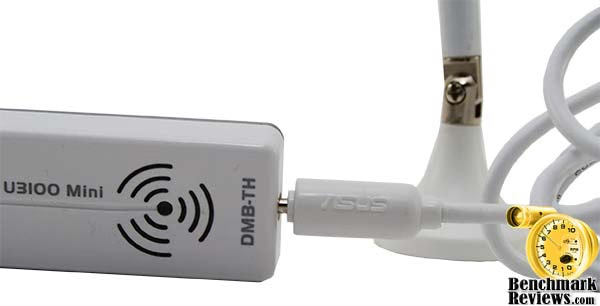
The coaxial connection has a wire that is about 1.5" long. The port allows a connection either to a larger antenna that you may already own or a cable connection for QAM reception.
The package also comes with two CDs a booklet and a card indicating that the TV adapter is compatible with the Eee PC. The CDs contain the drivers for the adapter as well as ArcSoft TotalMedia 3.5.
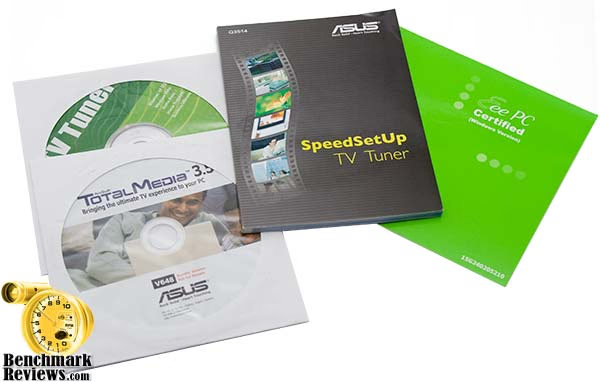
The included instruction booklet contains instructions in 15 languages. Unfortunately none apply directly to the Tuner itself. Instructions are available for download on ASUS's website for the My Cinema series which are a bit more descriptive, but are still for the entire series and don't offer much more information.
My Cinema U3100Mini Details
The ASUS My Cinema U3100Mini supports both ATSC and QAM. The test device I receive was labeled DMB-TH which is actually the Chinese digital TV standard, but my computers all saw the device as ATSC. A DVB version of the U3100Mini also exists for the European market as well.
The ASUS My Cinema U3100Mini supports the following resolutions and frame rates:
-
1080i
-
720p
-
480p
-
480i
-
576p
-
576i
-
60/59.97 fps
-
30/29.97fps
The system requirements listed for the device include:
-
Pentium 4, 2.6Ghz for PCs
-
Pentium M, 1.3Ghz for Netbooks
-
256mb for XP and 512mb for Vista
-
1GB of HDD space for XP and 15GB for Vista
-
Windows Media Player 9 or above
-
DirectX compatible audio
-
Core 2 Duo 2Gbz or higher is required for high definition TV
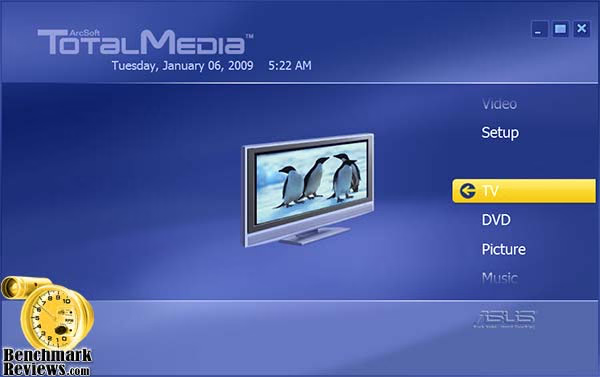
The ArcSoft TotalMedia software plays television through your television adapter as well as DVDs, photos, music, radio and videos (in WMV, MPG or AVI containers). The interface is reminiscent of Microsoft's Media Center software. Television is recorded at its original resolution and frame rate in an mpg container.
Testing & Results
I was curious to see what range of computers could use the ASUS My Cinema U3100Mini. The box states that a Pentium 4 2.6ghz is required for PCs and a Pentium M 1.3Ghz is required for Netbooks, but that a Core 2 Duo is required for high definition video. Most testing was conducted on my main computer, which contains these main specs:
-
Intel E8400 @ 3.0 Ghz
-
8GB (2GB x 4) DDR2 800
-
EVGA GeForce 9600GT
-
Seagate 500 GB HDD, 7200.11 RPM.
-
Windows Vista Ultimate 64-bit w/ SP1
I also tested this device on three other computers, a typical, low cost computer, a laptop and an HTPC using QAM. Their specs are as such:
-
Alternate Computer #1 (Laptop)
-
IBM T40 Laptop
-
Intel Pentium M 1.5Ghz (1GB + 512 MB)
-
1.5 GB DDR 400 memory
-
Mobile Radeon 7500
-
Seagate 120GB HDD, 5400 RPM
-
Windows XP Professional w/ SP3
-
Alternate Computer #2 (HTPC)
-
Athlon 64 X2 4200 (Socket 939)
-
2GB (512mb x 4) DDR 400
-
EVGA GeForce 7600GT
-
Seagate 250 GB HDD, 7200.10 RPM
-
Windows XP Professional w/ SP3
-
Alternate Computer #3 (Low Cost computer, Dell Vostro 200)
-
Intel Pentium Dual Core E2140
-
1GB (512mb x 2)
-
On-Board Intel G33/G31 video chipset
-
Generic 80 GB HDD, 7200 RPM
-
Windows XP Professional w/ SP3
The first thing I noticed, when testing the TV tuner out is that antenna adjustment and placement is of paramount import. Research on the matter indicates that the hierarchy of antennas would be to have an outdoor antenna and then to have an indoor antenna as a second choice. Indoor antenna reception is far more tenuous and larger designs are typically used (especially with telescopic poles like those in traditional rabbit ears).
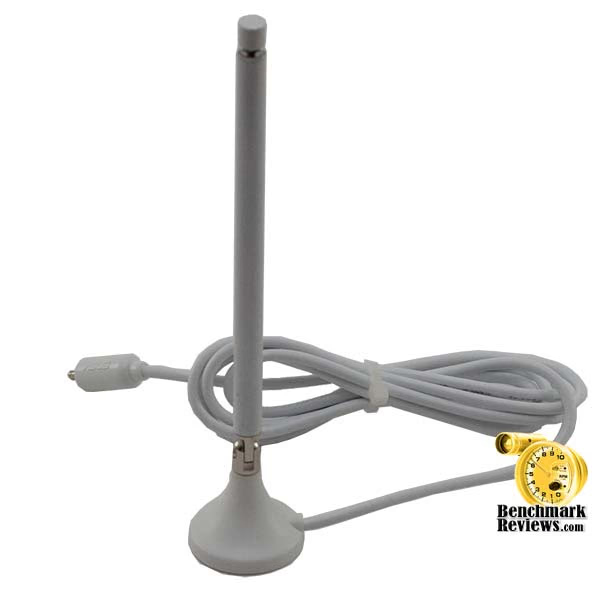
The included telescopic antenna that comes with the tuner is quite small, which makes it good for portability, but is not a great choice as a permanent fixture. The antenna tended to have somewhat weak reception. A larger antenna would work wonders for getting better reception. However, I was a little disappointed with the antenna connector on the tuner. It's a small plug that resembles that used by AC adapters, but its small size looks like it may be prone to breaking eventually.
When it comes to the digital signals and reception, you're not going to find the problems traditionally associated with TV reception. You're not going to have fuzzy or snowy reception with the audio going from clear to static over and over. Rather, when it comes to digital signals, you'll either have it or you will not. When you get weak reception, you'll find video drop outs (the video just stops or freezes) and sometimes video artifacts (color blocks, pixilation, etc). With an analog video signal, you could get away with small antenna in a non-optimal direction and still watch TV, albeit in a distorted fashion.
Digital TV requires an appropriate antenna be connected and pointing in an appropriate general direction to function, else the signal will not be received in its entirety. This, of course, is not a fault of the tuner itself, but more a function of digital TV as a whole. The trade off is that digital TV signals require far less bandwidth.
Testing & Results Part 2
The ArcSoft TotalMedia 3.5 software was used in testing the TV tuner. Setup with the U3100Mini and TotalMedia was fairly straight forward. The drivers came on a CD and were installed through a regular setup executable. The drivers are available on ASUS's website for XP, Vista 32-bit and 64-bit as well as Linux. TotalMedia was installed using a setup executable as well. Within TotalMedia, I'm presented with a full screen interface that is somewhat similar to Windows Media Center for Windows XP as well as the other media center applications. TV setup was also quite easy as it would scan for TV stations on its own, allowing you to choose which stations are selectable as well as previewing them.
Video quality was very nice in the software. TotalMedia allows for the user to record video at any time or they can create a recording schedule to record once, daily or weekly. Channel changing is available on the fly with previews shown in the bottom left hand corner. Television information is available either through the ATSC signal itself or through online sources. Switching audio or closed captioning sources was not particularly intuitive in the software.
The computer using the U3100mini needs to be powerful enough to play HD video. The U3100mini with the TotalMedia software performed just fine on the Core 2 Duo E8400 as well as the Athlon 64 X2 4200+ and Pentium Dual Core E2140 at HD resolutions. However, the Pentium M 1.5Ghz struggled with HD video. It would stutter and on 1080i sources, but seemed to play 720p sources somewhat competently. It played 480i and 480p sources just fine.
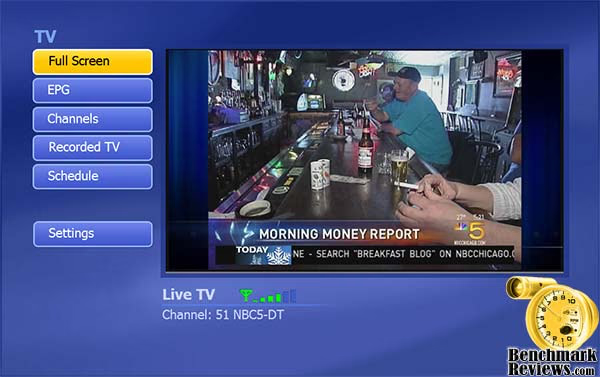
Video is recorded in an mpg container, typically containing mpeg-2 video and AC3 audio. The video appears to be intact with no transcoding (HD mpeg-2 video and AC3 audio would be very hardware intensive). Afterward, the video and audio can be converted to whichever format you want or watched as-is both through the TotalMedia software as well as through whichever media player you want.
HDTV Tuner Final Thoughts
The ASUS My Cinema U3100Mini is a very small and capable TV tuner for digital video. Considering the impending change to ATSC next month, such a device will be necessary for TV watching on your computer or a complete HTPC or computer DVR.
The device functions well on a computer that's fast enough, providing nice, clear digital video. Lower power computers can easily decode and watch SD material (480i/p and 576i/p), but will falter a bit on HD content. As such, it's important to check if the computer in question is able to decode HD mpeg-2 video in real time. I recommend finding a few HD mpeg-2 video clips (both 720p at 60fps or 1080i at 30fps) to determine if the computer in question is capable of displaying the video properly.
At $50-$60, it's at about the same price as its competition. I also liked the ArcSoft TotalMedia software that came with the tuner. However, there's a wealth of free and open source software available for use as well as Windows Media Center, which is included in Home versions of Vista. For the frequent TV watcher, the value of such a TV tuner is invaluable, especially considering the ease at which it can be used as a DVR. Its performance is quite good, but any user who wishes to use this on a computer and leave it in place must purchase and use a quality antenna with the device. The included antenna is decent for travel considering its size, but is not adequate enough for all channels.
Cinema-U3100Mini Conclusion
The ASUS My Cinema U3100Mini comes with everything that is needed for installation and use of digital TV broadcasts on your computer. However, the instruction manuals are quite lackluster. Fortunately, drivers are available for download for XP, Vista 32-bit and 64-bit and Linux.
The U3100Mini itself is a nice looking device sporting the all-white look that became popular as of late. The green light indicating activity turns on showing activity is a nice touch. Its low-profile size makes it easy to hide should the look or light be irrelevant to your TV watching.
The U3100Mini is slightly heavier than a typical USB flash drive. The antenna or coaxial input connects via a small plug that looks like an AC adapter tip. The small size looks like it can break easily, though it connects fairly snug.
The U3100Mini itself performed as it was supposed to as a ATSC and QAM tuner. Picture came in clearly with no real video defects or problems. The included antenna was rather lackluster providing subpar reception for many stations, necessitating a larger antenna.
The U3100Mini can be had for $50-$60 from various retailers, which puts it at about the same price as other USB ATSC/QAM TV tuner devices giving it a moderate value. As of July 2009, NewEgg lists the ASUS My Cinema-U3100Mini for $49.99. As an accessory for an HTPC, it's invaluable for the frequent TV watcher.
Pros:
+ Supports ATSC and QAM
+ Supports HDTV resolutions
+ Comes with ArcSoft TotalMedia 3.5
+ Comes with a miniature antenna and coaxial cable adapter
Cons:
- Miniature antenna has lackluster reception
- No other analog input (such as s-video, composite or component video)
Ratings:
-
Presentation: 8.00
-
Appearance: 8.50
-
Construction: 7.00
-
Functionality: 8.75
-
Value: 8.50
Final Score: 8.15 out of 10.
Questions? Comments? Benchmark Reviews really wants your feedback. We invite you to leave your remarks in our Discussion Forum.