
2010 CES: Computer Technology Highlights
I've been in the computer industry since the early 1980s, and attended trade shows throughout the years: from Computerworld in the 70s, though Comdex and MacWorld in the 80s, 90s, and early 2000s. I've wandered the aisles and done booth duty for both startups and established companies. But I've never seen anything like the Consumer Electronics Show.
CES is a vast and overwhelming panoply of products, with exhibitors ranging from tiny, two-man booths from unknown Taiwanese companies to 4+ acre spreads from Microsoft and Intel. In addition to exhibits in the Las Vegas Convention Center, vendors have invitation-only hospitality suites set up in various hotels around the Strip. With over 2,700 exhibitors from more than 140 countries, you're not going to see everything even if you spend every waking moment traipsing the show floor. What follows is a list of things which caught my eye, or that I thought were technically cool; it's in no way comprehensive, or even very organized, but should give you some idea of what the show was like.
The sheer scale of CES takes some getting used to. Its exhibitors are companies "...involved in the design, development, manufacturing, distribution and integration of audio, video, mobile electronics, wireless and landline communications, information technology, home networking, multimedia and accessory products", so there's a lot more (a LOT more) than just computer-related products. It's the longest-running show of its type, with the first CES being held in New York City in 1967! CES has served as the venue for the introduction of technologies such as Blu-Ray, the digital video recorder, high definition television, Microsoft's Xbox, and even the DVD.
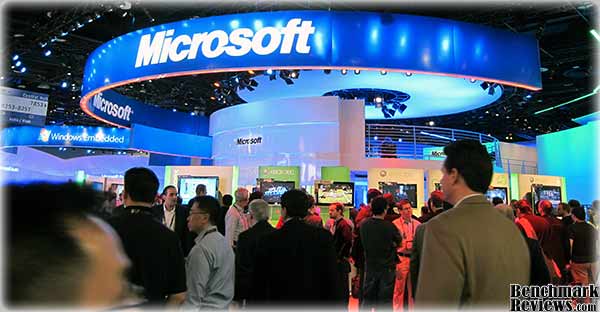
Unlike most other computer/technology shows, CES is not open to the public: you must be in the industry, a buyer (for an organization), or a member of the press. This makes the show noticeably different from most others, since the focus isn't on the individual consumer.
Benchmark Reviews has attended CES before; for a more detailed description of the sheer experience of attending the show, check out Benchmark Reviews Experiences 2008 International CES. Our overview of the emerging trends of the time can be read in 2008 International CES Computer Technology Highlights; it's interesting to look back and see the technologies that succeeded and those that failed or simply vanished.
About The Consumer Electronics Show:
With more than four decades of success, the International CES reaches across global markets, connects the industry and enables CE innovations to grow and thrive. The International CES is produced by the Consumer Electronics Association (CEA), the preeminent trade association promoting growth in the consumer technology industry. CEA represents more than 2,500 corporate members involved in the design, development, manufacturing, distribution and integration of consumer electronics products. All profits from CES are reinvested into industry services, including technical training and education, industry promotion, engineering standards development, market research and legislative advocacy.
2010 CES: NVIDIA
NVIDIA had a large booth showcasing both their existing product lines and their forthcoming products. NVIDIA's response to ATI's Eyefinity feature is their new 3D Vision Surround technology, which extends their 3D Vision capability to a triple-monitor setup. Of course, all three monitors have to be 120Hz capable, and while ATI can drive three monitors from one card, NVIDIA's triple-monitor implementation requires two cards in SLI, since existing NVIDIA cards only have two monitor outputs. However, since 3D Vision reduces your frame rates by at least half, you'd probably want the horsepower of an SLI system anyway! One nice thing is that this technology will be available to existing NVIDIA card owners via a driver upgrade. But given the number of pixels involved, I don't know if it would be even worth trying without a pair of overclocked GTX275s at the very least. Still, seeing true 3D gaming spread across three monitors was impressive.
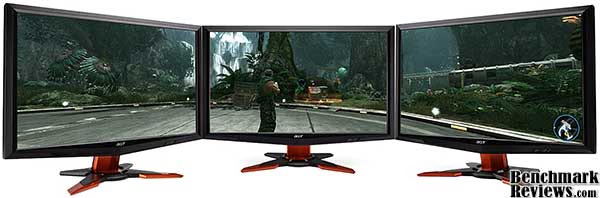
NVIDIA was also showing, albeit subtly, running versions of the forthcoming Fermi video card, some of which were driving 3D Vision Surround demonstrations. The demos looked good, but we still have little hard information on the card: clock rates, memory, pricing, and availability are all unknown. The cards themselves were in windowed cases and only the top edge of the cards was visible.
While the high-end graphics cards garner the most interest from consumers, NVIDIA devoted a lot of booth space to their Tegra mobile graphics processor. The first product to showcase this technology was Microsoft's new Zune HD, but NVIDIA is aggressively pushing it into as many venues as they can. One of the more interesting Tegra applications is in the 2011 Euro-spec Audi A8 luxury sedan, as shown in the dashboard mockup:
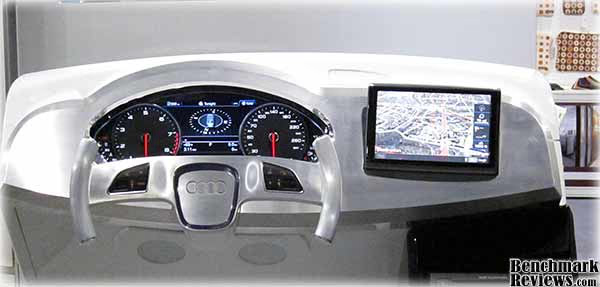
The navigation system in this car connects to the Internet and uses Google Earth images for the display, with the Tegra chip providing the graphics muscle to keep everything moving smoothly on-screen.

The forthcoming Tegra 2 will be a dual-core chip suited for things like larger tablet computers.
2010 CES: ASUS
ASUS had a large booth showcasing their motherboards, pre-built systems, and video cards. ASUS is aggressively pursuing the enthusiast market with new products like the P55-based Maximus III Extreme motherboard.
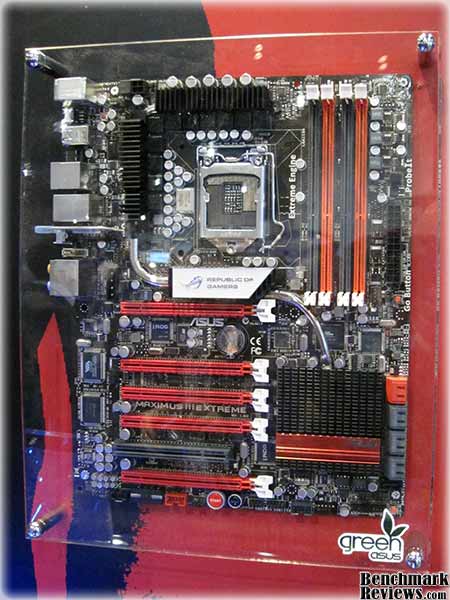
As a part of their "Republic of Gamers" series, the Maximus III Extreme is stuffed with high-end features. A new Bluetooth interface allows you to overclock your rig with your cell phone (presumably an application on your cell phone would be required, but I couldn't find any information on this, or which cell phones will be supported); and there's even an "LN2" jumper on the motherboard that "optimizes performance" when you're cooling with liquid nitrogen. 5 PCI-E x16 slots round out the features, and the board supports (presumably with the help of an NVIDIA NF200 bridge chip under the large heat sink near the SATA ports) full 2xSLI at 16x16, 3xSLI at 16x16x8, and even 4xSLI at 8x8x8x8. Of course there are also SATA 6Gb/s and USB 3.0 ports. It's obvious the P55 has come fully into its own as the basis for a high-end gaming rig. Frankly with boards like this it's hard to see why anyone would spend the extra money on an X58-based system.
But just in case you do want to spend the extra money, ASUS has also updated their X58 platform with the ASUS Rampage III Extreme, which (as shown in the photo above) can also handle 4-way SLI or Crossfire. With two 8-pin EPS12V and two 4 pin Molex connectors on the motherboard, ASUS obviously expects the board to be used by really hard-core overclockers. Although they're not visible in this photo, heat sinks for the voltage regulator modules and chipset are all very low profile, the better to make room for large 3rd-party coolers. The board also has the same Bluetooth, SATA 6Gb/s, and USB 3.0 features of the Maximus.

ASUS was also showcasing some of their pre-built desktop and laptop systems. The laptop, a Core i7 system with Bang & Olufsen audio, had oddly positioned dual touchpads on either side of the keyboard. The audio may have been wonderful, but it was impossible to tell on the noisy show floor! The desktop computer is the ASUS Essentio CG5275, a midrange Core i3 or Core i5 based system with a 1 terabyte drive and NVIDIA GTX260 graphics.
2010 CES: EVGA
Some of the most interesting things weren't on the show floor. In EVGA's suite at the Wynn Resort, we were able to see, handle, and ask questions about several very new or unreleased products. Here are some of the most interesting EVGA products, starting with the EVGA GTX285 Classified video card:

Note the three 6-pin PCI-E power connectors? The card has a beefy power supply section that can handle up to 640 watts, as well as dedicated voltage read points, easily-removable individual heat sinks (to make installing third party coolers simpler), and is the first 4-way SLI-capable NVIDIA video card - it's designed to be used in conjunction with the new EVGA X58 Classified 4-Way SLI motherboard. Such a motherboard (shown below) with four of these cards recently set a world record in 3DMark Vantage.

Perhaps even more interesting is the EVGA GTX275 CO-OP PhysX Edition. This card comprises both an NVIDIA GTX275 and a GTX250 GPU on-board: the 275 is used for rendering while the 250 serves as a dedicated PhsyX processor. It's a clever idea and it's refreshing to see something other than another NVIDIA reference design with a vendor-placed sticker on the cooler.

EVGA also had one of these cards with the stock cooler removed. The 275 GPU is the large chip at the right end of the board.

The star of the show, though, was this immense dual-processor Xeon motherboard, the 270 GT W555, obviously intended to take up where Intel's "Skulltrail" board left off. The standard ATX power spec is completely inadequate to handle a monster like this, with its 12 memory slots supporting up to 48 gigabytes of RAM and 7 PCI-E x16 slots...which is why each processor gets its own EPS12V connector and a separate PCI-E 6-pin connector; there's an additional PCI-E 6-pin connector by the card slots for extra power there, too. The board's massive and non-standard size (significantly larger than E-ATX) mean that it will only fit in a few of the largest cases. Dual NVIDIA NF200 bridge chips support four-way SLI or Crossfire with full x16 lanes on four cards.
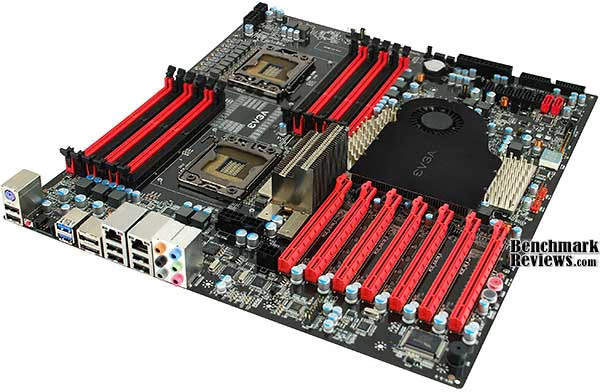
The two red SATA ports on the board are the latest SATA 6Gb/s, and the boards supports USB 3.0 as well. Pricing and availability are unknown at this time. But I want one; this single product almost justified the entire trip for me.
2010 CES: MSI
MSI has been showing the P55-based Big Bang "Fuzion" motherboard lately, and we got to see one in person in their suite:
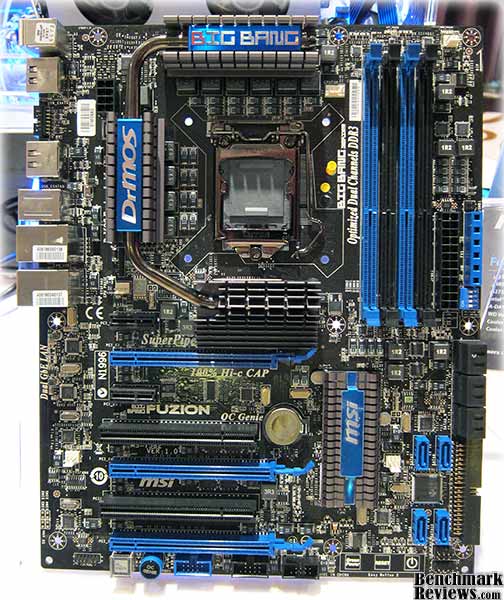
The Fuzion offers the unique capability of running both ATI and NVIDIA cards together in the same system, in a pseudo-SLI/Crossfire setup, using Lucid's "Hydra" chip. The chip and driver provide extra PCI-E lanes and intercept DirectX and OpenGL calls to provide intelligent load balancing across multiple graphics cards. How well does this work? We'll let you know when we receive one to review! The Fuzion does not include SATA 6Gb/s or USB 3.0, though. We also glimpsed a motherboard based on the as-yet-unannounced AMD 890FX chipset.
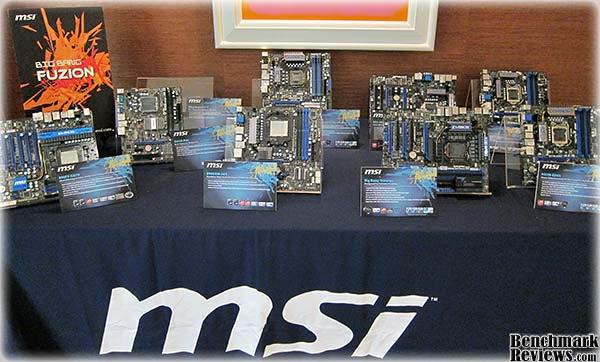
Of course MSI was showing off their entire line of motherboards and graphics cards, including new H55/H57 systems. Like other manufacturers, MSI's moving to solid tantalum-core capacitors and solid state chokes to improve the reliability and robustness of their power circuits.

My last "suite stop" was Thermaltake....
2010 CES: Thermaltake
Ah, the exquisite Level 10 chassis! This was the first opportunity I'd had to see one in person. It's much larger than I expected just from the photos, and is comprised of thick aluminum. It's the most "solid" feeling case I've ever seen with the possible exception of the HP Blackbird. The BMW-designed chassis hangs separate compartments for the power supply, motherboard, optical drives, and hard drives off a central "spine". It's an innovative, striking, and very expensive case.

Despite its high price (online retailers who have it charge between $800 and $850), the demand for the case has been very high. I was told the original plan was to produce 1,000 cases over the course of a year, that being the best the production facility could do given the size and complexity of the case. Well, they now have backorders for 6,000 cases and have ramped production up to 1,800 cases per year. If the demand holds out, it might become very difficult to get one of these cases, although as of the time of this writing, Newegg will be happy to sell you one for only $849.99. Oh, see that little hardback book at the bottom right of the photo? That's the brochure for the case. It'll probably be a collector's item some day; I managed to get one to salivate over.
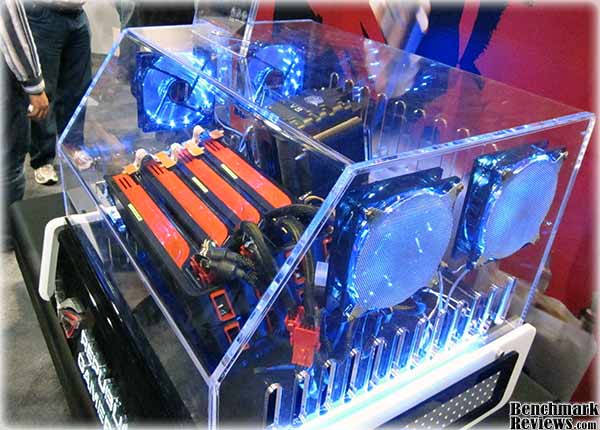
Another interesting case on display was this unnamed and unannounced item designed for multiple Fermi cards:

Notice the fan/wind tunnel contraption behind the lower 5.25" bays. This is designed to maintain a high air flow directly into the intakes of a pair of Fermis...which might be a hint about the power requirements and heat production of these cards.

Even more fans and ventilation could be seen on this Thermaltake Challenger gaming keyboard. You can plug in one or two of the tiny fans (one is visible near the Escape key) to keep your sweaty hands dry during those intense gaming sessions. If that's not enough, you could add the pair of larger fans seen in front of the keyboard.
But CES isn't just about computer hardware. In the next sectionI'll show you some of the more interesting non-computer technologies that were on display.
Television: 3D, OLED, and 4K
It's official: 2010 is the Year of the 3D television. I actually lost track of how many companies were showing 3D TVs, but it seemed as if everyone was.
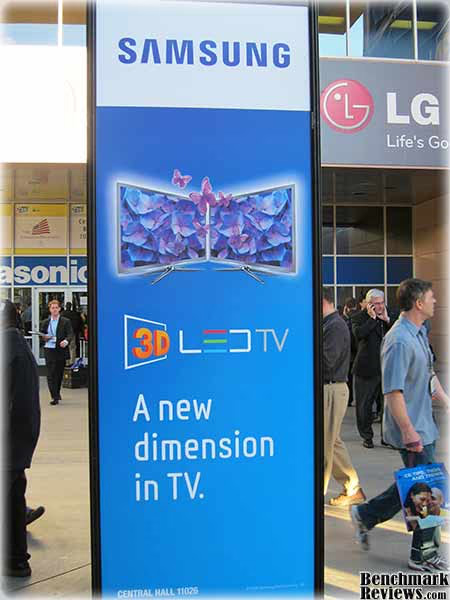
3D televisions were on display from Samsung, Sony, LG, Panasonic, and others. The technology is similar to that used by NVIDIA's 3D Vision system: the 3D content in the form of alternating left and right-view images is broadcast at 120 frames per second, with LCD shutter glasses alternately blocking each eye 60 times per second so that each eye only sees the appropriate image. Demonstration displays were everywhere but they were mobbed to the point where it was pretty much impossible to get close; I had no luck trying to get near Sony's demonstration OLED 3D TVs.
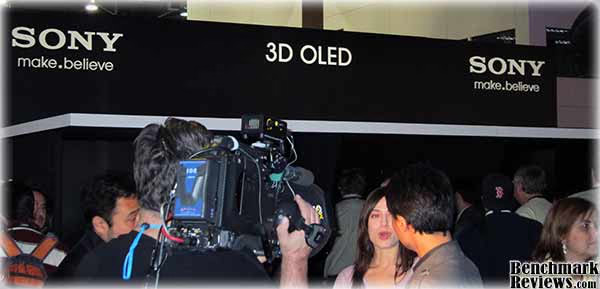
OLED (organic light emitting diode) televisions require no backlights, since the screens emit light directly. Right now, the only OLED television you can actually buy is the Sony XEL-1, an 11" (yes, eleven inch) screen that sells for a cool $2,500. Still, it's obvious OLEDs are the future once the production ramps up and the prices go down. Many companies were displaying prototype OLED TVs. It never occurred to me that water resistance is something to look for in a television, which I guess just goes to show why I'm a programmer and not a marketing person.
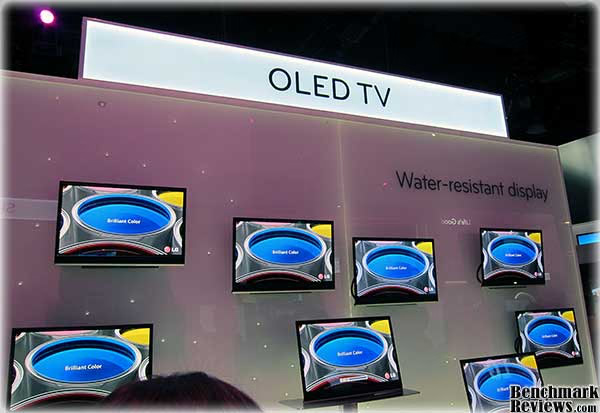
OLEDs not only show brighter colors and deeper blacks, but the lack of a backlight means you can make them thin. Very, very thin. Ridiculously thin:

The screen on Sony's XEL-1 is 3 millimeters deep. This 15" OLED prototype on display in LG's booth doesn't seem much thicker.
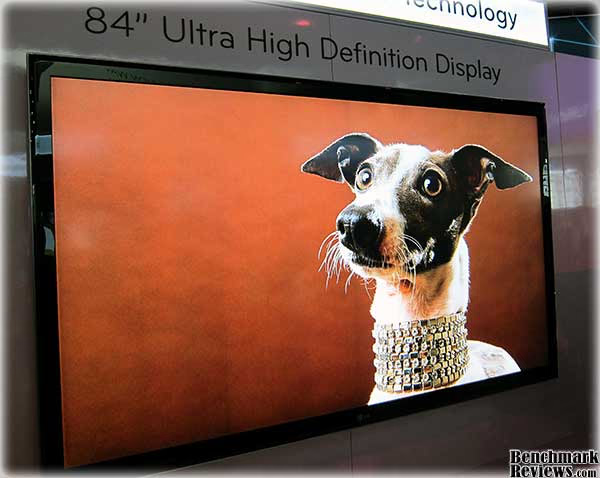
If thin doesn't excite you, perhaps ultra-high definition will. Sony and LG were showing very large "4K" televisions with four times the resolution of a 1080p set: that's right, TVs with 3,840 x 2,160 pixel displays! The (still) image on this 84" LG ultra-high definition set was incredible, but where will we get content in this resolution?
Lest you think CES is just about the high-end, high-dollar stuff, take a look at the next section...
iPhone cases, therapeutic robots, and miscellanea
Many of the exhibitors at CES are small Taiwanese or Chinese companies you never heard of, and it's amazing how many seem to be hawking the same type of products. There seemed to be dozens of displays of iPhone cases and small digital cameras. You would think the world had enough manufacturers of iPhone cases, small digital cameras, and the like. You'd be wrong.
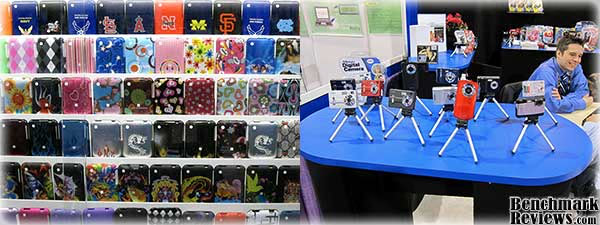
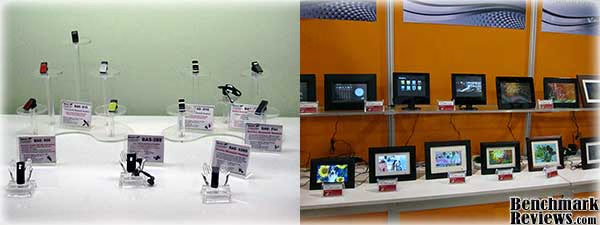
And let's not forget Bluetooth headsets and digital photo frames! By my count the anonymous company in the photos below makes at least 13 different models of Bluetooth headsets.
But a few unique products stood out. The Paro Therapeutic Robot is a little animatron of a baby harp seal. Apparently intended for invalids or shut-ins, it can, according to the company, "reduce stress on patients and caregivers" and "improve socialization of patients and caregivers".

The HoverCam X500 is a thin aluminum post whose top unfolds to reveal a 5 megapixel scanner. You place whatever you want to scan below it and press a button; a scan begins immediately and takes just a few seconds. For single documents it's much faster than most flatbed scanners, although the lack of a way to easily handle multiple sheet of paper would make scanning long documents tedious.

Navteq was showing their new LIDAR-based street mapping system. In addition to multiple high resolution digital cameras, the bulbous protrusion on the back of this vehicle contains a spinning mirror directing a low-power laser beam to capture high resolution positional data in real time. This is handy for determining things like the width of a road or the height of a bridge; this metadata could be added to the map produced. It would be a dandy thing to have for Google Street View.

Swiss Army Knife maker Victrinox was on-hand, too. What do knives have to with consumer electronics? How about a knife incorporating a Class II laser pointer and a 2 or 4 gigabyte USB key?

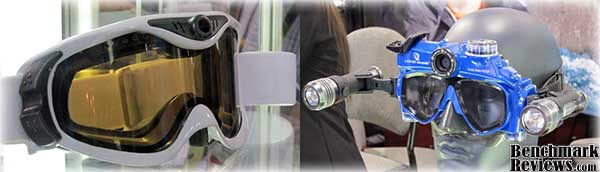
If you like to record your athletic exploits, Liquid Image was showing their line of sports goggles with integrated cameras, including a new underwater model with lights.
There's more, much more, but the limits of time and human endurance intrude...
2010 CES Final Thoughts
We are, we're told, recovering from a serious economic depression, and we're not out of the woods yet, with unemployment continuing to rise and retail sales down. This was in no way apparent at CES. I think this Intel booth (if a 4+ acre spread with hundreds of displays can be described as a "booth") sums up the CES perspective:
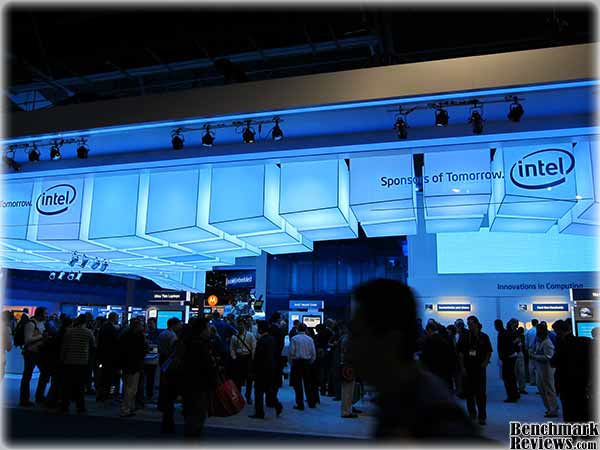
In other words, charging right along, economy be damned. Of course, Intel's net income was up over 800 percent in 2009, with record profit margins to boot, and they've just introduced so many processors that I've frankly given up trying to keep track. But the sense of optimism was pervasive, and the huge crowds (I am told that this was not the busiest CES ever. It's my first, so I have nothing to compare to except the fact that it was frequently difficult to make my way through the crush of attendees) would seem to indicate that a lot of vendors felt this way.
It looks as if 2010 will be an exciting year for computer enthusiasts. NVIDIA's Fermi GPU is the most anticipated enthusiast product, and after seeing them get kicked around the price/performance curve by ATI for the past two years, it looks as if Fermi will be all the payback an NVIDIA fanboy could ever want.
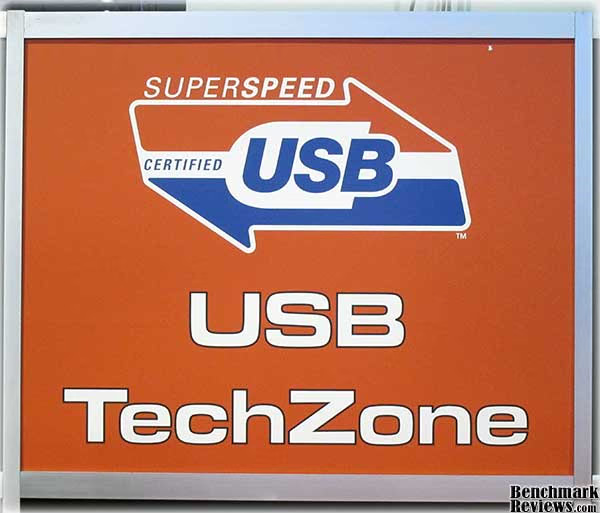
New enthusiast level motherboards and other components from the likes of ASUS, MSI, EVGA, Cooler Master, and others are raising the bar even more. While SATA 6Gb/s was disappointing (at least until new SSDs that can take advantage of the technology become available), the benefits of USB 3.0 are both real and immediate, and we at Benchmark Reviews look forward to testing the coming generation of USB 3.0 peripherals. This technology is so important that there was a separate, rather large area of the show flow devoted not to any one company, but to the technology in general:
Technology Highlights Conclusion
As I mentioned in the introduction, this was my first time attending the Consumer Electronics Show. Despite its name, it's not for consumers per se, and so the focus and feel of the show are quite different from a show like, say, MacWorld. What struck me about CES is that it's an indicator of trends: you can tell what "the industry" thinks will be important in the coming year by walking the aisles, attending the press briefings, and schmoozing at the parties and company hospitality suites. As far as the personal computer industry goes, here are the trends that made an impression on me:
Everybody's introducing H55/H57-based boards, but the price/performance ratio doesn't seem to be much better than existing integrated-video products. Some of the Clarksdale/Arrandale processors do seem to have a lot of overclocking headroom, but systems at this level are rarely overclocked.
The P55 chipset is the mainstream enthusiast user's platform of choice. There seems very little reason for most people to spend the extra money on an X58-based platform.
SATA 6Gb/s may be important some day, but it's not yet. USB 3.0, on the other hand, is important and useful right now.
Despite flash memory prices that are actually creeping upwards, SSDs - in the form of 2.5" disk replacements, PCI-E add-in cards, and even USB 3.0 keys - were everywhere. Many manufacturers are introducing smaller, less-expensive "boot drives" to give consumers a less expensive way to experience the performance benefits of SSDs.
And, of course, the slew of new and expensive consumer items like 3D televisions indicates "the industry" thinks that consumer spending's going to trend upwards this year. We'll see.
Questions? Comments? Benchmark Reviews really wants your feedback. We invite you to leave your remarks in our Discussion Forum.